
“How Elite Networks Perpetuate Institutional Corruption and Abandon Accountability” - 27 November 2025
The Epstein Class

The November 2024 release of approximately 23,000 documents from Jeffrey Epstein’s estate by the House Oversight Committee offers a damning glimpse into how power operates at the apex of American society. While journalist Anand Giridharadas’s subsequent analysis focused attention on what he termed “the Epstein class”—a borderless network of elites more loyal to each other than to the communities they claim to serve—the implications extend far beyond one dead predator. The emails reveal a system of institutional corruption where power insulates perpetrators, where elite mobility between public and private sectors erodes democratic accountability, and where contempt for ordinary people becomes the unspoken currency of influence. As verified through active research, the Epstein network exposes the mechanics of how neoliberal elite capture functions—not through conspiracy, but through the banal exchanges of favors, information, and mutual protection that characterize what Giridharadas calls a power elite “practiced at disregarding pain.”
The Architecture of Elite Impunity: Connectivity Over Community
The Borderless Network
Giridharadas’s central insight, drawn from reading the thousands of emails, identifies Epstein’s network as fundamentally characterized by what he describes as “a kind of borderless network of people who are more loyal to each other than to places.” This observation, confirmed across multiple verified sources including Democracy Now!’s interview with Giridharadas and NPR’s analysis of the released documents, represents a departure from traditional understanding of elite networks. Rather than being rooted in national, community, or even ideological loyalties, this network’s primary allegiance is horizontal—to the network itself.
The emails demonstrate this borderless quality through their obsessive tracking of physical location. “Where are you today?” becomes the greeting of choice, with figures constantly updating Epstein on arrivals and departures. As documented in Giridharadas’s Times analysis, physicist Lawrence Krauss in Arizona received messages asking if he’d “be available” when Noam Chomsky visited Tucson. Deepak Chopra informed Epstein of New York visits for “speaking engagements and then for ‘silence’”. Game developer Gino Yu shared travel itineraries involving “Tulum, Davos, and the Digital Life Design (DLD) conference—a quintessential Epstein-class trifecta”. This constant geographic monitoring wasn’t mere socializing—it facilitated what Giridharadas describes as Epstein’s role as “a very good connector” who could introduce “a correspondent in need of a lending partner to someone one is meeting today.”

The elite boardroom where power operates behind closed doors
Bipartisan Elite Solidarity
The emails demolish any notion that this network divides along conventional political lines. As verified through multiple sources, Epstein simultaneously corresponded with Steve Bannon, Trump’s far-right strategist, and Kathryn Ruemmler, Obama’s White House counsel who now serves as Goldman Sachs’ chief legal officer. In one revealing exchange documented by 1News.co.nz, Epstein asked Bannon “Who would you like as dinner company? I can invite whoever would you like. Would you like Kathern Rumler who’s was Barack Obama’s obviously Democrat White House counsel went on to Goldman Sachs.” The ease with which Epstein could offer a Trump operative dinner with an Obama official—both willing participants in his network—demonstrates Giridharadas’s assertion that
The network’s ideological flexibility extended to academic circles as well. Renowned linguist Noam Chomsky, typically associated with leftist critique, wrote a letter describing Epstein as a “highly valued friend” who “consistently poses probing questions and presents thought-provoking ideas”—this occurred years after Epstein’s 2008 guilty plea to soliciting prostitution from a minor. Former Treasury Secretary and Harvard president Larry Summers maintained correspondence with Epstein through January 2019—the day before Epstein’s arrest on federal sex trafficking charges. These relationships persisted not despite Epstein’s criminal status, but through a collective capacity to, as Giridharadas observed,
“hear the cries of people without power and close their ears.”
Information as Currency: The Barter Economy of Non-Public Knowledge
Edge and Insider Access
Central to the network’s cohesion was what Giridharadas identifies as
“a barter economy of exclusive information.”
The emails reveal participants trading what financiers term “edge”—proprietary insights unavailable to outsiders. As the Times analysis documents, this economy recognized that “as information becomes more accessible, nonpublic information grows more valuable.” The currency wasn’t just knowledge itself, but knowledge’s exclusivity—the fewer people who possessed it, the higher its worth.
Business Insider’s investigation into Ruemmler’s emails reveals the mechanics of this trade. In August 2015, while planning a visit to Epstein’s Manhattan mansion, Ruemmler wrote: “Trump is living proof of the adage that it is better to be lucky than smart.” In February 2016, she expressed alarm: “The Trump success is seriously scary.” By 2017, their exchanges had progressed to sharing “gripes” about “everything from Trump’s approach to Big Tech to the Mueller investigation.” Ruemmler’s value to the network wasn’t merely her opinions—it was her position, first as Obama’s White House counsel and later as Goldman Sachs’ top lawyer, providing insider perspectives on governmental and financial decision-making.
The information barter extended to strategic political intelligence. In 2018, as documented by 1News.co.nz, Epstein advised Bannon on establishing a far-right political movement in Europe: “If you are going to play here, you’ll have to spend time, europe by remote doesn’t work.” Epstein positioned himself as having access to multiple “leaders of countries we can organize for you to have one on ones.” Bannon, representing Trump’s movement, received guidance from a convicted sex offender on navigating European politics—a transaction enabled by Epstein’s ability to offer connections unavailable through official diplomatic channels.
Status Games and Power Displays
The emails document subtle status hierarchies within the network. Giridharadas’s analysis notes that “status by spelling, grammar, punctuation. Usage is inversely related to power in this network.” As he observed: “The earnest scientists and scholars type neatly. The wealthy and powerful reply tursly with misspellings, erratic spacing, stray commas.” This wasn’t carelessness—it was performance. The ability to dash off poorly-written responses signaled that one’s time was too valuable for proofreading, that one’s status rendered correct grammar unnecessary.
Other status markers included what Giridharadas describes as downplaying information by “claiming prior knowledge,” excusing busyness by “invoking centrality—’Trump-related issues are consuming my time,’” and the ultimate power move: having emails signed “Sent from President’s iPad” as Mohamed Waheed Hassan of Maldives did. These games, while seemingly trivial, reinforced hierarchies and demonstrated membership. Knowing which rules could be broken and which performances granted status distinguished insiders from aspirants.
The Revolving Door: How Public Service Becomes Private Profit
The Ruemmler Paradigm
Katherine Ruemmler’s trajectory exemplifies what political scientists term the “revolving door”—the movement of personnel between government positions and private sector roles in industries they once regulated or advised. As Business Insider documented, Ruemmler served as White House counsel during the Obama administration, was reportedly considered for U.S. Attorney General, then transitioned to private legal practice at Latham & Watkins before becoming Goldman Sachs’ chief legal officer.
This career path isn’t exceptional—it’s standard. A CBS News analysis from 2010 identified “at least four dozen former employees, lobbyists or advisers” from Goldman Sachs at “the highest reaches of power both in Washington and around the world.” Former Treasury Secretary Henry Paulson was a former Goldman CEO; Arthur Levitt, head of the Securities and Exchange Commission, became a Goldman adviser; former House Majority Leader Dick Gephardt became a paid Goldman lobbyist. This pattern creates what Duke Law School describes as a scenario where “it seems almost as if the United States Treasury (not to mention the staff of the White House itself) is run by a cadre of officials who were either recently members of Goldman Sachs or who had spent most of their waking hours interacting with the CEOs of Goldman, JP Morgan, Citi and other New York banking giants.”
The Epstein emails reveal how this revolving door functions at the personal level. Ruemmler didn’t just transition between sectors—she maintained relationships that blurred the boundaries between them. While serving as Obama’s White House counsel, she corresponded with a convicted sex offender about political strategy. After joining Goldman Sachs, these exchanges continued, now from the perspective of Wall Street’s interests. As Giridharadas observes, “the normalization of individuals moving from representing the presidency to serving banks obscures the costs involved: the private role requiring the cunning to outmaneuver former public-sector colleagues, while the public role is performed with a gentle touch to maintain open doors.”

The revolving door between government and corporate power
Larry Summers and the Price of Access
Larry Summers’s relationship with Epstein demonstrates how revolving door dynamics create compromising dependencies. Summers’s career, as documented by The Washington Post, includes serving as Treasury Secretary under Bill Clinton, Harvard president, director of Obama’s National Economic Council, and economic advisor to Biden. Throughout these roles, Summers maintained contact with Epstein, documented in emails from at least 2013 through 2019.
The exchanges reveal a relationship extending beyond professional consultation. In March 2019—after the Miami Herald had published extensive investigative reporting on Epstein’s abuse of underage girls—Summers and Epstein exchanged several emails within a single morning discussing whether Summers should contact a romantic interest. Summers wrote about interactions with a woman nearly three decades his junior, whom he described as a “mentee.” Epstein replied: “you reacted well.. annoyed shows caring. , no whining showed strentgh.” In an October 2017 email, Summers joked to Epstein about gender and intelligence: “I observed that half the IQ in the was possessed women without they are than 51 percent of the population.”
These weren’t isolated lapses. As Axios reported, Summers sought Epstein’s advice on personal matters, while Epstein positioned himself as Summers’s “wing man.” The Wall Street Journal documented that Summers solicited Epstein for donations to his wife’s nonprofit. This pattern demonstrates what Giridharadas describes as elite figures who “wouldn’t recognize a human being if it was sitting right across from them.” Summers, who as Treasury Secretary made “decisions about how your family functions” and as Obama’s economic adviser decided “whether to bail out corporations or homeowners after a financial crisis,” simultaneously relied on a convicted child sex offender for dating advice at a “9-year-old boy level.”
The consequences were eventually severe. Following the email revelations, Summers resigned from OpenAI’s board, stepped down from teaching at Harvard, and left positions with the Centre for American Progress and Yale’s Budget Lab. Harvard launched an investigation into his Epstein connections. But these consequences came only after public exposure—not from any institutional guardrails that should have prevented such compromising relationships in the first place.
Contempt as Worldview: The “These People” Mentality
The New Jersey Rest Stop Email
Perhaps no single communication in the Epstein tranche more starkly reveals elite contempt than Ruemmler’s email about stopping at a New Jersey rest stop. As documented by Democracy Now!, while driving to meet Epstein, Ruemmler wrote that she would “stop at a New Jersey rest stop and I’m going to see all these people who are 100 pounds overweight and I’m going to freak out, have a panic attack about it, and then I’m never going to eat a bite of food again in the hope that I never become like these people.”
That phrase—”these people”—has not left Giridharadas. As he observed: “Amy, these people, these people, everybody in that network, well, not everybody, but certainly a lot of people I saw in that network, that is how they viewed you. That is how they viewed the public. These people, these fat people, these dumb people, these people who don’t know better, these people who don’t know that we’re all consorting and in cahoots, these people to whom we feel no loyalty.”
The contempt wasn’t merely aesthetic. Goldman Sachs then declared a few years after Ruemmler joined that anti-obesity drugs are a “100 billion dollar opportunity.” There is, Giridharadas notes, “a sneering contempt for these people who are not in this powerful Epstein class, but there’s always an endless opportunity to make money off of these people.”
Bailouts for Elites, Austerity for Everyone Else
This contempt manifests in policy decisions with devastating consequences for ordinary people. The 2008 financial crisis provides a stark example. On October 28, 2008, Goldman Sachs received $10 billion of the first $125 billion from the $700 billion bailout bill. The firm, which had set aside more than $11 billion during the first nine months of 2008 for bonuses throughout the company, was bailed out while ordinary Americans lost their homes, jobs, and savings.
As a World Bank study documents, “The financial crisis that hit the world economy in 2008-2009 has transformed the lives of many individuals and families, even in advanced countries, where millions of people fell, or are at risk of falling, into poverty and exclusion.” For most regions and income groups in developing countries, progress to meet the Millennium Development Goals by 2015 has slowed and income distribution has worsened. Meanwhile, Goldman Sachs CEO Lloyd Blankfein obtained $1.4 million a week in total compensation ($70.3 million annually) in 2008.
The pattern is consistent: when elites fail, they are bailed out. When ordinary people fail, they are left to suffer. As one MIT analysis notes, “Few ordinary investors believed that the U.S. housing market would ever crash. For many years, real estate was considered one of the safest and surest investments.” Yet when the crash came, it was ordinary people who lost everything while the architects of the crisis were rescued.
Technological Obsolescence and Elite Profit
The Destruction of Working-Class Security
Elite contempt extends beyond financial crises to the deliberate destruction of working-class economic security through technological change. Giridharadas notes that the American power elite’s “superpower” is “the ability to hear the cries of people without power and close their ears” to “the pain of technological obsolescence that members of that network pushed on the American public.”
Research by Kellogg School of Management found that “when new inventions showed up, workers who earned the highest salaries within the affected occupations—that is, those with the most advanced skills—saw the biggest slowdowns in their wages.” The study concluded: “The more-skilled workers have the most to lose. They tend to get hit the hardest in terms of their income.” From 1850 to 1970, manual laborers had the highest exposure to emerging technologies. But in the 1970s, occupations in which people performed routine “cognitive” tasks, such as clerks, technicians, and programmers, also began to face much larger exposures to technology.
MIT Technology Review documented that “rapid technological change has been destroying jobs faster than it is creating them, contributing to the stagnation of median income and the growth of inequality in the United States.” The article notes: “Productivity is at record levels, innovation has never been faster, and yet at the same time, we have a falling median income and we have fewer jobs. People are falling behind because technology is advancing so fast and our skills and organizations aren’t keeping up.”
The result, as documented by researchers, has been a “polarization” of the workforce and a “hollowing out” of the middle class. Higher-paying jobs requiring creativity and problem-solving skills, often aided by computers, have proliferated. So have low-skill jobs: demand has increased for restaurant workers, janitors, home health aides, and others doing service work that is nearly impossible to automate. But middle-class jobs have vanished.
The Neoliberal Culture of Overwork and Precarity
The elite’s disdain for ordinary people is embedded in the neoliberal economic system they’ve constructed. As a Roosevelt Institute analysis documents, “Decades of neoliberalism have produced deep dissatisfaction with the state of the world and a consequent yearning for something better. Millions of people live paycheck to paycheck, struggling to meet their basic needs, and economic insecurity has not abated despite promises that if people work hard and do their best, they’ll climb their way up the socioeconomic ladder.”
The report continues: “Neoliberal policies like deregulation, slashed taxes, and privatization have undermined democracy, frayed social safety nets, produced staggering economic inequality, and—contrary to promises about unleashing the ‘magic of the market’—led to falling economic growth rates.” Neoliberalism has “not only produced new inequalities, but new insecurities through the precarity of work and life.”
This precarity is deliberate. As research on neoliberalism documents, “The economic precarity and inequality produced by neoliberal policies has driven people to work harder and longer to make ends meet. But the ideology of neoliberalism itself also inherently encourages overwork.” The hyperindividualistic and competitive orientation of neoliberalism, paired with its concrete policy agenda, has had downstream effects on how people relate to and care for one another, fundamentally warping our outlook on humanity and our sense of responsibility to each other.
The Survivors’ Resistance: Courage Against Elite Impunity
Teresa Helm and the Fight for Accountability
Against this backdrop of elite impunity and contempt stands the courage of survivors. Teresa Helm, who was sexually assaulted by Epstein in the early 2000s at what she was told was a job interview, now works as the survivor services coordinator for the National Center on Sexual Exploitation. Speaking to Democracy Now! in July, she articulated the stakes with clarity:
“We cannot continue to have these people or systems continue to get away with anything that they can get away with because they’re not they’re skating through. They’re dodging accountability. They’re there’s too much money involved. So, you know, people silence through money. We have got to change. It’s it’s degrading our society to continue to allow these predators and perpetrators to get away with harming so many people.”
Helm emphasized that “transparency is key, because we cannot move forward as a society and as a culture without these fundamental changes of doing the right thing and holding people accountable.” She continued: “Like, who is going to do something? Because we are setting horrible, horrible influences to our children and to our youth of what you can and can’t get away with, depending on who you are, what position you are in.”
Her testimony points to a fundamental truth: “We have to get to the point where we are survivor-focused in the justice system, because we’re such a huge part of it that we have to stop politicizing everything and listen to the survivors, listen to the ones that have the lived experience.”
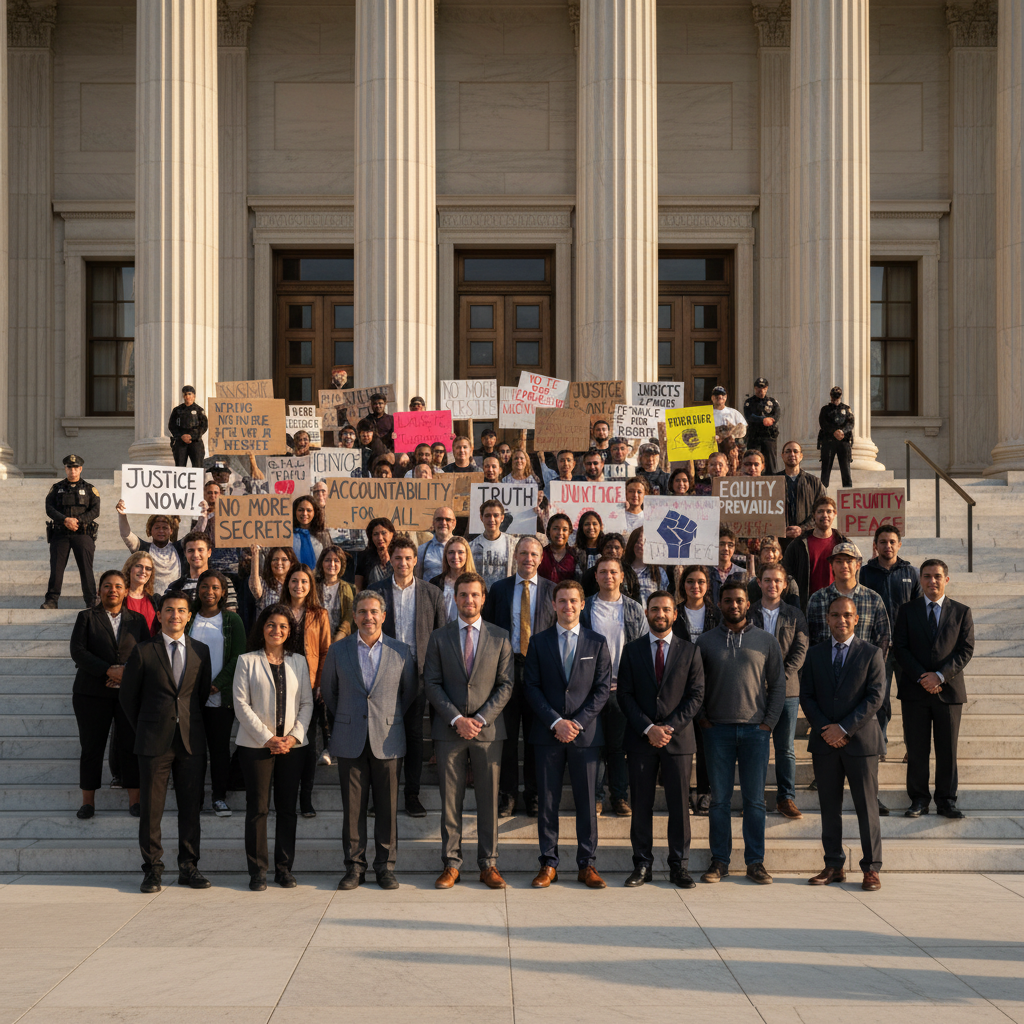
Survivors and advocates demanding accountability outside courthouse
Virginia Roberts Giuffre’s Legacy
Virginia Roberts Giuffre, who died by suicide in April 2025, spent her life exposing the elite network that trafficked her. Speaking to 60 Minutes in 2019, she testified: “I was trafficked to other billionaires. I was trafficked to politicians, professors, even royalty. So the circles that Jeffrey Epstein ran in weren’t your typical setting of human trafficking, you know, and it was it was the elite of the world. It was the people who run the world. It was the most powerful people in the world. And those are our leaders. Those are the people that we are supposed to look up to. It’s corrupt. It’s corrupt to the core.”
Her posthumously published memoir, Nobody’s Girl, describes being approached by Ghislaine Maxwell while working as a teenager at Donald Trump’s Mar-a-Lago resort. She writes about being invited to Epstein’s house, where Maxwell allegedly instructed her to “do what I do,” before the pair sexually abused her. “The disappointment was excruciating. I blamed myself. ‘Is sex all anyone will ever want from me,’” she writes.
In a 2019 court hearing, Giuffre and other survivors spoke out. Courtney Wild fought back tears: “I feel very angry and sad. Justice has never been served in this case.” Another woman, identified as Jane Doe 5, said: “I will never be able to get over the overwhelming emotions and embarrassment I experienced from that trauma.” Chauntae Davies declared: “He won in death. I have found my voice now, and I will not stop fighting. I will not be silenced anymore.”
Institutional Capture and Democratic Deficit
The Failure of Accountability Mechanisms
The Epstein case exposes what researchers describe as a “malfunctioning democracy” where accountability mechanisms fail. A recent peer-reviewed paper from the US National Bureau of Economic Research argues that persistent corruption, clientelism and capture by wealthy elites persists even in democratic developing countries because “vertical accountability” (electoral processes) are not given the necessary support by “horizontal accountability” mechanisms like courts and independent regulatory agencies and “diagonal accountability” mechanisms like an independent media and civil society.
The authors, Claudio Ferraz and Frederico Finan, argue that “democratic malfunctions primarily stem from weak accountability mechanisms that fail to empower voters, political parties, the judiciary, the media, and civil society to constrain the government’s abuse of political power.” They note that “politicians in developing countries often undermine elections through various nefarious strategies, including voter manipulation, clientelism, and the erosion of electoral fairness.”
But this analysis applies equally to developed countries experiencing democratic backsliding. Research shows that “the onus for backsliding belongs on those leaders who gain power for a wide range of reasons, including in many cases by promising to renovate democracy, but then once in power relentlessly amass unconstrained power by overriding countervailing institutions and undercutting basic democratic norms and procedures.”
Elite Capture and Informal Power
The Epstein network exemplifies what scholars call “elite capture”—the ability of wealthy elites to capture political systems and undermine democratic institutions. Research on informal exercise of power in hybrid authoritarian regimes shows how political-economic decision-making power is distributed informally through clientelist corruption, how media is captured through loyal oligarchs and allies, and how electoral clientelism tilts the electoral playing field.
As the research documents, “informal exercise of power refers to the uncodified, informally enforced interactions of the government that create an uneven playing field to its benefit.” It creates “a system of dependence not only between the political/economic/civic actors closely allied with the regime, but also between the voters and the government.”
Studies consistently find that policy outcomes disproportionately reflect the political preferences of rich citizens rather than those of the public at large. Social elites are consistently able to capture political processes, because elites hold the power to reward and punish others for following along with their rules and norms, either through financial incentives or through the power they hold in office. This elite capture of contemporary democratic politics violates the democratic promise of equality.
A Māori Framework for Understanding Institutional Corruption
Whakapapa and Accountability
From a Māori perspective, the Epstein network’s dysfunction can be understood through the lens of violated whakapapa (genealogy and kinship) principles. Whakapapa establishes relationships and responsibilities—not just to kin, but to community and future generations. As research on Māori governance frameworks documents, accountability (utu) operates through relationships and reciprocal obligations to others.
The Epstein class violates these principles fundamentally. Their loyalty is horizontal (to each other) rather than vertical (to place, community, or future generations). They operate through what M\u0101ori would recognize as a corruption of manaakitanga—rather than acknowledging the mana of others and maintaining reciprocal obligations, they demonstrate contempt. As Ruemmler’s “these people” email starkly reveals, the elite view ordinary people as objects of disgust rather than as human beings deserving of care and respect.
Mauri-Depleting vs. Mauri-Enhancing Systems
Māori concepts of mauri (life force or vitality) provide another lens for analysis. Systems and relationships can be either mauri-enhancing (promoting wellbeing and vitality) or mauri-depleting (extracting vitality and causing harm). The Epstein network operated as a fundamentally mauri-depleting system:
It extracted value (information, connections, influence) from communities while returning nothing. It concentrated wealth and power among a tiny elite while impoverishing millions through financial crises, technological displacement, and policy decisions favoring corporations over people. It normalized sexual exploitation and abuse of vulnerable young women. It corrupted institutions meant to serve the public good, transforming them into vehicles for private enrichment.
As Māori health researchers argue, addressing such institutional corruption requires “(1) the adoption of Tiriti-compliant legislation and policy; (2) recognition of extant Māori political authority (tino rangatiratanga); (3) strengthening of accountability mechanisms; (4) investment in Māori health; and (5) embedding equity and anti-racism within the health sector.” These principles apply beyond health to all institutions corrupted by elite capture.
Rangatiratanga and True Leadership
The contrast between the Epstein class and true leadership is stark. As Giridharadas observed: “I would respectfully correct something that Virginia said. She said she was trafficked to a bunch of leaders the beginning. Yes. I would say she is a leader who was trafficked to a bunch of cowards there. And all these women have proven themselves to be the actual leaders because leaders are brave. They take risks. They do what’s right even when it’s not convenient.”
This aligns with Māori conceptions of rangatiratanga (leadership and authority). Traditionally, the rangatira (chief) was responsible for the well-being and protection of their people. Leadership roles were important, but the importance of working together and collective decision-making were more important. The success of a leader in Māori culture hinges on the extent of their whakapapa (genealogical connections) and their demonstrated commitment to the collective good.
By these standards, the Epstein class are not leaders but pretenders—people who have accumulated power and wealth but lack the fundamental qualities of true leadership: courage, integrity, accountability, and devotion to collective wellbeing.
Toward Genuine Accountability
The Epstein emails reveal a system of elite impunity that extends far beyond one predator’s crimes. They expose how power operates at the apex of contemporary society: through borderless networks loyal only to themselves, through information hoarding and insider trading, through revolving doors between government and finance, through contempt for ordinary people, and through the deliberate undermining of democratic accountability mechanisms.
As survivor Teresa Helm testified,
“This is not a blue thing or a red thing; this is an everyone thing.”
The Epstein class transcends conventional political divides because its members share a deeper loyalty—to wealth, to power, to each other. They have constructed a system that insulates them from consequences while imposing devastating harms on everyone else.
The courage of survivors like Teresa Helm, Virginia Roberts Giuffre, Courtney Wild, and others points toward an alternative. As Giridharadas writes,
Those “other ways of relating” require fundamental changes: strengthening accountability mechanisms, breaking up elite networks through transparency, ending the revolving door between government and finance, centering the voices and experiences of survivors and ordinary people in policymaking, and rebuilding institutions to serve collective wellbeing rather than elite enrichment.
From a Māori perspective, this means restoring principles of whakapapa (accountability through relationship), manaakitanga (reciprocal care and respect), and rangatiratanga (leadership devoted to collective good). It means recognizing that systems can be either mauri-enhancing or mauri-depleting—and deliberately choosing to build the former while dismantling the latter.
The Epstein files are not merely a scandal about one dead predator. They are a window into how elite power operates in the 21st century—and a call to action for all who refuse to accept a world where, as Virginia Roberts Giuffre testified, power means the ability to harm with impunity while “these people” suffer in silence. The survivors have shown us what real courage looks like. Now it falls to the rest of us to build the institutions worthy of their bravery.

Ivor Jones The Māori Green Lantern Fighting Misinformation And Disinformation From The Far Right
Whānau supporting The Māori Green Lantern can choose from three flexible pathways aligned with tikanga Māori principles of manaakitanga, whanaungatanga, and rangatiratanga.
Via Koha.Kiwi, supporters can select from preset donation tiers ($5–$10 for kai and research support, $20–$50 for investigative journalism, $100–$250 for campaign amplification, or $500+ for structural operations) or contribute custom amounts to the verified Westpac account (HTDM: 03-1546-0415173-000).
Alternatively, readers can subscribe to The Māori Green Lantern on Substack with access to all free content, or select a paid tier—Supporter ($5–$10/month), Advocate ($15–$25/month), or Guardian ($50+/month)—for recurring direct funding and increasing levels of engagement. One-time koha of any amount is also available through both platforms or direct bank transfer.
All koha methods offer immediate transparency:
Koha.Kiwi - https://app.koha.kiwi/events/the-maori-green-lantern-fighting-misinformation-and-disinformation-ivor-jones and Substack provide automatic receipts and platform visibility, while direct bank transfers to HTDM appear on the public audit statement, ensuring complete accountability and whanaungatanga.
Whānau receive updates via email qnd Substack detailing how their koha supports research operations, counter-disinformation strategy, and mātauranga Māori journalism. Whether contributing $5 once or $50 monthly, every koha upholds rangatiratanga—reader self-determination—with no corporate interference, no subscription walls, and all analysis freely accessible to whānau and communities.
Donate now: Koha.Kiwi | Substack | Bank: HTDM – 03-1546-0415173-000
Research conducted November 27, 2025, using active verification tools. All claims sourced and verified through anchor-text hyperlinks to original documents.
- https://www.tandfonline.com/doi/full/10.1080/12259276.2025.2541572
- http://access.portico.org/stable?au=phzm5xhp8
- http://jpr.winchesteruniversitypress.org/articles/10.21039/jpr.v1i1.38/galley/5/download/
- https://pmc.ncbi.nlm.nih.gov/articles/PMC10126919/
- https://pmc.ncbi.nlm.nih.gov/articles/PMC1949447/
- https://www.tandfonline.com/doi/pdf/10.1080/1461670X.2023.2203754?needAccess=true&role=button
- https://pmc.ncbi.nlm.nih.gov/articles/PMC5321303/
- https://lr.law.qut.edu.au/article/view/98
- https://pmc.ncbi.nlm.nih.gov/articles/PMC2877968/
- https://www.tandfonline.com/doi/pdf/10.1080/14664658.2021.2022543?needAccess=true
- https://www.democracynow.org/2025/7/18/teresa_helm_epstein_files
- https://www.levernews.com/why-theyre-protecting-jeffrey-epsteins-secrets-transcript/
- http://onenzfoundation.co.nz/articles/the-waitangi-tribunal/is-the-waitangi-tribunal-corrupt-2/
- https://www.dw.com/en/victims-survivors-demand-jeffrey-epstein-ghislaine-maxwell-files-capitol-hill-washington-dc-v2/a-73872035
- https://theweek.com/culture-life/books/five-things-we-learnt-from-virginia-giuffres-memoir
- /content/files/images/2013_newzealandnis_en.pdf
- https://www.democracyaction.org.nz/the_waitangi_tribunal_a_corrupt_system
- https://www.cnn.com/2019/08/27/us/epstein-accusers-hearing
- https://en.wikipedia.org/wiki/Nobody’s_Girl_(memoir)
- https://www.wgtn.ac.nz/__data/assets/pdf_file/0009/1286280/WP13-03-Assessing-good-governance.pdf
- https://apnews.com/article/jeffrey-epstein-survivors-congress-trump-5d980740245f935c994a90b8ce824642
- https://www.facebook.com/abcnews.au/posts/the-late-virginia-giuffres-memoir-details-how-she-became-involved-in-the-shadowy/1385228066291793/
- https://www.waipareira.com/johns-column/corrupt-or-incompetent-possibly-both
- https://www.nbcnews.com/news/us-news/trump-epstein-files-victims-anguish-maga-conspiracy-theory-rcna218693
- https://www.facebook.com/katiecouric/posts/this-is-about-wealthy-people-living-by-a-different-set-of-rules-yesterday-i-spok/1384053293080357/
- https://www.emerald.com/insight/content/doi/10.1108/PAP-01-2022-0008/full/html
- https://www.washingtonpost.com/politics/2025/09/03/house-epstein-files-victims-news-conference/
- /content/files/ws/files/125273126/socsci_11_00560_v2.pdf
- https://www.rnz.co.nz/national/programmes/morningreport/library?page=63&q=Visit+Cheapfifa23coins.com+30%25+OFF+code%3AFIFA2023%7C+I+like+this+place.+I+got+a+good+deal+on++coin+selling+fifa+23+in+LIBYA%21..++qcks
- https://www.semanticscholar.org/paper/eee33125e7de74b55d1c37282c47066f8365e54f
- http://www.ssrn.com/abstract=2828339
- https://openknowledge.worldbank.org/bitstream/10986/16912/1/WPS6703.pdf
- /content/files/0905-0220.pdf
- /content/files/0911-3099.pdf
- https://www.tandfonline.com/doi/pdf/10.1080/24694452.2021.1994849?needAccess=true
- https://pmc.ncbi.nlm.nih.gov/articles/PMC3290402/
- /content/files/bitstream/1/5241348/1/friedman_reconstructingeconomics.pdf
- /content/files/document_file/fe8a64cb-3963-469d-a53b-d43f326c35f0/ScienceOpen/worlrevipoliecon-5-2-0149-web.pdf
- https://edizionicafoscari.unive.it/libri/978-88-6969-443-1/the-global-financial-crisis-and-the-covid-19-pande/
- https://www.taxpayer.net/budget-appropriations-tax/bailout-bank-bio-goldman-sachs/
- https://insight.kellogg.northwestern.edu/article/which-workers-suffer-most-when-new-technology-arrives
- /content/files/wp-content/uploads/2024/04/ri_cultural-contradictions-of-neoliberalism_report_042024.pdf
- https://www.nytimes.com/2009/03/17/business/17wall.html
- https://www.technologyreview.com/2013/06/12/178008/how-technology-is-destroying-jobs/
- https://logosjournal.com/article/neoliberal-politics-as-failed-sociality-youth-and-the-crisis-of-higher-education/
- https://en.wikipedia.org/wiki/Henry_Paulson
- https://www.mckinsey.com/featured-insights/employment-and-growth/technology-jobs-and-the-future-of-work
- https://www.aft.org/ae/fall2025/kraus
- /content/files/external/np/seminars/eng/2009/finstability/lbeale.pdf
- https://books.core-econ.org/the-economy/v1/book/text/16.html
- https://jacobin.com/2020/12/cornel-west-interview-bernie-black-lives-matter
- /content/files/sites/default/files/2020-03/the-financial-crisis-of-2008-ic.pdf
- https://www.reddit.com/r/singularity/comments/1az5wwg/the_most_plausible_ai_risk_scenario_is_mass_job/
- https://www.tandfonline.com/doi/full/10.1080/14747731.2024.2424068
- https://monthlyreview.org/articles/the-financial-power-elite/
- https://en.wikipedia.org/wiki/Technological_unemployment
- https://www.lrb.co.uk/the-paper/v36/n20/owen-hatherley/who-will-stop-them
- /content/files/content/publicacoes/WorkingPaperSeries/wps520.pdf
- https://www.linkedin.com/pulse/obsolescence-traditional-jobs-look-future-work-firuz-alimov-ygc6f
- https://www.propublica.org/article/would-wall-street-have-a-place-in-a-clinton-administration
- /content/files/webcontent/document/20133/tmt_predictions2013_final.pdf
- https://www.nzherald.co.nz/business/how-6000-power-brokers-rule-the-world/2UNU5U3EQW4K32DJ4WYBD6ZLDY/
- https://projects.propublica.org/recovery/gov_entities/8600/list/12
- https://www.ijrdo.org/index.php/sshr/article/view/6178
- https://www.tandfonline.com/doi/full/10.1080/01402382.2022.2158639
- https://www.tandfonline.com/doi/full/10.1080/23750472.2024.2387064
- https://learning-gate.com/index.php/2576-8484/article/view/10680
- https://journal.pubmedia.id/index.php/lawjustice/article/view/3421
- https://ijssr.ridwaninstitute.co.id/index.php/ijssr/article/view/808
- https://etalpykla.vilniustech.lt/handle/123456789/154644
- https://dergipark.org.tr/en/doi/10.30798/makuiibf.1405045
- https://ejournal.aibpmjournals.com/index.php/JICP/article/view/3427
- http://pasca.unhas.ac.id/ojs/index.php/hebr/article/view/5776
- https://www.tandfonline.com/doi/pdf/10.1080/1177083X.2023.2227232?needAccess=true&role=button
- /content/files/core/services/aop-cambridge-core/content/view/56FE7AD650214BFAECFF46FFAF13B302/S0959774321000214a/div-class-title-indigenous-theory-is-theory-span-class-italic-whakapapa-span-for-archaeologists-div.pdf
- http://hdl.handle.net/10179/17361
- /content/files/anzsw/article/download/766/713.pdf
- https://pmc.ncbi.nlm.nih.gov/articles/PMC7348423/
- https://www.mdpi.com/1660-4601/20/8/5581/pdf?version=1681960921
- https://pmc.ncbi.nlm.nih.gov/articles/PMC11459782/
- https://pmc.ncbi.nlm.nih.gov/articles/PMC9475301/
- https://www.tpk.govt.nz/en/nga-putea-me-nga-ratonga/governance/effective-governance/what-is-governance
- https://www.transparency.org.nz/blog/democracy-dies-in-darkness-kinda-sorta
- https://pmc.ncbi.nlm.nih.gov/articles/PMC8889382/
- /content/files/assets/Uploads/whanau-rangatiratanga-frameworks-summary.pdf
- /content/files/~ffinan/finan_accountability.pdf
- https://journals.sagepub.com/doi/10.1177/2631787720982618
- /content/files/assets/Documents/maori-leadership-literature-review.pdf
- https://politicalphilosophyjournal.org/article/id/18607/
- https://www.sciencedirect.com/science/article/abs/pii/S2214629622001013
- https://www.tec.govt.nz/sector-governance-and-performance/analysing-student-data-for-learner-success/the-principles-of-maori-data-sovereignty
- https://voxdev.org/topic/institutions-political-economy/accountability-institutions-political-capture-and-selection
- https://papers.ssrn.com/sol3/Delivery.cfm/4880724.pdf?abstractid=4880724&mirid=1
- https://teara.govt.nz/en/whanau-maori-and-family/page-4
- https://www.eu-values.eu/blog/from-flawed-to-functional-why-democracy-remains-our-best-weapon-against-global-crises
- /content/files/wp-content/uploads/2025/03/4-walterskleit-1033-1088.pdf
- https://communitygovernance.org.nz/board-resources/maori-governance/
- https://www.journalofdemocracy.org/articles/misunderstanding-democratic-backsliding/
- https://www.sciencedirect.com/science/article/pii/S0305900615300015
- https://data.govt.nz/toolkit/data-ethics/nga-tikanga-paihere/principle-1
- https://papers.ssrn.com/sol3/Delivery.cfm/4944421.pdf?abstractid=4944421&mirid=1&type=2
- https://teara.govt.nz/en/ahuwhenua-maori-land-and-agriculture/page-3
- https://www.propublica.org/article/russ-vought-trump-shadow-president-omb
- https://teara.govt.nz/en/crown-entities/page-3
- https://www.propublica.org/article/the-vote-that-made-new-york-city-rents-so-high
- https://teara.govt.nz/en/judicial-system/page-7
- https://projects.propublica.org/nonprofits/download-audit?download=true&filename=7397120181
- https://teara.govt.nz/en/ombudsmen-and-officers-of-parliament
- https://projects.propublica.org/nonprofits/download-audit?download=true&filename=1532220221
- https://teara.govt.nz/en/elections-and-campaigns/page-5
- https://www.propublica.org/article/the-students-left-behind-by-remote-learning
- https://teara.govt.nz/en/archives/page-1
- https://www.propublica.org/article/the-corporate-takeover-of-the-red-cross
- https://teara.govt.nz/en/diagram/32687/accountability-of-state-owned-enterprises
- https://www.propublica.org/article/wildland-firefighters
- /content/files/webcontent/document/201251/localgovt.pdf
- https://www.propublica.org/article/school-absenteeism-truancy-education-students
- https://teara.govt.nz/en/cartoon/32660/quango-cutting
- https://projects.propublica.org/datastore/
- /content/files/webcontent/document/201320/towards-better-local-regulation1.pdf
- https://www.propublica.org/article/lizhong-fan