"How IHC’s Settlement Exposes a System Designed to Fail Disabled Tamariki" - 12 December 2025
Thirteen Years to Justice, Thirteen Billion Seconds of Exclusion
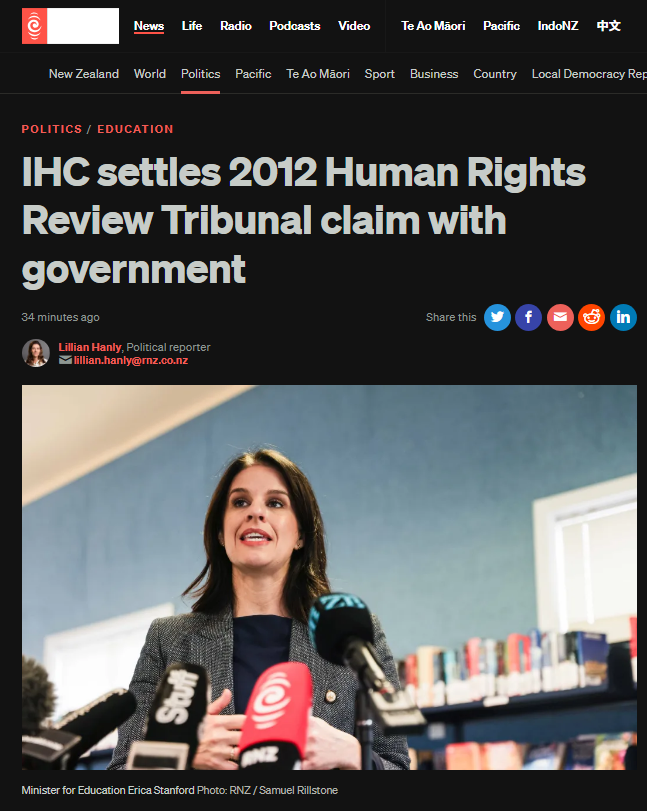
The Real Story Behind Yesterday’s Smiling Handshake at Parliament
On Thursday afternoon, as IHC Chief Executive Andrew Crisp signed a landmark settlement with Education Minister Erica Stanford and Secretary for Education Ellen MacGregor-Reid, the optics were perfect:
three officials at Parliament, pens poised, speaking of “historic days” and “true partnerships.”
But strip away the ministerial spin, and this settlement tells a darker story—one of deliberate delay, systemic ableism, and a government that needed to be dragged to the Human Rights Review Tribunal before admitting what disabled whānau have known for decades:
Aotearoa’s education system is built to exclude their tamariki.
This wasn’t cooperation. This was capitulation after seventeen years of advocacy. On 31 July 2008, IHC filed its complaint at the Human Rights Commission under the Human Rights Act 1993, after decades of work with the Ministry of Education failed to solve systemic problems. For thirteen of those years, the Crown fought to strike out IHC’s case, burning time and resources. IHC had a hearing at the Human Rights Review Tribunal in 2015 but had to wait five years for the Tribunal to hand down its decision—a delay IHC attributed to “poor resourcing of the Human Rights Review Tribunal itself”. Only at the end of 2020 did the Tribunal dismiss all of the Crown’s strike-out arguments, and in early 2021, the Director of the Office of Human Rights Proceedings agreed to provide legal representation to IHC, calling the discrimination “a serious matter of great public interest.”
Seventeen years. While officials debated legal technicalities, tens of thousands of disabled students experienced what IHC’s case documented: being denied enrolment at their local school, attending only partial days, excluded from activities, or forced to sit with parent-funded teacher aides while their peers learned. This is the machinery of exclusion, lubricated by the language of “resource constraints” and spinning with the centrifugal force of “best interests.”

The Working Homeless: Employed, Exploited, Excluded—How Neoliberal Housing Policy Manufactures Poverty as Performance
Hidden Connection #1: The Financial Alchemy—How $750 Million Becomes a Shell Game
Stanford was quick to trumpet:
“In Budget 25, we delivered the most significant investment in learning support in a generation—$750 million—directly tackling the long-standing inequities IHC has raised.”
Let’s examine that claim. Budget 2025 announced the “largest boost to Learning Support in a generation” with $746 million allocated over four years (Stanford rounded up to $750 million). But here’s what the press releases buried:
the Budget included $613.5 million in “reprioritised funding” within Vote Education—money carved out of “underperforming” initiatives.
What got cut? The $375 million Kāhui Ako scheme, which paid 4,000 teachers to lead collaborative improvement across school networks. Resource Teacher: Māori and Resource Teacher: Literacy roles—axed. Underspent primary school allocations, the Positive Behaviour for Learning scheme, Reading Together, study support centres, the greater Christchurch renewal programme—all gutted to “reinvest” in learning support.
This is not “investment.” This is rob-Peter-to-pay-Paul accounting, dressed in the language of “smart, system-wide reform.” The government didn’t find new money for disabled learners—it reallocated existing education funding, stripping support from Māori-focused roles and collaborative networks to create the appearance of addressing a crisis it allowed to fester for decades.
Cui bono? Not disabled students, who still navigate a deliberately limited, unfair, and unclear Ongoing Resourcing Scheme (ORS) that was critiqued in a 2009 study concluding ORS was “heart-breaking for all concerned and morally repugnant”. The settlement’s “Framework for Action” promises investigations into “alternative funding structures”—meaning the broken system remains intact while the Ministry “investigates.”
Cui malo? Disabled students, Māori learners who lost specialist support, and the education workforce stripped of collaborative infrastructure—all sacrificed to the altar of fiscal restraint and ministerial spin.
Hidden Connection #2: The Human Rights Review Tribunal’s “Quagmire”—Manufacturing Delay as Policy
Why did this case take thirteen years from filing to settlement? The answer lies in a systematically under-resourced Human Rights Review Tribunal that issued only one decision in the first half of 2024, with complainants waiting three years for rulings. IHC itself noted “the long history of IHC’s legal action is in part due to the poor resourcing of the Human Rights Review Tribunal itself resulting in long delays”.
This is not bureaucratic inefficiency—it is strategic neglect. By starving the Tribunal of resources, successive governments create a bottleneck that exhausts complainants and delays accountability. The Crown’s strike-out motions, heard in 2015 but not decided until 2020, consumed five years of legal limbo. Each year of delay is a year the system doesn’t change, a year more disabled children are discouraged from enrolling at their local school, excluded from activities, or stood down or suspended at rates two to three times higher than non-disabled learners.
The Tribunal’s glacial pace serves power. It protects government budgets from enforceable rights claims while maintaining the fiction of a human rights apparatus. The settlement avoided a full Tribunal hearing—a hearing that would have created binding precedent and exposed the full scale of systemic discrimination. Instead, the Ministry negotiated a non-enforceable “Framework for Action” that promises future investigations and progress “over time”. No timelines. No penalties for non-compliance. No structural change to the legal architecture that allowed this discrimination to persist.

Economic Colonialism 2.0: When a Corporate-Bred PM Surrenders National Sovereignty to Imperial Trade Warfare.
Hidden Connection #3: The Ableism Audit—Investigating Attitudes While Funding Segregation
Buried in the Framework for Action is a fascinating admission:
the Ministry will
Let’s decode that bureaucratic euphemism. The Ministry is promising to investigate its own role in fostering ableism—the very ableism that disabled students have identified as “the biggest barrier to their participation in schools and communities”. This is akin to an arsonist investigating the cause of fires. But here’s the darker irony: while investigating ableism, the government is expanding segregated education infrastructure.
Budget 2025 allocated $90 million for “approximately 25 new learning support satellite classrooms” across specialist school networks. These are segregated facilities—separate classrooms for disabled learners, often located on the grounds of mainstream schools but operating as satellites of specialist schools. As disability advocate Dr Bex wrote, this investment in “segregated education settings” alongside “the expansion of separate specialist school infrastructure” works to “entrench a dual-track system” that undermines inclusion.
The numbers tell the story: from 2,871 students in specialist schools in 2008 to 4,448 in 2023—a 55% increase during the exact period IHC’s case was winding through the legal system. Over a third of students with the highest ongoing disability needs are now enrolled in specialist schools, and in some Auckland areas, over 80% are segregated.
The UN Committee on the Rights of Persons with Disabilities has been clear: maintaining a dual system of mainstream and segregated schooling is inconsistent with Article 24 of the Convention on the Rights of Persons with Disabilities. New Zealand ratified that Convention. Yet the government’s response to a human rights settlement about educational exclusion is to build more separate facilities while promising to investigate whether its policies foster exclusionary attitudes. The cognitive dissonance is staggering—unless you understand that the policy is the ableism.
Hidden Connection #4: The “Historic” Minister and the Ideological Imports
Who is Erica Stanford, the minister calling this settlement a “hugely significant” day and promising a “true partnership”? Born in 1978, Stanford holds a BA (First Class Honours) in Political Science with a minor in Māori Studies from the University of Auckland. She worked in export sales before spending four years in former MP Murray McCully’s electorate office, entering Parliament in 2017.
Stanford’s political trajectory is instructive. She assumed the Education portfolio in December 2023 and immediately launched an inquiry into school property projects, declaring the sector “bordering on crisis”. By September 2024, Stanford was announcing plans to phase out NCEA by 2030, removing references to tikanga and Te Tiriti from curriculum documents, and stripping the Treaty of Waitangi obligation from the Education Act, telling schools: “You need to ensure equitable outcomes for Māori students, you need to be offering te reo Māori and you need to be culturally competent... But what is not clear is a conferred and unreasonable treaty duty”. This is assimilation dressed as “clarity.”
Then there’s Stanford’s ideological pedigree. In October 2025, as E-Tangata documented, Stanford “participated in plenary conversation with several of her ministerial role models who have implemented similar reforms”—international education ministers pushing market-driven, standardised-testing regimes. This is the neoliberal education playbook: dismantle collaborative structures (Kāhui Ako), centralise curriculum control, mandate assessments, and frame equity issues as technical problems requiring “evidence-based” managerial fixes.
The disabled student crisis isn’t a bug in Stanford’s reforms—it’s a design feature. Market-driven education systems incentivise schools to select high-performing, low-cost students and push out expensive, complex learners. A 2022 Education Review Office report found that 21% of disabled learners had been discouraged from enrolling at their local school, 27% have been asked to stay at home, and secondary school disabled learners are two to three times more likely to be stood down or suspended. An even more damning 2024 report found almost one in three children with disabilities are unlawfully denied school enrolment.
This isn’t failure—it’s competitive educational Darwinism functioning exactly as intended. Stanford’s settlement with IHC provides cover: she can claim to address discrimination while her broader reforms deepen the structural conditions that produce it.
Hidden Connection #5: The “Framework for Action” Con—Promising Everything, Delivering Later
What did IHC actually win? Not legal precedent. Not enforceable rights. Not structural reform. They won a “Framework for Action” committing the Ministry to “investigate” seven areas: data collection, specialist support access, agency coordination, curriculum inclusion, accessible infrastructure, alternative funding structures, and ableism impacts.
“Investigate.” “Consider.” “Take steps.” This is the vocabulary of deferral. The settlement establishes a stakeholder group “to support implementation”—but stakeholder groups advise; they don’t compel. Crisp acknowledged “system change will take years”—code for “don’t expect transformation soon.”
Compare this to what enforceable legal rulings achieve. When courts rule, governments must comply or face contempt proceedings. Precedent binds future cases. Remedies are specific and time-bound. The settlement offered none of that. By avoiding a full Tribunal hearing, the Ministry dodged a potential ruling that could have mandated changes to ORS, required reasonable accommodations, or established an enforceable right to inclusive education.
IHC said it was “satisfied the changes can remove barriers”—satisfied with what? A promise to investigate? After seventeen years, this feels less like victory and more like exhaustion-induced compromise. The Ministry secured an exit from litigation; IHC got a press conference and a vague roadmap. Meanwhile, disabled students wait “over time” for the system to fix itself.

Manufactured Scarcity: How Policy Chooses Winners and Weaponises Homelessness to Hide Systemic Failure
Hidden Connection #6: The Secretary Nobody’s Heard Of—MacGregor-Reid’s Convenient Ascension
Who signed this settlement alongside Stanford and Crisp? Ellen MacGregor-Reid, recently confirmed as Secretary for Education after serving as Acting Secretary since October 2024. She replaced Iona Holsted, who departed suddenly in October 2024 after eight years, leaving the Ministry’s top job vacant for over a year—one of the longest vacancies in recent public service history.
MacGregor-Reid has been at the Ministry since 2015, holding Deputy Secretary roles responsible for curriculum, early learning, and policy. She led the Curriculum Refresh and the NCEA Change Programme—the very reforms eliminating Treaty references and centralising control. She also led pay equity settlements and worked with iwi on equity partnerships—experience that makes her fluent in the language of equity while implementing policies that undermine it.
Her permanent appointment came three weeks before this settlement was signed. Coincidence? Or strategic placement of a bureaucratic insider who knows how to navigate political optics? MacGregor-Reid told media she “believes New Zealand does have some strengths in education, however they know they can do better” and is “ambitious for the kids... and thinks we can get to the top”.
This is managerial aspiration divorced from systemic analysis. MacGregor-Reid led curriculum development during the period IHC’s case documented widespread educational exclusion. The system she helped design produced the discrimination IHC sued over. Now she’s promising to investigate how to fix it. The fox isn’t just guarding the henhouse—she helped build it, then got promoted to head of security.
Hidden Connection #7: The Real Number—Quantifying Harm While Laundering Responsibility
Let’s quantify what seventeen years of delay actually means. New Zealand has approximately 120,000-160,000 neurodivergent students, with an estimated two-thirds—up to 100,000—not receiving adequate state-funded support. 67.7% of parents surveyed reported having no access to state-funded support.
The 2022 Education Review Office report found: 21% of disabled learners discouraged from enrolling at local schools, 27% asked to stay home, 9% attending school for less than four hours on a typical day, and secondary school disabled learners two to three times more likely to be stood down or suspended.
Now multiply those percentages across seventeen years. Conservatively, assume 100,000 disabled students per year experiencing inadequate support or exclusion. That’s 1.7 million student-years of educational harm during IHC’s litigation. If each student missed even one hour of school per week due to restricted attendance or exclusion, that’s 340 million hours of lost education—14.16 million days, or 38,904 years of cumulative school time stolen from disabled tamariki by a system that knew it was discriminating but chose to litigate rather than legislate.
The economic costs compound: students without adequate education are more likely to experience poverty and social exclusion, enter the criminal justice system (particularly neurodivergent Māori boys pushed out of school), require long-term welfare support, and face mental health crises. IHC told the Abuse in Care inquiry that denying schooling has “lifelong impact”, creating “diverse traumas that result in poor life outcomes”.
None of this harm is accounted for in Thursday’s settlement. No compensation. No apology. No acknowledgment of the generational damage inflicted by seventeen years of state-sanctioned educational apartheid. Just a Framework for Action and ministerial platitudes about “true partnerships.”
Implications for Aotearoa: The Ableism-Industrial Complex and the Treaty-Shaped Hole
This settlement exposes the mechanics of what we might call the Ableism-Industrial Complex—a self-perpetuating system where:
- Under-resourced support services create crises that justify segregated placements
- Market-driven school accountability incentivises exclusion of expensive, complex learners
- Legal bottlenecks delay justice until complainants settle
- Budgetary shell games create the appearance of investment while reallocating existing funds
- Managerial rhetoric (”evidence-based,” “system-wide reform”) masks ideological dismantling of collective structures
- Segregated infrastructure expansion proceeds alongside investigations into why segregation persists
The removal of Treaty obligations from schools isn’t coincidental—it’s structurally necessary for this system to function. Te Tiriti demands partnership, active protection of taonga (including te reo and tikanga), and equity. Those principles are incompatible with neoliberal education markets that require stratification and competition. By removing schools’ Treaty duties, Stanford freed them from the legal hook that might have been used to challenge discriminatory practices as Treaty breaches.
Consider:
if schools had explicit Treaty obligations to ensure equitable outcomes for Māori disabled learners—who are over-represented in exclusionary discipline and residential specialist schools—those obligations could ground legal challenges to ORS inequities, enrolment barriers, and funding models. Removing the Treaty removes that leverage. Stanford can claim the Crown retains Treaty duties while ensuring no specific institutions bear enforceable responsibility for honouring them.
This is distributed liability designed to produce systemic irresponsibility. When everyone is responsible, no one is accountable.
Thirteen Years to Sign a Promise to Investigate—The Mauri-Depleting Theatre of Educational Apartheid
So let’s return to Thursday’s signing ceremony. Andrew Crisp, who only joined IHC as Chief Executive in February 2025, inherits a settlement negotiated over years of exhausting advocacy. He speaks of families and teachers telling IHC “over several decades that government policies led to exclusion”, of disabled students not having “an equitable opportunity to enjoy a meaningful education”. His words carry the weight of generational harm—but what material change will this settlement produce?
Erica Stanford speaks of “delivering results,” of the government being “committed” to making up a “huge deficit”, pointing to her $750 million figure. But as we’ve shown, that “investment” is largely reallocated funds, accompanied by cuts to Māori education support and collaborative infrastructure, while expanding segregated schooling. Her reforms centralise power, strip Treaty protections, and import market-driven ideologies that produce the exclusion she claims to oppose.
Ellen MacGregor-Reid, freshly confirmed after a year-long vacancy, promises the Ministry has “committed to a Framework for Action” and will work with stakeholders to “deliver a better education experience.” But she led curriculum development during the period of discrimination IHC documented. The system she helped build is the system she now promises to investigate. This is institutional self-auditing as performative absolution.
And the settlement itself? A Framework for Action that requires “investigations” into areas already investigated for decades. Researchers told the government in 2009 that ORS was “deliberately limited, unfair and unclear... heart-breaking for all concerned and morally repugnant”. The Education Review Office reported in 2022 that disabled learners were being discouraged from enrolling, asked to stay home, and excluded from activities. These findings didn’t emerge from nowhere—they emerged from the lived experience of disabled whānau screaming into the void for decades.
Now the Ministry promises to investigate whether its policies might possibly be fostering ableism, while simultaneously building 25 new segregated satellite classrooms and stripping schools of Treaty obligations that might protect Māori disabled learners.
This is not progress. This is capitulation rebranded as collaboration. This is seventeen years of state-sanctioned discrimination laundered through the language of “detailed and collaborative discussions.” This is tens of thousands of disabled tamariki whose education, dignity, and futures were sacrificed on the altar of budgetary convenience and bureaucratic delay, now offered a “Framework for Action” that promises to investigate the very systems that harmed them—with no timelines, no enforceable rights, and no accountability.
Shane McInroe, who has learning difficulties including dyslexia and dyspraxia, spoke at the signing. “Maybe they just didn’t have adequate support and they didn’t have understanding of how to work with someone with a learning disability”, he said of his school experience. He spoke of the significance of the day “to the community and the whole of the schooling system”, saying students with disabilities could “actually be a student in a school” without concern about their support. “It will make a huge difference”, he said.
For his sake, and for the sake of every disabled tamaiti still navigating a system designed to exclude them, I hope he’s right. But hope is not strategy. Faith is not accountability. And a Framework for Action that promises to investigate discrimination while expanding the infrastructure of segregation is not justice.
It’s theatre. Theatre performed at Parliament, with cameras rolling and officials smiling, while the machinery of educational apartheid grinds on—just with better optics and a longer timeline for change that may never come.
Kia mau ki te tika. Hold fast to what is right. Because this settlement, for all its historic framing and ministerial promises, is a masterclass in how power maintains itself: delay until complainants exhaust, settle without admitting liability, promise investigations without timelines, then continue the very policies that produced the harm—all while proclaiming “partnership” and “commitment” to a better future that somehow always remains just out of reach.
Seventeen years. Thirteen billion seconds. Thirty-eight thousand years of stolen school time. And all disabled tamariki get is a promise to investigate—later.

Ivor Jones The Māori Green Lantern Fighting Misinformation And Disinformation From The Far Right
Only Support this mahi if you are able: Koha.Kiwi | Substack | Bank: HTDM 03-1546-0415173-000
All koha sustains free mātauranga Māori journalism. No paywall, no corporate interference.
- https://pmc.ncbi.nlm.nih.gov/articles/PMC2878829/
- https://pmc.ncbi.nlm.nih.gov/articles/PMC4539042/
- https://pmc.ncbi.nlm.nih.gov/articles/PMC3537588/
- /content/files/articles/10-1126/v2/pdf.pdf
- https://journals.sagepub.com/doi/pdf/10.1177/00187267241248530
- https://pmc.ncbi.nlm.nih.gov/articles/PMC2882919/
- https://journals.sagepub.com/doi/pdf/10.1177/0038038515590756
- https://pmc.ncbi.nlm.nih.gov/articles/PMC9586685/
- /content/files/wp-content/uploads/2024/05/ed-hub_illusion-of-inclusion-report_v2_low-res.pdf
- https://evidence.ero.govt.nz/documents/thriving-at-school-education-for-disabled-learners-in-schools
- https://www.ihc.org.nz/get-involved/advocacy/akona-to-teach-everyone
- /content/files/wp-content/uploads/2017/06/challenging-the-barriers.pdf
- /content/files/media/tgecmnzd/thriving-at-school-education-for-disabled-learners-in-schools-summary.pdf
- https://digitalnz.org/records/30161369
- /content/files/sites/default/files/downloads/highest-needs-review---what-matters-to-stakeholders.pdf
- /content/files/media/cvqeq54g/thriving-at-school-education-for-disabled-learners-in-schools.pdf
- https://tikatangata.org.nz/cms/assets/Documents/Reports-and-Inquiry/IMM-reports/Making-disability-rights-real-2012-2013.doc
- https://oag.parliament.nz/2009/special-education/appendix1.htm
- https://www.accessmatters.org.nz/why_standards_matter
- https://www.ihc.org.nz/news/denying-right-to-schooling-has-lifelong-impact-ihc-tells-inquiry
- https://www.ihc.org.nz/news/broken-system-leaves-disabled-students-without-support
- https://www.rnz.co.nz/news/national/475612/some-schools-discourage-enrolments-of-children-with-disabilities-education-review-office
- https://nzccl.org.nz/liberty-watch-march-2012/
- /content/files/teachers-work/article/download/516/609.pdf
- https://evidence.ero.govt.nz/documents/education-for-disabled-learners-from-early-childhood-to-school-summary
- /content/files/__data/assets_file/0016/22606/trish-grant-ihc-evidence.pdf
- https://www.education.govt.nz/education-professionals/schools-year-0-13/learning-support/overview-ongoing-resourcing-scheme
- /content/files/cms/assets/Documents/Periodic-Reviews/UPR-Pre-Session-7-March-2024-at-HRC-Wgtn-New-Zealand-Factsheets-and-Presentations/ieag_factsheet_march-2024.pdf
- https://www.nzherald.co.nz/nz/politics/resource-management-reforms-scrapped-under-urgency-minister-chris-bishop-says-replacement-not-expected-until-2026/F56IEVXYNNFJLPUJHGPMJJQYLI/
- https://www.rnz.co.nz/news/national/478452/horrible-experience-parents-angry-over-no-resolution-as-school-excludes-autistic-son-from-classes
- https://www.nzherald.co.nz/nz/ihc-court-claim-government-breaching-disabled-childrens-right-to-education/HVNBF65IDI3YZ4FGA24IYJH7ME/
- https://www.nzherald.co.nz/nz/public-sector-cuts-oranga-tamariki-to-focus-on-core-purpose-hundreds-of-jobs-set-to-go/SZQTWAVN2VDNDEX7EAWNSXG4EY/
- https://www.nzherald.co.nz/kahu/un-human-rights-office-sends-please-explain-to-nz-government-over-maori-human-rights-breaches/CYVQ4KU7QFCA5ME5Y75TUEI6DQ/
- https://www.nzherald.co.nz/nz/political-roundup-the-need-to-depoliticise-the-public-service/W764JUEY3RDPBMOVLS4LSGPYRQ/
- https://www.rnz.co.nz/news/national/493083/schools-for-people-with-disabilities-see-rising-demand-despite-un-call-to-close-them
- https://www.nzherald.co.nz/nz/inside-the-human-rights-review-tribunal-and-the-long-wait-for-justice-the-front-page/TBFLNLXL4BDUHGULVYDNZK6EVI/
- https://www.nzherald.co.nz/world/paradise-lost-the-fall-of-acapulco/V6Q2O45HTELLTMGYABW2ZQJKVY/
- https://www.rnz.co.nz/news/national/514330/accessibility-impacting-disabled-students-learning-representatives-say
- https://www.propublica.org/article/department-education-civil-rights-investigations-disability-gender-race-discrimination
- https://www.rnz.co.nz/national/programmes/morningreport/audio/2018881848/te-whatu-ora-wanted-lessons-from-ppps
- https://www.1news.co.nz/2022/09/28/disabled-students-being-failed-by-schools-report/
- https://www.rnz.co.nz/news/national/443368/ihc-going-to-human-rights-tribunal-over-education-discrimination-of-disabled
- https://www.nzherald.co.nz/nz/politics/deficits-workforce-shortages-training-mps-report-back-on-te-whatu-ora-health-nzs-first-full-year/QW2K6RQDYNBO7LLNZHOB7LDXJ4/
- https://www.rnz.co.nz/news/national/478970/enthusiastic-response-for-govt-plans-to-revamp-special-education
- https://www.nzherald.co.nz/topic/human-rights-commission/
- https://www.nzherald.co.nz/nz/oranga-tamariki-does-u-turn-on-plan-to-cut-record-keeping-jobs/ZDLZI5QOAJBQDEWTSX7BARPPP4/
- https://www.rnz.co.nz/news/political/478933/overhaul-of-the-1-point-2-billion-special-education-system-announced
- https://www.rnz.co.nz/news/national/243066/ihc-files-human-rights-complaint