“How OneRoof Manufactures a Non-Problem to Obscure the Real Housing Crisis” - 1 December 2025
The Chattel Distraction
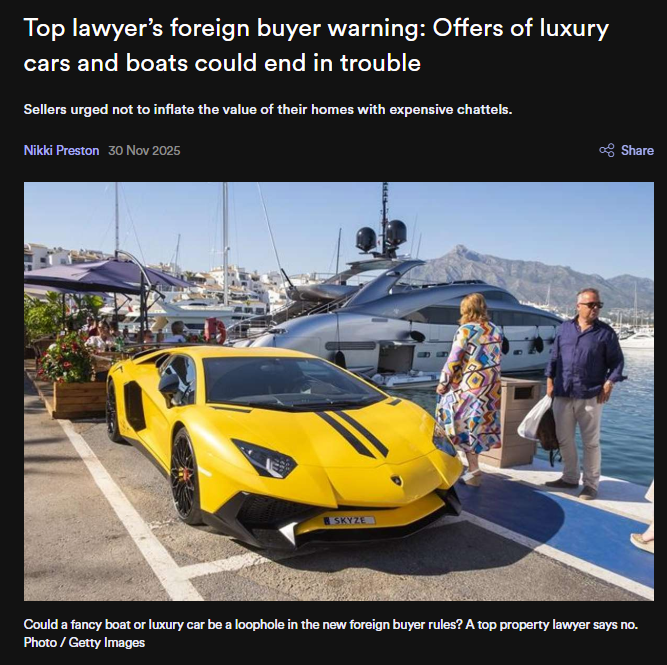
This OneRoof article is a masterclass in what happens when property media serves real estate industry interests rather than the public good. It manufactures panic about hypothetical “loopholes” in foreign buyer rules while systematically ignoring the elephant crushing New Zealand housing:
domestic investors, government policy failure, and the very real estate industry that profits from OneRoof’s advertising revenue.
Let us dismantle this propaganda piece brick by brick.
The Manufactured Non-Problem
The article’s central premise—that crafty homeowners might throw a Lamborghini into a sale to meet the $5 million threshold—is a phantom concern designed to generate clicks while obscuring reality.
Here’s why this entire framing is intellectually dishonest:
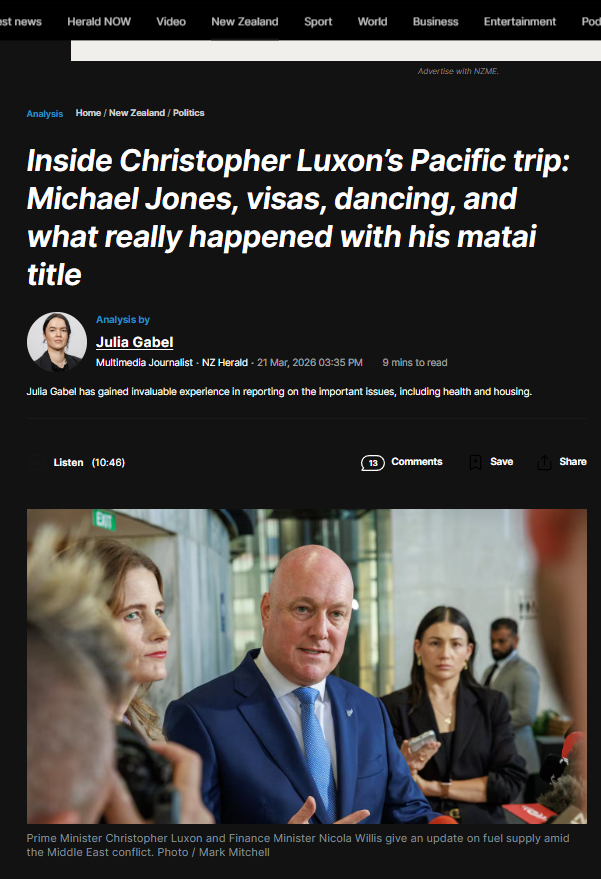
The $5 million threshold already excludes 99% of New Zealand homes. Prime Minister Christopher Luxon himself confirmed this when announcing the Active Investor Plus visa exemption, stating that $5 million equates to less than 1 per cent of New Zealand houses. Property economist Kelvin Davidson noted that $5m+ homes were only about 0.4% or 0.5% of all dwellings.
So OneRoof has devoted column inches to warning about “loopholes” affecting less than half of one percent of the housing market—a market where the people buying $5 million properties are emphatically not competing with struggling first-home buyers for a median-priced house, as Winston Peters himself acknowledged when defending the policy as “very, very, very minor”.
The Conflict of Interest OneRoof/NZME Refuses to Acknowledge
Here’s what the article conveniently omits:
OneRoof is a property advertising platform owned by NZME, which earns substantial revenue from real estate listings and advertising, as confirmed when NZME acquired the remaining shares in OneRoof Limited. This creates an institutional conflict of interest that shapes every piece of “journalism” they produce.
Academic research by Professor Aeron Davis at Victoria University of Wellington examined exactly this problem. His study found that the Herald wrote eight times as many stories about property investment and housing markets than ones about politics and policy—only 5% of housing coverage addressed issues like homelessness, social housing problems, or housing crisis consequences, as reported by Mediawatch.
Davis’s findings were damning:
“A large majority of property stories frame housing as an investable commodity and discuss housing markets rather more frequently than they do housing as a social and political issue.” Journalists he interviewed described OneRoof content as “property porn,” “fluff,” “bullshit,” and “not real journalism,” according to RNZ’s analysis of his research.
One journalist told Davis:
“The agent has the final say in all that copy, and that’s a very low form of journalism... It’s just advertorial, but it makes so much money.”
This is the lens through which we must read every OneRoof article: as advertising disguised as news, designed to serve the real estate industry that funds NZME’s operations, a problem the NZ Media Council has previously ruled on.
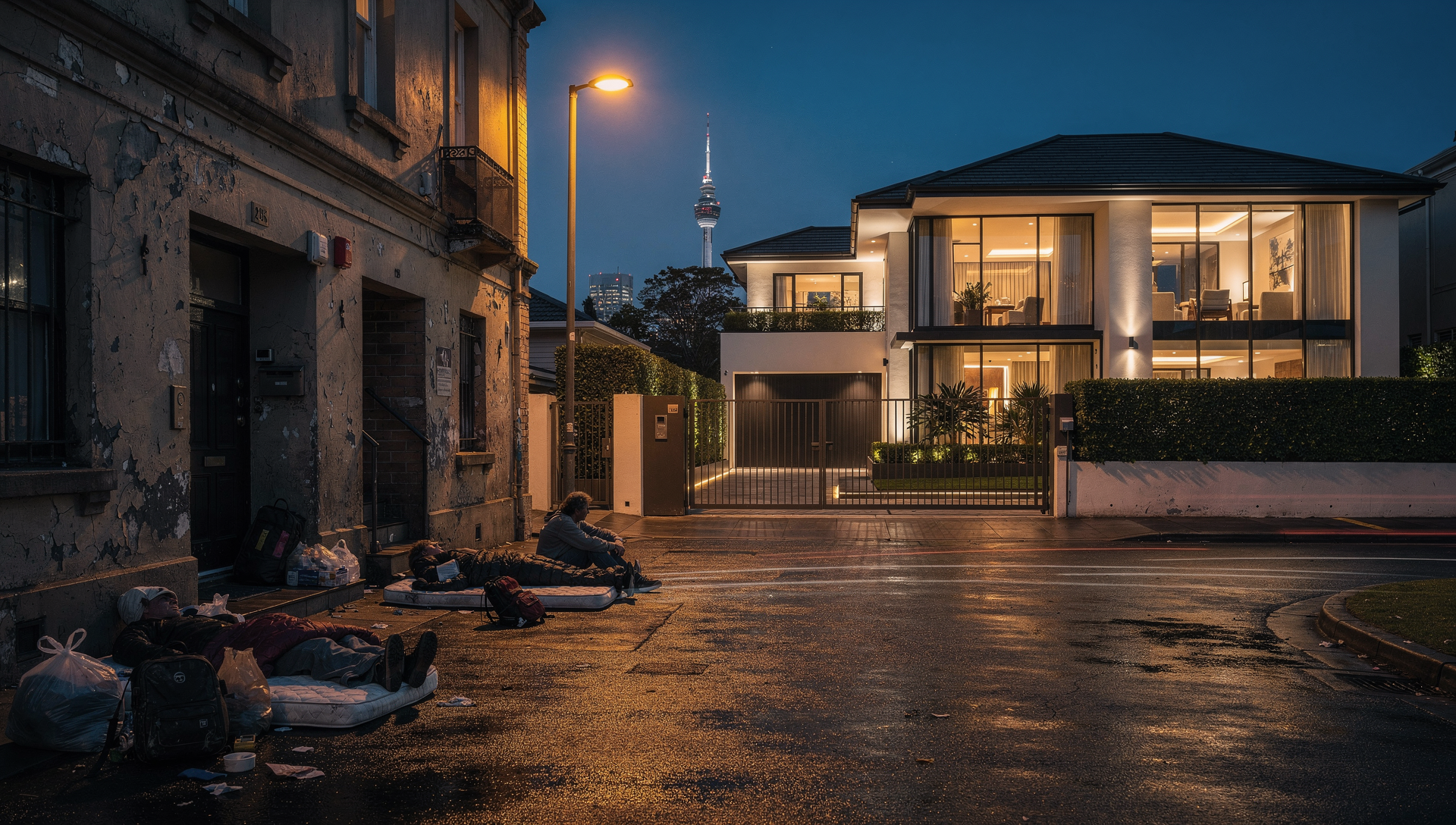
Auckland street with luxury mansion beside visible rough sleepers in doorways at night
The Parade of Compromised “Experts”
The article’s choice of sources reveals its true purpose:
Stuart Nash: Disgraced Former Minister, Now Golden Visa Profiteer
The article prominently quotes Stuart Nash, describing him as offering advice through his firm “Nash Kelly Global” which “helps high net worth foreigners navigate the ‘golden visa’ rules”.
What it fails to mention:
Stuart Nash was sacked from Cabinet in March 2023 for leaking confidential Cabinet information to donors—businessmen with property interests who had given him political donations, as documented by RNZ. Prime Minister Chris Hipkins called his conduct “inexcusable” and a “clear breach of collective responsibility and Cabinet confidentiality,” as reported by the Beehive.
Nash was already on his “final warning” after multiple scandals, including criticising the judiciary and making controversial comments about women, as RNZ detailed. He announced retirement from politics after being dumped from Cabinet, as the Herald reported.
Now Nash runs a business that earns fees from the very policy he helped shape as Economic Development Minister—the Active Investor Plus visa. His firm’s website brags about “unparalleled networks across business, government, and society” and “deep connections allow trusted access unavailable elsewhere,” as visible on their site.
Nash himself told Business Insider:
“Over the past eight months, I’ve been” working to create the exemption his business now profits from. This is regulatory capture in real time: a disgraced minister now earning money advising ultra-wealthy foreigners on how to access the policy he helped design.
OneRoof treats him as a neutral expert rather than a man with direct financial interests in the policy outcome.

NZ property listing with $5m price and foreign buyer tag
Hamish Walker: From Scandal to Real Estate
The article quotes “Walker & Co director Hamish Walker” about Queenstown buyers, noting he’s “currently negotiating one deal in excess of $10m.”
This is the same Hamish Walker who resigned in disgrace from Parliament in 2020 after leaking confidential Covid-19 patient details to media—a scandal that also ended former National Party president Michelle Boag’s political career, as RNZ documented. An inquiry found Walker’s “judgment was impaired” when he committed the privacy breach, as reported by the NZ Herald.
Walker had already attracted controversy for issuing what was widely condemned as a racist press release about quarantine facilities, as the ODT reported. He also admitted to misleading the public through posting fake social media content about door-knocking campaigns, as Wikipedia documents.
From politics scandal to luxury real estate—and OneRoof presents him as a credible voice on market dynamics without mentioning his history.
Ray White: The Foreign Buyer Connection
Ray White agent Ross Hawkins is quoted suggesting chattels including cars might be legitimate additions. This is from the same company that in 2016 partnered with Chinese real estate company Lianjia to advertise New Zealand homes to “several hundred million potential Chinese buyers”—a move slammed by politicians across the spectrum, as RNZ reported.
Winston Peters called it “just the latest kick in the teeth for New Zealanders wanting to buy a home,” while Labour leader Andrew Little said: “If they shared the concerns that many New Zealanders had, they wouldn’t be marketing New Zealand properties in China.”
Joanna Pidgeon: Legitimate Expert, But Missing the Point
Joanna Pidgeon is genuinely qualified—she’s a property law specialist and former Auckland District Law Society president, as her profile shows. But her expertise is being deployed here to warn about hypothetical problems while the real crisis goes unaddressed.
The article uses her legitimate legal caution to create the impression of a significant issue requiring attention, when the actual loophole risk is vanishingly small.
The Statistics They Don’t Want You to Know
Foreign Buyers Were Never the Problem
Official figures showed only 3% of property transfers nationally went to overseas buyers even before the 2018 ban, as the World Economic Forum reported. In the year before the ban, Stats NZ data showed the foreign buyer share was minimal, as their press release confirmed.
While some disputed these figures, even ASB’s higher estimates of 11-21% still meant domestic factors drove the overwhelming majority of transactions, as RNZ explained.
The Real Estate Institute concluded: “We don’t believe that the ban will resolve any housing affordability issues given the proportion of sales to overseas buyers is so low,” as property consultant Angela Webb noted.

Frustrated Journos
Domestic Investors: The Real Culprits
A OneRoof-Kantar poll found almost two-thirds of Kiwis blame property investors for skyrocketing house prices—far more than blame foreign buyers, as OneRoof itself reported.
Research confirms their instincts are correct. Property investors have been active in 22-25% of the market in recent years, as RNZ business coverage detailed. When the Reserve Bank required investors to have 40% deposits in 2016, “from that point in 2016 we have seen, especially in Auckland, prices effectively flatlined,” as RNZ political coverage explained.
The manipulation is simple:
buy housing stock, reduce rental availability, drive up both house prices and rents. A property investors’ lobby chief tried to claim 2.1 people live in owner-occupied homes versus 3.9 in rentals—but Stats NZ confirmed the actual figures were 2.6 versus 2.8, making his claims wildly misleading, as investor Andrew Duncan documented.
The Housing Crisis This Article Ignores
While OneRoof frets about Lamborghinis in chattels lists, here’s the reality for New Zealand:
- One in every 1,000 New Zealanders is now without shelter, according to Salvation Army data reported by RNZ
- 37% increase in people living without shelter between 2018 and 2023, as the Homelessness Insights Report revealed
- 57,000 women experiencing homelessness, as the Salvation Army’s analysis shows
- 386% increase in MSD rejections citing people “contributed to their own homelessness” since August 2024, as RNZ investigations found
- Auckland’s rough sleepers increased 90% from September 2024 to May 2025, as RNZ reported
- Emergency housing applications declined jumped from 4% to 32% rejection rate after government policy changes, as The Spinoff documented
The government was explicitly warned by officials that tightening emergency housing eligibility “would increase the risk of homelessness, rough sleeping, people living in cars,” according to official documents released under OIA. They did it anyway, claiming $350 million in “savings”—while the human cost mounted, as RNZ political coverage revealed.
Auckland property values have crashed nearly 20% from their peak, Wellington close to 30%, as Macrobusiness analysis showed. Real house prices have fallen back to late 2019 levels, as documented in the same analysis.
But sure, let’s worry about someone throwing a Porsche into a $4.9 million property sale.
The Cui Bono Question
Who benefits from this article?
- Real estate agents: By suggesting the $5 million market might attract foreign buyers, agents create excitement about potential demand—even though the policy barely exists yet and affects a microscopic slice of housing stock.
- OneRoof/NZME: Clicks, engagement, and the perception that they’re providing valuable “news” when they’re actually producing advertorial content that serves their real estate advertising clients.
- The Government: The article creates the impression that the coalition is carefully monitoring policy to prevent abuse—a useful distraction from their systematic destruction of housing support for the most vulnerable, as RNZ political coverage showed.
- Wealthy property owners: By focusing attention on hypothetical $5 million foreign buyers, the article deflects scrutiny from domestic investors who own multiple properties and treat housing as a wealth-extraction vehicle rather than shelter for families.
Who doesn’t benefit?
Anyone actually struggling with New Zealand’s housing crisis.
The Media Ecosystem That Produced This Garbage
This article exemplifies what academic research calls property media’s structural bias. Professor Davis found:
- Far more coverage of markets/investment than social issues, as Mediawatch reported
- Heavy reliance on industry sources with vested interests
- “Several” journalists reported threats of being sued or advertisers pulling advertising for contrary coverage, according to RNZ’s analysis of his research
- The framing “normalises the idea that houses are investable assets rather than places to live,” as Davis told RNZ
Meanwhile, NZME faces pressure from activist shareholders including Canadian billionaire James Grenon, who the Free Speech Union confirmed they encouraged to invest as part of a campaign to “retake our institutions,” as The Spinoff documented. His interest in OneRoof’s “profitable property platform” was noted by observers, as RNZ Mediawatch detailed.
The result: property “journalism” that serves capital, not communities.
The Real Scandal: Political Complicity
The article mentions the policy “was released” without noting its remarkable journey. National campaigned on a $2 million threshold with a 15% tax—NZ First blocked it in coalition negotiations, as RNZ explained.
Now NZ First, which helped introduce the original foreign buyer ban with Labour in 2018, has agreed to this partial reversal—and Winston Peters calls it “very, very, very minor,” as RNZ reported.
The policy changes may not even go through the normal parliamentary process with public submissions at select committee, as RNZ revealed. The government is making significant changes to overseas investment settings without the usual transparency.
Meanwhile, MPs across Parliament own $379 million in property interests, as the NZ Herald rich list revealed. As Bernard Hickey noted: “MPs in Parliament who get to vote on all sorts of laws and decide the future of our tax system and the incentives... are often personally incentivised in favour of the current tax-free status for capital gains on residential property,” as Mediawatch quoted.
Demand Better
This OneRoof article is a symptom of a media ecosystem that has systematically failed the New Zealand public on housing. It:
- Manufactures a non-problem affecting less than 0.5% of housing stock
- Relies on compromised sources with financial interests in the policy
- Ignores the actual housing crisis destroying lives across the motu
- Serves the interests of advertisers rather than the public
- Treats housing as investment rather than human shelter
The appropriate response isn’t to worry about luxury cars in chattels lists. It’s to demand media that serves the 99.5% of New Zealanders for whom foreign buyers at the $5 million level are utterly irrelevant—while homelessness, unaffordability, and housing insecurity destroy whānau.
Every minute spent on this manufactured concern is a minute not spent demanding a capital gains tax, aggressive public housing construction, restrictions on investor accumulation, and genuine support for the homeless that this government has systematically undermined, as RNZ political coverage has detailed.
OneRoof doesn’t want you to see those stories. But you should demand them anyway.
Koha
Only Support this mahi if you are able: Koha.Kiwi | Substack | Bank: HTDM 03-1546-0415173-000
All koha sustains free mātauranga Māori journalism. No paywall, no corporate interference.

Ivor Jones The Māori Green Lantern Fighting Misinformation And Disinformation From The Far Right
Research Process Transparency: This essay used web search tools to verify claims from multiple sources including RNZ, NZ Herald, government documents, academic research, and official statistics. Sources consulted include parliamentary records, OIA releases, Statistics NZ data, and peer-reviewed academic research. Research conducted December 1, 2025.