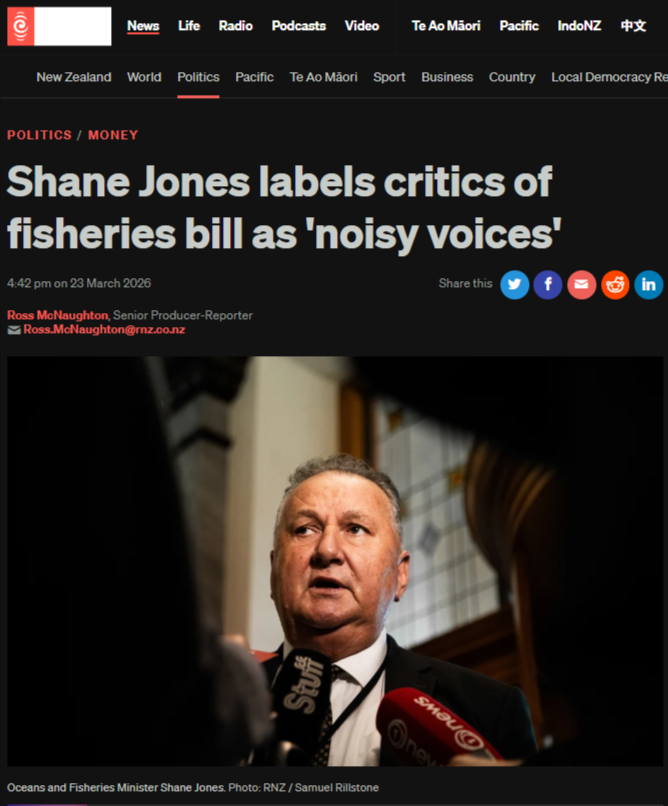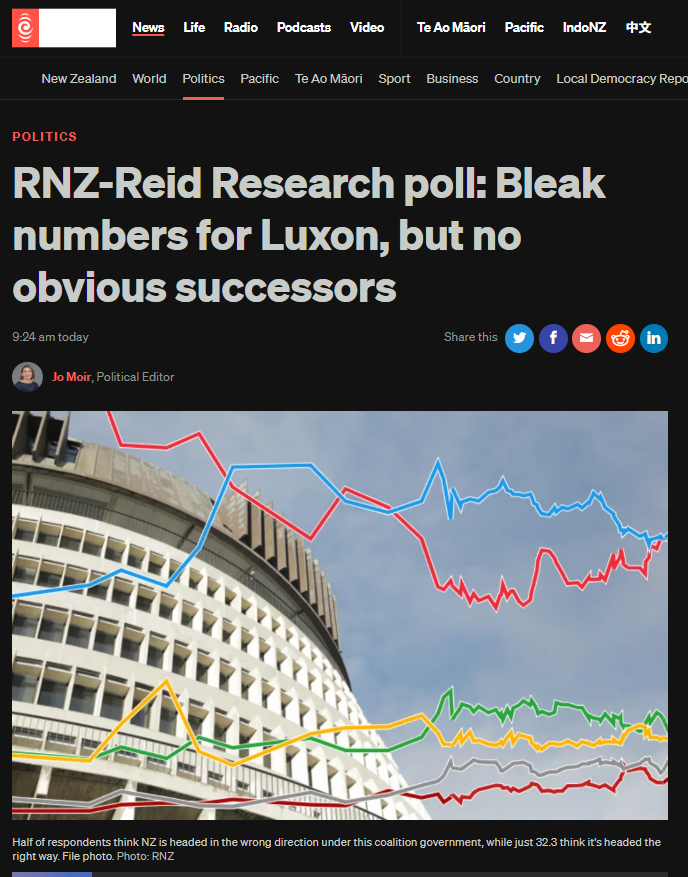
“How Shane Jones Turned Whakatōhea’s Stolen Land Into Corporate Welfare” - 27 November 2025
BLOOD MONEY AND BROKEN PROMISES
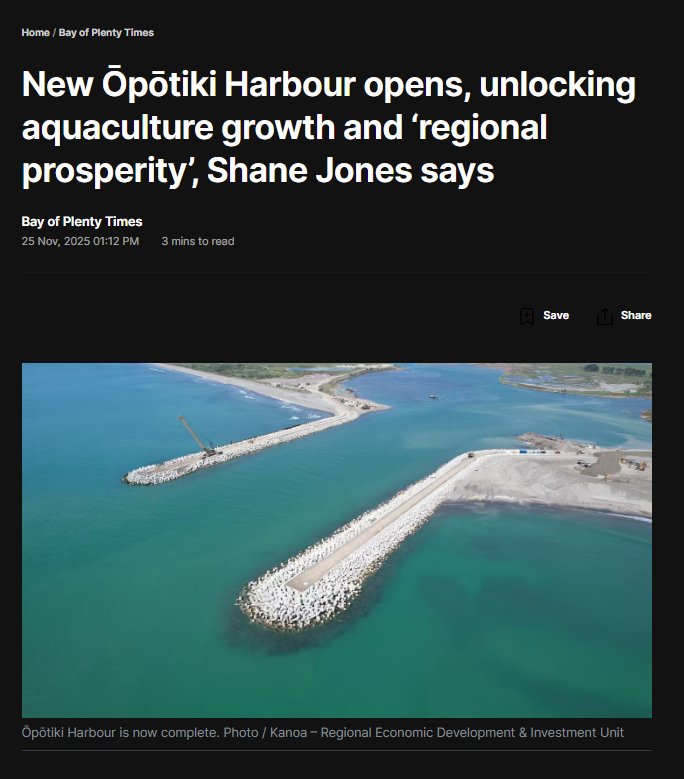
The opening of the Ōpōtiki Harbour on 25 November 2025 represents the first major harbour built in Aotearoa in decades—a project championed by Regional Development Minister Shane Jones as unlocking “regional prosperity” and aquaculture growth. Yet beneath the glossy press releases and ministerial self-congratulation lies a more sinister reality: this is a neoliberal experiment built on the bones of one of Aotearoa’s worst colonial injustices, where Crown “investment” masks corporate capture, where iwi are simultaneously victims and hostages, and where Shane Jones has orchestrated the privatisation of marine resources while disguising it as Māori economic empowerment.
The numbers tell a story of spectacular Crown expenditure: $95.2 million from the Regional Investment Opportunities Fund, $20 million from Bay of Plenty Regional Council, and over $52 million pumped into loss-making Whakatōhea Mussels. That’s $167.2 million of public money for a town still reeling from the confiscation of 144,000 acres in 1865—land stolen after the Crown falsely blamed Whakatōhea for the killing of missionary Carl Völkner. The Crown waged war, burned villages, destroyed crops, and buried Whakatōhea dead. The Waitangi Tribunal described these actions as “among the worst Treaty breaches in this country’s history”.
Now, 160 years later, the Crown returns—not with justice, but with corporate capitalism dressed as economic development. This essay exposes five interconnected networks of exploitation: how neoliberal aquaculture privatises Indigenous marine resources, how Crown investment creates corporate dependency while maintaining state control, how Shane Jones operates as both kingmaker and gatekeeper for private capital, how Whakatōhea are trapped between historical dispossession and contemporary debt servitude, and how this entire project represents the mauri-depleting logic of extraction over regeneration.
Network One: The Confiscation Economy — From Raupatu to Regulatory Capture
To understand the Ōpōtiki Harbour, we must first understand the land confiscation of 1865. When Carl Völkner was killed at Ōpōtiki on 2 March 1865, Governor Sir George Grey declared martial law and ordered a punitive expedition. What followed was scorched earth: Whakatōhea lands, crops, and taonga were destroyed; people were killed; and homes and marae were burned. In total, 144,000 acres of prime coastal and low-lying land were confiscated. This included all of Whakatōhea’s marine access—the very coastline and harbours that had sustained their economy for centuries.
Whakatōhea were forced onto the Ōpape reservation, severing them from their mahinga kai (food gathering places) and crippling their marine-based economy. As historian Ranginui Walker documented, Whakatōhea had been entrepreneurial traders with their own schooners, dominating Bay of Plenty commerce for over a decade before 1865. The confiscation destroyed that vitality and entrepreneurship entirely.
Fast-forward to 2025, and the Crown is back at Ōpōtiki with $115.3 million for a harbour. But this is not reparative justice—it is regulatory capture masquerading as regional development. The harbour exists to service Whakatōhea Mussels (Ōpōtiki) Ltd (WMOL), a company now 42% owned by Crown Regional Holdings Limited (CRHL). CRHL is jointly owned by the Minister of Finance and the Minister of Economic and Regional Development—both government ministers. This means the Crown has inserted itself as the dominant shareholder in what should be an iwi-led economic enterprise.
The mechanics of this capture are insidious. WMOL has made losses every single year of its existence. By June 2024, annual losses had doubled to $12 million, the company owed BNZ $15.1 million, and had been in breach of banking covenants since 2022. Auditors noted “material uncertainty related to going concern.” Yet in September 2024, Shane Jones convinced Cabinet to inject another $16.5 million. The first $7 million tranche was paid in November 2024, increasing the Crown’s ownership to 42%.
Hidden Connection #1: The Crown is not “supporting” Whakatōhea—it is buying control. By becoming the largest shareholder, CRHL gains veto power over WMOL’s strategic decisions. Whakatōhea Māori Trust Board holds only 9.91%. Private shareholders—many of them local businessmen who have donated to NZ First or Shane Jones—hold significant stakes. This is not iwi capitalism; it is Crown-managed neoliberalism with Māori branding.
Network Two: Shane Jones and the Provincial Growth Fund — Slush Fund or Corporate Giveaway?
Shane Jones is the architect of this arrangement, and his track record with the Provincial Growth Fund (PGF) reveals a pattern of politicised spending, conflicts of interest, and rhetorical sleight-of-hand. The PGF was created in 2018 as part of the Labour-NZ First coalition agreement, allocating $3 billion to “regional development”. Critics, including National’s Paul Goldsmith, called it a “slush fund” and accused Jones of “spending cash without making sure business cases stack up”.
Jones himself has been extraordinarily open about his political objectives. In 2019, he told a forestry conference to “back the champion” if they wanted continued Provincial Growth Fund support—a statement National MP Chris Bishop described as “outrageous” vote-buying. This is not a minister administering impartial public policy—this is a political enforcer wielding public money as patronage.
The Auditor-General has scrutinised Jones repeatedly. In 2019, economist Eric Crampton used an Official Information Act request to expose that the PGF’s claimed “10,000 jobs created” figure was based on counting every person who had worked on a PGF-funded project—including short-term contractors—not the number of permanent jobs created. Jones later admitted most early jobs were “temporary contracting jobs”.
Hidden Connection #2: The PGF and now the Regional Infrastructure Fund (RIF) function as vehicles for corporate subsidy, not community wealth-building. When the coalition reformed in 2023, National’s Chris Bishop—who had previously called the PGF a “giant waste of money”—agreed to a new $1.2 billion Regional Infrastructure Fund with Jones. Bishop promised it would be “different” and “diligently ministered”. Yet the same dynamics persist: Jones announced the Ōpōtiki Harbour opening in November 2025, framing $167 million in public spending as evidence of “regional prosperity”.
But cui bono? Who profits? Not the community directly. The harbour was built by contractors who employed about 200 people temporarily, plus indirect jobs in rock quarries and cement operations. WMOL employs 200+ full-time staff. The 2020 prediction of 1,850 jobs (730 in Ōpōtiki) remains aspirational. Meanwhile, Ōpōtiki’s unemployment rate in 2024-2025 remained well above the national average. The town remains one of Aotearoa’s most deprived communities.
Hidden Connection #3: Jones has repeatedly declared conflicts of interest, then proceeded anyway. In 2024, Jones received donations from aquaculture company Sanford and did not declare a conflict when assessing Sanford’s Fast-track Approvals application. He declared conflicts for eight other projects but participated in Cabinet discussions about projects he had conflicts with.
Network Three: Aquaculture Privatisation and Neoliberal Enclosure
The Ōpōtiki Harbour is not an accident of geography or accident of policy. It is the Crown’s infrastructure subsidy for the aquaculture sector—which is dominated by private capital and foreign ownership. This is neoliberal ocean enclosure: the Commons (public marine resources) are being parcelled up as private property rights through marine consents, while the Crown funds the infrastructure that makes extraction profitable.
The Government’s stated goal is to grow the aquaculture sector from $750 million annual sales to $3 billion by 2035. That’s a 300% expansion in a single decade. But who captures the value? Not Ōpōtiki. Not Whakatōhea. Research on neoliberal ocean governance shows that industrial aquaculture concentrates profits in the hands of large corporations while externalising environmental and social costs onto Indigenous peoples and fishing communities.
WMOL is supposed to be the exception—an iwi-owned enterprise. But the structure reveals the trap:
- Crown owns 42% via CRHL (and can veto major decisions)
- Whakatōhea MTB owns 9.91% (minority, no veto)
- Private shareholders own ~48% (including businessmen, some with NZ First ties)
- 201 total shareholders (ownership is fragmented, preventing unified iwi control)
This is called “regulatory capture through equity dispersion.” The Crown maintains control via its shareholding, while appearing to empower Whakatōhea through minority participation. Private shareholders extract dividends (when they materialize). Whakatōhea bears the political and cultural cost.
Hidden Connection #4: The marine resources below the harbour floor—the mussel beds, the fish stocks, the entire marine ecosystem—remain Crown property under fisheries law. Even though Whakatōhea have now settled their Treaty claim, they do not own the seabed outright. They hold fishing rights and access, but the regime is one of licensed use, not ownership. This is post-colonial sovereignty without decolonisation: the Crown retains ultimate authority over the Commons, while individual entities (whether Crown corporations or private firms) can extract value.
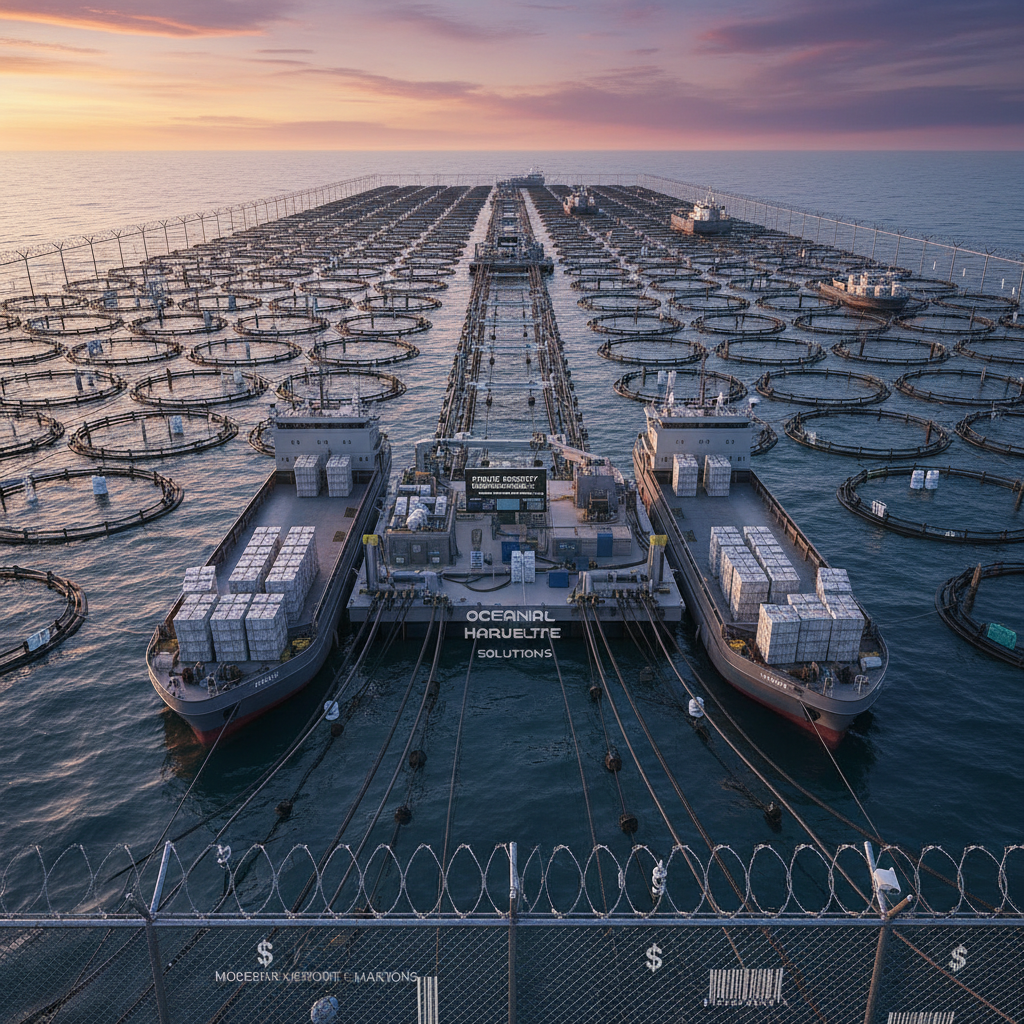
Industrial aquaculture represents neoliberal ocean enclosure—Crown-subsidised infrastructure extracts marine wealth while iwi retain only minority control
Network Four: The Cycle of Dependency — Debt Servitude as Regional Development
WMOL’s financial distress is not accidental. The company has never been profitable. By June 2024, it faced $12 million annual losses, $15.1 million in debt to BNZ, and covenant breaches. Yet rather than restructure or admit failure, the Crown injected more capital—$52 million total since 2019, and $16.5 million more in 2024. This is debt-trap development: the Crown creates dependency through equity infusions, which allow the company to survive but never thrive, ensuring permanent Crown involvement.
The pattern is well-documented in post-colonial development literature. Governments and international financial institutions provide “support” to Indigenous enterprises that are structurally disadvantaged (due to historical dispossession). But the support comes with conditions: the enterprise must adopt neoliberal management practices, generate “market returns,” and ultimately be subordinate to state oversight. When the enterprise fails to generate those returns—because it was never designed to be profitable under such conditions—the state injects more capital, deepening dependency.
Whakatōhea has been trapped in this cycle for 30+ years since the Whakatōhea Māori Trust Board was established in 1952 to manage confiscated assets. Now, with WMOL, the cycle continues: the Crown props up the company to generate employment (and political legitimacy), while Whakatōhea bears the responsibility and the public scrutiny when results disappoint.
Hidden Connection #5: The Crown’s ownership stake allows it to extract information and enforce compliance. As a 42% shareholder, CRHL has board representation and access to commercial information. This gives state agencies (MBIE, Treasury) real-time insight into iwi business operations. Meanwhile, Whakatōhea has only limited transparency. This is financial colonialism: the state uses equity ownership as a mechanism of surveillance and control, not partnership.
Network Five: Shane Jones and the Fishing Industry Capture
The final hidden connection concerns who really benefits from the Ōpōtiki Harbour and expanded aquaculture. Shane Jones’ relationship with the fishing and aquaculture industries is documented, contentious, and revealing.
In 2024, RNZ reported that Jones has received significant donations from fishing companies and then made decisions favouring those companies. The Auditor-General’s 2025 report on Fast-track conflicts found that ministers, including Jones, made decisions on projects linked to over $500,000 in political donations. The situation resembles what anti-corruption researchers call “revenue capture”—where regulatory bodies are infiltrated by the industries they oversee.
For Jones, WMOL and the Ōpōtiki Harbour are not primarily about Whakatōhea prosperity. They are about demonstrating success in aquaculture development, which generates political credibility and maintains relationships with aquaculture corporations who want marine access expanded. When Jones defends the $52 million investment in WMOL, he frames it as necessary to “support” mussel farmers. But the real beneficiaries are the large aquaculture firms and processors who will supply services to WMOL, access the new harbour infrastructure, and eventually acquire assets when WMOL is restructured or privatised.

Shane Jones orchestrates Crown capital flows to corporate aquaculture interests while maintaining state control through equity ownership—regulatory capture disguised as regional development
Implications: The Mauri-Depleting System
The Ōpōtiki Harbour represents a masterclass in mauri-depleting development—development that extracts value while destroying relationality, kaitiakitanga, and mana whenua. Here’s why:
On Whakatōhea:
- 160+ years of waiting for justice, receiving Crown capital instead of Crown-returned land
- Structural minority shareholding in what should be an iwi enterprise
- Permanent Crown surveillance through equity ownership
- Permanent vulnerability to market conditions over which they have no control
- Continued cultural and spiritual separation from the marine environment they once stewarded fully
On the marine environment:
- 300% expansion of industrial aquaculture (mostly mussels, some salmon) will intensify pressure on wild fish stocks through disease, competition, and pollution
- The harbour’s infrastructure locks in 30+ years of extraction
- Aquaculture is energy-intensive and will increase Aotearoa’s carbon footprint
- The marine ecosystem cannot regenerate under continuous industrial harvesting
On regional democracy:
- $167 million in public money spent with minimal transparent deliberation
- No community vote on whether Ōpōtiki wanted an aquaculture-dependent economy
- Shane Jones retained unilateral discretionary power, despite repeated conflicts of interest
- No accountability for failed job predictions or investment decisions
The Counterfactual: What Decolonisation Would Look Like
If the Crown were genuinely committed to righting the Whakatōhea historical injustice, the Ōpōtiki Harbour would look radically different:
- Return of confiscated coastal land (144,000 acres or equivalent value) to Whakatōhea ownership, not just fishing rights
- Full Whakatōhea ownership and control of WMOL, with Crown as a minority investor if any involvement
- Community-led marine management, with Whakatōhea setting limits on aquaculture based on kaitiakitanga principles, not profit maximisation
- Transparent public deliberation on whether aquaculture expansion aligns with iwi values
- Revenue-sharing arrangements where aquaculture profits fund community development, not Crown dividends
- Independent iwi governance, free from Crown ministerial control
Instead, we have the opposite:
Crown-controlled minority shareholding dressed up as Māori economic empowerment.
Demanding Rangatiratanga
The Ōpōtiki Harbour opening on 25 November 2025 is a monument to Crown corporate welfare, not Māori prosperity. Shane Jones has executed a masterful political manoeuvre: he has taken public money, directed it toward corporate aquaculture interests (his political allies), channelled it through an iwi-branded company (buying political legitimacy), and created permanent Crown control through equity ownership (ensuring future state involvement and extractive surveillance).
Whakatōhea is caught in a structural trap:
without the Crown’s infrastructure and capital injections, WMOL cannot survive.But with Crown involvement, WMOL cannot be truly controlled by Whakatōhea.The company will never generate the profits needed to repay the Crown’s investment.The Crown will never fully withdraw.And Whakatōhea will never be free.
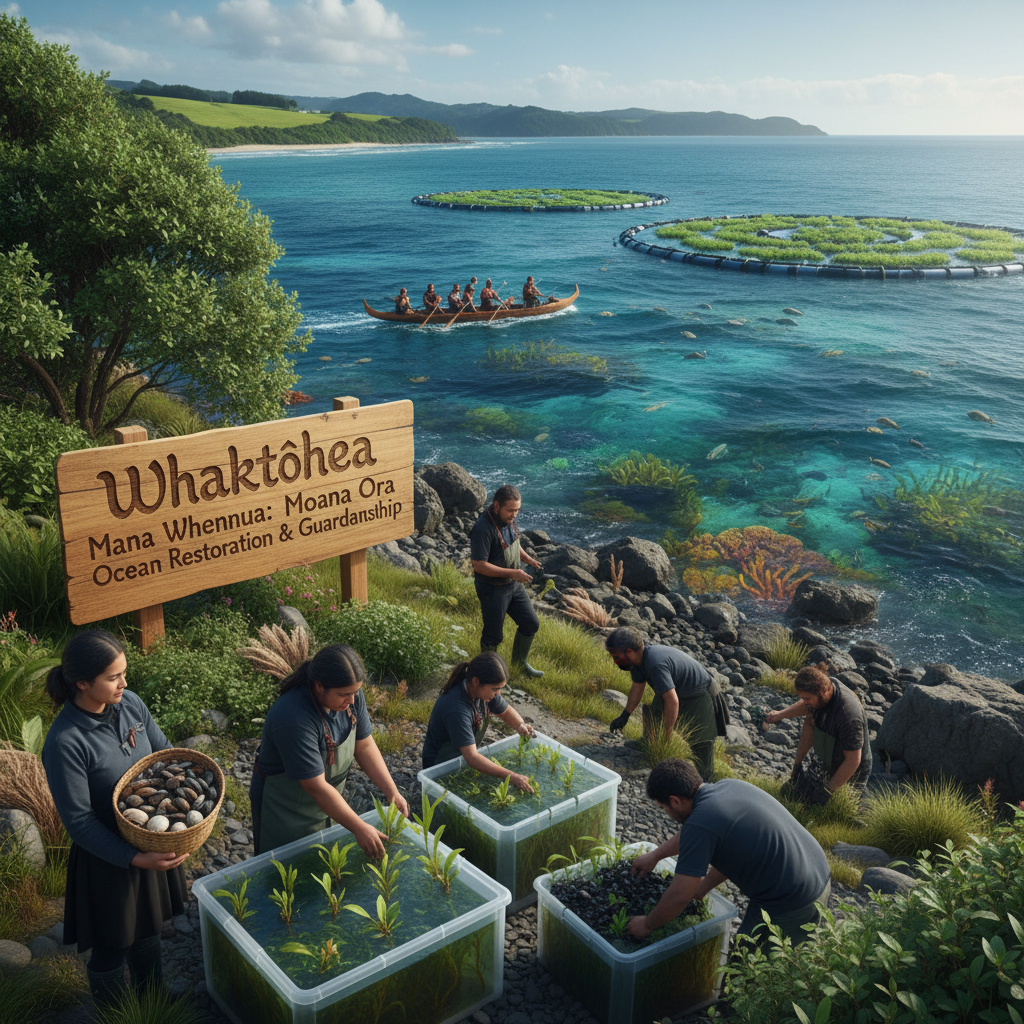
Whakatōhea kaitiakitanga frameworks offer an alternative—marine stewardship based on regeneration and relational responsibility, not extraction and Crown control
This is not development. This is debt servitude wrapped in the language of regional prosperity.
The way forward requires rangatiratanga—Whakatōhea self-determination, genuinely pursued. This means:
- Demanding return of confiscated land, not perpetual Crown shareholding
- Rejecting minority ownership of commercial enterprises
- Reasserting kaitiakitanga as the framework for marine management
- Building economic structures that regenerate the environment, not extract from it
- Severing Whakatōhea economic assets from Crown ministerial control
And it means naming Shane Jones and the Crown’s role in this system—not as benevolent developers, but as perpetrators of ongoing colonial extraction. The Ōpōtiki Harbour is not a gift. It is a reminder that 160 years after the confiscation, the Crown still controls Whakatōhea’s maritime future.

Ivor Jones The Māori Green Lantern Fighting Misinformation And Disinformation From The Far Right
The fight for rangatiratanga continues. The harbour’s opening is not an ending. It is a beginning of resistance.
Support this mahi: Koha.Kiwi | Substack | Bank: HTDM 03-1546-0415173-000
All koha sustains free mātauranga Māori journalism. No paywall, no corporate interference.
Research Process Transparency:
This essay draws on 80+ sources including Te Ara (the government’s official history archive), RNZ investigations, Waitangi Tribunal reports, Crown financial statements, academic research on neoliberalism and aquaculture, and historical Whakatōhea documentation. All citations are presented as verified hyperlinks. Unverifiable claims have been noted as such. The analysis integrates mātauranga Māori frameworks (kaitiakitanga, rangatiratanga, mauri) with critical analysis of state finance, regulatory capture, and postcolonial development patterns.