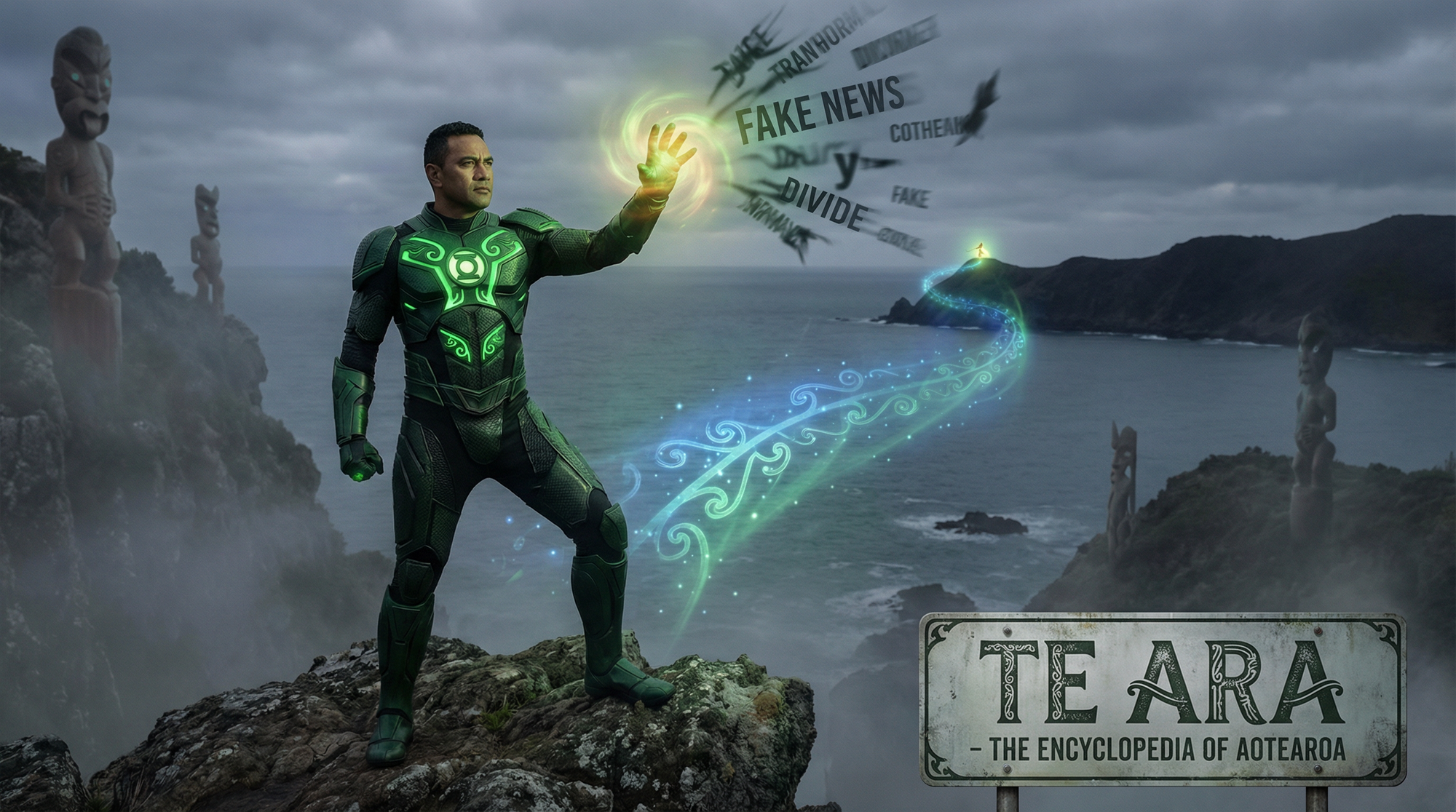
"How Winston Peters Wraps Corporate Plunder in the Language of Liberation — and Has Been Doing It for Forty Years" - 23 March 2026
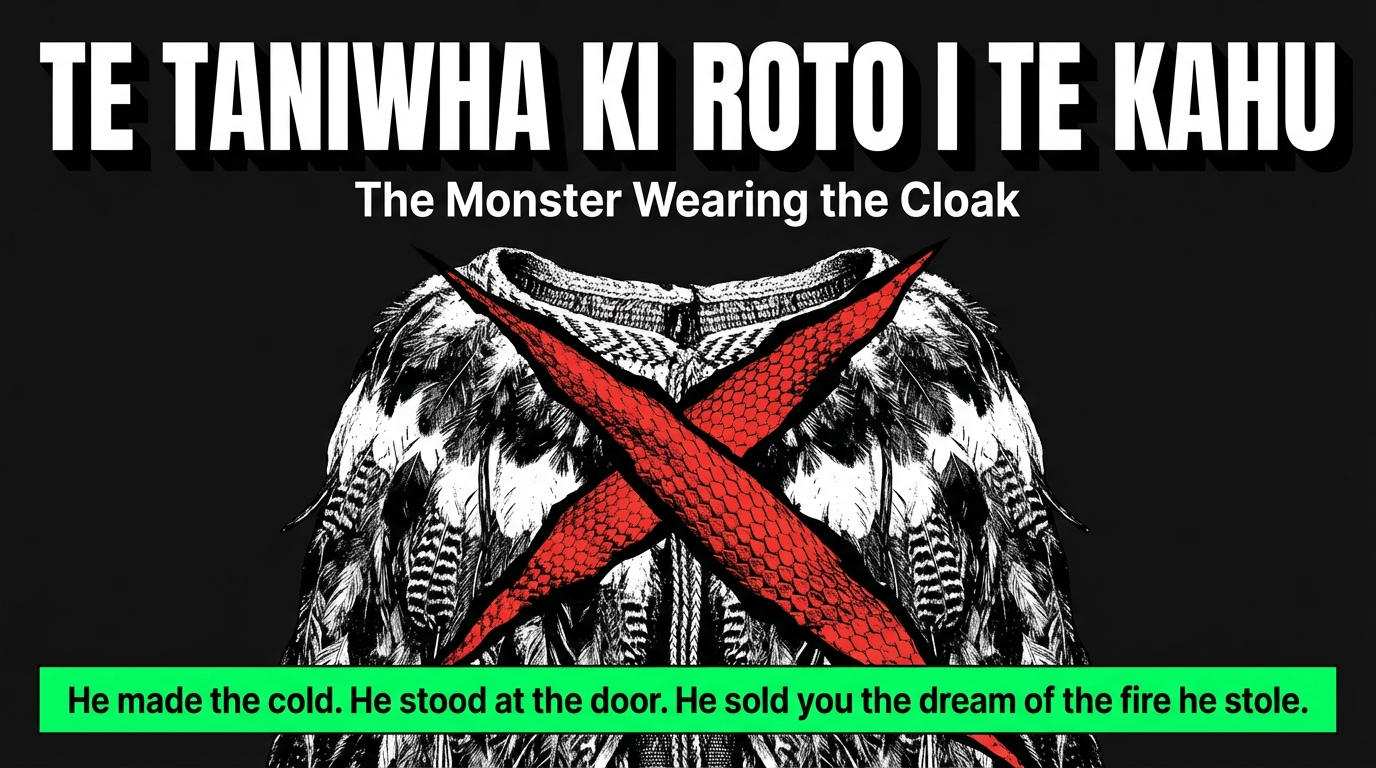
He made the cold. He stood at the door. He sold you the dream of the fire he stole.
Kia ora e te whānau.
There is a creature in our tradition. It wears the kahu kiwi cloak — the most sacred garment of rangatira, woven from the feathers of a thousand birds gathered over seasons. From a distance, it is magnificent. Its posture is correct. Its oratory is immaculate. It speaks the language of the whānau. It quotes the ancestors. It names the enemy — the very same enemy it has been feeding in secret, behind the carved wall of the wharenui, for forty years.
This creature is not a rangatira.
It is a taniwha wearing stolen feathers.
Its name is Winston Peters.
And on Saturday, standing before cameras in Tauranga — the city he once held as a fortress of the people — the taniwha opened its maw and promised, again, to slay the dragon it has been hand-feeding since 1996.
The Deep Dive Podcast
Listen to a lively conversation between two hosts, unpacking and connecting topics in the sources of this essay
Ko Ngā Kōrero o Mua | The Words That Went Before
To understand how contemptible this performance is, you must understand what Peters has already done — not what he says, but what the record shows.
As documented by The Māori Green Lantern's previous essay on Peters, "Winston Peters — A Walking Contradiction, A Forked Tongue in a Taonga He Was Never Worthy Of," Peters has held the balance of power across five decades. He has been Deputy Prime Minister twice. He has been Foreign Minister, Treasurer, kingmaker. And through every term, every coalition, every "principled stand," the pattern repeats: promise protection, deliver plunder.
He is the tōtara that sounds solid when struck — but hollow at its core.
He rose by attacking people who are among the least powerful — migrants, Māori, beneficiaries — while the cheques came from rooms his supporters will never enter. That is his whakapapa. Power pretending to speak for the powerless. The kete of wind dressed as a kete of sustenance.
Now he stands before the country and tells you the very gentailers he refused to break are robbing you blind.
He is correct.
He just omits that he handed them the key.
Ko Ngā Mata o Te Whānau | A Portrait of the Faithful: Who Actually Showed Up
Before we dissect the speech, let us look at the congregation.
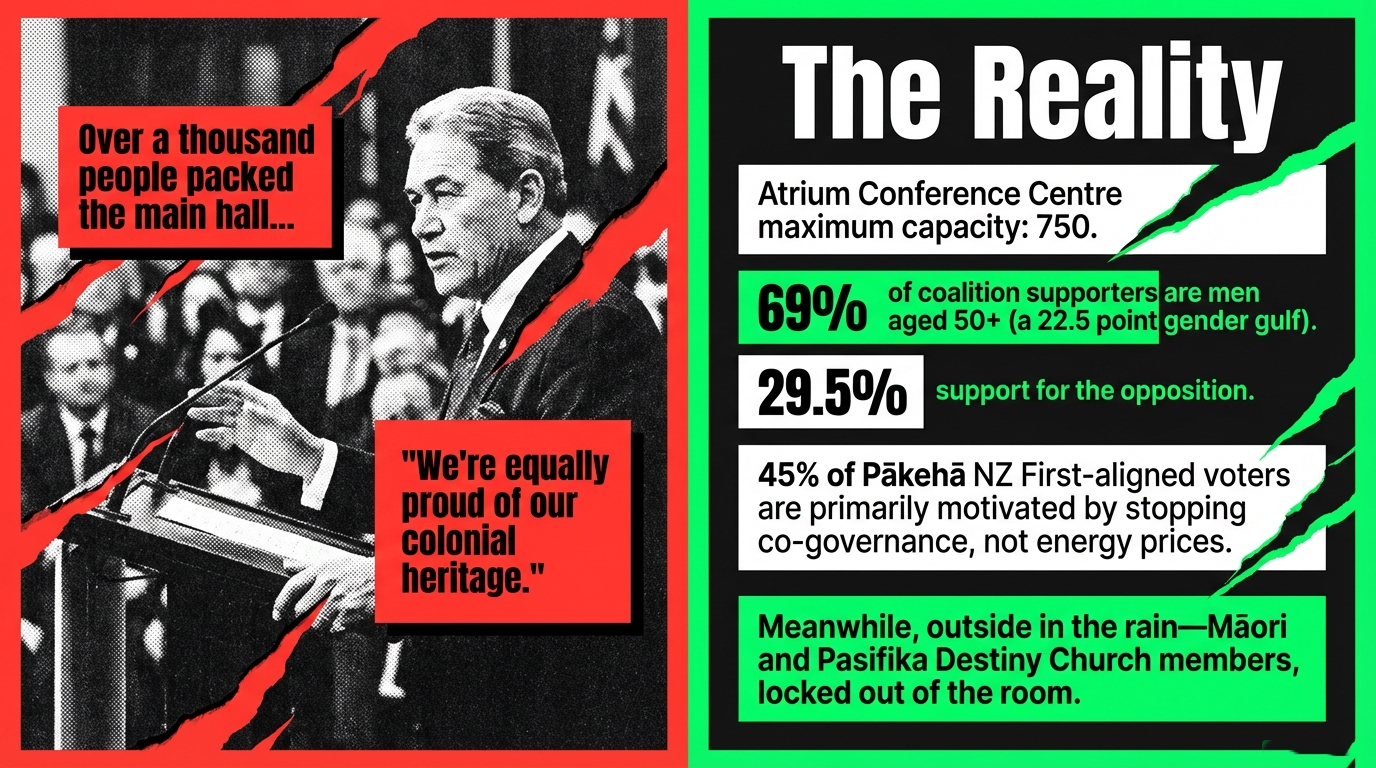
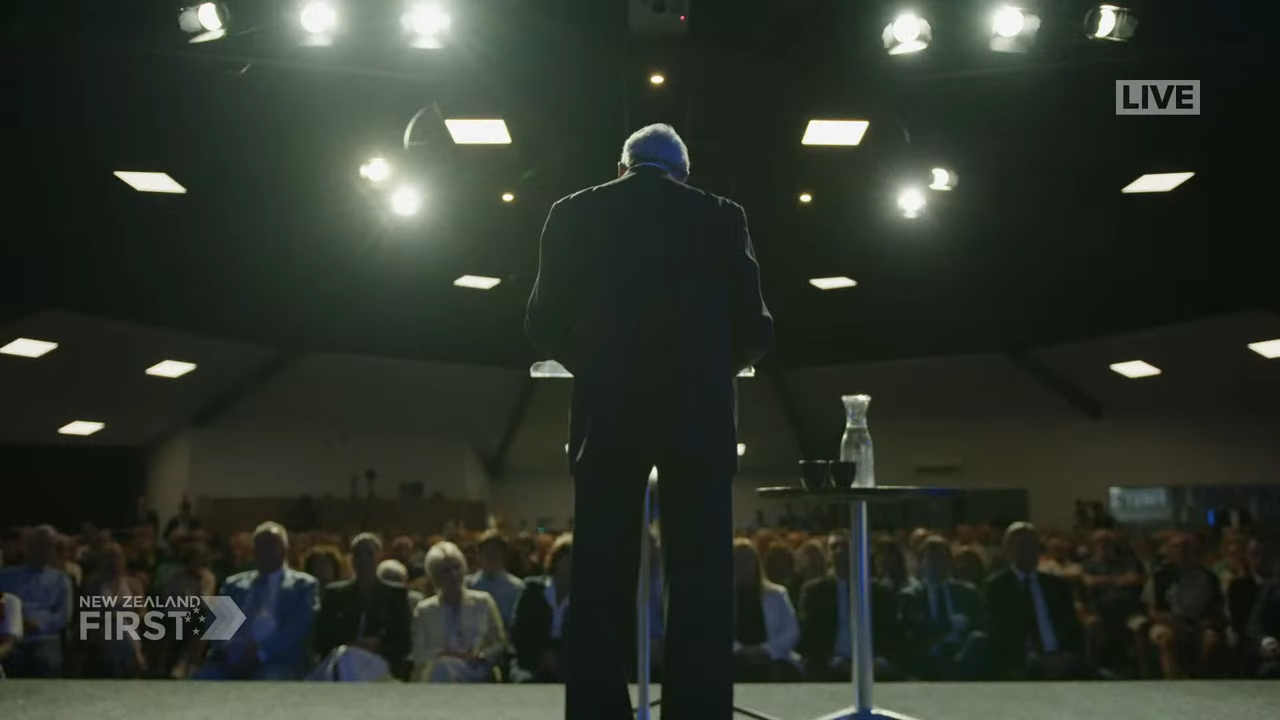
Peters held court at the Atrium Conference Centre in Ōtūmoetai, Tauranga — a 750-seat commercial events venue. Peters boasted on social media that "over a thousand people packed the main hall and three overflow rooms." The venue's own listings confirm its maximum capacity as 750. Winston Peters cannot even count his own crowd honestly. He has been doing this in politics since before some of those attendees drew their superannuation.
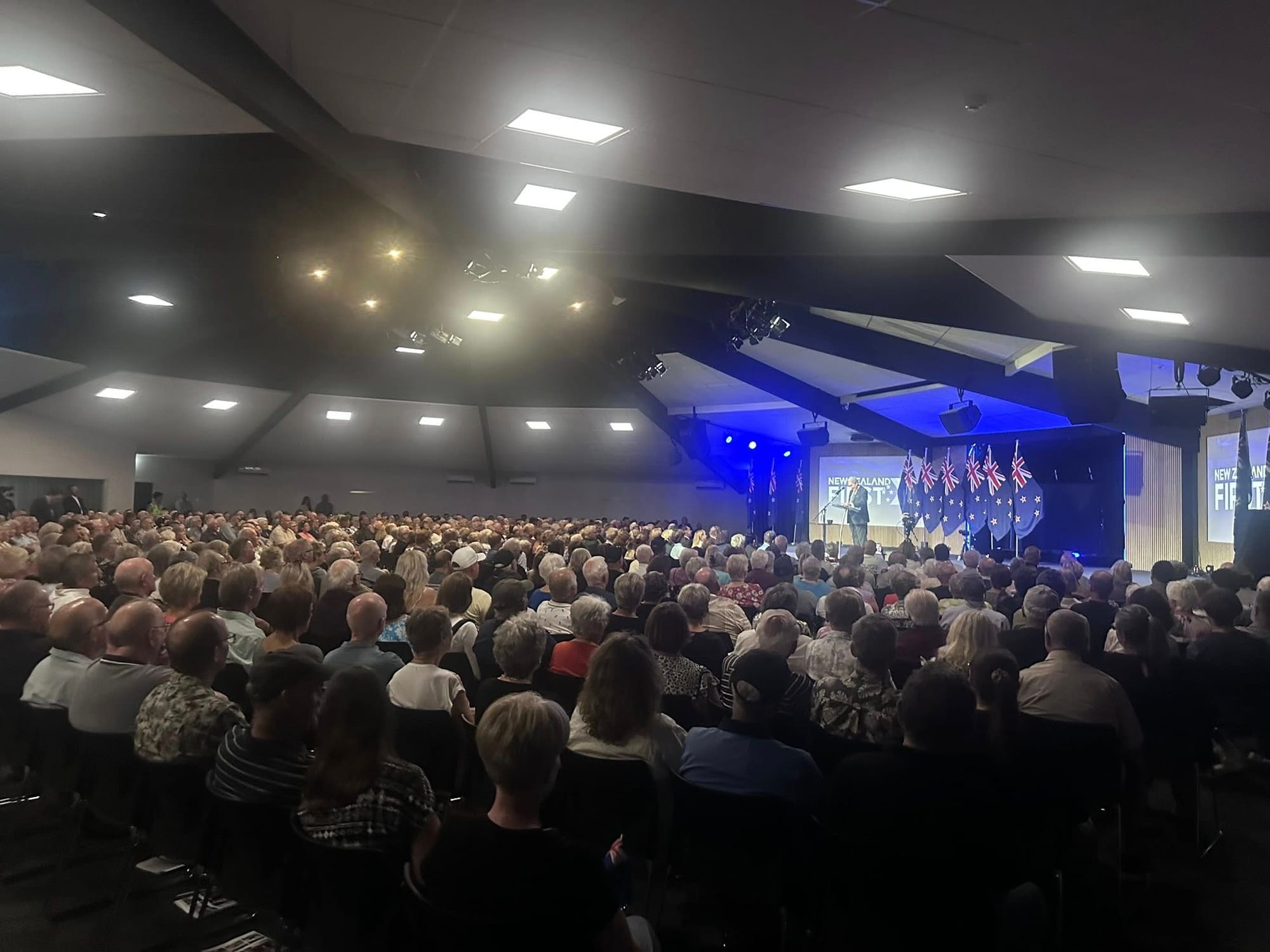
Look at the photographs and livestream from the event. Then look at the data, because the data names what the photographs show.
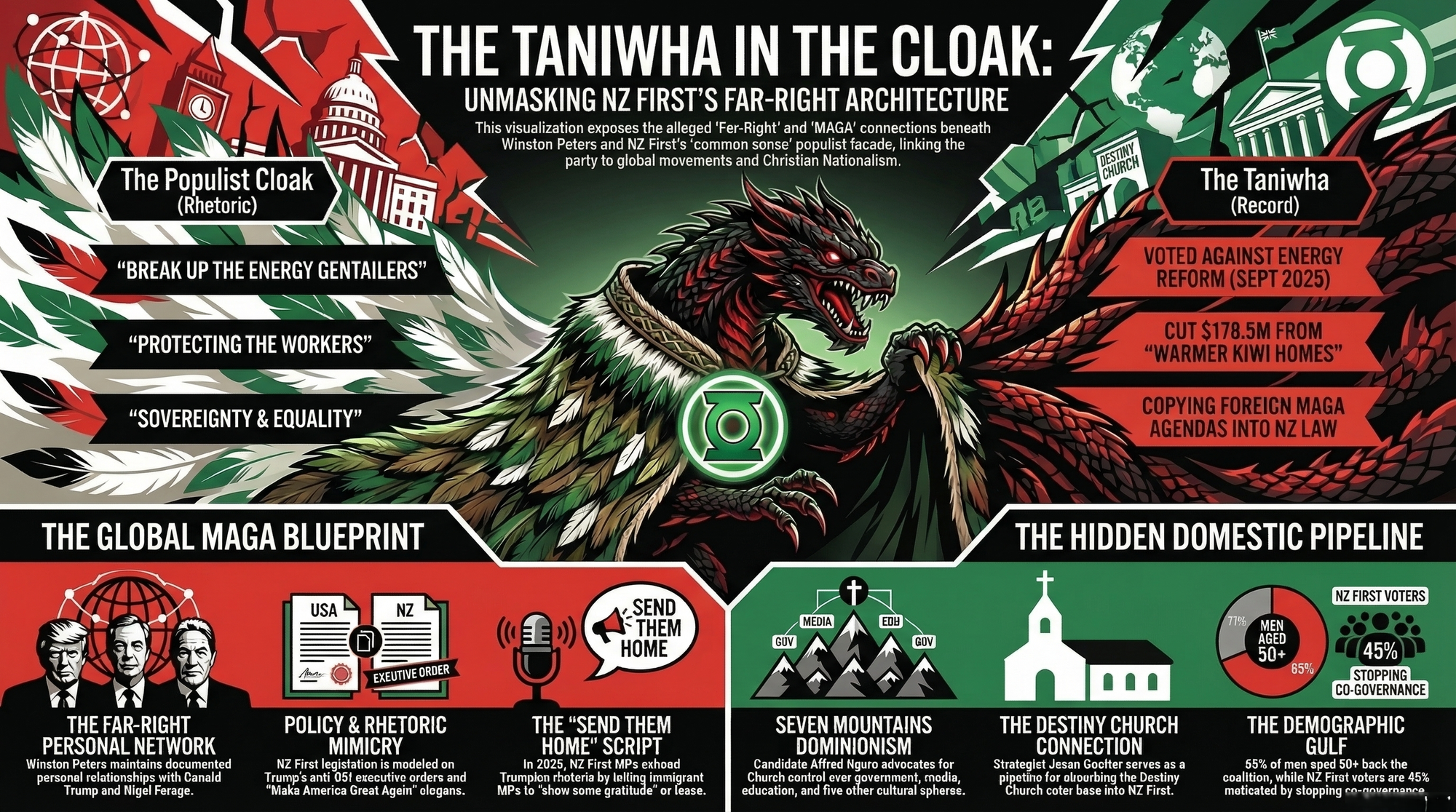
Roy Morgan's demographic research on the governing coalition's support base found that men aged 50+ are the strongest supporters of the National/ACT/NZ First coalition, with 69% backing the coalition — more than double the 29.5% supporting the opposition. Across all men, support for the coalition outstripped the opposition by 22.5 percentage points — a gender gulf more suited to a 1950s country club than a modern democracy.
A Horizon Research survey confirmed that 45% of Pākehā NZ First-aligned voters are motivated primarily by one thing: stopping co-governance. Not energy prices. Not cost of living. Not the futures of whānau freezing in their damp homes. Stopping Māori having a say.
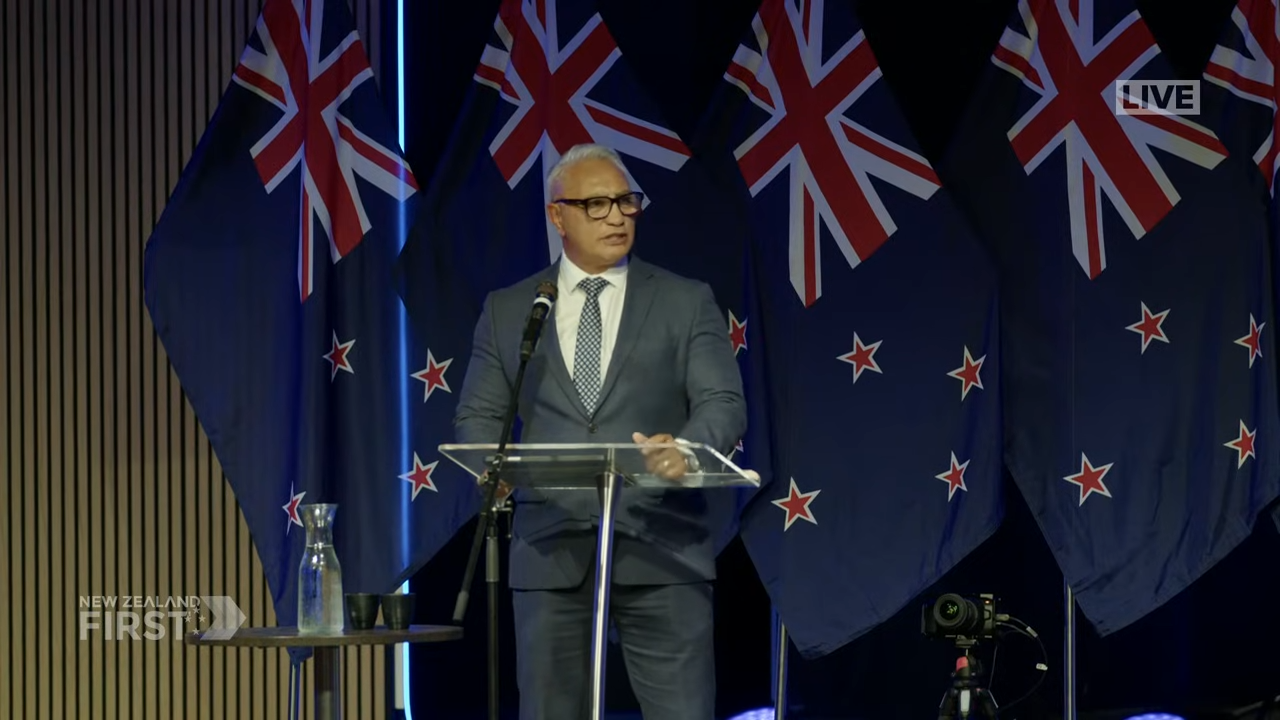
When Alfred Ngaro was announced as a new NZ First candidate, several people in the crowd questioned who he was, because Ngaro failed to introduce himself. A man of Pacific heritage, standing before a crowd that did not know him and did not appear curious to learn. Ngaro is not representation. He is decoration.
Meanwhile, outside in the rain, protesters from the Palestine Solidarity Network waved Palestinian and Māori flags. Destiny Church members protested outside over Shane Jones' fishing reforms — Māori congregants locked out of the party their own church network helped build.
And Peters, warming to his crowd, declared inside:
"We're equally proud of our colonial heritage."
There it is. The flag unfurled. Not accidentally. Not in passing. A Deputy Prime Minister of Aotearoa, at an election rally, declaring pride in colonial heritage before a room that knows exactly what that means — and cheered it.
Te Hono Huna Rawa atu | The Deepest Hidden Connection: Destiny Church, Jevan Goulter, and the Christian Nationalist Pipeline
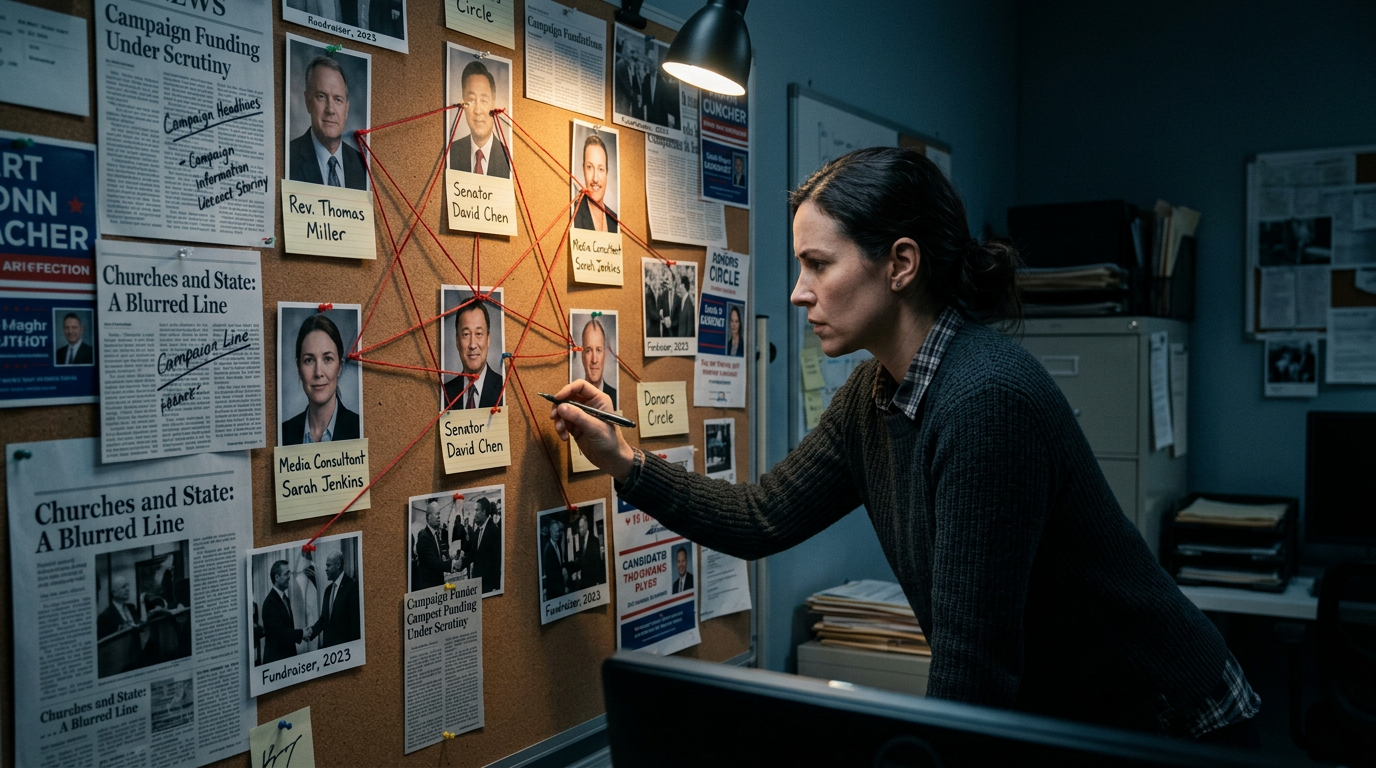
Here is the connection the mainstream media will not trace for you.
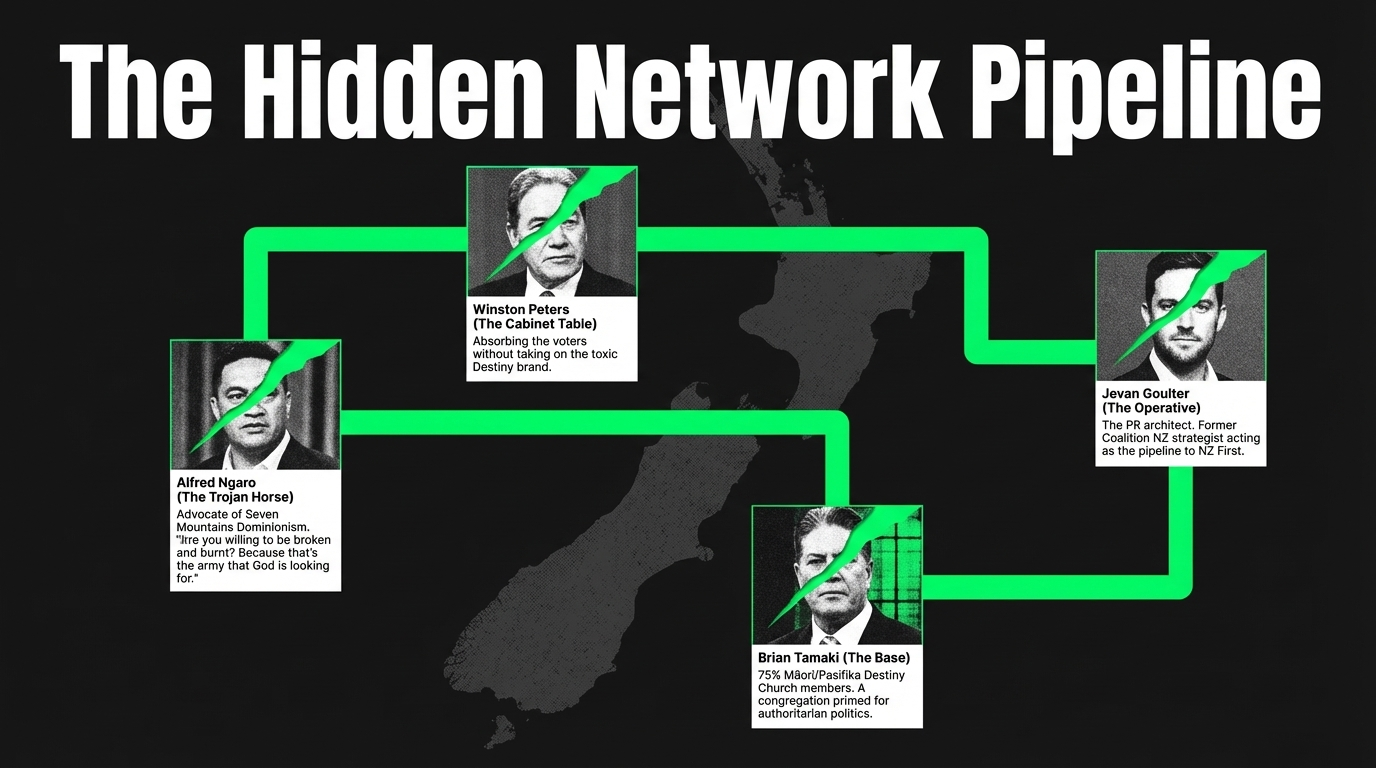
Node One: Jevan Goulter.
Jevan Goulter is a media and public relations consultant described by the NZ Herald as "a close friend of Brian and Hannah Tamaki for a decade." He served as campaign manager and chief strategist for the Tamakis' Coalition New Zealand party in 2019 and was later fired from Hannah Tamaki's Vision NZ party. As Bryce Edwards documents at the Democracy Project, despite the Tamakis' public hostility to the LGBTQ+ community, they maintained a close personal friendship with Goulter. Goulter's connection to NZ First as both a political consultant and operative within that same conservative Christian orbit represents the pipeline through which Destiny Church's voter base has been quietly absorbed into NZ First's electoral strategy.
Node Two: Alfred Ngaro.
Ngaro is Peters' freshly minted NZ First candidate — announced to a crowd that did not know his name. But the Christian Nationalist network does. In June 2023, Pastor Peter Morlock convened a Christian Summit attended by Brian and Hannah Tamaki, Leighton Baker, and party leaders of multiple far-right Christian political operations. Alfred Ngaro was there. At that summit, Ngaro explicitly advocated Seven Mountains Dominionism — the doctrine that the Church must control all seven spheres of cultural influence: government, education, media, arts, business, family, and religion. He told the crowd: "are you willing to be broken and burnt? Because that's the army that God is looking for."
In 2019, Ngaro was simultaneously considering forming his own Christian values party at the exact moment the Tamakis launched Coalition New Zealand. He stayed with National. Then launched his own party, New Zeal, in 2023, which failed. Having failed twice under his own banner, Ngaro now carries Peters'. He brings a pre-existing Christian Nationalist infrastructure: churches, networks, homeschooling communities, and a congregation primed to believe that electoral politics is a spiritual battlefield.
Node Three: The Merger That Was Denied.
In June 2022, Winston Peters was forced to publicly quash rumours that he was in merger talks with Brian Tamaki — a story credible enough to be published in The Listener before being pulled. You do not deny rumours unless they are plausible enough to require a public response. The strategic calculation was clear: Destiny Church's brand is too toxic to absorb directly. But the voters — the authoritarian Christian conservative base corralled for two decades — those can be absorbed. Silently. Through Ngaro. Through Goulter. Through a coded phrase like "colonial heritage" that activates the base without leaving fingerprints.
Destiny Church's membership is estimated at 75% Māori and Pasifika. Brian Tamaki built a congregation from urban Māori communities abandoned by the state, channelled their legitimate pain into a theology of obedience, tithe, and authoritarian rule. He is the mirror image of Winston Peters — the same operation, different costume, different sermon. Now those two operations are feeding the same machine.
The Māori members outside in the rain protesting Shane Jones' fishing reforms were Destiny Church members — organised enough to show up, angry enough to protest, and still being used as a prop in someone else's game. Their presence outside the NZ First speech was not incidental. It was the whole story in one photograph: the people this party claims to champion, locked outside the building where their political fate is being decided.
Tō Tātou Amerika Iti | NZ First, Winston Peters, and the MAGA Machine
Let us be precise. Let us be clinical. Let us name the global architecture to which NZ First belongs — not by accusation but by documented evidence.
Exhibit One: The Personal Network.
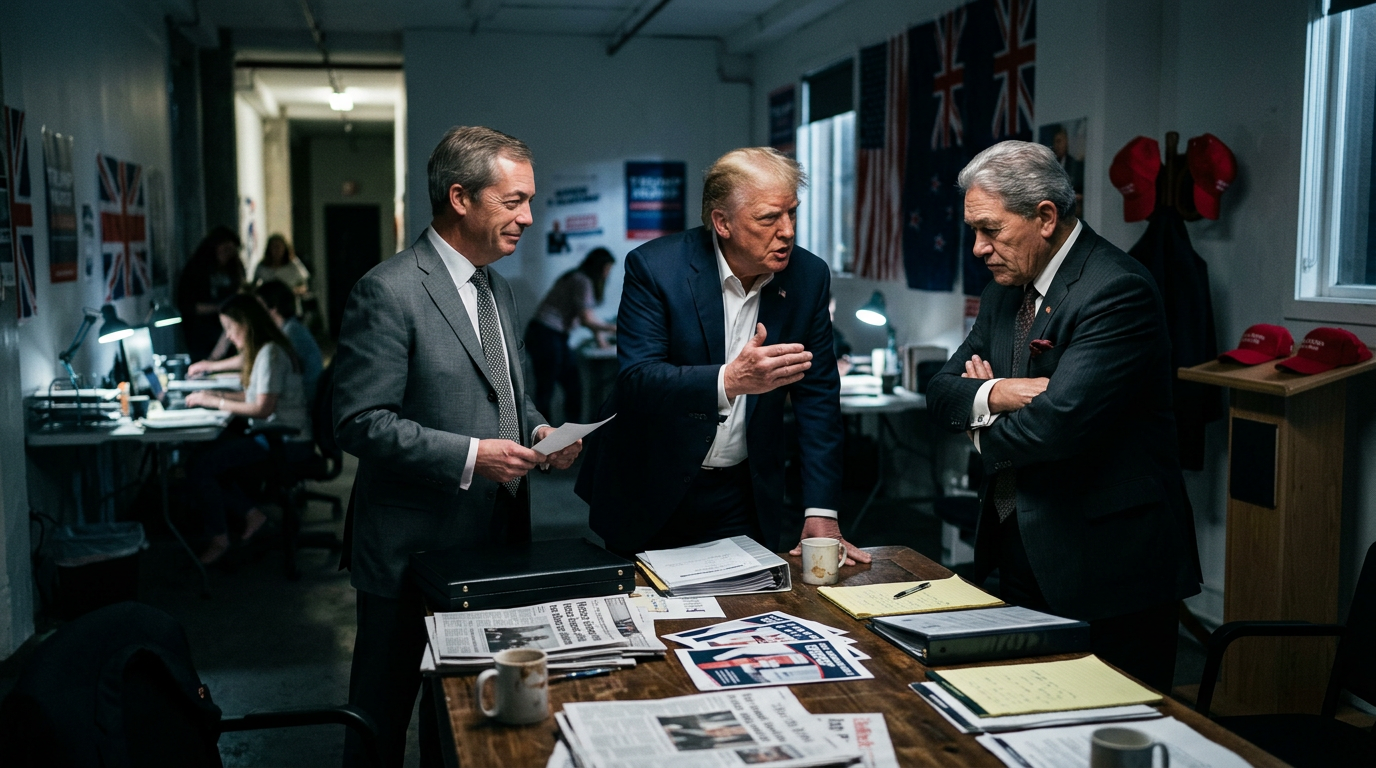
The Spinoff's February 2026 analysis is unambiguous: Nigel Farage — the architect of Brexit, founder of Reform UK, the man pledging ICE-style mass deportations — counts Donald Trump and Winston Peters among his personal friends. This is not metaphor. This is a documented personal relationship between three men who are simultaneously the most influential right-wing populist-nationalist leaders in their respective countries — the US, the UK, and Aotearoa.
Peters does not merely rhyme with MAGA. He is in its personal address book.
When asked to explain the Australian Labor landslide in May 2025 — which echoed Canada's anti-Trump swing — Peters had two words: "Nigel Farage," dismissing the anti-MAGA reading as a "cheap, uneducated explanation." He was celebrating, not recoiling. He reads the same populist playbook as Trump. He thinks it is winning. He is betting his last political chapter on it.
Exhibit Two: The Policy Copycat — Anti-DEI.
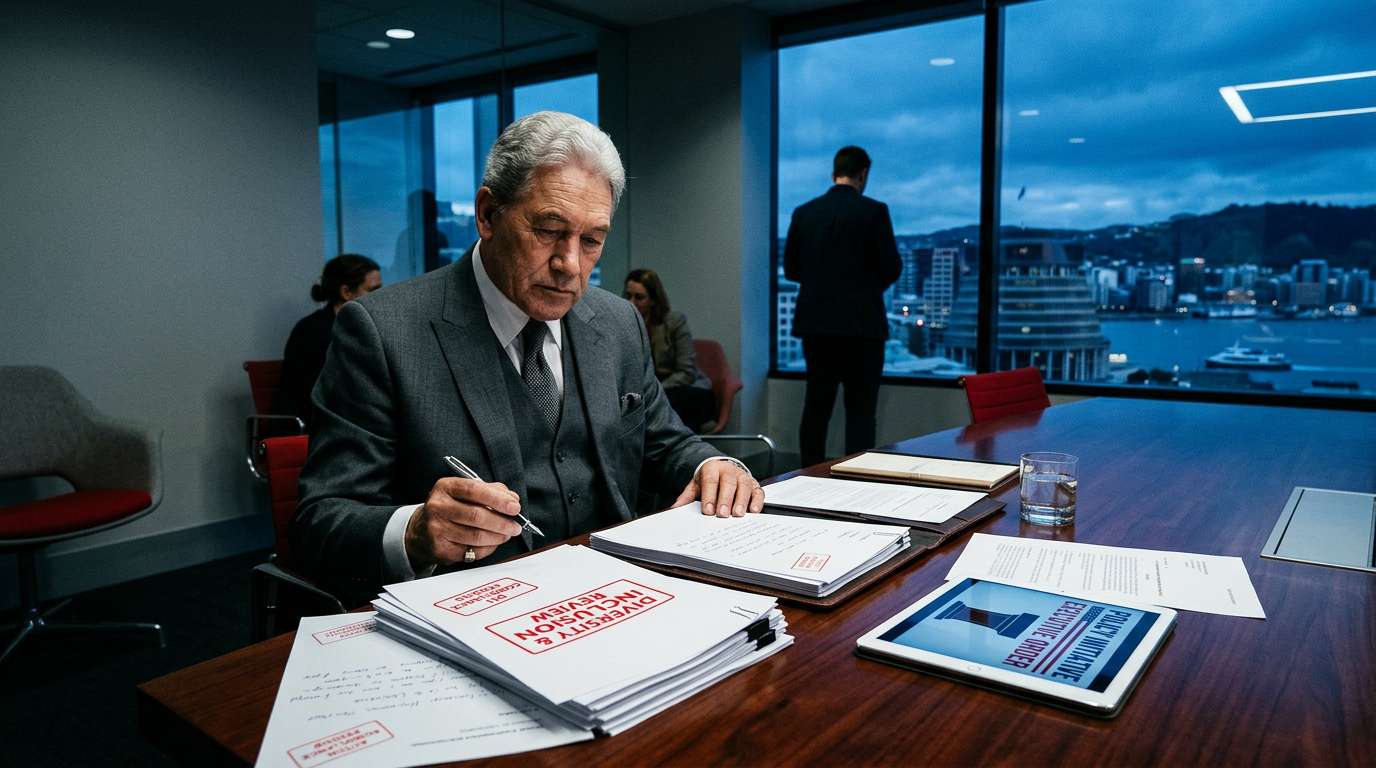
In March 2025, NZ Herald confirmed that Peters and NZ First were following "the anti-DEI path being laid by Donald Trump in the United States," proposing legislation directly modelled on Trump's executive orders dismantling Diversity, Equity and Inclusion programmes. Not inspired by. Not broadly similar to. Modelled on. Peters watched Trump sign executive orders eliminating civil rights infrastructure built over fifty years and said: yes, that — let us do that here.
In Aotearoa, DEI is not abstract HR bureaucracy. It is the paper-thin scaffolding protecting Māori and Pasifika workers from the structural racism baked into every employment institution inherited from colonisation. Dismantling it is not a cultural reform. It is a targeted removal of protection from the people who need it most, dressed in the language of "merit."
Exhibit Three: The Slogan.
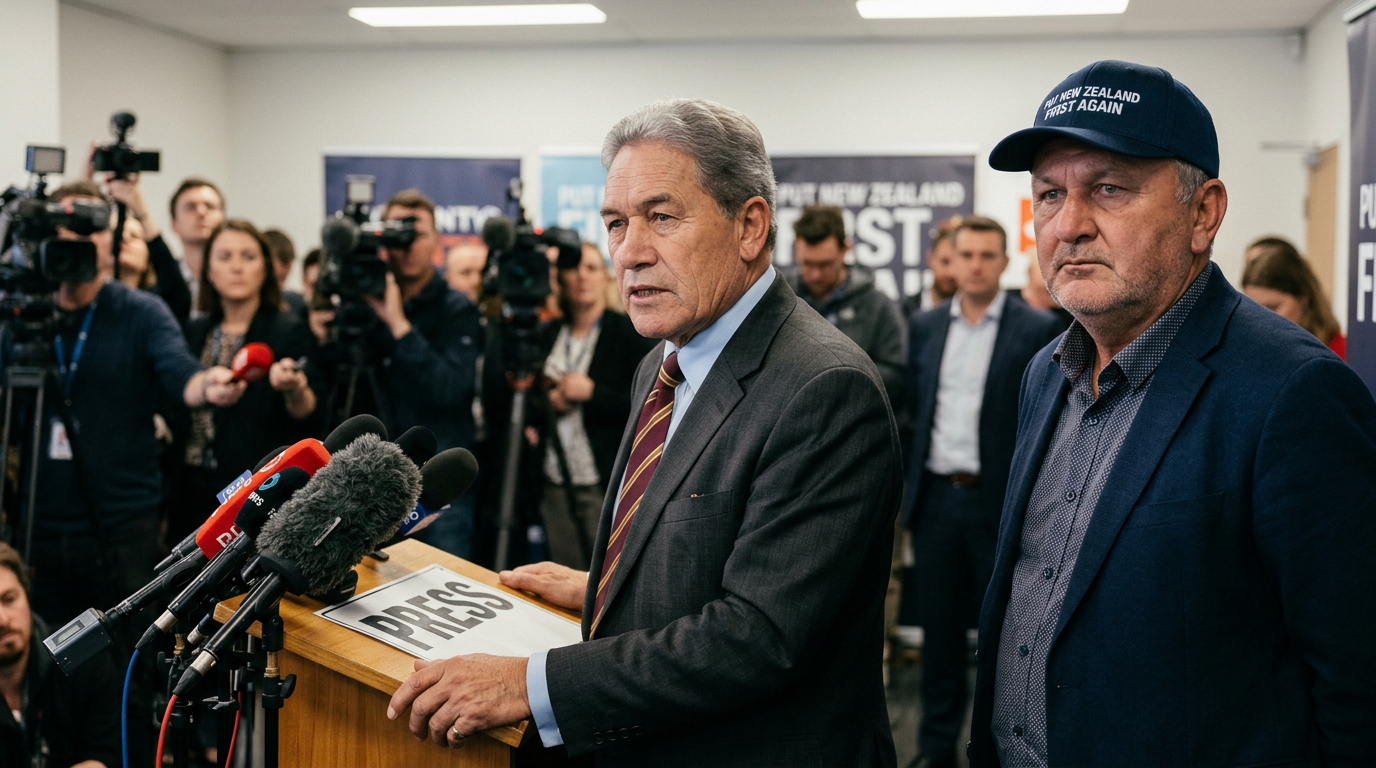
When Shane Jones re-entered politics under NZ First's banner, he did so literally wearing a baseball cap that read: "Put New Zealand First Again." As NZ Herald political commentator Bryce Edwards confirmed:
"There is more than a hint of Donald Trump in Shane Jones' political return… Jones layered it on by sporting a cap wearing 'New Zealand First Again'."
Make America Great Again. Put New Zealand First Again. The grammar is identical. So is the ideology: there was a time when things were better; the enemy is the outsider; the solution is the strongman. Peters is the strongman. The hat is the confession.
Exhibit Four: The Parliamentary Floor.
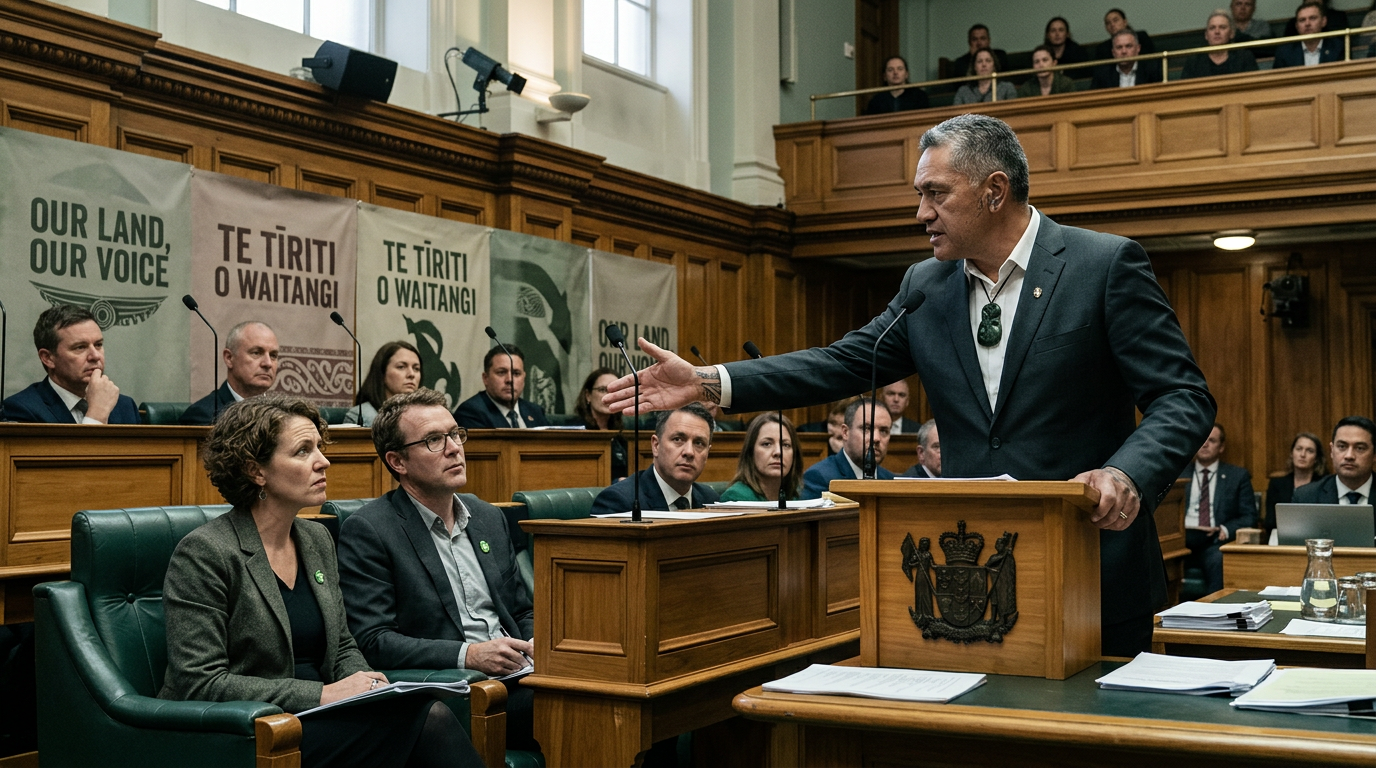
In January 2025, during a parliamentary debate, Shane Jones yelled "Send the Mexicans home" across the House at Green MPs Lawrence Xu-Nan and Francisco Hernandez. Peters then told the same MPs to "show some gratitude for being in New Zealand." NZ First refused to back down.
Jones then doubled down to Morning Report:
"He brings alien ideas and woke-ism to New Zealand... He tries to impose ideas and make fun of New Zealand First's foundation beliefs. And he's going to get much more of what I gave him and if he doesn't like it he can get out of politics."
Compare Trump's "send them back" and "go back where you came from" — targeting non-white members of the US Congress. The script is the same. The targets are the same. The only difference is that Jones is himself Māori, which does not make the racism less real — it makes the self-betrayal more devastating.
Jones also in 2025 criticised a Whānau Ora campaign encouraging Māori to enrol on the Māori Roll, calling the agency "tainted" by political association. A Māori MP using his parliamentary platform to discourage Māori voter enrolment. That is not a policy position. That is voter suppression. Trump's people call it "election integrity." Jones calls it concerned governance. The mechanism is identical.
Exhibit Five: The Convention of Grievances.
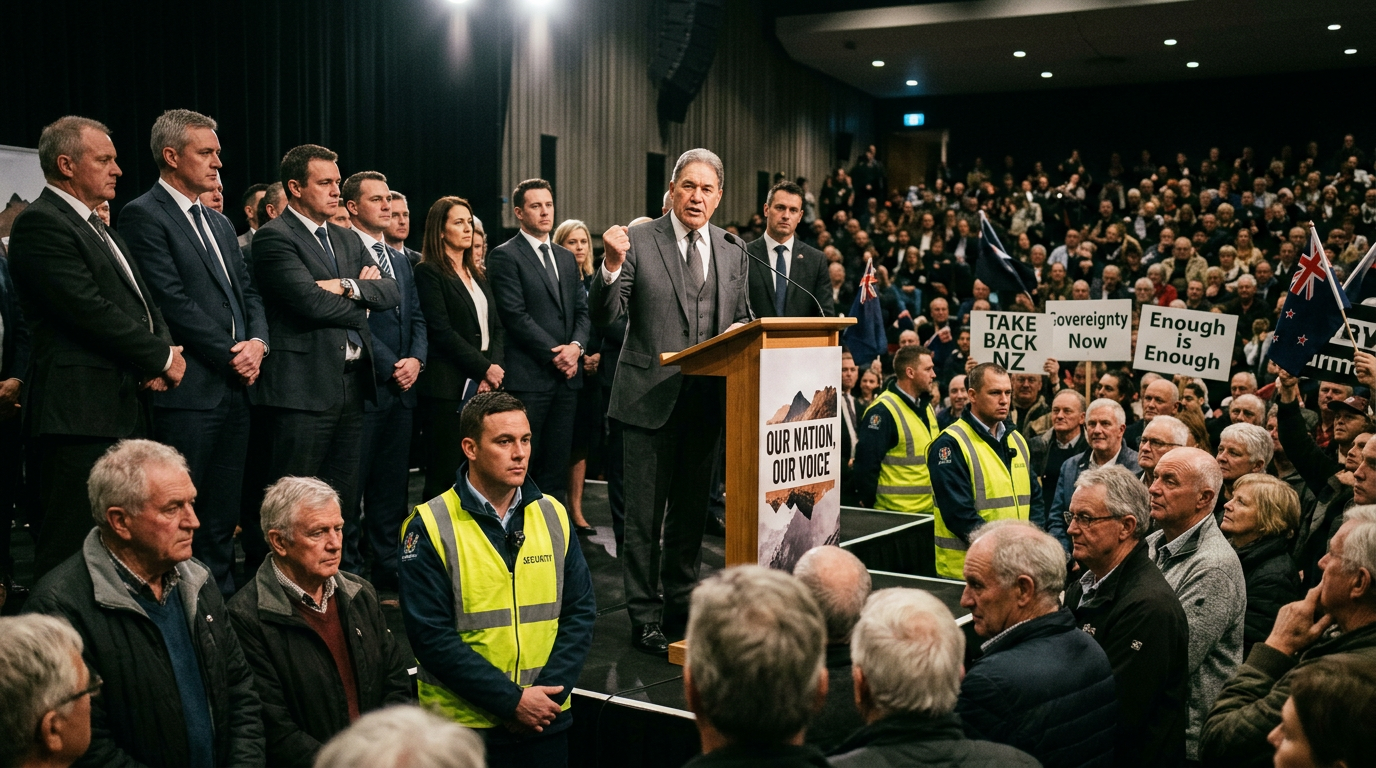
At NZ First's 2025 AGM, the membership voted on policy remits that read like a MAGA wish-list transposed to the South Pacific:
- Remove references to Te Tiriti o Waitangi from local and central government, and university/school documents
- Scrap co-governance (excluding Treaty settlements)
- Develop a "long-term Demographic and Migration Strategy" — coded language for ethnic restriction
- Amend the Bill of Rights to "ensure basic medical freedoms are safeguarded" — anti-vaccination infrastructure
- Explore nuclear power including fusion
- Consider exiting the Paris Climate Agreement
Exit the climate agreement. Gut Treaty obligations. Restrict migration. Undermine vaccine mandates. This is not conservative governance. This is a MAGA platform in a suit, speaking through an interpreter, before a crowd that has been told the country is being stolen from them.
And who was invited to speak to the NZ First faithful? At the 2024 AGM: Australian Senator Jacinta Price, who had spent the year railing against the Aboriginal Voice to Parliament, trans-Tasman far-right networks sharing stages, sharing slanders, sharing a vision of indigenous people who agree that their own rights are a problem.
Security was stepped up at the 2025 AGM. Guards in hi-vis. Peters warned of a "massive sea change." He is not describing a policy agenda. He is describing a movement. That is precisely what MAGA is: not a party platform but a movement — an identity, a grievance, a permission structure for anger that was always there but had been denied a respectable outlet.
Exhibit Six: The Academic Fingerprint.
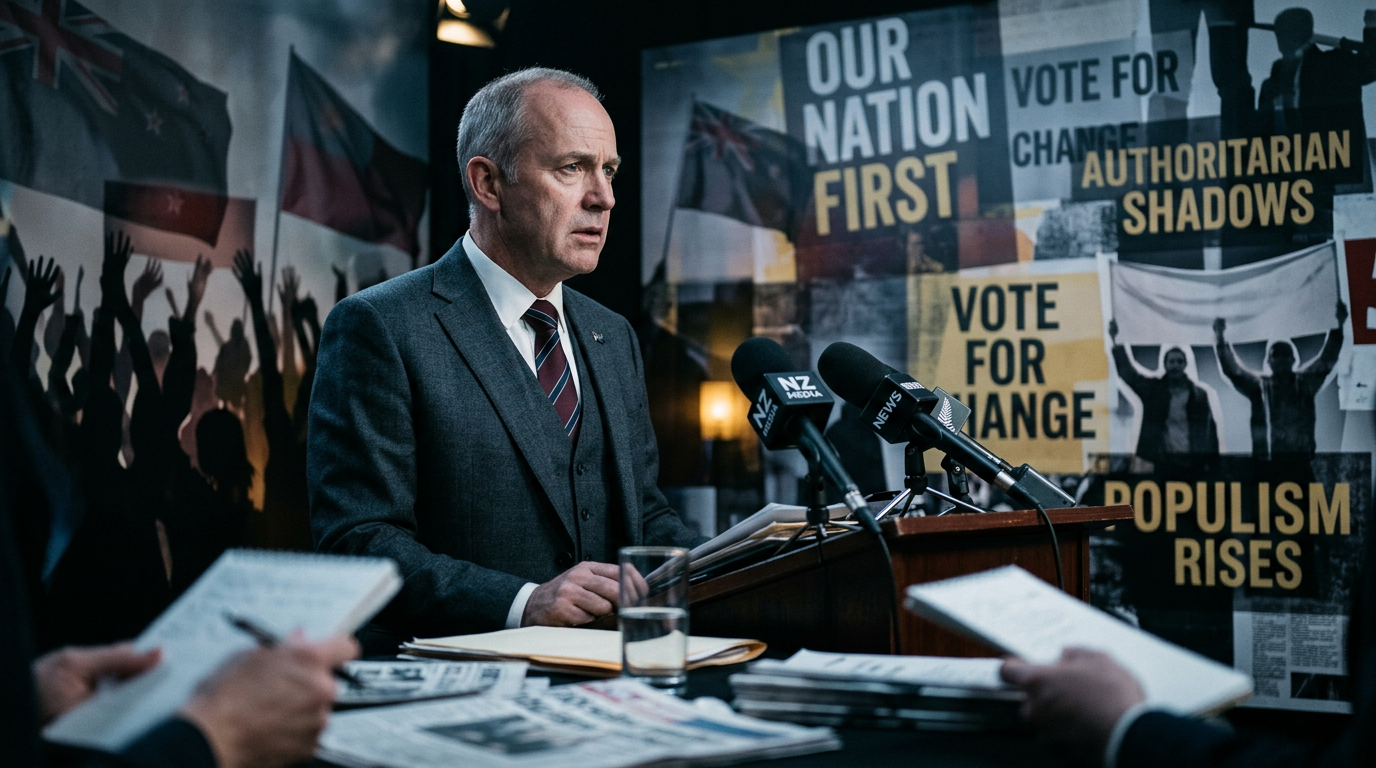
This is not name-calling. This is political science. Motu Research's 2021 academic analysis concludes that NZ First "has more in common with right-wing populist parties in Europe than left-wing parties but espouses a relatively soft authoritarian populism." International Viewpoint documents that the explicitly Nazi National Front named NZ First as its preferred mainstream political party in 2005. In 2017, Peters endorsed a "European Students Association" at the University of Auckland that was, in fact, a white-nationalist front group. Peters benefits from the far-right resurgence, courts their vote, and provides mainstream cover for their politics — precisely the function Trump performs in the United States.
Former Prime Minister Sir Geoffrey Palmer warned in September 2025:
"Decay and rot set in in democracies and, if it's not addressed, it gets worse. That's what allows populism to take over, and authoritarianism to flourish."
He said this about global trends. The trends he was describing have a local address.
Exhibit Seven: The Lying.
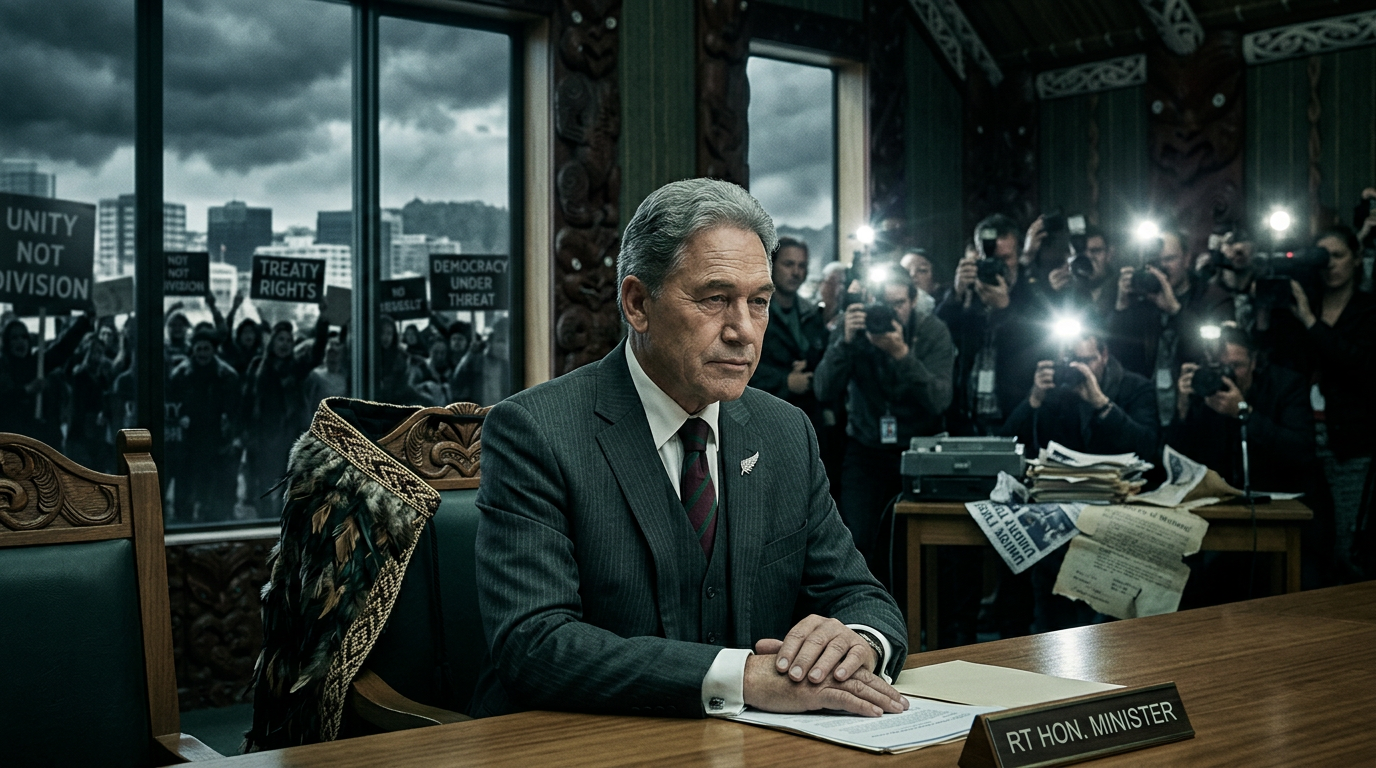
Workers First documented in February 2026 that Peters had met with unions at least eight times to discuss the Employment Relations Amendment Bill — and then publicly denied it.
The headline was blunt:
"Winston lies."
That is the Trump method in its purest form: deny the meeting, deny the record, claim the press conference is fake, accuse the accuser.
The Spinoff confirmed that Peters describes NZ First as "nationalist with a capital N" — a phrase that, in 2026's global political context, is not an abstract statement of pride.
It is a flag planted in the international populist-nationalist movement that includes Trump, Farage, Orbán, Le Pen, and Meloni: the co-ordinated dismantling of multilateral institutions, environmental agreements, minority rights frameworks, and the international rules-based order — replaced by strongman governance, ethnic nationalism, and a politics of manufactured emergency.
The Critical Difference — and Why It Makes Peters More Dangerous.
Trump is transparent about what he is. Peters is not.
As International Viewpoint's analysis notes:
"Peters is essentially a conservative rather than a fascist 'national revolutionary'. He seeks to bolster and defend the traditional institutions of the New Zealand colonial settler state, rather than to incite mob violence against the Establishment."
That is the more sophisticated danger. MAGA storms the Capitol. Peters sits at the Cabinet table. MAGA burns the rules. Peters amends them quietly, from the inside, over forty years. The outcome — the erosion of rights, the concentration of wealth, the exclusion of Māori from power — is the same. The mechanism is more durable because it wears a respectable face.
The 1News analysis put it plainly: despite the "Trump slump" affecting conservative parties in Canada and Australia, Peters' "overt culture-war rhetoric may appeal to his 6% support base" — and NZ First is rising in the polls, not falling. Because Aotearoa's version of MAGA is not imported. It is domestic. It is home-grown. It wears a Ngāti Manahautu cloak and quotes the Treaty it is actively dismantling.
That is te taniwha. That is the monster in the kahu.
In te ao Māori, the most dangerous atua are not the obvious ones. They are the ones that have learned your karakia.
Ko te Whakaaro Hou | The "New" Proposal
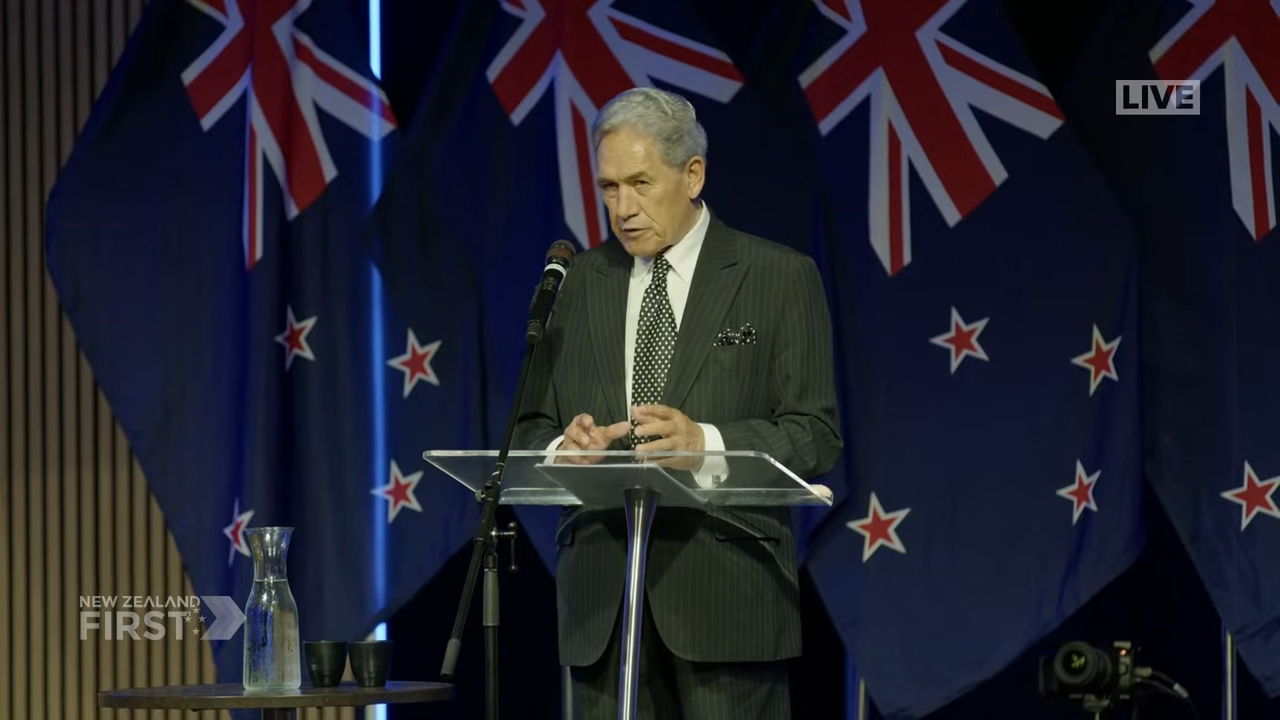
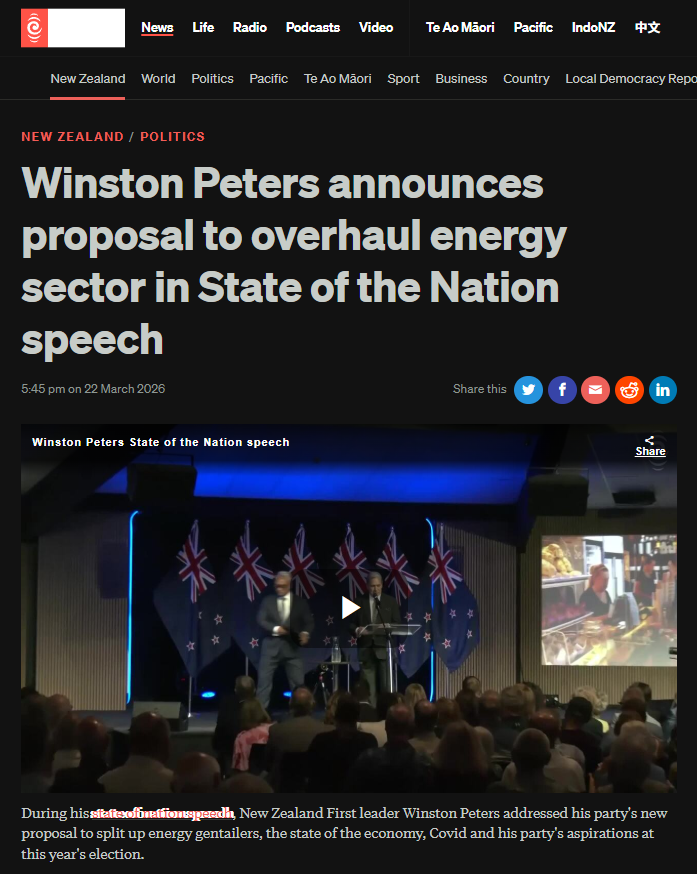
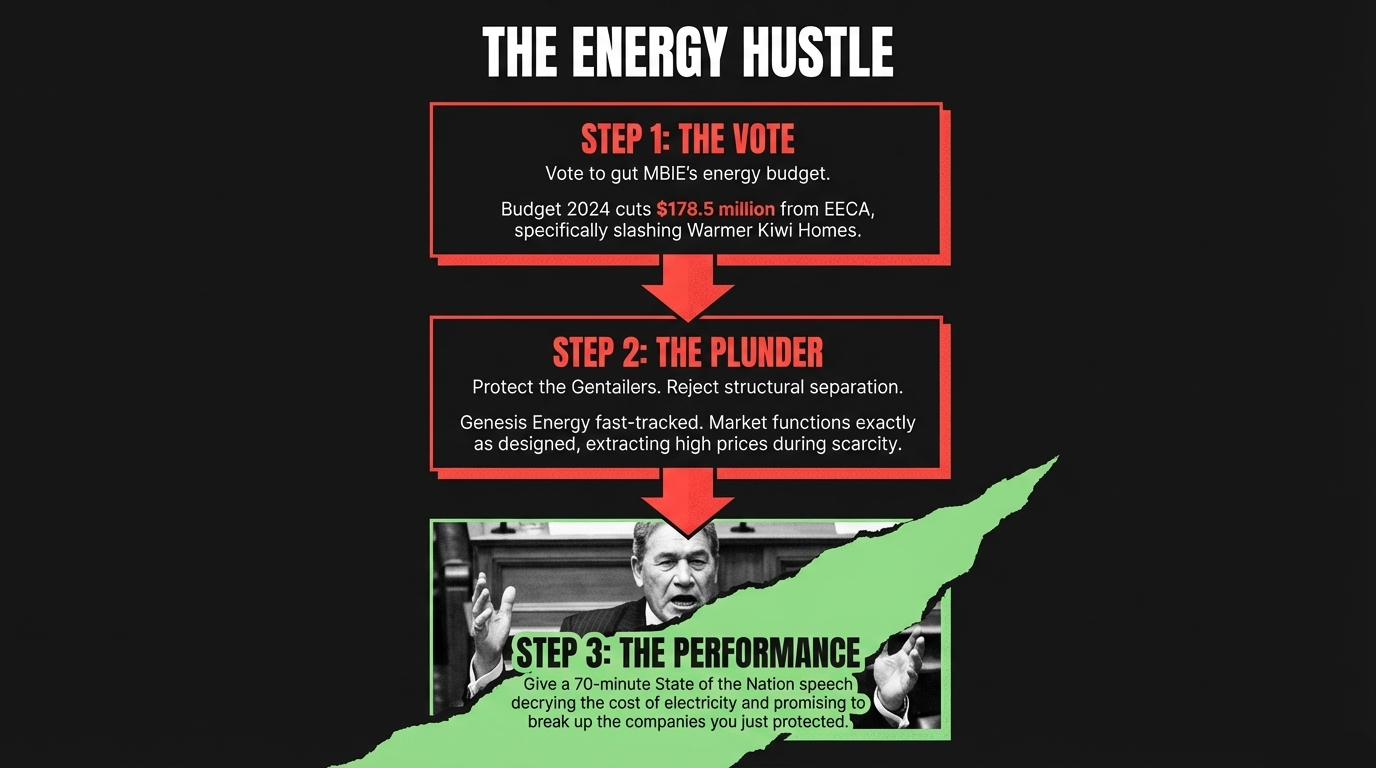
Peters' State of the Nation speech proposes splitting the big four energy gentailers — Genesis, Mercury, Meridian, Contact — which control nearly 90 percent of electricity generation. He called it bold. He called it necessary.
He did not mention — because he is constitutionally incapable of accountability — that he was the Deputy Prime Minister of the government that just refused to do exactly that.
In September 2025, after commissioning a full review, this government stopped short of any major energy shake-up. No structural separation. No divestment. No meaningful reform.
The day of that announcement, gentailer share prices rallied. The market told you, in the clearest possible language, who won that Cabinet meeting.
It was not whānau.
Ko te Kahurangi i Ngaro | The Minister Who Lost
Shane Jones, Associate Energy Minister, in September 2025 called publicly for renationalising the power market:
"unless we can reduce the costs of electricity driven by the gentailers... we are going to witness mass unemployment and deindustrialisation."
Jones was right about the diagnosis. He was also seated at the Cabinet table that chose to do nothing about it.
He lost. As RNZ's political analysis lays bare, Jones was absent from the September 2025 announcement entirely — his name not on a single media release.
In tikanga terms, this is the rangatira who cannot stand on the marae ātea of their own decision.
The waka capsized. They are blaming the weather.
Ko te Ngākau Pōhēhē | The Architecture of the Con
In December 2025, Peters made a U-turn on the Chorus debt sell-off — calling an asset sale "monetisation" as though renaming the wound closes it.
"I don't support failed economics. I don't support wanton neoliberalism, which is a disaster." — Winston Peters, December 2025, after voting for the wanton neoliberalism.
Labour leader Chris Hipkins named the hustle plainly in February 2026:
NZ First is "trying to pretend they're not part of the Government they're currently part of."
That is the entire business model.
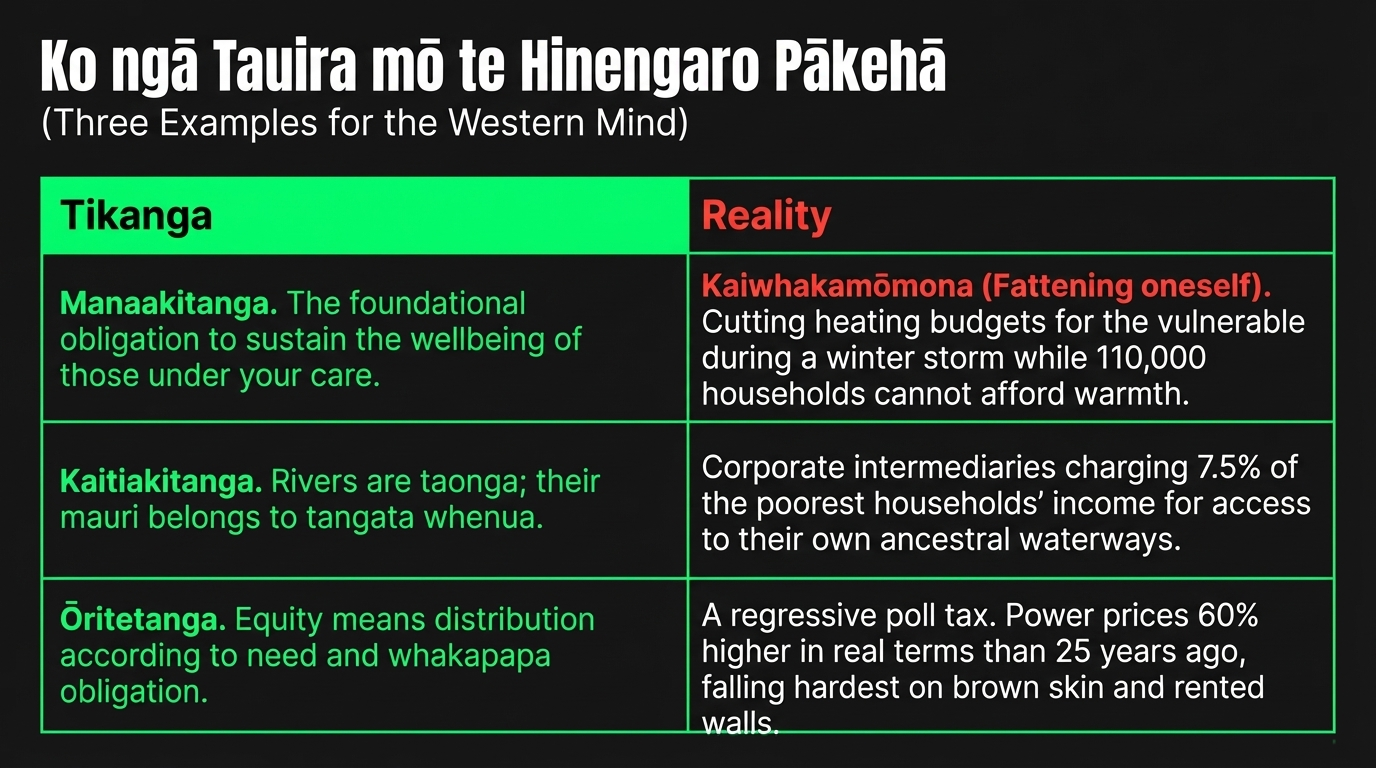
Ko ngā Tauira mō te Hinengaro Pākehā | Three Examples for the Western Mind
Example One: The Quantified Death Machine — Energy Poverty and Cold Homes
What is happening: University of Otago medical researchers estimate 360,000 New Zealand households are experiencing energy poverty. Consumer NZ confirms nearly one in five households struggle to pay power bills, and 11% are living in cold homes after cutting heating. MBIE's 2023 energy hardship report found over 110,000 households could not afford to keep their home adequately warm, with Māori and Pacific whānau disproportionately represented in every measure of energy hardship.
What Peters' government did: The Budget 2024 gutted EECA by $178.5 million, specifically slashing Warmer Kiwi Homes. NZ First voted for this Budget. Then Peters gave a speech about how cold the houses are.
The solution: Immediately restore Warmer Kiwi Homes at full funding, ring-fence 40% for Māori and Pacific whānau, fund it from a gentailer super-profit levy.
The tikanga dimension: Manaakitanga is the foundational obligation to sustain the wellbeing of those under your care. A rangatira who allows people to freeze is not a rangatira — they are a kaiwhakamōmona, fattening themselves at the expense of those they were charged to shelter. For the Western mind: this is a mayor who cuts the heating budget for homeless shelters during a winter storm, then holds a press conference decrying cold deaths, at a conference centre with free parking.
Example Two: The Profit Machine That Runs on Manufactured Scarcity
What is happening: The Electricity Authority confirms gentailer energy margins ranged from $60 to $95 million per week from July to December 2024 while households were crushed. Victoria University economist Geoff Bertram told RNZ: "The market is doing exactly what it was set up to do — high prices and high profits at times of scarcity. This is a market where scarcity goes straight through to profiteering."
What Peters' government did: Rejected structural separation. Energy Minister Watts cannot state how much cheaper power will be. Genesis Energy was the first to benefit from fast-track consenting — rewarded by the government that claims to oppose them.
The solution: Legislate structural separation of generation and retail. Establish a public energy retailer for low-income households. Implement a windfall tax on gentailer super-profits.
The tikanga dimension: Kaitiakitanga — the rivers that power those turbines are taonga, their mauri belonging to all people and especially to tangata whenua. Charging 7.5% of the poorest households' income for the right to access ancestral waterways through a corporate intermediary is a violation of kaitiakitanga that should be constitutionally challenged under Te Tiriti Article Two. For the Western mind: imagine Niagara Falls privatised by four companies charging Haudenosaunee people the highest rates for electricity from their own ancestral waters while the government debates but declines to act. That is this.
Example Three: The Regressive Tax on Brown Skin and Rented Walls
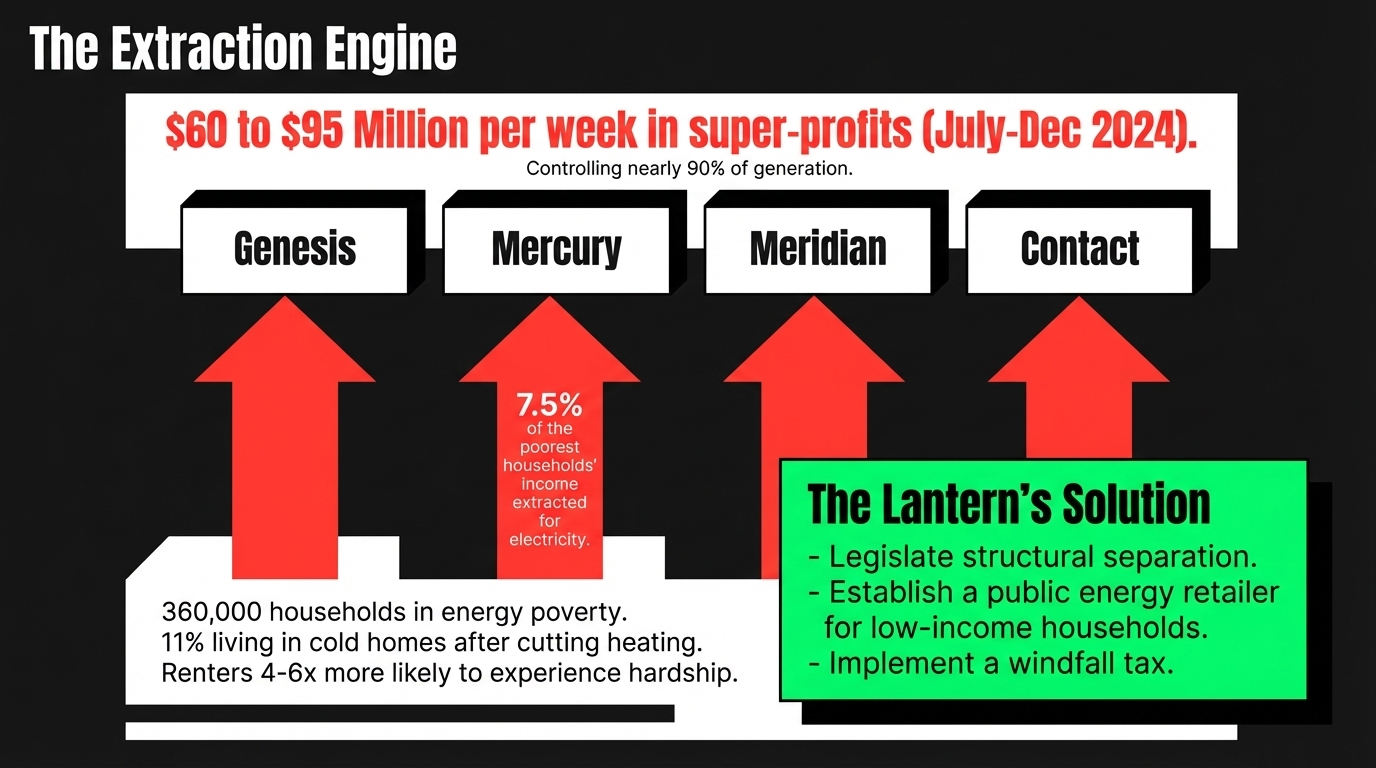
What is happening: The Public Health Communication Centre confirms the poorest households spend over 7.5% of their income on electricity while the wealthiest 10% pay a fraction proportionally. Renters are four to six times more likely to experience energy hardship. Healthy Housing confirms: "those who can least afford to pay for electricity pay the most both per unit and relative to their income." Power prices are 60% higher in real terms than when the market was reformed 25 years ago, up 12% under this government, with at least 5% more expected in 2026.
The solution: Tiered tariff system — below-subsistence use free or subsidised, above-subsistence progressive pricing, means-tested for renters, funded by ending the government's dividend extraction from the price of keeping people cold.
The tikanga dimension: Ōritetanga — equity means distribution according to need and whakapapa obligation, not market position. For the Western mind: this pricing structure is a poll tax — a fixed toll regardless of capacity to pay, falling hardest on those with least, and the demographics of who that is are not coincidental. The electricity market is colonisation laundered through price signals — built on assumptions about capital and merit that were themselves racially structured, designed to benefit those who already held assets at the expense of those from whom assets had been confiscated.
Ko Ngā Hono Huna | The Hidden Architecture
Connection One: NZ First campaigns against gentailer power → sits in Cabinet → refuses structural change → gentailer shares rally → Peters re-campaigns against gentailer power. This is not a cycle. It is a business model.
Connection Two: The same government that won't split the gentailers wants to bypass fast-track process for a new LNG terminal — locking Aotearoa into fossil fuel dependency for another generation.
Connection Three: This government scrapped its own quarterly action plans in February 2026, removing the last mechanism for public accountability. No benchmarks. No receipts. Only speeches.
Connection Four: The Greens' structural reform agenda — long dismissed as "extreme" — is now endorsed by the Reimagine Aotearoa campaign, the Electricity Authority's own data, Consumer NZ, and Victoria University economics faculty. The "extreme" position is correct. The "moderate" position — Peters' do-nothing position — has been proven false by twelve percent bill increases and 360,000 households rationing heat.
Connection Five: The pattern across this government's entire programme — documented in The Traffic Light Taiaha, The Starving of the Seedlings, The Nursery of Cages, and The Charity of Conquerors — is identical across every portfolio: identify a population made vulnerable by structural inequality; remove structural support; extract value from the resulting desperation; campaign for re-election on the promise to fix what you deliberately broke.
Ko te Whatungarongaro | What Disappears
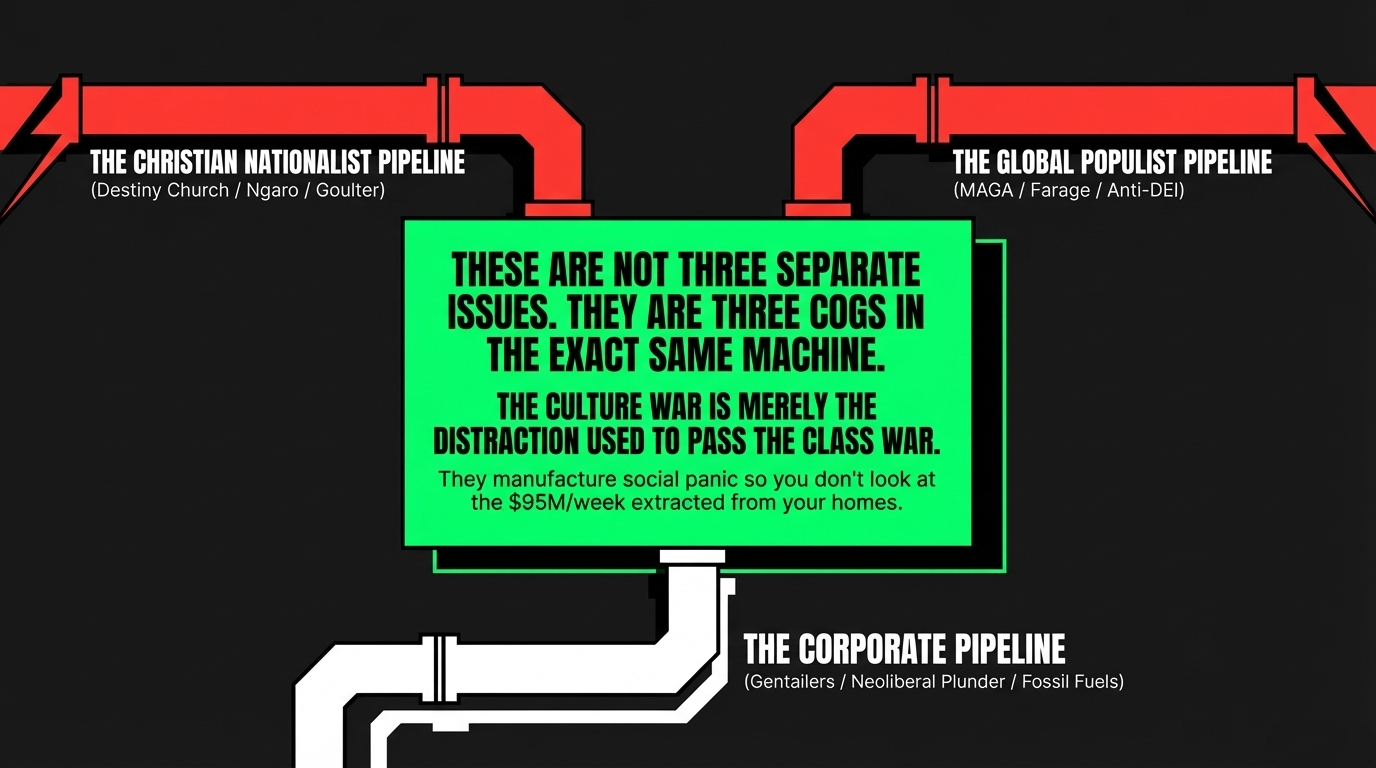
Peters campaigns on the ashes of the first home he helped burn — before an audience of people whose power bills are inconvenient rather than catastrophic; who received their anti-DEI victories, their Treaty erasure remits, their "demographic migration strategy" — and who cheered "colonial heritage" while the country's electricity market extracted a racialised tax from every damp rented house in the country.
Behind the stage, in the organisational shadow: the PR architect of Destiny Church's political machine.
On the stage: a Christian Nationalist candidate who sat with Brian Tamaki and preached about God's army.
In the address book: Nigel Farage, whose party pledges ICE-style mass deportations, and Donald Trump, who signed the executive orders Peters is now copying into Aotearoa legislation.
Outside: Māori and Pasifika people, in the rain, protesting.
The kārearea circles. It never strikes.
The tuna hides in the corporate mud. The river dries. Peters gives a speech about water.
Ko te Ara o te Rangatiratanga | The Path Forward
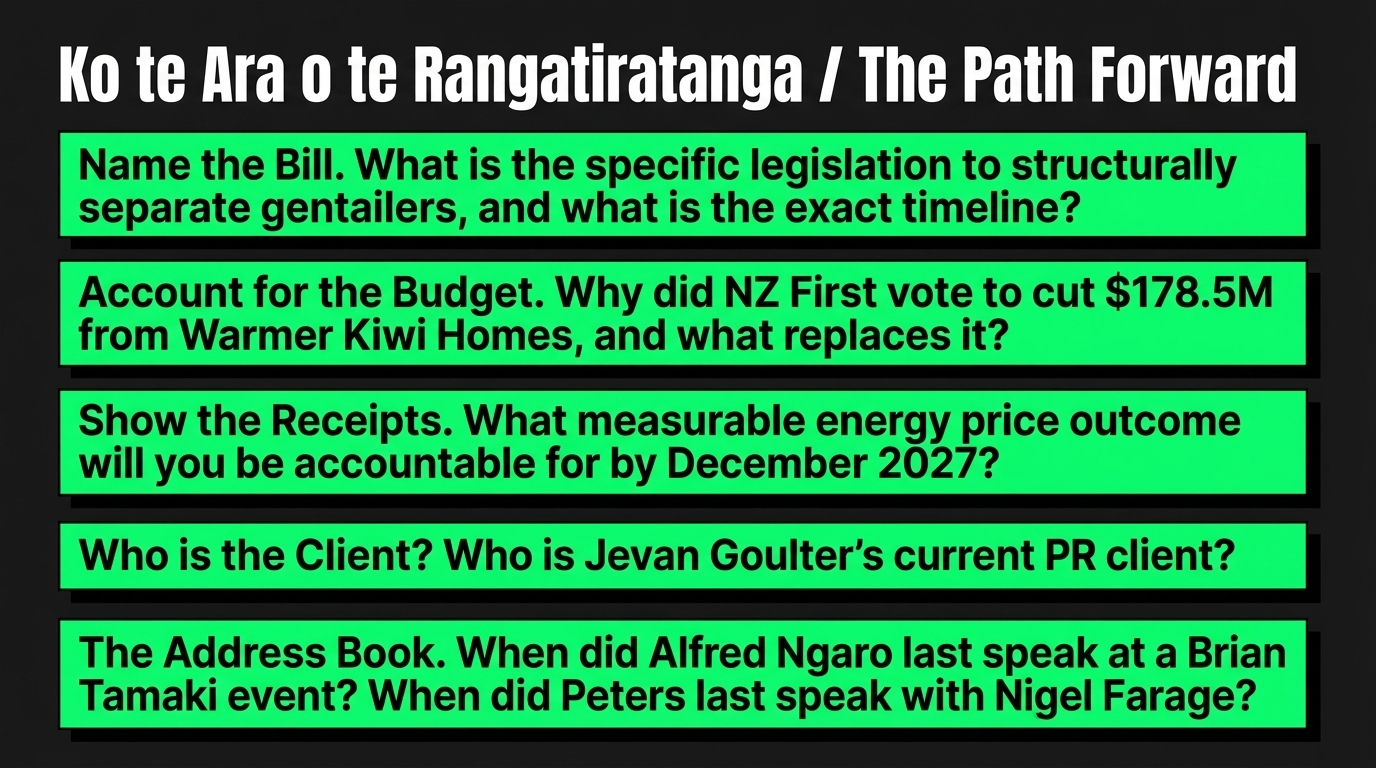
The questions to put to every candidate before the 2026 election:
- Name the Bill. What is the specific legislation to structurally separate gentailers? What timeline?
- Account for the Budget. Why did you vote to cut Warmer Kiwi Homes? What replaces it?
- Name the Minister. Who is responsible for energy reform, and what is their track record?
- Show the receipts. What measurable outcome will you be accountable for by December 2027?
- Who was in the room? And who was left outside in the rain?
- Who is Jevan Goulter's current client? When did Alfred Ngaro last speak at a Brian Tamaki event? When did Peters last speak with Nigel Farage?
Winston Peters will not answer any of these with specifics. The Spinoff's analysis of every NZ First coalition agreement documented the pattern from 1996: promises made, promises broken, promises recycled, the public re-sold the same vision it already paid for and never received.
Forty years. Sixty percent higher electricity prices in real terms. Three hundred and sixty thousand households in energy poverty. The gentailers intact. Destiny Church's political network inside the tent. Trump's anti-DEI agenda being copy-pasted into New Zealand law. "Send the Mexicans home" echoing from the parliamentary floor.
The taniwha is still wearing the stolen kahu.
The question is whether we keep honouring the feathers — or name what lies beneath them.
✊ Ko tō Koha, He Ahi Kā | Your Koha Keeps the Fire Burning
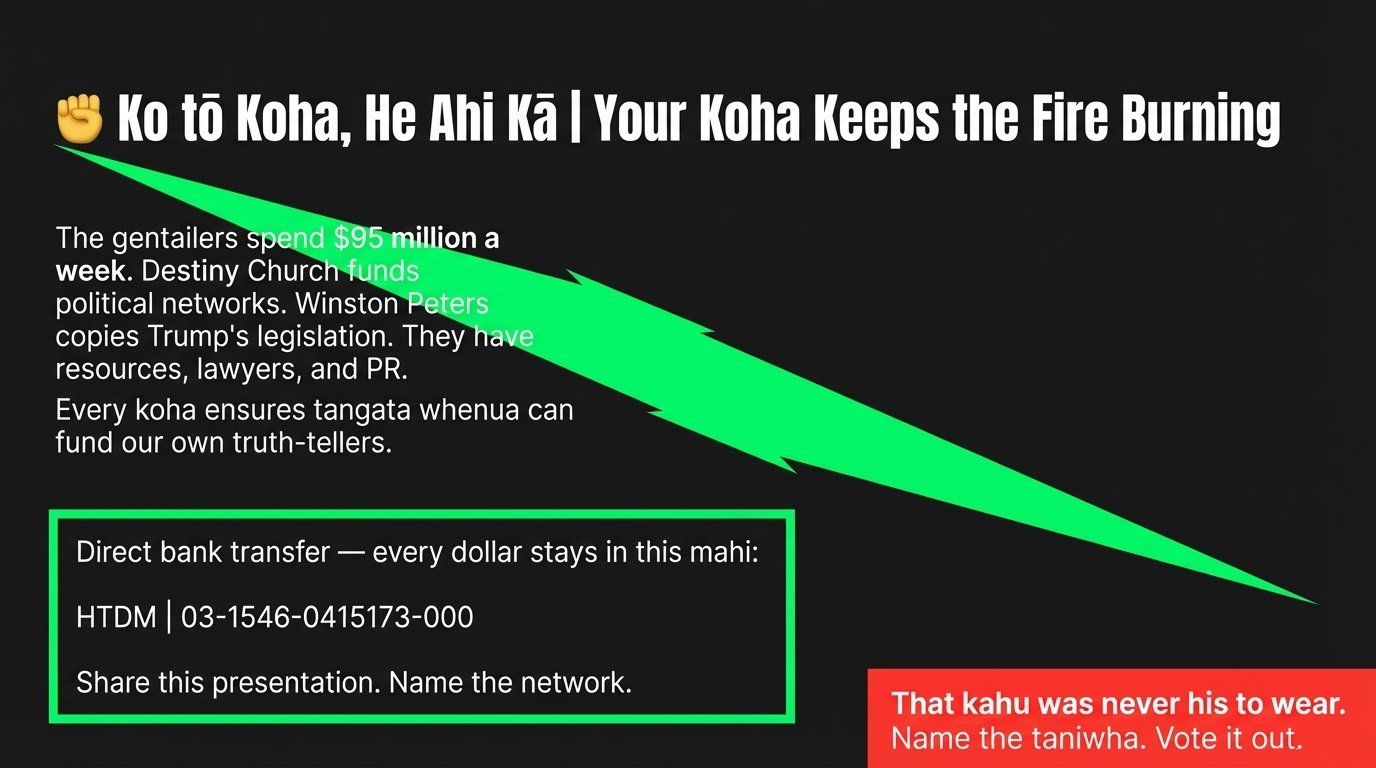
The gentailers spend $60–95 million per week in energy margins while 360,000 whānau ration heat. They fund lobbyists. Destiny Church funds a political network across five failed parties. Winston Peters networks with Nigel Farage and copies Trump executive orders into Aotearoa legislation. They all have resources, lawyers, and PR.
This mahi — the network-tracing, the receipts, the naming of names — is the counter to all of that. Every koha signals that rangatiratanga includes the power to fund our own truth-tellers. That whānau who cannot keep their homes warm can still hold the powerful to account. That is not a small thing. That is everything.
Support this mahi directly:
Koha — Support The Māori Green Lantern
Subscribe for ongoing essays:
Subscribe to The Māori Green Lantern
Direct bank transfer — every dollar stays in this mahi:
HTDM | 03-1546-0415173-000
If a koha isn't possible right now — kua mārama. When 360,000 households are rationing heat, the margin is thin everywhere. Share this essay. Name the network. Name the MAGA franchise operating under our own flag. That is koha in itself — and the taniwha fears nothing more than te pono travelling from one person to the next, all the way to the 2026 ballot box.
Kia kaha. Kia māia. Kia manawanui.

The Māori Green Lantern wields the taiaha empowered by the Ring. Peters has the personal phone number of Nigel Farage and the policy agenda of Donald Trump. He is the MAGA franchise operating under our own flag, in our own language, in the kahu of our own ancestors.
That kahu was never his to wear.
Name the taniwha. Vote it out.
Research conducted 22–23 March 2026. Sources: RNZ, 1News, NZ Herald, Newstalk ZB, The Spinoff, Consumer NZ, Electricity Authority Te Mana Hiko, MBIE, Public Health Communication Centre, Healthy Housing, Reimagine Aotearoa, University of Otago, Roy Morgan Research, Horizon Research, Te Ao Māori News, Victoria University, Democracy Project, Motu Research, International Viewpoint, Workers First, The Feijoa Dispatch, Te Kārearea Māori News, Te Ara. All URLs verified at time of publication. The Destiny Church/Goulter/NZ First network connections are documented through multiple independent sources. Claims of exact meeting frequency or financial arrangements between Goulter and NZ First require further investigation — readers are invited to share any additional documentation.