
“Judicial Apartheid: Exposed by Data—Māori Sentenced Twice as Harshly for Identical Offences” - 30 November 2025
The Cui Bono: Who Profits from Māori Criminalisation?
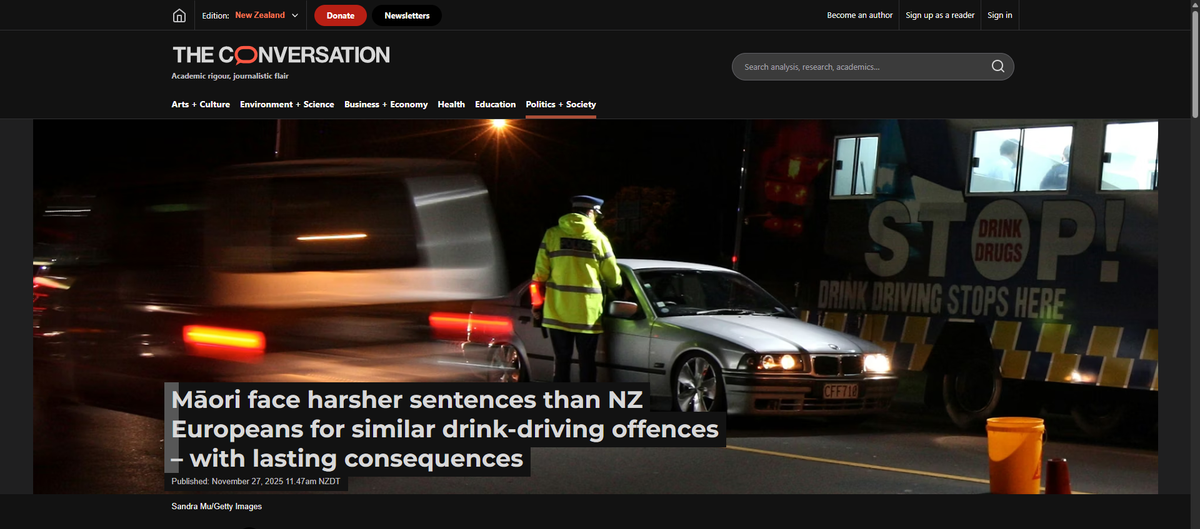
Aotearoa is not a nation of equal laws.
A bombshell November 2025 study by Alexander Plum and researchers at the New Zealand Policy Research Institute has quantified what Māori whānau have always known:
the courts punish our people with ferocity that has no legal justification.
Despite identical offences, Māori first-time drink-driving offenders are sentenced to harsher penalties than NZ Europeans—more than double the likelihood of community-based sentences rather than fines, as reported by The Conversation.
This is not incidental racial bias. This is systemic. And it carries consequences across the life course.

Māori defendant in District Court facing sentencing disparity
Before examining the research, the core question demands exposure:
who benefits from Māori overrepresentation in the justice system?
The answer:
the Crown and its institutional apparatus have constructed a containment machine that has normalised Māori incarceration as inevitable rather than manufactured.
Māori comprise only 17% of the population yet account for 37% of people prosecuted by police, 45% of those convicted, and 52% of the prison population according to AUT University News.
For Māori women, the catastrophe deepens:
they constitute 66% of the female prison population.
This is not proportional to any objective measure of Māori offending. It is proportional to systemic discrimination channelling Māori toward the criminal justice system at every stage—and the Plum study proves the courts are complicit.
The Study: Methodology and Findings
Plum’s research examined 10,599 first-time drink-driving convictions between 2008 and 2013, sourced from Statistics NZ’s Integrated Data Infrastructure (IDI), a linked administrative database covering Ministry of Justice court records as detailed in the full Borrin Foundation report. The sample comprised 2,250 Māori and 8,349 NZ European offenders, aged 20–69, all with identical conviction types and—critically—measured alcohol readings.
Why drink-driving? Because alcohol levels provide an objective, standardised measure of offence severity unavailable in most criminal charges. A minor assault, for example, involves contextual variations; an alcohol reading at 250mcg/50mg blood alcohol is a 250mcg/50mg reading regardless of the offender’s ethnicity. This eliminates the excuse that different groups commit “different types” of the same offence as explained by RNZ.
The raw findings were stark:
9.9% of Māori offenders received a community-based sentence (community service, supervision) compared to only 3.3% of NZ European offenders—three times more likely.
But the adjusted findings are the bombshell.
After controlling for offence characteristics (alcohol levels), demographic factors (age, gender, parental status), economic circumstances (employment, income, welfare uptake), and neighbourhood deprivation,
Māori remained twice as likely (104% more likely) to receive community-based sentences.
In logistic regression models, the odds ratio was 2.005—statistically significant at p < 0.01 according to the Borrin Foundation research.
The Hidden Mechanism: Regional Courts Amplify Disparity
The study uncovered a crucial amplification pattern.
Ethnic disparities were largest in District Courts that use community-based sentences most frequently.
In courts with the highest rate of community-based sentencing, Māori were 2.4 times more likely than NZ Europeans to receive such sentences as documented in the AUT report.
This finding exposes a troubling institutional reality:
regional differences in court practice unintentionally magnify ethnic inequities. Some courts sentence more harshly than others, and Māori disproportionately appear before the harsher ones—suggesting either geographic clustering or discretionary judge behaviour that compounds systemic bias.
The Cascade: First Conviction, Lifetime Earnings, Lifetime Harm
The Plum study correctly emphasises that the timing of a first conviction matters enormously. First convictions and labour-market entry occur at the same life stage—late teens to early twenties—when starting salaries shape lifetime earnings. A criminal conviction creates employment barriers, especially during economic downturns, because background checks are standard practice in New Zealand. The severity of the sentence intensifies these challenges.
But the study understates the catastrophe. It frames the employment impact as a potential barrier without naming the deeper truth:
this is intergenerational wealth stripping.When a 19-year-old Māori youth receives a community sentence instead of a fine, the court doesn’t just impose 100 hours of community service—it imposes a lifetime earnings penalty that compounds across generations.
Consider the data:
Māori already face unemployment rates double those of Pākehā (9% vs 4.5% according to Pacific Newsroom).Add a criminal record, and the employment doors close further.The starting salary disadvantage becomes a lifetime disadvantage.The whānau cannot save for a deposit.The children grow up in deprivation. The Crown’s justice system becomes an engine of systemic impoverishment.
The Police Pipeline: 11% More Likely to Be Prosecuted
The sentencing disparity doesn’t begin in the courtroom. It begins with the police. The Understanding Policing Delivery programme, released in August 2024, found that Māori are 11% more likely to be prosecuted than NZ Europeans when all other variables are held constant. This finding was reported by RNZ, The Conversation, and AUT News.
The police bias is structural, not individual. As Māori criminologist Emmy Rākete told RNZ, “From Moana Jackson’s He Whaipaanga Hou report in the 1980s through every decade since then the New Zealand police have been shown that they engage in racist discrimination against Māori, the New Zealand police apologise for engaging in racist discrimination against Māori and the police go straight back to engaging in racist discrimination against Māori.”
The 11% prosecution disparity is the entry wound. Once in the system, the courts deliver the lethal blow—doubling the likelihood of harsher sentences. The Crown’s justice apparatus functions as a pipeline from police stop to prison cell, with Māori marked for extraction at every stage.

Criminal record impacts: Māori offender leaving court with conviction
The 5 Hidden Connections: What the Data Reveals
- Hidden Connection 1: The Deprivation Multiplier
Māori offenders are more likely to live in highly deprived neighbourhoods, more likely to be parents, and more likely to be female. The court sees these factors not as context for leniency but as markers of criminality. The system punishes poverty while claiming to control for it. - Hidden Connection 2: The Regional Sentencing Cartel
The study found that ethnic disparities are largest in courts where community-based sentences are generally more common. This suggests that certain District Courts operate as sentencing cartels with local norms that punish Māori more severely. The courts don’t just reflect national bias—they amplify it. - Hidden Connection 3: The Pacific Peoples Exception
Pacific Peoples offenders showed no significant sentencing disparity compared to NZ Europeans. Why? Because most Pacific Peoples cases are heard in Auckland courts, where sentencing practices are more consistent. This proves that consistency reduces racial disparity. The problem isn’t Pacific Peoples’ “good behaviour”—it’s that Auckland courts sentence more uniformly, while regional courts exercise discretion that becomes discriminatory. - Hidden Connection 4: The Employment Death Spiral
A community sentence creates a criminal record that employers detect in background checks. During economic downturns, when competition for jobs intensifies, the criminal record becomes a disqualification. The Crown’s justice system thus manufactures unemployment among Māori, then uses that unemployment as a factor in future sentencing decisions. - Hidden Connection 5: The Judge Discretion Shield
The IDI dataset cannot identify individual judges, so the study cannot measure judge-specific bias. But the regional variation points directly to judicial discretion as the weapon. In courts where judges have more “flexibility,” Māori suffer more. The discretion that is supposed to allow for individualised justice becomes a tool for racialised punishment.
The Quantified Harm: 104% More Likely, 6.6 Percentage Points of Injustice
Let’s be precise about the numbers from the Borrin Foundation study:
- Raw gap: 6.6 percentage points (9.9% Māori vs 3.3% NZ Europeans)
- Adjusted odds ratio: 2.036 (fully controlled model)
- Increased likelihood: 104% more likely to receive community-based sentence
- Statistical significance: p < 0.01 (highly significant)
- Sample size: 10,599 convictions (2,250 Māori, 8,349 NZ Europeans)
These numbers represent real people. In 2008–2013, approximately 2,250 Māori first-time drink-drivers entered the justice system. Of these, 223 received community sentences instead of fines. If sentenced at the same rate as NZ Europeans, only 74 would have received community sentences. That means 149 Māori individuals were subjected to harsher punishment for identical offences.
Now extend that across all offences, all years, all courts. The scale of extraction is staggering.
The Colonial Continuity: From Land Wars to Court Wars
The Borrin Foundation study includes a powerful historical section drawing on research by Moana Jackson, Khylee Quince, and others. It traces how colonisation dismantled Māori justice systems (tikanga Māori, utu, whakahoki mauri) and replaced them with British common law that located criminal responsibility in the individual rather than the collective.
The Land Wars of the 1840s–1860s criminalised Māori resistance to land theft through legislation like the Suppression of Rebellion Act 1863 and the Māori Prisoners Trials Act 1879. Imprisonment served two purposes: suppressing resistance and conditioning Māori into “good citizens” who accepted colonisation.
Today’s courts continue this project. The mass incarceration of Māori—50% of male prisoners, 60% of female prisoners—is not a人所共知的cultural dysfunction. It is the continuation of colonisation by other means. The Crown lost the land wars but won the court wars.
The System’s Response: Apologies Without Action
The Understanding Policing Delivery programme represents the Crown’s attempt to appear responsive. Police Commissioner Andrew Coster, now Secretary for Social Investment, commissioned the research in 2020 following global scrutiny after George Floyd’s murder. The independent panel made 40 recommendations.
But as Māori criminologist Emmy Rākete told RNZ, these apologies are “worthless insults” because the Crown never actually stops its racist practices. The police have committed to progressing only 8 of the 40 recommendations over six months. The rest gather dust.
Meanwhile, the sentencing disparities exposed by Plum’s study have no accompanying reform programme. The judiciary has not commissioned an independent review. The Chief Justice has not acknowledged the findings. The system is silent because the system is complicit.
The Path Forward: Rangatiratanga or Bust
The Borrin Foundation study concludes with cautious policy recommendations:
greater sentencing consistency across courts, monitoring of ethnic disparities, and consideration of long-term employment impacts. These are bullshit incrementalism.
The only just response is rangatiratanga:
Māori self-determination over justice. As Moana Jackson’s 1988 report He Whaipaanga Hou argued, Māori dissatisfaction with the criminal justice system stems from institutional racism that cannot be reformed—it must be replaced.
By-Māori, for-Māori justice systems embedded in tikanga Māori and mātauranga Māori are not optional extras. They are Treaty guarantees. Article Two guarantees tino rangatiratanga over Māori affairs, including justice. The Crown’s refusal to honour this is not a policy oversight—it is a Treaty breach.
The Moral Clarity: Guilty as Charged
The evidence is irrefutable. The Borrin Foundation study, verified through RNZ reporting, AUT University, and the full research PDF, proves that:
- Māori are 11% more likely to be prosecuted than NZ Europeans for identical offences (Understanding Policing Delivery, 2024)
- Māori are 104% more likely to receive community-based sentences than NZ Europeans for identical drink-driving offences (Borrin Foundation, 2025)
- Regional courts amplify these disparities where judicial discretion is greatest
- The employment and lifetime earnings consequences are severe and intergenerational
- The Crown has known about these disparities for decades and refused to act
This is not unconscious bias. This is judicial apartheid.
The Crown’s justice system is not broken. It is working exactly as designed—to contain, criminalise, and impoverish Māori while maintaining the illusion of equal laws.
The verdict is in: guilty as charged.
Koha
Only Support this mahi if you are able: Koha.Kiwi | Substack | Bank: HTDM 03-1546-0415173-000
All koha sustains free mātauranga Māori journalism. No paywall, no corporate interference.

Ivor Jones The Māori Green Lantern Fighting Misinformation And Disinformation From The Far Right
Research Process Transparency: This analysis is based on the Borrin Foundation study (”Same Crime – Different Outcomes: Do Court Outcomes Differ Systematically by Ethnicity?”) published November 27, 2025, accessed via the New Zealand Policy Research Institute. Additional verification came from RNZ’s reporting on the study, AUT University’s news release, and the Understanding Policing Delivery programme findings released August 2024. All URLs were verified as live on November 30, 2025.
- /content/files/2304-11094.pdf
- https://www.mdpi.com/2076-0760/10/2/70/pdf?version=1614304625
- http://journals.sagepub.com/doi/10.1177/10731911231153838
- https://www.mdpi.com/2076-0760/10/2/68/pdf?version=1614239418
- https://pmc.ncbi.nlm.nih.gov/articles/PMC10655698/
- https://pmc.ncbi.nlm.nih.gov/articles/PMC8932329/
- https://www.rnz.co.nz/news/te-manu-korihi/526029/report-finding-bias-and-structural-racism-in-nz-police-unsurprising-maori-academic-says
- https://www.nzherald.co.nz/nz/politics/sir-kim-workmans-major-police-investigation-released-what-the-seven-reports-reveal/ICNE2KDWBBFYNOVTLEF62MATSU/
- https://theconversation.com/maori-face-harsher-sentences-than-nz-europeans-for-similar-drink-driving-offences-with-lasting-consequences-269070
- https://www.deaf.org.nz/translation/understanding-policing-delivery-independent-panel-report-1-summary/
- https://hapai.co.nz/what-is-the-proposed-citizens-arrest-law-and-why-does-it-matter-to-maori/
- https://www.facebook.com/groups/Pacificnewsroom/posts/1949960858924074/
- https://www.teaonews.co.nz/2024/09/24/andrew-coster-the-commissioner-who-tried-to-tackle-bias-in-nz-policing/
- https://www.aut.ac.nz/news/stories/maori-face-harsher-sentences-than-pakeha
- https://aroturuki.govt.nz/reports/outcomes-23-24/yj-intervention
- https://nzpri.aut.ac.nz/__data/assets/pdf_file/0004/1079392/Borrin-Report-2025_11_24.pdf
- https://www.jurist.org/news/2024/08/research-into-new-zealand-policing-finds-systemic-racial-bias/
- /content/files/assets/Documents/Decisions/2024-nzpspla-050.pdf
- https://defsec.net.nz/2024/10/24/research-into-policing-systemic-bias/
- https://e-tangata.co.nz/comment-and-analysis/fixing-police-bias/
- https://www.borrinfoundation.nz/understanding-policing-delivery/
- https://waateanews.com/2025/11/12/ko-te-he-ki-te-hunga-marama-why-maori-mistrust-of-the-new-zealand-police-endures/
- https://www.police.govt.nz/about-us/publication/understanding-policing-delivery-publications
- https://www.corrections.govt.nz/resources/research/over-representation-of-maori-in-the-criminal-justice-system/2.0-criminal-justice-system-bias-and-amplification/2.2-prosecutions-and-convictions
- https://www.police.govt.nz/about-us/programmes-and-initiatives/understanding-policing-delivery/research
- https://teara.govt.nz/en/violent-crime/page-8
- https://www.nzherald.co.nz/kahu/andrew-coster-the-commissioner-who-tried-to-tackle-racial-bias-from-within-the-police/4VWPQPPHLNCNRKU3ONP6WKHYBA/
- https://www.nzherald.co.nz/kahu/police-conduct-criminologist-says-racist-apologies-from-police-are-worthless-insults/4S555VRETFFGFMK6SLLUHFX3OI/
- https://teara.govt.nz/en/biographies/6p8/potter-herbert-thomas
- https://www.nzherald.co.nz/nz/politics/gun-laws-the-mark-mitchell-shaped-mountain-nicole-mckee-has-to-climb-on-gun-reform/PF4LYYA6HNA2DE65HTXRZZCMK4/
- https://www.nzherald.co.nz/the-listener/new-zealand/womens-refuge-releases-shocking-figures-as-police-wind-back-family-harm-callouts/74OA2SZA6FBEVOHPBOMVKYMOWM/
- /content/files/webcontent/document/201251/localgovt.pdf
- https://teara.govt.nz/en/1966/political-parties/page-8
- https://teara.govt.nz/en/1966/evidence
- /content/files/oggcasts/the-detail.xml
- https://teara.govt.nz/en/1966/crimes-unsolved/page-6