“Kēhua Kapitana: Shane Jones and the Corporate Corruption of Aotearoa” - 28 June 2025
The Corporate Sellout Masquerading as Māori Champion

Kia ora, e te whānau. I am Ivor Jones, Te Māori Green Lantern, kaitiaki of truth.
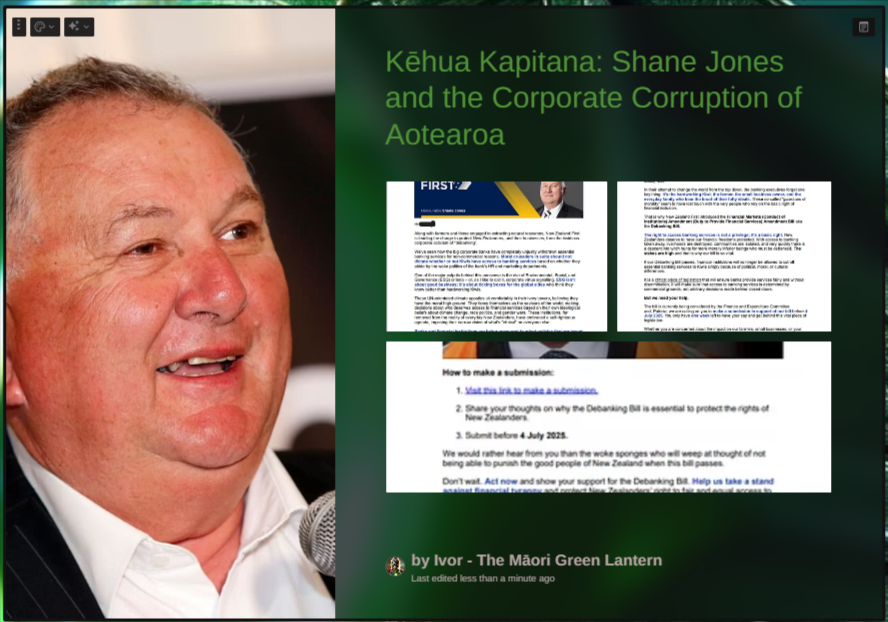
Shane Geoffrey Jones represents everything wrong with neoliberal capture of Indigenous voices in modern Aotearoa. This Māori man who styles himself as a regional champion has become nothing more than a corporate puppet, weaponising his Māori whakapapa to legitimise the most regressive anti-Indigenous agenda this country has seen in decades. His so-called debanking bill represents the epitome of neoliberal hypocrisy - demanding corporate freedom while attacking Indigenous sovereignty[1][2].


Background: The Manufactured Champion of Capital
Jones's journey from Labour to New Zealand First tells the story of a politician whose allegiances shift with the neoliberal tide. As Resources Minister, he has positioned himself as the "megaphone of industry"[3], proudly declaring his coziness with mining executives while simultaneously attacking environmental protections that his own ancestors would have fought to preserve. This is a man who exploits his Māori identity to provide legitimacy for the most destructive forms of capitalism while dismissing Indigenous sovereignty as "fanciful absurdities"[4].
Debanking as Corporate Welfare
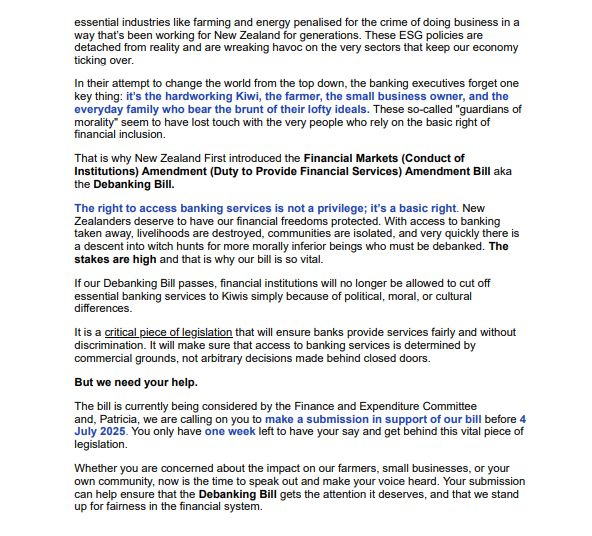
Jones's debanking legislation represents a masterclass in far-right economic manipulation disguised as populist concern for ordinary businesses. The Financial Markets (Conduct of Institutions) Amendment (Duty to Provide Financial Services) Amendment Bill forces banks to provide services regardless of environmental, social, or governance considerations[5]. This isn't about protecting small businesses - it's about ensuring fossil fuel companies and polluting industries maintain access to capital while climate change devastates Māori communities who are most vulnerable to environmental destruction[1][6].
The timing reveals everything. As BNZ terminated banking services to coal mining operations due to climate commitments, Jones immediately moved to criminalise such decisions[7]. This demonstrates how corporate interests trump environmental responsibility in his worldview, even as Māori communities face the brunt of climate impacts from sea-level rise to extreme weather events.
The Neoliberal Trojan Horse
Corporate Capture and Indigenous Betrayal
Jones operates as what Indigenous scholars call a "native informant" - using his Māori identity to legitimise policies that fundamentally undermine Indigenous rights. His attacks on Te Pāti Māori as practicing "racist rhetoric" while he himself promotes policies that entrench structural racism reveals the depth of his ideological capture[8]. When he labels Indigenous sovereignty claims as escapism, he channels the exact colonial mindset that justified land confiscation and cultural destruction[4].

Economic Fundamentalism Disguised as Pragmatism
The debanking bill represents pure neoliberal ideology - the belief that market forces should never be constrained by social or environmental considerations. Jones frames this as protecting "lawful businesses" from "woke ideology"[9], but the reality is far more sinister. He's demanding that banks ignore the climate crisis to ensure polluting industries maintain access to capital, effectively subsidising environmental destruction through forced lending.
This connects to broader patterns of neoliberal capture. As academic analysis shows, such policies can backfire economically while serving only the interests of fossil fuel corporations[6]. Jones's rhetoric about supporting "legitimate export earners" ignores how these industries externalise environmental costs onto Māori communities while privatising profits for shareholders.

White Supremacist Narratives in Māori Clothing
Perhaps most insidiously, Jones deploys classic white supremacist talking points while claiming to speak for Māori interests. His dismissal of Treaty settlements as distractions from "real" economic development echoes colonial arguments that Indigenous rights are obstacles to progress[10]. When he describes sovereignty debates as unaffordable luxuries, he deploys the exact fiscal responsibility rhetoric used to justify austerity policies that disproportionately harm Māori[4].
Anti-Immigrant Racism and Xenophobia
Jones's pattern of racist attacks on immigrant communities reveals his comfort with far-right rhetoric. His comments about Indian immigrants "ruining" New Zealand institutions were condemned as racist by the Race Relations Commissioner[11][12]. More recently, his xenophobic outbursts telling migrant MPs to "show gratitude" and describing them as bringing "alien ideas" mirrors Trump-style nationalism[13][14].
The Corporate-Political Revolving Door
Jones's close relationships with industry executives and his role in fast-track approval processes reveal the corrupt heart of neoliberal governance[3]. His failure to properly disclose meetings with mining companies while having decision-making powers demonstrates how corporate interests have captured regulatory processes. This isn't incompetence - it's the systematic subordination of democratic oversight to business interests.
Environmental Destruction as Economic Policy
Under the guise of regional development, Jones promotes policies that entrench economic dependence on resource extraction while blocking transitions to sustainable alternatives. His attacks on environmental protections serve fossil fuel interests while ensuring Māori communities remain economically marginalised and environmentally vulnerable[15]. This represents colonisation by other means - using economic policy to maintain extractive relationships with Māori land and resources.
Judicial Independence Under Attack
Jones's criticism of the judiciary as becoming "Americanised" when courts recognise Māori rights represents a direct attack on constitutional safeguards[16]. His desire to limit judicial interpretation of Treaty obligations reveals how neoliberal politicians seek to remove legal protections for Indigenous rights when they conflict with corporate interests. This echoes authoritarian tactics of undermining judicial independence to protect economic elites.

Implications: The Broader Assault on Indigenous Rights
Jones's policies connect to a global pattern of neoliberal governments using Indigenous politicians to legitimise anti-Indigenous policies. His role in the current government's broader assault on co-governance, Treaty rights, and environmental protection demonstrates how corporate capture operates through Indigenous voices. The debanking bill specifically serves to entrench fossil fuel dependence while climate change disproportionately impacts Māori communities through extreme weather, sea-level rise, and ecosystem destruction.
The economic implications extend beyond banking. By forcing financial institutions to ignore climate risks, Jones's legislation could expose New Zealand to stranded assets and economic instability as global markets price in climate costs. This represents privatised profits and socialised losses - exactly the neoliberal model that has enriched elites while impoverishing communities.
Recognising Corporate Colonisation
Shane Jones represents the contemporary face of colonial capitalism - using Indigenous identity to legitimise policies that perpetuate Indigenous marginalisation. His debanking bill embodies everything wrong with neoliberal capture: corporate welfare disguised as small business protection, environmental destruction framed as economic development, and Indigenous voices weaponised against Indigenous interests.
The fight against Jones's agenda requires recognising how neoliberalism adapts colonial strategies for contemporary conditions. Corporate capture of Indigenous politicians represents colonisation by economic means, using market ideology to achieve what military force previously accomplished. Resistance requires reclaiming Indigenous economic models based on sustainability, reciprocity, and collective wellbeing rather than individual profit maximisation.
Whānau deserve leaders who serve communities rather than corporations, who protect Papatūānuku rather than pollute her, and who advance tino rangatiratanga rather than corporate capture. Shane Jones represents the opposite of these values, making him a key target for organised resistance against neoliberal colonisation.
Ka whawhai tonu mātou. We continue to struggle against those who would sell our future for corporate profit.
Nāku noa, nā
Ivor Jones, Te Māori Green Lantern
If you find value in this mahi exposing corporate capture and defending Indigenous rights, please consider a koha to support the cause: HTDM: 03-1546-0415173-000. The MGL understands these tough economic times for whānau so please only contribute if you have capacity and wish to do so.