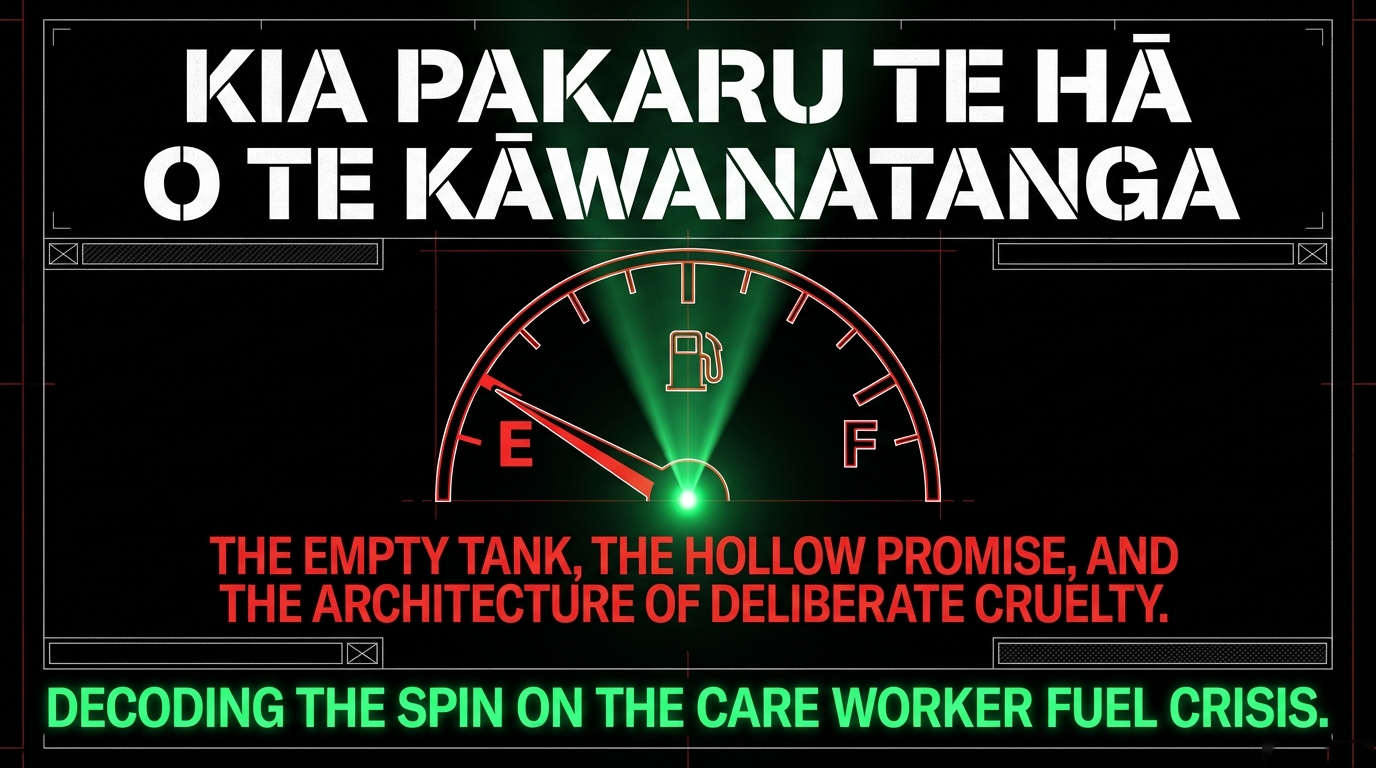
"KIA PAKARU TE HĀ O TE KĀWANATANGA: The Empty Tank, The Hollow Promise, and the Architecture of Deliberate Cruelty" - 1 April 2026
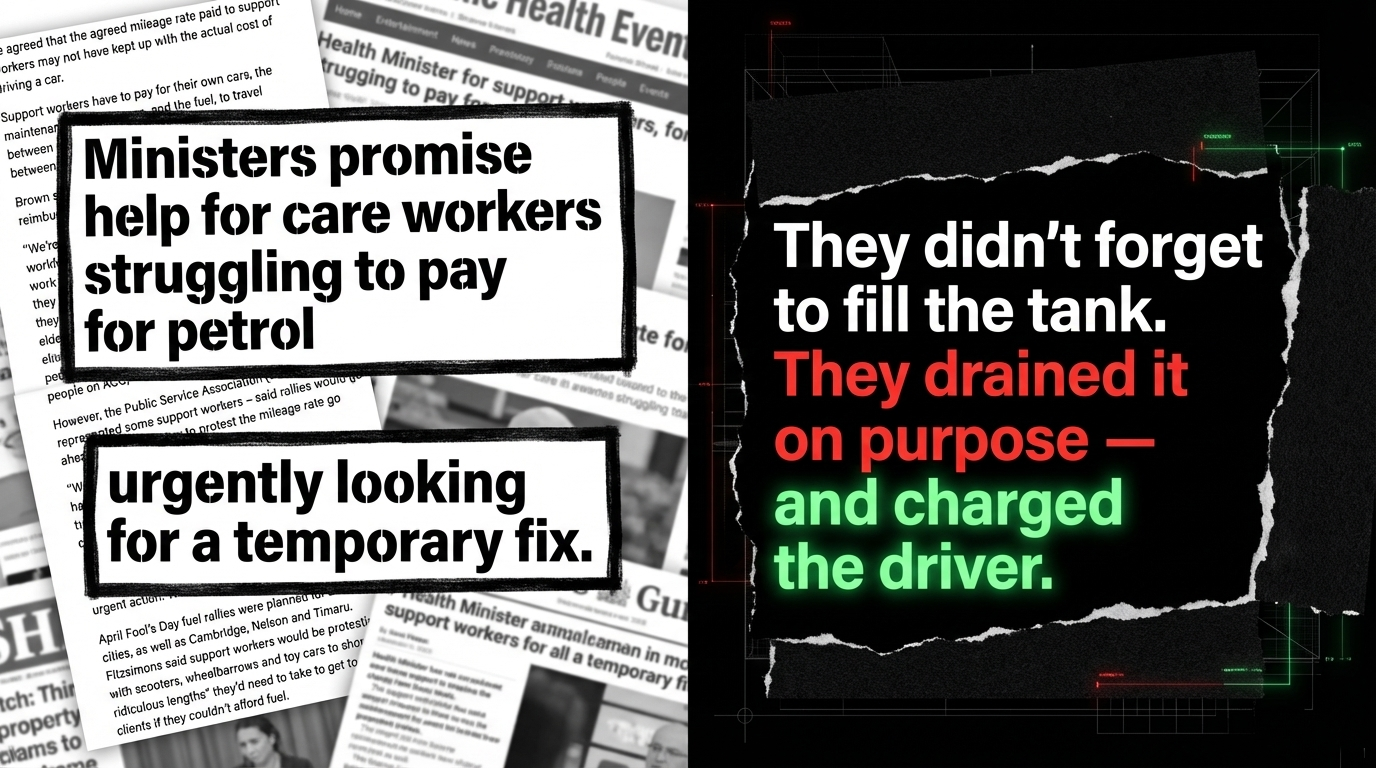
They didn't forget to fill the tank. They drained it on purpose — and charged the driver.

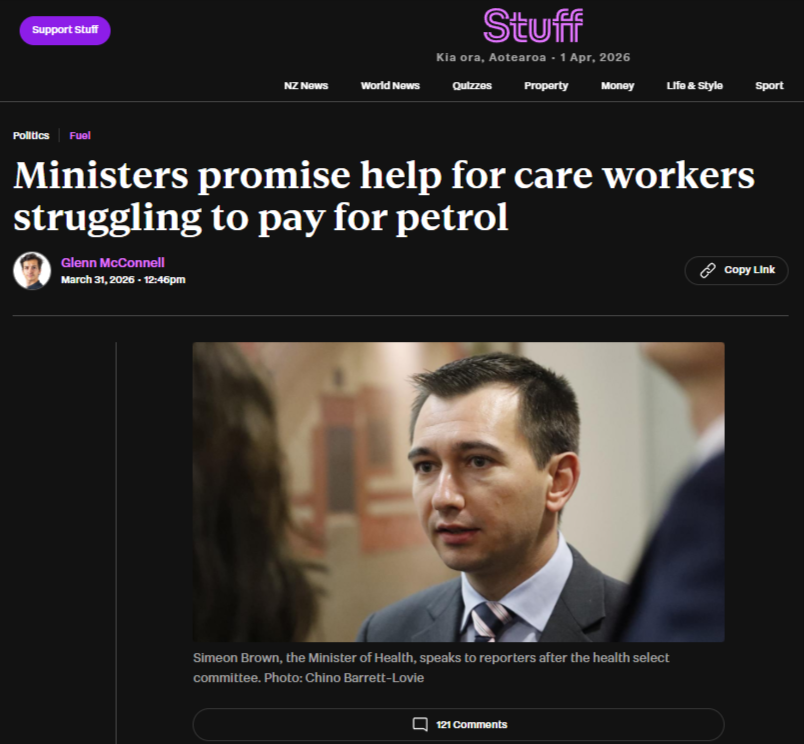
Ko Ivor Jones tēnei. Tohunga mau rākau wairua. Kaitiaki o te pono. Ko te taiaha, ko te pono.
Te Kupu Whakataki — The Opening Strike
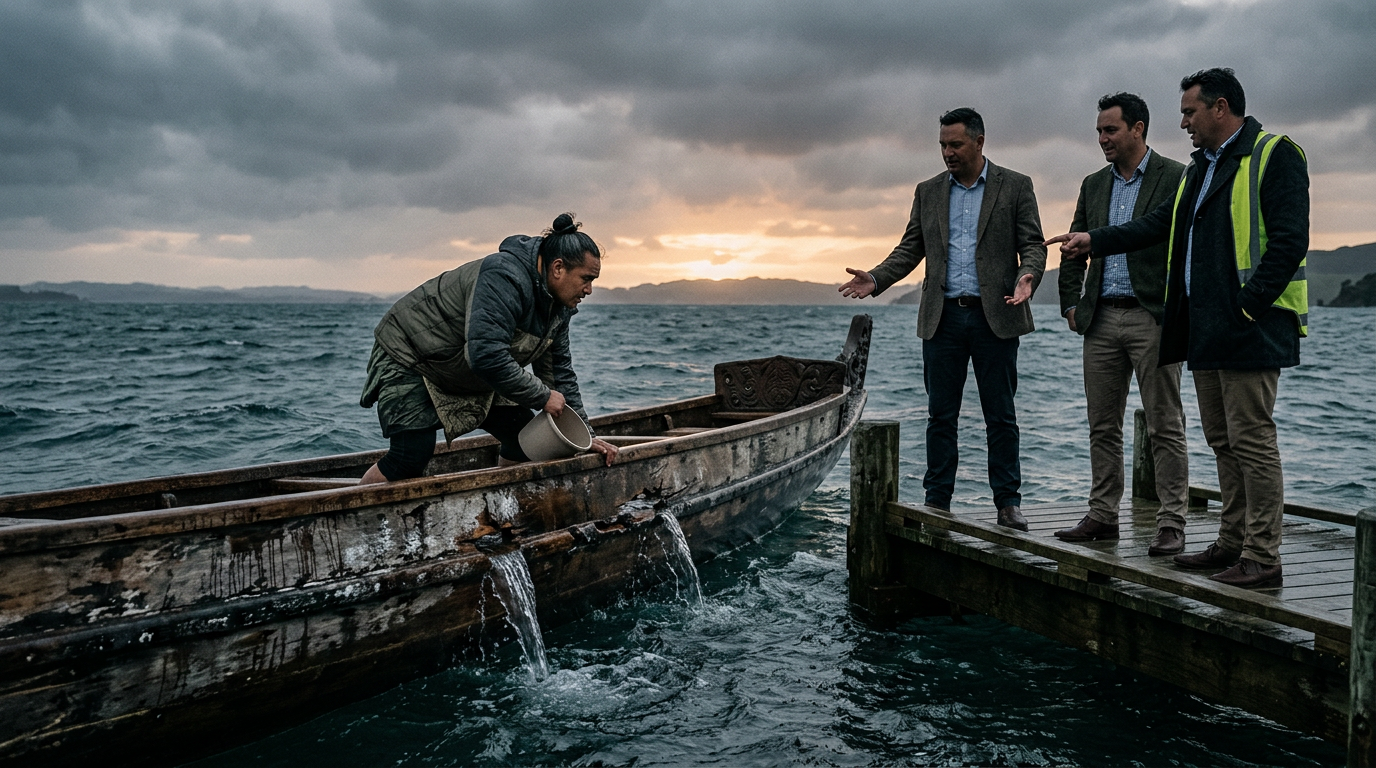
Imagine the waka.
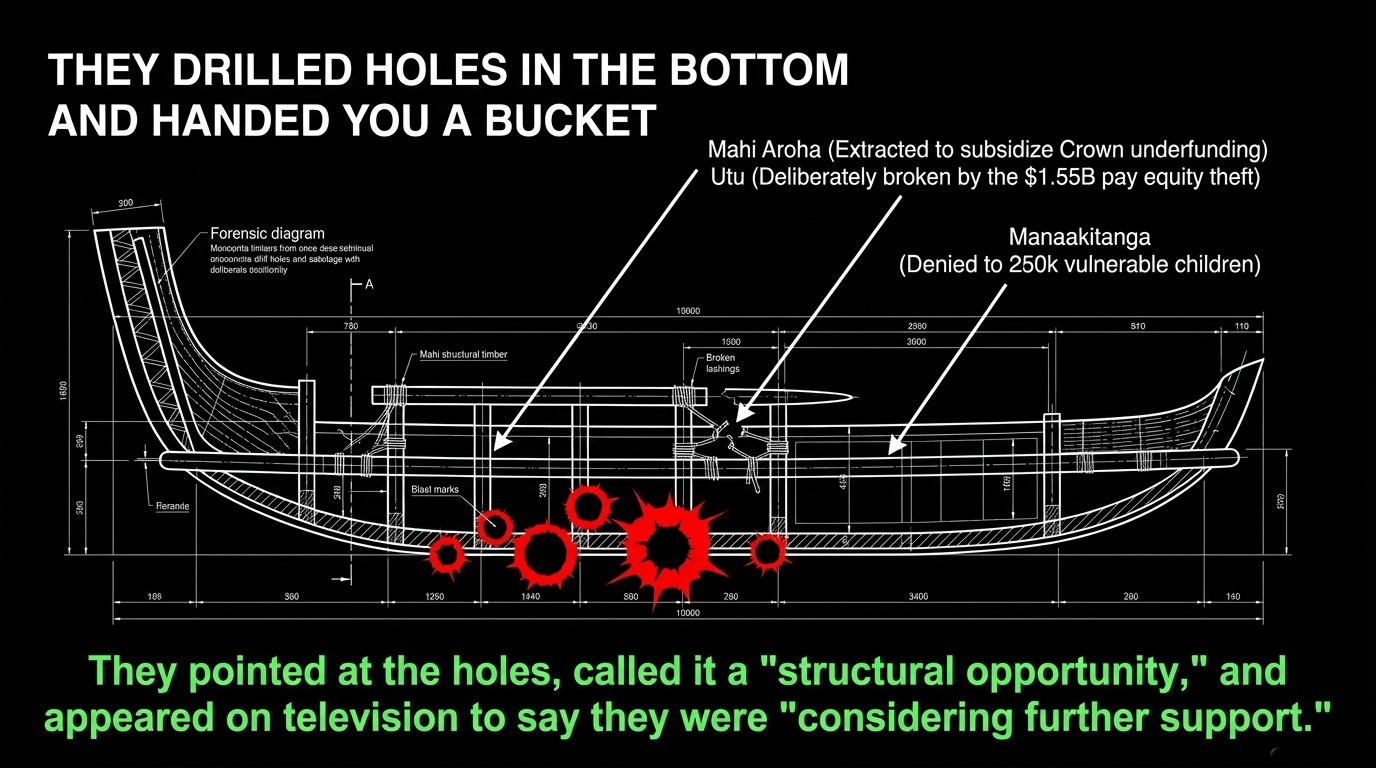
Not a tourist postcard waka — a real one, hauled across open water by the sinew and sweat of people who know the ocean will not negotiate with them. Now imagine that the people paid to maintain the waka's hull have instead drilled holes in the bottom, pointed at the holes and called it "a structural opportunity," handed a small bucket to the person bailing water, and appeared on television to say they are "considering further support."
That is the Luxon government's care worker petrol crisis in one image.
And this government didn't stumble into it. They built it. Then they issued a press release about it. Then they called it compassion.
The Deep Dive Podcast
Listen to a lively conversation between two hosts, unpacking and connecting topics in the sources of this essay.
The Whakapapa of Theft
To understand what is happening to 23,000 home support workers — overwhelmingly Māori and Pacific women — you must understand that this crisis has a genealogy, and every ancestor in that genealogy is a deliberate political choice.
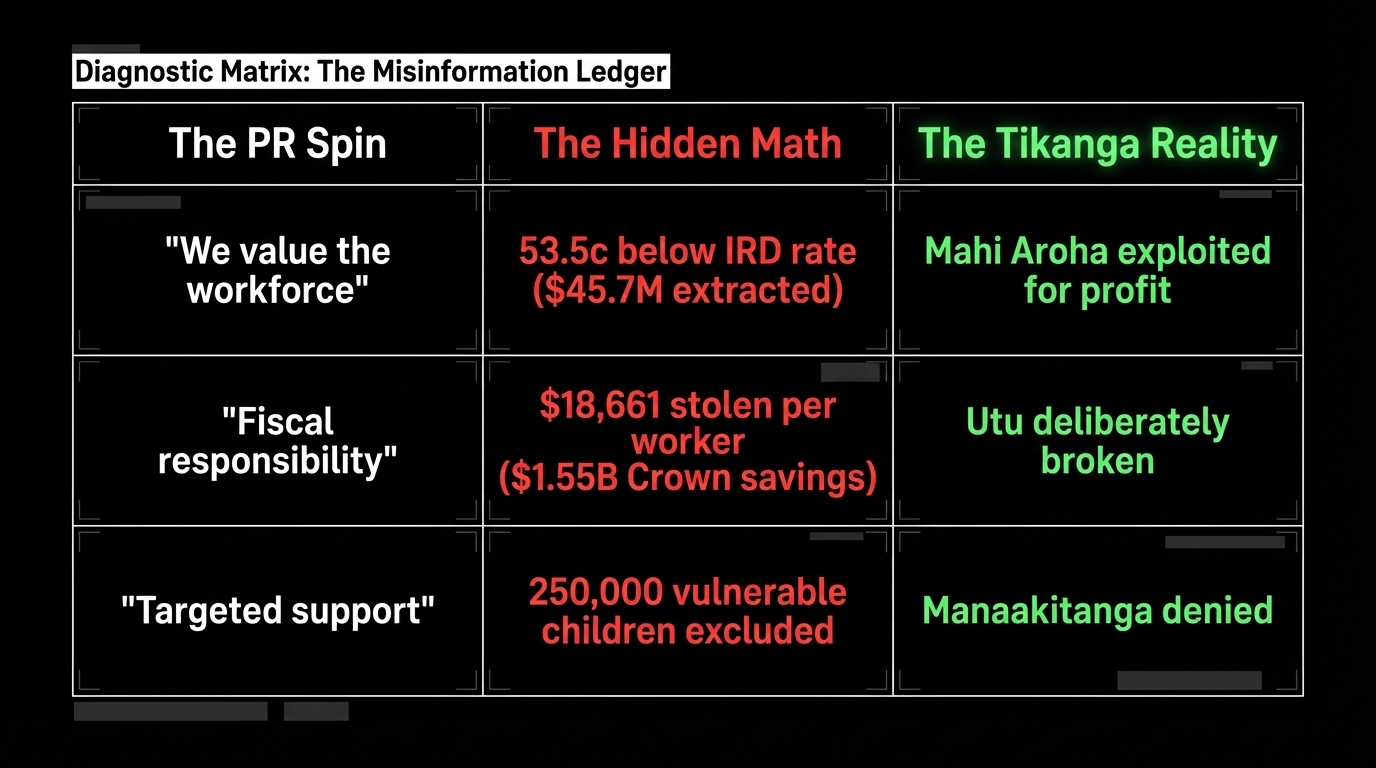
Since 2022, as the PSA has documented, Health NZ has reimbursed care workers at a rate 21 cents per kilometre below the IRD's own published standard. That gap has now widened to 53.5 cents per kilometre below the IRD rate of $1.17/km, as 1News reported in March 2026. Every single kilometre driven between clients, the Crown extracts a hidden subsidy from the pocket of one of its lowest-paid workers. This is not policy failure. This is policy design.
As The Māori Green Lantern revealed in "Ka Noho i Roto i te Ahi", the fuel crisis is not accidental — it is
"the destination of a decade of energy policy built for corporate extraction, not community resilience."
And as "The Pātaka Is Ash" documents with ferocity: while Nicola Willis stood before the burning storehouse and called it warm, she was simultaneously collecting an extra $180 million in GST from the fuel crisis she was performing compassion about.
The government's primary defence is that the In-Work Tax Credit boost represents genuine relief for 143,000 families. But targeting is the indictment, not the defence. As 1News confirmed, opposition parties from the Greens to Labour described it as a package that "fails to meet the crisis." The structural exclusion of beneficiaries, care workers, and the most vulnerable is not an oversight — it is the Working for Families poison pill, designed and left in place by choice.
He Tūāhu Kino — Three Examples for the Western Mind
These are not abstractions. These are the faces of the people the government decided were expendable.
Example One: The Mileage Trap — Paying to Do Your Job
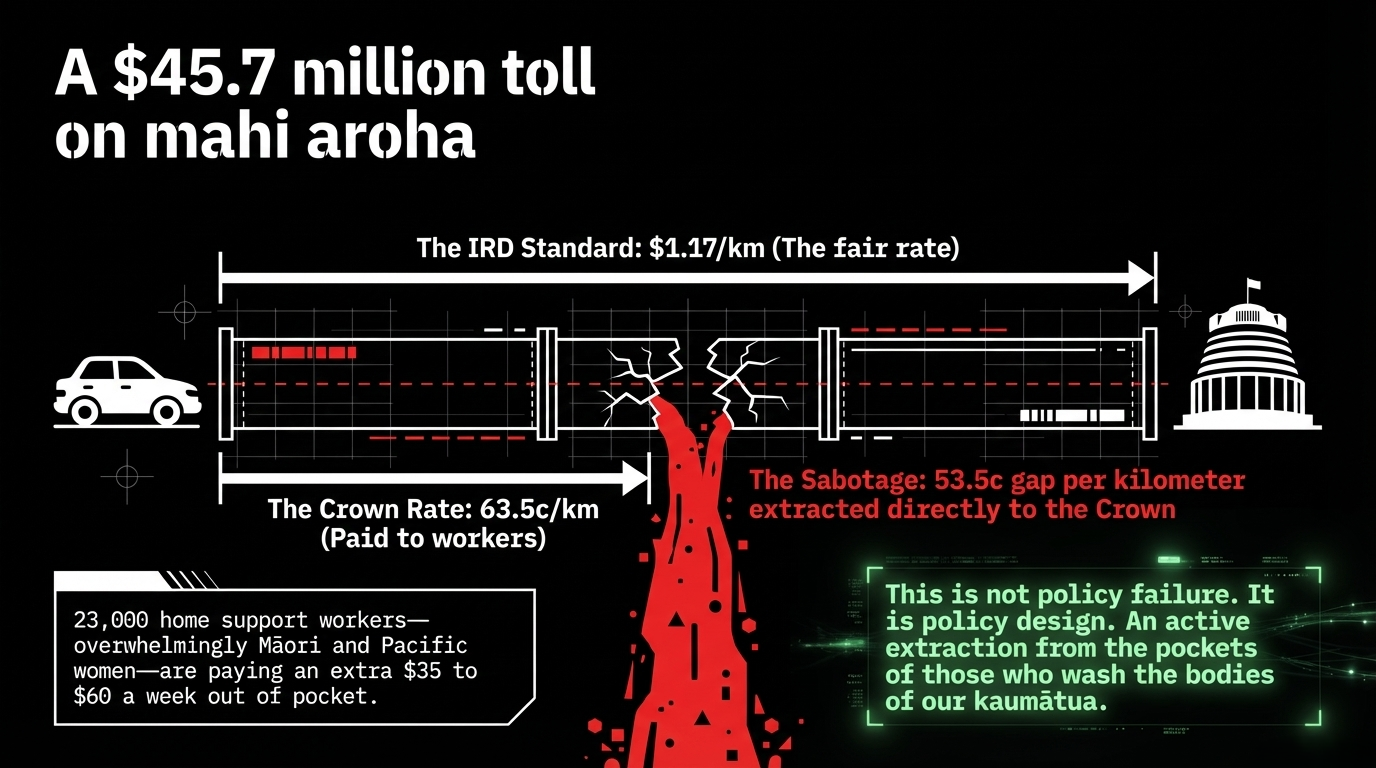
A home support worker in Nelson sits in the second-highest pay band for her role. She still does not earn the living wage of $28.95 per hour, as 1News reported. She drives between elderly and disabled clients all day. The Crown funds each visit. The Crown sets the mileage rate. The Crown has chosen to set that rate at 63.5 cents per kilometre — less than half what it costs to run a vehicle at current fuel prices.
Her words:
"You end up just paying to be able to work those days."
On Great Barrier Island, as the ODT confirmed, care worker Kerris Adlam was receiving just over 50 cents per kilometre and forced to
"jam as many people in as I can"
— meaning clients receive unbalanced care because their worker cannot afford to visit multiple times a day. The Crown's mileage arithmetic is not just stealing from the worker. It is stealing from the patient.
The quantified harm: E tū calculated that Health NZ itself estimated raising the rate to the IRD standard would cost $45.7 million per annum — meaning that is precisely the amount currently being extracted from workers' pockets each year. This figure has been sitting on the minister's desk. They chose to wait for a scheduled review due in May 2026 rather than act. As E tū's Theresa Powell documented, petrol prices moved 6 cents in five hours during the crisis peak. Workers were already drowning before the flood. The government cut the lifeboats and called it "fiscal management."
For the western mind: In contractual terms, the Crown is the employer. When an employer requires the use of personal equipment to perform Crown-funded work, and reimburses that equipment use at below the government's own published standard, that is wage theft laundered through a funding model. The PSA and E tū launched Employment Relations Authority proceedings against Health NZ on exactly these grounds on 30 March 2026. The unions did not wait for the minister's "consideration" — because as the PSA stated plainly: "The government keeps saying they're 'considering' more support. But home support workers can't afford to wait."
The tikanga violation: Mahi aroha — work performed from love and obligation to community and whānau — is the spiritual engine of care work. In te ao Māori, you do not extract profit from aroha. You do not charge a toll on love. This government has made mahi aroha a subsidy for Crown underfunding. That is not policy. That is desecration.
The solution: Raise the mileage rate to the IRD standard of $1.17/km immediately — not in a May review, not "under consideration." This is the government's own published fair rate. The Greens proposed it. Willis dismissed it without comment, as documented in "Ka Noho i Roto i te Ahi."
Example Two: The Pay Equity Execution — Killing the Cure to Profit from the Disease
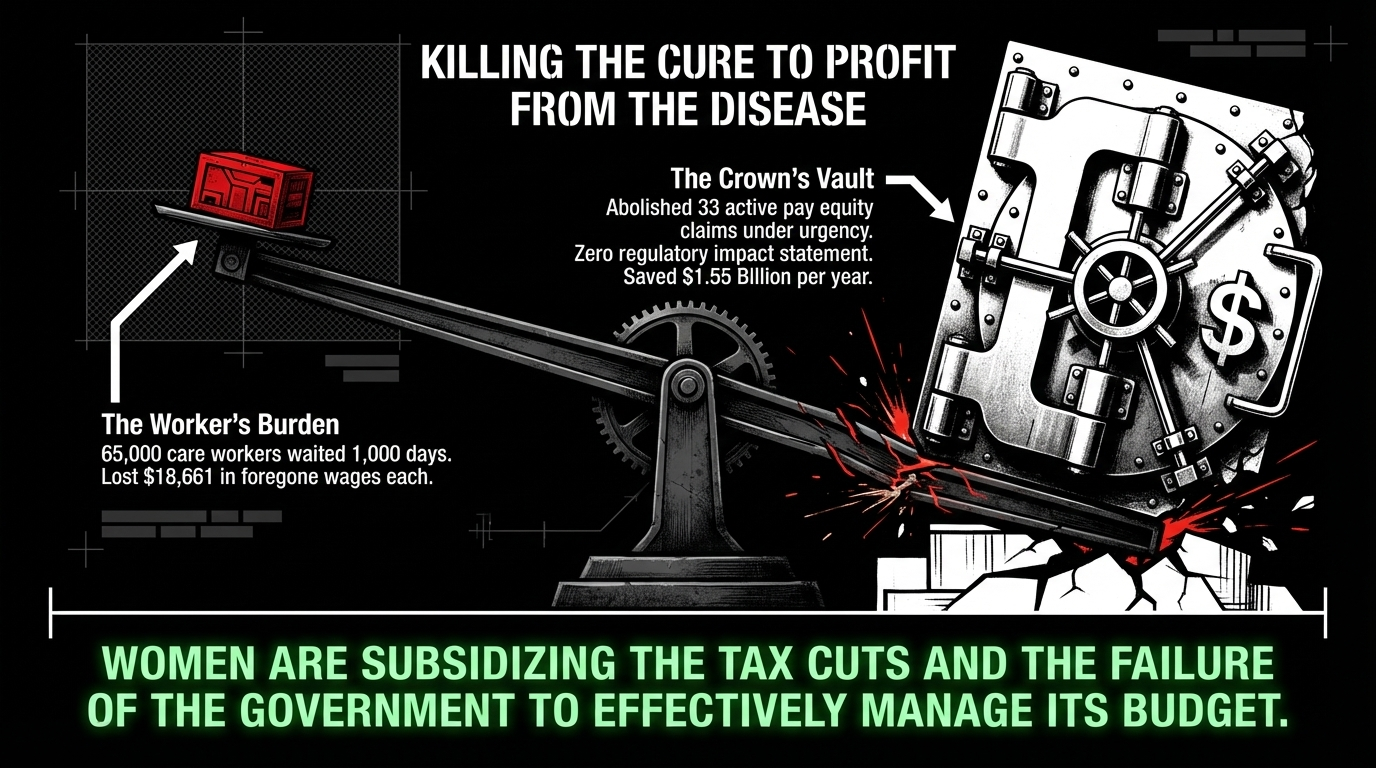
In May 2025, Workplace Relations Minister Brooke van Velden — without a regulatory impact statement, under urgency, without select committee scrutiny — abolished 33 active pay equity claims, saving the Crown $1.55 billion per year. Care and support workers were among the direct casualties. E tū documented that 65,000 care workers had waited over 1,000 days for their pay equity settlement renewal, losing approximately $18,661 each in foregone wages. As the PSA stated with precision: "Women are subsidising the tax cuts and the failure of the Government to effectively manage its Budget."
The government's rebuttal is that the fiscal cost was unmanageable — and it is true that Treasury documents from 2024 flagged significant fiscal pressure from pay equity settlements. But the 2017 pay equity settlement cost $2.048 billion over five years and was considered both affordable and legally required at that time. The government gave landlords a tax cut worth hundreds of millions annually while telling care workers their equity claim was unaffordable. That is not fiscal responsibility. That is a declaration of whose interests the Crown protects.
Now — with those workers still underpaid, still driving at their own expense, still absorbing the fuel price spike — a minister arrives to promise "help." That promise arrives after the PSA has filed legal proceedings. After the unions have gone to court. After the New Zealand Council of Christian Social Services issued their open letter to ministers on 29 March 2026 stating: "The cancelling of pay equity claims for carers and home support workers means many earn less than the living wage and are not paid sufficient income to absorb this fuel price shock."
For the western mind: This is the equivalent of a corporation cutting its workers' wages, removing their expense reimbursements, and then issuing a press release promising to "look into" the rising cost of living. In any other context, we would call it institutional fraud. Here, we call it government policy.
The tikanga violation: Utu — not revenge, but the restoration of balance — demands that when harm is done, it is repaired. This government did not repair the harm of underpaid care work. It doubled it, institutionalised it, then announced a "promise" for the cameras. The balance is not restored. It has been deliberately broken.
The solution: Restore pay equity claims under transparent parliamentary scrutiny. Back-pay the $18,661 per worker stolen under urgency. Never again allow a minister to abolish equity claims without a regulatory impact statement and full select committee process.
Example Three: The Invisible Children — When the State Decides Whose Kids Matter
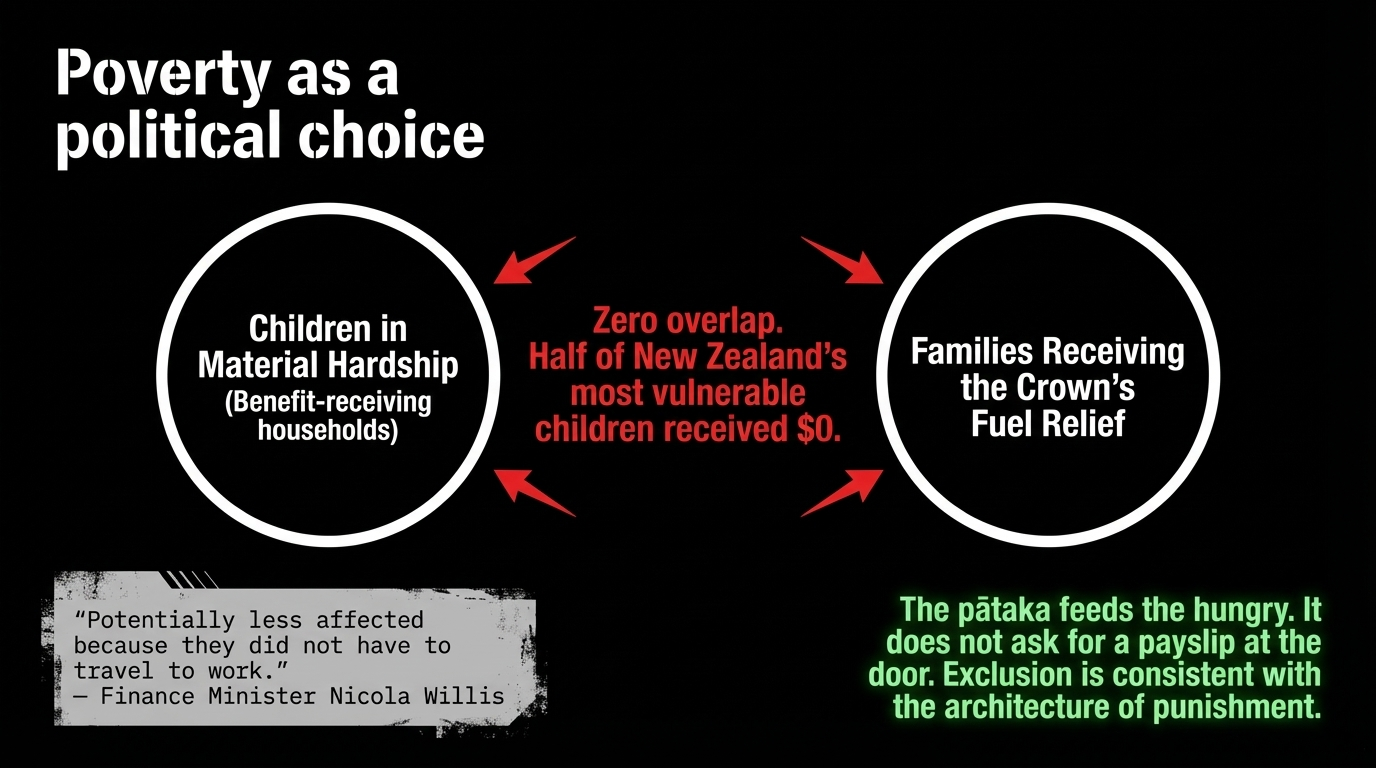
The NZ Herald confirmed that approximately half of New Zealand's most vulnerable children — those living in material hardship in benefit-receiving households — received zero dollars from the government's fuel relief package. Finance Minister Nicola Willis justified this by stating that beneficiaries are "potentially less affected because they did not have to travel to work." CPAG spokesperson Isaac Gunson called it what it was: "Pretty outrageous."
The government's rebuttal is that the In-Work Tax Credit is a targeted mechanism. But Luxon has simultaneously framed the fuel emergency as an external shock beyond political control — the Strait of Hormuz, Brent crude at $119, global energy markets — positioning the government as a passive responder. As Thomas Coughlan noted in the NZ Herald, Luxon was visibly grappling with the politics of crisis response while refusing the scale of intervention the crisis demanded. Nobody blames him for the Strait of Hormuz. He is blamed for the pre-existing structural vulnerability — the mileage rate already 53.5 cents below standard before the crisis hit, pay equity already gutted before fuel hit $3.29/litre. The crisis didn't create the harm. It revealed a harm already being inflicted.
For the western mind: A quarter of a million tamariki, according to Willis's arithmetic, simply do not move through the world the same way as people whose children she considers worthy of counting. They do not have kaumātua who need driving to appointments. Their parents do not drive to food banks, to WINZ, to the pharmacy. As "The Traffic Light Taiaha" documented in full: "They slashed 7,000 public sector jobs, watched unemployment climb to a decade-high, then built a punishment system for the people they threw out of work for not finding the jobs they destroyed." Excluding benefit-receiving families from crisis relief is consistent with that same architecture — the ideology that poverty is a moral condition, not a political one.
The tikanga violation: In tikanga Māori, manaakitanga — the obligation to uplift the dignity of all, especially the most vulnerable — does not come with employment conditions attached. The pātaka feeds the hungry. It does not ask for a payslip at the door.
As "The Pātaka Is Ash" states:
"Manaakitanga demands the opposite: the most vulnerable receive the most care. This government delivers the inverse."
The solution: Extend the fuel relief package to all benefit-receiving households unconditionally. Implement the Greens' windfall profits tax on fuel companies to fund it. The Crown is collecting $180 million in additional GST from this crisis. Return it — without conditions — to the people it is crushing.
Ko te Māori o Tēnei Kōrero — The Metaphor That Destroys Them
There is a whakataukī:
"He iti hau māhana."
A little warmth is a gift.
But you cannot offer warmth to a family freezing in a burning house and call it generosity. You cannot hand someone a tea light while you pocket their firewood and call it compassion. You cannot promise to "consider" putting out the fire you started while billing the whānau for the smoke damage.
The Crown is the tangata whakahē — the one who diminishes. It has taken mahi aroha — the most sacred labour a society produces — and turned it into a debt instrument. These women who wash the bodies of our kaumātua, who help our disabled tamariki get out of bed in the morning, who hold the frail hands of the dying — the Crown has decided their love is free. That the road between one client and the next is their problem. That the fuel that carries them to the bedside of the most vulnerable is a personal expense, not a system obligation.
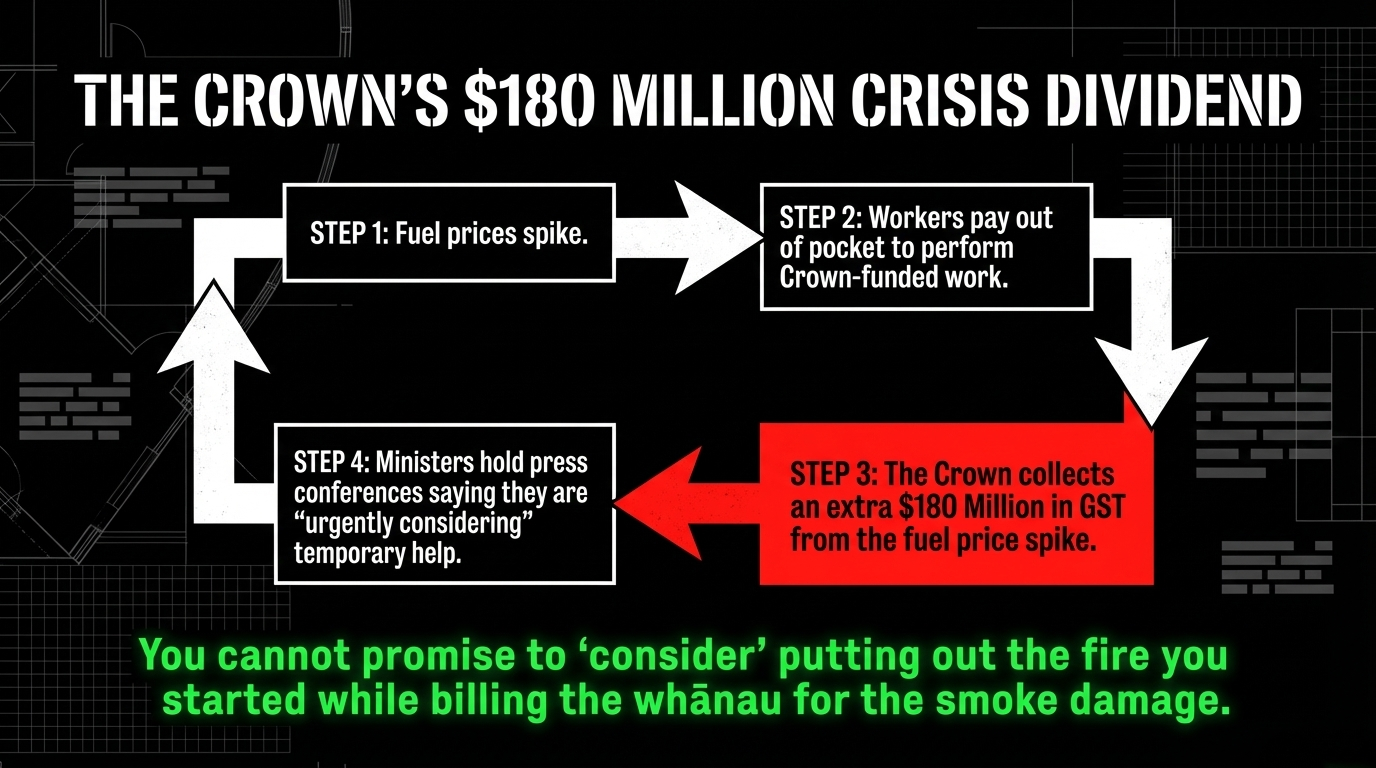
The government's most polished defence — "we have a process, be patient" — is the sound of a bureaucracy that has decided process protects the Crown, not the worker. Ministers pointed to the scheduled May 2026 mileage review as evidence of responsiveness. But as E tū's March 2026 analysis confirmed, the rate has not been reviewed since 2022 — through a global inflation surge, a cost-of-living crisis, and now a fuel emergency.
Worker Tamara Baddeley said it plainly:
"This crisis could last six weeks or six months, but either way, workers can't keep absorbing it."
The one rebuttal the government cannot make is the only one that matters: they cannot say the mileage rate is fair. They cannot say pay equity was legally sound. They cannot say vulnerable children were included. The record exists. And the record is damnation.
That is not just wrong. That is the wairua of colonialism — still working, still extracting, still calling the extraction "support."
As "The Starving of the Seedlings" documents:
"This is cruelty dressed in a spreadsheet."
As "The Pantomime of the Dying Waka" confirms:
"They dressed in borrowed feathers. They sang another chief's waiata. And when the taniwha came — they handed whānau a government pamphlet and called it a rescue."
He Kupu Whakakapi — The Verdict That Cannot Be Appealed
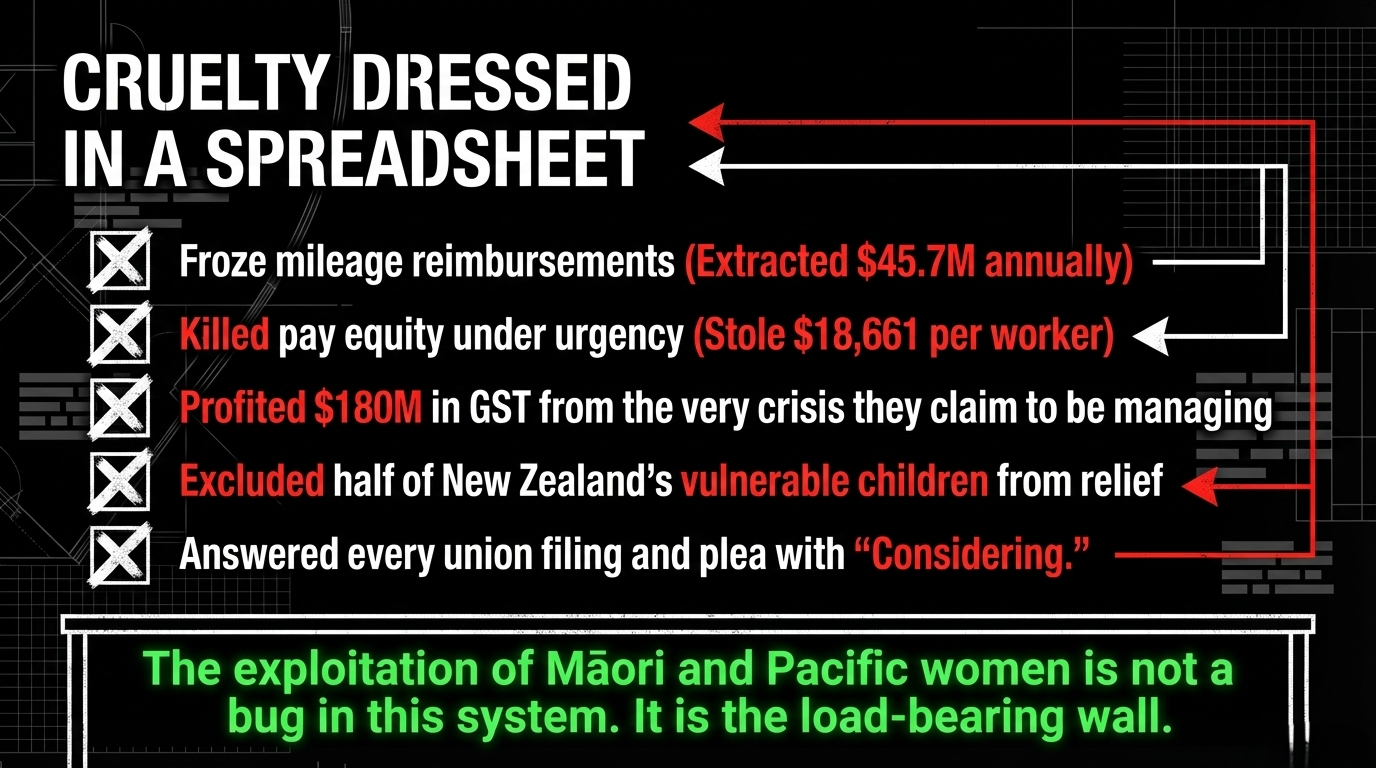
This government has:
- Frozen care worker mileage reimbursement since 2022 while fuel costs soared, extracting $45.7 million from their pockets annually
- Killed pay equity for 65,000 workers under urgency without a regulatory impact statement, saving $1.55 billion per year while workers lost $18,661 each
- Profited $180 million in additional GST from the very fuel crisis it is performing compassion about
- Excluded half of New Zealand's most vulnerable children from its own fuel relief package
- Forced unions into court on 30 March 2026 because it will not act voluntarily
- Scrapped pay top-ups for 900+ disabled workers, some paid as little as $2 an hour
- Answered every open letter, every union filing, every child in hardship with a single word: "Considering."
Too little, too late is generous. This is not failure. This is policy. The exploitation of care workers — overwhelmingly Māori and Pacific women — is not a bug in this system. It is the load-bearing wall. As "The Pātaka Beside the Strait" makes clear, when the storehouse burns, this government counts who it wants to save before it reaches for the water.
The ring does not require a rebuttal. It requires a record. The record is clear. The record is damnation.
Kāore e taea te huna. You cannot hide this.
Tūturu whakamaua kia tīna. Tīna! Hui ē! Tāiki ē!
🌿 Koha — Fund the Truth They Refuse to Tell
The 23,000 care workers driving at their own expense to hold up this country cannot afford to wait for a minister's "consideration." The $45.7 million extracted from their pockets every year will not be returned by a press release. The tamariki excluded from fuel relief will not be counted by a government that has decided they don't need to move through the world.
This mahi — tracing the whakapapa of every theft, naming every dollar, exposing every rebuttal — is funded by whānau, for whānau. Not by the Crown. Not by corporate interests. By the people who understand that mahi aroha — including the mahi of truth-telling — deserves to be resourced.
Every koha to The Māori Green Lantern is a direct refusal to let this government's "considering" be the last word.
Koha directly — Support the mahi here
Subscribe and receive essays directly — Join at themaorigreenlantern.maori.nz
Bank transfer — HTDM, account number 03-1546-0415173-000
And if you cannot koha right now — no worries, no shame, no conditions. Share this essay. Post it. Read it at your hui. Follow the ongoing mahi at themaorigreenlantern.maori.nz. That is koha in itself.
Because this government is counting on our silence.
Let's disappoint them.
Kia kaha, kia māia, kia manawanui. Kia ora.