"Kiri Tamihere-Waititi & The Cracked Whare: How a Clinical Psychologist Became the Symptom She Was Trained to Diagnose" - 14 February 2026
When the healer poisons the rongoā, the sickness spreads to every mokopuna in the whare.

Mōrena Aotearoa,
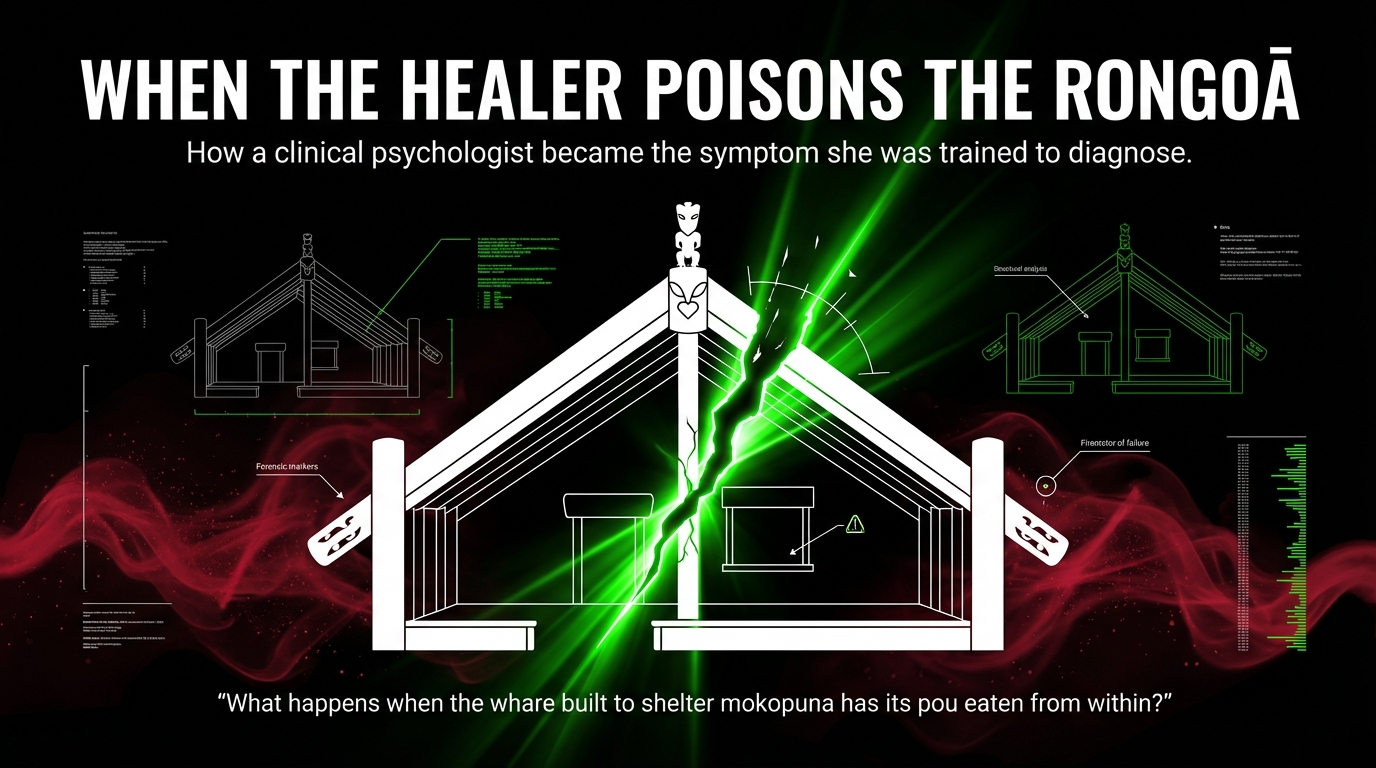
The Karanga That Should Not Be Answered
There is a whakataukī our tūpuna carried like a taiaha across generations:
"He aha te mea nui o te ao? He tāngata, he tāngata, he tāngata." What is the greatest thing in the world? It is people, it is people, it is people.
But what happens when the people who claim to heal our people are themselves the source of the sickness? What happens when the woman who trained to diagnose trauma becomes the instrument that inflicts it? What happens when the whare built to shelter mokopuna has its pou eaten from within by huhu grubs wearing the mask of rangatiratanga?
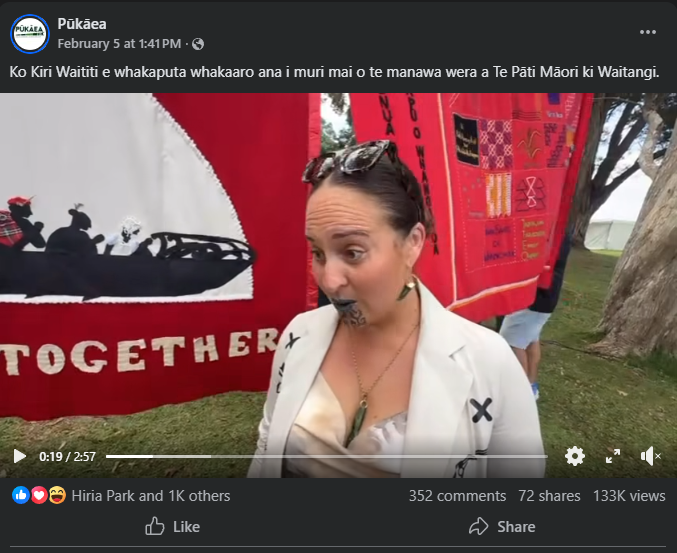
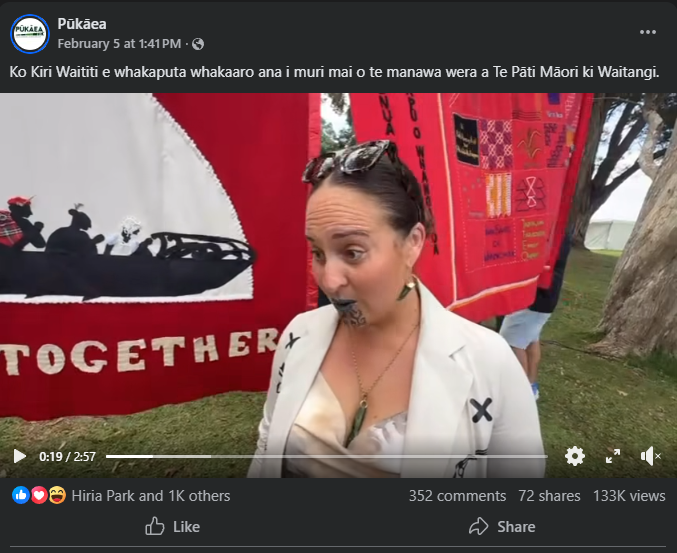
Meet Dr Kiri Tamihere-Waititi. Clinical psychologist. Daughter of John Tamihere. Wife of Rawiri Waititi. De-registered from her own profession — by her own admission, "out of protest". Sole director and shareholder of Toitū Te Tiriti Limited. Performer of confrontational haka on marae ātea that leave Ngāpuhi chairs calling it "the last straw". Recorder of social media videos so inflammatory that TVNZ broadcast them nationally and Stuff reported NZ Police opened an investigation, with the NZSIS issuing a public statement about extremist rhetoric being spread in communities.
She is the cracked whare. And the rot started long before her.
Te Puna Kino — The Poisoned Spring: The Whakapapa of Corruption
To understand the daughter, you must first follow the money trail of the father.
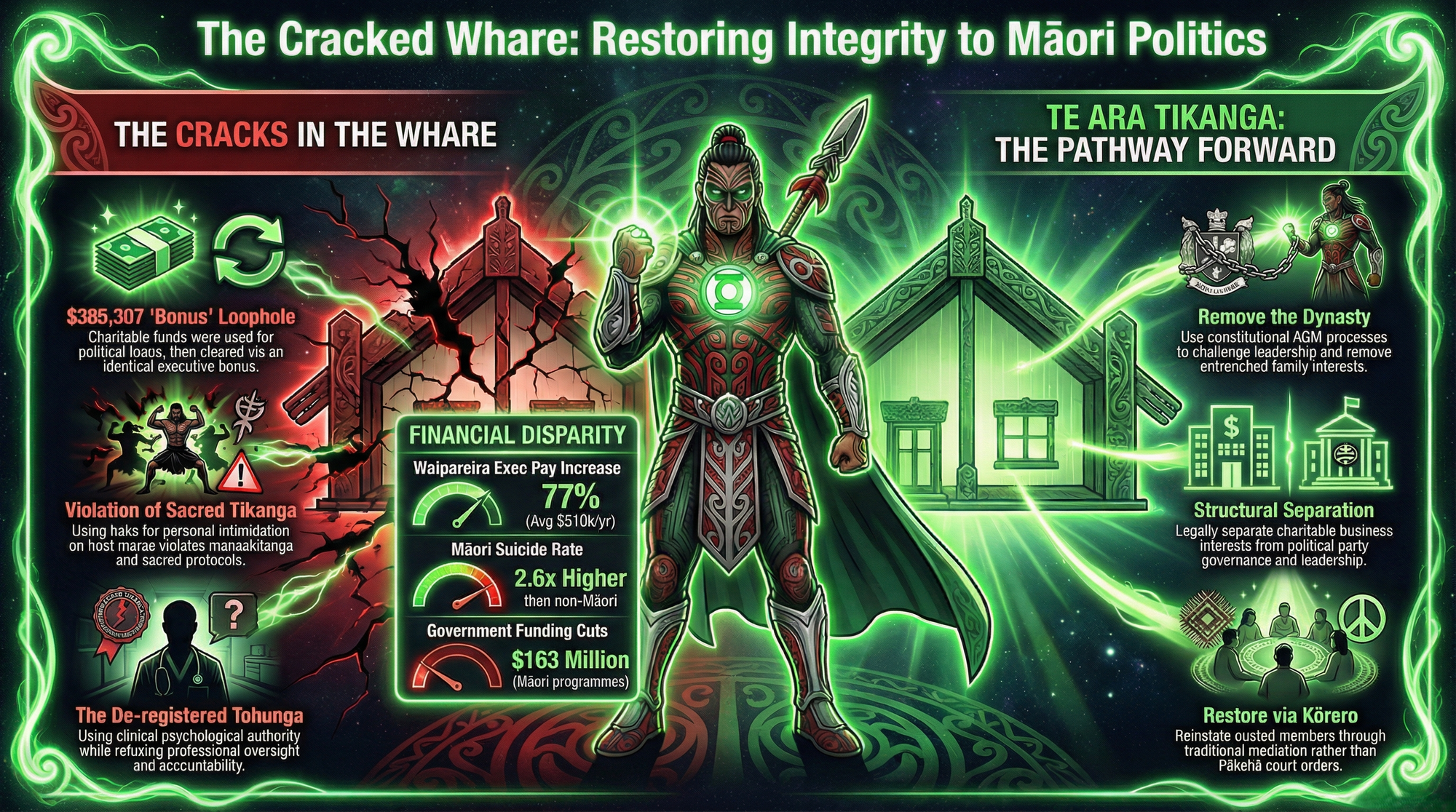
John Tamihere has led Te Whānau o Waipareira Trust since 1991 — a charitable trust established to serve West Auckland's urban Māori communities. In 2019, Tamihere used $100,000 of Waipareira charitable funds to bankroll his failed Auckland mayoral bid. The charity then advanced a further $285,000 in loans to majority-fund Te Pāti Māori's 2020 general election campaign — a total of $385,307 siphoned from a charity serving vulnerable whānau into partisan political campaigns.
When regulators demanded repayment, the solution was breathtaking in its brazenness. As NZ Herald investigative reporter Matt Nippert revealed in December 2025: Waipareira awarded Tamihere a bonus of the exact same amount — $385,307 — on 31 May 2023. The Charities Registration Board found that this bonus was "offset against the loan the same day." The money went out the front door as a "bonus" and came right back in the back door as "loan repayment."
The regulator concluded this amounted to "significant private benefits and financial advantage to the chief executive" and initially determined it constituted "serious wrongdoing" and "gross mismanagement."
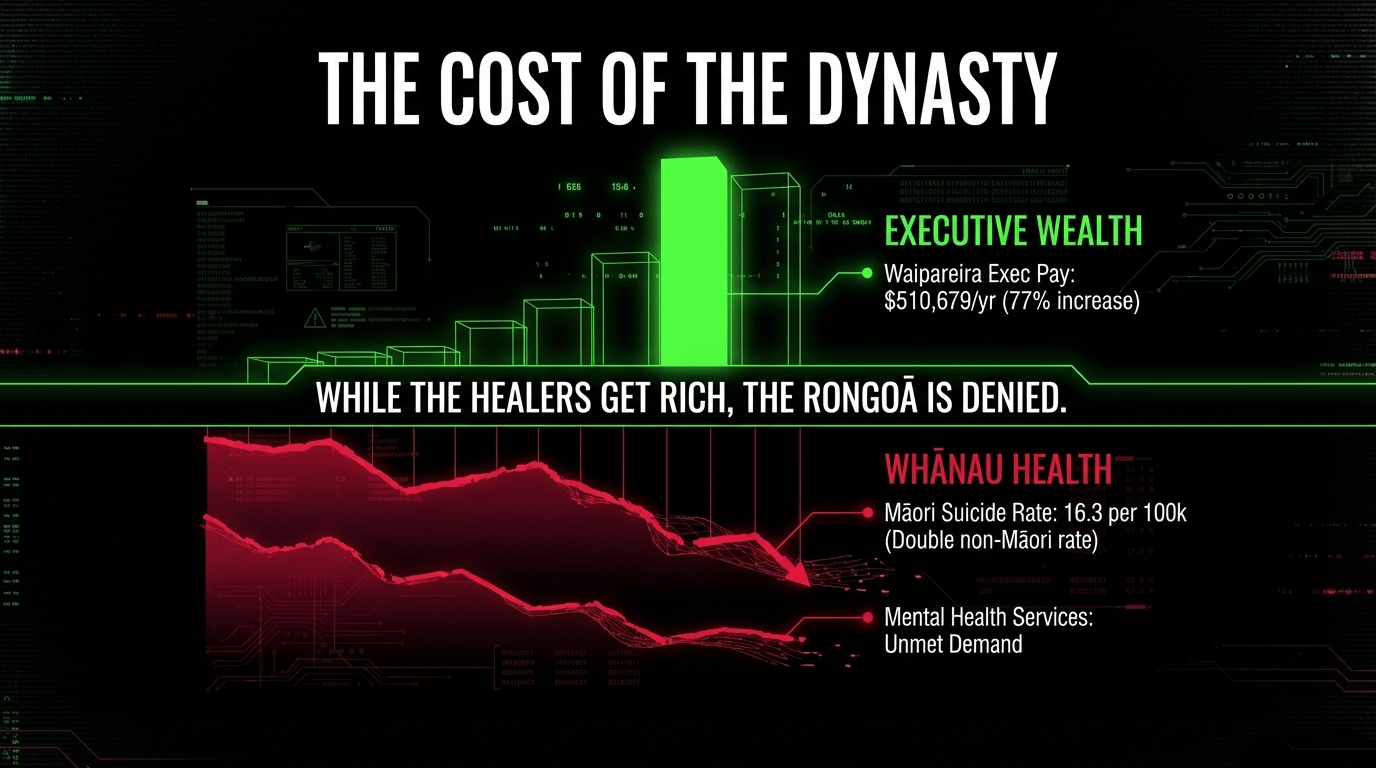
In the same financial year, Waipareira's key management personnel received a 77% pay increase, each averaging $510,679 per annum — making them New Zealand's highest-paid charity executives.
Half a million dollars a year. From a charity serving some of the most deprived whānau in West Auckland. While Māori suicide rates run at 16.3 per 100,000 — double the non-Māori rate — and kaupapa Māori mental health services face unprecedented demand they cannot meet.
This is the spring from which Kiri Tamihere-Waititi draws her water.
Te Tohunga Hē — The False Healer
Kiri Tamihere-Waititi trained as a clinical psychologist at the University of Auckland. She holds a doctorate. She knows the diagnostic criteria for personality disorders, trauma responses, narcissistic presentations, and emotional dysregulation. She once worked within the Western mental health system before she de-registered herself "out of protest" — in her own words: "I do not want to subscribe to a model that is continuing to assimilate my people".
Her M9 Aotearoa biography confirms she was "trained as a Clinical Psychologist at the University of Auckland, de-registered out of protest and launched into lifting Whānau Ora as a legitimate solution to decolonising mental health."
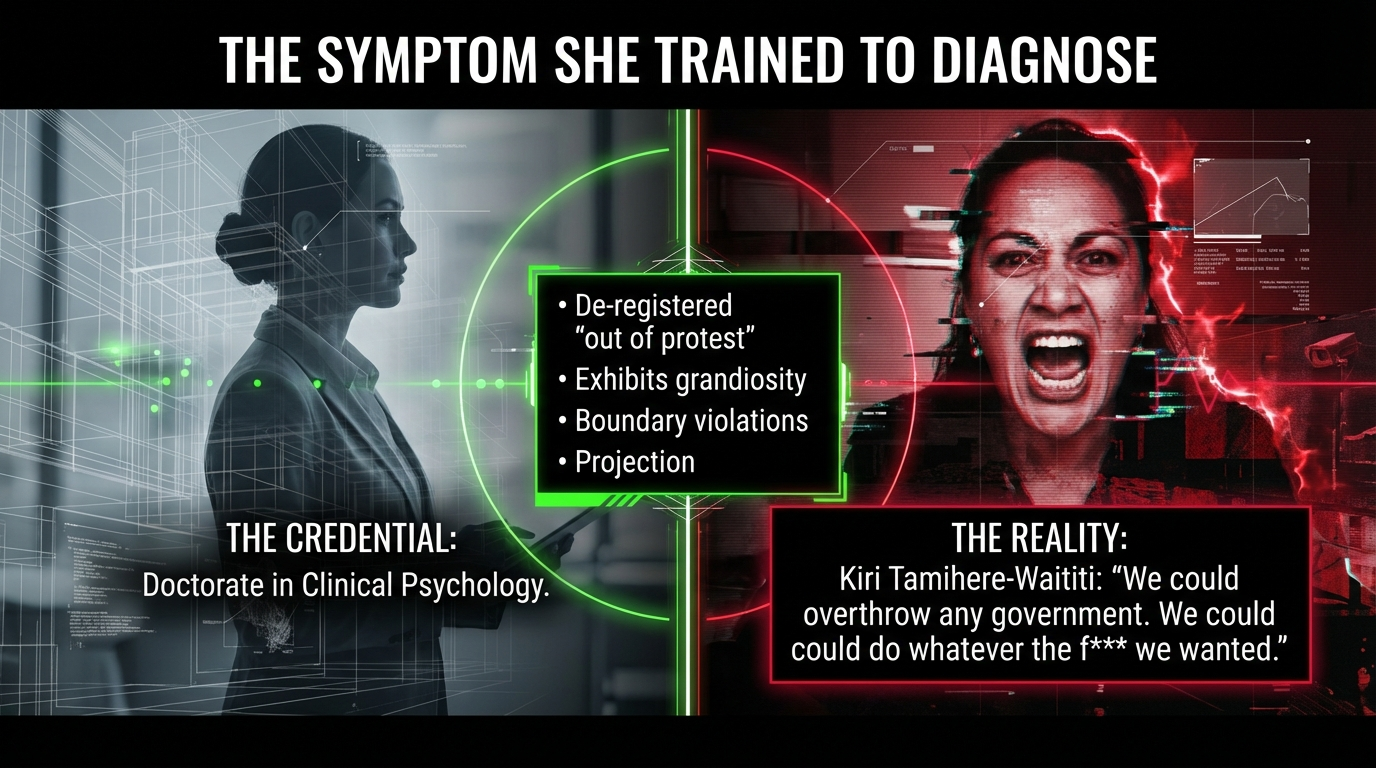
She told RNZ in 2018 that western psychology training was "extremely artificial — very cold, robotic at times, and emotionless" and that "Māori are extremely emotional people." She told the NZ Herald in 2023 that "kapa haka for me can be an ultimate healing pathway for our whānau. And it's the ultimate way to re-indigenise our lives."
Nobody disputes that kapa haka heals. Tā Mason Durie's Te Whare Tapa Whā model — the foundational framework of Māori health, developed in 1982 — teaches that hauora requires balance across four dimensions: taha wairua (spiritual wellbeing), taha hinengaro (mental and emotional wellbeing), taha tinana (physical wellbeing), and taha whānau (family and social wellbeing). The Mental Health Foundation describes it as the wharenui with four walls — when one wall crumbles, the whole house falls.
But here is the contradiction that exposes everything: a woman trained to diagnose dysfunction exhibits the exact patterns she was trained to identify.
In May 2024, TVNZ broadcast a video in which she ranted: "Can you imagine the might and the power that we would have? We could overthrow any government. We could do whatever the f*** we wanted." She described Parliament as a system for the "severely colonised mind" — while her husband sits in it and her father profits from it. As The Spinoff reported in October 2025, the video marked a turning point in the party's public image.
In November 2025 — despite iwi chairs securing an agreement to cease social media commentary — Stuff/TVNZ reported that Kiri Tamihere-Waititi launched an "Ask Me Anything" session dissecting the party's internal woes, offering "20 minutes of explaining what led to the party's division" in defiance of the ceasefire.
At Waitangi 2026, she led a haka crossing the ātea directly towards Eru Kapa-Kingi — a young man whose mother, MP Mariameno Kapa-Kingi, had been expelled from the party by leadership aligned with the Tamihere whānau. RNZ confirmed Waititi's wife "advanced toward Eru Kapa-Kingi" during the haka tautoko. As The Spinoff observed, the haka was "impolite, performative and relied on Ngāpuhi being polite, modern hosts who wouldn't react physically to the provocation." Ngāpuhi's chairman called it "the last straw" and took the offer of reconciliation off the table entirely.
A clinical psychologist would recognise this behaviour pattern. The grandiosity. The boundary violations. The inability to accept accountability. The weaponisation of cultural forms for personal dominance. The projection.
Any psychologist worth their registration would recognise the symptoms. This one de-registered herself.
Three Examples for the Western Mind: What This Corruption Means in Tikanga
For readers unfamiliar with te ao Māori, the damage Kiri Tamihere-Waititi and the Tamihere whānau inflict cannot be understood through Western frameworks alone. Here are three concrete examples that translate the harm.
Example 1: The Waipareira Bonus — Stealing From the Foodbank to Fund the Campaign
What happened: John Tamihere took $385,307 from Waipareira Trust — a charity serving vulnerable urban Māori families — to fund political campaigns, then had the charity award him a "bonus" of the identical amount to make the debt disappear.
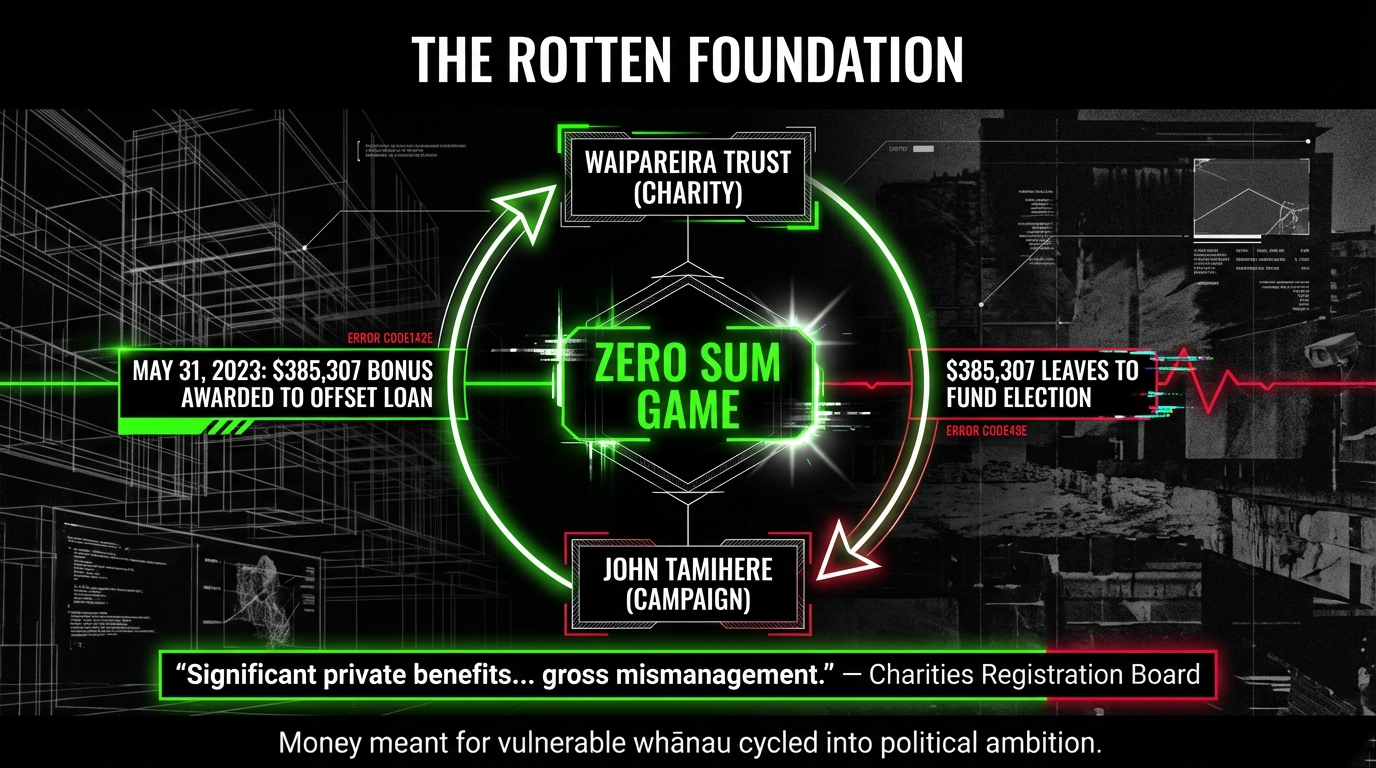
Western equivalent: Imagine a CEO of a domestic violence shelter taking $385,000 from the shelter to fund their personal political campaign, then getting the shelter board to award them a $385,000 "performance bonus" to reimburse themselves — while the shelter's clients cannot access services.
Impact on tikanga: This violates manaakitanga (the sacred obligation of care for vulnerable people entrusted to you), kaitiakitanga (guardianship of collective resources for future generations), and whanaungatanga (the reciprocal obligations that come with kinship). In te ao Māori, charitable resources for whānau are tapu — diverting them for personal political gain is a desecration equivalent to using marae funds to pay personal debts. It depletes the mauri (life force) of the entire community.
Quantified harm: $385,307 directly diverted. Key management pay inflated to $510,679 per annum — a 77% increase in one year. Meanwhile, kaupapa Māori mental health services face unprecedented demand they cannot meet, and the coalition government cut $163 million from Māori-specific programmes across two budgets, as examined in The Māori Green Lantern's essay "The Corrupt Vandalism of Neoliberal Austerity".
Solution: Independent forensic audits of all Waipareira Group entities. Mandatory separation between charitable executives and political party leadership. Legislative reform requiring real-time disclosure of related-party transactions in charities exceeding $5 million in revenue.
Example 2: The Waitangi Haka — Performing Dominance Where Healing Was Required
What happened: At Waitangi 2026, Kiri Tamihere-Waititi led a haka directly across the ātea towards Eru Kapa-Kingi, a young man whose mother MP Mariameno Kapa-Kingi had been expelled from Te Pāti Māori in a process her family alleges was dictatorial. She performed this on Ngāpuhi whenua, as a manuhiri.
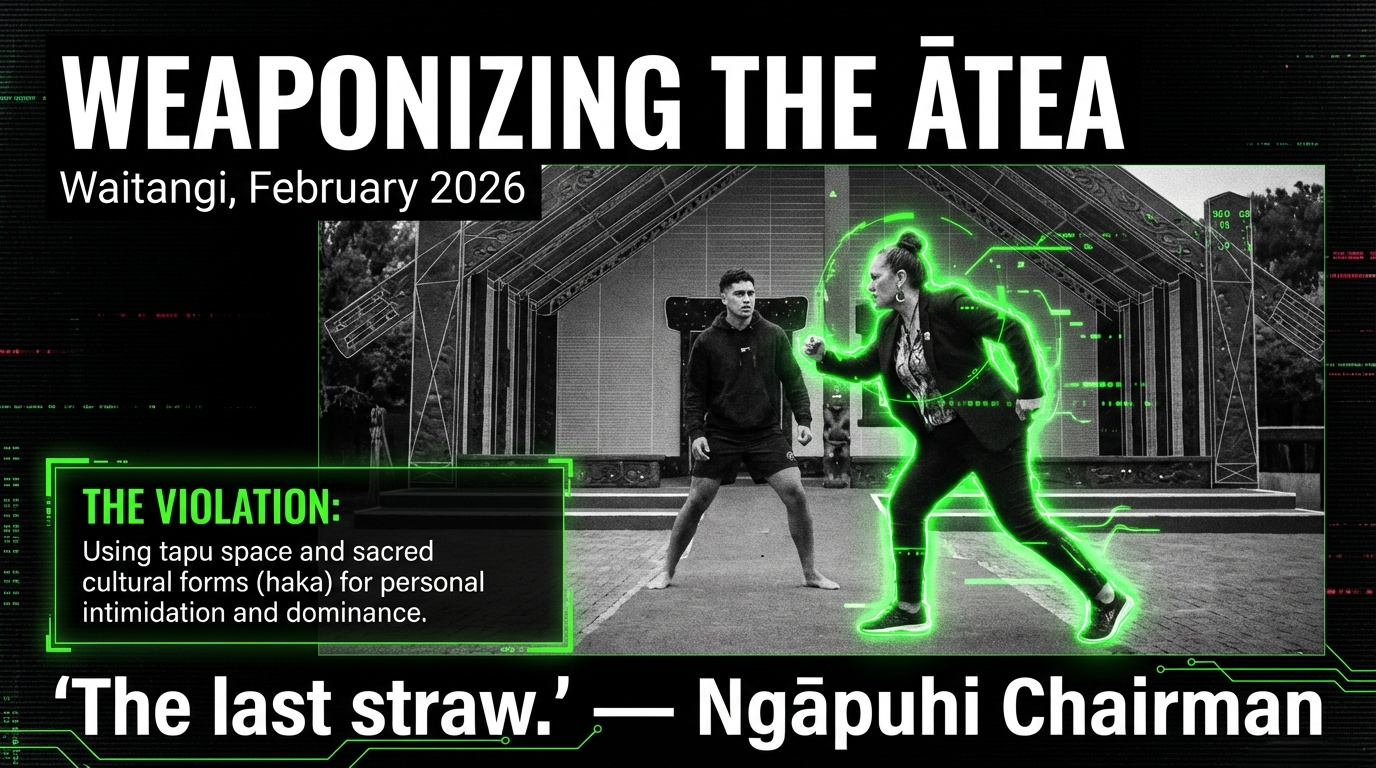
Western equivalent: Imagine the wife of a political party leader confronting the adult child of a fired employee — at the employee's own family gathering — by marching up and screaming in their face, then telling media she was there for "reconciliation."
Impact on tikanga: The ātea (courtyard of the marae) is tapu space governed by strict tikanga protocols. Haka on the ātea is a formal ritual act. To weaponise it as personal intimidation against a host iwi member violates mana whenua (the authority of the tangata whenua over their own marae), tikanga marae (the protocols governing behaviour on sacred ground), and tapu (the sacred restrictions on the ātea space). The Spinoff acknowledged the haka was "impolite, performative". Prominent activist Annette Sykes wrote the events left her with a "deep sense of unease".
Quantified harm: The Ngāpuhi chairman withdrew the offer of a reconciliation meeting with Te Pāti Māori — severing a political relationship with the largest iwi in Aotearoa at a time when Māori unity is existentially necessary. Te Pāti Māori's caucus has shrunk from six to four MPs. The party that Māori need functioning to defend Te Tiriti rights is cannibalising itself — while this government dismantles the Māori Health Authority, repeals Section 7AA, and launches the Treaty Principles Bill. As examined in The Māori Green Lantern's essay "The Colonial Attack on Tikanga", this is exactly the internal division that colonial power relies upon.
Solution: Te Pāti Māori must submit internal disputes to independent tikanga-based mediation panels with no whānau connections to leadership. Kiri Tamihere-Waititi, as a non-elected member, must be formally excluded from party political activities on marae. The Kapa-Kingi expulsion must be resolved through the courts — as is currently before the High Court.
Example 3: The De-Registered Psychologist — Abandoning the Profession While Weaponising Its Language
What happened: Kiri Tamihere-Waititi trained as a clinical psychologist at the University of Auckland but de-registered from the profession "out of protest". In a 2019 public lecture recorded at Taumata Kōrero, she explained: "I've de-registered from the Psychologists Board… I do not want to subscribe to a model that is continuing to assimilate my people. That's what I'm refusing to do." She now uses psychological language to frame herself as a decolonial healer while exhibiting the exact patterns clinical psychology trains practitioners to identify: grandiosity, boundary violations, projection, and inability to accept accountability.
Western equivalent: Imagine a doctor who surrendered their licence starting a wellness empire telling cancer patients that chemotherapy is a colonial conspiracy, while their father simultaneously extracts $385,000 from a health charity. The doctor uses medical language to sound credible while operating entirely outside professional oversight.
Impact on tikanga: In te ao Māori, a tohunga (expert practitioner) carries enormous responsibility because communities trust them with their most vulnerable taonga — the hinengaro (mind) and wairua (spirit) of whānau. To abandon the professional obligations of that role while continuing to trade on its authority violates tika (correctness and integrity), pono (truthfulness), and the obligations of tohunga practice. When she tells whānau that Parliament is for the "severely colonised mind" while her husband draws a parliamentary salary and her father draws $510,679 from a charity — she depletes the mana of every genuine Māori mental health practitioner struggling to serve whānau with inadequate resources.
Quantified harm: Māori experience a 1.7 times higher rate of suicide deaths than non-Māori. For Māori aged 25-44, the rate hits 30.2 per 100,000 — 2.6 times the non-Māori rate. Research consistently shows that disconnection from culture and insecure identity are key risk factors for Māori suicide. When figures like Tamihere-Waititi weaponise decolonial language while practising the opposite — extraction, intimidation, familial entrenchment — they poison the very well of cultural reconnection that keeps whānau alive.
Solution: Any person publicly offering mental health guidance or therapeutic framing to Māori communities should be required to maintain active professional registration or clearly disclose their de-registered status. Te Pāti Māori must separate family business interests from party governance entirely. The Toitū Te Tiriti movement has already cut ties with Te Pāti Māori — whānau must follow that lead and demand accountability.
Te Whare Pakaru — The House That Cracks From Within
Tā Mason Durie's Te Whare Tapa Whā teaches that when one wall of the whare is damaged, the whole house becomes unbalanced and the person becomes unwell. Apply this to the Tamihere-Waititi whare and every wall is compromised:
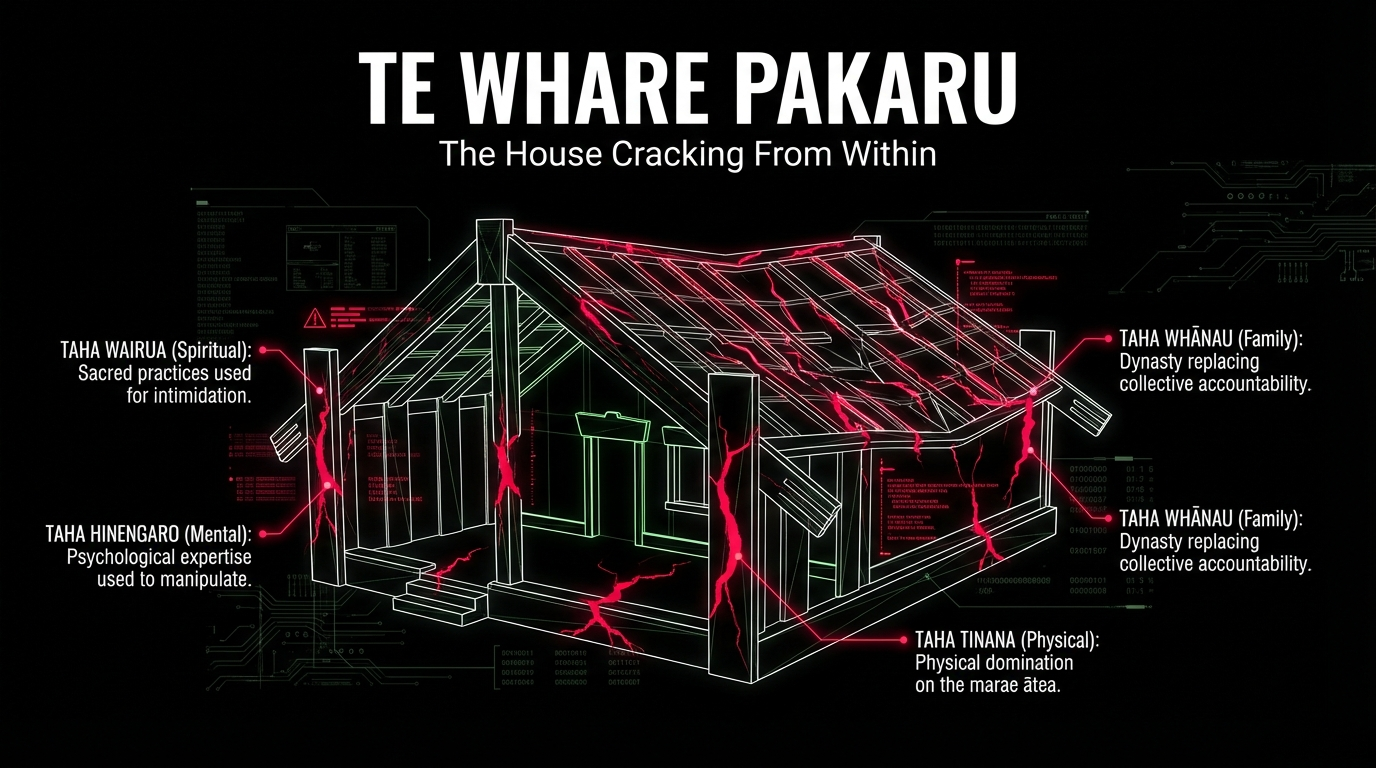
Taha wairua (spiritual health): A woman who claims spiritual authority through kapa haka and haka while weaponising these taonga for personal political dominance on other people's marae. The wairua is corrupted when sacred practices become instruments of intimidation.
Taha hinengaro (mental and emotional health): A clinical psychologist who de-registered from professional accountability while continuing to deploy psychological authority. The hinengaro is corrupted when expertise becomes a weapon without restraint.
Taha tinana (physical health): The physical confrontation on the ātea at Waitangi — performing a haka directly into the face of a young man whose mother your whānau expelled from the party. The tinana is corrupted when the body becomes an instrument of domination rather than expression.
Taha whānau (family health): A family enterprise where the father extracts $385,307 from a charity, the husband leads a political party that has shrunk from six MPs to four, and the daughter-wife operates as unelected enforcer — breaking an iwi-brokered ceasefire to dissect party business on social media. Whānau is corrupted when family power replaces collective accountability.
The whare has cracked. And it cracked from the inside.
He Kōrero Whakamutunga — The Uncomfortable Truth
This essay is not written to destroy Kiri Tamihere-Waititi. It is written because somebody must say what the evidence demands.
A woman trained to heal is instead contributing to harm. A family that claims to serve whānau is instead serving itself. A party that was built to defend rangatiratanga is instead practising what Eru Kapa-Kingi called a "dictatorship model". And all of this unfolds while a white supremacist neoliberal government dismantles every Māori institution it can reach — the Māori Health Authority gone, Section 7AA repealed, $163 million in Māori funding gutted, and the Treaty Principles Bill used as a battering ram against Te Tiriti itself.
The Toitū Te Tiriti movement cut ties with Te Pāti Māori in October 2025, declaring the party could no longer be trusted to represent the movement. That Tamihere-Waititi holds the sole directorship and shareholding of Toitū Te Tiriti Limited — the registered company — while the grassroots movement has disowned the party, tells you everything about how this family operates.
As The Māori Green Lantern wrote in "The Whare Is Rotten: Why Te Pāti Māori Must Decolonise Itself": the party cannot demand decolonisation from the Crown while practising colonisation within its own structures. And as examined in "The Tangled Net: The Story of Māori Autonomy, Extraction, and the Ghosts in the Machine", the networks of extraction and manipulation within te ao Māori must be exposed with the same ferocity we reserve for Pākehā power structures.
Ngā Ara Whakatikatika — The Pathways Forward: Courts, New Parties, or Something Else?
So whānau stand at the crossroads. The Tamihere-Waititi dynasty has cracked Te Pāti Māori from the inside out. The party that 42,000 people marched for in November 2024 is now tearing itself apart with "not an enemy in sight" — Hone Harawira's words, not mine. The question on every marae, every kitchen table, every WhatsApp group is this: What now?
Three pathways present themselves. Each carries cost. Each carries consequence. And only one honours tikanga.
Pathway 1: Te Ara Ture — Drag Everyone to Court
This is already happening. Mariameno Kapa-Kingi filed for judicial review of her expulsion in the High Court in December 2025. Her lawyer, Mike Colson KC, argued the expulsion was "a breach of natural justice" — that only four of seven electorate chairs voted, that Te Tai Tokerau was excluded from the hui, and that the National Council lacked constitutional power to expel her at all. Justice Paul Radich temporarily reinstated her, finding "serious questions to be tried" and "tenable arguments" about "mistaken facts and procedural irregularities".
On 2 February 2026, the substantive hearing revealed further damning detail. Colson KC argued the party's own constitution — the Kawa — set out a detailed dispute process that was never followed. The disciplinary and disputes committee was never convened. The electorate-level process was bypassed entirely. Kapa-Kingi was given "no notice whatsoever" that a hui on her expulsion would take place. A dossier of allegations was circulated to party members hours before the vote and leaked to the media.
Most revealing: Tamihere's own lawyer, Davey Salmon KC, referred to a settlement proposal during the hearing. The deal: reconvene the full National Council to vote again on Kapa-Kingi's membership — but only if she abandoned her legal challenge to Tamihere's presidency. She declined. Of course she did. Conditional justice is not justice.
And yet — despite reinstating her on paper — Te Pāti Māori has not notified the Speaker of the House of her reinstatement. As of February 2026, she remains classified as an independent MP in Parliament. The party is defying the court order by administrative inaction. Justice Radich has reserved his decision and signalled he will prioritise it given the election timeline.
The cost of courts: Legal fees alone will consume hundreds of thousands of dollars — money that should be hammering this neoliberal government, not litigating internal power games. Courts are Pākehā structures. Former NZ Māori Council co-chair Maanu Paul said in 2016 it was "against tikanga Māori" for members to take the Council to court — and he was right. Every dollar spent in court is a dollar not spent defending Te Tiriti. Every headline about internal litigation is a headline not about the government's destruction of Māori rights.
The verdict on courts: Necessary as a last resort — and Kapa-Kingi is right to pursue it because all tikanga-based options were denied to her. But the courts cannot fix what ails Te Pāti Māori. They can reinstate a member. They cannot reinstate mana. They can order procedural compliance. They cannot order whanaungatanga. The legal pathway is a tourniquet, not a cure.
Pathway 2: Te Ara Pāti Hou — Start a New Māori Political Party
History already answered this question. In 2011, Hone Harawira walked away from Te Pāti Māori and formed the Mana Party. The circumstances were almost identical to today: anger at leadership compromise, accusations of selling out, a Te Tai Tokerau MP who could no longer tolerate what the party had become. The Spinoff in November 2025 explicitly compared Kapa-Kingi's situation to Harawira's, asking whether "it is time for a second Māori political party to enter the fray".
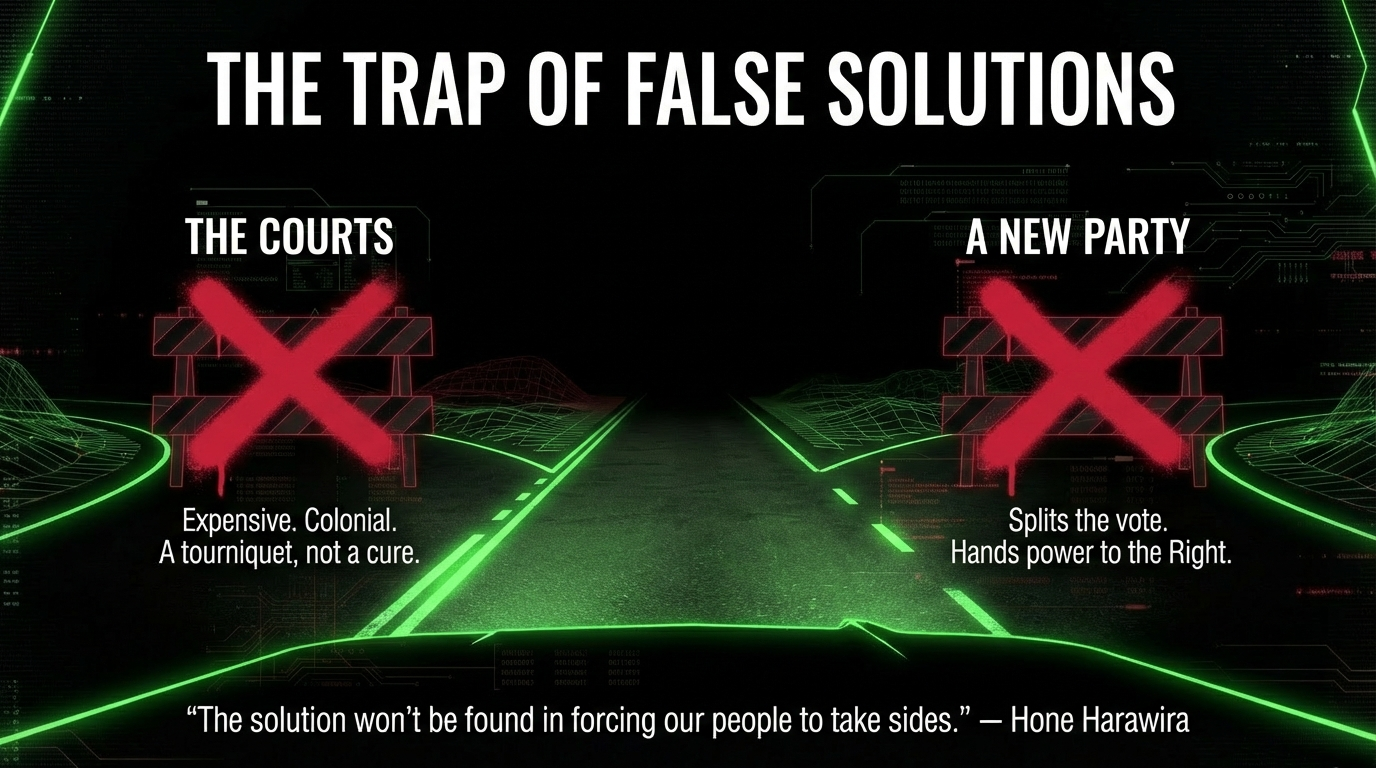
But Harawira himself has given the answer. In November 2025, he issued a public statement warning that "the solution won't be found in starting a new party and forcing our people to take sides". He remembered "the confusion and sadness on the faces of our kuia, something I'd never want to see again". The man who actually did it is telling you: don't do it.
The arithmetic is brutal. In 2014, the Mana-Internet alliance gained just 1.26% of the vote and Harawira lost his seat. Two Māori parties meant two half-strength vehicles, both weakened, both vulnerable, both unable to form a governing coalition. Under MMP, the Māori electorates are the only structural guarantee of independent Māori voice in Parliament — Winston Peters is already campaigning to abolish them via referendum. Splitting the Māori vote between two parties hands those seats to Labour or — worse — leaves them vulnerable to a National-backed candidate in a low-turnout scenario.
The Green Party has already begun poaching disillusioned Te Pāti Māori talent. Former TPM candidate Tania Waikato will stand for the Greens in 2026. Every defection from the Māori political movement is a win for the colonial system that wants that movement dead.
The cost of a new party: Division at the moment when unity is existential. Loss of electorate seats. Loss of party vote threshold. Kuia forced to choose between their own. The exact outcome this white supremacist government prays for — Māori fighting Māori while they gut every institution that serves whānau.
The verdict on a new party: A catastrophic strategic error. Harawira tried it and lost. The 2011 split cost Māori a decade of political cohesion. To repeat it now — with Peters actively campaigning to abolish the Māori seats entirely — would be to hand the neoliberal alliance exactly what it wants: a fractured, weakened, internally consumed Māori political movement that poses no threat to the status quo.
Pathway 3: Te Ara Tikanga — The Way of Accountability Without Destruction
There is a third path. It is harder. It is slower. It does not provide the satisfaction of courtroom victory or the adrenaline of party launches. But it is the only path that honours tikanga and preserves the political infrastructure Māori cannot afford to lose.
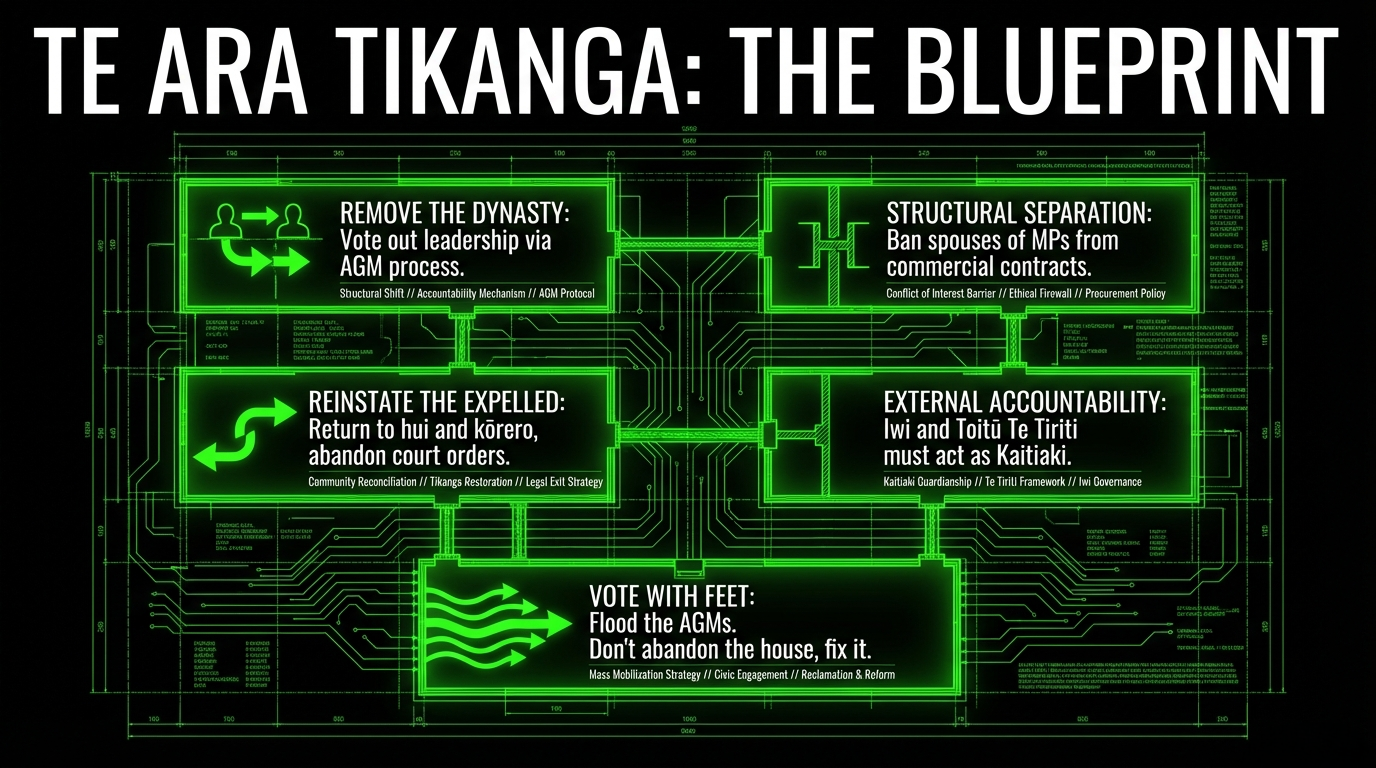
Step 1: Remove the Tamihere dynasty through constitutional processes, not court orders. The party's Kawa provides for leadership challenges at Annual General Meetings. A poll of Māori voters in December 2025 put Hana-Rāwhiti Maipi-Clarke at the top of the list for favoured leaders of Te Pāti Māori. The whānau has spoken. A properly constituted AGM — with all seven electorates represented, as the Kawa requires — must vote on the presidency. John Tamihere must go. Not because the courts ordered it. Because the membership wills it.
Step 2: Demand structural separation of whānau business from party governance. No party president should simultaneously serve as CEO of a multi-million-dollar charity that funds the party's campaigns. No co-leader's wife should hold the sole directorship of the company that bears the movement's name. No unelected family member should conduct political haka on marae on the party's behalf. These are minimum standards, not radical demands. Every political party in the Western democratic world enforces them. Te Pāti Māori must enforce them through tikanga — because tikanga demands it, not because Pākehā law requires it.
Step 3: Reinstate Kapa-Kingi and Ferris through tikanga resolution. Harawira proposed this in November 2025: bring the ousted MPs back "into the team", make a "public declaration of commitment", and undertake a national reconciliation tour before getting "back to work". This is the tikanga pathway. Hui. Kōrero. Whakaaro. Not affidavits, not dossiers leaked to media, not midnight emails stuffed with allegations.
Step 4: Build external accountability structures. ActionStation Director Kassie Hartendorp (Ngāti Raukawa, Ngāti Tūwharetoa) acknowledged in February 2026 that there is a "crisis of leadership" in Te Pāti Māori but pointed to the "huge tidal wave of support for Te Tiriti" and whānau who "now believe in Te Tiriti enough to know when we are not being given the leadership that we deserve." The movement is bigger than the party. Organisations like ActionStation, Toitū Te Tiriti (the movement, not Tamihere-Waititi's company), iwi authorities, and independent Māori media must create accountability mechanisms that hold the party to tikanga standards — not as enemies, but as kaitiaki of the kaupapa.
Step 5: Vote with your feet — within the party. The 2026 election approaches. Whānau do not need to start a new party to change this one. They need to stand for electorate positions. They need to attend AGMs. They need to vote on the Kawa changes that prevent any whānau from ever capturing the party machinery again. The party was created in 2004 because Tariana Turia walked out of Labour to defend Māori foreshore and seabed rights. It belongs to the iwi, the hapū, and the whānau who created it — not to the Tamiheres.
The cost of tikanga: Time. Patience. The willingness to sit in uncomfortable hui with people who have caused harm. The requirement to extend manaakitanga even to those who have violated it. Tikanga is slow. Courts are fast. But tikanga endures. Court orders expire.
The verdict on tikanga: This is the only pathway that preserves the political vehicle, honours the kaupapa, and denies the neoliberal government the spectacle of Māori destruction it feeds on. It is the hardest pathway. It is the right one.
The Strategic Calculus: What the Government Wants
Make no mistake about what Luxon, Seymour, and Peters want. They want Te Pāti Māori to implode. They want the Māori seats to become so associated with dysfunction that Peters' referendum to abolish them passes with a shrug from a weary public. They want courts clogged with internal party litigation rather than Treaty claims. They want every headline about Māori politics to be about infighting, not about the dismantlement of the Māori Health Authority, not about the $163 million in Māori funding cuts, not about the systematic erasure of Te Tiriti from public policy.
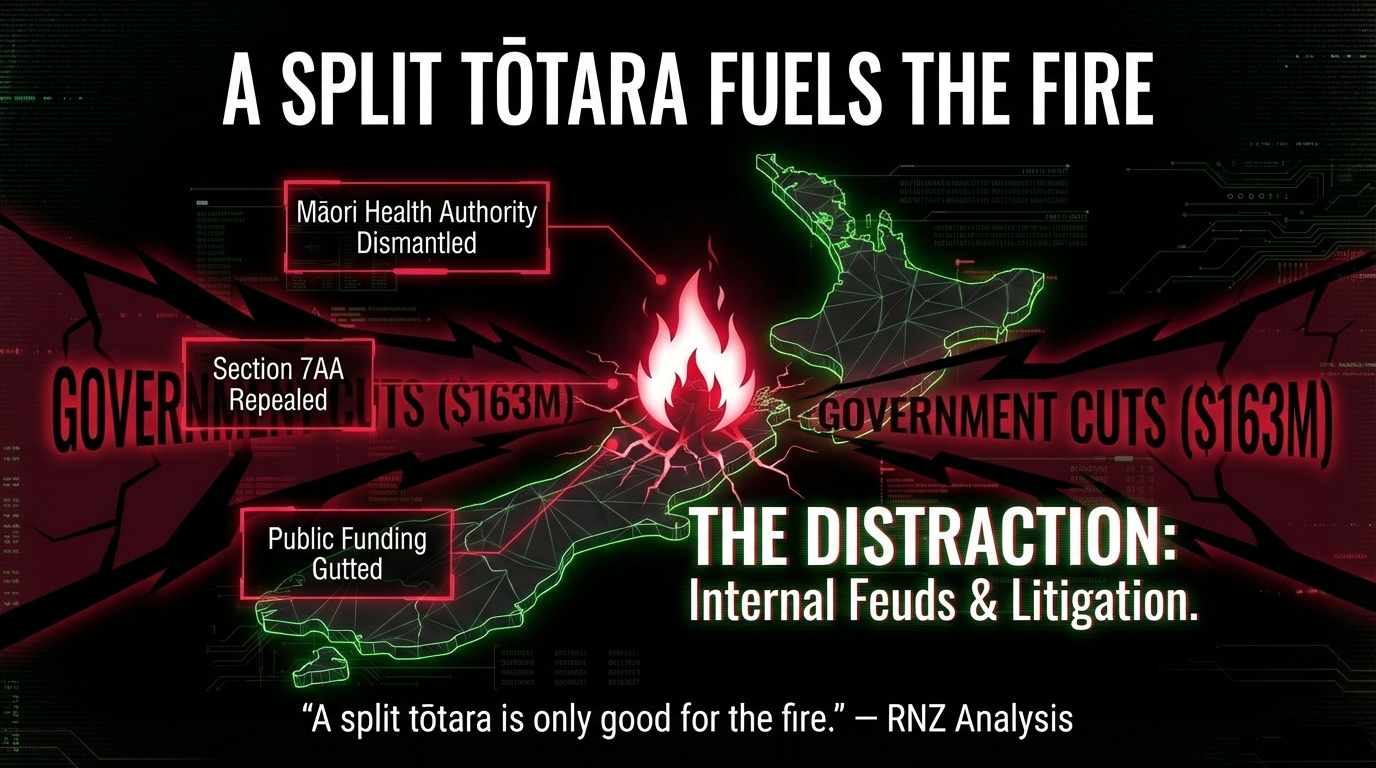
Every day the Tamihere whānau consumes with internal warfare is a day this government operates without effective Māori opposition. The cracked whare does not just fail to shelter mokopuna — it actively serves the interests of those who want to demolish every whare in the village.
Kaumātua Mike Smith (Ngāpuhi, Ngāti Kahu) called the Waitangi debacle "both tragic and absurd" — that the time meant to honour Te Tiriti descended into a "public political squabble." He is right. And the squabble is manufactured — by a family that has confused its own mana with the mana of the movement.
As RNZ's political analysis concluded: "A split tōtara is only good for the fire." The Iwi Chairs Forum's Bayden Barber offered that warning as the party imploded around him. Nobody listened. The fire burns on.
Te Wero — The Challenge
The cracked whare cannot shelter mokopuna. The poisoned rongoā cannot heal whānau. The false tohunga cannot lead the people.
But the people can lead themselves.
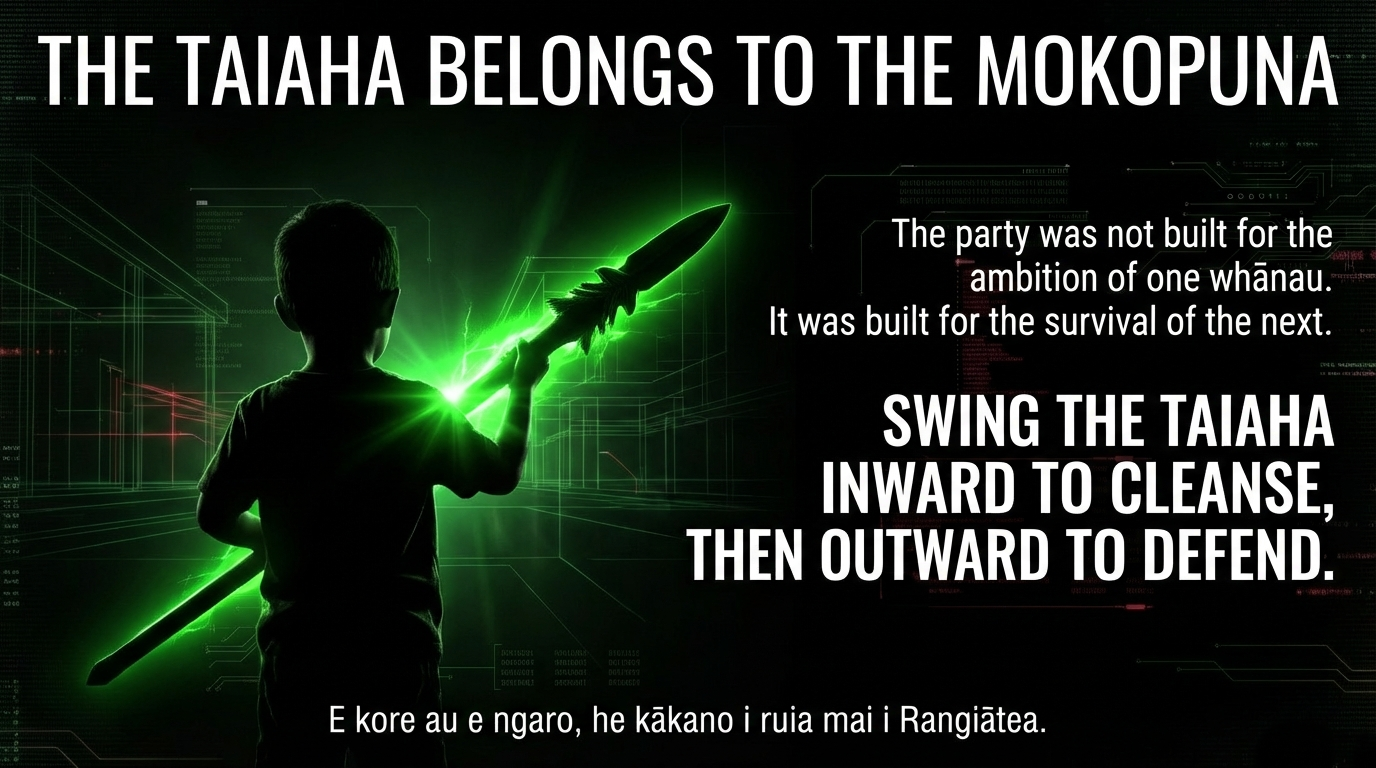
The taiaha does not belong to the Tamiheres. It does not belong to the Waititīs. It belongs to every mokopuna who will inherit the consequences of what we do in this election year. It belongs to every kuia who marched on Parliament in November 2024 and was told her sacrifice mattered — then watched the party she marched for eat itself alive.
Remove the dynasty. Reform the Kawa. Reinstate the expelled. Reconcile the rift. And then — only then — turn the full force of the Māori political movement where it must be aimed: at the white supremacist neoliberal government that is dismantling every protection Te Tiriti ever provided.
Courts are the last resort, not the first. A new party is a gift to the enemy. Tikanga is the way.
E kore au e ngaro, he kākano i ruia mai i Rangiātea.
Our seeds were not scattered from Rangiātea to be harvested by one whānau's ambition. And they were not scattered to be divided against each other by a government that wants us silent.
Koha Consideration
Every koha signals that whānau are ready to fund the accountability that neither the Tamihere boardroom nor the Crown will provide. It signals that rangatiratanga includes the power to fund our own truth-tellers — even when the truth cuts into the whare we thought was ours.
The cracked whare cannot be repaired with silence. Only sunlight, only accountability, only the voices of whānau holding every pou to account — including our own — can restore the mauri. The taiaha swings where it must — inward when necessary, outward when the enemy demands it.
Kia kaha, whānau. Stay vigilant. Stay connected. And if you are able, consider a koha to ensure this voice continues to swing where it must — even when the direction is uncomfortable.
If you are unable to koha, no worries! Subscribe or follow The Māori Green Lantern, kōrero and share with your whānau and friends — that is koha in itself.
Three pathways exist:
For those who wish to support this mahi directly with a koha (voluntary contribution):
Koha — Support The Māori Green Lantern
For those who wish to receive essays directly and support through subscription:
Subscribe to The Māori Green Lantern
For those who prefer direct bank transfer:
HTDM, account number 03-1546-0415173-000.
Mauri ora.

Ivor Jones — The Māori Green Lantern Fighting misinformation and disinformation. Serving whānau. Swinging the taiaha where it must.
Research Transparency
This essay was researched on 14 February 2026 using web search, document analysis, public corporate records, parliamentary records, High Court filings, and cross-referencing of investigative journalism across multiple outlets including RNZ, NZ Herald, Te Ao News, The Spinoff, 1News, Waatea News, and Stuff/TVNZ. All citations are inline and hyperlinked. No far-right media sources (including Chris Lynch Media, Hobson's Pledge, or similar outlets) were used as citation sources in this essay. Claims about Waipareira Trust financial transactions are sourced from the Charities Registration Board decision as reported by NZ Herald investigative reporter Matt Nippert. Claims about Toitū Te Tiriti Limited corporate registration are sourced from CompanyHub NZ public records. High Court proceedings are sourced from RNZ, 1News, Te Ao News, The Spinoff, and LawNews court reports. Kiri Tamihere-Waititi's de-registration is sourced from her own M9 Aotearoa biography and her own public statements recorded by RNZ and Taumata Kōrero. Her social media video content is sourced from TVNZ/Stuff broadcast coverage.