"Ko te Taniwha Kei Roto i te Whare: The Crown Fed the Numbers to a Beast and Called the Bones "Reform"" - 12 March 2026
427,000 Broken Promises — How Luxon's Coalition of Cruelty Manufactured a 12-Year Welfare Catastrophe, Set the Wharenui on Fire, and Handed Out Sunglasses to Block the Smoke

Mōrena Aotearoa,
Kupu Whakataki — The Fire Has a Name
There is a whakataukī that says:
"Ehara tāku toa i te toa takitahi, engari he toa takitini."
My strength is not that of one, but of many.
This government has spent two years dismantling the many — one benefit cut at a time, one sanction at a time, one broken promise at a time — and dressing the wreckage in the language of personal responsibility.
Listen carefully to what has just been confirmed, whānau.
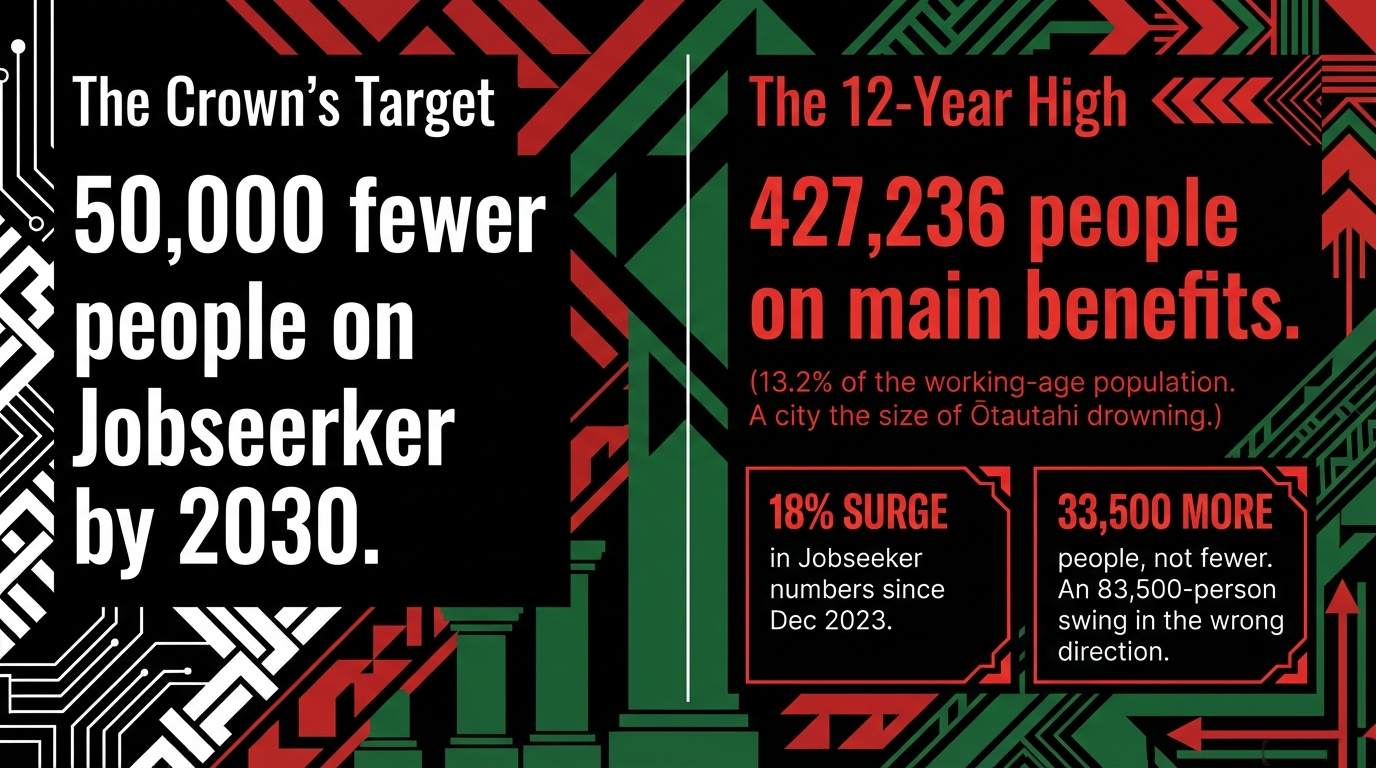
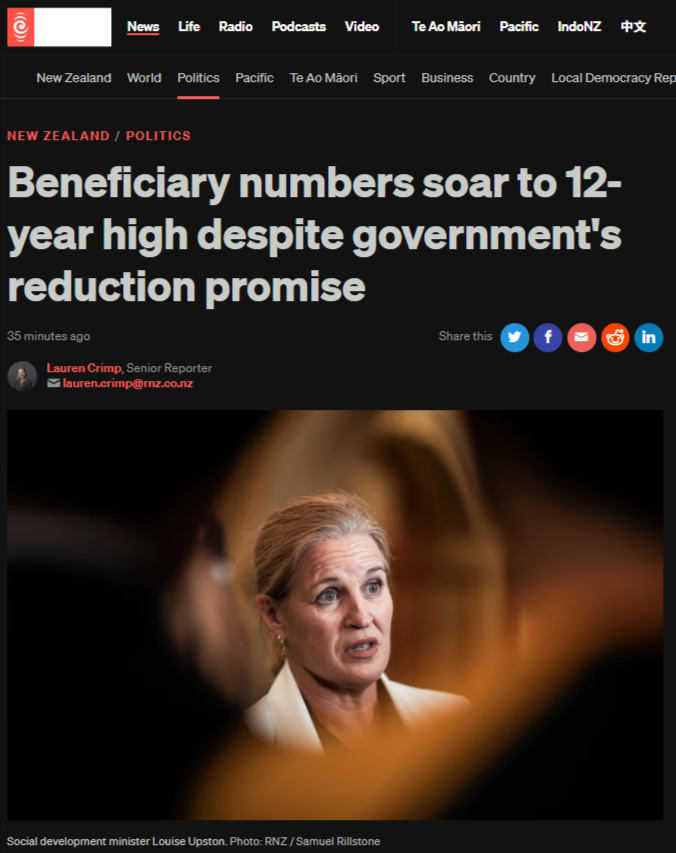
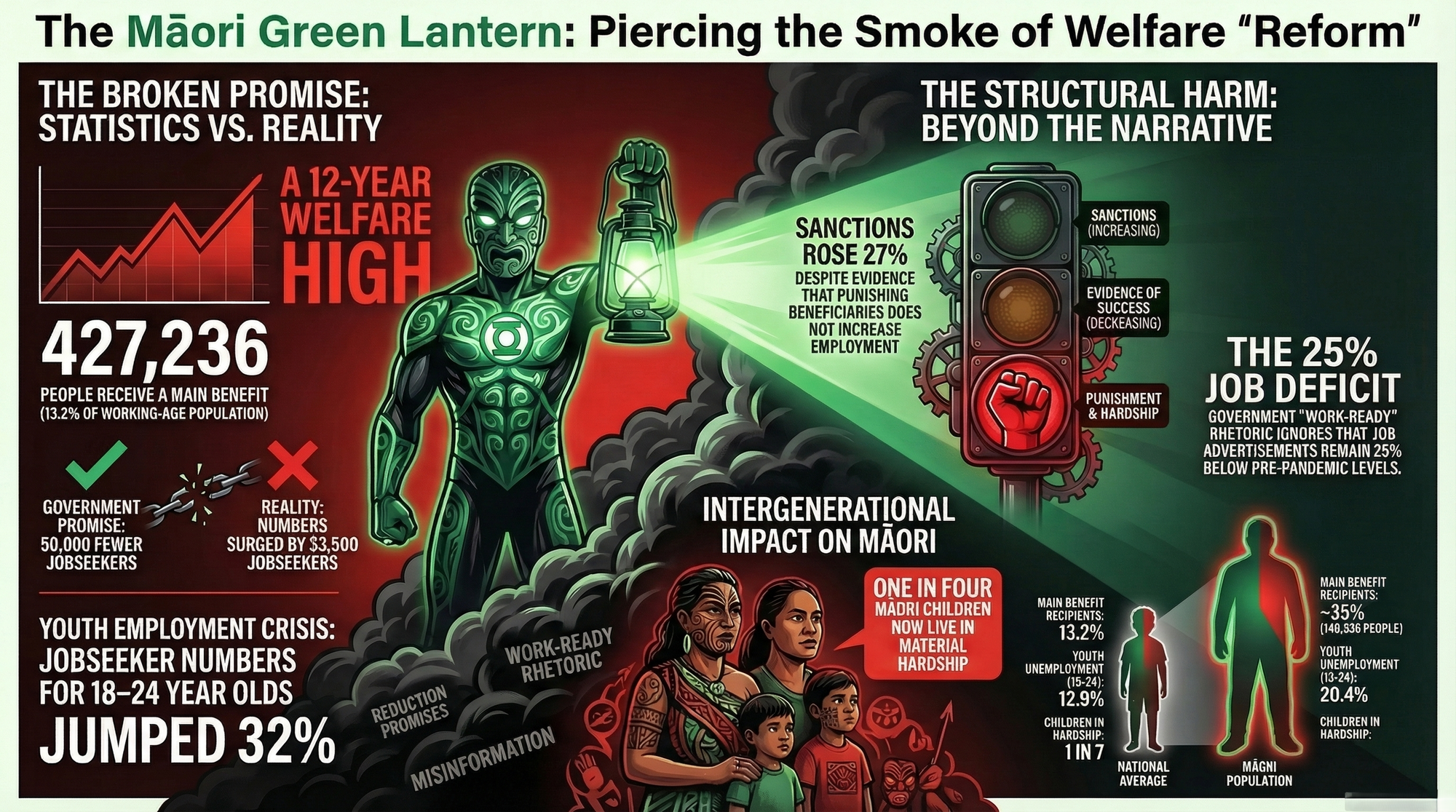
As of December 2025, 427,236 people are receiving a main benefit — that is 13.2 percent of the working-age population, the highest recorded since at least 2013. This is not a statistic. This is a whānau the size of Ōtautahi — Christchurch — drowning. And this is the same government that promised, with the full chest of a tūāhu freshly carved, to reduce welfare dependency. Instead, it has presided over an 18 percent surge in Jobseeker numbers — from 190,000 in December 2023 to 223,512 by December 2025. The government set a target of 50,000 fewer. It delivered 33,500 more.
This is not incompetence. This is not an inheritance. This is architecture.
Deep Dive

Tune into a lively conversation between two hosts, unpacking and connecting topics in the sources of this essay
Ko te Whakapapa o te Hara — The Genealogy of the Harm
To understand what this government has done, you must understand the whakapapa — the genealogy — of this crisis. Harm does not appear from nowhere. It has parents, grandparents, and great-grandparents with names and addresses.
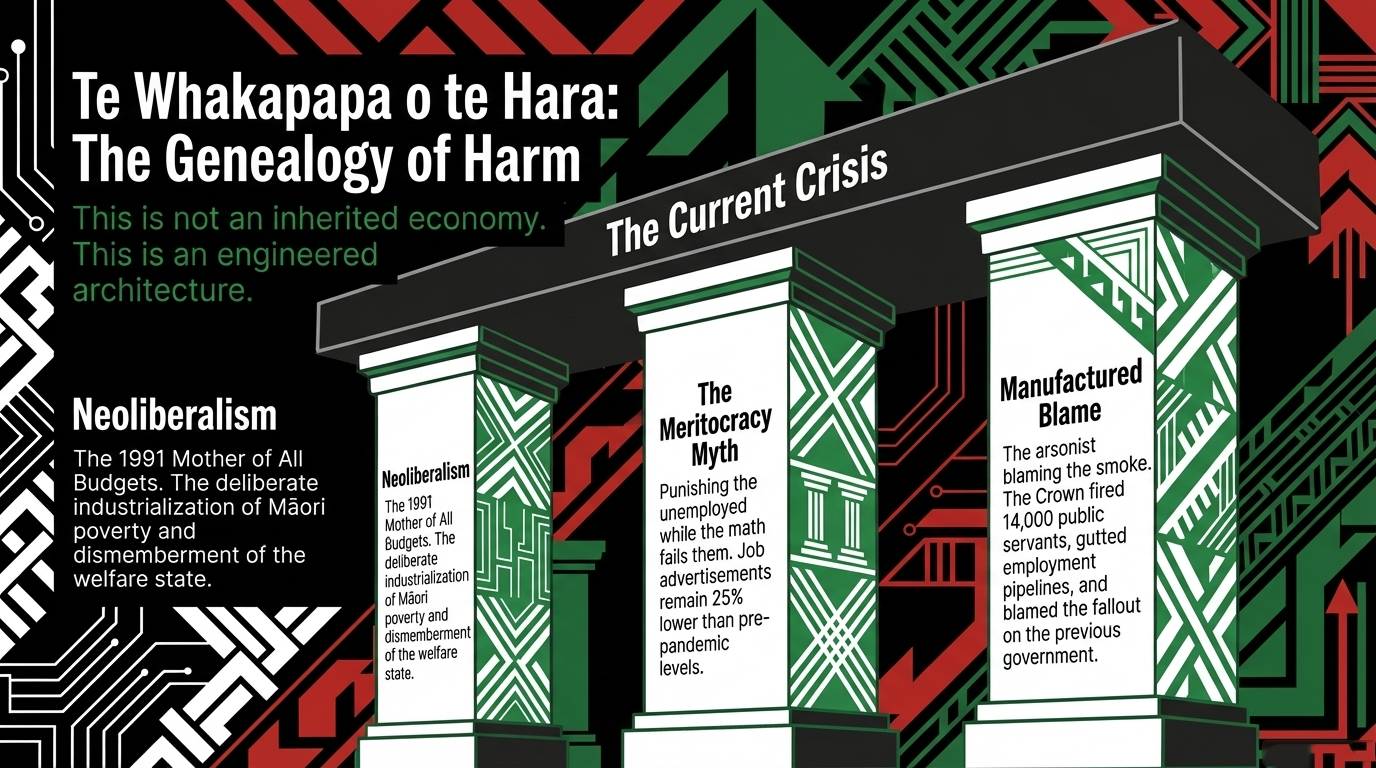
The first ancestor is neoliberalism — the doctrine that markets must be freed, the state must shrink, and the poor must discipline themselves into prosperity. As documented on Te Ara, it was Ruth Richardson's 1991 "Mother of All Budgets" that began the long dismemberment of the welfare state — slashing benefits, deunionising workers, and reversing Māori home ownership gains that had been building for a decade. As Radio Waatea has documented, Māori communities already disadvantaged by colonial land dispossession and institutional racism bore the compounded weight of those reforms. Neoliberalism did not discover Māori poverty. It industrialised it.
The second ancestor is the lie of meritocracy — the fiction that in a fair market, hard work guarantees reward. Infometrics principal economist Brad Olsen confirmed this week that jobs advertised in the economy are still 25 percent lower than pre-pandemic, and the unemployment rate is at a 10-year high. There is no meritocracy in a labour market that does not have enough jobs. There is only a queue — and the queue is longer because this government fired tens of thousands of public servants, killed the apprenticeship pipelines, and gutted the agencies that placed people into work.
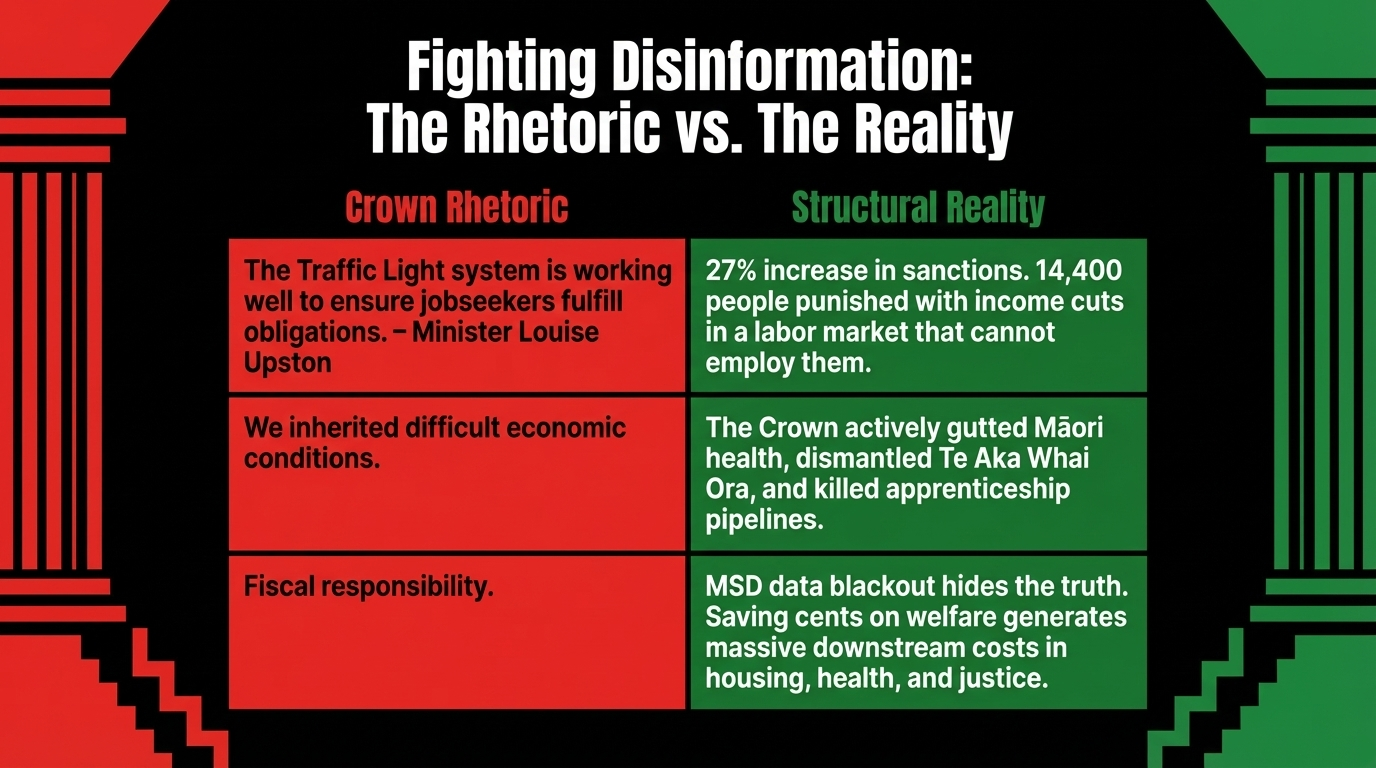
The third ancestor is the deliberate manufacturing of blame. Social Development Minister Louise Upston stood in Parliament this week and told the country that rising beneficiary numbers were the fault of the previous Labour government — as if National did not fire 14,000 public servants, gut Māori health, dismantle Te Aka Whai Ora, strip the social housing budget, and introduce a punitive traffic light sanctions regime that has so far delivered a 27 percent increase in benefit sanctions against a population with nowhere else to go. The arsonist is blaming the smoke.
💚 Koha — Feed the Accountability This Government Refuses to Fund
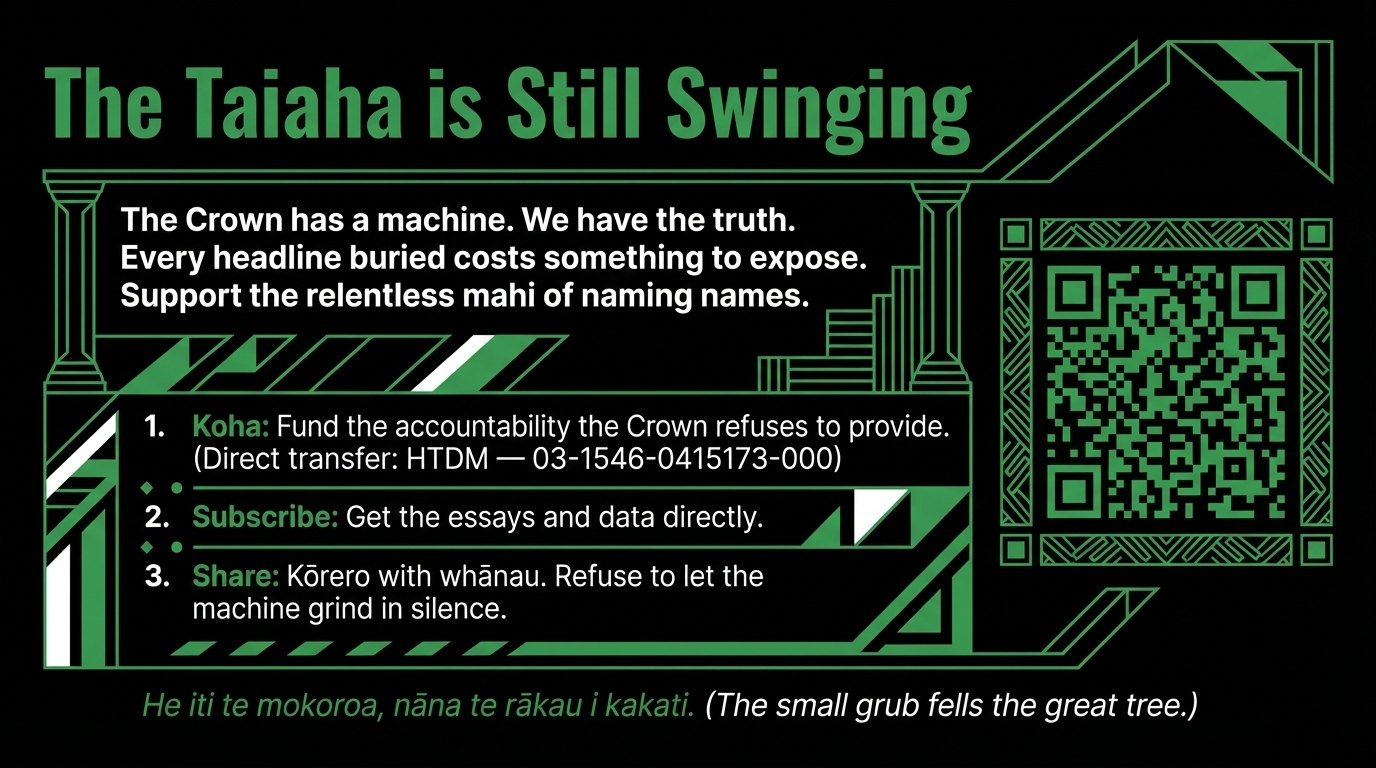
Every headline this government buries — every 427,236-person catastrophe it rebrands as "inherited conditions" — costs something to expose. The Māori Green Lantern does not have a ministerial budget, a communications team, or a lobbying firm. What it has is you, and the truth, and the relentless mahi of naming names until they cannot hide.
While Louise Upston's traffic light machine sanctions 14,400 beneficiaries and the data system conveniently breaks, this voice keeps counting — the 148,539 Māori in the benefit queue, the 25.1% of mokopuna Māori in material hardship, the 427,236 promises this government made and broke.
Every koha signals that whānau are ready to fund the accountability that Crown and corporate structures will not provide. It signals that rangatiratanga includes the power to fund our own truth-tellers — the ones who sit with the numbers, name the architects of harm, and refuse to let the machine grind in silence.
Kia kaha, whānau. Stay vigilant. Stay connected. And if you are able, consider a koha to ensure this voice continues.
If you are unable to koha, no worries — subscribe, kōrero, and share with your whānau and friends. That is koha in itself.
Three pathways exist:
🌿 Koha direct support: Koha — Support The Māori Green Lantern
📩 Subscribe to receive essays directly: Subscribe to The Māori Green Lantern
🏦 Direct bank transfer: HTDM — 03-1546-0415173-000
Ko te Mata o te Taniwha — The Face of the Beast
He taniwha tō roto, he taniwha tō waho. There are dangers within and dangers without. But this government is not a taniwha lurking in the depths — it is a taniwha that sits at the Cabinet table, signs the minutes, and issues press releases.
Let us name the taniwha's faces:
Christopher Luxon — Prime Minister, former Air New Zealand CEO worth millions, who told unemployed rangatahi this year that the solution to their joblessness was to pick kūmara in Dargaville — and when they failed to show up, blamed their work ethic. The man does not understand hunger because he has never been hungry. He does not understand precarity because his CV does not contain it. He runs economic policy for 427,000 beneficiaries from a position of total insulation from their reality.
Louise Upston — Minister of Social Development — who has spent two years building a traffic light system designed to punish poverty rather than address it, has watched Jobseeker numbers rise 18 percent under her own watch, and has had the audacity to call this "working well." As The Māori Green Lantern exposed in the February 2026 essay The Traffic Light Taiaha: How a White Supremacist Government Built a Punishment Machine, the regime Upston built has delivered 14,400 sanctions against people the economy cannot employ, manufactured a sanctions-to-foodbank pipeline, and pushed sanctioned beneficiaries toward homelessness, debt, and food poverty — with Māori disproportionately bearing every single blow.
Ko Āku Tūāhu — The Three Revelations for the Western Mind
Example One: The Youth Unemployment Trap
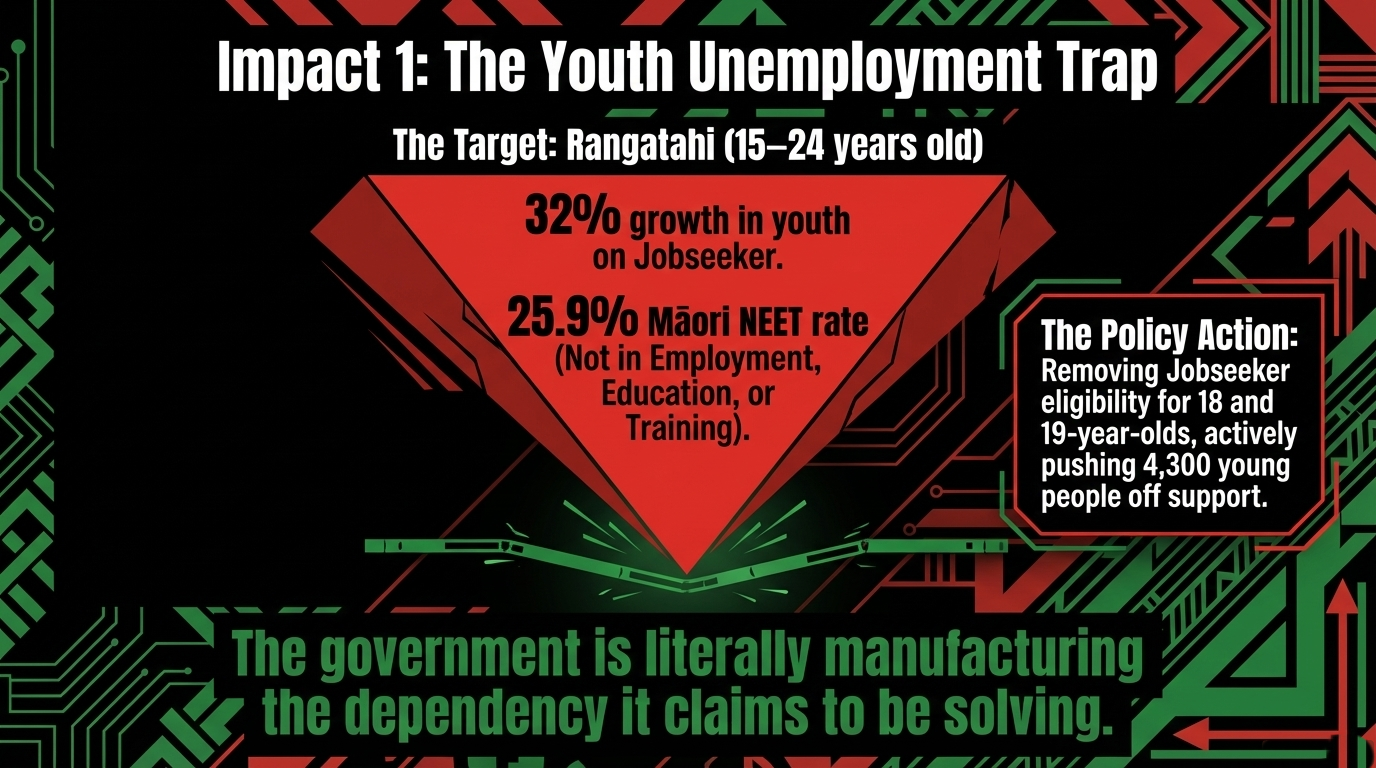
Here is a number that should end a political career: rangatahi Māori aged 15–24 face a 20.4 percent unemployment rate, while the national youth unemployment rate sits at roughly 12.9 percent for the same bracket. Māori youth aged 20–24 face a 25.9 percent NEET rate — meaning more than one in four are not in employment, education, or training. Nationally, 18 to 24-year-olds on Jobseeker benefit grew 32 percent under this government.
The government's response? In November 2025 they removed Jobseeker eligibility for 18 and 19-year-olds whose parents earn over $65,000 — a policy that, as 1News reported, will push roughly 4,300 young people off support into a labour market that cannot absorb them. A kaupapa Māori youth homelessness group warned this will put rangatahi on the streets.
Quantified harm: The Māori NEET rate for young people has increased five-fold in generational impact terms — rangatahi entering adulthood without income, skills-building, or state support will carry that economic scar for decades. MSD's own data shows each year spent on the benefit before age 25 statistically increases long-term welfare dependency. The government is literally manufacturing the dependency it claims to be solving.
For the Western mind: Imagine you're 19. Your town's largest employer closed last year. There are no new jobs. The government removes your income support, your parents can't help, and the Prime Minister suggests you go pick vegetables in a region three hours away. Now imagine that the same government cut the subsidised bus routes to that region, defunded the youth employment programme that connected you to employers, and fired the case manager at Work and Income who actually knew your name. That is not a jobs policy. That is a cruelty festival dressed in a hi-vis vest.
Solution: Restore and expand Māori-led rangatahi employment pathways such as Te Ara Mahi and the Mana in Mahi programme this government gutted. Fund sustainable trades and apprenticeship pipelines in regions with the highest Māori youth unemployment. Reintroduce Jobseeker eligibility for 18-19 year-olds unconditionally while the labour market remains 25 percent below pre-pandemic job advertisement levels.
Example Two: The Children in the Cold
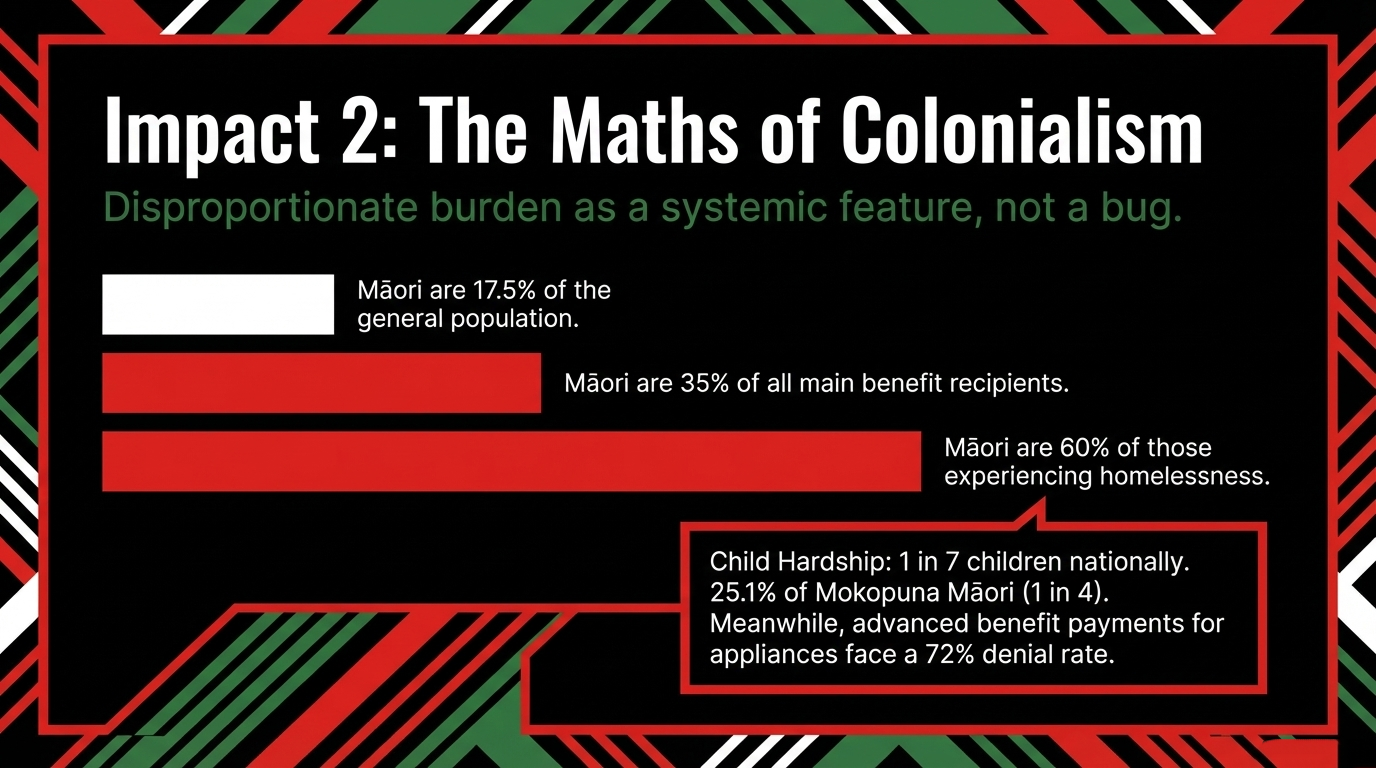
One in seven New Zealand children is living in hardship — that is official Stats NZ data for the year to June 2025, released in February 2026. For mokopuna Māori, the rate is 25.1 percent. For Pacific children, 31 percent. This is not a recession statistic — this is a governance decision. Child poverty does not just happen. It is built, budget by budget, cut by cut.
Meanwhile, application denials for advanced benefit payments skyrocketed under this government — including a 72 percent denial rate for appliances. Whānau cannot buy a heater. Whānau cannot repair a washing machine. And beneficiaries faced an inflation rate of 3.4 percent in the September 2025 quarter — higher than the national average of 2.4 percent — because the goods the poor depend on are rising faster than the goods the wealthy consume.
Quantified harm: According to The Māori Green Lantern's February 2026 investigation, there were 47,500 more children in hardship in three years — the direct yield of this government's austerity agenda across social housing, food in schools, Māori health, and welfare support. The Children's Commissioner has demanded urgent action. The government is building more sanctions.
Impact on tikanga: For the Western mind, this requires a direct translation. Manaakitanga — the obligation to uplift, care for, and protect the dignity of others — is not a cultural nicety in te ao Māori. It is constitutional. It is the operating system of society. A society that lets one in four of its mokopuna go cold and hungry has not just failed economically. It has committed a profound spiritual breach. It has damaged the mauri — the life force — of the collective whakapapa. When you damage a child's mauri, you do not just damage one person. You fracture the whakapapa line in both directions — the ancestors who gave that child existence, and the descendants that child was meant to become. For the Western mind: this is not welfare policy. This is intergenerational destruction performed by people in suits who will receive pensions.
Solution: Restore the free and healthy school lunch programme to all schools, expand it to include early childhood, and return it to kaupapa Māori providers who serve their communities with cultural competence. Fund Whānau Ora properly. Mandate child poverty impact assessments for every piece of legislation. Stop cutting the social housing budget while the waiting list sits at over 25,000.
Example Three: The Housing-Homelessness-Welfare Vortex
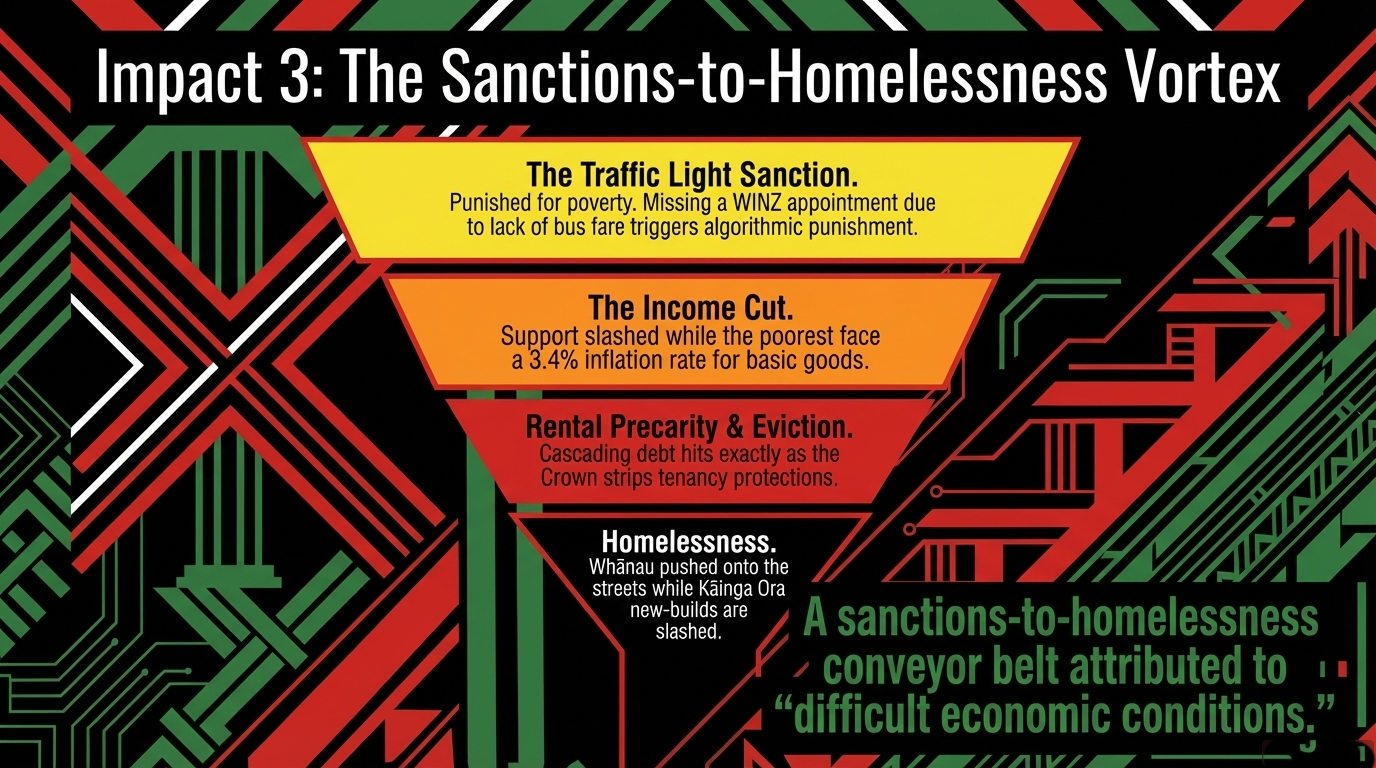
Māori home ownership has collapsed from 71 percent in 1936 to 27.5 percent in the 2023 census — a catastrophic structural decline driven by neoliberal reform, land confiscation, and legislative barriers as documented in research by MĀPIHI. Today, more than 60 percent of those experiencing homelessness identify as Māori. Māori are 17.5 percent of the population. They are 60 percent of the homeless. The maths of colonialism is brutal and consistent.
This government has slashed the Kāinga Ora new-build programme, attempted to sell state houses, and introduced legislation stripping tenancy protections. The predictable consequence: beneficiaries pushed from sanctions into rental precarity, rental precarity into eviction, eviction into homelessness — a sanctions-to-homelessness conveyor belt that this government operates and then attributes to "difficult economic conditions."
For the Western mind: Imagine your grandfather's house was taken by the government in the 1950s. You grew up renting. You lost your job when the government fired 14,000 public servants. Your benefit was sanctioned because you missed an appointment at WINZ — you couldn't afford the bus. You are now couch-surfing with four mokopuna. The government's response? A traffic light system. Green. Orange. Red. Now your benefit is cut. Welcome to 2026. The Prime Minister is at an Air New Zealand shareholder event.
Quantified harm: According to researchers at the University of Canterbury, if current trends continue, Māori will be almost entirely renters by 2061 — homeless and landless in two generations on land that belongs to them. This is not housing policy failure. This is the completion of the colonial project by financial instruments instead of muskets.
Solution: Fully fund papakāinga housing on Māori land. Restore tenancy protections removed in 2024. Reverse Kāinga Ora cuts. Establish a Māori-led housing authority with Treaty-backed authority and genuine funding. As the Māori Green Lantern previously exposed in New Zealand's Housing Crisis: A Neoliberal Nightmare Masquerading as Reform, the solutions exist — they are being actively dismantled by a government that serves landlords, not whānau.
Ngā Hononga Huna — The Hidden Connections
Five connections this government does not want you to see:
Connection 1 — The Promise-Failure Chasm. The government promised 50,000 fewer people on Jobseeker by 2030. It has delivered 33,500 more in two years. That is an 83,500-person swing in the wrong direction against the government's own target. No accountability. No resignation. No restatement of the target. Just Louise Upston at the dispatch box, blaming Labour and calling the traffic light system "working well."
Connection 2 — The Ethnic Math of Dispossession. Māori are 17.5 percent of New Zealand's population but 148,539 of the 427,236 main benefit recipients — approximately 35 percent of all beneficiaries. The annual average Māori unemployment rate reached 9.7 percent to March 2025, more than double the national average. These are not coincidences. They are the yield of colonial structural disadvantage — compounded by every policy decision this government has made, including cutting Māori-specific employment programmes, dismantling Te Aka Whai Ora, and defunding Whānau Ora.
Connection 3 — The Data Blackout. In March 2026, the Ministry of Social Development apologised for a broken data system that has left months of social housing and benefit data unpublished — with no fix in sight. When the numbers are this bad, the infrastructure for counting them mysteriously fails. This is not a server error. This is governance.
Connection 4 — The Sanctions Surge. Even as beneficiary numbers hit a 12-year high, this government increased benefit sanctions by 27 percent in the year to June 2025. As documented in The Traffic Light Taiaha, MSD's own officials found that sanctions do not increase the likelihood of finding work. They increase the likelihood of food bank visits, eviction, and debt. The government is not solving the problem. It is deepening it — deliberately.
Connection 5 — The Fiscal Hypocrisy. The government frames its welfare cruelty as fiscal responsibility. But 17,000 people descended on a single Auckland job fair in March 2026 — people desperate for work that does not exist at scale. Infometrics confirmed job advertisements remain 25 percent below pre-pandemic levels. There is no moral case for punishing people for the failure of a labour market. The fiscal case is equally hollow: every dollar cut from welfare generates cascading costs in health, housing emergency support, and justice. The Crown is saving cents and spending dollars — and the poorest whānau are paying the exchange rate.
Ko Te Tikanga i Pakaru — What Has Been Broken
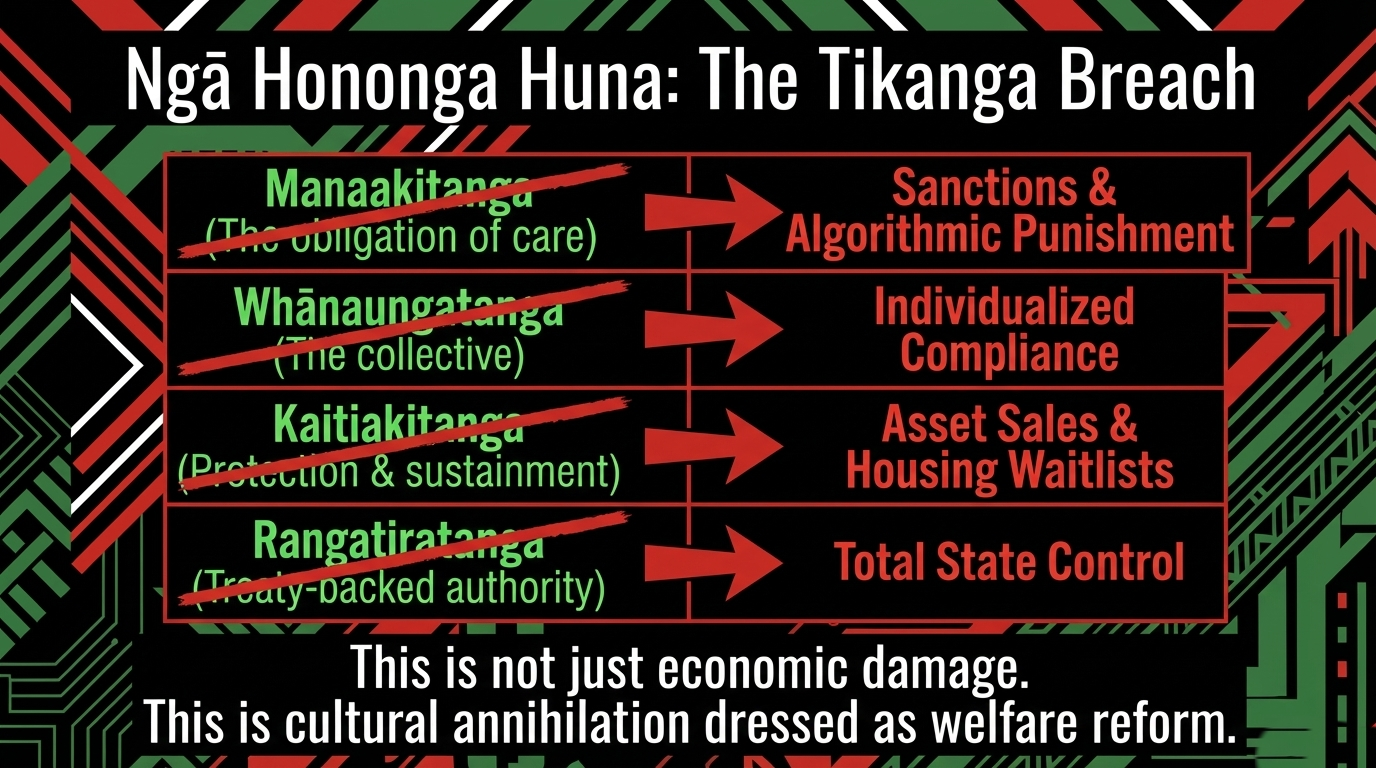
For those coming to this through a Western lens, hear this carefully: tikanga is not a cultural preference. It is not an ethnic flavour added to policy documents for diversity optics. Tikanga is the lawful framework for right relationships — between people, between generations, between the living and the dead, between the land and its stewards.
Manaakitanga — the obligation to elevate others — has been replaced by sanctions.
Whānaungatanga — the obligation of collective care — has been replaced by individualised compliance obligations.
Kaitiakitanga — the obligation to protect and sustain — has been replaced by asset sales and housing waitlists.
Rangatiratanga — the authority guaranteed under Article Two of Te Tiriti o Waitangi — has been replaced by a traffic light system that decides the fate of Māori whānau with an algorithm designed by people who have never sat in a WINZ waiting room.
This is the true cost of what this government is doing. Not just economic damage. Not just political failure. Cultural annihilation dressed as welfare reform.
Ko te Whakaaro Whakamutunga — The Verdict
The mauri of this country's welfare system has been destroyed. What remains is a machine — 427,236 people feeding it, Māori disproportionately ground by its gears, children going cold in its shadow, and Louise Upston standing before the cameras calling the machine "working well."
Christopher Luxon promised a government that lifts New Zealanders. He has delivered a government that counts them, punishes them, and blames them — while the numbers climb, the promises collapse, and the mokopuna go hungry.
As previously exposed on The Spectacle of Poverty: How Neo-Liberal Housing Policy Weaponises the Working Poor and in The Neoliberal Whakapapa of Exploitation, these connections are not new. The whakapapa of harm is long, documented, and verifiable.
The taniwha has a name. It wears a suit. It blames the previous government. And it is coming for the benefit, the house, and the future of your mokopuna — one traffic light at a time.
Ko au ko koe, ko koe ko au. I am you, you are me. What is done to one of us is done to all of us.
The taiaha is still swinging, whānau.

Ivor Jones The Māori Green Lantern Fighting Misinformation And Disinformation Frorm The Far Right
He iti te mokoroa, nāna te rākau i kakati. The small grub fells the great tree.