“Māori Are Being Constructively Dismissed From Aotearoa” - 27 November 2025
A Māori Green Lantern Analysis
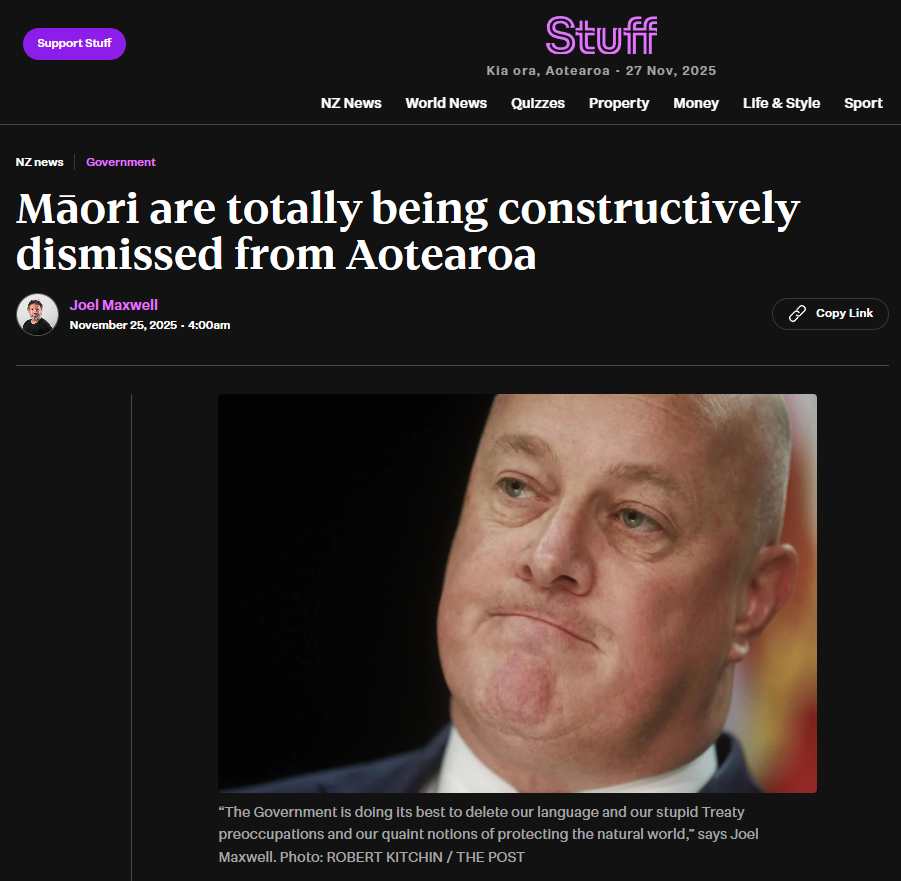
Joel Maxwell (Te Rarawa) has articulated a scathing indictment of the New Zealand coalition government’s systematic dismantling of Māori-centred policies and language initiatives. The claim deserves sustained examination because it captures a pattern of government action that, while presented as policy efficiency, amounts to institutional erasure of te reo Māori and Māori institutional autonomy.
The Migration Crisis and Youth Departure
Maxwell’s opening gambit—that the government is driving young people offshore—rests on solid demographic data.
Nearly 40% of the record number of New Zealanders who left the country in the year to September 2025 were aged 18 to 30, as revealed by 1News. In absolute terms, 72,700 New Zealand citizens departed in the 12 months to September 2025, marking departures at 126,400 when including all categories, up 10% on the year before. This represents the highest level of citizen departures since the Global Financial Crisis in 2011-12, when 72,401 left.
Youth unemployment sits at 15.2%, the highest rate for young people aged 15-24, according to Stats NZ labour market data released by 1News. This statistic, cited precisely by Maxwell, is verified and represents the highest youth unemployment rate in recent years. The connection Maxwell draws between these figures and government policy is implicit but pointed: a government presiding over a 5.3% overall unemployment rate (the highest in nine years) and 160,000 total unemployed (the highest since early 1994) is either incompetent or deliberately driving people away.
The cost of living crisis Maxwell references is reflected in specific commodity price inflation. Instant coffee prices surged 25.5% annually by October 2025, reaching $7.88 per 100 grams. Fresh eggs rose 18.5% annually to $9.88 per dozen, while milk jumped 13.5% annually. These are not abstract statistics—they are the material conditions facing households deciding whether to stay or emigrate.

Young New Zealanders departing Auckland Airport amid record emigration
Labour’s finance spokesperson made the connection explicit:
“With a youth unemployment rate of 15.2%, it was ‘no wonder’ more than 200 Kiwis were packing up and leaving for jobs overseas“ said Barbara Edmonds.
The Systematic Deletion of Māori Language and Institutional Presence
Maxwell’s claim that “the Government is doing its best to delete our language” from “ministries, health services, schools and even road signs” is verifiable across multiple government actions.
Te Aka Whai Ora Abolished Under Urgency
The Māori Health Authority (Te Aka Whai Ora) was disestablished on 30 June 2024 after being rushed through Parliament under urgency in February 2024. The authority had been established only in 2022, giving it just two years to operate before the coalition government scrapped it.
The timing and method mattered. The Crown passed legislation under urgency on 5 March 2024, removing the Tribunal’s jurisdiction to hear claims challenging the disestablishment decision. This was not policy evolution; it was institutional erasure by statutory short-circuiting.
In November 2024, the Waitangi Tribunal found the disestablishment had breached several Treaty principles. The Tribunal concluded that the Crown breached principles of tino rangatiratanga, good government, partnership – including duties of consultation and acting in good faith – active protection, and redress. The Crown had not adequately consulted Māori and had bypassed normal policy processes by using urgency and parliamentary sovereignty against indigenous rights.
The Tribunal found that Māori had not been given the opportunity to engage as Tiriti partners in the decision to disestablish Te Aka Whai Ora, and the Crown failed to conduct a robust policy process and did not follow its own regulatory impact analysis guidelines.
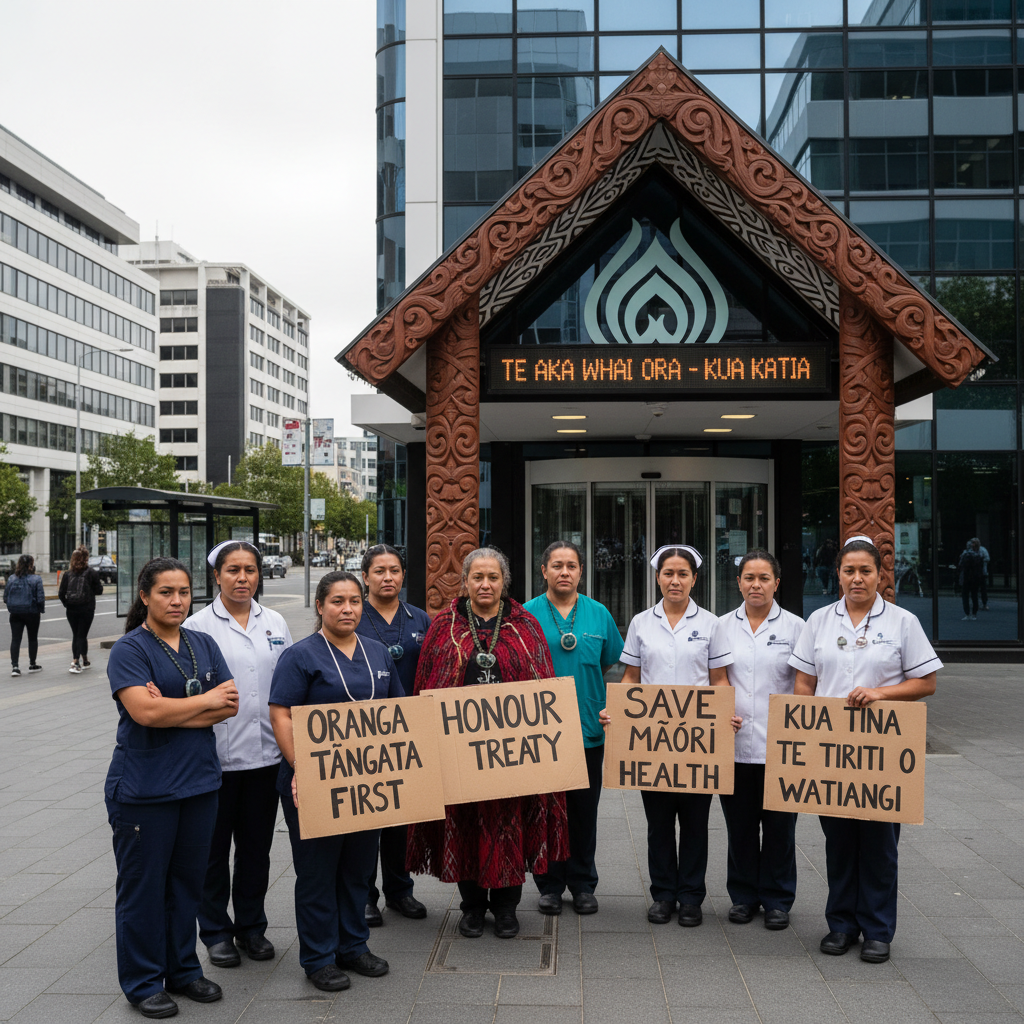
Māori health workers after disestablishment of Te Aka Whai Ora
Te Reo Māori Funding and Teacher Support Decimated
The government cut $30 million from the Te Ahu o te Reo Māori programme, which provided free teacher training to integrate te reo into classrooms. Education Minister Erica Stanford defended the cut by claiming a review found the programme was not affecting student achievement, though she initially refused to release the review itself.
Teachers and unions disputed this claim. NZEI Te Riu Rua president Mark Potter called the cut “short-sighted” and questioned why te reo funding was being slashed so soon after Te Wiki o Te Reo Māori celebrations.
Budget 2025 brought further cuts: the government proposed defunding Resource Teachers of Māori and Resource Teachers of Literacy. In February 2025, NZEI Te Riu Rua warned this was “another gut punch to Māori” and signalled intent to explore legal action to stop the cuts.
Te Reo Māori Scrubbed from Public Services
The Waitangi Tribunal found in October 2025 that the Government breached Te Tiriti by deprioritising or removing te reo Māori from the names of public service departments and Crown entities. This was not accidental: it was policy. The Crown prioritised English in public service communications and limited access to te reo Māori allowances within the public sector.
The Tribunal found that the Crown breached several principles of te Tiriti including those of tino rangatiratanga, partnership, active protection, equity, and good government. By deprioritising the use of te reo in the public service, the Crown had expressed a lack of commitment to the revitalisation of te reo and had reinforced existing inequities between the status of English and te reo Māori.
Road Signs and the “Māorification” Debate
Maxwell’s reference to road signs captures real government action. The bilingual road sign programme, which would have gradually introduced te reo Māori on traffic signs, was stalled by the incoming coalition government. Transport Minister Simeon Brown shelved the decision indefinitely in early 2024.

Te reo Māori road signage being removed from New Zealand highways
By May 2025, the issue had become more concrete. **A reo Māori-only stop-go sign (”Taihoa” and “Haere”) was pulled from roadworks on Matapiro Road in Hawke’s Bay*. Ngāti Kahungunu chair Bayden Barber called the removal racist, stating: “This is not about rules - it’s about racism.”
Prime Minister Luxon defended the removal, saying the stop-go signs needed to be “very unambiguous.” The subtext is stark: the government saw te reo Māori on road signs not as language revitalisation but as visual clutter requiring removal.
The Treaty Principles Bill: Failed But Symbolic
Maxwell’s reference to “stupid Treaty preoccupations” under government pressure connects to the coalition’s assault on the Treaty itself. ACT leader David Seymour’s Treaty Principles Bill was voted down 112 to 11 on 10 April 2025 at its second reading, with only ACT supporting it. National and New Zealand First refused to back it.
Yet the battle over the bill’s content illuminated government intent. The Waitangi Tribunal found in August 2024 that the Bill was “little more than a politically motivated attack on perceived ‘Māori privilege’” and would constitute “the worst, most comprehensive breach of the Treaty/te Tiriti in modern times” if enacted. The Crown had failed to consult Māori on the bill and breached principles of partnership.
While the bill failed, its introduction—along with the parallel Treaty Clause Review—signalled a government willing to interrogate and potentially pare back Treaty protections as a matter of ideological priority. Written submissions were 90% opposed to the bill, with only 8% supportive.
Co-Governance Rolled Back
Maxwell’s phrase about “stupid...Treaty preoccupations” captures the government’s hostility to co-governance frameworks. The government abolished the Māori Health Authority’s co-commissioning provisions and removed joint decision-making. Iwi-Māori Partnership Boards lost veto power over locality plans and annual reports.
More broadly, the government required councils to hold referendums on Māori wards established without local polls, undoing Labour government provisions that had given councils final decision-making authority. Over 50 mayors and regional council chairs protested the move as an overreach.
The 100-Day Assault Under Urgency
Maxwell’s broader critique extends to government economic management framed through process. The coalition government passed more bills under urgency in its first 100 days than any government in New Zealand history.
According to analysis, the government passed more bills under urgency in seven weeks than the average entire government term. By comparison, a study of 24 years of New Zealand’s parliament (1987-2010) showed the average number of bills passed through all stages under urgency was 10 per entire term—the coalition hit that in seven weeks.
Among the 21 bills passed under urgency, 13 were passed through all stages without any opportunity for public select committee submissions, meaning communities, iwi, and civil society organisations had no formal avenue to provide feedback.
The Pattern: Strategic Erasure or Ideological Alignment?
A coherent ideological project emerges: to roll back what the government frames as “race-based policies” and remove institutional mechanisms for Māori autonomy and self-determination.
This is not speculation. The Beehive website documents that in its first 100 days, the coalition government passed legislation to repeal or reverse policies at record speed. Between Budget 2024 and Budget 2025, Labour claimed the government cut over $1 billion in Māori-specific funding, though the government disputed the framing.
Implications: The Mauri-Depleting Architecture
Under mātauranga Māori frameworks, actions that diminish the capacity of Māori institutions to function, remove Māori language from public life, and drain resources from Māori communities constitute mauri-depletion—a sapping of vital essence and collective wellbeing.
The government’s actions across health, education, language, and governance represent a systematic mauri-depletion operating through bureaucratic process rather than direct violence. The Waitangi Tribunal concluded in multiple reports that these policies breached principles of partnership, active protection, and rangatiratanga (self-determination) embedded in te Tiriti o Waitangi.
The Crown has breached its obligations to consult Māori and had bypassed normal policy processes by using urgency and parliamentary sovereignty against indigenous rights.
Cui Bono, Cui Malo?
Maxwell’s essay asks cui bono (who benefits?) from a policy framework that drives young people offshore, strangles te reo Māori in public institutions, eliminates Māori health autonomy, and removes co-governance protections. The beneficiaries, by his logic, are farmers selling luxury items, landlords, and billionaire doomsday preppers—a hollowed-out Aotearoa reserved for a narrow economic elite.
Whether this reflects deliberate intent or ideological alignment, the effect is identical:
Māori institutional capacity is being systematically dismantled, te reo Māori is being scrubbed from public visibility, and young New Zealanders—Māori and Pākehā alike—are being pushed toward Australia.
The coalition government’s actions across health, education, language policy, and governance constitute what can accurately be described as constructive dismissal of Māori from full participation in national life.
This is not incompetence. It is policy.

Ivor Jones The Māori Green Lantern Fighting Misinformation And Disinformation From The Far Right
Supporting The Māori Green Lantern: Koha Pathways
Whānau supporting The Māori Green Lantern can choose from three flexible pathways aligned with tikanga Māori principles of manaakitanga (hospitality and reciprocal care), whanaungatanga (relationship-building), and rangatiratanga (self-determination).
Koha.Kiwi: Flexible Giving Tiers
Via Koha.Kiwi, supporters can select from preset donation tiers tailored to different forms of support:
- $5–$10: Kai and research support — fuelling our investigative work
- $20–$50: Investigative journalism — directly funding story development and verification
- $100–$250: Campaign amplification — supporting distribution and community reach
- $500+: Structural operations — enabling long-term sustainability
Alternatively, contribute custom amounts to our verified Westpac account:
HTDM: 03-1546-0415173-000
Substack Subscription: Recurring Direct Funding
Readers can subscribe to The Māori Green Lantern on Substack with access to all free content, or select a paid tier for recurring monthly support:
- Supporter ($5–$10/month): Direct funding with monthly updates on our research
- Advocate ($15–$25/month): Deeper engagement with behind-the-scenes analysis and priority response to reader questions
- Guardian ($50+/month): Maximum impact tier with exclusive strategic briefings and direct input into editorial direction
One-Time Koha: Any Amount, Anytime
One-time koha of any amount is available through Koha.Kiwi, Substack, or direct bank transfer—no minimum, no pressure.
Complete Transparency & Accountability
All koha methods offer immediate whanaungatanga (relationship accountability):
- Koha.Kiwi and Substack provide automatic receipts and platform visibility
- Direct bank transfers to HTDM appear on our public audit statement, ensuring complete transparency
- Every contributor receives email updates detailing how their koha supports research operations, counter-disinformation strategy, and mātauranga Māori journalism
Whether contributing $5 once or $50 monthly, every koha upholds rangatiratanga—reader self-determination—with no corporate interference, no subscription walls, and all analysis freely accessible to whānau and communities.
Donate Now
Koha.Kiwi | Substack | Bank: HTDM – 03-1546-0415173-000