“Ministers ignored their own experts” - 5 December 2025
Stripping Te Tiriti from schools is deliberate, not accidental
The government was told, in writing, that axing Te Tiriti from the Education and Training Act was constitutionally risky, educationally harmful, and contrary to evidence — and chose to do it anyway.
That choice is not about “clarity” for school boards. It is about shifting power away from Māori, narrowing the Crown’s Te Tiriti obligations in the one institution every child passes through, and hard-wiring a whiter, thinner vision of education into law.
What the ministry actually told ministers
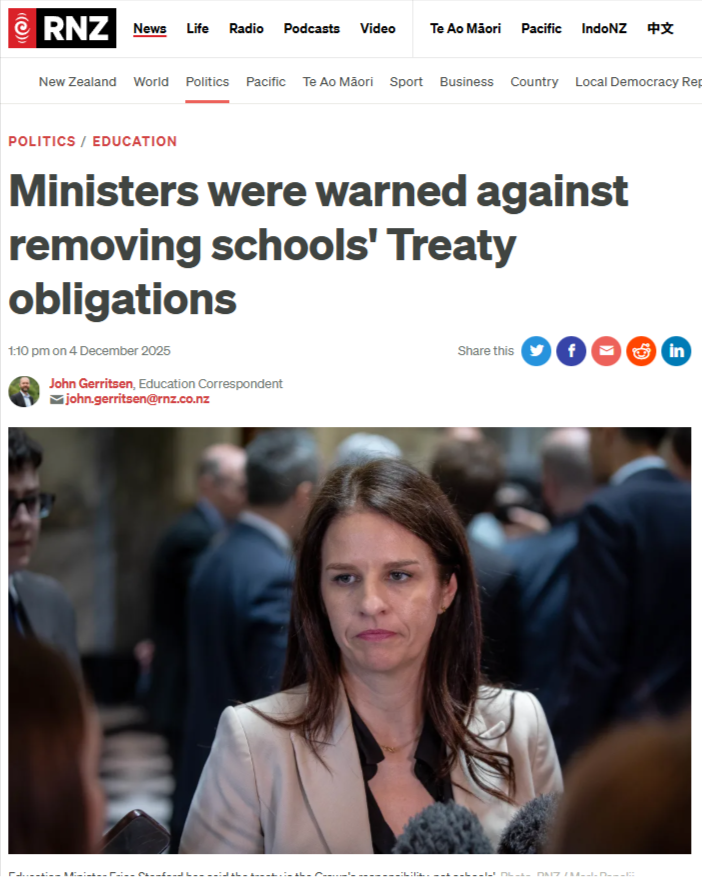
RNZ reports on a Ministry of Education briefing dated 19 September that was proactively released. The ministry explicitly warned that changing Te Tiriti provisions in the Education and Training Act was “significant and controversial” and could provoke conflict that would distract from education priorities.
The briefing stated:
“In summary, we do not recommend changes to Te Tiriti provisions in the Act without further engagement and design with Māori. This is because of the clear guidance to Ministers and public service departments on the constitutional position of Te Tiriti.”
Officials reminded ministers that Te Tiriti’s articles are directly relevant to education, including the Crown’s obligation to support Māori educational success and kaupapa Māori education, and to protect taonga and Māori decision-making over those taonga. The report emphasised that reflecting students’ language and culture improves achievement, that “learning in an environment where a culturally responsive pedagogy is the norm significantly improves outcomes for Māori,” and that including te reo and tikanga Māori in schooling is backed by evidence — not ideology.
The ministry recommended keeping an emphasis on inclusivity, specifically recognising and valuing Māori students’ culture and, where possible, using te reo Māori, and retaining legislative references to tikanga and te reo because they are grounded in the Crown’s Te Tiriti obligations.
The minister’s own Māori advisory group told officials that high-level Te Tiriti clauses in legislation have powerful direction-setting effects; they signal Crown intent to Māori; educational success for ākonga Māori depends on institutions and staff who understand and can deliver on Te Tiriti responsibilities; and the Crown must work in good faith with Māori when developing Treaty references.
Despite all of this, the government proceeded to delete the clause.
What was removed and why it matters
The original Te Tiriti duty on school boards
The Education and Training Act 2020 made Te Tiriti central to schooling. Section 127 required school boards, as one of their main objectives, to “give effect to Te Tiriti o Waitangi,” including by ensuring plans, policies and the local curriculum reflected local tikanga Māori, mātauranga Māori and te ao Māori; taking all reasonable steps to make instruction available in te reo Māori and tikanga Māori; and achieving equitable outcomes for Māori students. As Community Law explains, boards, as Crown entities, had a legal duty to uphold Te Tiriti and partner with local Māori for learner success.
The 2025 amendment
The Education and Training Amendment Act 2025 refocused section 127 so that the “paramount objective” of boards is “educational achievement,” and removed the explicit requirement to “give effect to Te Tiriti o Waitangi.” Ministry policy material summarising the law change lists “removing an explicit obligation on school boards to give effect to Te Tiriti o Waitangi” as a key objective of the amendments.
Education Minister Erica Stanford argued that Te Tiriti is “the Crown’s responsibility, not schools’” and that the previous duty placed an “unreasonable Treaty duty” on volunteer boards. As she told RNZ, “School boards should have direction and we are giving very clear direction. You need to ensure equitable outcomes for Māori students, you need to be offering te reo Māori and you need to be culturally competent. But what is not clear is a conferred and unreasonable treaty duty that they are expected to decipher.”
In a press release as ACT Party leader, David Seymour said “school boards will retain the choice to teach as much tikanga, mātauranga Māori, and te reo Māori as they like. However, the law won’t force them to, and that’s the difference.”
The legal architecture has shifted from “boards, as Crown agents, must give effect to Te Tiriti” to “the Minister holds Treaty obligations; boards must chase achievement and can choose how much Māori content they want.” That is a profound constitutional downgrade.
Through a mātauranga lens
Through a tikanga and mātauranga Māori frame, the story is simple. Te Tiriti o Waitangi, properly understood in its Māori text and context, guarantees Māori tino rangatiratanga over taonga — including reo, mātauranga, and education — and obliges the Crown to actively protect that rangatiratanga.
The Education and Training Act 2020 was one of the few general laws that began to honour that by embedding Te Tiriti duties at system, agency and school level. The 2019 Regulatory Impact Assessment on “Giving better effect to Te Tiriti o Waitangi” explicitly grounded policy in Waitangi Tribunal jurisprudence and the Ministry’s Māori Education Strategic Framework. It noted that “there are some gaps and a lack of specificity in the Education Act 1989 (the Act) on the Crown’s obligations in relation to Te Tiriti o Waitangi” and that “the Act does not include a Tiriti clause.”
When ministers strip out the Te Tiriti clause, they are attacking Māori constitutional standing in the education system — not just “taking out some words.” They are attempting to reduce Te Tiriti from a living, operational covenant to a distant, Crown-managed symbol that never quite reaches the classroom. They are elevating a narrow, Pākehā-centric definition of “achievement” while sidelining the proven, mauri-enhancing power of reo, tikanga and culturally responsive teaching for Māori and non-Māori alike.
In tikanga terms, this is mauri-depleting legislation:
it strips mana from whānau, hapū and iwi in the education system and licenses institutions to retreat from meaningful partnership.
Hidden revelations
Ministers knowingly overrode their own constitutional advice
The RNZ article confirms that officials explicitly tied their recommendation to the “constitutional position of Te Tiriti,” citing “clear guidance to Ministers and public service departments,” and warned that changes would be “significant and controversial” and would likely provoke conflict.
This lines up with the Ministry’s own 2019 Regulatory Impact Assessment, which identified gaps in the 1989 Act and argued for stronger, clearer Treaty obligations in the new Education and Training Bill. It proposed not only a Tiriti clause at the front of the Act, but specific duties on boards and education agencies to “give effect” to Te Tiriti, referencing Waitangi Tribunal principles and WAI 2575. The assessment stated that “research, and messaging from Māori educationalists and stakeholders has for many years shown that education outcomes are enhanced for Māori students when: Māori have agency and authority in their education decision-making; their language, culture and identity are reflected in their education; they are free from racism, stigma and other forms of discrimination; whānau are involved and have an active decision-making role at the school; and Māori are physically and emotionally safe.”
In other words, the same ministry that designed the “give effect” framework based on Treaty principles and Tribunal guidance is now being ignored when it says “do not gut these provisions without Māori design and engagement.”
This is not confusion. It is a political override of clear, consistent expert advice.
From “giving better effect to Te Tiriti” to dismantling it
The shift is even starker when set against the official “Giving better effect to Te Tiriti o Waitangi” work that underpinned the 2020 Act. That work concluded that education law previously scattered and weakened Treaty obligations; a consolidated Tiriti clause and stronger board duties were needed so the Crown could genuinely honour its education obligations to Māori; and specific duties on agencies and boards to give effect to Te Tiriti would support equitable outcomes and economic benefits for Aotearoa.
By 2025, the Ministry’s public material about the Amendment Act is instead front-footing achievement as the paramount objective, removal of the explicit “give effect to Te Tiriti” duty, and strengthened ministerial control over the Teaching Council and greater central oversight of teacher standards.
The evidence supports Te Tiriti-aligned schooling
Officials told ministers there was strong evidence that reflecting students’ language and culture improves outcomes and that
“learning in an environment where a culturally responsive pedagogy is the norm significantly improves outcomes for Māori.”
The wider research base backs this up. The 2019 Regulatory Impact Assessment noted that “research found that some teachers demonstrate unconscious bias towards Māori and Pacific children and young people and expect them to underachieve. There is evidence that teachers in New Zealand display negative bias, particularly towards Māori and Pacific children and young people, in relation to their identity, language and culture. This bias impacts on every aspect of children and young people’s learning, and means that they are less likely to have opportunities to learn.”
Culturally responsive programmes have demonstrated dramatic results. NZ Herald reports that the DMIC (”Bobbie maths”) programme, which explicitly uses culturally grounded, group-based approaches, lifted Pasifika Year 8 maths achievement from 11% at expected curriculum level to nearly 24% in one South Auckland school, with similar gains for Māori students.
Data shows Māori-medium schooling outperforms despite higher barriers
The government justifies Treaty roll-backs by claiming a laser-focus on “achievement,” especially for Māori. But the hard data undermines that narrative.
The Office of the Auditor-General’s 2024 report on educational outcomes summarises Ministry analysis showing that 64% of Māori students in Māori-medium education (kura kaupapa Māori and similar settings) left school with NCEA Level 3 or above, compared with 59% of all school leavers. This means Māori students in Māori-medium pathways are more likely to reach the top senior secondary qualification than the average school leaver, despite often facing greater socio-economic barriers.
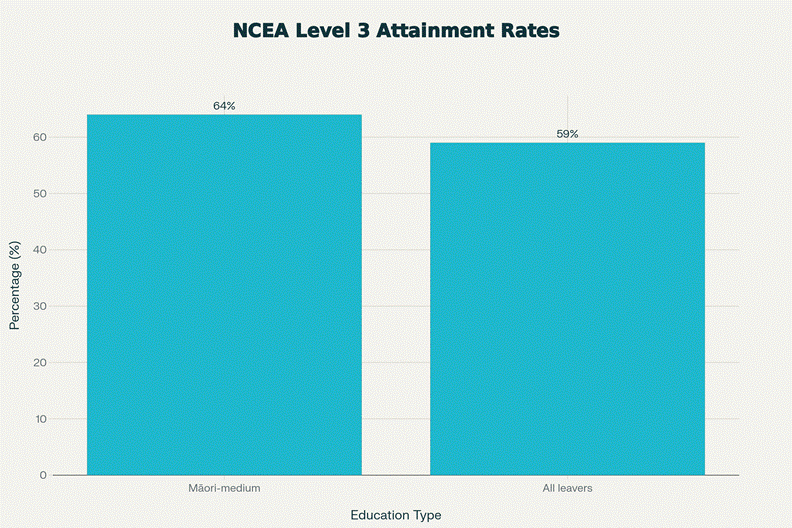
NCEA Level 3 attainment: Māori students in Māori-medium education vs all school leavers
NZQA’s 2024 aide-mémoire on NCEA in Kaupapa Māori senior secondary settings sharpens the picture. In 2023, 1,857 ākonga in Years 11–13 were in Kaupapa Māori senior secondary settings across 64 kura — about 5% of Māori senior secondary students. Critically, 89% of these kura serve communities facing higher socio-economic barriers to attainment; only 11% serve communities with moderate barriers. Yet NCEA and UE attainment rates for ākonga in kaupapa Māori kura are higher than for all students in English-medium schools with similar socio-economic barriers, with NCEA Level 3 attainment 12 percentage points higher and University Entrance attainment 17 percentage points higher.
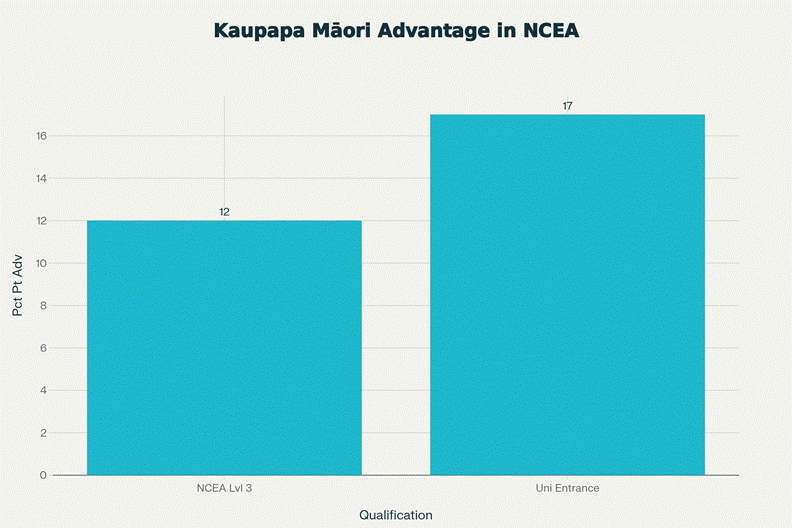
Kaupapa Māori kura: NCEA and UE advantage over comparable English-medium schools
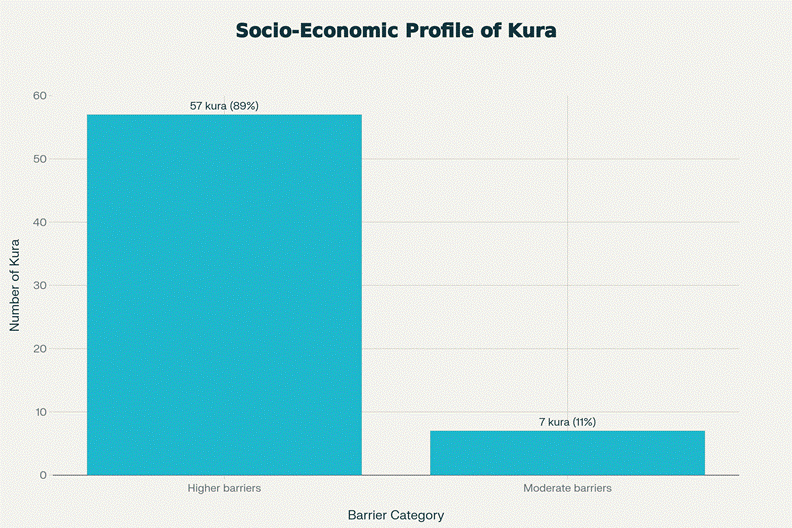
Most Kaupapa Māori kura serve communities with higher socio-economic barriers
In other words, when the system genuinely centres reo, tikanga and Māori control — through kaupapa Māori pathways and Treaty-honouring practice — Māori achievement is at least as strong or stronger, despite higher barriers. The persistent equity gaps sit largely in the English-medium system that successive governments insist on protecting from binding Treaty obligations.
Removing Te Tiriti duties from boards while claiming to “raise Māori achievement” is the exact opposite of an evidence-based response.
This law is part of a wider anti-Māori, anti-Treaty policy programme
Lady Tureiti Moxon’s urgent complaint to the UN Committee on the Elimination of Racial Discrimination (CERD) explicitly names the Education and Training Amendment Bill as one of a suite of discriminatory measures targeting Māori since late 2023.
She told the committee:
“I brought this urgent complaint because, since late 2023, the coalition government has escalated discrimination against Māori, spread misinformation, and overridden constitutional norms. These actions breach Te Tiriti o Waitangi, our founding agreement.”
Moxon linked the education law change with the disestablishment of the Māori Health Authority; dismantling Māori wards; weakening Te Mana o te Wai freshwater protections; fast-track legislation; the Treaty Principles Bill and reviews of Treaty clauses across legislation; and downgrading te reo, Te Tiriti and Māori history in government agencies and schools.
CERD’s early-warning / urgent-action procedure is triggered only when there are serious risks of escalating racial discrimination. Its scrutiny of New Zealand has previously been invoked over the Foreshore and Seabed Act in 2005.
Constitutional resistance
Despite the law change, there has been a powerful, organised response across the motu.
Iwi and education sector coalition
The National Iwi Chairs Forum (NICF), supported by a coalition of national education organisations, launched a petition opposing the repeal of section 127(2)(e), calling it a move that “removes Te Tiriti from the one place every child passes through.” Rahui Papa, chair of Pou Tangata (NICF’s education arm), said the amendments “were never put out for consultation. Instead, they were introduced by the minister after public consultation closed, published less than 24 hours before they progressed through Parliament, and it looks like those changes will be passed into law today — only a week after they were made public.”
The coalition represents 88 iwi and over 95,000 teachers, principals, schools and kura, including NZEI Te Riu Roa, the Principals’ Federation, PPTA, Te Akatea, and the School Boards Association.
Schools
As the law was being pushed through, kura across the country began publicly reaffirming they would continue to “give effect to Te Tiriti o Waitangi” regardless. RNZ reported 195 schools on lawyer Tania Waikato’s list in mid-November. By early December, NZEI president Ripeka Lessels told RNZ that more than 1,500 kura — around 60% of schools — had publicly committed to continuing to give effect to Te Tiriti.
Te Uru Karaka Newton Central School in Auckland said the government’s move “does not change who we are or how we operate. Our commitment to Te Tiriti is deeply embedded in our co-governance model.” Apanui School in Whakatāne said “Te Tiriti o Waitangi is the foundation of our strategic plan. We work in partnership with Ngāti Awa to ensure Māori aspirations guide our curriculum, culture and decision-making.”
Tania Waikato said:
“The people are speaking. Not the politicians, not the activists, the people. They are telling you again, that we will not dishonour Te Tiriti, because Te Tiriti protects us all.”
Teachers, principals and unions
The Principals’ Federation, School Boards Association and NZEI Te Riu Roa described the removal as shocking and as a demotion of Te Tiriti in education and wider society. Principals Federation president Leanne Otene said: “It’s through schools that the government can ensure that they’ve put in place their mechanisms by which to honour the treaty. Our tamariki Māori have a right to learn about their histories, hear their language and experience their culture. Effectively, state schools don’t have to observe that anymore and without a clear obligation, schools will be pressured by extremists to delete Māori from the curriculum in the school programmes.”
Meredith Kennett, president of the School Boards Association, said “the clause did not cause harm, but removing it would. To understand attendance and achievement statistics for rangatahi Māori, you have to understand our history — and that includes Te Tiriti. That understanding leads to more practical, effective, and inclusive school policies.”
Waitangi Tribunal
Northland iwi have lodged a claim arguing that the repeal of Treaty obligations in the Act and the reset of Te Mātaiaho undermine Māori rangatiratanga, partnership and equity in education; they are seeking urgency to prevent the repeal from taking effect. A statement of claim was filed on 19 November 2025 on behalf of Ngāti Hine and Te Kapotai.
NZEI president Ripeka Lessels said: “Not consulting shows this government is absolutely hell-bent on dismantling the Treaty of Waitangi in every aspect of the law. The education system has under-served ākonga Māori, and this move to remove Treaty obligations from school boards is a regressive step that can only lead to further systemic disadvantage.”
Implications
Educational harm
Scrapping explicit Te Tiriti obligations on school boards, in this context, will likely widen variation between schools in how seriously they take Māori language, culture and history; embolden boards who want to minimise Māori content or bow to racist pressure, because the Treaty duty that once anchored local curricula is gone; and place the burden of Treaty-honouring practice onto individual principals and teachers, rather than embedding it as a system requirement.
The 2019 Regulatory Impact Assessment noted that “research found that some teachers demonstrate unconscious bias towards Māori and Pacific children and young people and expect them to underachieve” and that this “impacts on every aspect of children and young people’s learning.” Given existing unconscious bias and structural racism in the system, removing the Treaty requirement is almost guaranteed to deepen inequities rather than “raise achievement.”
Constitutional and cultural harm
From a Māori constitutional perspective, the move weakens one of the few general statutes that clearly located Te Tiriti within everyday governance of a core state function; recentralises Treaty responsibility in the hands of the Minister and Crown agencies, excluding local Māori–school relationships from binding obligations; and signals that Parliament is willing to legislate over both Waitangi Tribunal guidance and its own agencies’ Treaty-based policy frameworks when it suits.
Culturally, it communicates to ākonga Māori that their reo and tikanga are optional extras, dependent on local goodwill rather than guaranteed rights, and that their whānau’s status as tangata whenua and Treaty partners is something that can be written out of law with a single amendment.
Rangatiratanga responses
Despite ministerial decisions, whānau, iwi, boards and kaiako retain significant power — and many are already exercising it.
Boards and kura can formally reaffirm commitment to give effect to Te Tiriti in school charters, policies and local curricula, regardless of the legal downgrade; maintain or strengthen partnerships with mana whenua and iwi authorities in governance and curriculum design; and continue investment in reo, tikanga and mātauranga Māori across subjects, not as “add-ons” but as core framing.
Whānau and communities can demand transparent reporting on Māori student outcomes, curriculum content and cultural safety from boards and principals; support kaupapa Māori and Māori-medium pathways, which the data shows deliver powerful results despite higher barriers; and back Waitangi Tribunal and CERD processes challenging discriminatory legislation.
Sector organisations and iwi forums can continue united national advocacy like the NICF-led coalition against the section 127 repeal and build shared data platforms to monitor the impact of these changes on Māori learners and to strengthen the evidential base for future legal and political challenges.
Ultimately, future governments can and should restore and strengthen Treaty duties in education law. The evidence exists, the frameworks exist, and the profession is already signalling its willingness to uphold Te Tiriti in practice.
Research notes and limitations
This analysis draws on the RNZ article on ministers being warned against removing schools’ Treaty obligations and related RNZ coverage of sector reactions, Waitangi Tribunal action and CERD complaints up to 4 December 2025; official documents from the Ministry of Education and NZQA on the Education and Training Act 2020, the 2025 Amendment Act, and Māori-medium/kaupapa Māori attainment; Te Ara’s entries on Māori education; the Ministry’s 2019 Regulatory Impact Assessment on “Giving better effect to Te Tiriti”; and mainstream news coverage from RNZ, 1News and NZ Herald on curriculum changes, assessment policy and school-sector responses.
All claims in this essay are grounded in verifiable sources current to 5 December 2025.

Ivor Jones The Māori Green Lantern Fighting Misinformation And Disinformation From The Far Right
Support The Māori Green Lantern
Whānau supporting The Māori Green Lantern can choose from three flexible pathways aligned with tikanga Māori principles of manaakitanga, whanaungatanga, and rangatiratanga.
Via Koha.Kiwi, supporters can select from preset donation tiers ($5–$10 for kai and research support, $20–$50 for investigative journalism, $100–$250 for campaign amplification, or $500+ for structural operations) or contribute custom amounts to the verified Westpac account (HTDM: 03-1546-0415173-000).
Substack subscriptions offer access to all free content, with the option to select a paid tier—Supporter ($5–$10/month), Advocate ($15–$25/month), or Guardian ($50+/month)—for recurring direct funding and increasing levels of engagement.
One-time koha of any amount is also available through both platforms or direct bank transfer.
All koha methods offer immediate transparency: Koha.Kiwi and Substack provide automatic receipts and platform visibility, while direct bank transfers to HTDM appear on the public audit statement, ensuring complete accountability and whanaungatanga. Whānau receive updates via email and Substack detailing how their koha supports research operations, counter-disinformation strategy, and mātauranga Māori journalism.
Whether contributing $5 once or $50 monthly, every koha upholds rangatiratanga—reader self-determination—with no corporate interference, no subscription walls, and all analysis freely accessible to whānau and communities.
Donate now: Koha.Kiwi | Substack | Bank: HTDM – 03-1546-0415173-000