“Nobby Clark's Consultant Cash Splash Exposes the Neoliberal Con Job” - 29 June 2025
White Power Politics in the South: How a Mayor's Spending Spree Reveals the Hidden Mechanics of Colonial Control
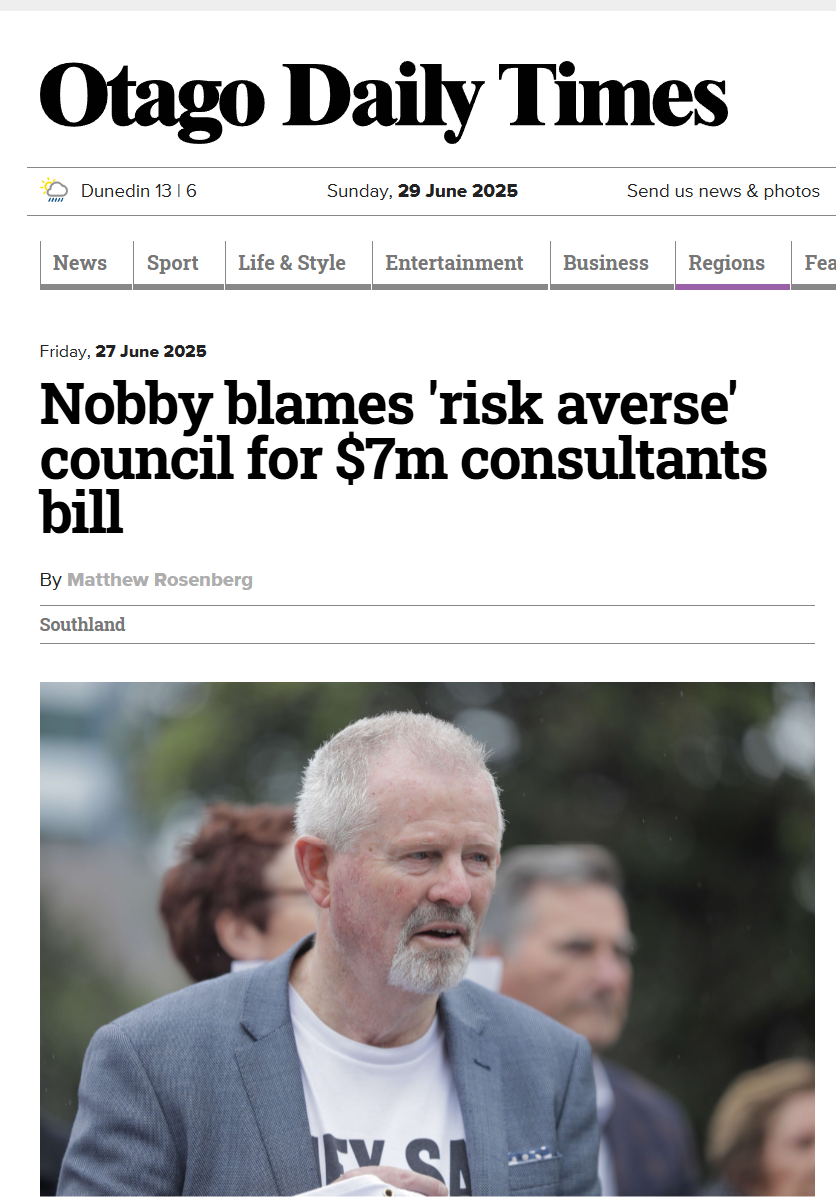
The latest scandal to emerge from Invercargill City Council reads like a masterclass in how neoliberal ideology operates as a cover for institutional incompetence and resource capture. Nobby Clark's outburst over the council's $7.3 million consultant spending1 reveals far more than fiscal mismanagement - it exposes the fundamental contradictions at the heart of neoliberal governance and the colonial mindset that views public resources as private playgrounds.
Background
To understand this latest episode in Clark's unending parade of controversies, we must first grasp who this man is and what he represents. Nobby Clark has spent years building his reputation as a racist provocateur2, someone who deliberately platforms himself at anti-co-governance meetings3 and repeatedly uses racial slurs on television4. His pattern of breaching council conduct codes through racist and homophobic language5 speaks to a man who sees public office as a platform for white supremacist messaging.
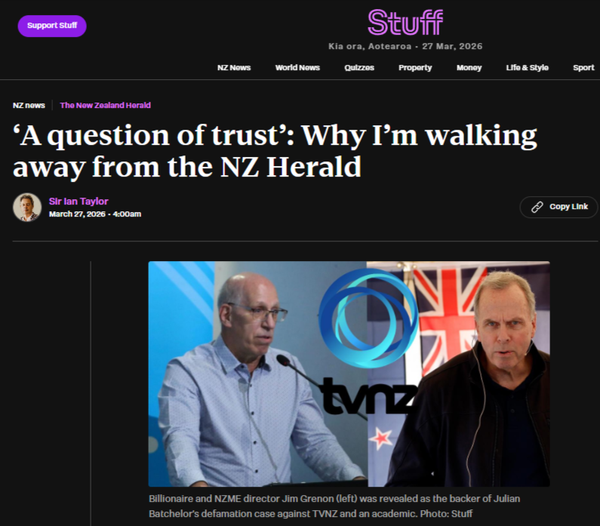
Clark's involvement with Julian Batchelor's Stop Co-Governance Tour6 - where he told audiences that Māori have "more power than they should have"6 - reveals his fundamental opposition to Treaty partnerships and Indigenous rights. This is the same tour that has been described as promoting "anti-Māori racism and spreading disinformation about co-governance"7.
The consultant spending revelation emerged through a LGOIMA request from the Taxpayers' Union8, showing the council spent more than $7.3 million on consultants between July 2022 and December 20249. This included more than 160 companies, with Deloitte topping the list at over $424,00010.
The Consultant Cash Grab: More Than Just Poor Judgment
Clark's response to this revelation tells us everything about how neoliberal ideology operates in practice. His claim that the council should "take more risks" and "if we get it wrong, we get it wrong"9 exposes the casual disregard for public resources that defines neoliberal governance. This is not about efficiency or accountability - it is about normalising the extraction of public wealth for private gain.
The staggering scale of this spending - $7.3 million in less than three years8 - represents a fundamental breach of te taonga (treasured resources) that belongs to the people of Murihiku. From a Māori perspective grounded in kaitiakitanga (guardianship), this careless spending violates the principle that public resources must be protected and nurtured for future generations11.
The use of "more than 160 companies" during this period10 suggests a systematic approach to outsourcing that serves corporate interests rather than community needs. When Deloitte alone receives over $424,000 for "reviewing rates, contract compliance, internal audit support, and risk and assurance support"10, we see how neoliberal ideology creates a consulting class that profits from the deliberate weakening of public institutions.
This pattern mirrors what we have seen with other major projects. Clark's museum project alone spent $5.5 million on consultants12, demonstrating how the same neoliberal playbook operates across different council activities.
The Neoliberal Con: Privatising Expertise, Socialising Risk
Clark's outburst reveals the central contradiction of neoliberal governance: while claiming to reduce the role of the state, neoliberalism actually expands state spending on corporate consultants and private contractors13. This is not about smaller government - it is about redirecting public resources away from communities and into corporate coffers.
The neoliberal attack on public institutions operates by first defunding and deskilling them, then claiming they cannot function effectively without private sector "expertise"13. This creates what economists call "market failure by design" - deliberately weakening public capacity to justify privatisation14.
From a Māori worldview, this violates the principle of manaakitanga (reciprocal care and hospitality). True manaakitanga requires that public leaders act with aroha (compassion) and ensure that public resources enhance the mana (power and wellbeing) of the entire community15. Clark's casual dismissal of proper resource management represents the antithesis of Indigenous values.
The racism here is structural, not just personal. By weakening public institutions through consulting contracts, neoliberalism makes it harder for Māori communities to access quality public services and democratic participation16. This creates what scholars call "neoliberal racism" - policies that appear race-neutral but systematically disadvantage Indigenous peoples17.
White Supremacy and Resource Capture
Clark's comfort with massive consultant spending while opposing Māori participation in governance reveals the white supremacist logic that underpins neoliberalism. His opposition to iwi involvement in wastewater decisions18 - where he complains about "iwi relationship at any cost" processes - shows how he views Indigenous rights as obstacles to corporate profit.
This pattern reflects what Māori scholars call "settler colonial resource capture" - the systematic exclusion of Indigenous peoples from decisions affecting their own territories while opening those resources to corporate extraction19. When Clark pays millions to corporate consultants while resisting Treaty partnerships, he reinforces colonial hierarchies that prioritise profit over people and land.
The casual way Clark suggests councillors should "accept the risk" of wrong decisions20 reveals the fundamental inequality of neoliberal risk distribution. Corporate consultants get paid regardless of outcomes, while communities bear the consequences of poor decisions. This violates the Māori principle of whakatōhea (collective responsibility), which requires that those making decisions also bear responsibility for their consequences.
Clark's history of racist behaviour21 - including his repeated use of racial slurs22 and support for anti-co-governance messaging23 - demonstrates how white supremacy and neoliberalism operate together to exclude Indigenous voices from resource decisions.
The Treaty Alternative: Māori Values for Resource Management
The consultant spending scandal highlights why Treaty partnerships matter. Māori decision-making processes, grounded in whakatōhea (collective deliberation) and guided by kaitiakitanga principles, require careful consideration of long-term impacts24. This stands in stark contrast to the neoliberal approach of outsourcing decisions to corporate consultants who have no ongoing relationship with affected communities25.
Traditional Māori resource management operated on principles of reciprocity and long-term sustainability26. Decision-makers were accountable to their communities across generations, creating strong incentives for careful resource stewardship27. This is the opposite of the consultant model, where external experts extract payment while communities bear the risks.
Co-governance arrangements, which Clark consistently opposes, actually provide more accountability and community connection than consultant-driven processes28. When Māori participate in decision-making as Treaty partners, they bring both cultural values and practical expertise that cannot be purchased from consulting firms29.

Implications for Democracy and Justice
Clark's consultant cash splash reveals how neoliberalism undermines both democratic accountability and Indigenous rights. By transferring decision-making power from elected officials to corporate consultants, this system weakens democratic oversight while increasing corporate influence over public policy30.
This has particular implications for Māori communities, who face what researchers call "double exclusion" - shut out of both colonial democratic processes and traditional governance systems31. When public institutions are weakened through consultant outsourcing, it becomes even harder for Indigenous communities to influence decisions affecting their territories32.
The pattern we see in Invercargill - massive consultant spending combined with opposition to Treaty partnerships - reflects the broader neoliberal project of replacing democratic accountability with corporate power33. This is not about efficiency or expertise - it is about ensuring that decisions about public resources serve corporate interests rather than community needs.
Clark's casual attitude toward public money while maintaining rigid opposition to Māori participation reveals the racial hierarchy that neoliberalism reinforces28. Corporate consultants are trusted with millions, while Treaty partners are portrayed as threats to democracy.
Nobby Clark's consultant spending scandal exposes the ugly reality behind neoliberal rhetoric about efficiency and accountability. This is not about reducing bureaucracy or improving services - it is about transferring public wealth to corporate interests while weakening democratic institutions34.
Clark's combination of racist rhetoric and fiscal irresponsibility reflects the broader failure of neoliberal governance21. When public officials can spend millions on corporate consultants while attacking Treaty partnerships as too expensive, we see how white supremacy and corporate capture operate together18.
The alternative exists in Treaty partnerships and Māori values. Kaitiakitanga offers a framework for resource management based on long-term thinking, community accountability, and intergenerational responsibility35. Manaakitanga provides principles for public service based on reciprocal care and collective wellbeing36. Whakatōhea ensures that decisions emerge from collective deliberation rather than corporate influence37.
Clark's time as mayor is ending, but the systems that enabled his failures remain. Real change requires rejecting both the racism and the neoliberalism that Clark represents. It requires embracing Treaty partnerships not as threats to democracy, but as pathways to more accountable and sustainable governance.
The people of Murihiku deserve better than mayors who attack Indigenous rights while handing millions to corporate consultants. They deserve leaders who understand that public service means serving the public - all of it - rather than enriching the few at the expense of the many.
If readers find value in this analysis and wish to support continued work exposing the connections between racism and neoliberalism, please consider making a koha to support this kaupapa. The MGL understands these are challenging economic times for whānau, so please only contribute if you have the capacity and desire to do so: HTDM: 03-1546-0415173-000.
Noho ora mai, Ivor Jones The Māori Green Lantern