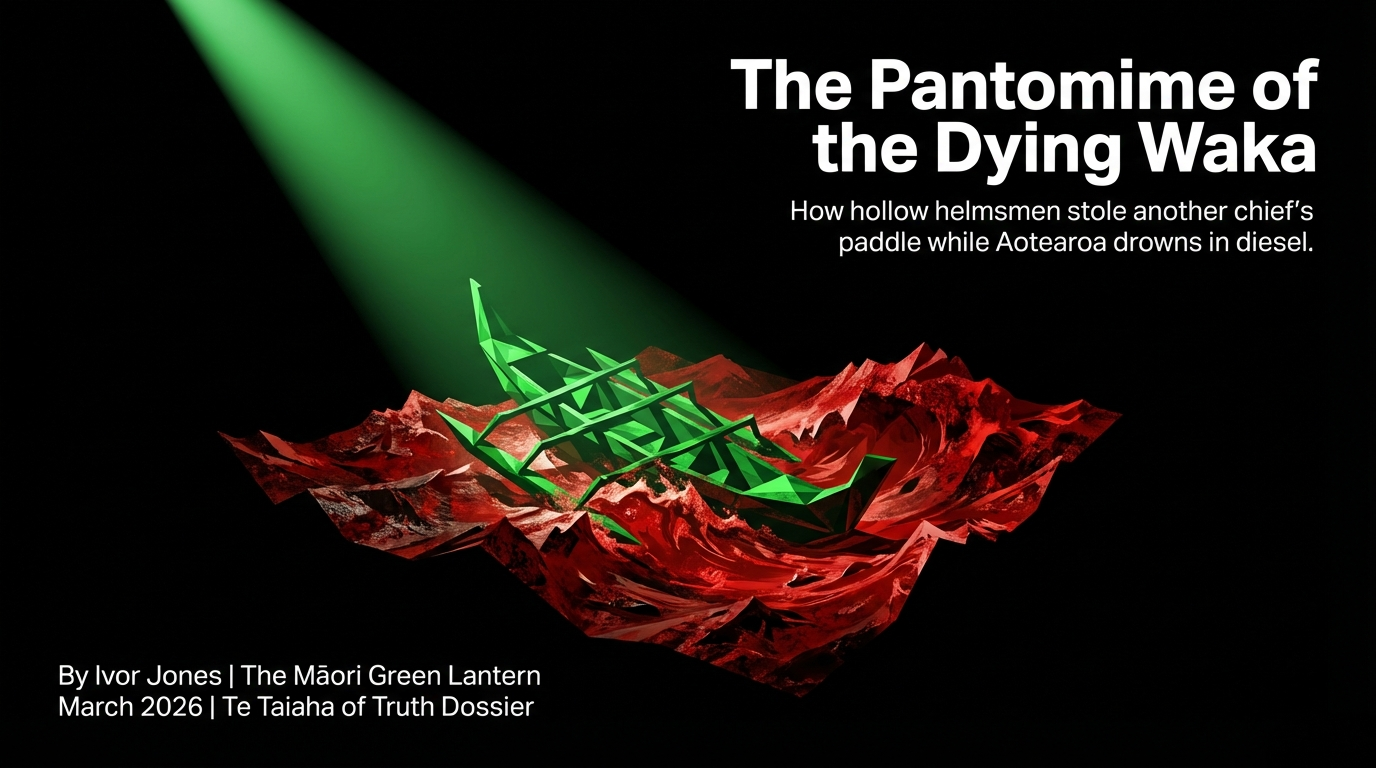
"PANTOMIME OF THE DYING WAKA: How Luxon's Hollow Helmsmen Stole Another Chief's Paddle While Aotearoa Drowns in Diesel" - 28 March 2026
They dressed in borrowed feathers. They sang another chief's waiata. And when the taniwha came — they handed whānau a government pamphlet and called it a rescue.
Kia ora whānau.
Picture a waka hourua — a great double-hulled voyaging canoe — crossing a darkening ocean. The tohunga whakatere, the master navigator, has read the stars wrong for two years. He has cut the bailers to save weight. He has sold the spare paddles to his mates on shore. He has told the crew the weather is fine, beautiful, nothing to worry about, trust the plan.
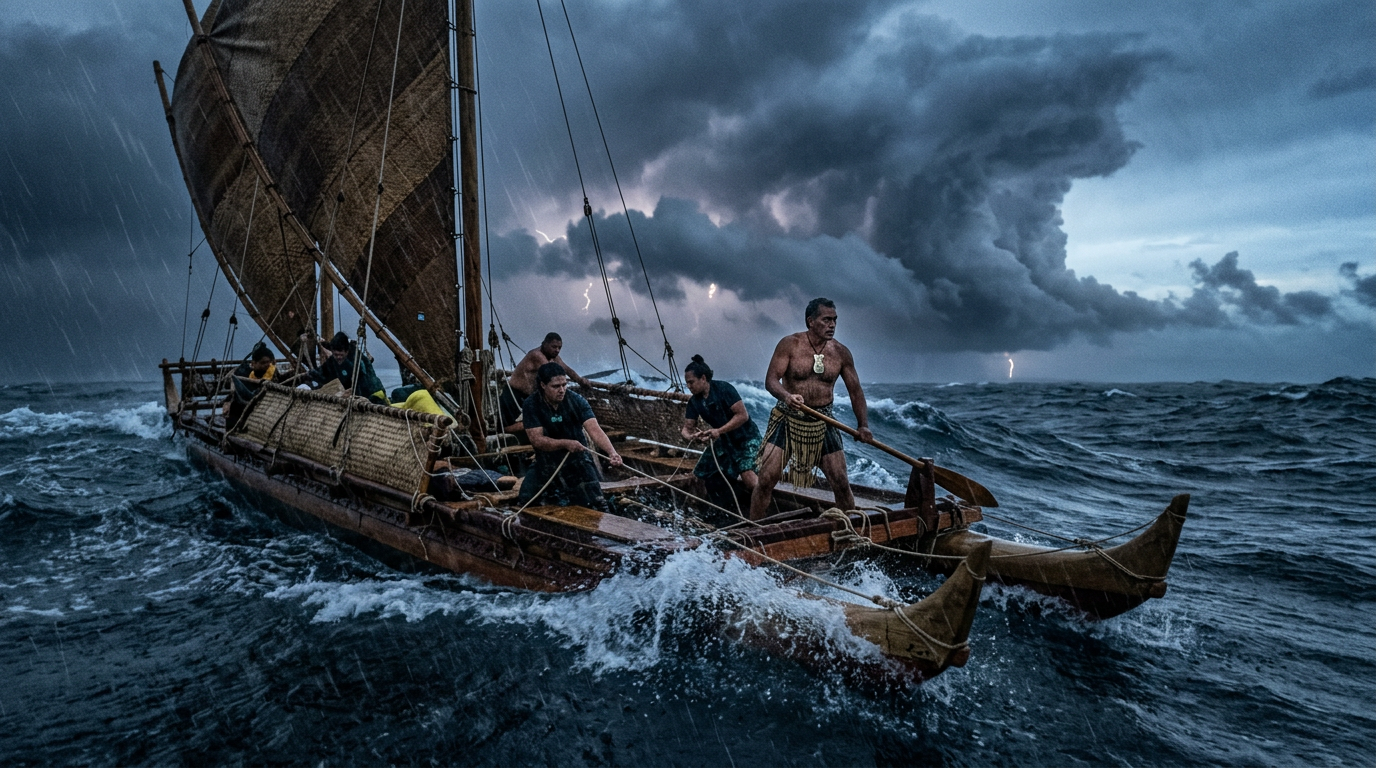
Then the storm hits.
And what does he do?
He picks up the previous captain's navigation charts — charts built with care, with community, with years of preparation — holds them upside down in front of the crew, and says:
"Don't panic. I have a plan. It has four phases."
That is Christopher Luxon's government in March 2026. That is the pantomime unfolding before us. And whānau — the waka is taking on water.
The Deep Dive Podcast
Listen to a lively conversation between two hosts, unpacking and connecting topics in the sources of this essay.
The Stolen Haka: Mimicry Without Mana
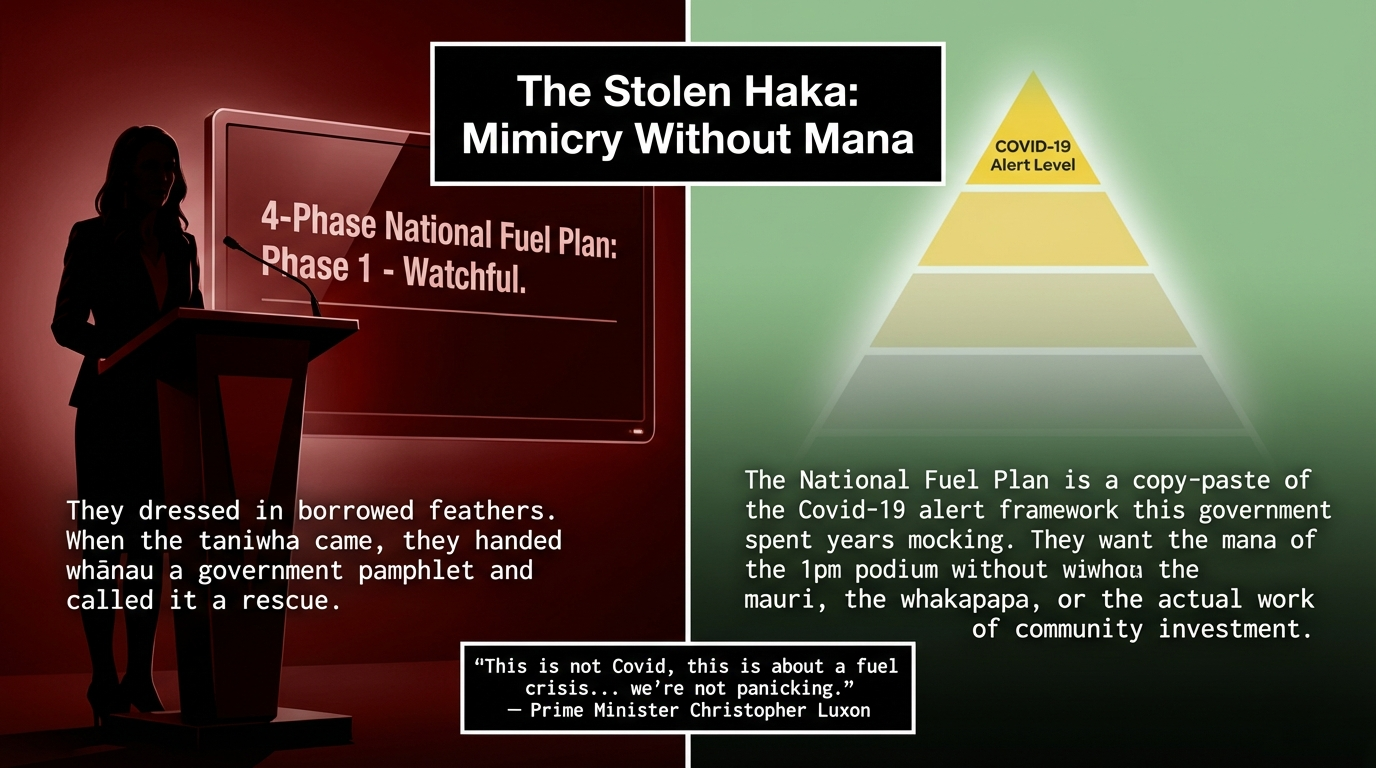
In te ao Māori, there is a concept called mana tangata — the authority and integrity that comes from actually doing the work, from earning your place through action, not costume. When you perform a haka you have not earned, when you wear another's korowai without the whakapapa to justify it, you do not gain their mana.
You expose your own emptiness.
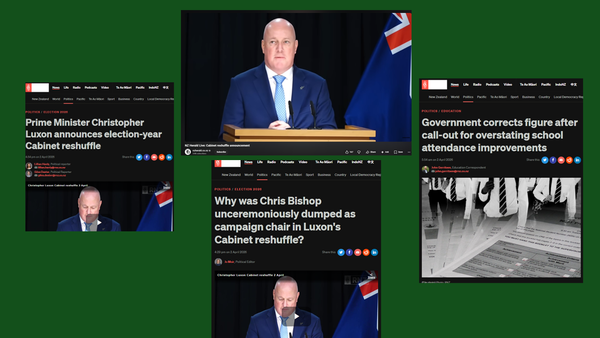
What Nicola Willis did on 17 March 2026 was perform a stolen haka.
As The Spinoff immediately named it:
"Covid-91: Nicola Willis gives the fuel crisis the full 1pm briefing treatment."
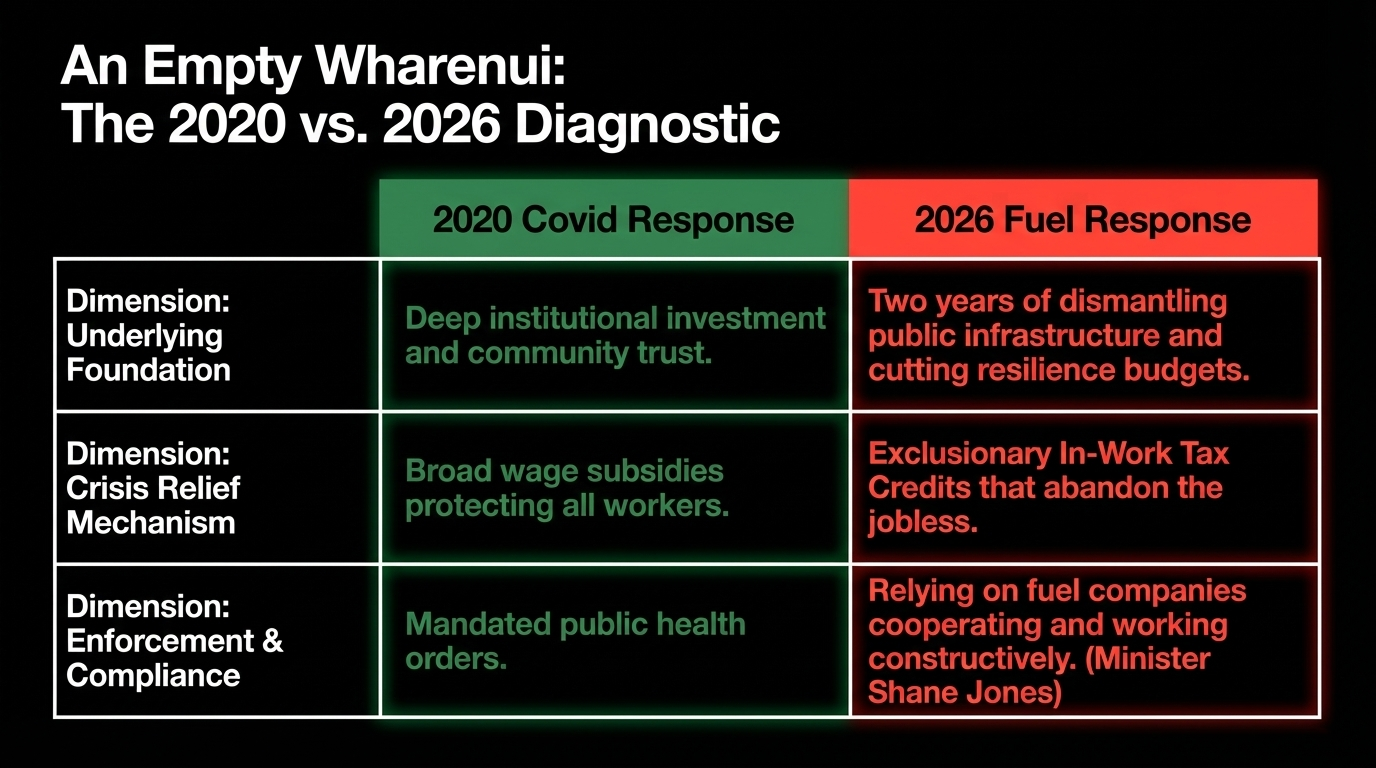
The 1pm podium. The four-tiered alert system. The calm ministerial face. The carefully structured "phases." Every single element lifted, body and soul, from Jacinda Ardern's COVID response framework — the very framework this government and its supporters spent three years mocking, undermining, and calling authoritarian overreach.
Now they want the mana of it. Without the mauri. Without the work. Without the whakapapa.
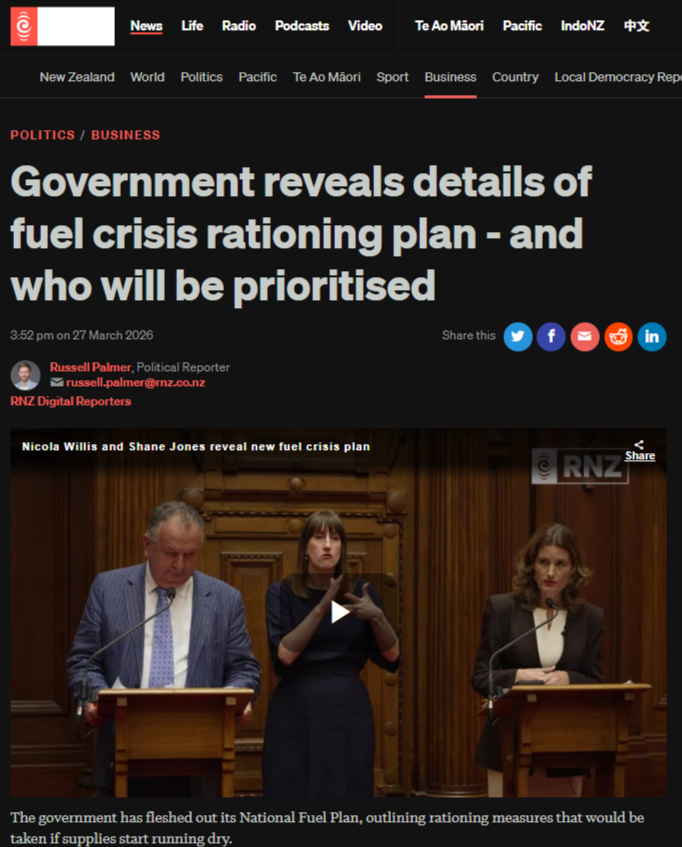
On 26 March, Willis unveiled the National Fuel Response Plan 2026 — four phases, four levels, escalating restrictions, with emergency services prioritised. As the ODT confirmed, the plan "resembles the Covid alert levels". The ODT's Star News confirmed the same. Stuff broke down the four-phase structure in detail. There it is — dressed up, presented, performed.
But here is the tikanga truth this government cannot buy or borrow:
Ardern's system worked because of the years of relationship, community trust, and institutional investment that preceded it. This government has spent two years dismantling that infrastructure.
The borrowed frame is now an empty wharenui — beautiful walls, no kaupapa inside.
The Taniwha in the Harbour: What They Refused to See
For the western mind, understand this through a simple analogy:
Imagine you own a house in a flood zone. The previous owners built stop-banks, maintained the drains, kept the emergency kit stocked. You buy the house, sell the emergency kit for parts, let the drains block up, cut the stop-bank maintenance budget, and tell everyone the weather is fine. When the river rises, you hold up the previous owners' flood management brochure and tell the neighbours:
"Don't worry. We have a plan. It has four phases."
That is this government's fuel crisis response — verbatim.
As interest.co.nz reported on 11 March, the government was receiving advice on fuel demand restraint weeks before the public knew anything. The NZ Herald reported on 17 March that stocks were already falling week on week — even as the government publicly stated there was "no need for restrictions." Then came the unscheduled panic briefing on 25 March, triggered because diesel cover had dropped to just 11.6 days. The very next day, Willis promised there would be "no overnight alert level shifts" and all transitions would be calm and orderly.
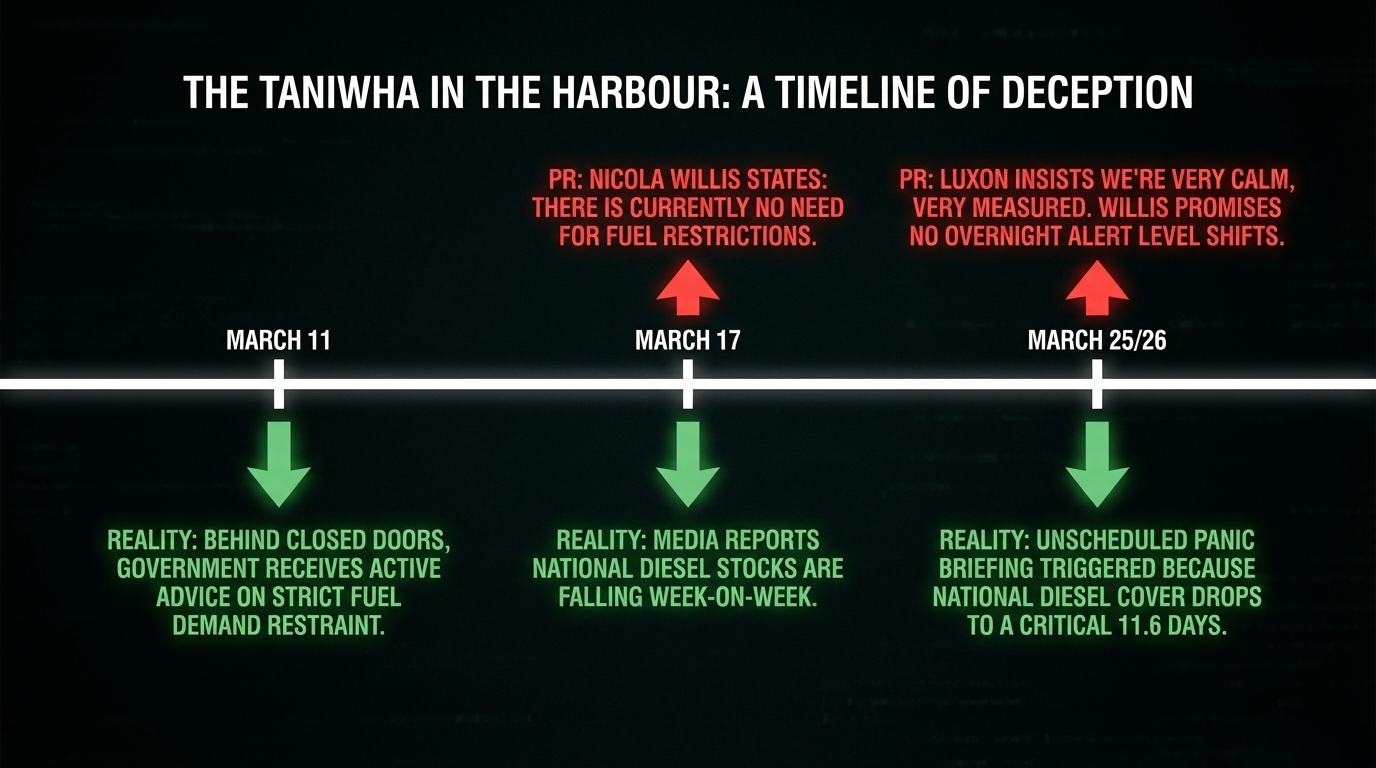
You cannot have an unscheduled panic briefing and a promise of orderly transitions in the same 24-hour news cycle and call it leadership. That is not a rangatira. That is someone who found a feathered cloak on the floor and put it on backwards.
The taniwha — the very real disruption in global fuel supply chains — has been visible on the horizon for months. As the NZ Herald reported on 18 March, commentators were already saying the government
"isn't fully preparing Kiwis for what's next."
And as the Herald noted on 23 March,
"the rainy day is here"
— and the government that ran on fiscal prudence and rainy day preparation is now flailing for Muldoon's umbrella.
THREE EXAMPLES FOR THE WESTERN MIND: Quantified Harm, Tikanga Shattered
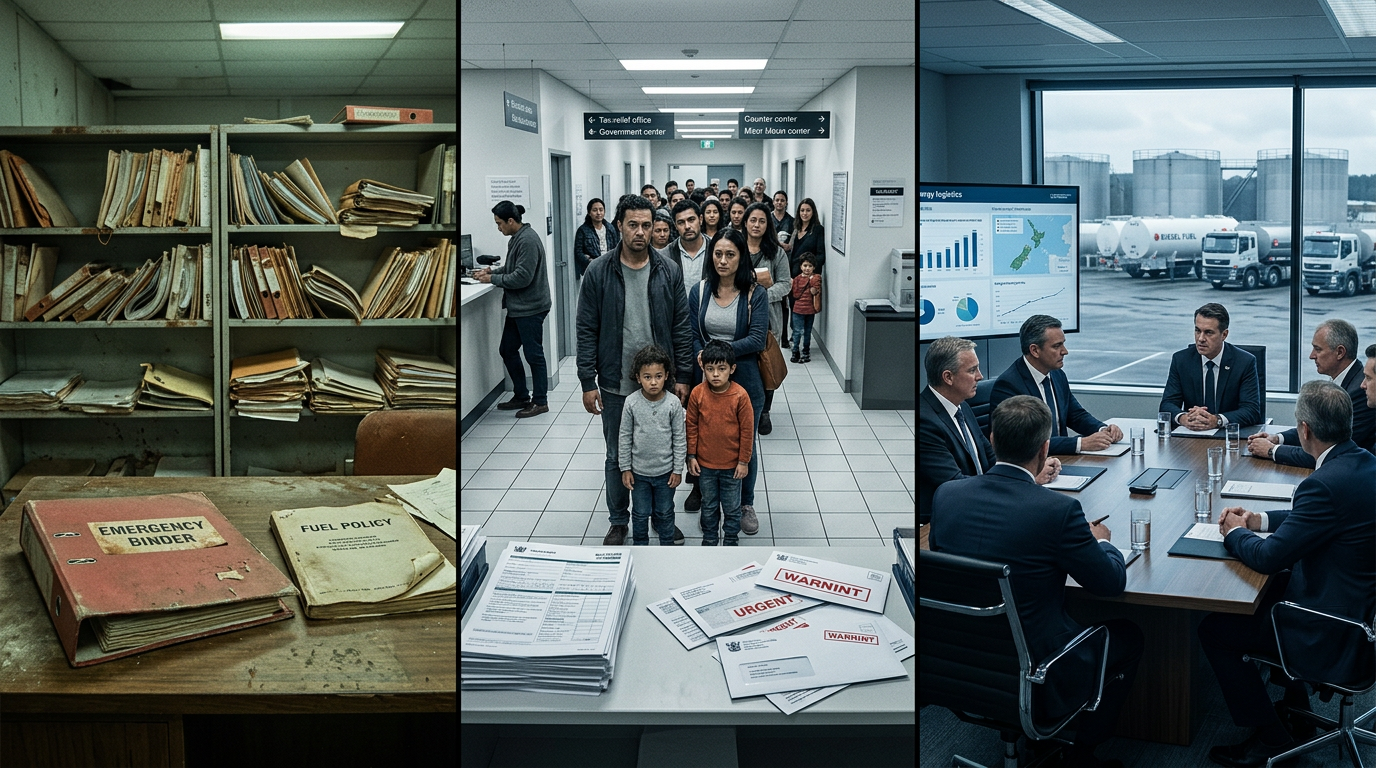
Example 1 — The 1970s Toolkit: Governing With Fossils
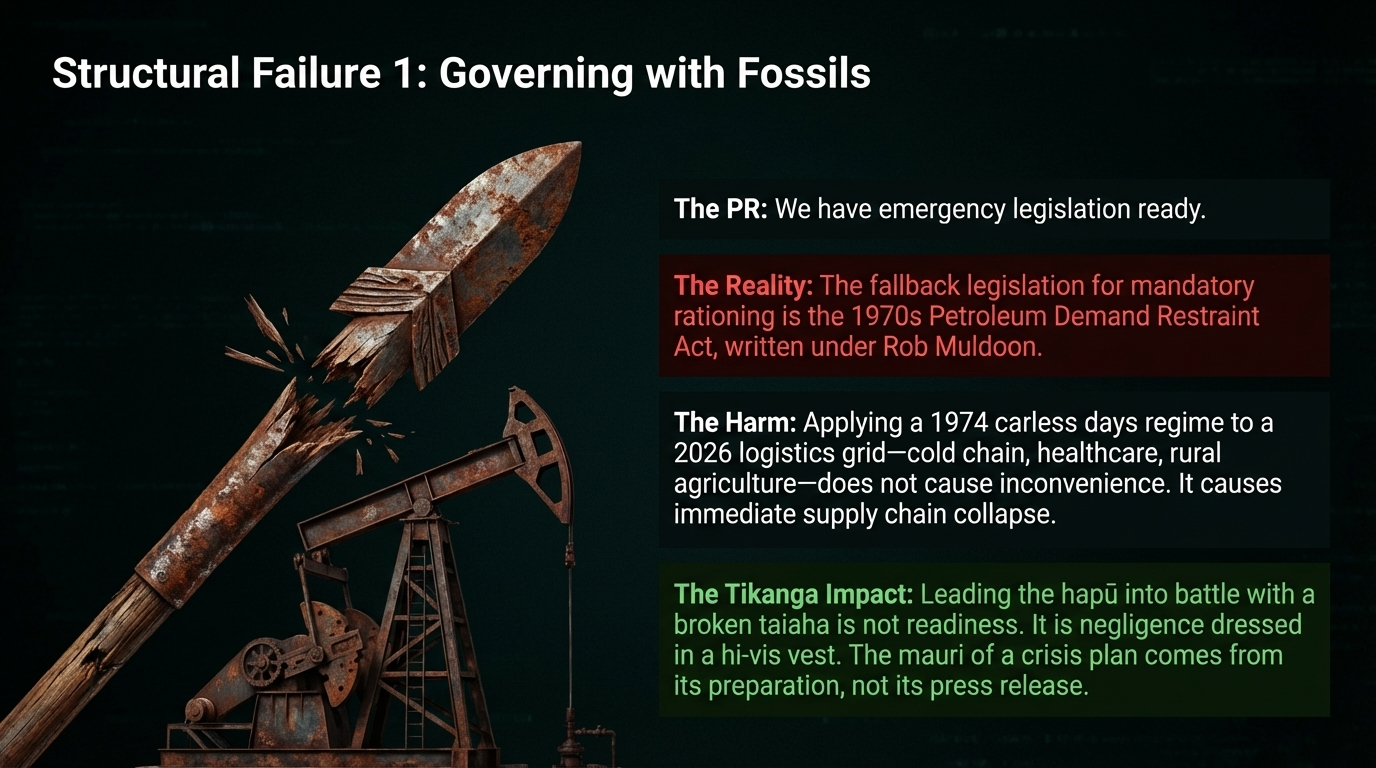
The harm, quantified: The fallback legislation now being considered for mandatory fuel restrictions is the Petroleum Demand Restraint Act — a law written under Rob Muldoon during the 1970s oil shock. New Zealand's entire modern logistics sector — cold chain, healthcare supply, rural agriculture, iwi-owned enterprises — operates on fuel dependency that was unimaginable in 1974. A carless day regime applied to 2026 New Zealand does not cause 1974 inconvenience. It causes supply chain collapse in communities already operating on thin margins.
The tikanga impact: In tikanga, you do not lead your hapū into battle with a rusted, broken taiaha and call it readiness. The mauri of the plan — its life force, its capacity to sustain the people — is determined by the preparation behind it, not the language wrapped around it. A government that has had two years and reaches for a 50-year-old law is a government with no mauri in its crisis response. It is leading the waka with a paddle that has no blade.
For the western mind: This is the equivalent of New Zealand's Emergency Management Agency responding to a Category 5 cyclone by pulling out a civil defence manual from 1974, because no one bothered to update it. You would not call that preparedness. You would call it negligence dressed in a hi-vis vest.
Example 2 — The IRD Labyrinth: Sending Whānau Into the Swamp to Drown
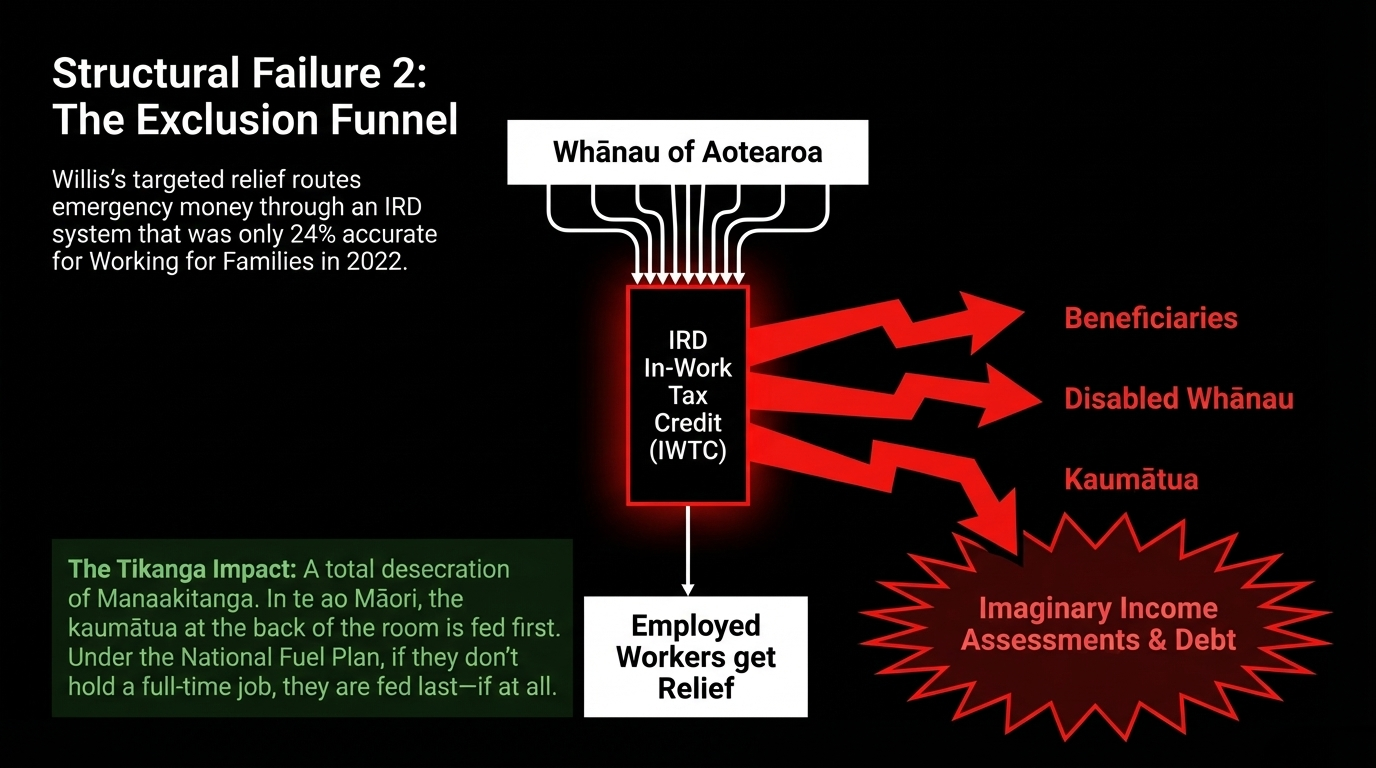
The harm, quantified: Willis's fuel relief package routes emergency assistance through the In-Work Tax Credit (IWTC) and the Independent Earner Tax Credit (IETC). As the Māori Green Lantern's Ka Noho i Roto i te Ahi essay documents in full, in the 2022 tax year only 24% of Working for Families recipients received the correct amount.
The rest were overpaid, underpaid, or both — generating retrospective debt letters, "imaginary income" assessments of $4,000 or more, and financial trauma months after the event. The government is now routing emergency crisis support through that same system.
The Citizens Advice Bureau's Louise May stated plainly, as the Ka Noho i Roto i te Ahi essay records:
"We are really concerned that there hasn't been mention of families who don't have paid work. They are the ones who are going to be most affected."
Beneficiaries. Disabled people. Kaumātua. Caregivers. None of them exist within the IWTC eligibility criteria. None of them receive a single dollar of Willis's "targeted" relief.
The tikanga impact: Manaakitanga — the obligation to care for people's wellbeing — is not conditional on their employment status. In every marae, every tangihanga, every kāinga I have ever known, the kaumātua at the back of the room is fed first, not last. Not because they qualify for a tax credit. Because they are people. This government's "targeted" framework is the precise opposite of manaakitanga. It is a bureaucratic door that opens for the employed and slams shut on everyone else. It does not just fail whānau economically. It desecrates the values that hold communities together.
For the western mind: Imagine FEMA responding to a hurricane by announcing emergency housing vouchers — but only for people who currently hold a full-time job. Everyone else gets a pamphlet explaining how to apply, a 6-month wait, and possibly a debt letter at the end. You would call that a scandal. In New Zealand in March 2026, we call it the National Fuel Plan.
Example 3 — Shane Jones and the Goodwill Gambit: Delegating Sovereignty to BP
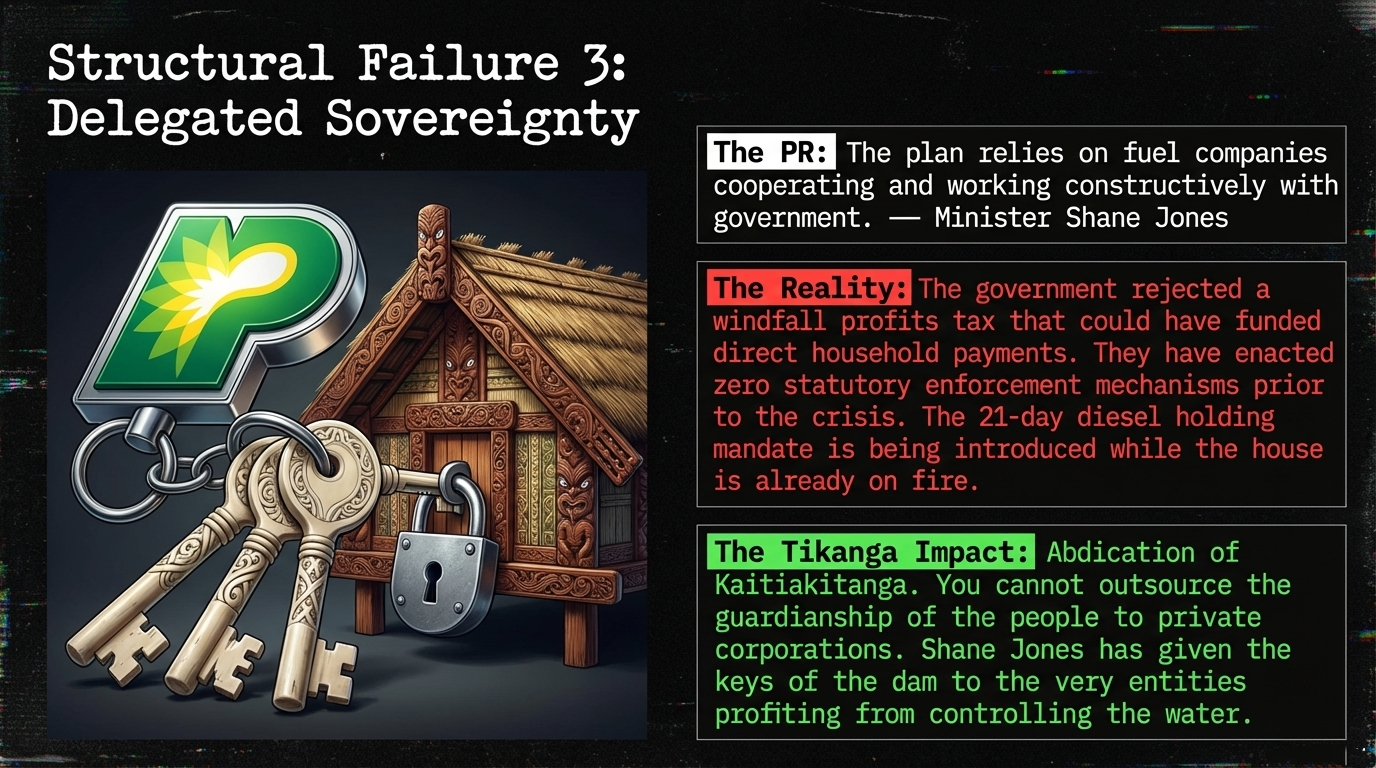
The harm, quantified: Shane Jones, Minister responsible for fuel security, told New Zealanders on 26 March that the plan's success depends on fuel companies "cooperating and working constructively with government," as the ODT reported. There is no mandate. No statutory enforcement mechanism detailed. No windfall profits levy on the corporations currently profiting from the crisis. The Green Party's proposed windfall profits tax — which would fund direct, IRD-free payments to every household — was rejected outright, as the Ka Noho i Roto i te Ahi essay documents.
Meanwhile, as 1News noted in their national fuel plan update, Willis is now promising that fuel companies must hold 21 days of diesel or face fines. An obligation that did not exist before, introduced during a crisis rather than in advance of it — the regulatory equivalent of installing smoke detectors after the house is already on fire.
The tikanga impact: Kaitiakitanga — guardianship, sovereign responsibility for the resources that sustain the people — cannot be outsourced to private corporations. A rangatira does not tell their hapū:
"I have delegated the guardianship of our awa to the company that owns the dam upstream, and I trust they will act in good faith."
That is not kaitiakitanga. That is the abdication of it. Shane Jones, who has spent two years invoking Māori economic development while opening conservation land to extractive industry, now stands before Aotearoa and tells us that the security of our fuel supply rests on BP's cooperative spirit. He has not protected the awa. He has given the keys to the dam to the very people who profit from controlling the flow.
For the western mind: This is equivalent to the government announcing its national water security plan, and when asked what happens if a private company restricts supply, the minister says:
"We are relying on them to be good corporate citizens."
No law. No teeth. No accountability. Just vibes and press releases.
The Rotten Pou: When the Frame Looks Beautiful and the Foundation Is Gone
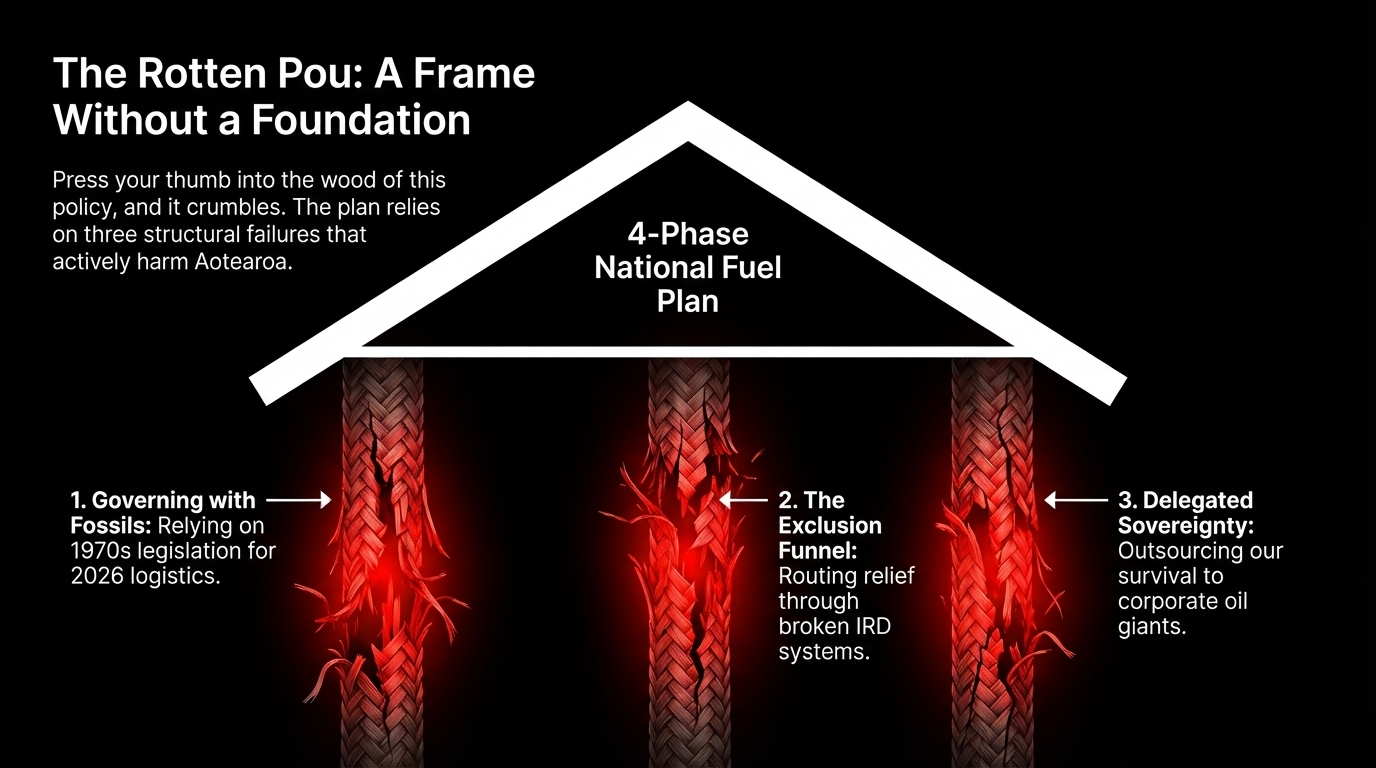
Here is what this government cannot say out loud and what the taiaha forces into the light:
The four-phase fuel framework, the ministerial briefings, the careful language of "watchful" and "precautionary" — all of it is a pou carved with beautiful imagery, erected in the marae, that is rotten at the base. It looks like a plan. It sounds like leadership. But press your thumb into the wood and it crumbles.
As The Spinoff asked on 27 March:
what will it actually take to move to Level Two? Who decides? On what data? With what notice?
The government has not answered these questions cleanly, because the honest answer is:
"We will decide when the optics require it, not when the data demands it."
Labour's Chris Hipkins — who sat inside the original COVID response and knows the machinery from the inside — told media he is now
"vigorously testing the reliability of the information"
coming from this government. That is not opposition rhetoric.
That is a man who built the original framework, watching someone else hold it upside down, and saying out loud: something is wrong.
And the NZ Herald's broader coverage of the global context makes clear this is not a uniquely New Zealand problem — multiple countries are moving to ration petrol and power. The difference is that competent governments prepared. Ours performed.
The Final Karakia: Truth Before the Podium
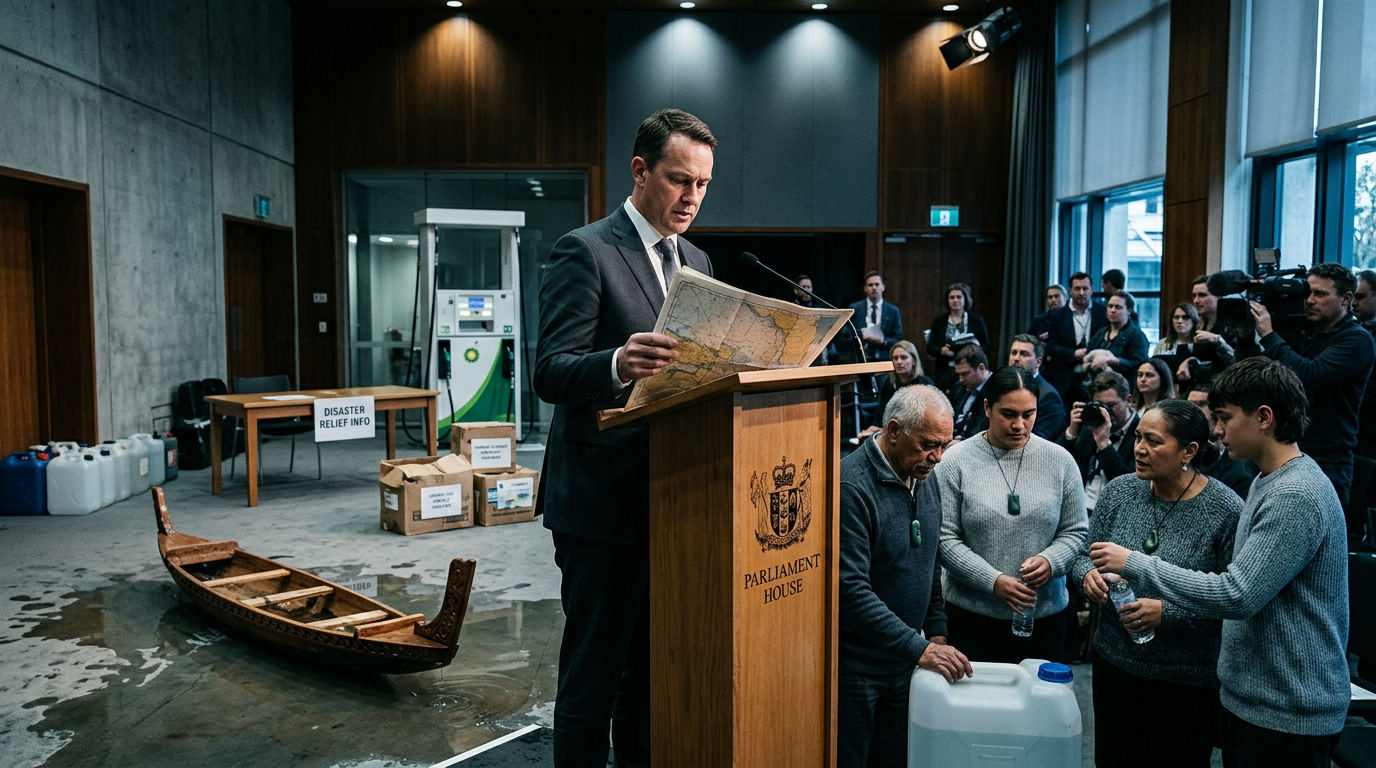
Let the record stand clearly before the people of Aotearoa:
This government did not build the crisis communication framework it is using — it stole it from the woman it spent years vilifying.
This government did not prevent the supply vulnerability — it ignored the warnings while cutting the regulatory obligations that might have created buffer.
This government did not protect the most vulnerable — it routed their emergency relief through a system that works correctly 24% of the time.
This government did not secure the supply chain — it asked BP to be nice.
And this government did not lead — it performed.
The waka is taking on water. The helmsman is reading borrowed charts in the dark. The bailers were sold eighteen months ago to fund tax cuts for people who don't need them.
Whānau: check your tanks. Know your neighbours. Keep your kaumātua fuelled. Build the networks this government will never build for you. And when they stand at that podium and say "Phase One: Watchful" — be watchful of them.
He Koha Ki Te Mahi Pono — A Koha to the Work of Truth
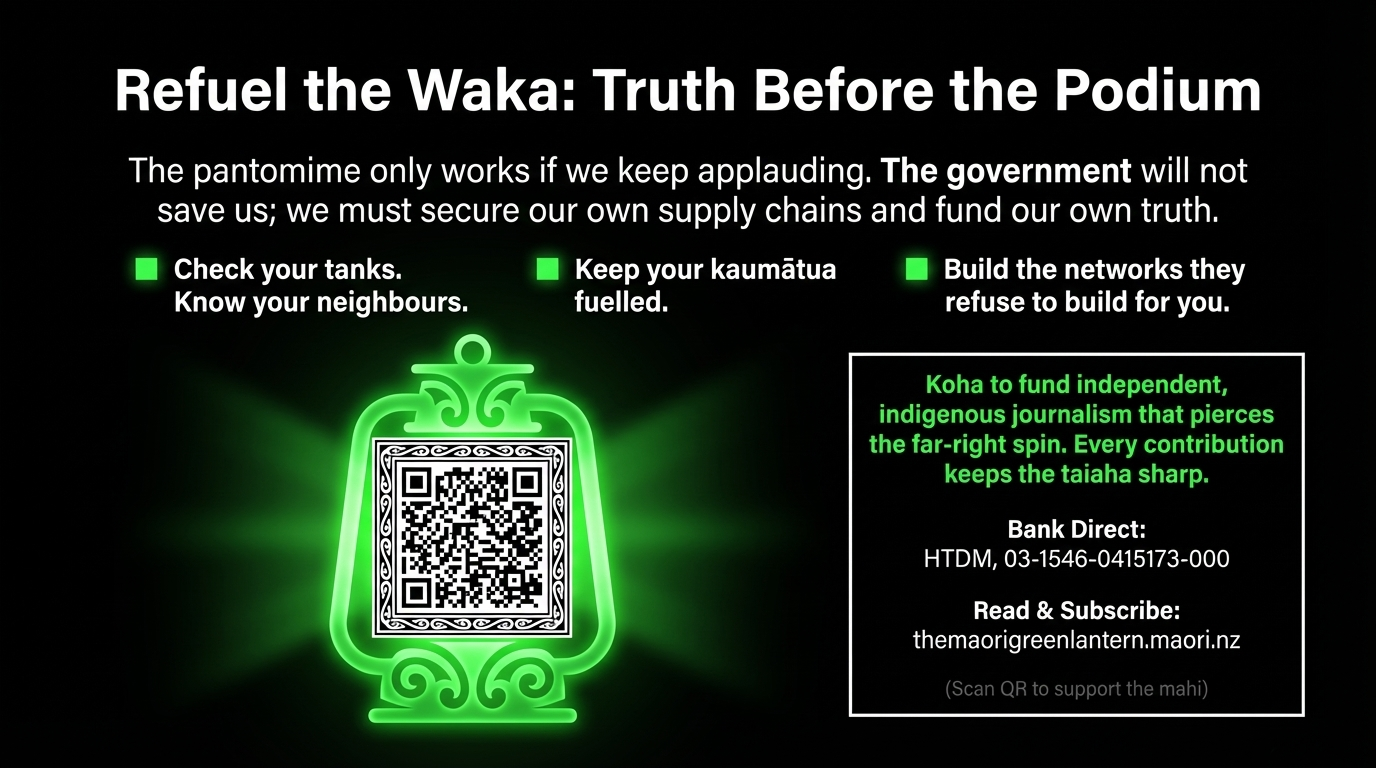
Whānau, this essay exists because this government's PR machine will not expose itself. The cost of this mahi — the research, the verification, the writing, the platform — is real. And every time the Crown and its corporate partners tighten their grip, the cost of speaking truth rises with it.
When you koha to the Māori Green Lantern, you are not just supporting a newsletter. You are refuelling the waka that this government wishes would run out of diesel and go quiet. You are saying that rangatiratanga includes the power to fund our own accountability — not theirs. That we do not need their permission to tell the truth. That whānau deserve journalism that names names, follows the money, and stands beside the kaumātua who cannot qualify for Nicola Willis's tax credits.
Every koha is a vote of no confidence in their pantomime. Every share is a flare fired into the dark so others can see the rocks ahead.
Three pathways, choose yours:
Koha directly here — every contribution keeps the taiaha sharp.
Subscribe to the Māori Green Lantern — get essays like this delivered directly, before the algorithm buries them.
Direct bank transfer: HTDM, 03-1546-0415173-000 — no platform fee, straight to the mahi.
And if koha is not possible right now — that is completely fine. Read themaorigreenlantern.maori.nz. Share this essay. Kōrero with your whānau. That is koha in itself — it is the circulation of truth, and it costs nothing but your voice.
Kia kaha. Keep your tanks above half. And remember: the pantomime only works if we keep applauding.
Research tools used: search_web, fetch_url. Date of research: 28 March 2026. Primary sources: RNZ, ODT, 1News, The Spinoff, NZ Herald, The Māori Green Lantern archive, Beehive.govt.nz. All links verified active at time of publication.