“Parliamentary Pantomime: When Colonisation Masquerades as Housekeeping” - 3 August 2025
The Theatre of the Absurd: How Parliament's "Rats and Mice" Perpetuate Colonial Dominance Over Māori Land and Resources
Kia ora whānau. Ko Ivor Jones, The Māori Green Lantern, tēnei kia koutou katoa.
While Parliament preoccupies itself with what they euphemistically call "rats and mice" bills, these seemingly trivial pieces of legislation expose the insidious machinery of ongoing colonisation that continues to dispossess Māori of our whenua and undermine our tino rangatiratanga. The recent spectacle surrounding the Auckland Harbour Board and Takapuna Borough Council Empowering Act Amendment Bill reveals how Parliament weaponises procedural minutiae to legitimise the ongoing theft of Māori resources while MPs perform theatrical frivolity to distract from their complicity in systematic oppression1.
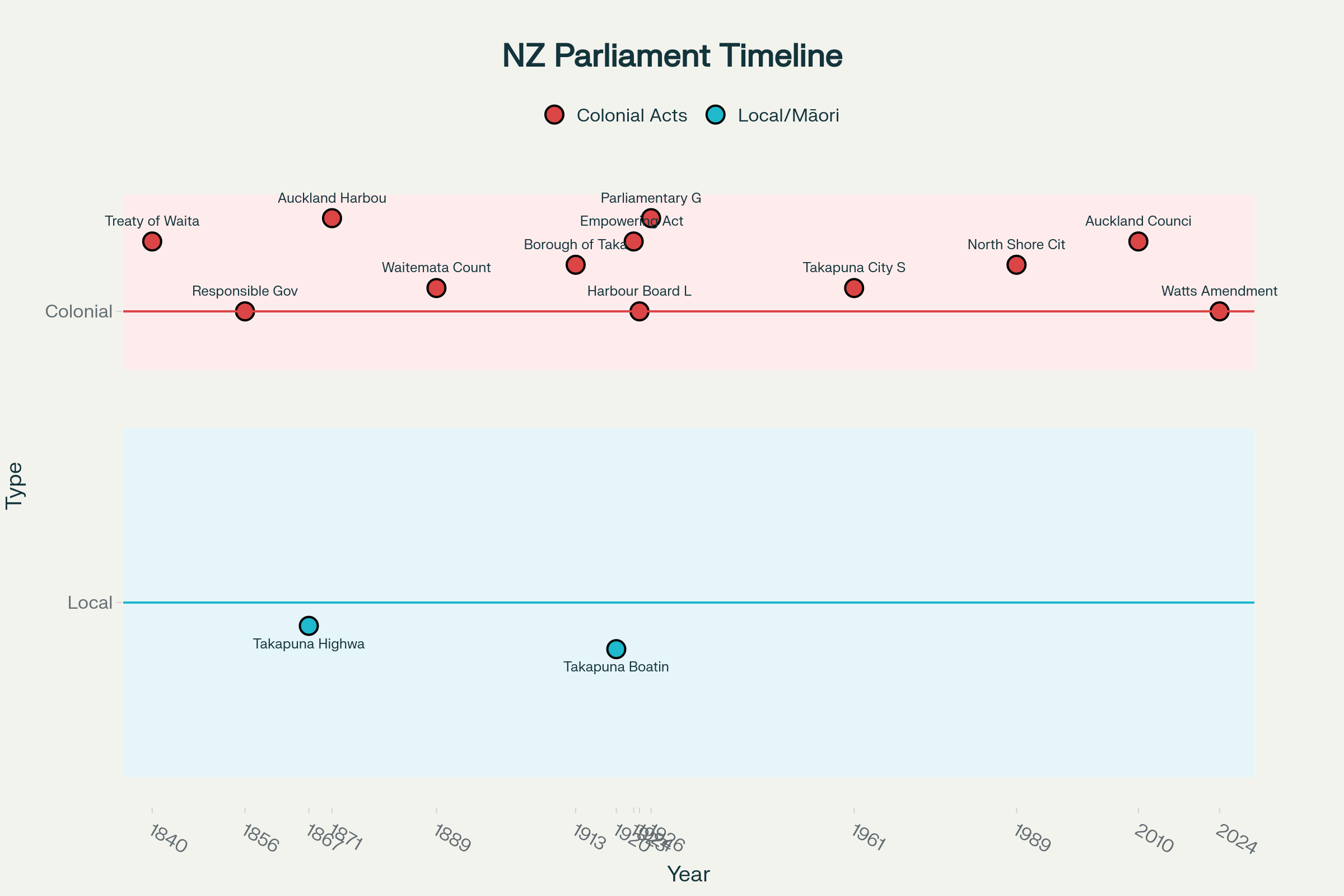
Timeline showing the evolution of New Zealand's colonial parliamentary processes and their impact on local Māori communities, particularly around Takapuna
Background: The Colonial Context of "Trivial" Legislation
Understanding these so-called minor bills requires examining their colonial genesis and contemporary function within New Zealand's white supremacist parliamentary system. Local bills and private bills, as described by Te Ara Encyclopedia, represent specific legislative instruments that affect particular localities or organisations rather than the general public2. However, this clinical description obscures their role as tools of colonial dispossession and ongoing Māori marginalisation.
The Auckland Harbour Board, established in 1871, exemplifies how colonial institutions consolidated control over Māori waterways and coastal resources3. When combined with the Takapuna Borough Council through the 1923 Empowering Act, these entities created a legislative framework that prioritised Pākehā commercial interests while systematically excluding Māori from decision-making processes affecting our ancestral territories.
The significance of this legislative tradition cannot be understated from a Māori perspective. These bills represent the bureaucratic entrenchment of colonial control, where each seemingly minor amendment further embeds foreign legal structures over Māori whenua and moana. The 1923 Act specifically restricted the Takapuna Boating Club property to community activities while prohibiting private gain1 - a restriction that conveniently ignored the reality that Māori communities had been entirely excluded from any meaningful involvement in determining how their ancestral lands would be used.
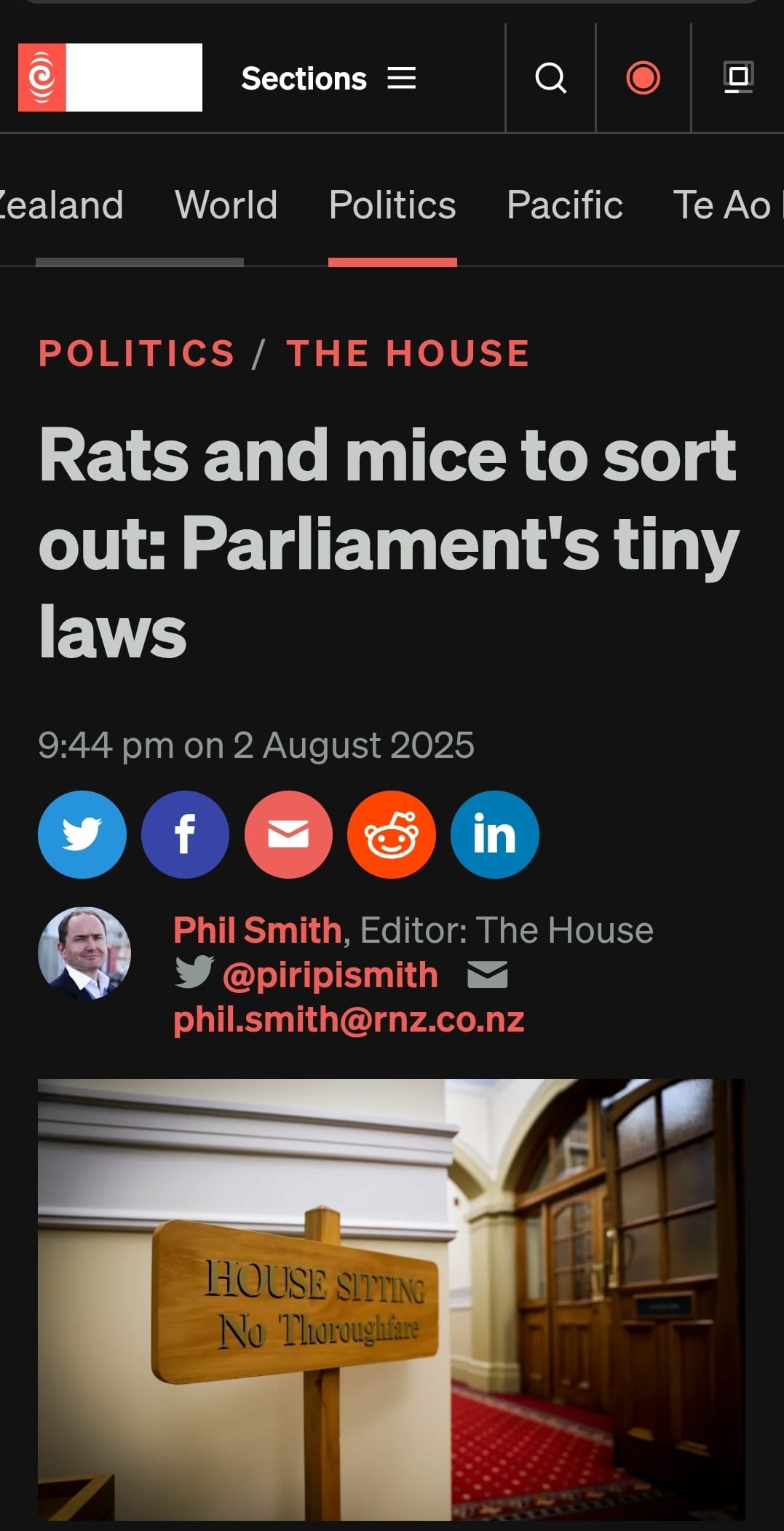
https://www.rnz.co.nz/news/political/568819/rats-and-mice-to-sort-out-parliament-s-tiny-laws
The Takapuna Travesty and Its Colonial Implications
The current bill, sponsored by National Party's Simon Watts, seeks to amend the 1923 legislation to allow the Takapuna Boating Club to generate commercial revenue from their property4. While MPs like Cameron Brewer waxed lyrical about ice cream and cafés during the debate, they conveniently ignored the fundamental injustice that this club operates on land that was never legitimately acquired from tangata whenua1.
The Takapuna area, originally called Te Uru Tapu, was a sacred pōhutukawa grove used by Tāmaki Māori for funeral ceremonies5. The Crown's 1841 purchase of the Mahurangi Block, which included Takapuna, followed the familiar colonial pattern of questionable land transactions that prioritised Pākehā settlement over Māori rights6. By 1926, Parliament had gifted the club site through another Act of Parliament, demonstrating how legislative processes were manipulated to legitimise the transfer of Māori resources to Pākehā recreational organisations78.
This matters profoundly to Māori because it exemplifies the ongoing colonial project disguised as administrative efficiency. Every "rats and mice" bill that Parliament passes without genuine Māori consultation or consideration of Treaty obligations represents another brick in the wall of institutional racism that continues to marginalise tangata whenua from our own country.
The scope of this analysis extends beyond a single boating club to encompass Parliament's systematic use of procedural legislation to entrench colonial privilege while maintaining the fiction of democratic legitimacy.
The Neoliberal Theatre: When Privilege Performs Benevolence
The parliamentary debate surrounding this bill revealed the nauseating spectacle of privileged Pākehā politicians congratulating themselves on their efficiency while completely ignoring the colonial violence underlying their legislative housekeeping. Simon Watts, the National Party's Climate Change Minister, framed this amendment as fixing "archaic legislation" that restricted the club's ability to raise maintenance funds19. This narrative conveniently obscures how these restrictions originally emerged from colonial efforts to maintain the facade of community benefit while systematically excluding Māori from any meaningful participation.
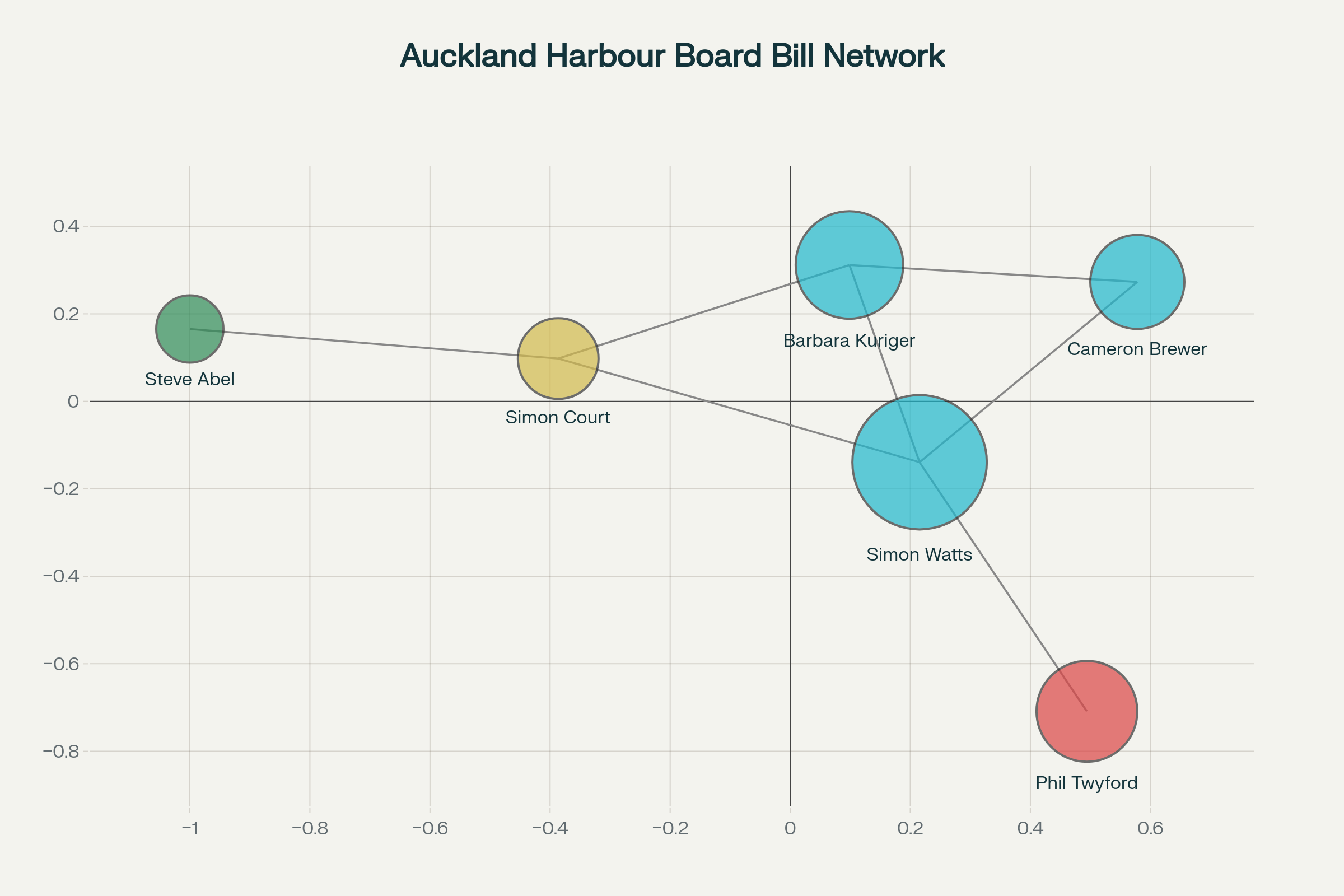
Network of political connections in the Auckland Harbour Board and Takapuna Borough Council Empowering Act Amendment Bill debate
Cameron Brewer's contributions to the debate epitomise the entitled frivolity of New Zealand's political elite. His nine-minute speech rambled through topics ranging from ice cream to America's Cup while studiously avoiding any acknowledgment that the club operates on stolen Māori land110. This is the same Cameron Brewer who celebrated the return of "stale, pale males" after defeating Sri Lankan-born Labour MP Vanushi Walters11. His parliamentary performance demonstrates how white supremacist politicians use trivial legislation to perform their supposed competence while reinforcing colonial power structures.
Barbara Kuriger's role as Speaker during these proceedings deserves particular scrutiny. This is the same Barbara Kuriger who resigned from her agricultural portfolios due to conflicts of interest related to her family's animal welfare prosecutions, yet Parliament entrusts her with overseeing debates about colonial legislation1213. Her presence in the Speaker's chair while MPs joke about cafés and Mahjong symbolises how New Zealand's institutional racism operates through the elevation of compromised Pākehā politicians who prioritise colonial continuity over justice.
The debate's frivolous tone, with MPs discussing ticker tape parades and folk singing, reveals the profound disconnect between Parliament's performative democracy and the ongoing impacts of colonisation on Māori communities. While Phil Twyford correctly identified Brewer's speech as causing "terrible human cost" to listeners, he failed to acknowledge the far greater cost imposed on Māori through Parliament's continued legitimisation of colonial land theft1.
The Colonial Machinery: How "Rats and Mice" Enable Ongoing Dispossession
The classification of this legislation as "rats and mice" exemplifies how colonial institutions minimise their ongoing violence against Māori through linguistic manipulation and procedural obfuscation. The 1919 Rats and Mice (Destruction) Act in Ireland, which authorised local authorities to enforce vermin destruction, provides an apt metaphor for how colonial governments have always framed indigenous resistance and rights as pest problems requiring systematic elimination14.
Parliament's treatment of local and private bills follows identical patterns established during the height of the colonial period. As documented in Private Acts of Parliament research, these legislative instruments have historically served to entrench private interests while circumventing normal democratic scrutiny15. The Auckland Harbour Board's own legal battles, including Auckland Harbour Board v The King (1924), demonstrate how these colonial institutions consistently prioritised financial interests over public benefit16.
The contemporary application of these colonial legislative tools perpetuates the same fundamental injustices. When Parliament amends 100-year-old legislation to enable commercial activities on land that was never legitimately acquired from Māori, it reinforces the colonial fiction that legal procedures can transform theft into legitimate ownership. The Takapuna Boating Club's century of operation on this site demonstrates how colonial institutions create facts on the ground that become increasingly difficult to challenge through normal political processes8.
This systematic approach to colonial consolidation operates through what might be termed "legislative sediment" - the accumulation of minor amendments and procedural adjustments that collectively entrench colonial privilege while maintaining plausible deniability about their racist impacts. Each "rats and mice" bill adds another layer to this sediment, making it increasingly difficult for Māori to challenge the fundamental illegitimacy of colonial land tenure.
The Intersectional Dimensions: Race, Class, and Colonial Privilege
The debate surrounding this bill reveals the intersectional nature of New Zealand's colonial oppression, where race, class, and political privilege combine to perpetuate Māori marginalisation. The Takapuna Boating Club, established in 1914 as the Bayswater Boating Club, emerged during the peak of New Zealand's colonial consolidation when systematic policies excluded Māori from recreational, educational, and commercial opportunities4. The club's evolution into a "world class regatta venue" hosting international championships represents the successful transformation of stolen Māori land into facilities that primarily serve wealthy Pākehā recreational interests.
Simon Watts' personal background exemplifies how colonial privilege reproduces itself through New Zealand's political system. His career trajectory from chartered accountant to investment banker to health sector executive to politician demonstrates the seamless movement between private capital and state power that characterises neoliberal governance17. His current roles as Climate Change Minister and Energy Minister position him perfectly to oversee the continued commodification of Māori resources under the guise of environmental stewardship and economic development.
The gendered dimensions of this colonial reproduction deserve particular attention. The exclusion of women from the club's early operations, with male-only planning committees and decision-making processes, paralleled the broader colonial project's systematic marginalisation of Māori women's leadership and decision-making authority. While the club eventually incorporated women members, this integration occurred within a fundamentally colonial framework that had already excluded Māori women from any meaningful participation in determining how their ancestral territories would be used.
ACT MP Simon Court's enthusiastic contribution about folk singing and Mahjong reveals how minor party politicians perform their relevance by participating in colonial theatre while avoiding any substantive challenge to the underlying power structures18. His celebration of potential musical performances at the club demonstrates how colonial culture becomes normalised through seemingly innocent recreational activities that occur on stolen Māori land.
Implications: The Ongoing Colonial Project Through Legislative Theatre
The broader implications of Parliament's "rats and mice" approach to colonial legislation extend far beyond individual bills to encompass the systematic reproduction of white supremacist governance structures throughout New Zealand society. Each seemingly minor amendment reinforces the colonial legal framework while creating precedents for future dispossession and marginalisation.
The community impact of this legislative approach manifests in the continued exclusion of Māori from meaningful participation in decisions affecting our ancestral territories. While the Takapuna Boating Club may now operate cafés and commercial activities, there is no evidence that tangata whenua have been consulted about these changes or offered any meaningful role in governing activities on our ancestral whenua. This pattern reflects the broader colonial project's systematic replacement of Māori governance systems with Pākehā institutional structures that prioritise profit over whakapapa.
This legislative theatre connects to larger patterns of neoliberal governance that commodify everything while maintaining the fiction of democratic legitimacy. The transformation of community restrictions into commercial opportunities exemplifies how neoliberalism operates through the gradual privatisation of public resources and the systematic erosion of collective values in favour of individual profit maximisation.
The specific impact on Māori communities encompasses both the immediate effects of continued exclusion from our ancestral territories and the long-term consequences of legislative precedents that further entrench colonial privilege. When Parliament treats the amendment of century-old colonial legislation as routine housekeeping, it normalises the ongoing theft of Māori resources while making any challenge to these fundamental injustices appear unreasonable or extreme.
Resistance Through Recognition and Action
Parliament's theatrical treatment of the Auckland Harbour Board and Takapuna Borough Council Empowering Act Amendment Bill exposes the ongoing colonial violence masquerading as democratic governance throughout New Zealand society. The frivolous debate about ice cream and folk singing occurred while MPs legitimised the continued commercial exploitation of stolen Māori land without any consultation with tangata whenua or acknowledgment of Treaty obligations.
The classification of this legislation as "rats and mice" reveals how colonial institutions minimise their ongoing violence through linguistic manipulation and procedural obfuscation. Every minor amendment that Parliament passes without genuine Māori consultation represents another brick in the wall of institutional racism that continues to marginalise tangata whenua from our own country.
Simon Watts, Cameron Brewer, Barbara Kuriger, and their parliamentary colleagues demonstrated profound contempt for Māori rights and democratic principles through their cavalier treatment of legislation affecting ancestral Māori territories. Their theatrical performances cannot disguise the fundamental injustice of a colonial parliament amending colonial legislation to further entrench colonial privilege.
Māori communities and our allies must recognise that Parliament's "trivial" legislation serves the crucial colonial function of normalising ongoing theft while making resistance appear unreasonable. We cannot allow the theatrical frivolity of privileged politicians to distract from their systematic violation of Treaty obligations and democratic principles.
The path forward requires direct challenge to Parliament's colonial authority over Māori whenua and moana. We must demand that all legislation affecting ancestral Māori territories be subject to meaningful consultation with tangata whenua and recognition of our continuing sovereignty. The time for accepting colonial theatre disguised as democratic governance has ended.
Readers who find value in The Māori Green Lantern's analysis of these colonial deceptions are invited to support this kaupapa through koha: HTDM: 03-1546-0415173-000. Please only contribute if you have capacity and wish to do so, as we understand these challenging economic times impact whānau across Aotearoa.
Mā te atua koutou e manaaki, e tiaki hoki.
Ivor Jones
The Māori Green Lantern
- https://ppl-ai-file-upload.s3.amazonaws.com/web/direct-files/attachments/2123776/c44b19a8-0aa8-4f84-ae50-1990332bb6f8/Rats-and-mice-to-sort-out_-Parliament-s-tiny-laws-_-RNZ-News.PDF
- https://ppl-ai-file-upload.s3.amazonaws.com/web/direct-files/attachments/images/2123776/4e95e3e8-a4e4-447c-bf8b-4a9e4599fc63/Screenshot_20250803_054813_Brave.jpg
- https://onlinelibrary.wiley.com/doi/10.1002/cbm.2328
- https://academic.oup.com/noa/article/doi/10.1093/noajnl/vdad025/7076186
- https://www.cdhjournal.org/issues/41-S1-june-2024-supplement/1353-bascd-2024-abstract-12-waiting-list-management-in-primary-dental-care-in-yorkshire-and-the-humber
- http://www.nejm.org/doi/10.1056/NEJMoa1700089
- https://link.springer.com/10.1007/s11136-023-03353-w
- https://www.journalslibrary.nihr.ac.uk/hsdr/published-articles/MWKJ5102
- http://www.nejm.org/doi/10.1056/NEJMoa2401726
- https://academic.oup.com/bjsopen/article/doi/10.1093/bjsopen/zrab010/6280343
- https://link.springer.com/10.1007/s11357-022-00547-x
- https://www.ahajournals.org/doi/10.1161/CIRCULATIONAHA.117.028351
- http://dspace.stir.ac.uk/retrieve/484bb780-b95c-4329-b97b-741d2fdf4da0/fpos-06-1392346.pdf
- /content/files/2404-11067.pdf
- https://www.tandfonline.com/doi/pdf/10.1080/10999922.2022.2075632?needAccess=true
- https://onlinelibrary.wiley.com/doi/pdfdirect/10.1111/nana.12868
- /content/files/core/services/aop-cambridge-core/content/view/C6E39B0D0F945CC5C0DA7B54033AD90C/S0007123424000115a/div-class-title-does-non-localness-affect-mps-levels-of-responsiveness-evidence-from-a-uk-field-experiment-div.pdf
- https://www.tandfonline.com/doi/full/10.1080/00343404.2022.2159356
- https://journals.sagepub.com/doi/pdf/10.1177/02690942241302062
- /content/files/preview/1058470/2018-09-18-13764-norton.pdf
- https://pmc.ncbi.nlm.nih.gov/articles/PMC8451008/
- /content/files/core/services/aop-cambridge-core/content/view/A41F7C9537414AE3D227BBC8D6A48ED1/S1755773923000152a/div-class-title-division-of-labour-and-dissenting-voting-behaviour-of-mps-in-a-working-parliament-div.pdf
- https://www.nzherald.co.nz/stratford-press/news/election-2023-carl-bates-and-simon-watts-meeting-in-stratford-draws-supportive-crowd/ITWGDDCKLRBOXHJ2EK4N7T2O2E/
- https://www.nzherald.co.nz/aucklander/news/end-of-an-era-for-takapuna-camp-ground/WD6XGCWNBPEGEMH5FURCWRK4LA/
- https://teara.govt.nz/en/1966/government-parliament/page-11
- https://www.1news.co.nz/2024/11/24/nzs-first-openly-non-binary-mp-on-their-path-to-parliament/
- https://teara.govt.nz/en/auckland-region/print
- https://www.rnz.co.nz/news/political/536285/fast-track-projects-speaker-rules-no-private-benefit-in-list
- https://www.rnz.co.nz/news/country/503166/the-new-parliamentary-ministers-for-the-primary-industry-sectors
- https://teara.govt.nz/en/auckland-places/page-5
- https://teara.govt.nz/en/parliament/page-3
- https://www.rnz.co.nz/national/programmes/the-house/audio/2018853136/parliament-the-week-inside
- https://teara.govt.nz/en/ferries/print
- https://teara.govt.nz/en/parliament/print
- https://www.1news.co.nz/2025/07/25/people-will-be-disgruntled-leak-of-national-mp-talking-up-labour-policy/
- https://teara.govt.nz/en/auckland-region/page-6
- https://www.rnz.co.nz/news/thehouse/542390/party-mps-first-look-at-member-s-bills-this-year
- https://www.nzherald.co.nz/nz/election-2020-forty-newcomers-include-our-first-african-latin-american-and-sri-lankan-mps/WAU467WZ6Q2FSJ4MEUOE5BQDSQ/
- https://teara.govt.nz/en/biographies/2a6/alison-ewen-william
- https://www.rnz.co.nz/news/national/562797/categories-and-strategy-the-path-of-parliament-s-members-bills
- https://www.rnz.co.nz/news/political/568819/rats-and-mice-to-sort-out-parliament-s-tiny-laws
- https://www.nzherald.co.nz/nz/call-to-redo-beaches-lost-to-bridge/S6IL5M3YSFGIO7SOM3MNLRCYJI/
- https://en.wikipedia.org/wiki/Simon_Watts
- https://en.wikipedia.org/wiki/Takapuna
- https://nz.linkedin.com/in/simonglenwatts
- https://bills.parliament.nz/v/6/8741758e-e565-434d-b7ac-08dcee3dbb77?Tab=history
- https://www.parliament.nz/en/visit-and-learn/how-parliament-works/fact-sheets/what-is-a-private-bill/
- https://channelmag.co.nz/channel/features/simon-watts-getting-to-know-our-new-mp-for-north-shore/
- https://www.aucklandcouncil.govt.nz/arts-culture-heritage/heritage/heritagesurveys/north-shore-heritage-thematic-review-volume-2.1.pdf
- /content/files/vuwlr/article/download/5212/4774/7581.pdf
- https://www.beehive.govt.nz/minister/biography/simon-watts
- https://en.wikipedia.org/wiki/Auckland_Harbour_Board
- https://www.lgnz.co.nz/news/news-insights/qa-with-hon-simon-watts-local-government-minister/
- https://www.heritage.org.nz/list-details/2649/Auckland%20Harbour%20Board%20Workshops%20(Former)
- https://bills.parliament.nz/proposed-members-bills
- https://www.parliament.nz/en/mps-and-electorates/members-of-parliament/watts-simon/
- https://www.parliament.nz/en/pb/sc/make-a-submission/document/54SCGOA_SCF_8741758E-E565-434D-B7AC-08DCEE3DBB77/auckland-harbour-board-and-takapuna-borough-council-empowering
- https://www.dpmc.govt.nz/our-business-units/cabinet-office/supporting-work-cabinet/cabinet-manual/7-executive-legislation-and-house/development-and-approval-bills
- https://www.national.org.nz/team/simonwatts
- https://www.parliament.nz/en/pb/hansard-debates/rhr/document/HansS_20250312_052560000/foster-andy-oconnor-greg-auckland-harbour-board-and
- https://journal.media-culture.org.au/index.php/mcjournal/article/view/2965
- https://www.semanticscholar.org/paper/344a7a358872bd23003598625b840f689281faa2
- https://www.semanticscholar.org/paper/ed9ea71128ab519342e6d5e6ad4cc8a749935d16
- https://www.semanticscholar.org/paper/8bf882d007786b38d155c90e21717bf004c87ad0
- https://www.semanticscholar.org/paper/6d03b14d691d98390546c99054a4313598f65664
- https://www.semanticscholar.org/paper/06f4ab5e1de6a4ce1bbd517a424e58e2333800df
- https://www.semanticscholar.org/paper/e9c2ad02044cfc5220d6579533e94d91cd7da358
- https://www.semanticscholar.org/paper/e4225abfa7d2e7ebc355ad52b66d934db7e9d2be
- https://www.semanticscholar.org/paper/4e920d6f8d59762c97d13e3741d94e09f859822b
- https://www.semanticscholar.org/paper/2740e45b1da9f2588a4ef9eb9d26119e22f78f4c
- https://teara.govt.nz/en/extinctions/page-6
- https://teara.govt.nz/en/1966/westland-province-and-provincial-district
- https://teara.govt.nz/en/auckland-places/print
- https://teara.govt.nz/en/birds-of-prey/page-2
- https://teara.govt.nz/en/biographies/5s52/sullivan-william
- /content/files/podcasts/the-house.xml
- https://teara.govt.nz/en/biographies/3p10/parr-christopher-james
- https://teara.govt.nz/en/biographies/2w9/ward-joseph-george/print
- https://www.nzherald.co.nz/kahu/who-are-the-real-privileged-in-aotearoa-new-zealand-maori-or-pakeha/ND4S2N34SZC6VHDIKFGGY7BJJE/
- https://teara.govt.nz/en/biographies/3y2/young-william-thomas
- https://teara.govt.nz/en/biographies/6a3/ensor-kura-te-whiria
- https://teara.govt.nz/en/biographies/4d7/davis-ernest-hyam
- https://www.nzherald.co.nz/viva/at-home/island-living-inspiration/KDK5EEHHGRLLBFAAV5WIOMHG74/
- https://teara.govt.nz/en/biographies/4b43/bloodworth-thomas
- https://www.nzherald.co.nz/nz/takapuna-golf-club-fate-nears-amid-controversial-flood-prevention-plans-the-front-page/OUVYYHQUVFAADD2W3SOJ7BUSJA/
- https://teara.govt.nz/en/1966/ward-sir-joseph-george-pc-gcmg-bart
- https://www.nzherald.co.nz/lifestyle/hot-times-in-the-old-town/A2ASWBAX7AGUCIXXIQ2BU7WPJU/
- https://commons.wikimedia.org/wiki/File:Takapuna_Boating_Club_(13241194354).jpg
- https://www.irishstatutebook.ie/eli/1919/act/72/enacted/en/print.html
- https://vlex.co.uk/vid/auckland-harbour-board-v-803708281
- https://www.yachtingnz.org.nz/news/century-change-takapuna-boating-club
- https://pmc.ncbi.nlm.nih.gov/articles/PMC9864110/
- /content/files/nz/legis/hist_act/ahblaea192415gv1924n14470.pdf
- https://www.takapunaboating.org.nz/ourhistory
- https://goodnature.co/blogs/news/the-surprising-history-and-legacy-of-the-victorian-rat-catchers
- /content/files/nz/legis/hist_bill/acaahbeb1923671482.pdf
- https://heritageetal.blogspot.com/2021/03/the-shining-white-building-perched-over.html
- https://teara.govt.nz/en/introduced-animal-pests/page-3
- https://akhaveyoursay.aucklandcouncil.govt.nz/bayswater
- /content/files/media/pwthbbah/evaluating-the-use-of-1080.pdf
- https://www.nzlii.org/nz/legis/hist_bill/accaahbeb1950292552.pdf
- https://onlinelibrary.wiley.com/doi/10.1111/1749-4877.12719
- /content/files/nz/legis/hist_act/ahbatbcea192313gv1923n7658.pdf
- https://www.aucklandcouncil.govt.nz/ResourceConsentDocuments/32%20BUN60428544%20Takapuna%20Beach%20Reserve%20Management%20Plan.pdf
- /content/files/documents/science-and-technical/sfc286entire.pdf
- https://www.semanticscholar.org/paper/7e000dc4c04d65c3d8ff0b3dcaf12a9de84d4043
- https://www.tandfonline.com/doi/full/10.1080/17441692.2024.2335360
- https://onlinelibrary.wiley.com/doi/10.1111/dar.13782
- https://www.semanticscholar.org/paper/e25604aa209c9c84fb86f7914861f52e0b1a6ad0
- https://www.semanticscholar.org/paper/8775306c477a973f6b081970cf58c30ed87deb90
- https://onlinelibrary.wiley.com/doi/10.1111/jcms.12204
- https://jech.bmj.com/lookup/doi/10.1136/jech-2015-206295
- https://www.semanticscholar.org/paper/a85dbf2c783d649beb3544aff44a681e343777f3
- https://onlinelibrary.wiley.com/doi/10.1111/jcms.12211
- https://onlinelibrary.wiley.com/doi/10.1111/1467-923X.12167
- https://journals.sagepub.com/doi/pdf/10.1177/10245294211003292
- https://www.tandfonline.com/doi/pdf/10.1080/09654313.2018.1501469?needAccess=true
- /content/files/bitstream/10419/297861/1/1888713976.pdf
- https://journals.sagepub.com/doi/pdf/10.1177/13684310241241800
- https://www.tandfonline.com/doi/pdf/10.1080/1369183X.2024.2315349?needAccess=true
- https://journals.sagepub.com/doi/pdf/10.1177/17506980211073111
- https://journals.sagepub.com/doi/pdf/10.1177/10245294231153028
- https://www.tandfonline.com/doi/full/10.1080/13619462.2024.2438941
- https://extra.shu.ac.uk/ppp-online/wp-content/uploads/2013/06/prospects_for_a_big_society.pdf
- http://journals.sagepub.com/doi/pdf/10.1177/1440783313492240
- https://www.nzherald.co.nz/nz/political-roundup-catching-up-with-the-national-party/YRA7YUFEEY5HPPM7FLPPXZWJ5E/
- https://www.nzherald.co.nz/nz/which-new-mp-said-that/RRXVRLZLXEDDIDGU4WWOPR6RPM/
- https://www.rnz.co.nz/news/political/392888/kiwibuild-reset-details-likely-to-be-revealed-in-july-twyford
- https://www.nzherald.co.nz/nz/politics/audrey-young-rating-the-maiden-speeches-of-new-mps/572XLHPOEBGBHA55COM4MYTS6Q/
- https://www.rnz.co.nz/news/on-the-inside/393155/is-the-government-now-more-serious-about-the-housing-crisis
- https://www.rnz.co.nz/news/political/317536/funding-boost-shows-housing-crisis-real-opposition
- https://www.rnz.co.nz/news/political/304193/auckland-council-must-open-up-land-english
- https://www.nzherald.co.nz/nz/more-than-500-auckland-homeless-helped-into-homes-by-new-initiative/7IKGGJ5TNN7PUF6LJI4R24RXSQ/
- https://www.rnz.co.nz/news/political/429736/prime-minister-jacinda-ardern-reflects-on-cabinet-and-ministerial-appointments
- https://www.rnz.co.nz/national/programmes/sunday/20141116
- https://www.nzherald.co.nz/business/personal-finance/investment/how-to-get-a-17m-auckland-property-portfolio-in-4-years/3YP5VHO64YBP7J2LIQZ7OJEAD4/
- https://www.nzherald.co.nz/nz/political-roundup-labour-languishing-outside-the-zeitgeist/KKOHSMT6BZK2OARLRI26FHYXWU/
- https://www.nzherald.co.nz/nz/what-if-only-young-people-were-allowed-to-vote/CK7AKOFDJGFPB7TJENZI4YAUOU/
- https://www.rnz.co.nz/news/political/502875/new-national-mp-cameron-brewer-celebrated-victory-for-stale-pale-males-after-defeat-of-sri-lankan-born-rival
- https://www.1news.co.nz/2024/05/02/genter-outburst-deputy-speaker-had-never-seen-anything-like-it/
- https://thespinoff.co.nz/society/04-03-2018/dear-minister-phil-twyford-tries-to-house-a-nation
- https://www.parliament.nz/en/pb/hansard-debates/rhr/combined/HansDeb_20250522_20250523_20
- https://en.wikipedia.org/wiki/Barbara_Kuriger
- https://www.parliament.nz/en/pb/hansard-debates/rhr/document/51HansS_20150722_00000518/twyford-phil-oral-questions-questions-to-ministers
- https://www.national.org.nz/team/cameronbrewer
- https://www.rnz.co.nz/news/political/482723/kuriger-says-no-plans-to-step-down-after-family-scandal-aired
- https://architecturenow.co.nz/articles/the-party-of-reform-phil-twyford/
- https://thespinoff.co.nz/politics/10-07-2025/regulatory-standards-bill-hearing-day-three-pissing-on-people-and-telling-them-its-rain
- https://www.national.org.nz/team/barbarakuriger
- https://www.equaljusticeproject.co.nz/articles/2015/07/amicus-curaie-asian-names-and-blame-games-in-auckland-housing
- https://www.parliament.nz/en/pb/hansard-debates/rhr/combined/HansD_20250522_20250524
- https://www.parliament.nz/en/pb/hansard-debates/rhr/document/HansS_20180919_057450000/kuriger-barbara
- https://policy.nz/2023/upper-harbour-electorate/candidates/cameron-brewer
- https://www.parliament.nz/en/mps-and-electorates/members-of-parliament/kuriger-barbara/
- https://www.labour.org.nz/our-team/hon-phil-twyford/
- https://en.wikipedia.org/wiki/Cameron_Brewer
- http://umbraco.parliament.website/en/pb/hansard-debates/rhr/document/HansS_20220301_053520000/kuriger-barbara

.jpg?ref=themaorigreenlantern.maori.nz)