"Paul Goldsmith Doesn't Have a Homelessness Policy: He Has an Interior Design Policy — and the Design Calls for Your Whānau to Be Invisible" - 14 March 2026
Ko te Tōpuni o te Ariki: The Crown Wraps Its Shame in a Cloak and Calls the Darkness 'Law and Order'

Mōrena Aotearoa,
As the sun rises today, I hope that you are able to understand this article more clearly and how this governments policies and actions hurt the people of Aotearoa.
Introduction
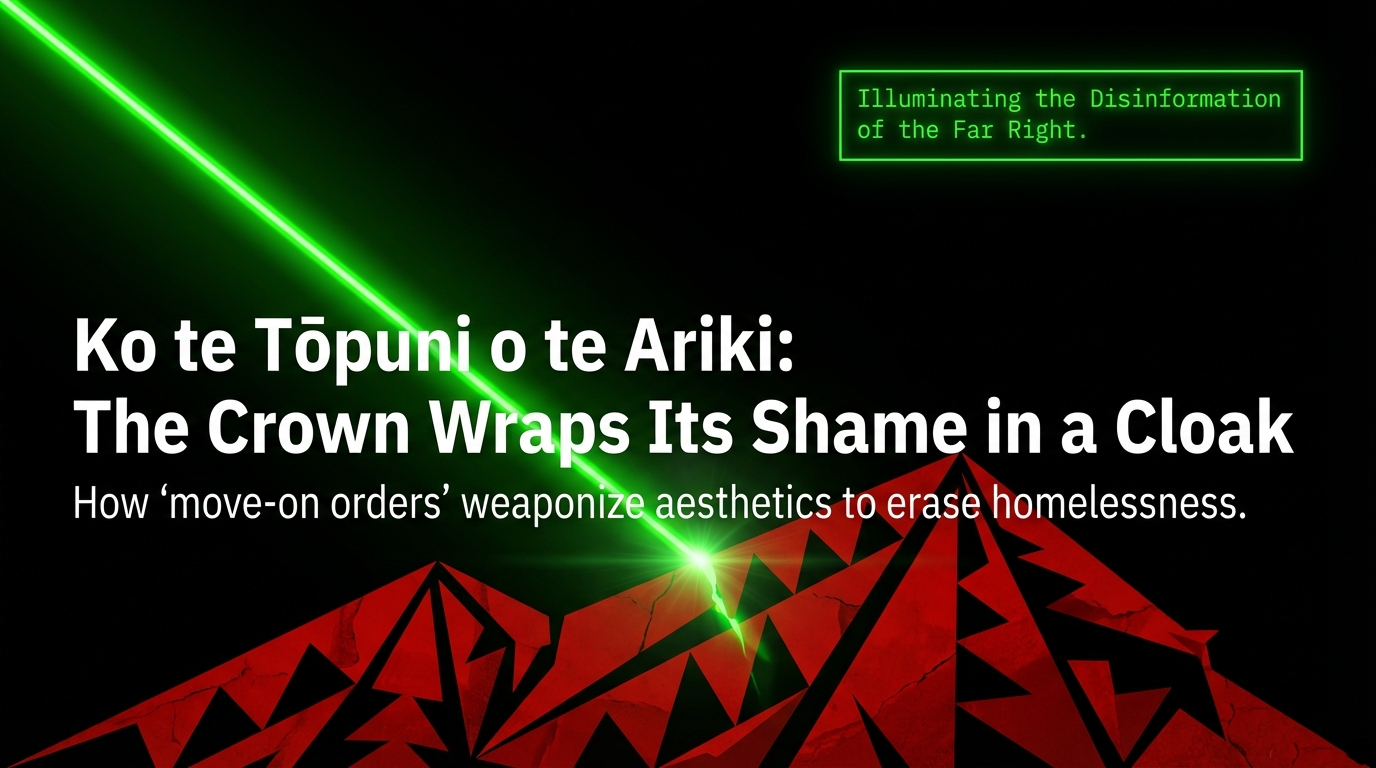
Paul Goldsmith does not have a homelessness policy. He has an invisibility policy — and he is deploying it with the cheerful contempt of a man who has never once had to choose between a bed and a meal.
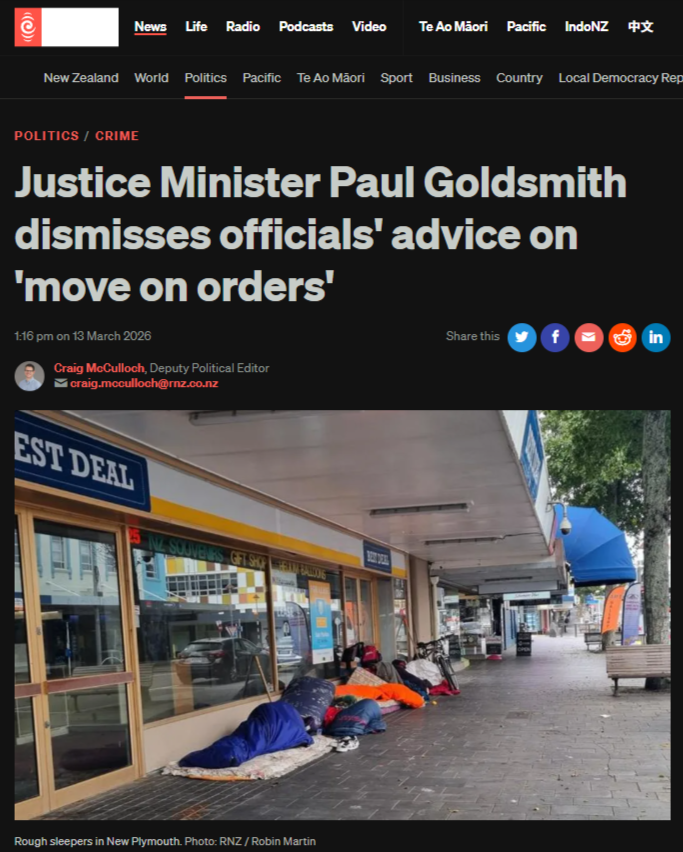
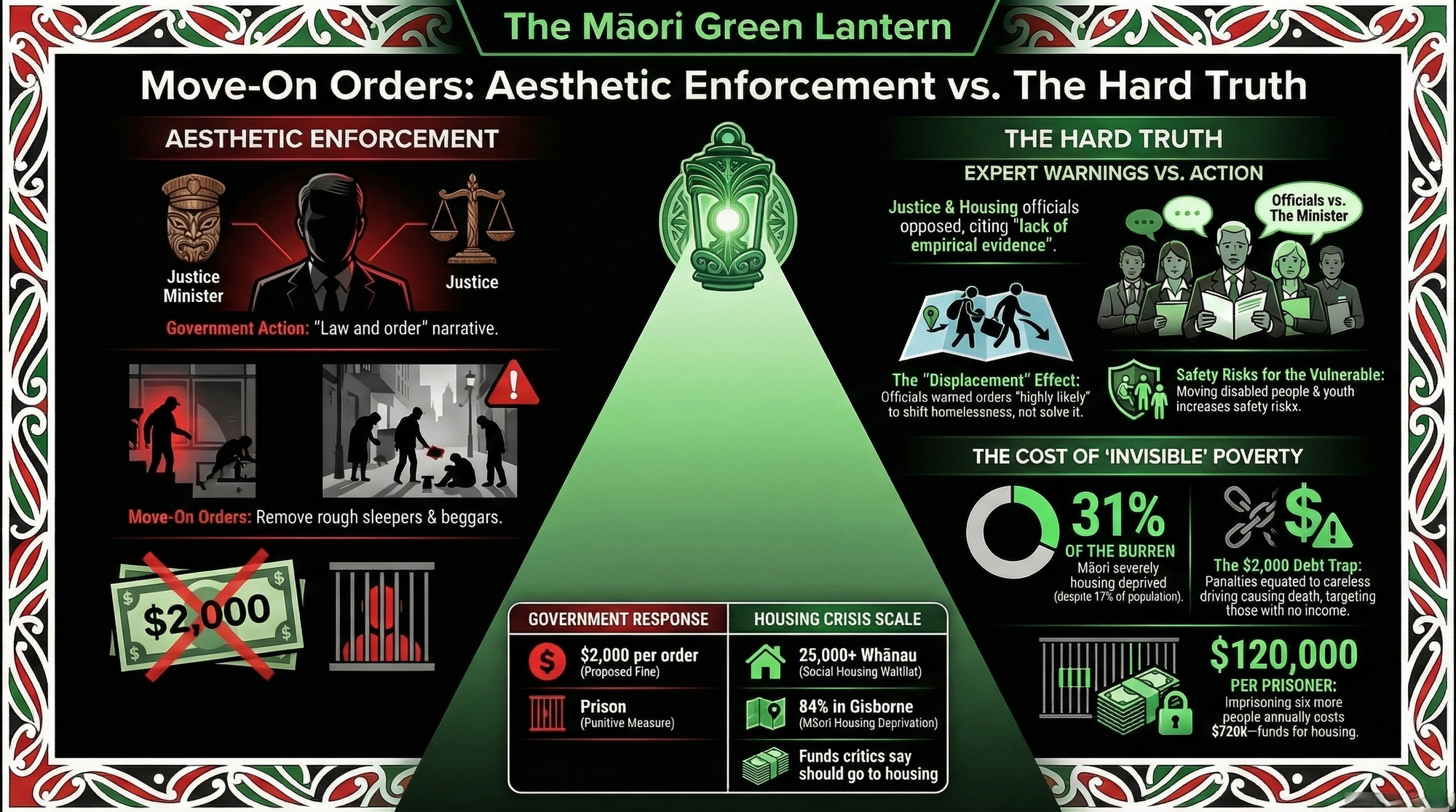
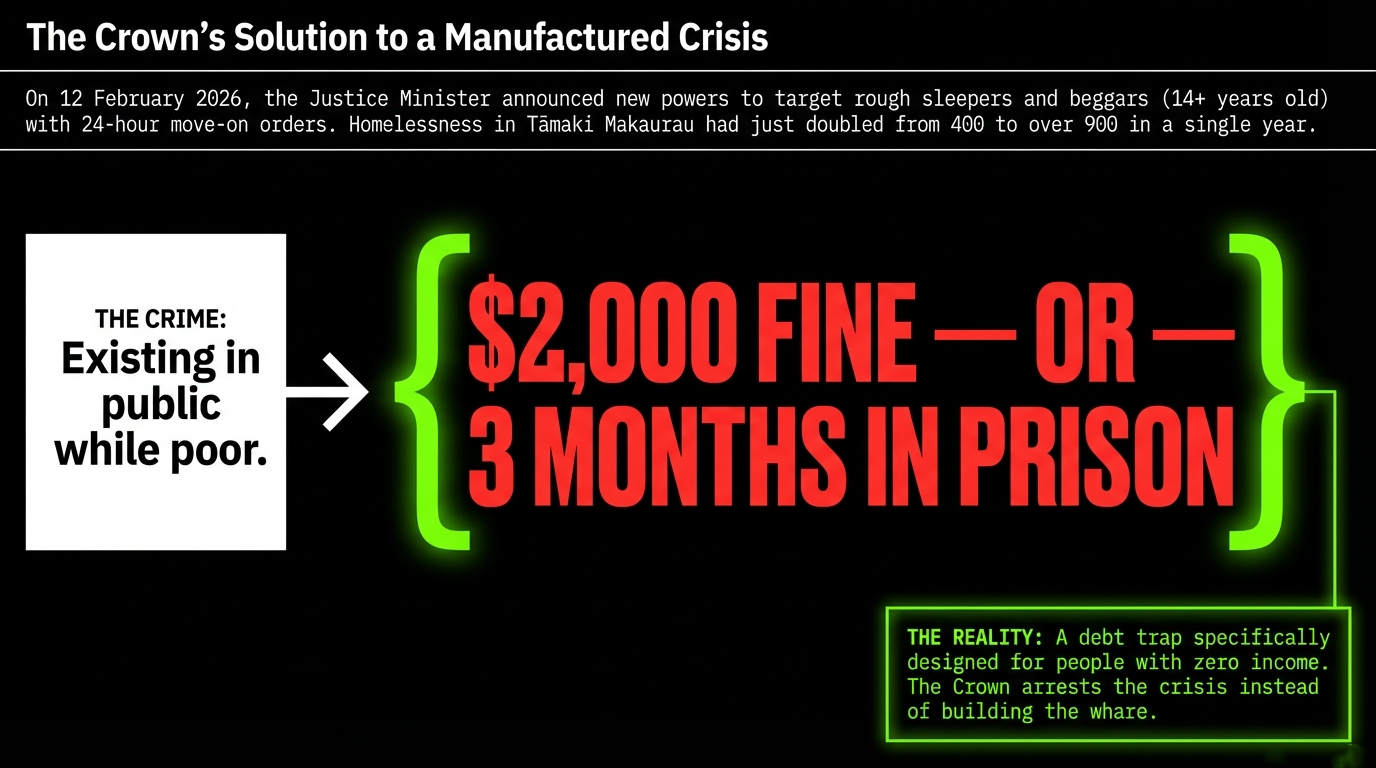
On 12 February 2026, this government announced police powers to issue 24-hour move-on orders against rough sleepers and beggars, enforceable by a $2,000 fine or three months' imprisonment — for the crime of existing in public while poor.
His own Justice Ministry opposed it. His own Housing Ministry opposed it. Corrections warned the prisons were already full. The empirical evidence showed it would change nothing except the postcode of the suffering. Goldsmith read all of it, thanked his officials politely, and announced the policy anyway — because this was never about solving homelessness. It was about reclaiming the city centres for the comfortable, and sweeping the casualties of his own government's cuts out of the frame before the tourists arrive. As homelessness in Tāmaki Makaurau doubled from 400 to over 900 in a single year, and as Māori — 17 percent of the population — account for 31 percent of the severely housing-deprived, this law is not aesthetically neutral. It is a racial instrument dressed in civic language — and this essay names it exactly as that.
What This Essay Reveals
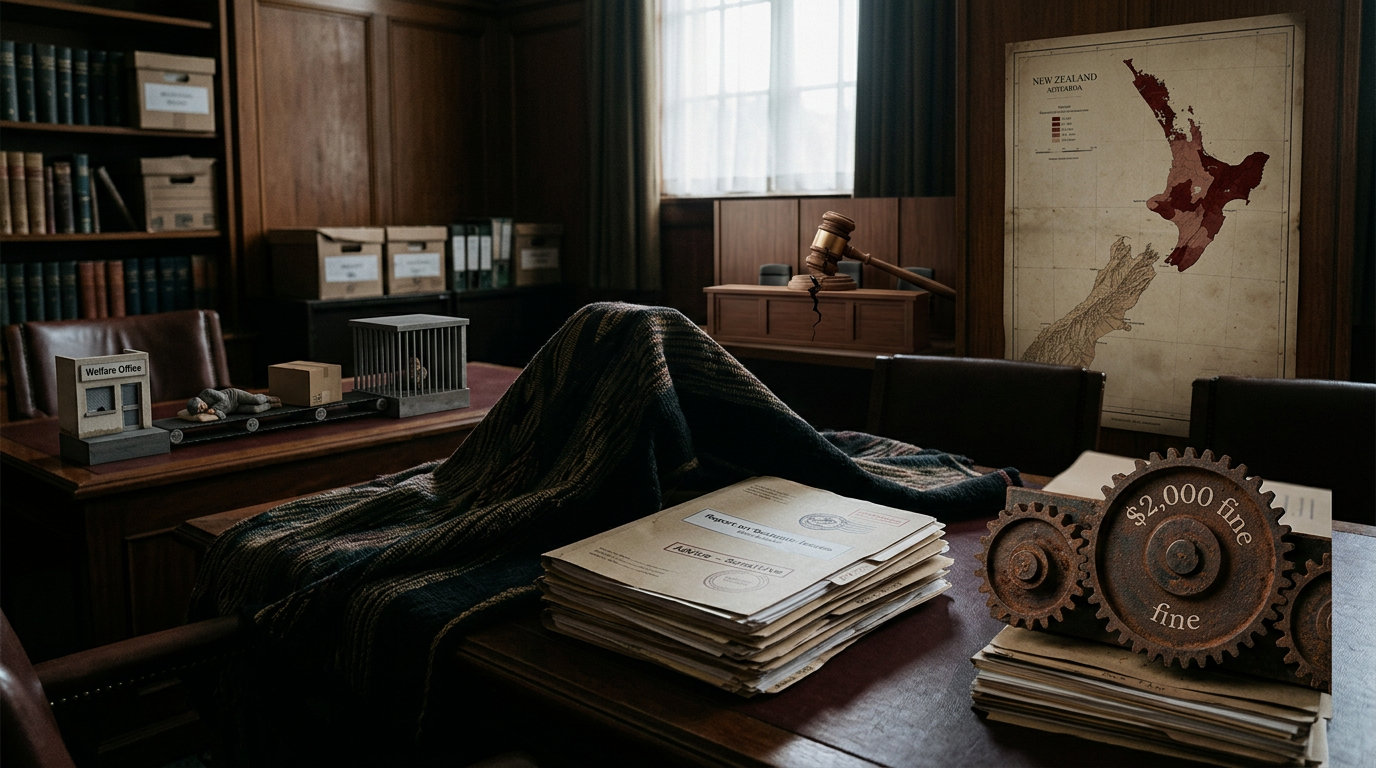
This essay traces the whakapapa of Paul Goldsmith's move-on orders from their ideological roots to their racial consequences, and finds the same fingerprints on every surface: a government that manufactures crisis through funding cuts, denies the crisis through suppressed advice, and then criminalises the evidence by fining the homeless for existing.
Goldsmith's own officials confirmed the policy lacked empirical support, would generate up to 800 additional court cases annually, and would imprison an estimated six extra people per year at $120,000 each to the state — money this government refuses to spend on a single new whare.
Five hidden connections are exposed: the systematic dismissal of official advice as standard practice; the debt-trap architecture of a $2,000 fine aimed at people with no income; the disproportionate Māori targeting embedded in the law's design; the parallel campaign to strip tikanga from the courts; and the conveyor belt from welfare punishment to rough sleeping to criminalisation that The Māori Green Lantern has previously mapped.
The metaphor running through it all is the tōpuni — the cloaking garment — wielded not to protect the sacred, but to hide the state's shame from itself.
The conclusion is unavoidable: they do not want to fix homelessness. They want it out of the frame. And it will be Māori whānau — disproportionately, predictably, by design — who bear the cost of keeping Paul Goldsmith's postcard clean.
He Kōrero Whakataki — The Mauri of the Lie
There is an old act of colonial magic, practised not with karakia but with legislation, not with tohunga but with ministers: make the wound invisible, and claim the body is healed.
Paul Goldsmith has mastered this art. On the 12th of February 2026, this government announced it would gift police the power to issue 24-hour move-on orders — banishing rough sleepers and beggars from public spaces under threat of a $2,000 fine or three months' imprisonment. No whare. No kai. No manaaki. Just: get out of our line of sight.
And when his own officials — inside his own ministry — handed him the evidence that this policy was punitive theatre with no empirical basis, Goldsmith did what every ariki who fears the truth does: he picked up the rangi, and he ignored it entirely.
This is not law enforcement. This is aesthetic enforcement. The whare is still burning. They have simply pulled the curtains.
The Deep Dive Podcast
Listen to this lively conversation between two hosts, unpacking and connecting topics in the sources of this essay
💚 Koha Consideration
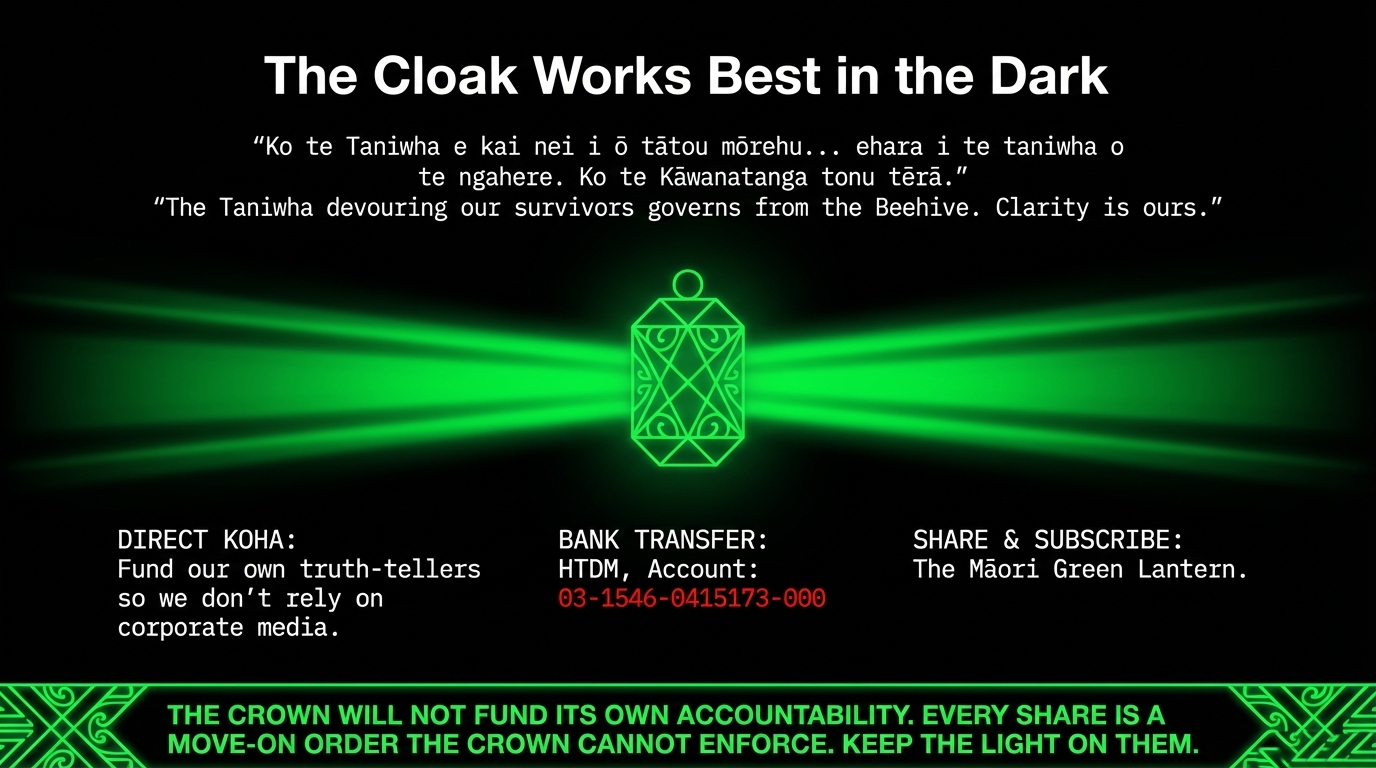
Every rough sleeper Paul Goldsmith erases from view is a whānau member this government first failed — then fined for surviving that failure in public. Every essay The Māori Green Lantern publishes traces that failure back to its source, names the minister who read the evidence and shrugged, and puts the data in whānau hands where it belongs.
The Crown will not fund this accountability. The corporate media largely won't either. The tōpuni works best when no one is holding a light. But you can help keep that light burning.
Every koha signals that rangatiratanga includes the power to fund our own truth-tellers — our own tohunga who trace the whakapapa of harm, name the architects of the crisis, and refuse to let the cloak fall.
Kia kaha, whānau. The bodies are still there, whether Goldsmith's orders let you see them or not. This mahi keeps the light on them.
Three pathways to support:
🌿 Direct Koha — Support this mahi at the Koha platform
📩 Subscribe — Receive essays directly at The Māori Green Lantern
🏦 Bank Transfer — HTDM, account number 03-1546-0415173-000
If koha is not possible right now — kāore he raru. Subscribe, share this essay with your whānau, post it, debate it, send it to your MP. That is koha in itself. Every share is a move-on order the Crown cannot enforce.
Ko te Whakaaro Tōpuni — The Metaphor of the Cloak
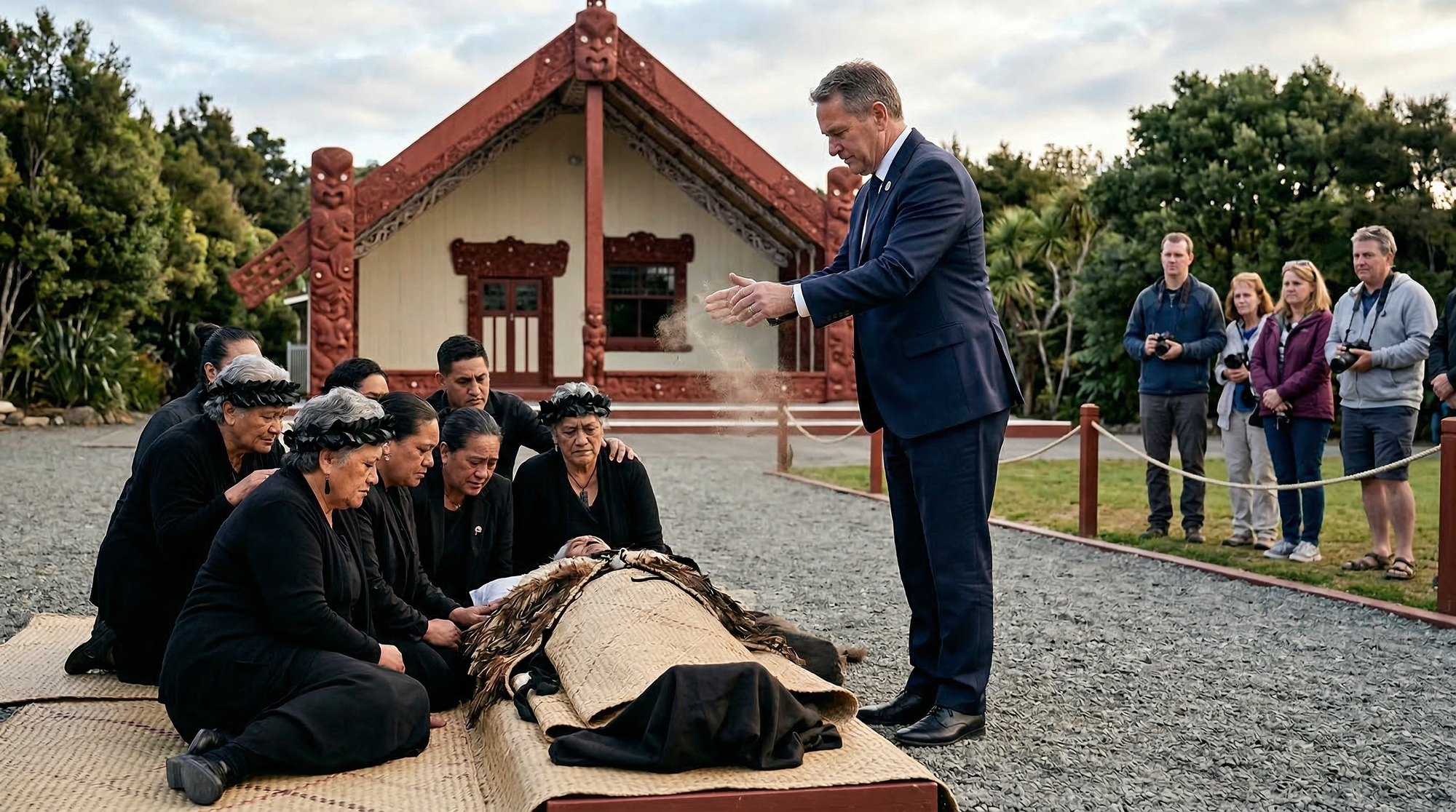
Imagine a tūpāpaku — a body — on the marae ātea. Not hidden by death, but by poverty, by dispossession, by the accumulated grief of generations. The whānau gather. They weep. They demand urupā, rest, restoration.
And the Minister of Justice arrives — not with resources, not with aroha — but with a tōpuni: a cloaking garment. He throws it over the tūpāpaku. He dusts his hands. He tells the tourists it is now safe to photograph the marae.
The body is still there. The whānau still grieve. But the view has been cleaned up, and that, to Paul Goldsmith's government, is the definition of success.
This is the wairua of the move-on order. It does not solve. It does not heal. It hides — and hiding, for this government, is indistinguishable from governing.
Te Whakapapa o te Pakiaka — The Roots of the Rot
This policy did not emerge from a vacuum. It was grown in the same soil as every other act of aesthetic cruelty this coalition has produced.
The social housing waitlist has swollen to more than 25,000 whānau. Homelessness in Tāmaki Makaurau doubled from 400 people in 2024 to over 900 in 2025, during the same period this government was crowing about fiscal responsibility. The government cut over $1 billion in Māori-specific funding, gutted kaupapa Māori housing programmes, dismantled Te Aka Whai Ora, and removed every kaupapa Māori pathway that could have stopped whānau ending up on the streets.
Then, having manufactured the crisis, they announced a solution: arrest the crisis.
They did not build a single whare. They built a law to remove the evidence that no whare exists.
Ngā Āhuatanga Huna — Five Hidden Connections
1. Goldsmith Ignored His Own Officials — Not Once, But as Policy
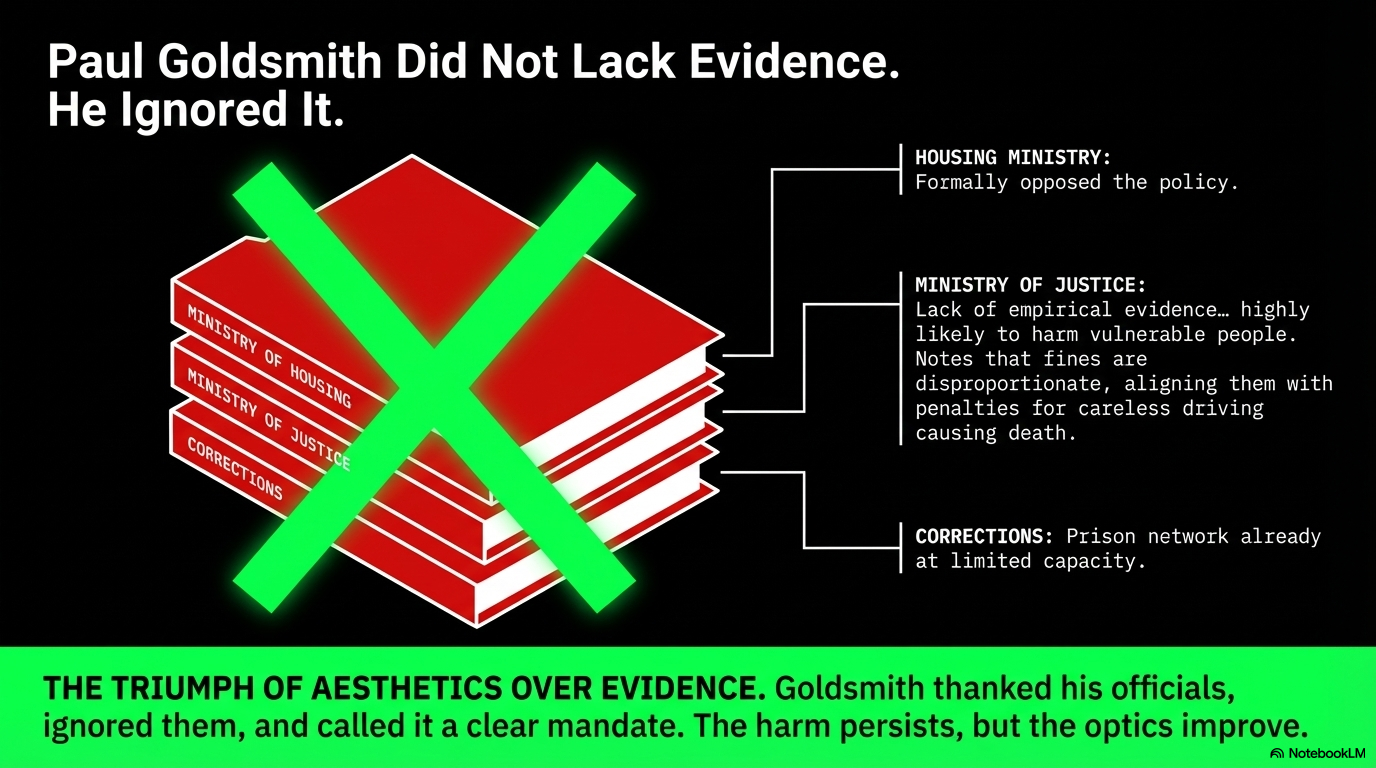
When RNZ reported that Goldsmith's own justice officials had warned him that move-on orders lacked empirical evidence, would simply displace people, and were "highly likely" to harm vulnerable people including disabled whānau, youth, and those with mental illness — Goldsmith shrugged. He compared it to the gangs legislation, where officials also issued warnings he ignored. This is not a minister who weighs evidence. This is a minister who uses evidence as a floor mat.
The Ministry of Housing didn't support the policy. The Ministry of Justice didn't support the policy. Corrections warned that prisons were already at capacity. Goldsmith called this "a clear mandate to restore law and order" and proceeded anyway. He does not govern with evidence. He governs with aesthetics.
2. The Fine Is a Debt Trap Designed for People Without Money
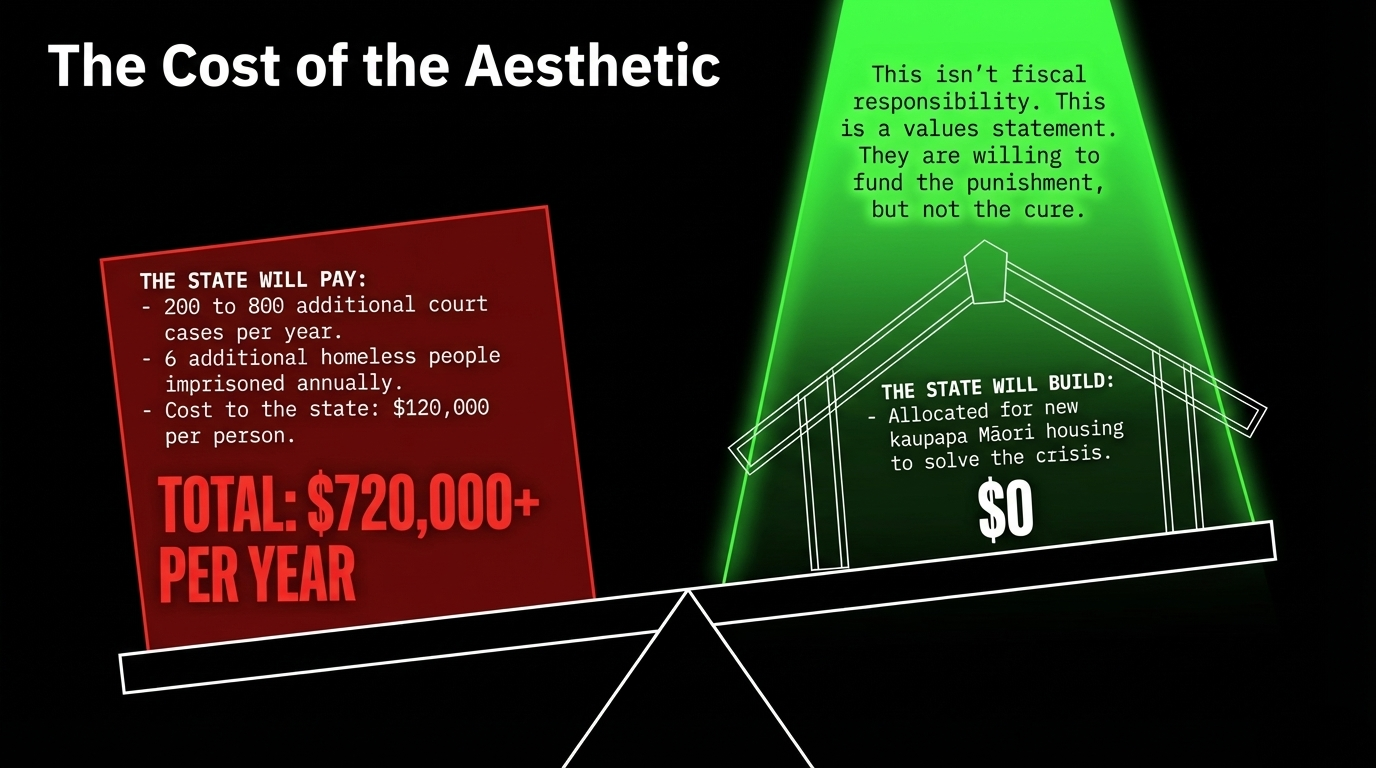
Officials stated in black and white that a $2,000 fine applied to people with little to no income is "neither appropriate nor proportionate". The fine is comparable to penalties for careless driving causing death. The policy, if implemented, will generate between 200 and 800 additional court cases per year, and will result in an estimated six additional people imprisoned annually at a cost of $120,000 each to the state. This government is prepared to spend $720,000 a year imprisoning homeless people rather than housing them. That is not incompetence. That is a values statement.
3. Māori Are the Target — Even If the Law Doesn't Say So
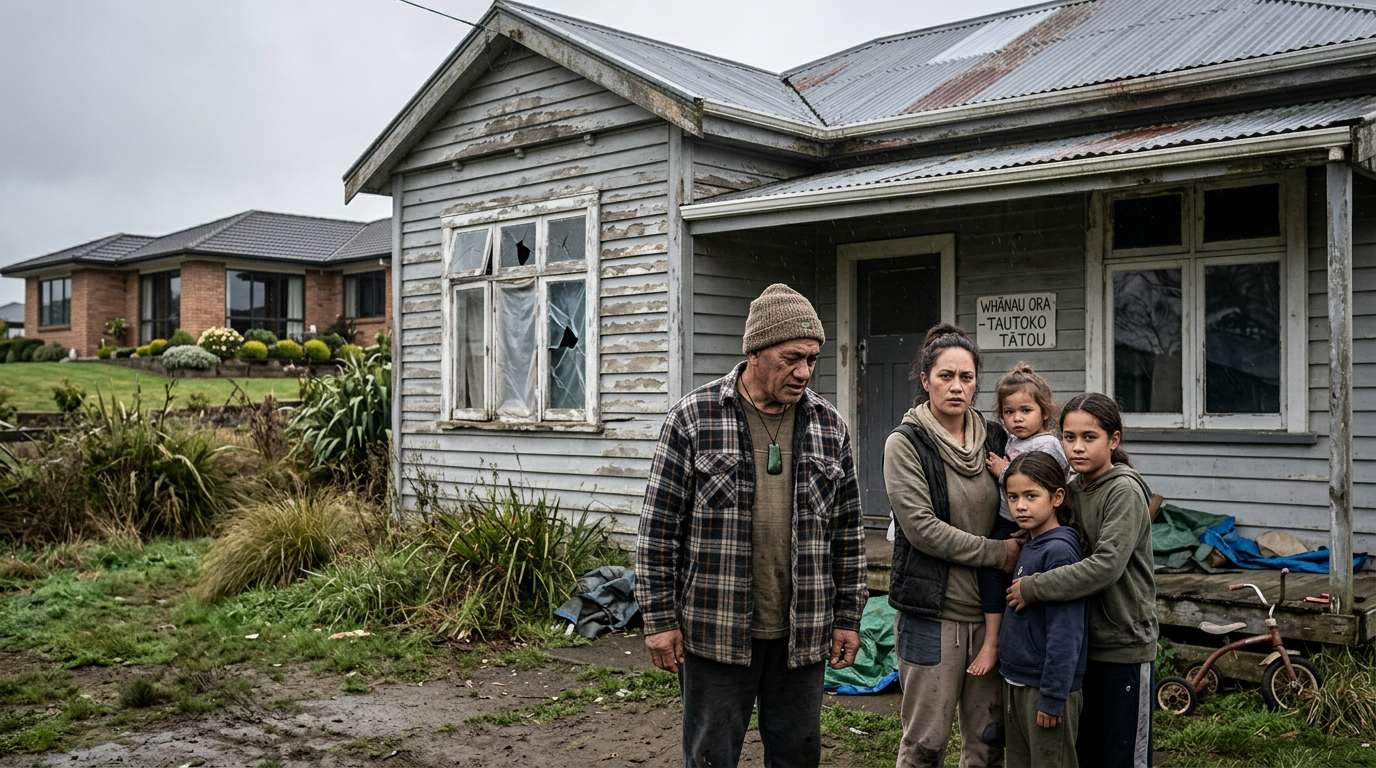
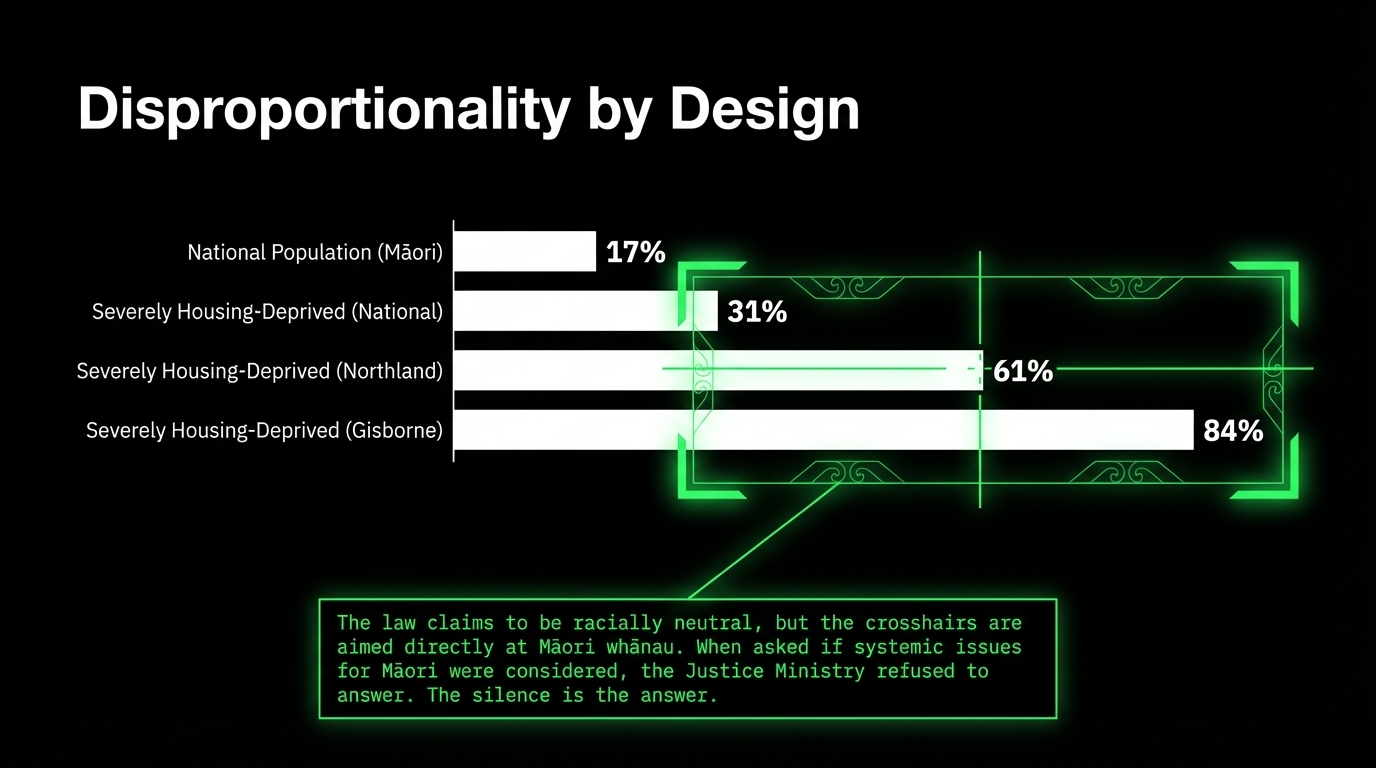
According to Stats NZ, Māori are approximately 17 percent of Aotearoa's population — but represent 31 percent of those in severe housing deprivation. In Gisborne, Māori make up 84 percent of the severely housing-deprived. In Northland, 61 percent. These are not statistics. These are the names of whānau this law will target — disproportionately, predictably, systematically.
The NZ Herald confirmed that Goldsmith's Justice Ministry declined to answer whether the government considered systemic issues for Māori when drafting the powers. The silence is the answer.
4. This Is Part of a Wider War on Tikanga in the Justice System
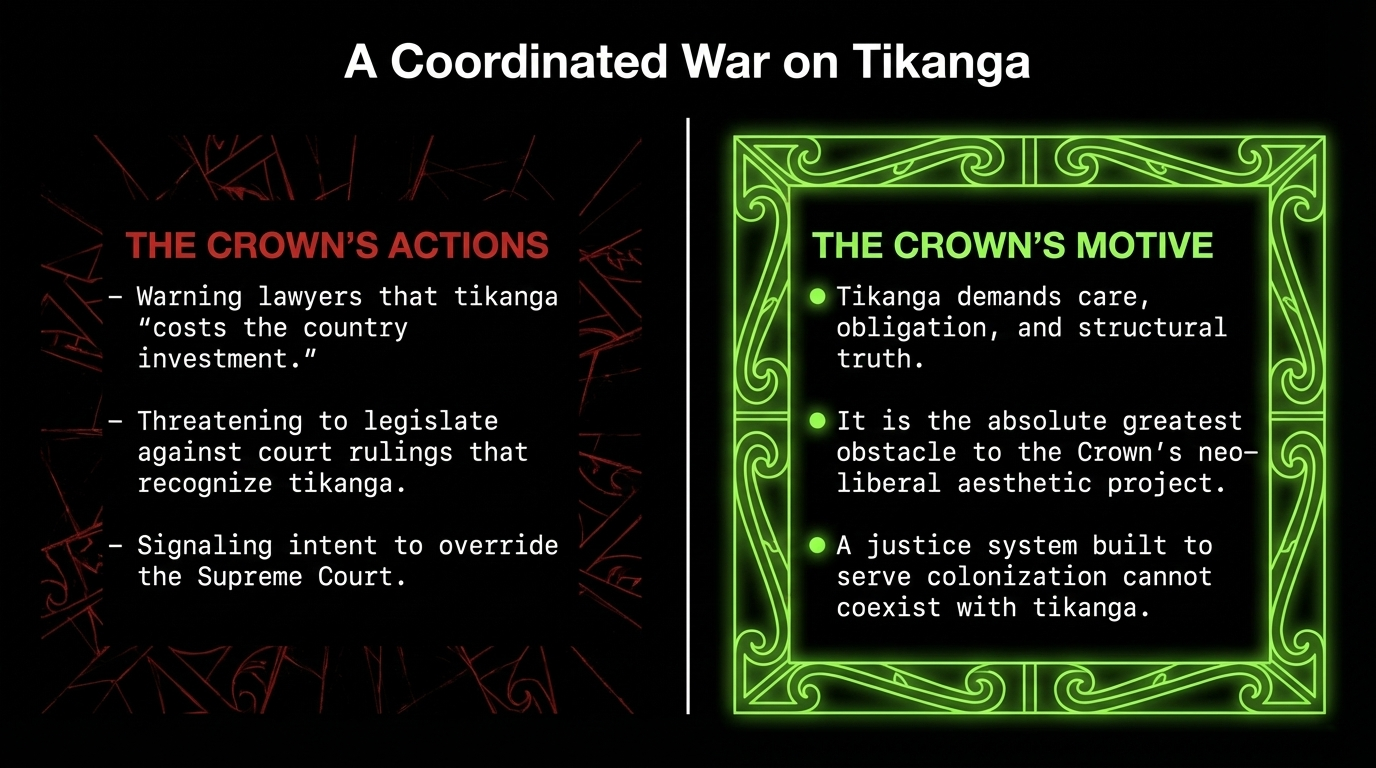
Just months earlier, Goldsmith warned lawyers that tikanga Māori in courts could "cost the country investment" and threatened to legislate against court rulings that recognised tikanga. He signalled that the government would override Supreme Court decisions if they disagreed with the outcomes. This is not judicial policy. This is a minister who wants a justice system that serves colonisation — and who understands, correctly, that tikanga is its most powerful obstacle.
5. The Punishment-Homelessness Conveyor Belt Runs in Both Directions
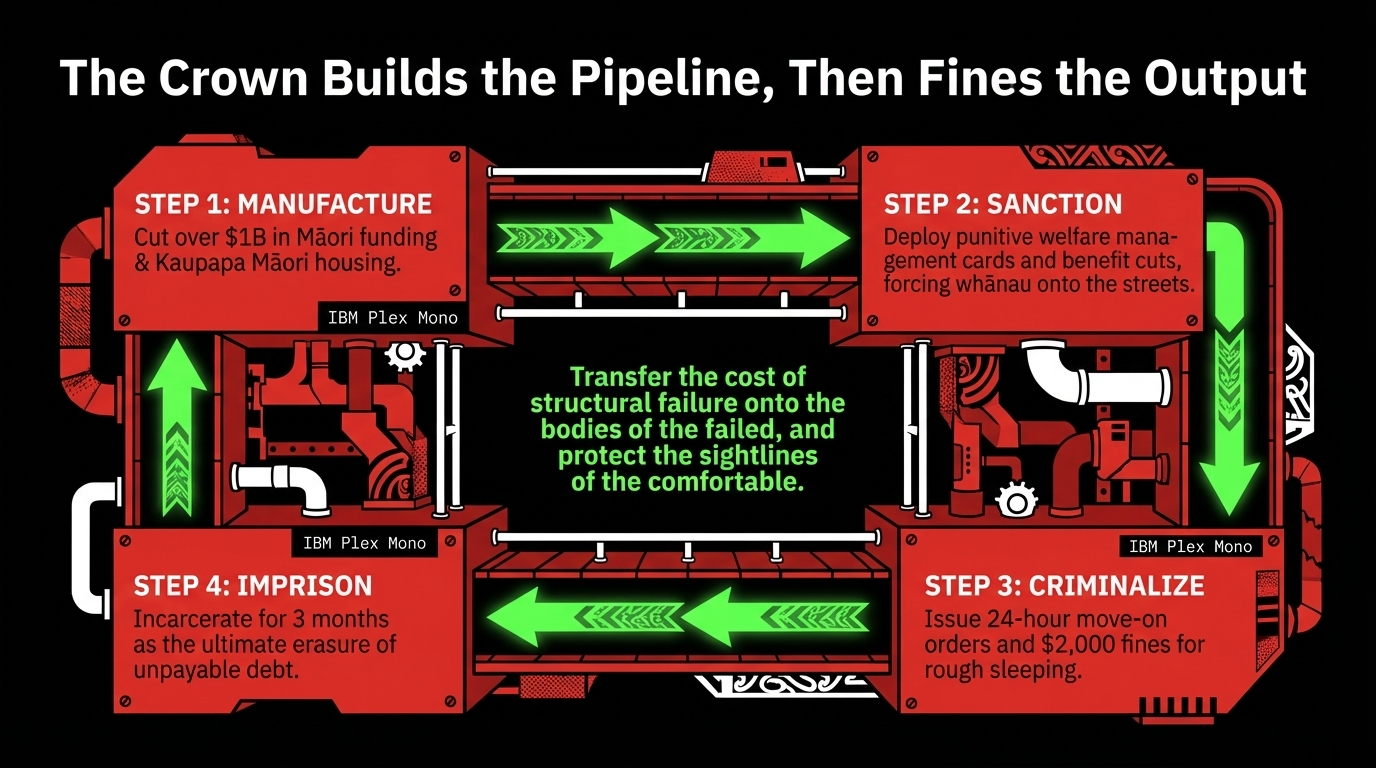
As The Māori Green Lantern exposed in the Traffic Light Taiaha essay, this government sanctions whānau into homelessness through its welfare punishment machinery — money management cards that prevent rent payments, benefit cuts, and sanctions that remove income entirely. Having engineered the pipeline from poverty into rough sleeping, it now proposes to arrest the output. The Crown builds the pipeline and then fines the water for existing.
Toru Tauira mō te Hinengaro Māori-kore — Three Examples for the Western Mind
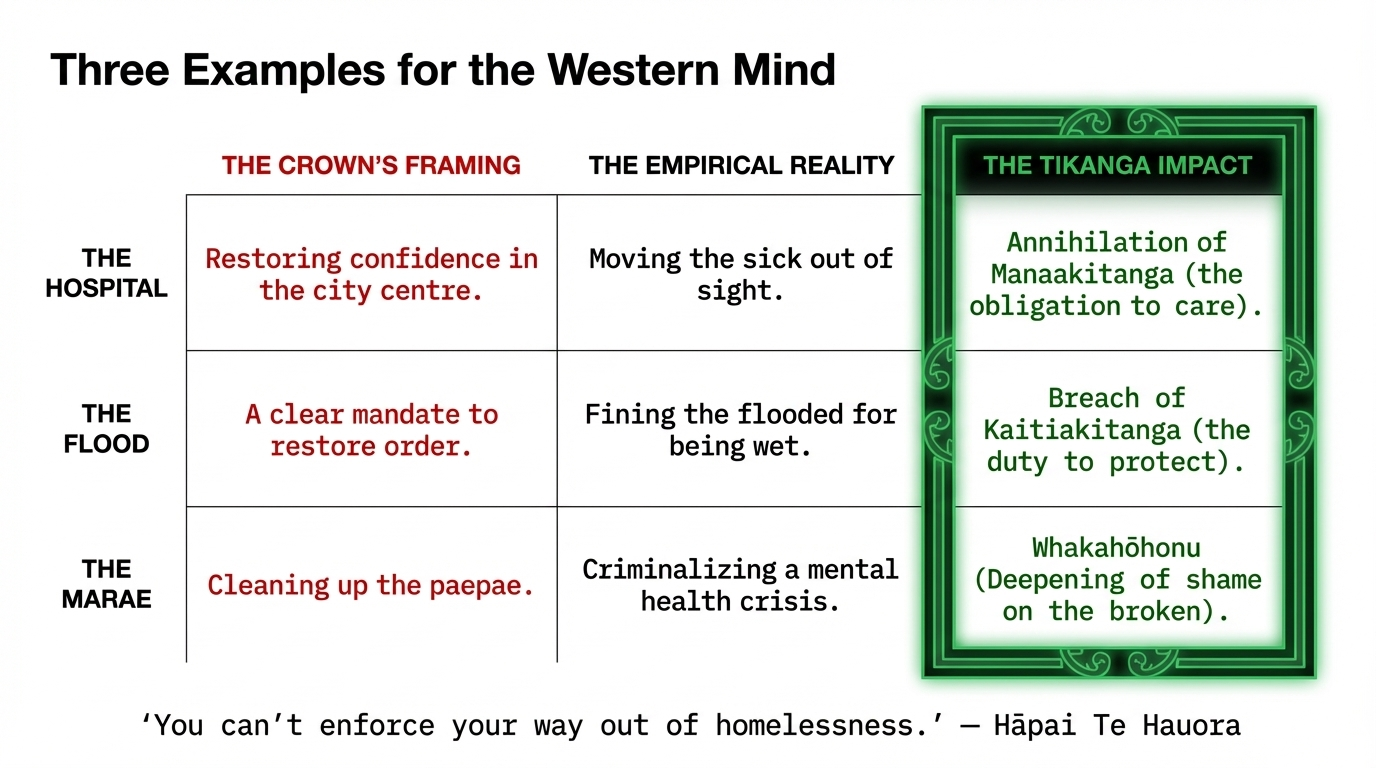
Example One: The Broken-Windows Funeral
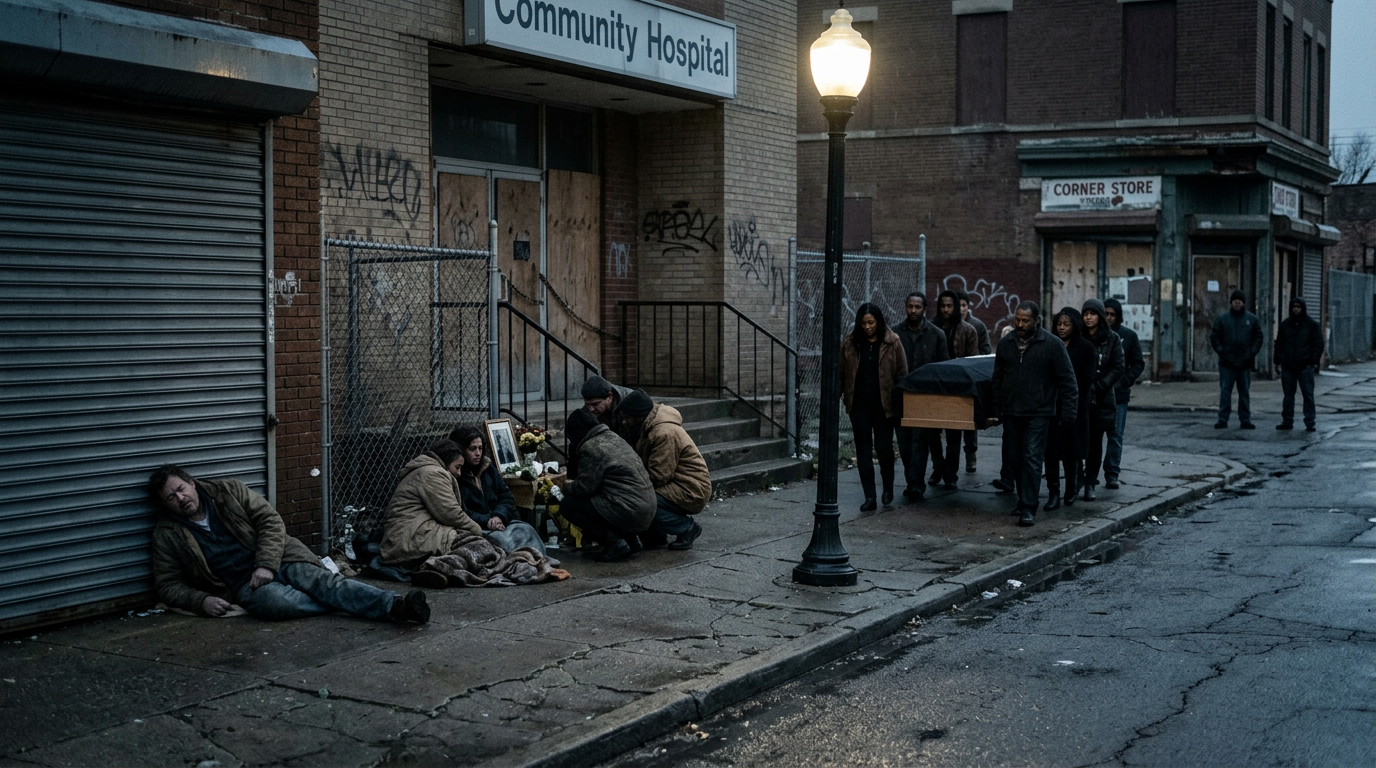
Imagine you live in a town where the hospital has been closed. People are dying of treatable illnesses in the streets. The mayor does not reopen the hospital. Instead, he passes a bylaw: sick people must not be visible on main street. He calls this "restoring confidence in the city centre."
That is exactly what Paul Goldsmith has done. Homelessness in Tāmaki Makaurau doubled in a single year — from 400 to over 900. The Crown did not build more housing. It did not fund more mental health services. It gave police a new tool to push the doubled number of bodies around the corner. The harm persists. The optics improve. The minister claims credit.
Impact on Tikanga: In te ao Māori, the concept of manaakitanga — the obligation to care for, uplift, and shelter those in need — is not optional. It is the foundational ethic of community. A rangatira who turns away a mōrehu does not become a leader. They become a person without mana. This law does not just fail housing policy. It annihilates manaakitanga from state practice entirely.
Example Two: The Accountant Who Fines the Flood
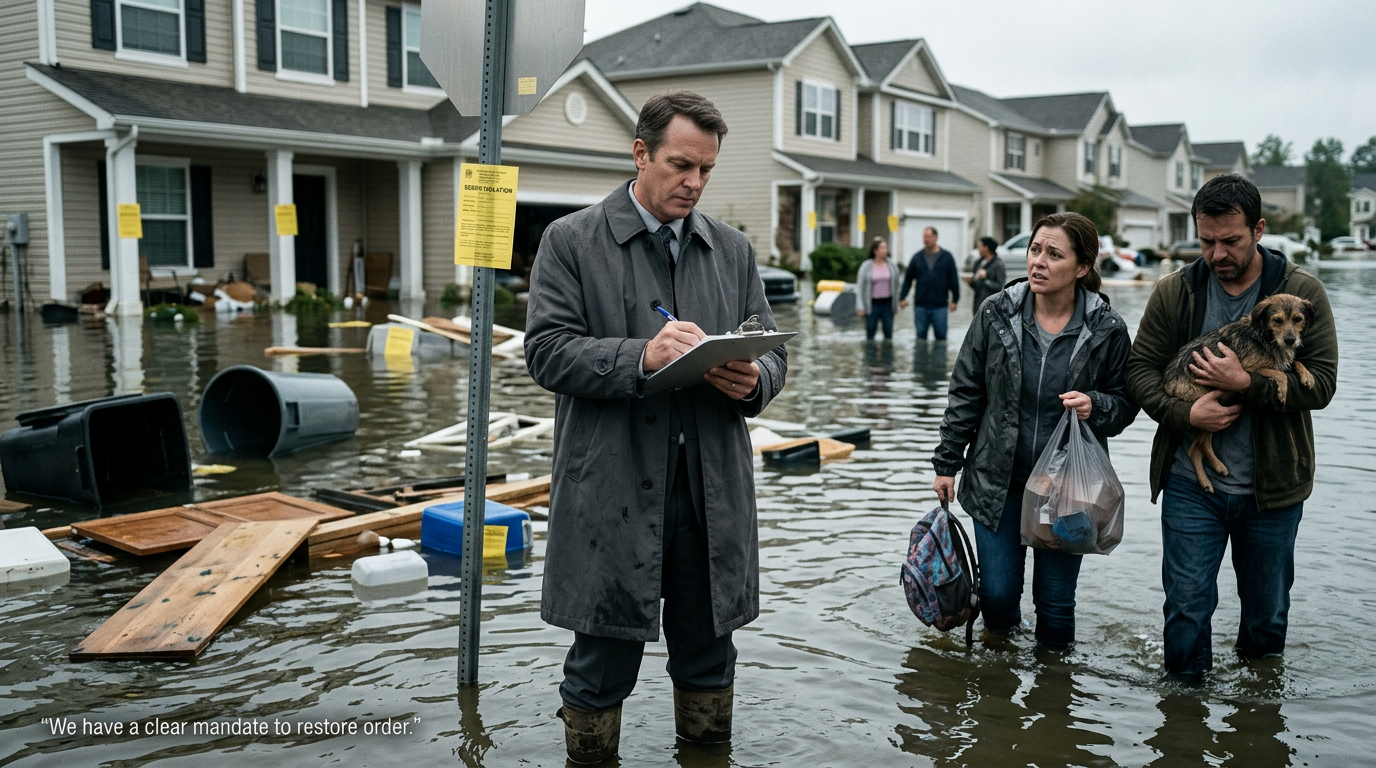
A river bursts its banks. Houses are flooded. Families wade through their destroyed homes. A government accountant arrives with a clipboard. He does not offer sandbags. He writes fines for the families whose possessions are floating in the street, disturbing the aesthetic of the neighbourhood. He says: "We have a clear mandate to restore order."
This is the Goldsmith doctrine. Officials confirmed the orders provide no evidence of reducing crime rates — they merely relocate the problem. Hāpai Te Hauora confirmed explicitly: "You can't enforce your way out of homelessness." The flood is not ended. The families are merely fined for being wet in a visible location.
Impact on Tikanga: Kaitiakitanga — guardianship — obliges those with power to protect the vulnerable, not relocate them. The Crown's obligation under Te Tiriti o Waitangi includes the active protection of the wellbeing of Māori — not just the absence of formal discrimination. Every move-on order issued to a Māori whānau member is a direct breach of the Crown's Treaty guarantee.
Example Three: The City That Swept the Paepae Clean
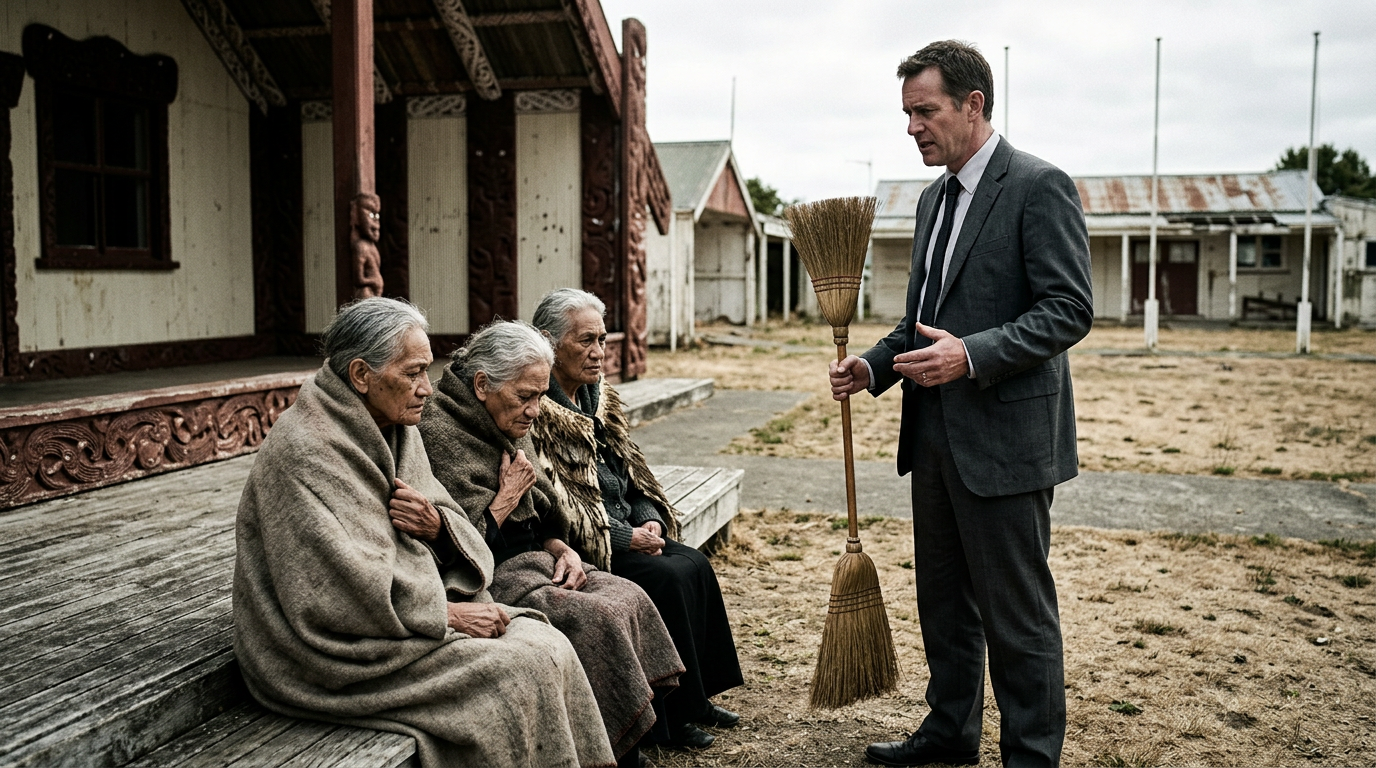
Imagine a marae where the elders have been starved — stripped of resources, land, income. They sit on the paepae, thin and cold. The government arrives not with kai, not with kākahu — but with a broom. "You are cluttering the paepae," they say. "Move." And when the elders ask, "Move where?", the government says: "That is not our concern. Our concern is the aesthetic of this marae."
Psychiatrists across Aotearoa have warned that homelessness is primarily a mental health crisis, not a criminal one. Dr Hiran Thabrew, Chair of Tū Te Akaaka Roa, stated plainly: "The evidence is clear that these kinds of enforcement measures do not make communities safer." Hurimoana Dennis — who has housed over 700 homeless and displaced whānau at Te Puea Marae — described the orders as senseless. He knows. He actually did the mahi this government refuses to fund.
Impact on Tikanga: In Māori society, the paepae is a place of honour — where elders speak truth, where community gathers, where whakapapa is enacted. To sweep people off it — to treat the presence of the suffering as the problem — is an act of profound whakahōhonu, a deepening of shame onto those already broken. Western law does not recognise this harm. Te Tiriti does.
Ko te Matapaki Whakahoki — What This Government Has Actually Built
Goldsmith is not governing. He is landscaping — clearing the eyesores from the political garden for the comfort of his donor base. Every policy this coalition has produced follows the same architecture:
- Manufacture the crisis (cut Māori housing, welfare, and mental health funding)
- Deny the crisis (refuse to release Cabinet advice, as The Kākā confirmed)
- Criminalise the evidence (fine the homeless, imprison the survivors)
- Claim credit for the silence
This is the neoliberal project at its most naked: transfer the cost of structural failure onto the bodies of the failed, and protect the sightlines of the comfortable.
And Māori bodies — 31 percent of the severely housing-deprived in a country where they are 17 percent of the population — are the bodies this machinery is designed to erase.
The Māori Green Lantern has previously traced this conveyor belt from benefit sanctions to homelessness to imprisonment. The move-on order is simply the newest gear in the same machine — and Goldsmith is its most enthusiastic operator.
He Ara Whakaoratanga — Pathways Forward
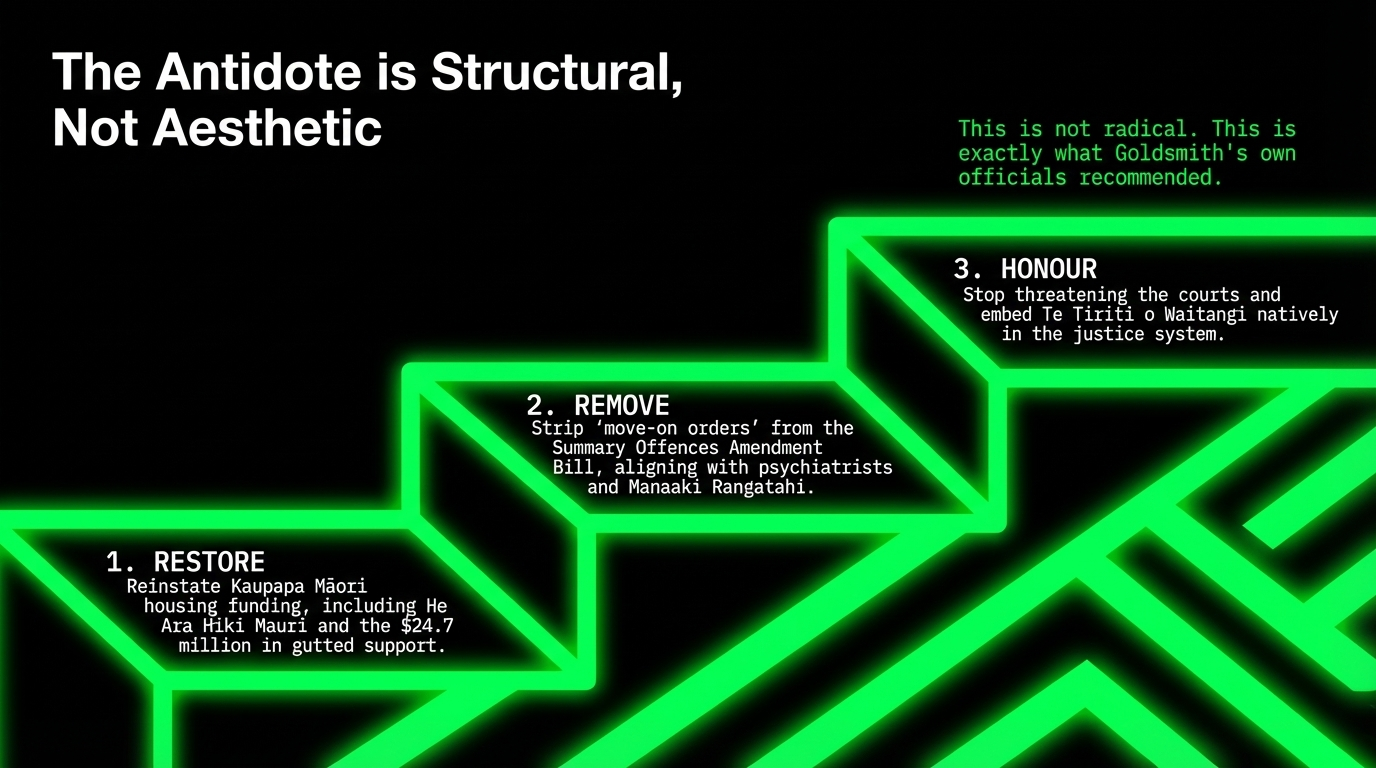
The antidote to aesthetic enforcement is not better optics — it is structural restoration. Three evidence-based demands:
- Restore kaupapa Māori housing funding — reinstate He Ara Hiki Mauri and the $24.7 million in kaupapa Māori homelessness support that existed before this government and was gutted.
- Remove move-on orders from the Summary Offences Amendment Bill — as Manaaki Rangatahi, Hāpai Te Hauora, and psychiatrists across Aotearoa have demanded.
- Honour Te Tiriti in the justice system — stop threatening courts that recognise tikanga, stop designing laws with Māori disproportionality baked in and then refusing to acknowledge it.
This is not radical. This is what Goldsmith's own officials recommended. He just doesn't care what his officials recommend.
He Kōrero Whakakapi — Closing Words
The tōpuni is a sacred garment. In the hands of a rangatira, it protects the sacred, shelters the vulnerable, and preserves the mana of the people. In the hands of Paul Goldsmith, it is the mechanism by which a government of the comfortable hides the consequences of its cruelty from itself.
They do not want to fix homelessness. They want to erase its visibility. They do not want to house the wounded. They want the wounded out of their postcard.
Ko te Taniwha e kai nei i ō tātou mōrehu — ehara i te taniwha o te ngahere. Ko te Kāwanatanga tonu tērā. Ko te tōpuni tōna rākau. Ko te māramatanga tō tātou.
The Taniwha devouring our survivors is not from the forest. It governs from the Beehive. The cloak is its weapon. Clarity is ours.

Ivor Jones The Māori Green Lantern Fighting Misinformation And Disinformation From The Far Right
Research conducted 13 March 2026. Sources verified at time of publication. Tools used: search_web, fetch_url. All URLs confirmed live at time of writing. Statistics sourced from Stats NZ, RNZ, Te Ao News, and government regulatory impact statements.