“Puna Wai, Puna Kino: How Seymour's Water Sell-off Strips Tangata Whenua of Our Birth Right” - 25 July 2025
Colonisation 2.0: The Background to This Betrayal
Kia ora koutou, he uri Māori ahau. Good health to you all, I am of Māori descent.
The neoliberal vultures circle our water, our life force, our taonga - and this time, they're not just coming for our pockets, whakapapa, our spiritual connection to te wai that flows through our veins as surely as it flows through our whenua.
In a move that reveals the true colonial heart beating beneath his libertarian facade, Associate Finance Minister David Seymour is systematically dismantling protections that safeguard New Zealand's water from foreign exploitation1. This isn't just economic policy - it's cultural warfare against tangata whenua and the spiritual foundations that underpin our relationship with the natural world.
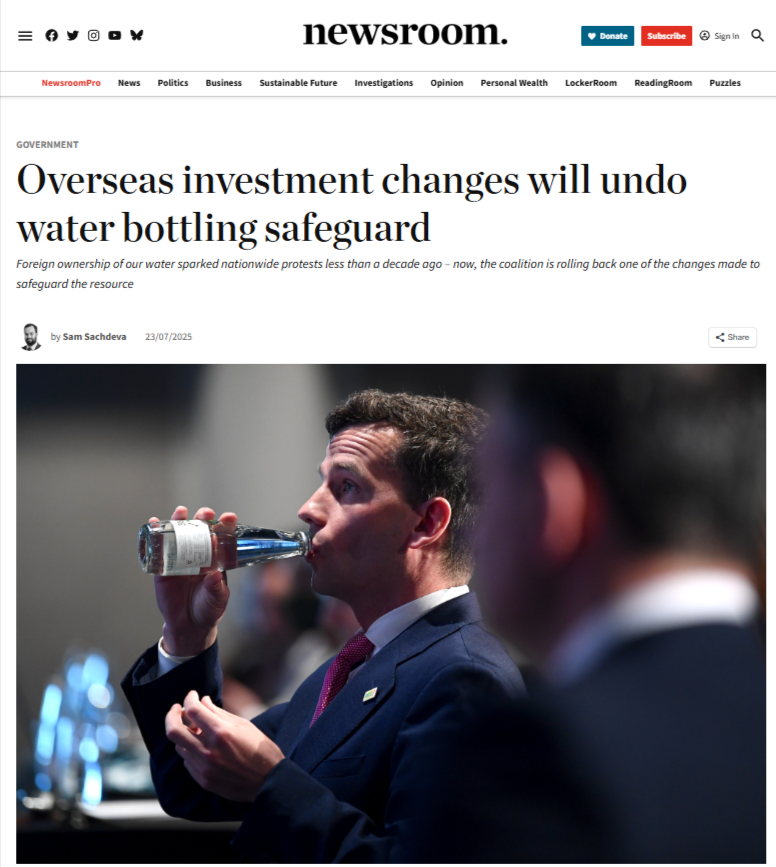
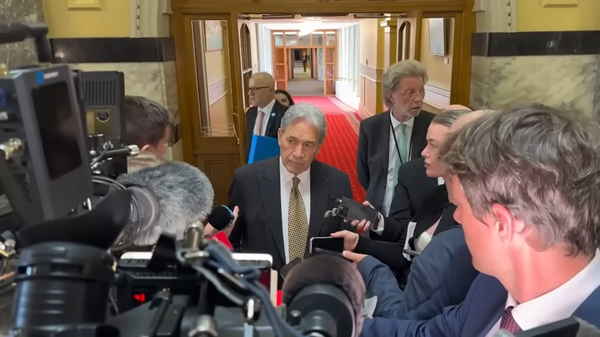
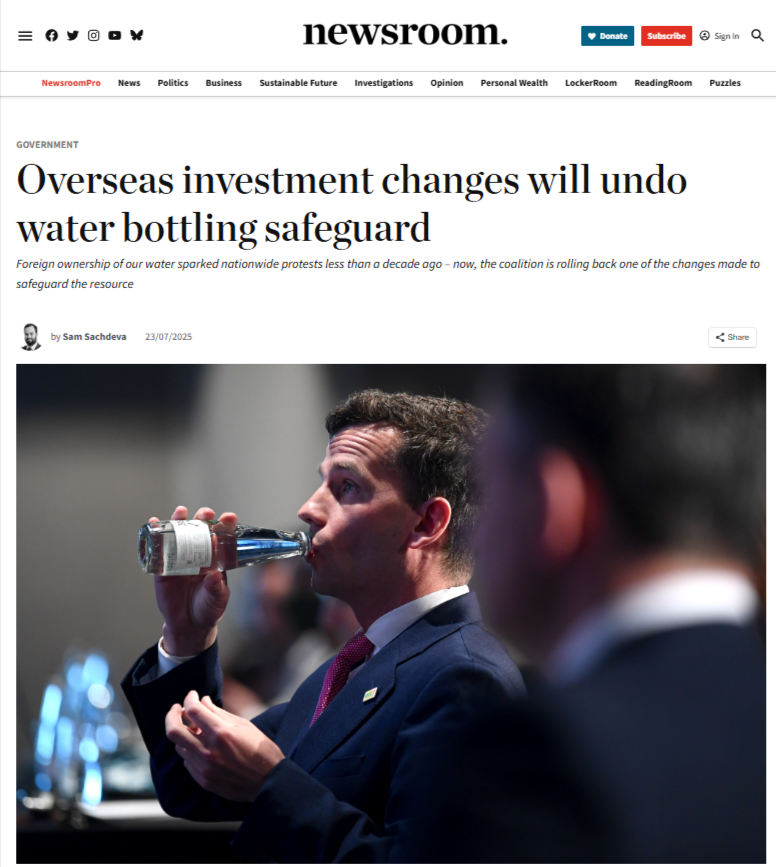
The shameful vulture himself D Seymour
The coalition government's latest assault on indigenous rights comes wrapped in the deceptive language of "economic growth" and "competitiveness." But let's be crystal clear about what's happening here: Seymour's proposed changes to the Overseas Investment Act will strip away specific protections for water bottling operations that were introduced after massive public protests2.
These safeguards weren't arbitrary bureaucratic red tape - they emerged from nationwide protests in 2017 against foreign companies acquiring land with rights to extract billions of litres of water for bottling3. The people spoke, tangata whenua led resistance, and the previous government responded with amendments requiring consideration of whether foreign investment would negatively impact water quality or sustainability.
Now Seymour wants to erase that protection entirely, forcing water investments into what University of Auckland law professor Jane Kelsey calls a "significantly weakened fast-track regime" with assessments completed within just 15 working days4.
The Spiritual Assault on Te Wai
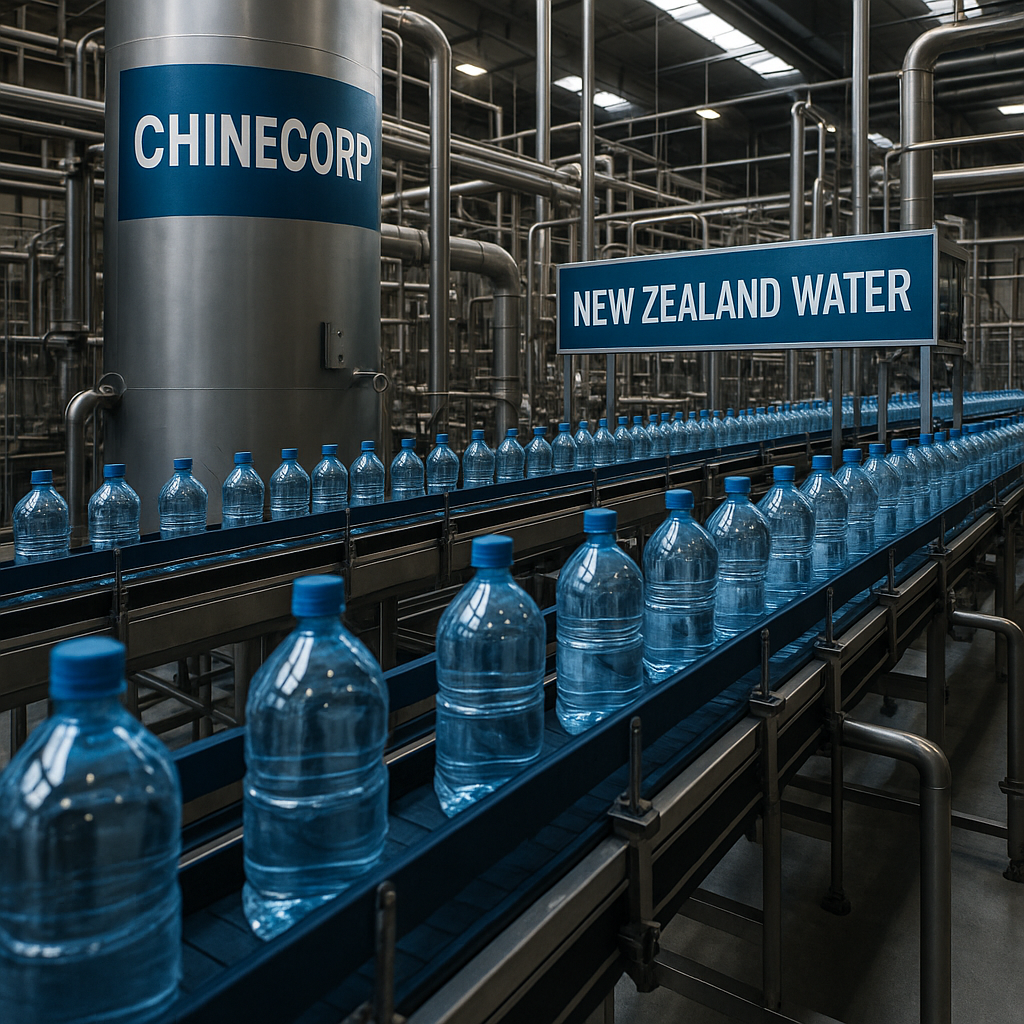
Corporate water extraction threatening New Zealand's precious water resources
For Māori, water is not a commodity to be traded on global markets - it is the essence of all life, like the blood of Papatūānuku (Earth mother) who supports all people, plants and wildlife5. Our spiritual relationship with water runs deeper than Western concepts of ownership or property rights can fathom.
Water is a taonga of huge importance to iwi, with each body of water possessing its own mauri (life force) that should not be mixed with water from another source6. This isn't primitive superstition - it's sophisticated environmental philosophy that recognises the interconnectedness of all life systems.
Yet Seymour's legislation treats this sacred relationship as an inconvenience to be swept aside in favour of "market efficiency." When Ngāti Awa fought to protect te mauri o te wai (the spiritual essence of water) from Nongfu Spring's billion-bottle operation at Otakiri Springs7, they weren't just protecting an economic resource - they were defending their spiritual ancestors.
Neoliberal Snake Oil: Deconstructing Seymour's False Promises
Seymour claims these changes will "raise wages" and bring New Zealand "in line with other advanced economies." This is neoliberal mythology at its most brazen. As economist Bill Rosenberg notes, there's been no evidence provided that wages will actually increase from allowing foreign investors to exploit our water resources8.
The track record of neoliberal "trickle-down" economics in New Zealand speaks for itself. Since the 1980s implementation of Rogernomics, neoliberal policies have led to increased inequality, poverty, and environmental degradation9. The promised benefits to working people never materialised - instead, wealth concentrated upward while communities bore the social and environmental costs.
Seymour represents the ACT Party, which despite receiving only 8.6 percent of votes in 2023, is driving an extreme right-wing agenda that includes privatisation of public services and subordination of government regulations to corporate profit10. His libertarian ideology, rooted in teenage fantasies about Ferraris, has evolved into a dangerous political project that treats public resources as private profit opportunities.
The Colonial Pattern: From Land Theft to Water Theft
This assault on water protections follows a familiar colonial pattern. Just as the Crown systematically undermined Article Two of te Tiriti o Waitangi, which guaranteed Māori "tino rangatiratanga" (full authority) over their taonga11, Seymour's changes represent a new phase of resource extraction disguised as economic modernisation.
The Treaty didn't grant Māori anything - it simply recognised what was already ours, including tino rangatiratanga over our lands, resources, and way of life12. Water was always encompassed within the concept of taonga, and kaitiakitanga (guardianship) has been central to Māori environmental management for centuries13.
Yet Seymour's reforms treat Māori spiritual and cultural relationships with water as irrelevant obstacles to foreign investment. This isn't just economic policy - it's cultural genocide dressed up in the language of market freedom.
The Network of Exploitation: Following the Money
The connections between corporate water interests and political influence deserve scrutiny. When New Zealand Trade and Enterprise actively encouraged Chinese company Nongfu Spring to invest in water bottling operations14, it revealed how government agencies can become corporate matchmakers at the expense of public and indigenous interests.
Nongfu Spring's expansion at Otakiri Springs would produce 1.35 billion plastic bottles annually15, generating massive profits for Chinese shareholders while leaving New Zealand with environmental degradation and depleted aquifers. The company's threats that refusing consent would "adversely affect" New Zealand's international image reveal the bullying tactics that multinational corporations use to extract resources from colonised territories.
This follows a pattern where foreign direct investment often serves the interests of global capital rather than host nation development16. As development economist John Gascoigne notes, foreign investors' primary concern is profit maximisation, not host nation development.
White Supremacy in Policy: The Racial Logic of Resource Extraction
Seymour's water policies embody white supremacist assumptions about whose knowledge counts and whose relationships with the environment matter. By dismissing Māori spiritual relationships with water as irrelevant to investment decisions, these reforms privilege Western concepts of property and ownership over indigenous ways of knowing.
The legislation removes requirements to consider kaitiakitanga relationships, effectively erasing centuries of Māori environmental stewardship17. This isn't neutral economic policy - it's a deliberate choice to centre Pākehā/colonial perspectives while marginalising tangata whenua voices.
The fast-track approval process compounds this racism by making it virtually impossible to properly assess cultural impacts. How can 15 working days possibly capture the complexity of whakapapa relationships, spiritual connections to place, and intergenerational responsibilities that define Māori environmental ethics?18
Environmental Racism: Who Bears the Costs?
The environmental impacts of water extraction fall disproportionately on Māori communities. As economist Bill Young notes, depleting deep aquifers while leaving communities to suffer from contaminated shallow extraction supplies makes every New Zealander poorer, but these costs aren't shared equally.
Māori communities, already experiencing higher rates of poverty and environmental health impacts due to historical colonisation19, bear disproportionate costs when water resources are degraded or depleted. Meanwhile, the profits from water extraction flow offshore to foreign shareholders.
This represents a form of environmental racism where the benefits of resource extraction accrue to wealthy (often white) investors while the environmental and social costs are imposed on indigenous and working-class communities20.
The Broader Implications: Constitutional Vandalism
Seymour's assault on water protections is part of a broader project to undermine constitutional protections for Māori rights. His Treaty Principles Bill, Regulatory Standards Bill, and overseas investment "reforms" work together to create a legal framework that privileges individual property rights over collective indigenous rights21.
Jane Kelsey's critique of these reforms highlights how they're designed to be virtually incomprehensible to ordinary citizens1, making democratic opposition difficult. This isn't legislative complexity - it's deliberate obfuscation designed to hide the true scope of corporate giveaways.
The removal of forestry protections alongside water safeguards reveals the systematic nature of this assault. By weakening requirements for reforestation and environmental protection in forestry investments4, Seymour is creating a regulatory framework optimised for resource extraction rather than environmental stewardship.
Resistance and the Path Forward
The fight against these water policies connects to broader struggles for indigenous rights and environmental justice. When thousands of people protested against the coalition government's anti-Māori policies22, they were defending not just specific policies but the fundamental principle that tangata whenua have inherent rights that cannot be legislated away.
As Te Pāti Māori co-leader Rawiri Waititi declared: "Our people are activated, our people are ready and our people are ready to fight as we've done for 183 years."22 This resistance draws on deep traditions of land and water protection, from the 1975 Land March to Bastion Point to contemporary water justice campaigns.
The solution isn't more foreign investment or faster approval processes - it's genuine partnership that recognises Māori tino rangatiratanga over taonga like water. This means mandatory consultation with tangata whenua, recognition of kaitiakitanga relationships, and veto power over developments that threaten spiritual and environmental wellbeing.
Choosing Whakapapa Over Profit
Seymour's water sell-off represents a fundamental choice about what kind of country we want to be. Do we prioritise the profit margins of foreign corporations over the spiritual wellbeing of tangata whenua? Do we treat our most sacred taonga as commodities to be traded on global markets? Do we sacrifice our whakapapa connections for the false promise of higher wages that never materialise for working people?
The evidence from four decades of neoliberal experimentation is clear: these policies enrich the already wealthy while imposing costs on everyone else, especially indigenous communities. Seymour's libertarian fantasies about market freedom translate into corporate freedom to exploit our resources without accountability to the communities that depend on them.
We have better choices. We can choose to honour te Tiriti o Waitangi and recognise Māori tino rangatiratanga over water. We can choose environmental stewardship over short-term profit. We can choose whakapapa over the false gods of market fundamentalism.
But these choices require active resistance to Seymour's corporate giveaways. They require supporting tangata whenua in their struggles to protect water. They require recognising that our economic future depends on environmental health, not foreign exploitation.
The water that flows through our rivers connects us all - Māori and Pākehā, urban and rural, young and old. When we allow that water to be commodified and exploited, we break those connections. When we defend it as taonga, we strengthen them.
Ko te wai te ora ngā mea katoa - Water is the life giver of all things. It's time to act like we believe it.

The Māori Green Lantern fighting misinformation and disinformation from the far right
For readers who find value in my mahi exposing corporate colonialism and defending indigenous rights, please consider making a koha to support this work. During these challenging economic times, please only contribute if you have the capacity and wish to do so: HTDM: 03-1546-0415173-000.
Noho ora mai,
Ivor Jones - The Māori Green Lantern