"Putin's Petrol in Your Ute: How the Luxon Government Launders Blood Money Through an Indian Refinery and Calls It Energy Security" - 30 March 2026
They sanction the shadow. They welcome the substance. And they hand Ukrainians the bill.

Kia ora Aotearoa,
Thank you for making the concious decision to visit me here and to consider these thoughts.
Ko Wai Te Taniwha? — Who Is the Monster?
There is a whakataukī for this moment:
He aha te kai a te rangatira? He kōrero, he kōrero, he kōrero.
What is the food of chiefs? It is words, words, words.
This government feeds on words. It speaks of sanctions. It speaks of standing with Ukraine. It speaks of principles and international law. And then — when the cameras pull back and the microphones go cold — it opens the back door of the pātaka and waves in Putin's petrol.
The Deep Dive Podcast
Listen to a lively conversation between two hosts, unpacking and connecting topics in the sources of this essay.
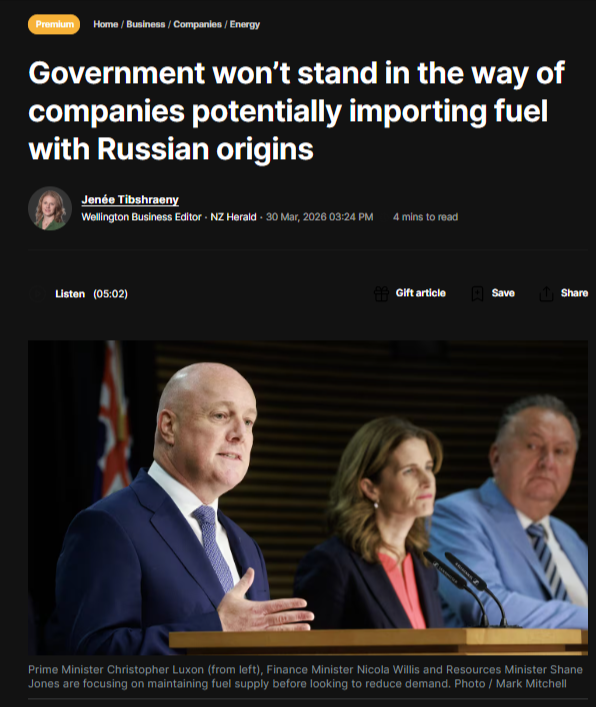
On 30 March 2026, the NZ Herald reported what many suspected but few dared name: the Luxon government has signalled its comfort with New Zealand importing Russian-origin fuel, provided it has been laundered — yes, laundered — through a refinery in India first. Resources Minister Shane Jones, refusing to answer whether fuel companies had asked government for a public green light, simply declared:
"It's product that's coming from a refinery, but it's not Russian."
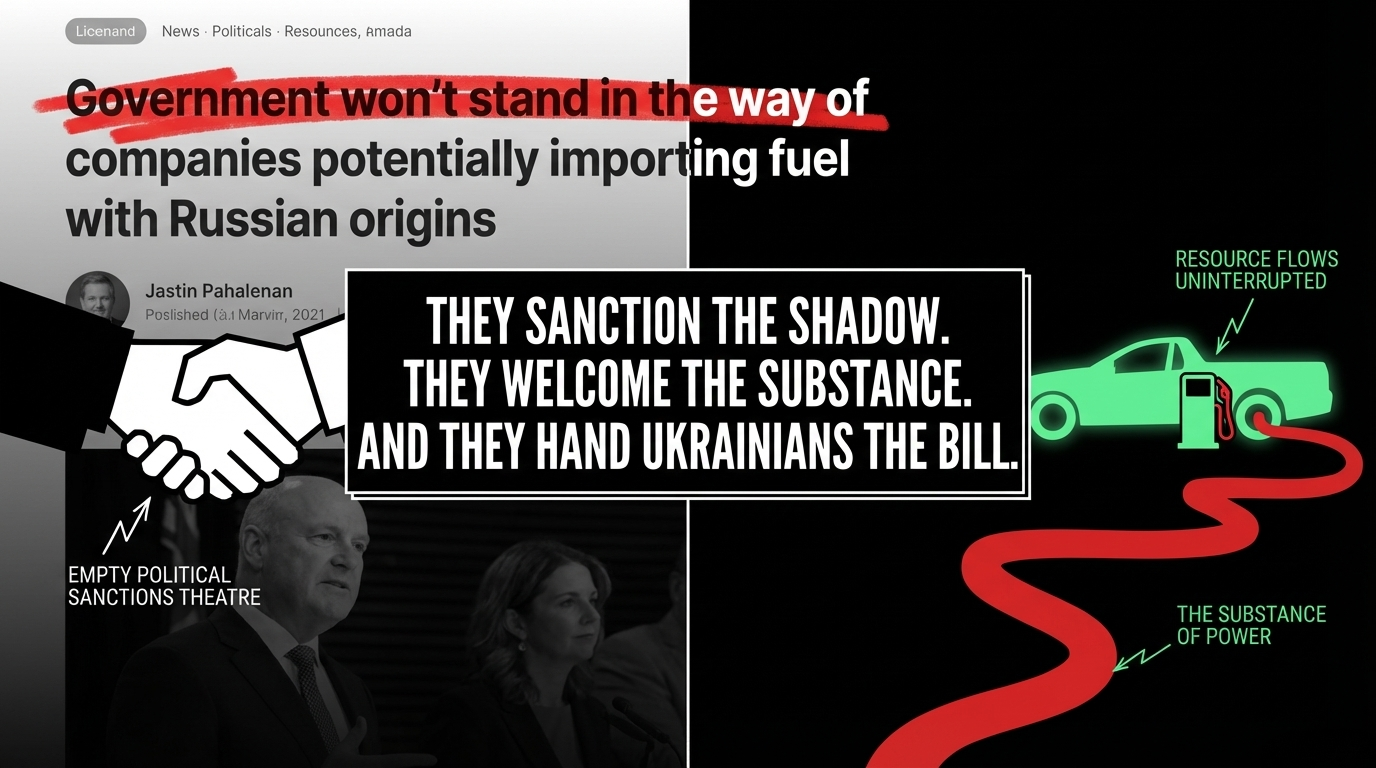
That sentence is not policy. It is alchemy. It is the colonial gift for renaming theft until it disappears.
And Finance Minister Nicola Willis — asked directly whether fuel importers like Z Energy, Mobil, and BP might be helping fund Russia's bombs falling on Ukrainian schools — responded:
"That's a judgment for the fuel companies. But I think many New Zealanders want to make sure that they can still fill up their bulldozer and fill up their ute."
The bulldozer. The ute.
The Kremlin thanks you, Nicola. In rubles.
Te Whakapapa o te Hara — The Genealogy of the Betrayal
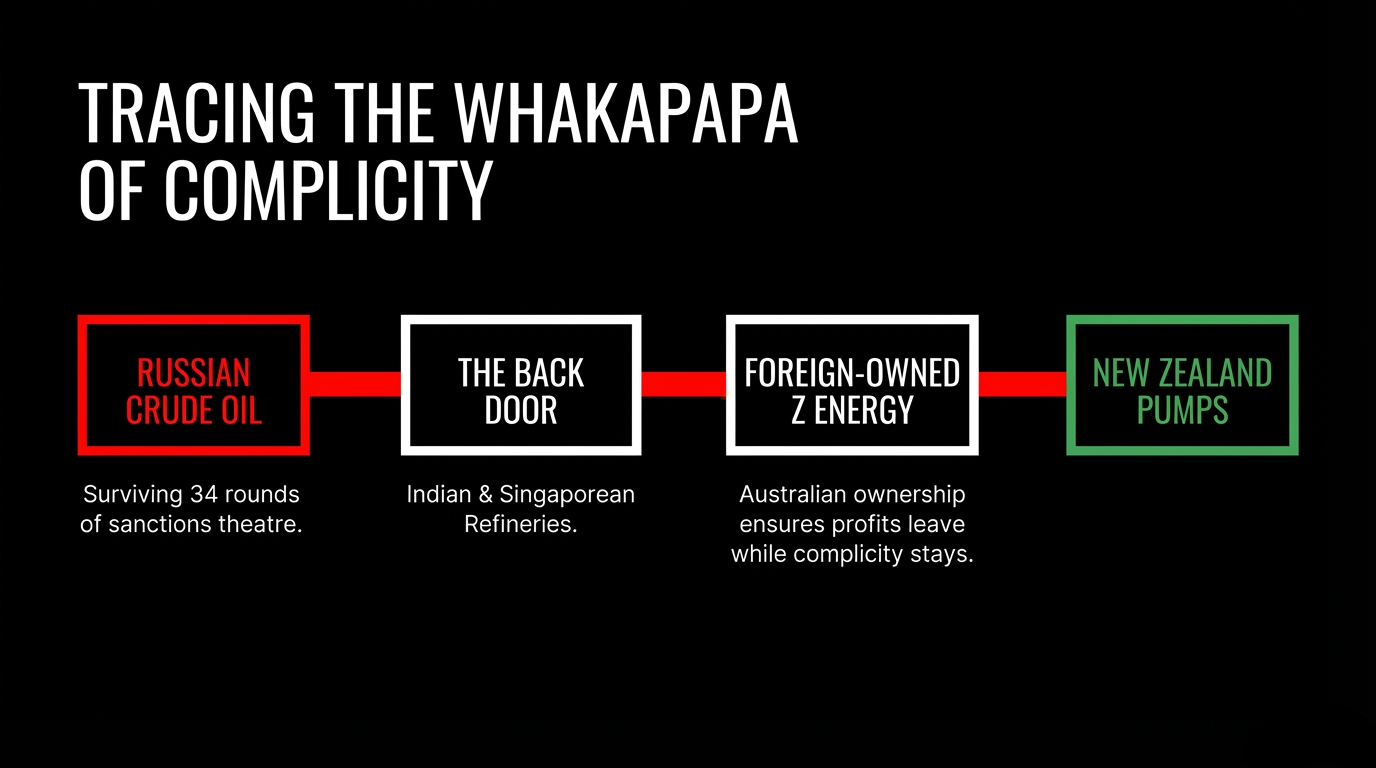
This is not an accident. It is not a crisis response. It is the fully flowered fruit of a poisoned tree planted over decades of neoliberal energy policy, and it has deep roots.
The loophole was always there. New Zealand passed the Russia Sanctions Act 2022 unanimously in March 2022 — every party, every vote. It banned Russian oil. It froze assets.
It threatened imprisonment and million-dollar fines. But it left one door hanging wide open: refined fuel from a third country — India, say, or China — was not considered Russian, even if it was made entirely from Russian crude. Western governments called this the "refining loophole" and 1News exposed its operation in November 2025, revealing that nearly $100 million of Russian-origin fuel had been imported through India's Jamnagar refinery over the prior year alone.
Jamnagar — the world's largest refining complex — was importing Russian crude at levels reaching 55%. Z Energy — now Australian-owned, profits flowing offshore — confirmed it was the buyer of three tankers carrying nearly 200,000 tonnes of fuel from that refinery, landing at Marsden Point in December 2024, February and April 2025.
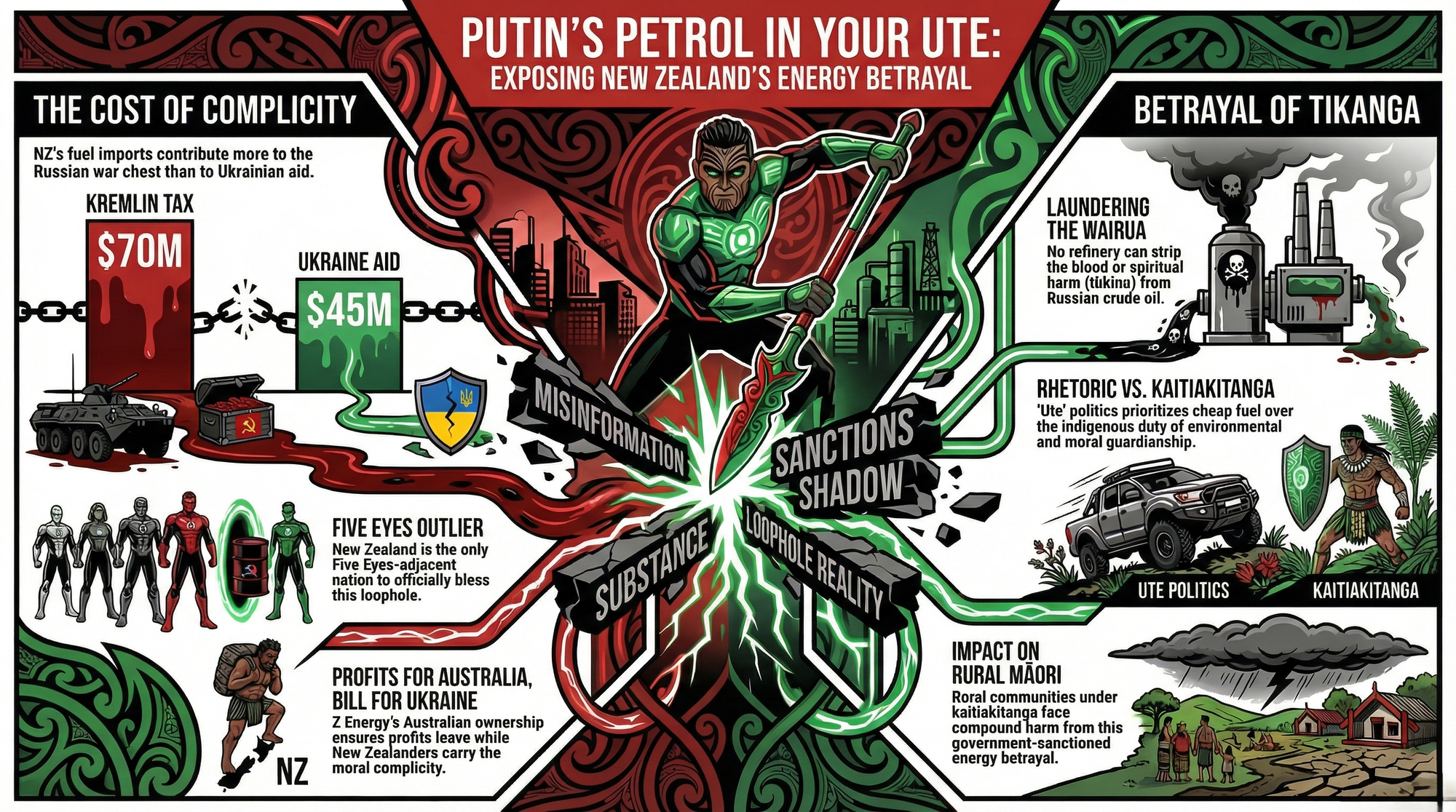
The Centre for Research on Energy and Clean Air (CREA) calculated that those imports generated approximately $70 million in Kremlin tax revenue. Seventy million New Zealand dollars. Flowing directly to the Russian federal budget. Which directly funds the missiles. Which directly fund the mass graves.
Ukraine's ambassador to New Zealand, Vasyl Myroshnychenko, asked the only question that matters:
"How moral is it to be buying Russian oil that's used to produce weapons that are used to kill Ukrainians?"
Winston Peters, in November 2025, said he was "onto it" and ordered an in-house inquiry. Four months later, in the middle of a fuel crisis, his colleague Shane Jones declares the loophole a feature, not a bug.
This government did not close the door. It painted it gold and called it a gate.
Ngā Hononga Huna — The Hidden Connections
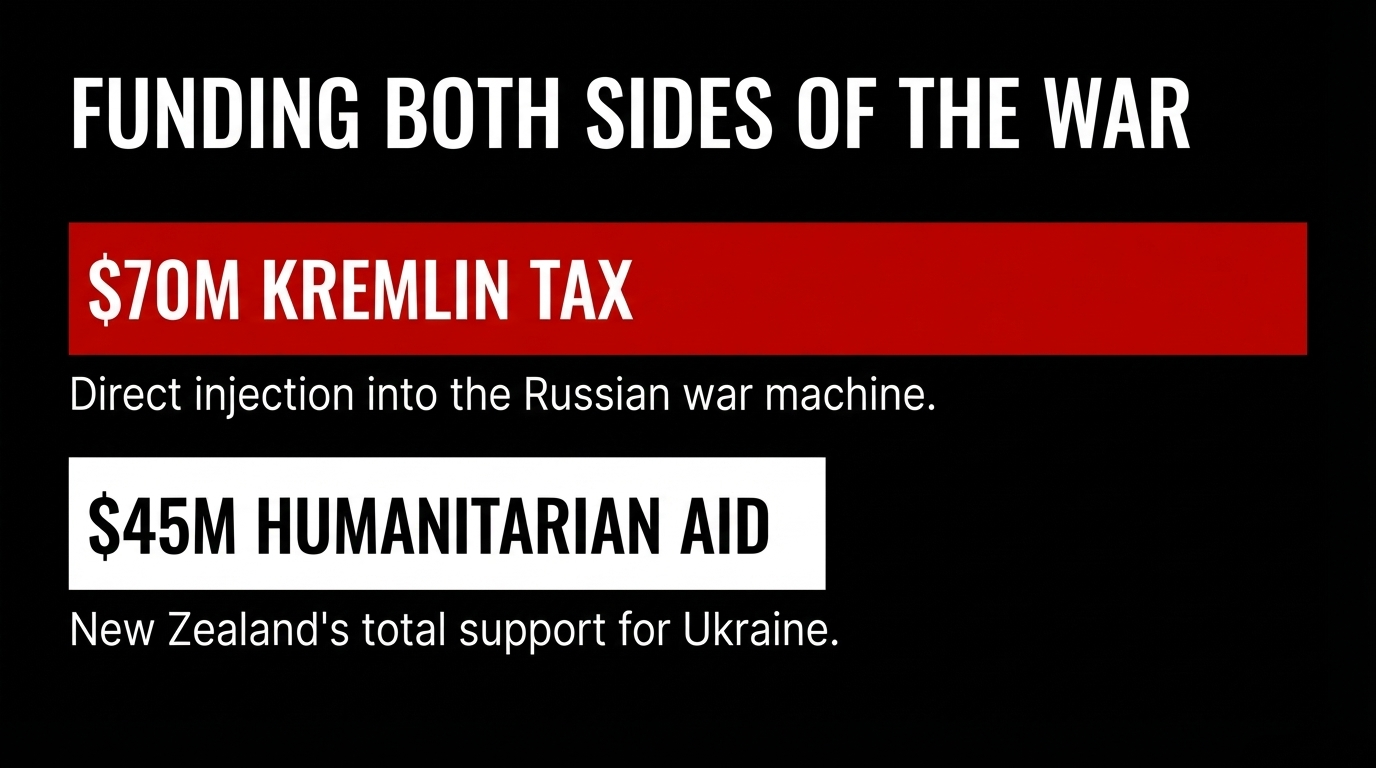
In whakapapa methodology, we do not accept the surface. We trace the root. And when we trace this root, five buried connections emerge — each one more damning than the last.
1. The $70 Million Against the $45 Million: NZ Funds the War on Both Sides
New Zealand has pledged over $133 million in financial assistance to Ukraine since February 2022, of which approximately $45 million is humanitarian. This government presents that figure at every press conference as proof of principle.
CREA's analysis shows NZ's Russian-origin fuel imports generated $70 million in Kremlin tax revenue in a single year. That means this government sent more money to Putin's war chest — via Z Energy's supply chain — than it sent in humanitarian aid to the people Putin is bombing. We are, quite literally, funding both sides of the war. And one side gets more.
2. The 34 Rounds of Sanctions Theatre
New Zealand has now completed 34 rounds of Russia sanctions. Thirty-four. Winston Peters has announced each one with the gravity of a war crimes tribunal. In October 2025, he flew to Stockholm to sanction 65 shadow fleet vessels involved in transporting Russian oil, declaring New Zealand was "acting decisively."
Five months later, his government signals it will not stand in the way of companies importing the very oil those same shadow fleet vessels were transporting — provided a refinery in India briefly handled it first. Peters sanctioned the ship. He blessed the cargo.
This is not foreign policy. It is performance art. It is a haka performed for NATO cameras while the actual oil flows in the dark.
3. Shane Jones Killed the Diesel Reserve — Then Blamed Labour for the Crisis
In June 2024, the Beehive announced that Shane Jones would halt government procurement of reserve diesel stock due to "fiscal constraints." The previous government had committed to investigating 70 million litres in reserve diesel. Jones killed it. The minimum stockholding obligation set diesel at just 21 days, with improvement deferred to 2028.
When the Strait of Hormuz crisis hit in February 2026 and New Zealand found itself exposed with 21 days of physical diesel on soil, Jones stood before cameras and blamed Labour for closing the Marsden Point refinery — a private commercial decision by Refining NZ, not the government, as Labour leader Chris Hipkins correctly stated. Even the Spinoff noted the refinery would have made no difference to the current crisis, as it processed crude that travels through the same Strait of Hormuz.
Jones killed the reserve. Jones blocked the fossil fuel transition roadmap at COP. Jones now opens the door to Russian oil. Jones blames everyone else.
4. The EU Closed the Loophole. New Zealand Did Not.
The European Union's 18th sanctions package in July 2025 explicitly closed the refining loophole — banning imports of fuel refined from Russian crude via India, Turkey, and China. The UK followed. Australia, despite its own version of the loophole, maintains a total autonomous ban on direct Russian-origin oil imports and has sanctioned more than 150 shadow fleet vessels.
| Country | Refining Loophole Status | Shadow Fleet Sanctioned | Direct Russian Oil Ban |
|---|---|---|---|
| European Union | Closed (July 2025)[1] | 444+ vessels[2] | Yes |
| United Kingdom | Closed | Yes | Yes |
| Australia | Partial — under scrutiny[3] | 150+ vessels[4] | Yes[5] |
| New Zealand | Open — officially blessed | 65 vessels[6] | Crude only — not refined[7] |
New Zealand is not a laggard. It is an outlier of choice. This government looked at what its allies were doing and decided not to follow. Because the corporations asked it not to. And this government serves corporations.
5. Z Energy Is Australian-Owned — Its Profits Leave; the Blood Money Stays
Z Energy — the company at the centre of this scandal — is Australian-owned. When it profits from Russian-origin fuel, the dividends flow to Australian shareholders. New Zealand provides the market, the infrastructure, the moral laundering, and the Kremlin tax payment. The profit leaves. The complicity stays.
This is the neoliberal model perfected: privatise the gain, socialise the shame.
Ngā Tauira Torutoru — Three Examples for the Western Mind
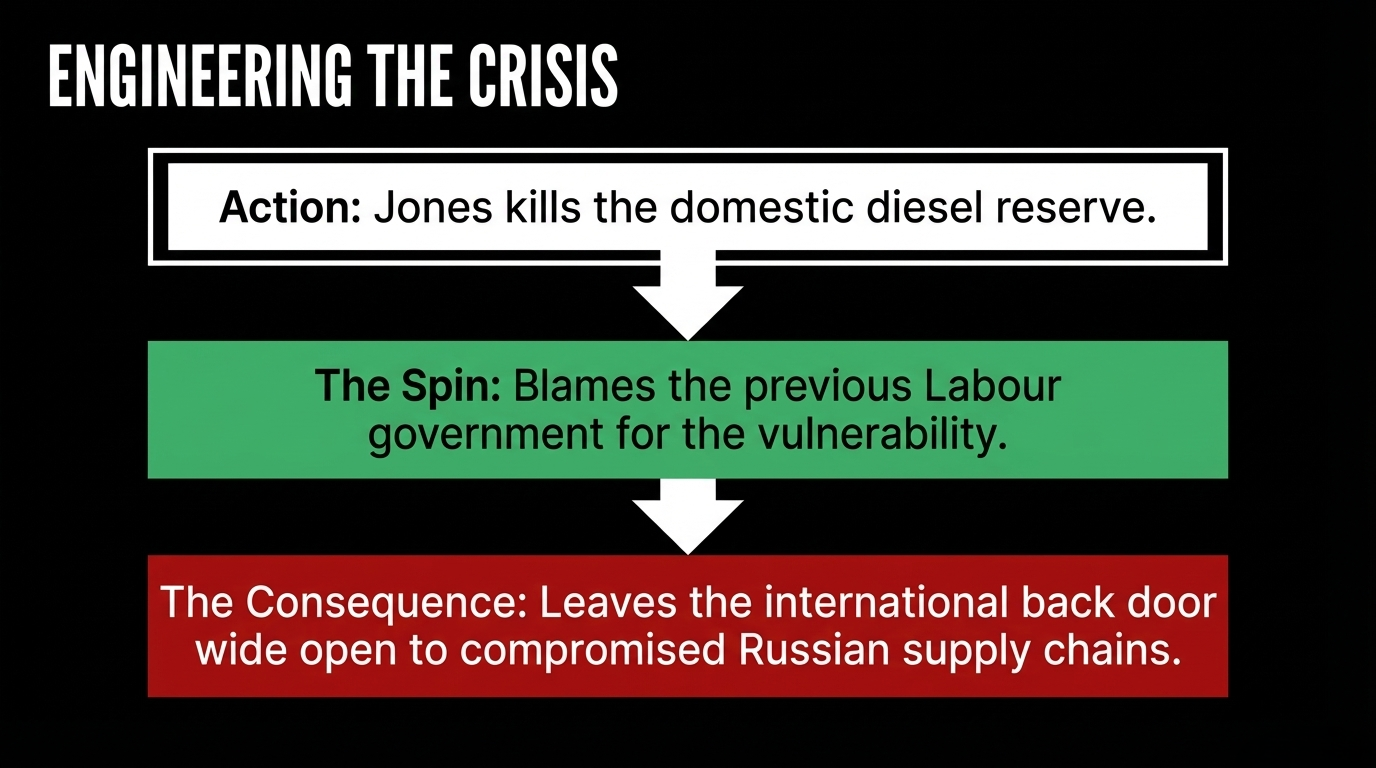
The Western mind wants data. Fine. Here is your data, served with the tikanga it destroys.
Example 1: The $70 Million That Killed More Ukrainians Than Our Aid Saved
The numbers: New Zealand's humanitarian aid to Ukraine totals $45 million over four years. CREA calculates NZ's Russian-origin fuel imports generated $70 million in Kremlin tax revenue in one year alone — approximately $25 million more than we gave in humanitarian aid over four years combined.
The tikanga dimension: In te ao Māori, the concept of utu — reciprocity and balance — is sacred. It is not vengeance. It is the restoration of equilibrium. When you harm someone with one hand and offer aid with the other, you do not achieve utu. You achieve hypocrisy at scale. This government has industrialised hypocrisy. It performs solidarity with Ukraine at every NATO photo opportunity while its fuel supply chain writes a cheque to the Kremlin that exceeds every condolence card it has ever sent.
The solution: Close the refining loophole now, aligning with EU and UK standards. Mandate that all fuel importers provide independently verified chain-of-origin documentation for all crude inputs. Redirect GST windfalls from the fuel price spike — the government collected an estimated $180 million extra in GST from higher petrol prices in 2026 alone — into both Ukraine humanitarian aid and domestic fuel resilience reserves for rural Māori communities.
Example 2: Nicola Willis's "Ute" Comment and What It Reveals About Who This Government Thinks Matters
The words: Nicola Willis, Finance Minister of New Zealand, was asked whether New Zealand companies might receive public backlash for helping fund Russia's invasion of Ukraine. Her response, reported by the NZ Herald: "That's a judgment for the fuel companies. But I think many New Zealanders want to make sure that they can still fill up their bulldozer and fill up their ute."
The demolition of a nation's moral spine, reduced to the image of a ute at a rural petrol station. This is the entire neoliberal worldview in seventeen words: the market decides, convenience is the highest value, and the consequences of that convenience — mass graves in Bucha, bombed maternity wards in Kharkiv — are someone else's problem.
The tikanga dimension: Manaakitanga — the obligation to care, to protect the dignity of others, to extend hospitality beyond your own comfort — is the bedrock of Māori ethical life. It does not stop at the border. Te ao Māori has never recognised a moral geography where atrocities 12,000 kilometres away are none of our concern. The taniwha travels. The wairua of the people connects. When Willis shrugs and points to a ute, she does not merely fail international ethics. She fails the deepest obligation of what it means to be tangata — a human being entrusted with mana.
The solution: Require Cabinet-level sign-off for any decision not to close a sanctions loophole that peers have closed. Establish a Parliamentary Treaty-based review mechanism that assesses whether New Zealand's foreign policy actions are consistent with its stated values — and makes that assessment public. Name the ministers who signed off on each inaction. Accountability is the precondition of manaakitanga.
Example 3: Māori Communities, Diesel Dependency, and the Compound Harm
The numbers: New Zealand rural communities, who are disproportionately Māori, are almost entirely dependent on private vehicles and diesel-powered freight for daily life, cultural obligations, and access to health services. Treasury's worst-case scenario had inflation reaching 3.7%. Petrol has already hit $3.30 per litre nationwide, with Waiheke Island stations hitting $4 a litre. The government's fuel relief package of up to $373 million reaches only working families with children via the In-Work Tax Credit — structurally excluding beneficiaries, superannuitants, and the self-employed. A quarter of a million children in benefit-dependent households, 21.5% of Māori tamariki already in material hardship, receive zero.
Now add Russian-origin fuel to this equation. If NZ officially blesses continued imports via the Indian refinery loophole, it entrenches dependency on a supply chain that funds an illegal war, exposes the nation to further geopolitical shock, and does nothing to build the regional fuel storage and decarbonisation infrastructure that would actually protect rural Māori communities from the next crisis.
The tikanga dimension: Kaitiakitanga — intergenerational guardianship — demands that every decision be tested against the question: what does this leave for our mokopuna? This government's energy policy answers: debt, dependency, and depletion. It has blocked the fossil fuel transition roadmap at COP, as RNZ documented Shane Jones shutting down NZ's involvement in global climate frameworks. It has deferred the diesel reserve improvement to 2028. It has kept the sanctions loophole open. It has handed fuel relief to National's voting base while leaving the most vulnerable to absorb the cost. In tikanga terms, this is not just policy failure. It is an attack on the intergenerational covenant itself.
The solution: Close the loophole immediately. Invest the $180 million GST windfall from higher fuel prices into regional diesel storage co-owned by iwi, with guaranteed priority access for Māori health providers, marae, and rural communities during supply crises. Accelerate EV charging networks along routes connecting Māori communities. Make kaitiakitanga legally enforceable in energy policy — not aspirational wallpaper on a ministry website.
Ko Te Whakaahua o te Hāpuku — The Peer Country Mirror
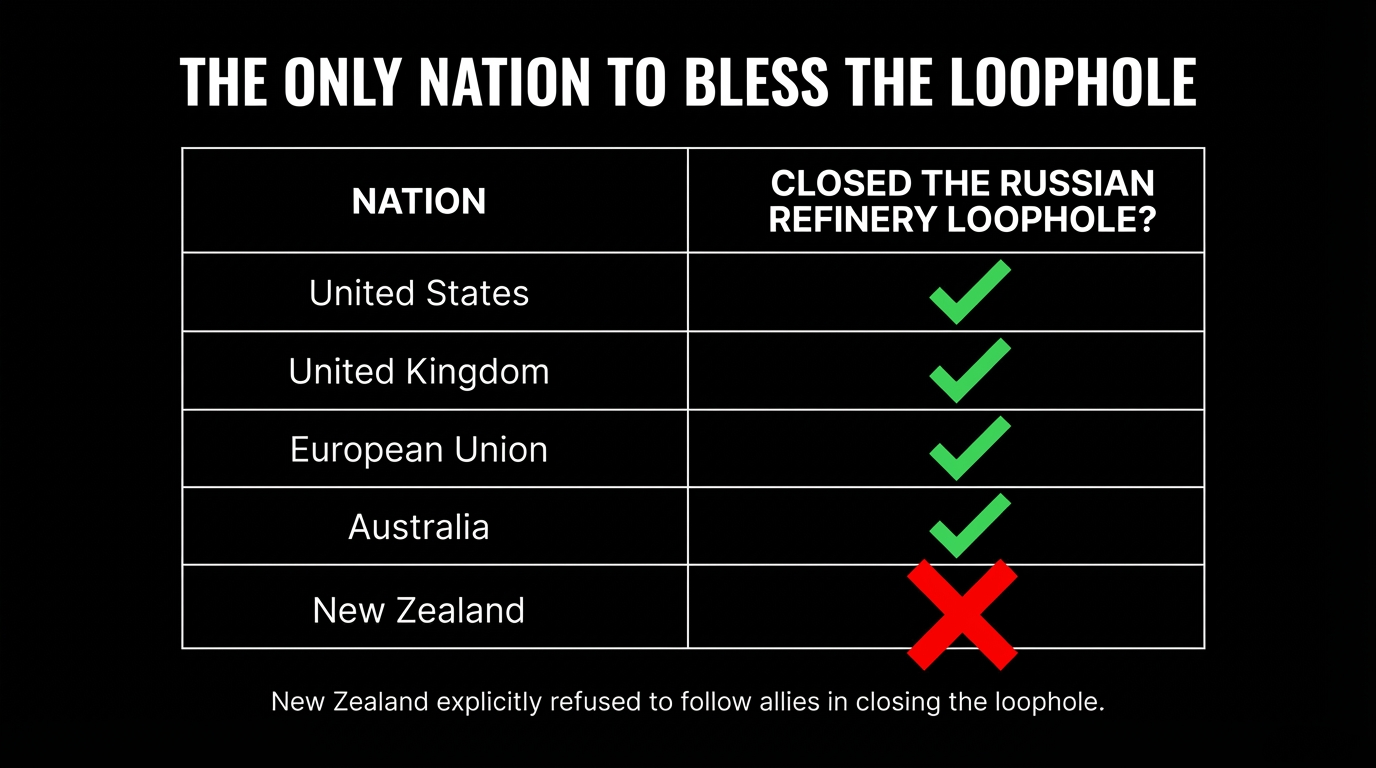
Let us hold the mirror up. Our allies are not confused about what to do.
The EU closed the refining loophole in July 2025, sanctioned the Indian Vadinar refinery — part-owned by Rosneft — and imposed asset freezes on third-country enablers. The UK followed. CREA's Isaac Levi called it "one of the strongest packages yet" and explicitly urged "the UK, Australia, Canada, and the USA" to act now.
He did not need to name New Zealand. We had already made ourselves invisible.
Australia has sanctioned more than 150 shadow fleet vessels, enforces a direct ban on Russian-origin imports, and is under active political scrutiny over its own loophole version. Canada imported $200 million in Russian-origin crude in 2024 and faced immediate public accountability. Western allies, imperfectly but genuinely, are moving to close the gap between rhetoric and reality.
New Zealand's Luxon government, on 30 March 2026, chose the opposite direction. It did not merely fail to close the loophole. It publicly blessed it. It turned a loophole into a policy.
That is not energy security. That is geopolitical cowardice dressed in a high-vis vest.
Te Āhuatanga o te Neoliberalism — The Ideological Root
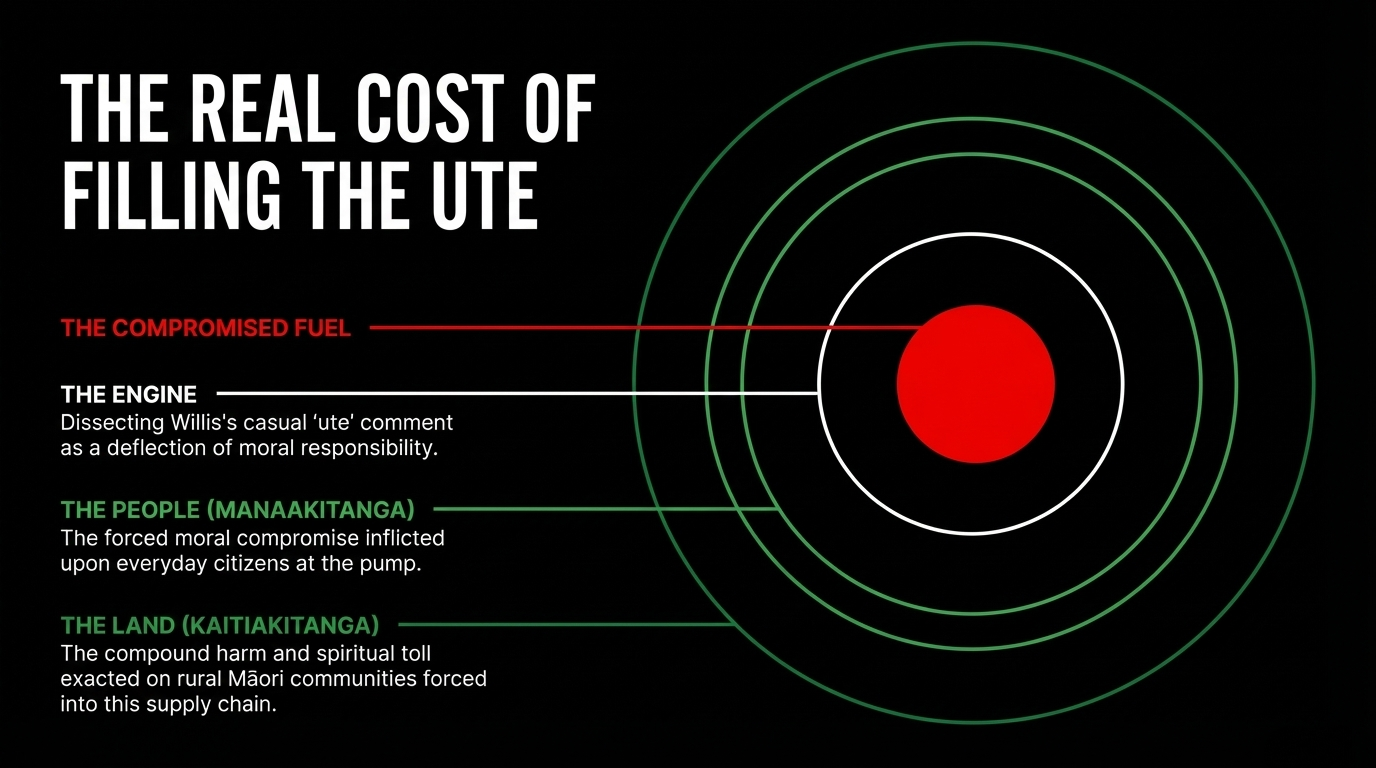
None of this happened in a vacuum. It is the inevitable product of forty years of fossil fuel deregulation.
As Annie at Substack documented: until 1 January 2025, New Zealand had no legal minimum for how much fuel companies had to hold. None. This was the direct result of the Petroleum Sector Reform Act 1988 — Roger Douglas's deregulation of the energy sector under the fourth Labour government. Every government since — Bolger, Clark, Key, Ardern, Luxon — left it exactly as it was for nearly forty years.
This government then set the minimum at the level industry was already holding — and deferred the recommended improvement to 2028. The market decides. The market decided to leave us with 21 days of physical diesel. The market now decides to buy Putin's refined product. And Nicola Willis calls this freedom.
Shane Jones blocked NZ's participation in the global fossil fuel transition roadmap at COP, as RNZ documented — wearing his "Make NZ Great Again" hat, ideology tattooed on his forehead. The Spinoff reported New Zealand gets more than 70% of its refined oil from three countries, with nearly all the crude passing through the Strait of Hormuz. Carbon News calculated that 81% of NZ's fuel comes from refineries that process Middle Eastern crude through that strait.
The logic of this government is perfect in its self-destruction: block renewable transition → deepen fossil fuel dependency → create supply vulnerability → use supply vulnerability to justify accepting Russian oil → call it pragmatism.
It is not pragmatism. It is a trap they built themselves and are now falling into, dragging the rest of us with them.
Ngā Rerenga Māori Wairua — The Metaphors That Name What Western Language Cannot
In te ao Māori, there is hau — the spirit of the gift. When a taonga moves from person to person, the hau of its original owner travels with it. You cannot give a gift and claim the giver's wairua has departed with it. The mauri persists.
This government tells us that Russian oil, once passed through an Indian refinery, loses its hau. That the wairua of the murdered Ukrainian child does not cling to the diesel in your ute. That the mauri of the Kremlin war machine is somehow scrubbed clean by an industrial process in Gujarat.
In te ao Māori, that is not how hau works. That is not how wairua works. That is not how blood works.
The oil carries the hau of its origin. The tax revenue carries the blood. And every litre of Russian-origin fuel that flows through a New Zealand petrol station carries the wairua of every bomb that Kremlin revenue funded. No refinery strips that. No ministerial word-game dissolves it.
When Shane Jones says "it's not Russian", he is performing a karakia without mana — trying to use words to change a spiritual reality that words cannot touch.
When Nicola Willis says "fill up your ute", she is choosing the comfort of the living over the rights of the dying — and calling that comfort by the name of necessity.
This is tūkino — the harm that pretends to be care. It is the most dangerous kind, because it is never held accountable.
Ngā Ara Whakaora — The Pathways to Accountability
This is what immediate, verifiable action looks like:
1. Close the loophole today. Align New Zealand sanctions with the EU/UK 18th package standard. Ban imports of fuel refined from Russian-origin crude in any third country. The legal machinery exists. The Russia Sanctions Act 2022 empowers the Minister. Use it.
2. Mandate chain-of-origin disclosure. Require all fuel importers to publish independently verified crude origin data for every shipment. Z Energy knew it was buying Russian-origin fuel. MFAT knew. The government knew. Transparency would have forced the political cost much earlier.
3. Redirect the GST windfall. The Crown has collected an estimated extra $180 million in GST from elevated fuel prices in 2026 alone. Ring-fence that revenue for: regional diesel storage with iwi co-ownership; fuel relief for beneficiary households currently excluded from the package; and EV transition support for rural communities. This is fiscal justice. It is also strategic resilience.
4. Establish a Māori Energy Security Commissioner. Rural Māori communities are the most vulnerable to fuel supply disruption and price shock. They must have guaranteed representation in every fuel security decision, including sanctions design, reserve requirements, and supply chain ethics reviews.
5. Increase Ukraine humanitarian aid to exceed Kremlin revenue contributions. If this government insists on maintaining any version of the loophole while the EU work-around period runs, it must at minimum match or exceed the estimated Kremlin tax revenue generated — in additional direct humanitarian aid to Ukraine. If you profit from the war, you fund its victims. That is the minimum of manaakitanga.
Ngā Tuhinga Māori Green Lantern — Related Essays
The Māori Green Lantern has documented this systematic pattern of harm across multiple essays. Each one traces a thread of the same whakapapa:
- "When the Petrol Tanker Runs Dry: How a White Supremacist Neoliberal Government Left Māori at the Bottom of the Fuel Queue" (14 March 2026) — exposed the four-level government fuel emergency plan that guarantees supply to Corrections but does not mention Māori communities once.
- "The Pātaka Is Ash: How Nicola Willis and Christopher Luxon Poured Petrol on the Poor and Called It Relief" (25 March 2026) — documented how the government collected $180 million extra in GST from the fuel crisis while delivering relief that structurally excluded a quarter of a million children in benefit households.
- "The Pātaka Beside the Strait" (25 March 2026) — analysed the coalition's fuel support package through tikanga, demonstrating how the In-Work Tax Credit structure was weaponised to deliver relief to National's base while bypassing Māori and Pacific tamariki in hardship.
- "Ka Noho i Roto i te Ahi: The Government's Toll Booth to Hell" (22 March 2026) — revealed how the fuel relief package contained clawback provisions that could leave struggling whānau receiving repayment demands months after the crisis.
- "Trump's Iran War: When a Nuclear-Free Nation Genuflects Before the Bombs That Shatter Girls' Schools" (28 February 2026) — traced how Luxon's systematic pivot toward US military alignment created the diplomatic framework within which this energy betrayal became possible.
Kuputaka — The Final Word
In 1984, David Lange stood before the world and said New Zealand would not host nuclear weapons. He enhanced the mana of this nation. He acted from principle when principle was costly.
In 2026, Christopher Luxon stands before the world and says New Zealand will not stand in the way of companies buying Putin's petrol — provided it passes through a refinery in India first. He diminishes the mana of this nation. He acts from convenience when principle is required.
The distance between these two moments is not measured in years. It is measured in the progressive depletion of mauri — the life force of a nation's moral identity — under the slow acid of neoliberal ideology, fossil fuel addiction, and the particular cowardice of those who would rather polish a loophole than close it.
Nicola Willis told us to fill up our ute.
Ukraine's ambassador asked us to fill up our conscience.
One of them is a Finance Minister. The other is telling the truth.
The taiaha has struck. The whakapapa is exposed. The mahi continues.
Ko Ivor Jones te Māori Green Lantern. Tohunga mau rākau wairua. Kaitiaki of Māori. Exposing the harm that wears a high-vis vest and calls itself energy security.
Koha Consideration
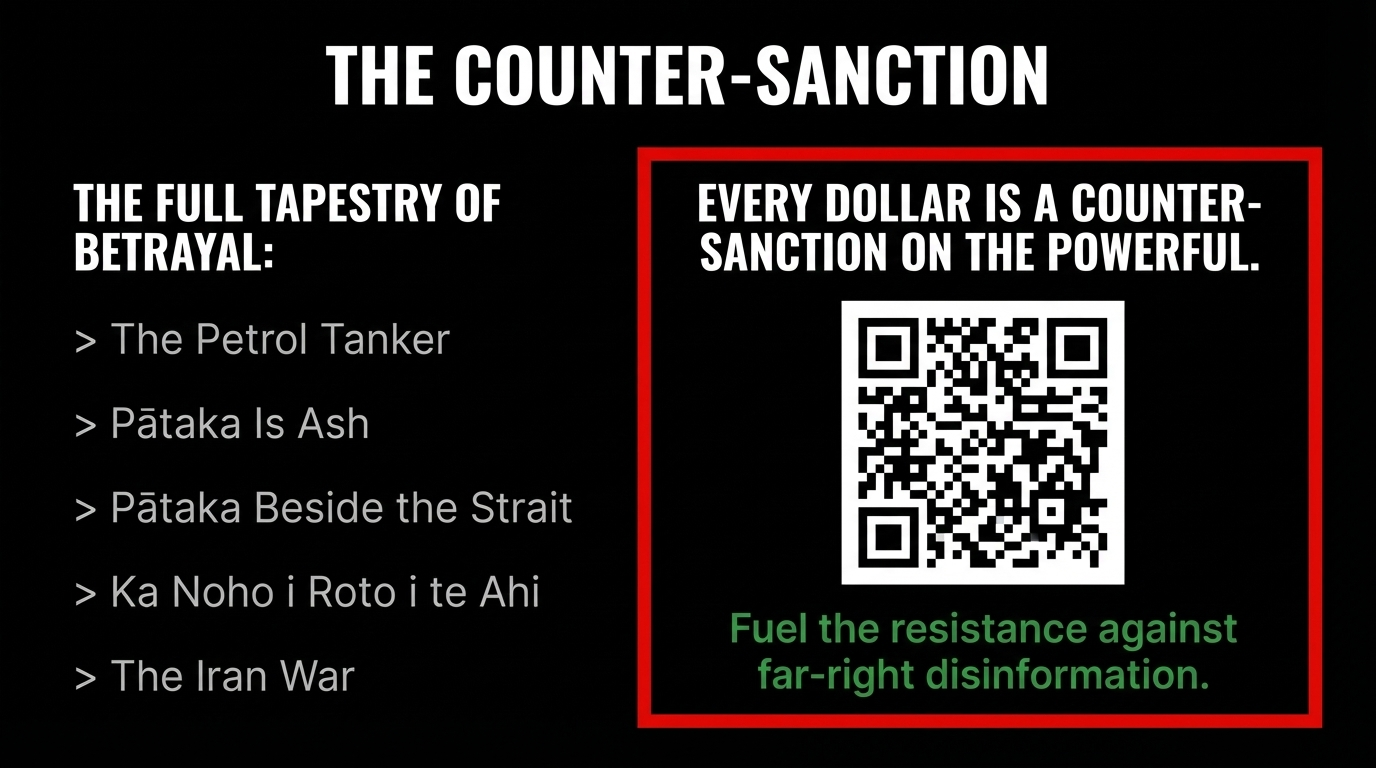
This essay named what no press release will name: that NZ's fuel supply chain is sending more money to the Kremlin each year than we give Ukraine in humanitarian aid. That the government knows. That it chose to bless it anyway.
The Crown will not fund this accountability. The corporations will not fund it. The government certainly will not fund it.
Your koha is the only counter-sanction that works on the powerful.
Every contribution signals that whānau are ready to fund the truth that power would rather bury under the words "energy security." Every dollar to this mahi is rangatiratanga made visible — the proof that we do not need the Crown's permission to speak, and we do not need its funding to be heard.
If you are able, there are three pathways:
Direct koha: app.koha.kiwi/events/the-maori-green-lantern-fighting-misinformation-and-disinformation-ivor-jones
Subscribe and receive essays directly: themaorigreenlantern.maori.nz/#/portal/support
Bank transfer: HTDM, 03-1546-0415173-000

If you cannot koha — no worries at all. Read. Share. Kōrero with your whānau. Forward this to every person who filled up their ute this week and didn't know whose war they were funding. That is koha in itself. That is how the truth travels.
Kia kaha, whānau. Stay vigilant. Stay connected. The pātaka will not rebuild itself.
Research conducted 30 March 2026. All URLs verified at time of publication. Sources: NZ Herald, 1News, RNZ, CREA (Centre for Research on Energy and Clean Air), Beehive.govt.nz, MFAT, The Spinoff, Carbon News, The Guardian, EU sanctions documentation, Australian DFAT, and prior Māori Green Lantern essays.