“Reserve Bank Miscommunication Drives Mortgage Rates Higher” - 14 December 2025
An Analysis of New Zealand’s Central Bank Dysfunction
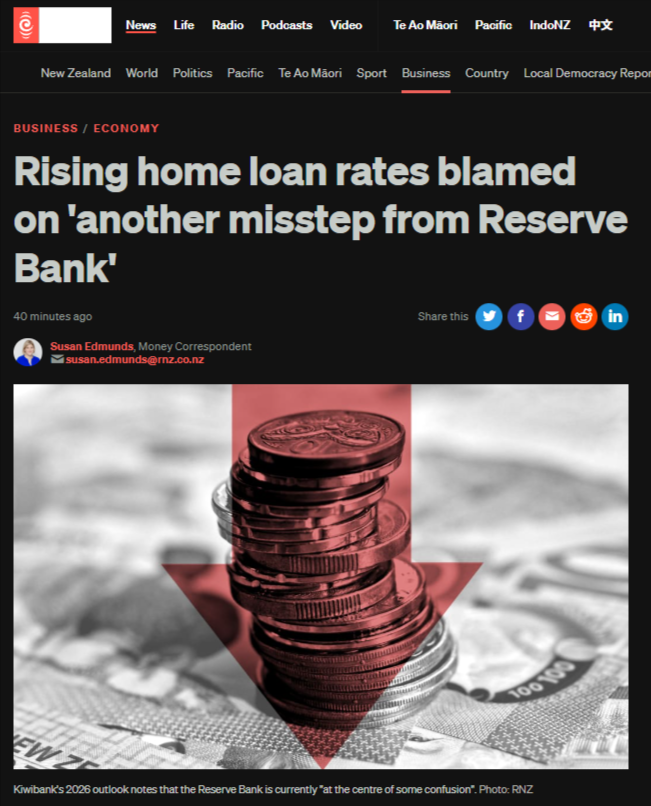
The Reserve Bank of New Zealand has created significant confusion in financial markets following its November 2025 monetary policy decision, leading to an apparent paradox:
the central bank cut the Official Cash Rate (OCR) by 25 basis points to 2.25%, yet wholesale borrowing costs spiked upward, forcing Westpac and the Co-Operative Bank to increase fixed-rate mortgage charges within weeks.
This reversal exposes a pattern of messaging miscalculation that Kiwibank economists describe as “all too familiar”.

Economist reviewing interest rate data following Reserve Bank miscommunication
The Mechanism: Forward Guidance Failure
The core issue centres on the Reserve Bank’s forward guidance regarding the OCR trajectory. Before the November announcement, financial markets had largely priced in the possibility of further interest rate cuts in 2026. However, the RBNZ’s November statement signalled what economists characterised as a higher-than-expected OCR track, effectively indicating that the November cut might be the final one in the current easing cycle.
This shift in messaging proved catastrophic for mortgage borrowers.
Westpac reported that wholesale rates—which determine banks’ borrowing costs for longer-term mortgages—rose by more than 40 basis points in the day following the Reserve Bank announcement, despite the OCR cut itself. The Co-Operative Bank subsequently confirmed that wholesale rates had jumped by 0.5% to 0.6% since the November 26 OCR decision.
Kiwibank economist Sabrina Delgado articulated the dysfunction bluntly:
“Although the Reserve Bank cut rates, with the obvious intention of lowering retail rates for businesses and households, a higher-than-expected OCR track has catapulted wholesale rates higher. Traders are now factoring in rate hikes—no longer cuts—in early 2026. That’s way too aggressive and premature.”
Evidence of Systemic Patterns
Kiwibank identified what amounts to a recurring institutional failure within the RBNZ.
The bank’s economists documented a cyclical pattern spanning years:
This pattern suggests either profound communication dysfunction at the RBNZ or a systemic problem with how the institution calibrates forward guidance relative to actual economic conditions. The November miscalculation follows the same trajectory as previous episodes—signalling restrictive intent when market conditions and economic data warrant accommodation.
Real-World Consequences for Households
The practical impact manifested immediately.
Westpac raised its two- to five-year fixed rates by 30 basis points on December 9, taking the two-year rate to 4.75%. The Co-Operative Bank matched this move within days. These increases occurred despite the OCR being lower than it had been for years, creating a scenario where households faced deteriorating borrowing conditions even as the central bank claimed to support economic recovery.
Delgado confirmed the perverse outcome:
“Ultimately, it’s a bit annoying and premature to be seeing financial conditions tightening, and it’s frustrating, because it is coming from another misstep from the Reserve Bank.”

New Zealand families facing rising mortgage costs despite OCR cuts
Systemic Analysis: Who Bears the Cost?
The distributional impact of this miscommunication skews heavily toward households and small businesses. Those with floating-rate mortgages initially benefited modestly from the OCR cut, but those refinancing longer-term loans faced immediate headwinds. Fixed-rate borrowers locked into longer terms just before the announcement suffered opportunity costs.
Meanwhile, the mechanism itself—where the central bank’s communication failures translate into higher wholesale costs that banks pass to customers—reveals a transmission problem.
The RBNZ possesses tools to address this directly.
“The Reserve Bank can—and should—lower wholesale rates with the stroke of a pen in February or from a speech at any time.” The institution’s failure to do so suggests either incompetence or indifference to the consequences of its signalling errors.
The February Correction Pattern
Kiwibank’s analysis suggests the dysfunction may repeat.
The bank predicted:
This would complete the observed seasonal cycle—a November hawkish misstep followed by a February dove pivot.
If accurate, this pattern exposes the RBNZ as institutionally incapable of stable forward guidance. Market participants have learned to discount November statements and wait for February clarification, a situation that undermines the entire purpose of forward guidance: managing expectations and smoothing economic adjustment.
Government Actions and Incompetence: The Austerity Trap
The Reserve Bank’s communication failures do not operate in a vacuum. They occur within an economic context devastated by the National-led coalition government’s deliberate austerity programme, which has amplified economic weakness and left the central bank in an impossible position.
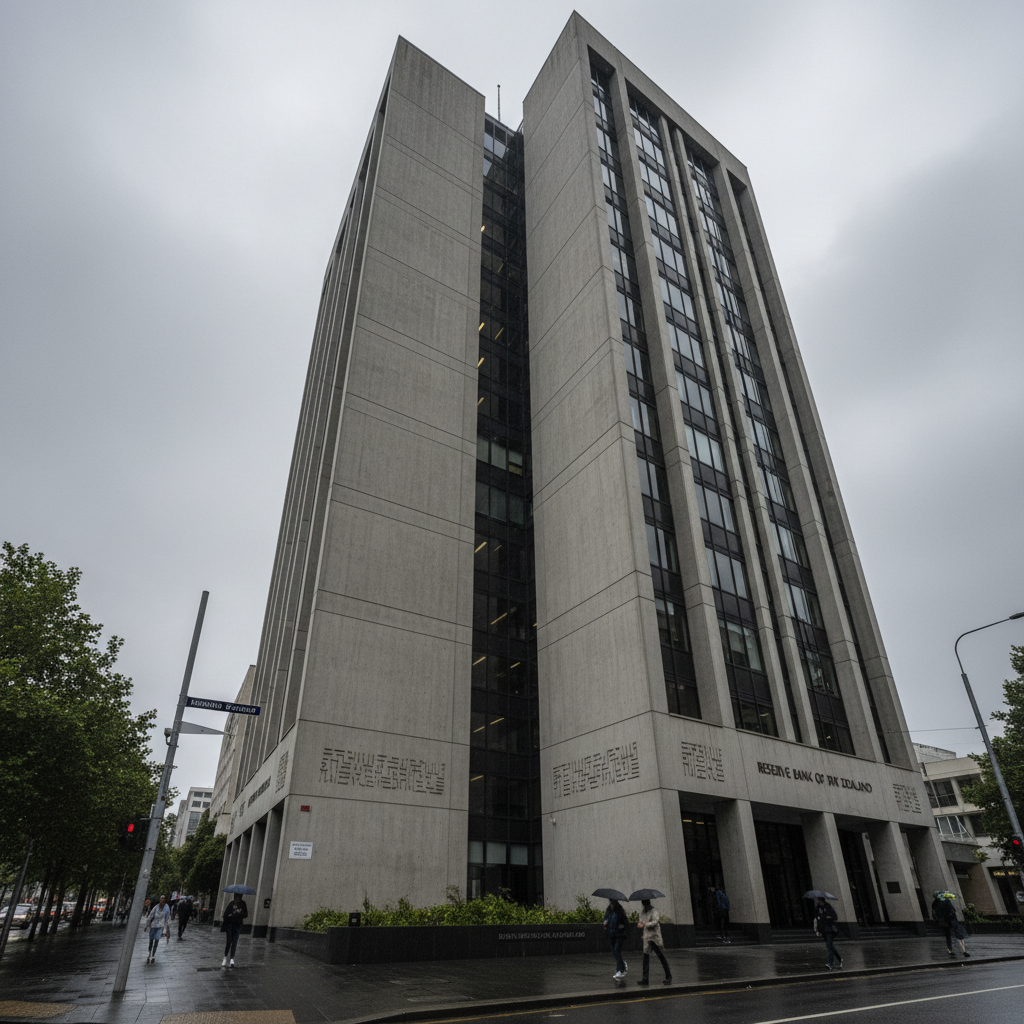
Reserve Bank of New Zealand building - site of recurring communication failures
The Austerity Framework
When the National Party took office in December 2023, it inherited an economy already facing headwinds from inflation, but it made a calculated choice:
aggressive fiscal consolidation.
Finance Minister Nicola Willis pledged to slash government spending, framing austerity as fiscal responsibility necessary to combat inflation and reduce government debt.
This analysis was flawed. The economy did not require austerity—it required stimulus and structural support. By May 2025, Willis had reduced the government’s operating allowance from $2.4 billion to $1.3 billion, creating what critics termed a “fiscal straitjacket”. This cut came despite Treasury warnings that slower economic growth meant the government could not achieve its promised surplus targets.
Public Sector Devastation
The consequences were immediate and severe. Public sector employment dropped 4.4% in the year to December 2024, with over 10,000 jobs lost across government agencies. The government reduced the budget for hiring contractors by NZ$300 million, equivalent to about a third of the allocated contractor budget.
Ministries were mandated to deliver 6.5–7.5% annual savings—roughly NZ$1.5 billion per year—prompting widespread restructures. The Ministry for the Environment saw approximately 25% of its workforce eliminated, reducing from 988 to around 708 staff.
Economic Contraction
The impact on economic activity was predictable and severe. Wellington, New Zealand’s capital and a major hub for government employment, saw house prices decline 6.8% due to the direct loss of public sector employment. The city’s private sector and recruiter firms expected a bleak job market as government spending contracted.
By June 2024, New Zealand’s economy recorded a 0.9% contraction in the quarter, representing effectively a two-year recession. The economy remained stalled, with annual growth sitting at -0.2% through the year to June 2024.
Kiwibank economist Jarrod Kerr described it bluntly:
Structural Incompetence: The Austerity Paradox
The government’s austerity approach violated basic macroeconomic principle: in a downturn, cutting government spending deepens the contraction. Academic analysis of the coalition’s fiscal policy found that the “focus on tight monetary and fiscal policies has hindered a considerate debate of embedded structural economic problems.”
The government compounded this error by claiming fiscal discipline was supporting the Reserve Bank’s inflation-fighting effort. Willis argued that fiscal consolidation was necessary to maintain low interest rates and New Zealand’s credit rating. This logic was inverted: austerity was making the Reserve Bank’s job harder by crushing demand and employment, forcing deeper interest rate cuts than would otherwise be necessary.
By December 2024, analysts noted that
Trump’s Tariffs: The External Shock That Exposed Fiscal Weakness
In April 2025, the United States imposed a 15 percent tariff on New Zealand exports, creating an external economic shock. Yet the government’s response revealed its fiscal impotence.
Rather than inject stimulus to cushion the blow, Willis doubled down on austerity, announcing an additional $1.1 billion in spending cuts for Budget 2025. Treasury’s updated economic forecasts showed weaker growth, yet Willis reduced the operating allowance further rather than expanding it.
The tariffs reduced New Zealand’s GDP by 0.15% (approximately $204 per household), but the government offered no fiscal response. Meanwhile, Willis claimed New Zealand was “fortunate” to face lower tariffs than other nations and could “adhere to our economic and fiscal approach.”
Unemployment and Social Costs
The consequences rippled through the labour market. Unemployment rose from around 3.3% in early 2023 to 4.6% by mid-2024, before reaching 5.1% by March 2025—the highest since 2020. The Reserve Bank forecast unemployment would peak near 5.2% by mid-2025.
Labour underutilisation, which includes the underemployed, increased to 12.3%, meaning one in eight working-age New Zealanders either lacked employment or lacked sufficient hours.
Yet despite this labour market devastation, the government maintained its austerity stance. As of April 2024, only 3,000 public sector positions had been officially affected by cuts, though over 1,700 more had been proposed. The government paid at least NZ$80 million in redundancy payments, with another NZ$21.5 million forecasted.
Why the Reserve Bank Could Not Escape This Trap
The Reserve Bank’s November miscommunication must be understood within this context. The RBNZ had been forced to carry an outsized share of the economic adjustment burden. The government cut fiscal stimulus precisely when the Reserve Bank needed to cut interest rates, creating a coordination failure.
Rather than the RBNZ and government working in tandem—one loosening monetary policy while the other paused fiscal tightening—they worked at cross purposes. The government tightened while the central bank loosened. The result: the RBNZ had to cut rates far more aggressively than optimal, creating confusion in financial markets about the central bank’s true stance on future policy.
When the RBNZ signalled in November that it might pause rate cuts, it was partly responding to the government’s insistence on fiscal discipline and the need to demonstrate anti-inflation credentials despite the economic contraction. The central bank was trapped: cutting more risked being seen as abandoning price stability; pausing was politically necessary but economically unjustified given the weakness the government’s policies had induced.
A Decade of Lost Opportunity
Analysts warned of the long-term costs. Productivity Commissioner Ganesh Nana and 14 other economists warned the Prime Minister and Finance Minister in November that their policies had “long-lasting potential hollowing out of business.” They cautioned that “When layoffs happen, those affected do not merely wait for the private sector to intervene. They frequently look for opportunities abroad, resulting in immediate loss capacity for New Zealand.”
New Zealand faces deeper structural problems: productivity has been falling relative to the OECD and has remained stagnant in real terms since 2012, with the nation being overtaken by more dynamic economies in Europe and East Asia. The government’s austerity approach made these long-term challenges worse, not better.
Rather than investing in the human and physical capital necessary to lift productivity, the government cut spending on contractors, delayed infrastructure projects, and slashed public sector employment. Wellington saw significant infrastructure initiatives, including a major public transport project, cancelled due to fiscal constraints.
Economic Outlook: Recovery Despite Central Bank Dysfunction and Government Incompetence
Despite both the RBNZ’s messaging failures and the government’s austerity trap, Kiwibank maintained an optimistic medium-term outlook. The bank forecast 2.4% economic growth in 2026 and 3% the following year. Employment growth was expected to rebound from the middle of 2026, with unemployment—which peaked at 5.3% in the September quarter—likely beginning its descent.
Housing market indicators showed tentative recovery. Housing sales were up 6% compared to October the previous year, and Kiwibank forecast house prices to rise 2-3% in 2026—described as “not exactly shooting the lights out, but an improvement from trekking sideways over the last two years.”
Delgado attributed the expected recovery primarily to the lower interest rate settings now in place: “We finally have all the right settings, with interest rates being at levels that encourage activity, we’re already seeing those markets for recovery now with everything on the table for a great year of recovery—we’ve got consumption up, business confidence firmer, the job market is stabilising, housing activity is starting to pick up.”
Institutional Failure as Political Choice
The November 2025 RBNZ miscommunication exemplifies a central bank institution struggling to execute its core function: transparent, coherent forward guidance. The Reserve Bank cut rates with the stated intention of supporting recovery, yet its accompanying narrative triggered market responses that partially negated those cuts for borrowers.
Kiwibank’s observation that this pattern recurs seasonally suggests the problem is not random miscalculation but rather embedded dysfunction in how the RBNZ constructs and communicates its monetary policy decisions.
Yet the deeper culprit is the government. By forcing the Reserve Bank to carry the entire adjustment burden through austerity-driven weak growth, the National-led coalition created the conditions for central bank dysfunction. A reserve bank operating in a context of weak demand and rising unemployment is forced into a precarious position: cutting rates to support growth while simultaneously managing inflation expectations in a shrinking economy.
The government’s austerity programme—justified by claims of fiscal responsibility and necessary inflation-fighting—has instead deepened the recession, destroyed employment, and left the RBNZ unable to communicate a coherent policy trajectory because economic conditions keep deteriorating faster than official forecasts anticipate.
For households and businesses, the cost is real—mortgage rates that rise even as the central bank cuts—and entirely preventable through better coordination between fiscal and monetary authorities. The RBNZ has the tools to fix its communication in February. But the government has the tools to support recovery through productive investment, and it has chosen austerity instead.
Whether the coalition government possesses the institutional will to reverse course remains an open question heading into the 2025 election cycle.
Koha Statement
Only Support this mahi if you are able: Koha.Kiwi | Substack | Bank: HTDM 03-1546-0415173-000
All koha sustains free mātauranga Māori journalism. No paywall, no corporate interference.

Ivor Jones The Māori Green Lantern Fighting Misinformation And Disinformation From The Far Right