"Seymour's Silver Spoon Scheme” - 17 August 2025
When Elite Education Gets a Government Handout

Kia ora koutou katoa - Greetings to all of you
The wealthy elite are laughing all the way to the bank while Māori children struggle in underfunded classrooms. David Seymour has just handed his rich mates a multi-million dollar gift wrapped in the lie of educational diversity, all while systematically destroying support for Indigenous education.
The Herald's shameless coverage of this blatant wealth transfer exposes both its colonial bias and its role as a propaganda machine for the privileged class. Eva de Jong's puff piece reads like a press release from St Cuthbert's College marketing department, complete with fawning descriptions of "well-groomed lawns" and "manicured trees" that reek of colonial nostalgia.nzherald

Historical Context: The Colonial Project Continues
Education has always been a weapon of colonisation in Aotearoa. The missionary schools of the early 1800s were explicitly designed to "civilise" Māori children, stripping them of their language and culture. The Native Schools Act of 1867 made this assault systematic, forcing Māori children into boarding schools where they were beaten for speaking te reo Māori and trained only for manual labour because colonial officials believed Māori were "better calculated by nature to get their living by manual rather than by mental labour".cambridge+1
This educational apartheid created generational trauma that still echoes today through significant health inequities between Māori and non-Māori that are intrinsically linked to Aotearoa New Zealand's colonial and colonising racist history. The same colonial mindset that once deemed Māori unworthy of academic education now drives policies that funnel public money into elite private schools while gutting support for Māori education.tandfonline
The Numbers Don't Lie: A System Rigged for the Rich
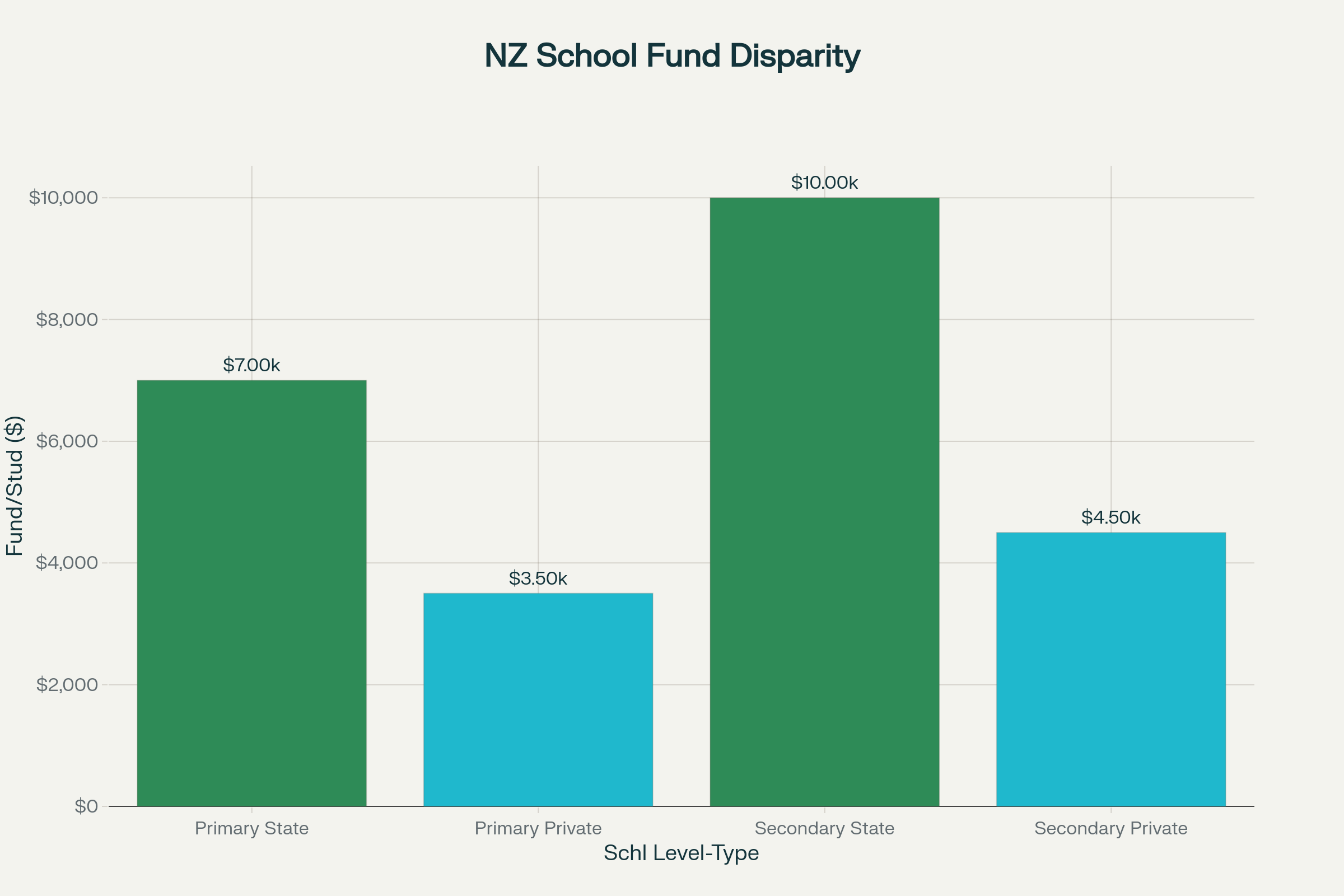
Funding disparity between New Zealand state and private schools per student (2025)
The funding disparity is staggering and reveals the true nature of this neoliberal scam. State school students receive nearly eight times more per-pupil funding than private school students at primary level, yet Seymour frames this massive inequality as somehow unfair to the wealthy. This is neoliberal doublespeak at its most cynical - portraying the privileged as victims while the real victims suffer in silence.
Budget 2025 allocates $4.6 million in additional funding for private schools, bringing their total annual subsidy to $46.2 million. Meanwhile, the same budget cuts $72 million over four years from Māori education programmes, including Resource Teachers of Māori who provide crucial support for tamariki struggling in mainstream education.nzherald+1
The ACT Party's Ideological Assault
David Seymour's private school subsidy represents far more than educational policy - it's a calculated assault on public education designed to accelerate the neoliberal privatisation agenda. ACT's core education policy involves giving all public schools the choice to become charter schools, effectively dismantling the state education system from within.rnz
The timing is no coincidence. Seymour represents Epsom, one of the country's wealthiest electorates with a high concentration of private schools. Post Primary Teachers' Association president Chris Abercrombie correctly identified this naked self-interest, pointing out that "David Seymour's Epsom electorate has a lot of private schools in it."nzherald
This is classic neoliberal capture - a politician using public office to benefit his wealthy constituents while dressing it up as principled policy. The accumulation economy of private schools operates by extracting public resources to enlarge, enrich and sustain itself, exactly what Seymour's subsidy achieves.tandfonline
The Herald's Colonial Propaganda Machine
NZME's coverage of this scandal reveals the deep-seated colonial bias that permeates New Zealand's mainstream media. The Herald has a long history of anti-Māori coverage dating back over 140 years, with professor Ranginui Walker documenting how "the Pakeha press has played an active role in stirring up anti-Maori feeling" since colonial times.nzherald
Eva de Jong's article employs classic colonial framing techniques:
Privilege Normalisation: The piece quotes St Cuthbert's principal Charlotte Avery saying "privilege is not a dirty word" - a brazen attempt to normalise inequality while Māori children lack basic educational resources.
False Equivalence: Scots College headmaster Graeme Yule claims private schools pay $150 million in GST while receiving only $40 million in subsidies, deliberately obscuring the massive tax advantages and charitable status benefits these institutions enjoy.
Victim Inversion: Seymour frames wealthy private school families as victims of an unfair system, classic neoliberal rhetoric that portrays the privileged as oppressed while ignoring actual inequality.
Deficit Discourse: The article amplifies claims about state school "failures" while ignoring the systemic underfunding and colonial structures that create these problems.
The White Supremacist Logic of Educational Apartheid
This policy embodies the white supremacist principle of maintaining separate and unequal systems. New Zealand has one of the most unequal education systems in the OECD, yet instead of addressing this inequality, Seymour deepens it by subsidising elite institutions.rnz
The "choice" rhetoric is particularly insidious. When only wealthy families can exercise this "choice," it becomes a mechanism for consolidating class privilege while abandoning working-class and Māori children to increasingly underfunded state schools. This creates a growing divide between the "haves and have-nots" that mirrors apartheid-era educational policies.
Principal Lynda Knight from a small Porirua school captured this reality perfectly: "I think we're increasing that disparity if we're increasing the funding [for private schools]; we must be decreasing the amount of money for public schools like mine." Her school has lost funding for Reading Recovery, Pasifika literacy programmes, te reo Māori training, and whānau liaison workers - real support that makes a difference for struggling children.
The Neoliberal Destruction of Public Education
Seymour's broader agenda involves allowing people to opt out of public healthcare and education systems, taking their funding with them to private providers. This would create what policy expert Danyl McLauchlan correctly identifies as "a gigantic wealth transfer from the poor to the rich".rnz+1
The coalition government has allocated $153 million to bring back charter schools, opening public education to private business interests. These changes represent what critics accurately describe as "privatisation by stealth" - the systematic dismantling of public education through incremental policy changes that benefit private operators at public expense.nzherald
The Māori Values Response: Kotahitanga and Manaakitanga
From a Māori worldview, education should embody kotahitanga (unity) and manaakitanga (caring for others). Seymour's policy violates both principles by creating division and prioritising profit over people. Traditional Māori education through whare wānanga was collective and aimed at strengthening the entire community, not just the elite.
Whakapapa (relationships and connections) teaches us that we are all interconnected - when some children receive world-class education while others struggle in underfunded schools, the entire community suffers. Māori educators are deeply concerned by government proposals to cut funding for Resource Teachers of Māori, recognising this as another attack on Indigenous education.rnz
The principle of tino rangatiratanga demands Māori control over our own educational destiny, not colonial systems that perpetuate inequality. The growth in Māori-language education through kōhanga reo, kura kaupapa Māori, and wānanga represents resistance to colonial education, yet government funding for these initiatives remains precarious while private schools get guaranteed subsidies.teara
Broader Implications: The Colonial Matrix of Power
This education funding scandal connects to broader patterns of colonial domination that persist in contemporary Aotearoa. The same structural racism that creates health inequities also operates in education, with historically marginalised groups facing "significant economic, social, and cultural obstacles" despite government claims of progress.scholarlyreview
Media bias remains a crucial factor in maintaining these inequalities, with journalists who are "ill-equipped to handle Māori issues" consistently promoting Pākehā perspectives while marginalising Indigenous voices. The Herald's coverage of private school funding exemplifies this bias, presenting elite perspectives as neutral while ignoring the voices of those harmed by these policies.nzherald
The "competition of ideas" about educational inequality masks a deliberate refusal to address the colonial structures that create and maintain educational apartheid. When the Ministry of Education admits it lacks "sufficient understanding" of inequality while simultaneously funding private schools, the problem isn't knowledge - it's political will.rnz
Impact on Māori Communities
The devastating impact on Māori communities cannot be overstated. Schools report spending significant time dealing with the effects of poverty, including homelessness, overcrowded housing, lack of food, and family violence - problems that wealthy private schools never face. Yet it's these struggling schools that lose funding while elite institutions get subsidies.rnz
At Porirua's small school with 110 students, principal Lynda Knight noted that for many children, school camp represents their only holiday experience. Meanwhile, St Cuthbert's College students enjoy month-long camps at their "outdoor campus" in the Bay of Plenty, funded partly by taxpayers who may never be able to afford such experiences for their own children.
This creates what researchers identify as "barriers to biculturalism" where historical negation and symbolic exclusion predict increases in opposition to bicultural policies. When the state visibly prioritises Pākehā elite education over Māori needs, it reinforces colonial hierarchies and undermines efforts toward genuine partnership.journals.sagepub
Call to Action
This scandal demands immediate action on multiple fronts. We must recognise Seymour's private school subsidy for what it is - a calculated assault on educational equity designed to benefit his wealthy constituents while deepening inequality for Māori and working-class children.
The Herald's complicit coverage reveals the urgent need for independent Māori media that centres Indigenous perspectives rather than elite interests. Young urban Māori are already using digital platforms to advance decolonisation, creating counter-narratives that challenge colonial propaganda.journals.sagepub
We must demand the immediate reversal of private school subsidies and the reallocation of this funding to schools serving Māori and working-class communities. Educational equity requires structural change, not charitable crumbs from the elite table.
Most importantly, we must continue building alternative educational systems that honour Māori knowledge and values. The success of kaupapa Māori education demonstrates that Indigenous-led approaches work - we need expansion of these programmes, not their defunding.teara

The Māori Green Lantern fighting misinformation and disinformation from the far right
David Seymour's private school subsidy represents everything wrong with neoliberal education policy - it deepens inequality, rewards privilege, and punishes the poor while claiming to promote choice and diversity. The Herald's sycophantic coverage exposes its role as a colonial propaganda machine that consistently elevates elite voices while marginalising Indigenous perspectives.
From a Māori worldview grounded in kotahitanga and manaakitanga, this policy violates fundamental principles of collective care and responsibility. True educational justice requires dismantling the colonial structures that create inequality, not subsidising the institutions that perpetuate it.
The wealthy will always find ways to buy privilege for their children. The state's responsibility is ensuring every child has access to quality education, not making it easier for the elite to maintain their advantages while others struggle.
This fight is far from over. As our tīpuna understood, education is liberation - but only when it serves all our children, not just those born with silver spoons.
Readers who find value in this analysis and want to support independent Māori voices challenging colonial propaganda are invited to consider a koha to HTDM: 03-1546-0415173-000. The MGL understands these are tough economic times for whānau, so please only contribute if you have capacity and wish to do so.
Noho ora mai rā,
Ivor Jones - The Māori Green Lantern