Shane Jones and the Poisonous Rhetoric of Anti-Iwi Backlash
The Colonial Mindset's Last Stand Against Indigenous Partnership
He wahine, he whenua, he tangata – let them be destroyed. The settler mindset endures.
Unveiling the Mask: When Politicians Reveal Their True Intentions
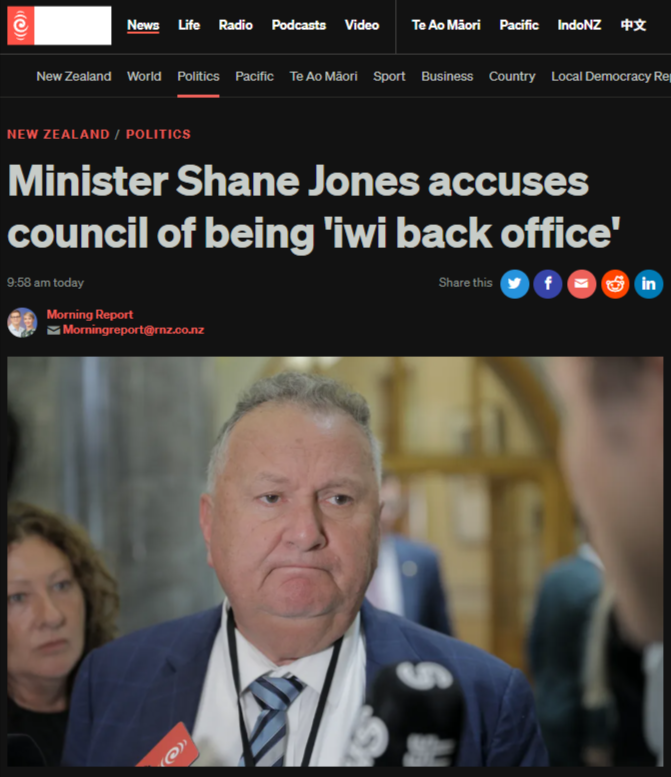
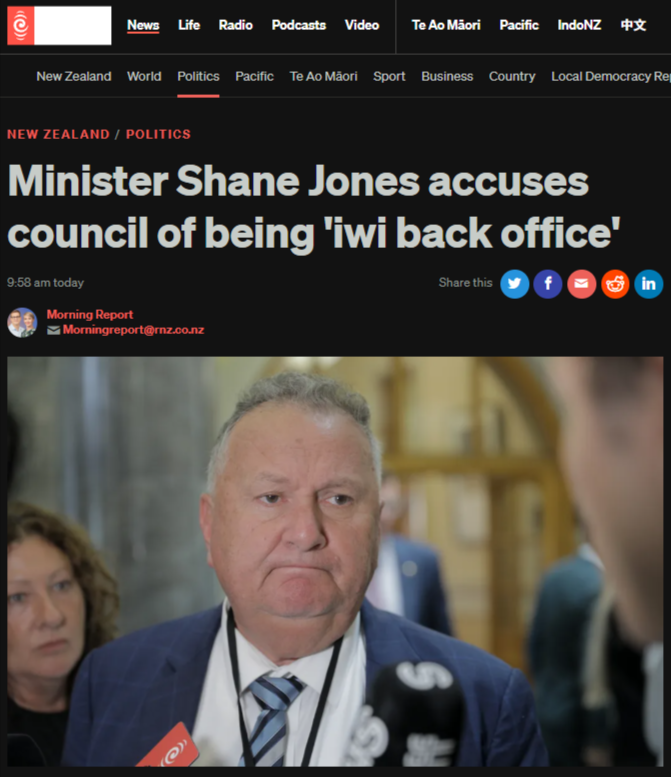
In the grand theatre of New Zealand politics, few moments reveal the underlying colonial attitudes as starkly as Shane Jones's recent outburst labelling the Waikato Regional Council as an "iwi back office"1. This inflammatory rhetoric, delivered with the casual cruelty that has become Jones's trademark, represents far more than political posturing. It is a deliberate assault on indigenous sovereignty, cloaked in the language of economic development and efficiency.
The Minister for Regional Development's comments expose the deep-seated white supremacist ideology that underpins New Zealand First's approach to Māori self-determination. When Jones declares he is "deeply concerned that the Waikato Regional council is turning into some sort of iwi back office"1, he is not merely critiquing administrative processes. He is weaponising racist dog whistles designed to terrify Pākehā voters with the spectre of Māori "taking over" democratic institutions.

Background: The Context of Co-Governance and Treaty Rights
To understand the toxicity of Jones's rhetoric, we must first grasp what co-governance actually represents in the Waikato context. The Waikato River Authority, established in 2010 as part of the Waikato-Tainui Treaty settlement, embodies genuine partnership between the Crown and iwi23. This co-governed body has successfully managed New Zealand's longest waterway through consensus-based decision-making, with five iwi representatives and five Crown appointees working together to restore the river's health4.
The Authority represents everything that terrifies those clinging to colonial power structures: effective Indigenous governance that delivers tangible environmental and cultural outcomes5. For over a decade, this model has operated successfully, proving that genuine partnership between Māori and the Crown can work when both parties commit to good faith engagement67.
Similarly, multiple joint management agreements exist between the Waikato Regional Council and five iwi, establishing clear protocols for co-management responsibilities in environmental planning and resource consent processes8. These arrangements, far from being some sinister "back office" operation, are legally mandated partnerships that recognise iwi as Treaty partners with legitimate rights to participate in decisions affecting their ancestral territories.

Jones's Attack on Indigenous Rights
Shane Jones's attack on iwi participation in regional governance represents a carefully orchestrated assault on Māori tino rangatiratanga. By characterising legitimate Treaty-based partnerships as an "iwi back office," Jones employs the classic white supremacist tactic of portraying Indigenous rights as a threat to democratic institutions1.
This rhetoric matters because it feeds directly into the Great Replacement Theory narrative that has become mainstream in far-right discourse9. The suggestion that iwi involvement in regional councils somehow corrupts or undermines legitimate governance echoes the xenophobic fears that Indigenous peoples are "replacing" white democratic control with their own agenda.
Jones's comments become even more sinister when examined alongside his broader assault on Māori institutions. His criticism of Whānau Ora for encouraging Māori electoral roll enrolment10, his attacks on co-governance arrangements11, and his dismissive attitude toward hapū sovereignty claims11 reveal a systematic campaign to undermine Māori political participation.
The timing of these attacks is not coincidental. They come as New Zealand First positions itself as the defender of Pākehā privilege against imagined Māori encroachment, a strategy designed to harvest white grievance votes in the lead-up to the next election.

Deconstructing the Colonial Logic of Economic Development
Jones positions his attack on iwi participation within a broader narrative about economic development and mining permits1. This framing is particularly insidious because it presents Indigenous rights as inherently opposed to economic progress, perpetuating the false dichotomy between environmental protection and economic growth that has justified colonial extraction for generations.
The minister's complaint that regional councils are "standing in the way of mining and marine farming permits"1 reveals the neoliberal assumption that unconstrained resource extraction equals progress. This worldview cannot comprehend kaitiakitanga - the Māori concept of environmental guardianship that recognises the interconnectedness of ecological health and human wellbeing12.
When Jones dismisses environmental concerns about mining in Otago as being about "some dead moth"1, he exposes the colonial mindset that views the natural world as nothing more than a collection of resources awaiting exploitation. This attitude directly contradicts Māori values that understand mauri (life force) as present in all natural systems, requiring protection and respect1213.
The irony is palpable: Jones, a man of Māori descent who should understand the spiritual connection between tangata whenua and their ancestral lands, instead champions the very extractive industries that have devastated Indigenous communities worldwide14. His Croatian and Māori heritage15 makes his advocacy for colonial extraction particularly tragic, representing the complete internalisation of colonial values over indigenous wisdom.
The Weaponisation of Bureaucratic Efficiency
Jones's criticism of regional councils extends beyond anti-iwi sentiment to embrace the neoliberal preference for centralised, corporate-style governance over genuine democratic participation. His suggestion that regional councils should be abolished1617 fits perfectly with the broader conservative agenda to reduce local democratic input in favour of business-friendly decision-making processes.
This approach reflects the neoliberal belief that democratic participation is inherently inefficient, a barrier to the smooth operation of market forces18. By characterising iwi involvement as creating a "back office" that slows down permits and approvals, Jones frames Indigenous rights as a bureaucratic problem rather than a fundamental question of justice and sovereignty.
The attack on regional councils also serves New Zealand First's populist agenda by providing a convenient scapegoat for economic problems. Rather than addressing the structural inequalities created by decades of neoliberal policy, Jones can blame Indigenous participation for slowing down development projects that supposedly would create jobs and prosperity.
Doug Leeder's response as Bay of Plenty Regional Council chair correctly identifies the complexity of environmental management functions that regional councils perform119. These include flood protection, biosecurity, water quality monitoring, and public transport - hardly the work of an "iwi back office" but rather essential democratic institutions that protect communities and environments.
Exposing the White Supremacist Playbook
Jones's rhetoric follows the established white supremacist playbook of portraying Indigenous advancement as a zero-sum threat to white interests. The suggestion that iwi participation somehow corrupts regional councils echoes the "reverse racism" narrative that has become central to far-right discourse globally209.
This approach deliberately conflates legitimate Indigenous rights with racial favouritism, suggesting that any recognition of Treaty partnerships represents unfair advantage over Pākehā citizens. The framing obscures the historical reality that colonial governments systematically excluded Māori from decision-making processes for over a century, making contemporary partnership arrangements a modest correction to historical injustice rather than preferential treatment.
The use of loaded language like "back office" is particularly calculated. This term suggests shadowy, undemocratic influence - the kind of secretive manipulation that conspiracy theorists associate with minority groups seizing control from legitimate authorities. It plays directly into antisemitic and anti-Indigenous tropes about hidden puppet masters controlling democratic institutions.
Jones's attacks also reflect the broader conservative panic about "woke" institutions that has gripped right-wing politics internationally. By suggesting that regional councils have been captured by iwi interests, he taps into fears that democratic institutions are being corrupted by minority rights advocates who don't represent "real" New Zealanders.
The Intersection of Neoliberalism and Racism
The convergence of Jones's anti-iwi rhetoric with his pro-mining advocacy reveals how neoliberalism and white supremacy reinforce each other in contemporary politics. The demand for streamlined resource consent processes serves corporate interests while simultaneously attacking Indigenous environmental protection rights.
This intersection is not accidental. Neoliberal economics requires the elimination of democratic barriers to capital accumulation, including Indigenous rights that might slow down or prevent profitable extraction projects18. The dismissal of iwi concerns as bureaucratic obstacles serves both the ideological goal of maintaining white supremacy and the material goal of facilitating corporate resource extraction.
Jones's background at Harvard and his previous corporate roles1521 suggest he understands exactly how this system operates. His critique of regional councils comes not from grassroots frustration with bureaucracy but from sophisticated understanding of how to remove democratic constraints on capital.
The minister's pivot from his earlier support for Māori development to attacking Indigenous rights reflects the broader trajectory of neoliberalism, which initially embraced limited Indigenous participation as long as it remained subordinate to market imperatives. As Indigenous communities have asserted greater autonomy, particularly around environmental protection, the neoliberal establishment has increasingly turned against Indigenous rights altogether.
The Environmental Justice Dimension
Jones's attack on iwi participation in environmental decision-making comes at a moment when Indigenous environmental leadership has never been more critical. Climate change, biodiversity loss, and pollution require exactly the kind of long-term, holistic thinking that kaitiakitanga represents13.
The Waikato River Authority's success in improving water quality through consensus-based decision-making demonstrates the effectiveness of Indigenous environmental management46. Rather than celebrating this success, Jones portrays it as a problem because it constrains the extractive industries that continue to treat the environment as a colonial commodity.
This attitude reflects the deeper colonial assumption that Indigenous peoples are obstacles to progress rather than holders of sophisticated ecological knowledge. The dismissal of environmental concerns as coming from an "iwi back office" erases the reality that Māori have been effective environmental managers for centuries before colonial settlement introduced the extractive mindset that has degraded New Zealand's ecosystems1213.
The irony is particularly sharp given Jones's own Pacific heritage and the devastating impact that climate change is having on Pacific Island communities. His advocacy for expanded mining and his attacks on environmental protection directly undermine the wellbeing of the very communities he claims to represent through his Pacific Economic Ambassador role22.
The Broader Pattern of Anti-Māori Politics
Jones's comments about regional councils fit within a broader pattern of anti-Māori rhetoric that has characterised his recent political career. His attacks on Māori electoral roll enrolment10, his dismissal of hapū sovereignty11, and his criticism of tikanga practices2324 reveal a systematic campaign to undermine Māori political and cultural autonomy.
This pattern reflects the broader conservative backlash against Indigenous rights that has emerged as Treaty settlements have become more significant and Māori political influence has grown. The success of initiatives like the Waikato River Authority threatens the colonial status quo by demonstrating that Indigenous governance can work effectively within New Zealand's constitutional framework.
Jones's role as the Māori face of this backlash makes it particularly insidious. His Māori heritage provides political cover for attacks that would be immediately recognised as racist if delivered by Pākehā politicians. This tokenism allows New Zealand First to maintain plausible deniability while pursuing policies that directly undermine Māori tino rangatiratanga.
The minister's history of controversial statements about other ethnic communities25 suggests that his anti-Māori rhetoric is part of a broader pattern of racial scapegoating designed to mobilise white grievance. His attacks on Indian students and his inflammatory comments about immigration reveal the same willingness to sacrifice marginalised communities for political advantage.
Implications for Māori Sovereignty and Democratic Participation
The implications of Jones's rhetoric extend far beyond regional council structures to fundamental questions about Māori sovereignty and democratic participation in Aotearoa. By characterising legitimate Treaty partnerships as illegitimate influence, he undermines the constitutional foundation that recognises Māori as Treaty partners rather than just another interest group.
This attack comes at a crucial moment when the Waitangi Tribunal has confirmed that Māori chiefs never ceded sovereignty in 184026. Jones's rhetoric serves to delegitimise any expression of tino rangatiratanga by framing it as undemocratic manipulation rather than the exercise of inherent Indigenous rights.
The broader campaign to discredit co-governance arrangements threatens to roll back decades of progress toward genuine Treaty partnership. If successful, this campaign would return New Zealand to the colonial model where Māori concerns are marginalised and Indigenous rights are subordinated to Pākehā economic interests.
For Māori communities, the stakes could not be higher. Environmental protection, cultural preservation, and economic development all depend on maintaining meaningful participation in decision-making processes. Jones's attacks threaten to exclude Māori voices from exactly the forums where they can most effectively protect their ancestral territories and advocate for their communities' wellbeing.
The Response and Resistance
Doug Leeder's measured response to Jones's attacks1 demonstrates the kind of principled leadership that regional councils require. His defence of the complex environmental management functions that councils perform stands in stark contrast to Jones's simplistic attack on "bureaucracy" and his dismissal of legitimate democratic processes.
The broader resistance to Jones's rhetoric must recognise it as part of a systematic campaign to undermine Indigenous rights and environmental protection. Effective opposition requires connecting these attacks to the broader patterns of white supremacist politics and neoliberal ideology that they represent.
Māori communities and their allies must continue to assert the legitimacy of Treaty partnerships and co-governance arrangements. The success of initiatives like the Waikato River Authority provides powerful evidence that Indigenous governance works when supported by adequate resources and genuine commitment to partnership.
Environmental groups, labour unions, and community organisations must recognise that attacks on Indigenous rights are ultimately attacks on democratic participation and environmental protection. Jones's rhetoric serves corporate interests that would prefer to operate without democratic oversight or environmental constraints.
Defending Indigenous Rights and Democratic Values
Shane Jones's characterisation of the Waikato Regional Council as an "iwi back office" represents more than political rhetoric - it is a deliberate assault on Indigenous sovereignty disguised as concern for economic development. His comments reveal the persistence of colonial attitudes that view Māori participation in governance as inherently illegitimate and threatening to Pākehā interests.
This attack comes at a critical moment when genuine partnerships between Māori and the Crown have begun to deliver tangible benefits for both environmental protection and democratic participation. The success of co-governance arrangements like the Waikato River Authority threatens the colonial status quo by demonstrating that Indigenous peoples can be effective partners in governance rather than obstacles to progress.
The implications extend far beyond regional councils to fundamental questions about New Zealand's constitutional future. Jones's rhetoric serves the broader conservative campaign to roll back Treaty rights and subordinate Indigenous concerns to corporate interests. His attacks on environmental protection and democratic participation serve the same extractive industries that have profited from colonial dispossession for generations.
Defending Indigenous rights requires recognising these attacks as part of the broader white supremacist playbook that portrays minority advancement as a threat to democratic institutions. Effective resistance must connect Indigenous sovereignty to broader struggles for environmental justice, democratic participation, and social equity.
The choice facing New Zealand is clear: we can continue down the path toward genuine Treaty partnership and sustainable development, or we can allow the politics of racial resentment and corporate capture to drag us back toward the colonial attitudes that Jones's rhetoric represents. The future of both Māori tino rangatiratanga and democratic governance hangs in the balance.
For those who find value in this analysis, please consider offering koha to support continued resistance to these colonial attitudes: HTDM: 03-1546-0415173-000. These are tough economic times for whānau, so please only contribute if you have capacity and wish to do so.
Kia kaha, kia maia, kia manawanui.
Ivor Jones, The Māori Green Lantern