Shane Jones' Gas Gambit: Colonial Fossil Fuel Handouts Breach Trade Law - 24 June 2025
How Shane Jones' Fossil Fuel Handouts Expose New Zealand's Climate Hypocrisy and Colonial Resource Extraction
Kia ora koutou katoa - Greetings to all
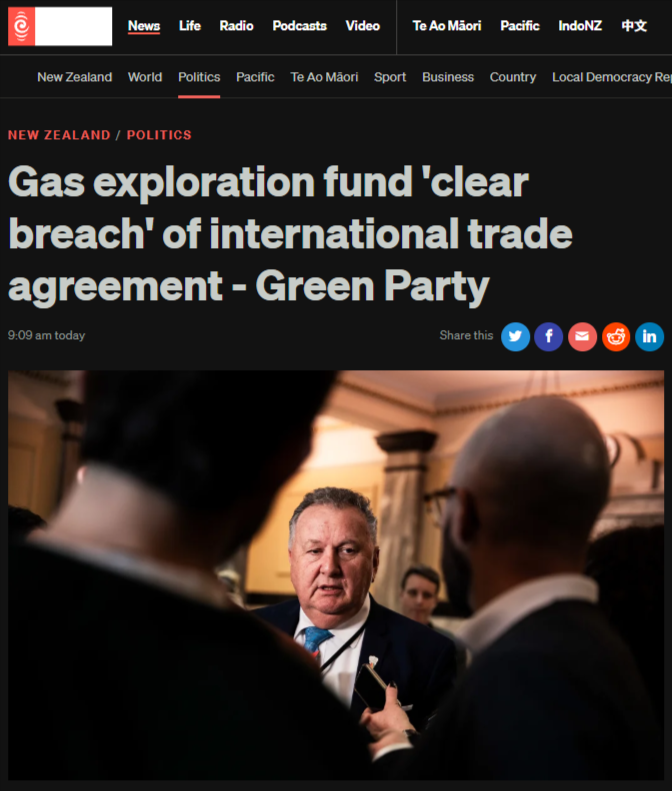
The National-ACT-NZ First coalition government has been caught red-handed breaching international trade law just six months after signing the Agreement on Climate Change, Trade and Sustainability (ACCTS) (1, 2). Resources Minister Shane Jones' $200 million fossil fuel handout represents more than just poor economic management - it exposes the colonial mindset that continues to prioritise corporate profits over environmental justice and Māori rights to a healthy environment.
Background
The ACCTS agreement was signed by New Zealand alongside Costa Rica, Iceland, and Switzerland in November 2024, representing what Trade Minister Todd McClay called a "ground-breaking" trade agreement that delivered commercial opportunities while addressing climate change and sustainability challenges (3, 4). The agreement explicitly prohibits fossil fuel subsidies and was designed to support the global transition to renewable energy while furthering the objectives of the Paris Agreement (5, 6).
New Zealand's energy sector faces significant challenges, with natural gas production plunging to a 40-year low in 2024, producing just 119 petajoules - approximately 20% less than 2023 (7). However, the government's response reveals a fundamental misunderstanding of both economic sustainability and environmental justice, choosing to subsidise dying fossil fuel industries rather than investing in renewable alternatives that could provide genuine energy security.
Shane Jones' Budget 2025 announcement of a $200 million contingency fund for co-investment in new gas fields has triggered legal challenges from multiple quarters. Legal advice commissioned by the Green Party, prepared by barrister Nura Taefi KC, confirms that this funding "falls within the definition of a prohibited fossil fuel subsidy in article 4.3, because it involves a financial contribution by the government targeting the exploration, extraction, refining and/or processing of a fossil fuel, and will confer a benefit by way of a cost reduction for co-investors" (1, 2, 8).
This breach matters profoundly for Māori because it demonstrates the government's willingness to violate its own international commitments to pursue extractive industries that threaten environmental integrity. The decision to subsidise fossil fuel exploration represents a continuation of colonial patterns that prioritise short-term corporate profits over long-term environmental sustainability and intergenerational responsibility - core values in Māori worldview (9, 10).
Climate advocates and legal experts have condemned the plan as both economically reckless and environmentally destructive, with Green Party co-leader Chlöe Swarbrick stating: "There's no grey area here. This is a blatant violation of our international commitments" (1, 11).

Far-Right Fossil Fuel Propaganda and Neoliberal Ideology
Shane Jones' aggressive promotion of fossil fuel expansion reveals the toxic intersection of neoliberal economics and colonial attitudes toward environmental exploitation. His statement that "Natural gas will continue to be critical in delivering secure and affordable energy for New Zealanders for at least the next 20 years" demonstrates the same short-term thinking that has characterised extractive colonialism for centuries (1, 12).
Jones' rhetoric at recent industry events, including his declaration that "all acreage is open for application" under new oil and gas exploration rules, exposes the government's true agenda: opening New Zealand's entire Exclusive Economic Zone to multinational fossil fuel corporations (13, 14). This represents environmental colonialism in its most blatant form - the subordination of indigenous sovereignty and environmental protection to corporate profit margins.
The neoliberal framework underlying these policies treats natural resources as commodities to be extracted rather than taonga (treasures) to be protected for future generations. This ideological framework directly contradicts Māori values of kaitiakitanga (guardianship) and whakatōhea (sustainability), reducing complex ecological relationships to simple market transactions (15, 16).

White Supremacist Environmental Destruction
The government's willingness to breach international agreements to subsidise fossil fuel extraction reflects deeper patterns of white supremacist thinking that prioritise corporate profits over indigenous rights and environmental justice. The decision to ignore legal advice and proceed with fossil fuel subsidies demonstrates the same colonial arrogance that justified land confiscation and resource extraction throughout New Zealand's history (9, 17).
Environmental racism manifests clearly in this policy, as the impacts of fossil fuel extraction disproportionately affect Māori communities while the profits flow to predominantly Pākehā-owned corporations and international investors (18, 17). The government's failure to consult meaningfully with iwi and hapū about these decisions violates both the Treaty of Waitangi and established principles of environmental justice.
The systematic exclusion of Māori voices from climate policy decisions represents a continuation of colonial practices that deny indigenous peoples' inherent rights to environmental protection and self-determination (19, 20). This exclusion becomes particularly egregious when considering that Māori communities have been leading climate activism and offering genuine solutions based on traditional ecological knowledge for decades.
Legal and Constitutional Violations
The ACCTS agreement defines fossil fuel subsidies comprehensively, covering any "financial contribution by a government" that provides benefits through "direct transfer of funds" or "potential direct transfers of funds or liabilities" targeting fossil fuel exploration, extraction, refining, or processing (5, 6). Jones' $200 million fund clearly meets these criteria, representing a direct government investment in fossil fuel development.
The agreement's objective explicitly states its purpose: "to discipline and eliminate harmful fossil fuel subsidies in order to mitigate their adverse impact on the environment and contribute to global efforts to rapidly reduce greenhouse gas emissions" (5). New Zealand's breach occurs barely six months after signing this agreement, suggesting either gross incompetence or deliberate disregard for international law.
Legal expert Nura Taefi KC's analysis demonstrates that the government failed to seek proper legal advice before announcing this policy, revealing a pattern of decision-making that prioritises political theatre over legal compliance (1, 21). This cavalier attitude toward international law undermines New Zealand's credibility as a responsible international actor and damages relationships with key trading partners.
Impact on Māori and Environmental Justice
The government's fossil fuel subsidies directly threaten Māori environmental rights and violate fundamental principles of environmental justice. Victoria University law students have already challenged the government's oil and gas exploration permits in court, arguing that decisions failed to properly consider climate change impacts or Treaty of Waitangi obligations (22).
Māori climate activist India Logan-Riley has powerfully articulated the connections between historical colonialism and contemporary climate destruction, explaining how "Land in my region was stolen by the British Crown in order to extract oil and suck the land of all its nutrients while seeking to displace people" (9). Jones' fossil fuel subsidies represent a continuation of these extractive colonial practices.
The decision to prioritise fossil fuel subsidies over renewable energy investments particularly harms Māori communities, who have consistently advocated for sustainable energy solutions that respect environmental limits and support community resilience (23, 24). By choosing fossil fuel subsidies, the government ignores Māori expertise and perpetuates systems that benefit corporate elites at the expense of community wellbeing.
Broader Implications for Climate Justice
This breach of international trade law demonstrates New Zealand's retreat from genuine climate leadership under the current coalition government. Despite announcing new climate targets claiming 51-55% emissions reductions by 2035, the government's actions reveal its true priorities: expanding fossil fuel extraction rather than accelerating renewable energy transitions (25).
The government's dual approach - announcing ambitious climate targets while simultaneously subsidising fossil fuel expansion - exemplifies the greenwashing that has characterised neoliberal climate policy for decades (26). This approach allows politicians to claim environmental credentials while maintaining the extractive economic systems that drive climate destruction.
International observers have noted the hypocrisy of wealthy nations like New Zealand abandoning climate commitments while expecting developing nations to make sacrifices (20). This dynamic reflects ongoing patterns of climate colonialism, where wealthy nations export environmental damage while claiming moral authority on climate issues.
Call for Genuine Climate Justice
The ACCTS breach represents an opportunity to demand genuine climate leadership that centres indigenous rights and environmental justice. Rather than subsidising dying fossil fuel industries, New Zealand should invest the $200 million in renewable energy infrastructure, just transition programs for affected workers, and community-led climate adaptation initiatives.
Chlöe Swarbrick's demand that the government "recall" this fossil fuel handout represents the minimum acceptable response (1, 11). However, genuine climate justice requires more fundamental changes: ending all fossil fuel subsidies, implementing binding targets for renewable energy expansion, and ensuring meaningful Māori participation in all climate policy decisions.
The government must abandon its colonial fantasy of endless resource extraction and embrace the indigenous wisdom that recognises environmental limits and intergenerational responsibility. This means rejecting the neoliberal ideology that reduces complex ecological relationships to market transactions and instead developing economic systems that support both people and planet.
The struggle against Shane Jones' fossil fuel subsidies connects to broader fights for climate justice, indigenous rights, and democratic accountability. By exposing the government's willingness to breach international law for corporate profits, this issue reveals the urgent need for fundamental changes in how New Zealand approaches environmental policy and economic development.
Readers who find value in this analysis and wish to support continued exposure of government misinformation and corporate capture are invited to consider a koha (donation) to HTDM: 03-1546-0415173-000. Please only contribute if you have capacity and wish to do so during these challenging economic times for whānau.
Noho ora mai - Be well
Te Māori Green Lantern