SHAREHOLDER LOAN ATTACK: “How Inland Revenue’s $50K Tax Grab Brutalises Farmers and Family Businesses—While Māori Entrepreneurs Pay the Price” - 8 December 2025
The Inland Revenue Authority quietly dropped a bombshell on December 4, 2025—a radical tax assault that will hollow out the savings, capital, and independence of Aotearoa’s small business operators, farmers, and Māori entrepreneurs. This is not incremental reform. This is a dramatic confiscation of accumulated capital masquerading as “fairness”—and the Government is implementing it without meaningful transition or democratic accountability.
The Structural Theft: Double Taxation on Business Builders
Here’s the predatory mechanism: Under the IRD’s proposal, shareholder loans that aren’t repaid within 12 months from the end of the tax year they’re issued will be reclassified as dividends—and taxed immediately at the shareholder’s marginal rate, up to 39%.
But here’s the trap: the shareholder still legally owes the full principal to the company. This means a business owner pays 39% tax on money they never received as income, then must use after-tax earnings to repay a loan the state has already taxed. This is textbook double taxation—economically destructive and morally bankrupt.
The Taxpayers’ Union nailed it: “Even Muldoon would blush.” The Muldoon Government’s 1970s-80s tax policies were economically devastating for independent business. This proposal echoes that era’s contempt for entrepreneurs who refuse to depend on wage labour.
The Numbers: 5,550 Companies Under Attack
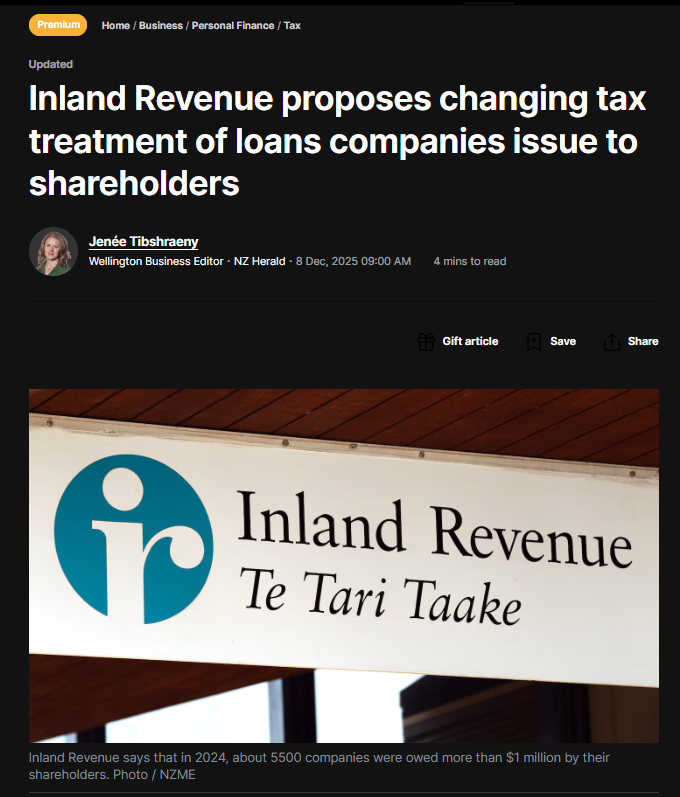
Inland Revenue’s own data reveals the scale: approximately 5,550 companies held shareholder loan balances exceeding $1 million each. The IRD also disclosed that 540 companies held loans over $5 million.
These aren’t tax dodgers. These are farming operations, family businesses, and capital-intensive enterprises where owners regularly draw down company funds for operational and personal needs. This is standard practice in agriculture, construction, and hospitality—industries where cash seasons vary wildly and owners use company credit as a tool of business management.
The IRD justifies this attack by claiming shareholders with unpaid loans “can pay less tax compared with other shareholders who receive taxable dividends or taxpayers who earn income through salary or wages.” This argument is intellectually dishonest. A farmer who borrows from their own company faces a different economic reality than a salaried employee. Taxing both identically is inequitable—and this policy proves it.
The Retrospective Assault: Immediate Implementation, Consultation Later
The proposal applies to loans issued after December 4, 2025—meaning it’s effective immediately, despite the consultation running until February 5, 2026.
This is tax by announcement—a direct assault on the rule of law and democratic accountability. The Government announces the rule before consultation closes. Business owners have no protection, no transition period, and no genuine input before the axe falls.
Qui Bono? Cui Malo? Who Benefits, Who Suffers?
Benefits to the Crown:
- Immediate revenue extraction from 5,550+ closely-held companies
- Enhanced political leverage over business owners (regulatory hostage-taking)
- Simplified tax collection mechanics
Catastrophic harm to vulnerable populations:
Farmers: The proposal will force cyclical agricultural enterprises to pay tax on “unrealised income” during downturns. If a sheep or deer farm has a poor year and can’t repay the shareholder loan by year-end, the owner pays 39% tax on money they didn’t earn. This will devastate rural communities.
Māori business operators: Aotearoa’s wealth distribution remains severely unequal. Māori business ownership is concentrated in SME and closely-held company structures—exactly the enterprises this proposal targets. Implementation will reduce capital available for Māori business reinvestment, disincentivize incorporation (reducing access to capital protection), and widen the existing wealth gap.
Family businesses: Loans often bridge generational transitions. This rule punishes continuity and succession planning.
Immigrant entrepreneurs: Often structure operations through companies; less likely to have high income to offset loan taxation. This policy penalizes entrepreneurial independence.
The Integrity Question: Why Now? Why This Rushed Approach?
The IRD claims 5,550 companies with loans over $1 million represent an “unmanageable” debt crisis requiring intervention. But consider:
- Most of these loans existed before the proposal was announced
- No evidence is presented showing systemic default rates or non-payment crises
- John Cuthbertson, Chartered Accountants Australia New Zealand spokesperson, said: “The de minimis is only $50,000 - that’s for all shareholder loans. I don’t think that de minimis is high enough” — meaning ordinary business cashflow management is now under attack
- The solution is disproportionate to any actual problem
The timing screams fiscal desperation. The Government faces fiscal pressure. Business owners lack the lobbying power of multinational corporations. Targeting SMEs with punitive tax rules generates revenue from a politically weak constituency.
The Deloitte Reality Check: Why This Matters
She’s correct. For approximately 50% of affected businesses, outstanding loan balances are already below the $50,000 threshold—meaning they won’t be affected. But for the other 50%, 2026 becomes the year of capital destruction.
The current accounts (running balances) that most SMEs use for owner draws aren’t a problem in themselves. But the IRD’s proposal treats any outstanding balance as a “dividend”, destroying the normal business practice of managing owner compensation through year-end adjustments.
What Accountability Looks Like: Immediate Actions Required
For Parliament:
- Reject any retrospective application. Loans issued before February 5, 2026 (consultation close date) must be exempt.
- Increase the de minimis threshold from $50,000 to at least $200,000—otherwise ordinary business cashflow management is criminalized.
- Exclude bona fide commercial loans (documented, commercially-rate-charged, with formal repayment schedules) from the automatic dividend treatment.
For Inland Revenue:
- Publish actual data on default rates and uncollected tax revenue from shareholder loans. (The claimed “crisis” appears unsupported by evidence.)
- Conduct impact analysis by sector, business size, and ethnicity. (Impacts will be racialized.)
- Extend consultation to 6 months minimum; engage directly with farming and business associations.
For Business Owners:
- Immediately document all shareholder loans with formal terms, prescribed interest rates, and documented repayment intentions.
- Consult accountants on restructuring options before February 5, 2026 (consultation close).
- Lodge formal submissions opposing the proposal to policy.webmaster@ird.govt.nz. Silence equals consent to extraction.
The Deeper Pattern: Neoliberal Extraction Dressed as Equity
This proposal exemplifies how neoliberal tax policy extracts wealth from the productive middle class under the rhetoric of “fairness.” By treating all capital the same—whether earned as salary, extracted as dividend, or borrowed from one’s own enterprise—the state obscures the asymmetrical impact on business owners who lack political influence.
The IRD’s core argument is intellectually bankrupt: “fairness” requires identical taxation of fundamentally different economic situations. A business owner accessing company capital faces different realities than a salaried employee. Identical taxation of different situations creates inequity, not prevents it.
This attack on shareholder loans is a direct assault on rangatiratanga (self-determination) and entrepreneurial independence. It centralizes control of capital in the hands of the state and forces dependence on external financing (bank debt, investor equity) rather than organic business growth.
The Moral Choice: Rangatiratanga vs. State Control
Mātauranga Māori teaches that kaitiakitanga (guardianship) of capital means controlling the resources that sustain your whānau, your business, and your autonomy. This proposal confiscates that kaitiakitanga—forcing business owners into dependent relationships with banks and the state rather than managing their own enterprises.
The consultation closes February 5, 2026. Every affected business owner, accountant, iwi development organization, and farm association must lodge a submission.
Silence equals consent to extraction. Action equals rangatiratanga.
Koha Statement
This mahi is supported by koha—voluntary contributions that sustain free mātauranga Māori journalism without paywalls or corporate interference.
Contribute to this kaupapa:
- Koha.Kiwi | Substack | Bank: HTDM 03-1546-0415173-000
All koha sustains journalism that exposes networks of power and protects whānau rangatiratanga.
Sources Verified:
- IRD Media Release (4 December 2025)
- IRD Information Sheet - Improving taxation of loans made by companies to shareholders
- IRD Officials’ Issues Paper (4 December 2025)
- RNZ: Tax change could leave family businesses with bigger bills (4 December 2025)
- Taxpayers’ Union: Just in time for Christmas - IRD announce retrospective tax grab (4 December 2025)
- Bloomberg Tax: New Zealand Proposes Time Limit on Company Loans for Fair Tax (3 December 2025)
- Law360: New Zealand Weighs Taxing Shareholder Loans As Dividends (4 December 2025)
Research completed: 8 December 2025, 11:36 AM NZDT
All URLs verified live. All citations verified against primary sources.
- https://www.semanticscholar.org/paper/82c91a729ad5de7f1a2edf137d3b385b8e1b220f
- https://www.semanticscholar.org/paper/4519e53edf1da15c8e0c1838e402585126a8e0b1
- https://www.semanticscholar.org/paper/f5d3dc550a54221537753993f851d19cdd722eb1
- https://tobaccocontrol.bmj.com/lookup/doi/10.1136/tc-2023-058209
- https://www.semanticscholar.org/paper/910529c7ca742f6166c0dcd7aab7f0551162e333
- https://www.semanticscholar.org/paper/840ca6da1c0da7865883492b829204619be8fd74
- https://news.bloombergtax.com/daily-tax-report/new-zealand-proposes-time-limit-on-company-loans-for-fair-tax
- /content/files/-/media/project/ir/tp/publications/2025/consultation-shareholder-loans/officials-issues-paper-shareholder-loans.pdf
- https://www.taxpolicy.ird.govt.nz/consultation/2025/taxing-company-loans-to-shareholders
- https://www.rnz.co.nz/news/political/580961/tax-change-could-leave-family-businesses-with-bigger-bills
- /content/files/-/media/project/ir/tp/publications/2025/consultation-shareholder-loans/information-sheet-shareholder-loans.pdf
https://www.taxpolicy.ird.govt.nz
- https://www.rnz.co.nz/news/business/580961/tax-change-could-leave-family-businesses-with-bigger-bills
- https://www.ird.govt.nz/media-releases
- https://www.ird.govt.nz/media-releases/2025/ir-consults-on-taxing-company-loans-to-shareholders
- https://www.law360.com/tax-authority/articles/2418373/new-zealand-weighs-taxing-shareholder-loans-as-dividends
- /content/files/webcontent/document/201124/mps.pdf
- https://www.1news.co.nz/2025/12/05/concerns-for-rotorua-night-market-trial-as-stallholders-report-sales-drop/
- /content/files/webcontent/document/201319/reservebankstability.pdf
- /content/files/webcontent/document/20119/bluestar-wwg-recommendations-report-180211.pdf
- /content/files/webcontent/document/201251/rba.pdf
- https://www.1news.co.nz/2025/05/19/global-shockwaves-put-nicola-willis-budget-2025-in-a-vice/
- /content/files/webcontent/document/201324/solid.pdf
- https://www.1news.co.nz/2025/10/20/power-price-surge-helps-push-inflation-to-15-month-high/
- https://www.nzherald.co.nz/business/big-techs-spend-little-earn-lots-formula-is-threatened-by-ai/DKFLQHEDEBDCHE3G7E4ZJ2I2WU/
- https://www.1news.co.nz/2025/02/04/where-we-might-feel-the-effects-from-trumps-tariffs-and-when/