”Sound Process, Shaky Truth: How the Fast-Track Conflict Management Whitewashes Cronyism” - 25 June 2025
Conflict of Interest or Conflict of Truth? How the Fast-Track ‘Soundness’ Claim Masks Cronyism and Undue Influence
Tēnā koutou katoa – greetings to you all.
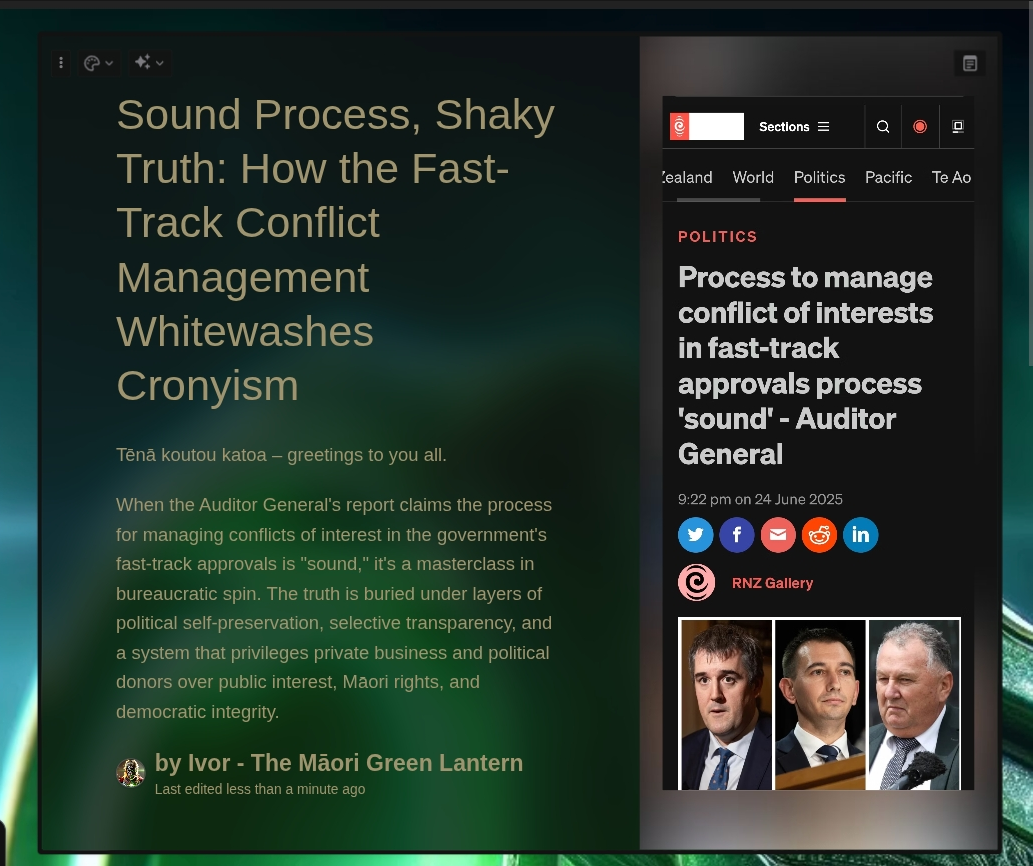
When the Auditor General’s report claims the process for managing conflicts of interest in the government’s fast-track approvals is “sound,” it’s a masterclass in bureaucratic spin. The truth is buried under layers of political self-preservation, selective transparency, and a system that privileges private business and political donors over public interest, Māori rights, and democratic integrity.
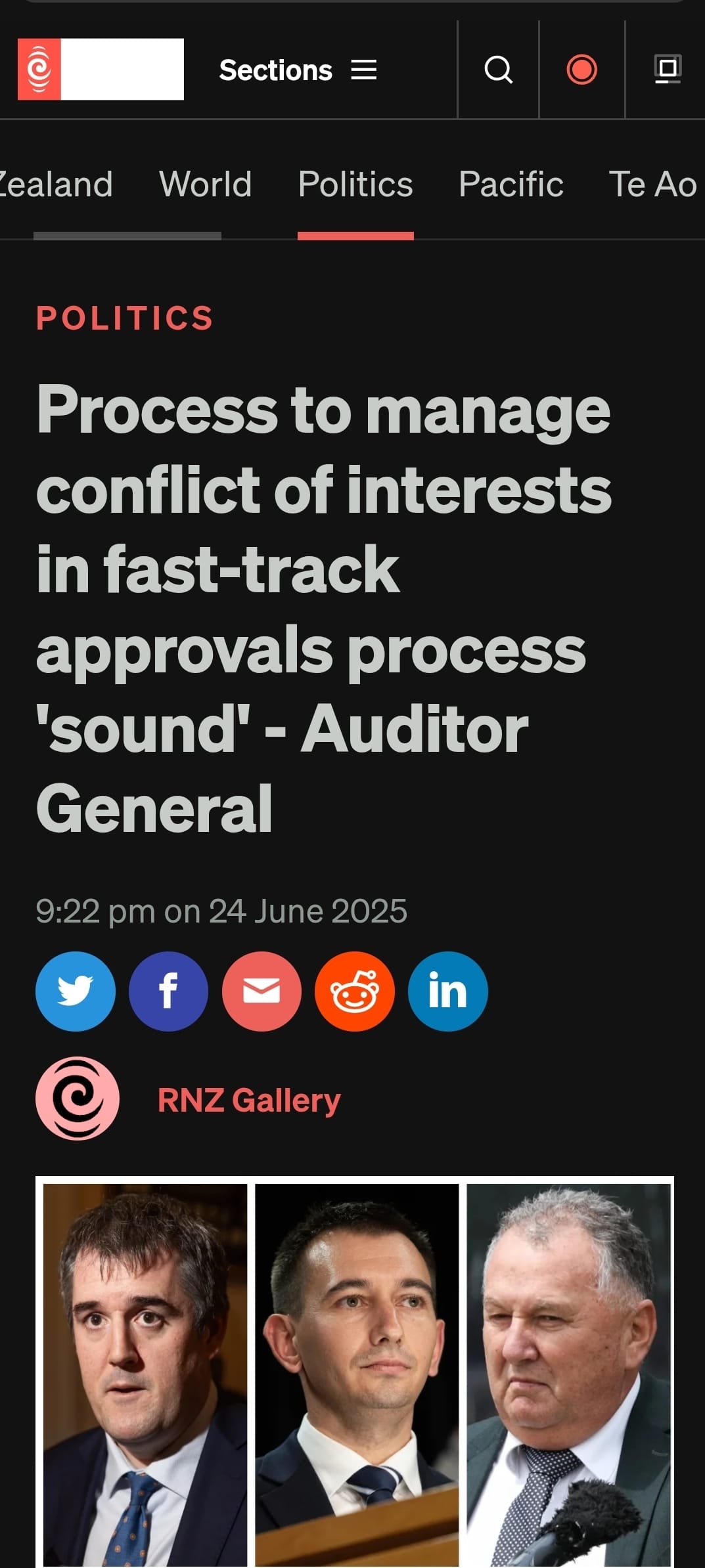
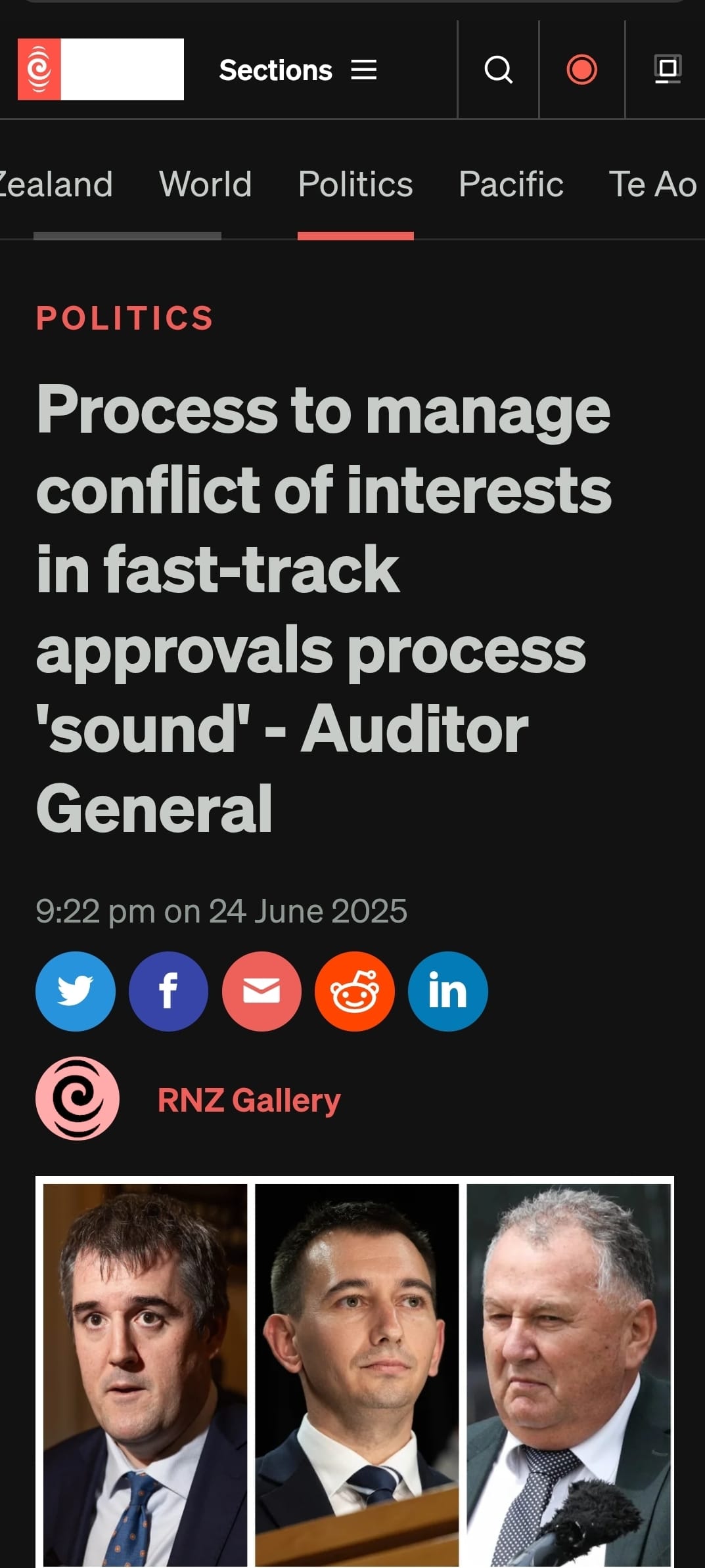
https://www.rnz.co.nz/news/political/565046/process-to-manage-conflict-of-interests-in-fast-track-approvals-process-sound-auditor-general
Introduction
The government and its media mouthpieces want you to believe that the fast-track approvals process is robust, fair, and above reproach. “Process to manage conflict of interests in fast-track approvals process 'sound' – Auditor General,” trumpets RNZ, echoing the government’s own talking points123. But this is a half-truth at best. The real story is one of hidden conflicts, opaque decision-making, and a system designed to benefit the powerful few. This essay exposes the misleading nature of the “sound process” claim, unpacks the deeper risks for Māori and democracy, and calls out the neoliberal and white supremacist logic underpinning the fast-track regime.
Background
The Fast-Track Approvals Bill hands sweeping powers to ministers to greenlight major infrastructure and development projects, bypassing normal checks, environmental protections, and public consultation4. Under this regime, ministers have wide discretion to pick which projects go ahead, with decisions often benefiting private business interests, including those who donate to political parties56. The Auditor General’s office launched its inquiry after public uproar over the lack of transparency and the risk of political cronyism56. For Māori, this issue is not abstract: fast-track projects routinely threaten whenua, wai, and taonga, and the process sidelines Māori voices and tino rangatiratanga.
https://gamma.app/docs/Sound-Process-Shaky-Truth-How-the-Fast-Track-Conflict-Management--n6b2s0lfvhn4lss
The Auditor General’s report admits there were “concerns about the transparency” of the process, especially as ministers had “a broad margin of discretion and the decisions benefit private businesses”123. The report describes conflicts as “perceptions of bias, predetermination, and undue influence” – all present in the fast-track process123. Yet, despite these red flags, the Auditor General concludes that the conflict management process was “sound,” while quietly suggesting a “range of options to strengthen conflict management”123. The scope of the inquiry was narrow: it did not examine the merits of the Bill, the design of the process, or the actual decisions made about projects123. This sleight of hand allows politicians and media to claim everything is above board, while the real risks go unaddressed.
Superficial “Soundness” Masks Structural Rot
The Auditor General’s “sound process” verdict is based on technical compliance, not substantive integrity. The report notes that ministers and the Cabinet Office considered a “broad range of potential conflicts,” including family, close associates, and campaign donations, and that management plans were in place123. But it also highlights major gaps: ministers should declare conflicts earlier, ideally before receiving advice or picking projects, and should consider recusing themselves from Cabinet even if not the final decision-maker123. These are not minor tweaks – they are admissions that the current system is wide open to abuse.
Transparency: More Rhetoric Than Reality
Despite government claims, the process is anything but transparent. Ministers have refused to disclose which projects they had to recuse themselves from, and the public is left in the dark about the true extent of conflicts7. Even when some conflicts were acknowledged, the details remain “behind closed doors,” with only partial information released under pressure7. This secrecy is not accidental; it is a deliberate strategy to shield ministers from scrutiny and protect political donors.
Political Donations: Cronyism by Another Name
The heart of the issue is the flow of money between private interests and political parties. RNZ revealed that more than $500,000 in donations came from companies or shareholders linked to 12 of the 149 fast-track projects76. The Auditor General’s own submission to Parliament warned that the Bill “lacked robust mechanisms for identifying and managing conflicts among ministers,” especially given the risk of donor influence6. Yet, the final report sidesteps the question of whether these donations actually shaped decisions – a glaring omission that undermines any claim of “soundness.”
Neoliberalism and White Supremacy: The Hidden Logic
The fast-track process is a textbook case of neoliberal governance: deregulation, executive power, and the prioritisation of private profit over collective wellbeing4. For Māori, this is doubly dangerous. The process sidelines Māori participation, ignores Te Tiriti obligations, and accelerates projects that threaten whenua and wai. It is also a white supremacist project, reinforcing colonial control over land and resources while dismissing Māori concerns as “special interests.” As Transparency International NZ points out, the Bill “raises concerns around democratic decision-making, the principle of the separation of powers, increased power of the Executive, participation and overall transparency”4.
Counterarguments and Their Failures
Ministers like Chris Bishop claim that conflicts were “carefully managed” and that Cabinet Office advice was followed5. But this is belied by the Auditor General’s own warnings, the lack of transparency, and the ongoing influence of political donations67. The government’s defenders argue that donations are publicly declared and that recusal processes are sufficient7. Yet, as multiple watchdogs and civil society groups have pointed out, the current system is inadequate and fails to protect against undue influence46.
Implications
The implications are profound. The fast-track process erodes public trust, undermines democracy, and entrenches the power of wealthy interests. For Māori, it is another assault on tino rangatiratanga and the right to meaningful participation in decisions affecting whenua and wai. The system’s opacity enables cronyism and perpetuates structural racism, making it harder for Māori and other marginalised groups to hold power to account.
The claim that the fast-track conflict management process is “sound” is, at best, a bureaucratic half-truth and, at worst, a deliberate lie. The system is designed to shield ministers and donors from scrutiny, not to protect the public or honour Te Tiriti. True integrity requires transparency, accountability, and a commitment to Māori values – manaakitanga, kaitiakitanga, and tino rangatiratanga. Until then, the fast-track process will remain a vehicle for cronyism and colonial power.
If you value this kind of truth-telling and advocacy for Māori rights, please consider a koha/donation to support the kaupapa: HTDM: 03-1546-0415173-000. Only contribute if you have the capacity and wish to do so.
Ngā manaakitanga,
The Māori Green Lantern

- https://www.rnz.co.nz/news/political/565046/process-to-manage-conflict-of-interests-in-fast-track-approvals-process-sound-auditor-general
- https://ppl-ai-file-upload.s3.amazonaws.com/web/direct-files/attachments/2123776/b0e4766b-61a4-4708-846e-0d7d560ecb36/Process-to-manage-conflict-of-interests-in-fast-track-approvals-process-sound-Auditor-General-_-RNZ-News.PDF
- https://www.interest.co.nz/economy/130522/parliaments-watchdog-will-examine-how-conflicts-interest-were-managed-fast-track

- https://www.transparency.org.nz/blog/fast-track-approvals-bill
- https://www.rnz.co.nz/news/political/532449/auditor-general-to-inquire-into-possible-conflicts-of-interest-by-ministers-over-fast-track-projects
- https://www.rnz.co.nz/news/national/530520/ministers-lift-the-curtain-on-fast-track-approval-conflicts
- https://pplx-res.cloudinary.com/image/private/user_uploads/2123776/db9eb39a-1aa3-40b4-bff9-3839633bc391/Screenshot_20250625_032450_Brave.jpg
- https://ppl-ai-file-upload.s3.amazonaws.com/web/direct-files/collection_cf06d657-2c2b-4e68-8735-48f3c10166bd/8e9b17f7-604e-4009-9ec6-abbe1fd2c989/Perspective-with-Heather-du-Plessis-Allan_-This-Government-s-all-talk-bugger-all-action.PDF
- https://www.nzherald.co.nz/nz/politics/inquiry-launched-into-how-conflicts-of-interest-dealt-with-during-fast-track-approval-project-decision-making/GRCB5QIGXVAWJPOIXKMHPFP2U4/
- https://www.rnz.co.nz/news/in-depth/536978/how-the-fast-track-approvals-bill-became-law
- https://www.rnz.co.nz/news/environment/515307/fast-track-bill-could-affect-nz-s-reputation-transparency-international
- https://www.nzherald.co.nz/nz/politics/fast-track-approvals-projects-raise-conflict-of-interest-questions-govt-maintains-robust-process-followed/7L3BBZB3EBHK3F32G7FWD37JAI/
- https://www.nzherald.co.nz/nz/swamped-by-a-wave-of-deceit/V65W6SOLKWCND7Y3Z6YSNOR7ME/
- https://www.1news.co.nz/2024/06/24/analysis-fast-track-bill-recognises-resource-management-is-political/
- https://www.rnz.co.nz/national/programmes/focusonpolitics/audio/2018939792/fast-track-bill-hits-hurdles-of-public-outrage
- https://oag.parliament.nz/2025/fast-track-conflicts
- https://niagaraindependent.ca/bill-c-5-is-a-dangerous-solution-to-liberal-failures/
- https://www.1news.co.nz/2024/10/31/auditor-general-to-probe-possible-conflicts-of-interest-for-fast-track-projects/
- /content/files/files/financial-reports/Annee_2023_2ieme_Trimestre/se_report_laurentian_pilotage_authority_april_2023.pdf
- https://theconversation.com/resource-management-is-always-political-the-fast-track-approvals-bill-is-just-honest-about-it-232256
- https://b2bnews.co.nz/news/auditor-general-initiates-inquiry-into-conflicts-of-interest-in-fast-track-projects/