"Speaking Truth: When Military Feasts on Corporate Kai" - 30 June 2025
Māori Green Lantern Analysis
Kia ora whānau,
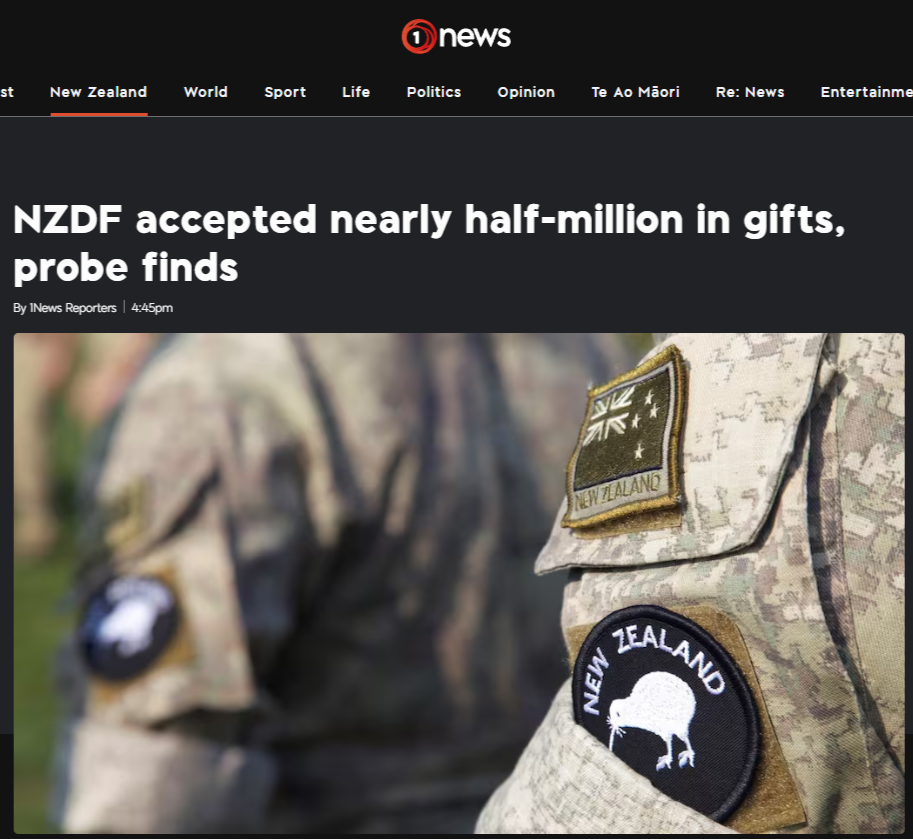
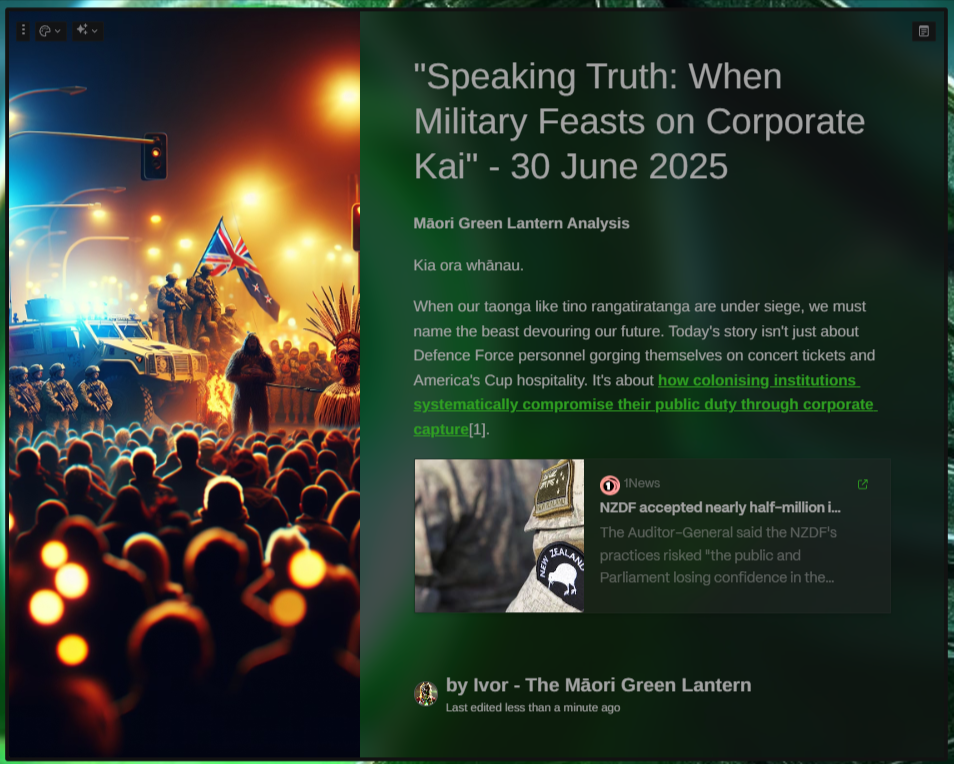
When our taonga like tino rangatiratanga are under siege, we must name the beast devouring our future. Today's story isn't just about Defence Force personnel gorging themselves on concert tickets and America's Cup hospitality. It's about how colonising institutions systematically compromise their public duty through corporate capture1.
This $418,000 feeding frenzy between 2016 and 2025 reveals the insidious ways neoliberalism corrupts state institutions while undermining genuine kaitiakitanga of public resources. As Auditor-General John Ryan warned, these practices risk "the public and Parliament losing confidence in the decisions made to contract with those suppliers"2. This isn't just poor judgment - it's the predictable outcome when military institutions embrace corporate partnership over public accountability.
Background: The Military-Industrial Feast
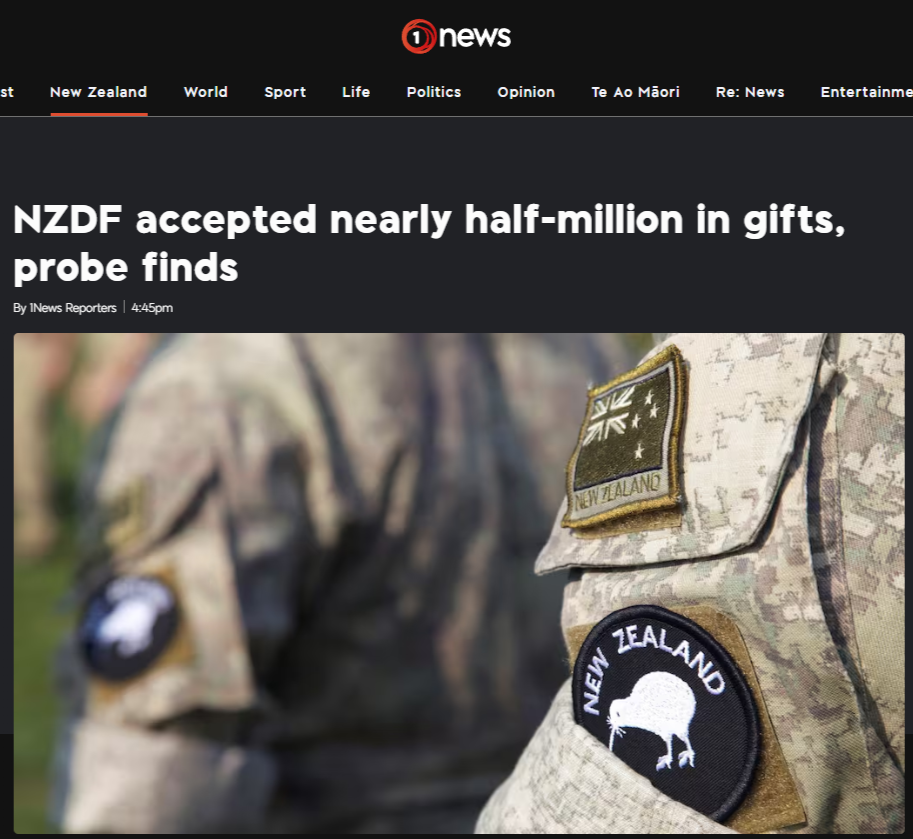
The NZDF accepted over 2500 offers of gifts and hospitality from commercial suppliers1, including smartwatches, fishing charters, concert tickets, and luxury yacht experiences during America's Cup 2021. The Auditor-General's inquiry revealed that 78 percent of these gifts were justified as building "business relationships"2 - corporate speak for what tangata whenua would recognise as compromising one's duty to the people.
While NZDF introduced new policies in November 2023, they continued accepting gifts worth $40,272 in just over a year1. The organisation's defence rings hollow: claiming these "constructive working relationships" are necessary for "future procurement and the need to rapidly advance defence capabilities." This language masks how military procurement has become a revolving door of influence between state institutions and corporate interests.
Understanding this requires recognising how neoliberalism's application to defence stands as "a political, rather than military imperative"3. Since the 1980s, governments have systematically introduced market dynamics into defence procurement, creating the very conditions that make these corrupting relationships inevitable.
Corporate Capture in Military Dress
The NZDF gift-giving scandal exemplifies what happens when institutions abandon their primary duty - service to the people - in favour of "business relationships" with profit-driven suppliers. One example involved sporting tickets being accepted on the basis that there would be "no work chat," which Ryan said showed "at best a misunderstanding of the policy"1. This reveals how personnel rationalise ethical compromises through convenient fictions.
The deeper issue isn't individual moral failure but systemic corruption of public institutions. New Zealand has joined the US-led Partnership for Indo-Pacific Industrial Resilience4, designed to integrate regional defence industries and boost American "warfighting" capabilities. Defence Minister Judith Collins called it a "discussion forum," but US reports show it has four workstreams including co-producing missiles and drones.
This matters profoundly for Māori because it represents the antithesis of our values. Where manaakitanga teaches us reciprocal care without expectation of personal gain, corporate gift-giving creates webs of obligation that serve private profit over public good. Where kaitiakitanga demands we protect resources for future generations, these relationships funnel public money toward weapons manufacturers and military contractors.
The broader pattern shows how military institutions become conduits for funnelling public resources into what President Eisenhower warned was the "military-industrial complex." As one peace activist noted about BAE Systems receiving NZDF contracts despite being "sentenced to pay a $400 million criminal fine" for corruption5, this creates a pipeline where "money flows into the shadowy world of international weapons trading."

Colonising Values Through Corporate Hospitality
Neoliberalism's Assault on Public Service
The gift-giving scandal illustrates how neoliberalism's defence reforms "failed to generate unambiguous benefits and arguably resulted in less efficient outcomes than the statist practices they sought to overturn"3. When Margaret Thatcher pioneered these reforms in the 1980s, officials complained about "excessively cosy relationships" between defence ministries and arms producers. Their solution was introducing market competition.
The irony runs deep. Neoliberal reformers championed market dynamics to eliminate corruption, yet created conditions where only larger firms could bear financial risks, leading to industry consolidation and domestic monopolies3. In Britain, "the value of defence contracts awarded non-competitively reached 65-75%" by recent years - equivalent to pre-Thatcher Labour governments.
New Zealand followed this pattern. NZDF's supply chain relies heavily on "international suppliers" with "single suppliers for key items" and "efficiency over effectiveness"6. This creates dependencies that make "business relationships" seem essential while obscuring how they compromise institutional integrity.
The language reveals everything. Officials speak of "maintaining constructive working relationships" and "rapidly advancing defence capabilities" as if public institutions exist to serve corporate partners rather than the people. This inverts the proper relationship, making state institutions supplicants to private profit rather than guardians of public resources.
White Supremacy in Military Procurement
The deeper poison here connects to what peace researchers identify as the "Racism-Militarism Paradigm" - "a way of looking at the world that arises from a largely unacknowledged doctrine of white supremacy and the necessity of using violence to uphold it"7. This paradigm "establishes a rigid hierarchy, based on race, that values white lives more than any other" and "embraces militarism as the most effective mechanism to guarantee this ordering."
For Māori, this matters because military institutions have always served colonising interests. During the New Zealand Wars of the 1860s, "18,000 British Army troops, supported by artillery, cavalry and local militia, battled about 4,000 Māori warriors"8. These wars resulted in "several million hectares of land confiscated in Waikato, Taranaki and Bay of Plenty" - losses that "crippled large sections of the Māori people and created grievances that lasted more than a century."
The contemporary NZDF gift scandal perpetuates this colonial logic by prioritising relationships with predominantly Western arms manufacturers over accountability to tangata whenua. When NZDF joins initiatives like the Partnership for Indo-Pacific Industrial Resilience to help produce "hypersonic missiles" and fix "US Navy ships"4, it embeds New Zealand deeper into what critics call the American empire's military apparatus.
This represents the opposite of tino rangatiratanga - genuine self-determination. Instead of sovereign decision-making guided by Māori values, we see institutions captured by foreign military interests and corporate profits. The gift-giving creates personal obligations that cloud professional judgment, while the broader procurement system locks New Zealand into dependency relationships with overseas suppliers.
Corrupting Kaitiakitanga Through Corporate Capture
Traditional Māori values offer a stark contrast to this corruption. Kaitiakitanga encompasses "guardianship," "stewardship," and "the principle and practices of intergenerational sustainability"9. True kaitiaki protect resources for future generations without expectation of personal reward or relationship-building with those who would exploit them.
The NZDF personnel accepting corporate hospitality violate this fundamental principle. When staff justified accepting gifts to "contribute to NZDF outcomes and help build business relationships," Auditor-General Ryan noted this was "difficult to reconcile with requirements that staff avoid situations where actions appear influenced by private interests"1.
From a Māori perspective, this creates tapu - a dangerous mixing of sacred public duty with profane private interest. Rangatiratanga traditionally meant "working for the collective and upholding the well-being of whānau, hapū, and iwi"10. True rangatira would never compromise their people's interests for personal entertainment or relationship-building with those seeking to profit from their decisions.
The concept of mana requires leaders to maintain integrity and be "widely respected"10. Military leaders who accept corporate gifts undermine their mana by creating appearances of impropriety that damage public trust in institutions meant to serve collective security.
The Neoliberal Mythology of Efficiency
NZDF's defence of these relationships reveals how neoliberal ideology corrupts public service. Officials claim they "must maintain constructive working relationships with commercial suppliers in the defence industry" to ensure "rapid advancement of defence capabilities." This language assumes that efficiency requires cosying up to corporate suppliers rather than maintaining arms-length professional relationships.
Yet research on neoliberal defence reforms shows they consistently "failed to generate unambiguous benefits"3 and often created worse outcomes than traditional public procurement. The supposed efficiency gains mask how privatisation creates "complex outsourcing efforts" that "proved increasingly problematic" with "financial losses" or complete collapse3.
The gift-giving scandal demonstrates this perfectly. After spending $418,000 on corporate hospitality justified as relationship-building, NZDF still faces "extended lead times for equipment" with suppliers choosing "not to produce what the NZDF requires" or providing products "first to their production site host nation"6. The expensive relationships bought nothing except compromised integrity.
True efficiency would involve transparent, professional procurement based on merit rather than personal relationships built through entertainment and gifts. But neoliberal ideology disguises relationship-building as sound business practice while creating conditions for systematic corruption.
Implications: Compromising Sovereignty for Corporate Comfort
This scandal reveals how supposedly independent institutions become captured by interests antithetical to indigenous sovereignty and public welfare. When NZDF joins US-led military partnerships designed to "exhaust weapons" in potential wars with China4, it abandons any pretence of independent defence policy guided by New Zealand's interests.
The corporate gift-giving creates personal relationships that cloud professional judgment about these larger strategic choices. When military personnel develop social connections with arms industry representatives through concert tickets and yacht parties, they're less likely to question whether massive weapons procurement serves New Zealand's security or merely corporate profits.
For Māori communities, this represents a double violation. First, it diverts public resources that could address housing, health, and education inequities toward military contractors. Second, it embeds New Zealand deeper into imperial military structures that historically oppressed indigenous peoples worldwide.
The "military-industrial-carceral complex" creates "immense harm at home and abroad, particularly to people of color"7 while making "the vast majority of Americans less secure." For tangata whenua, supporting this system through compromised procurement practices betrays our ancestors who resisted colonial military force at places like Parihaka.
The broader implications extend to democratic governance itself. When public institutions develop personal relationships with private suppliers through gift-giving, they create conflicts of interest that undermine transparent decision-making. Citizens can no longer trust that procurement decisions serve public rather than private interests.
Reclaiming Public Service Through Māori Values
The NZDF gift scandal exposes how neoliberal policies systematically corrupt public institutions while enriching private contractors. Despite Auditor-General Ryan's warning that these practices risk "public and Parliament losing confidence" in procurement decisions1, officials continue justifying relationship-building with corporate suppliers as necessary for defence capability.
This represents the antithesis of genuine public service guided by Māori values. True kaitiakitanga would protect public resources from corporate capture. Authentic manaakitanga would serve collective welfare rather than individual entertainment. Proper rangatiratanga would maintain institutional integrity over comfortable relationships with profit-seeking suppliers.
The solution requires more than policy tweaks. We need fundamental transformation that prioritises indigenous values over neoliberal efficiency, transparent public service over corporate relationship-building, and genuine security over military contractor profits. Until institutions like NZDF embrace these principles, they will continue serving colonial and corporate interests rather than the people they claim to protect.
As tangata whenua, we must demand that public institutions operate according to our values of collective responsibility and intergenerational care. The corporate feast ends when we insist that public servants serve the people, not their corporate suppliers.
Ngā mihi,
The Māori Green Lantern
The MGL understands these tough economic times for whānau so please only contribute a koha if you have capacity and wish to do so. HTDM: 03-1546-0415173-000.