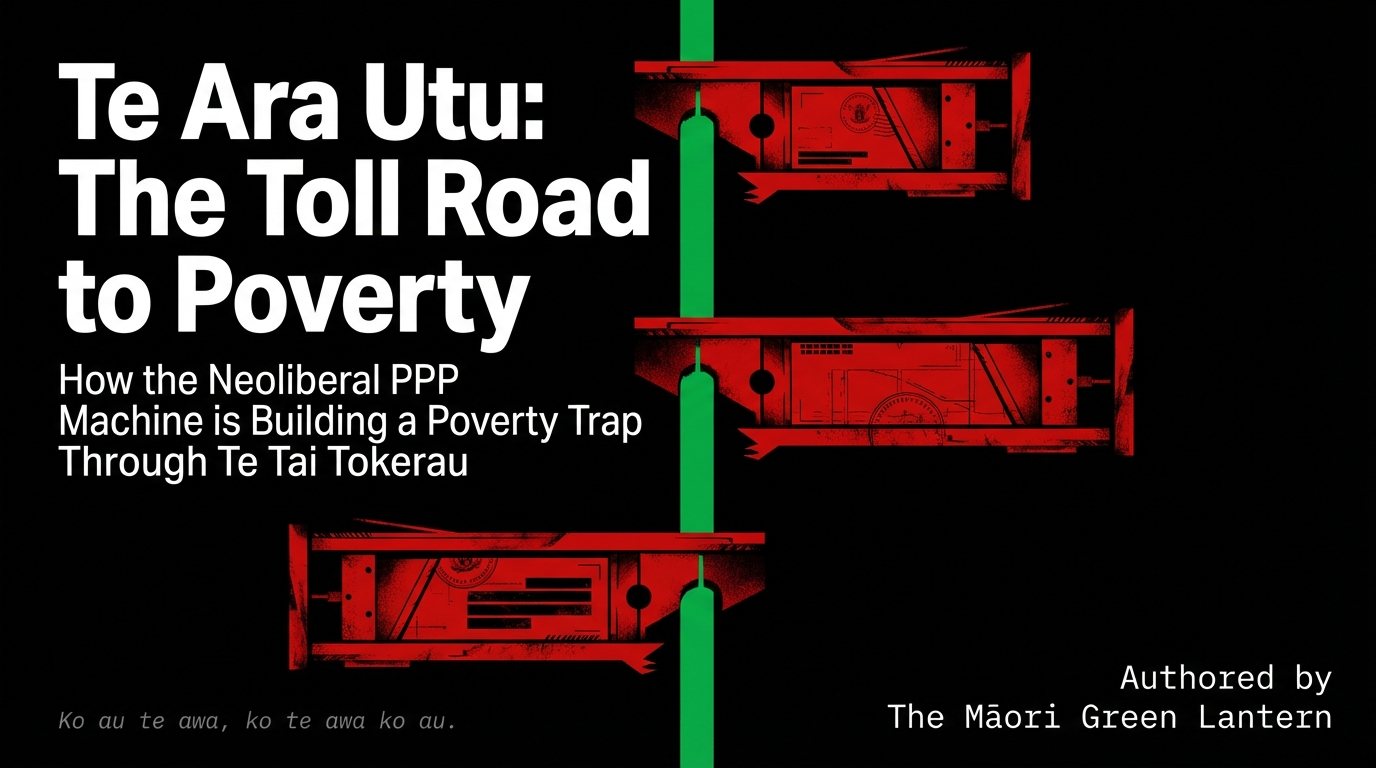
"Te Ara Utu: The Toll Road to Nowhere — How Chris Bishop's Neoliberal PPP Machine Is Building a Poverty Trap Through the Heart of Te Tai Tokerau" - 6 April 2026
"Ko au te awa, ko te awa ko au." - I am the river, the river is me.

Kia ora Aotearoa on this Easter Monday.
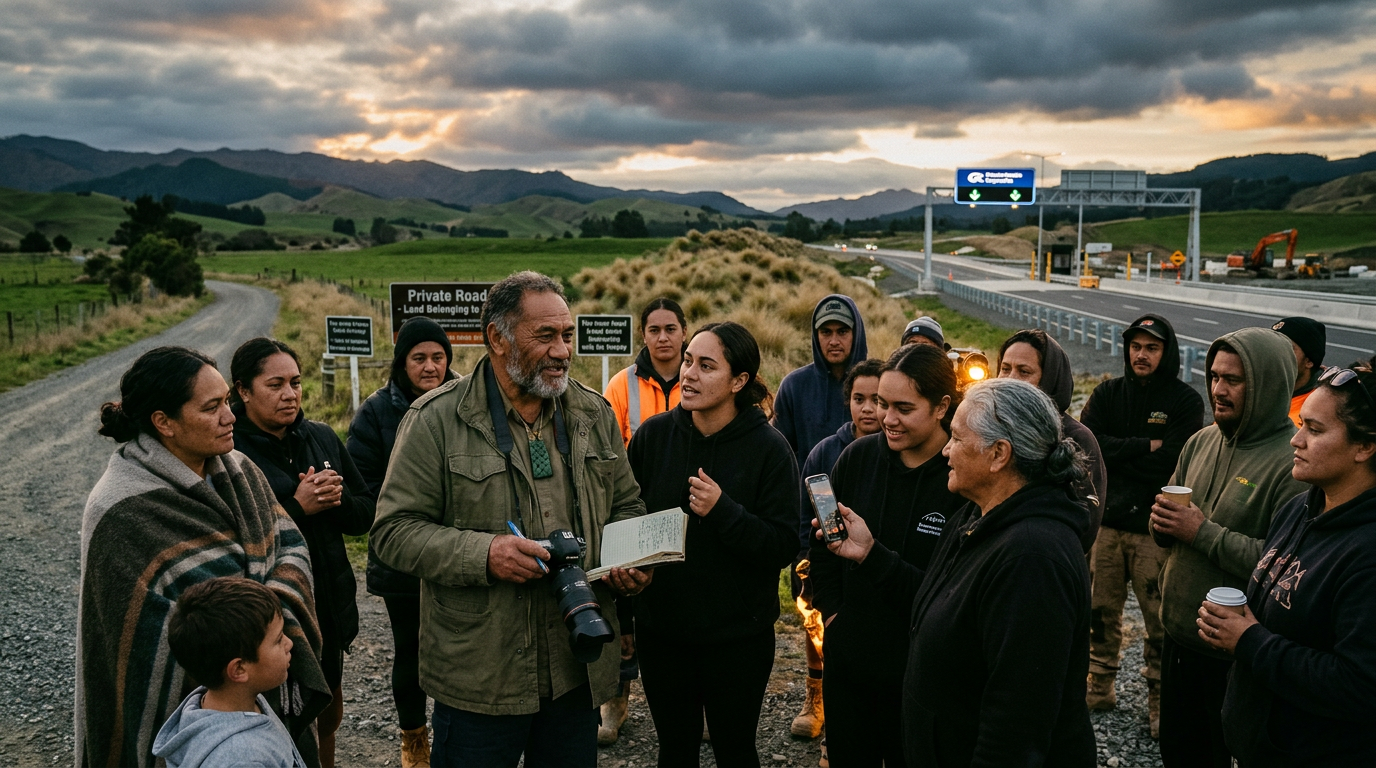
The road through Te Tai Tokerau is not just tarseal and concrete. It is the artery of a people. And now a white supremacist neoliberal government wants to toll it — and hand the profits to private investors who have never set foot on that land and never will.
The Hidden Play Nobody Is Talking About
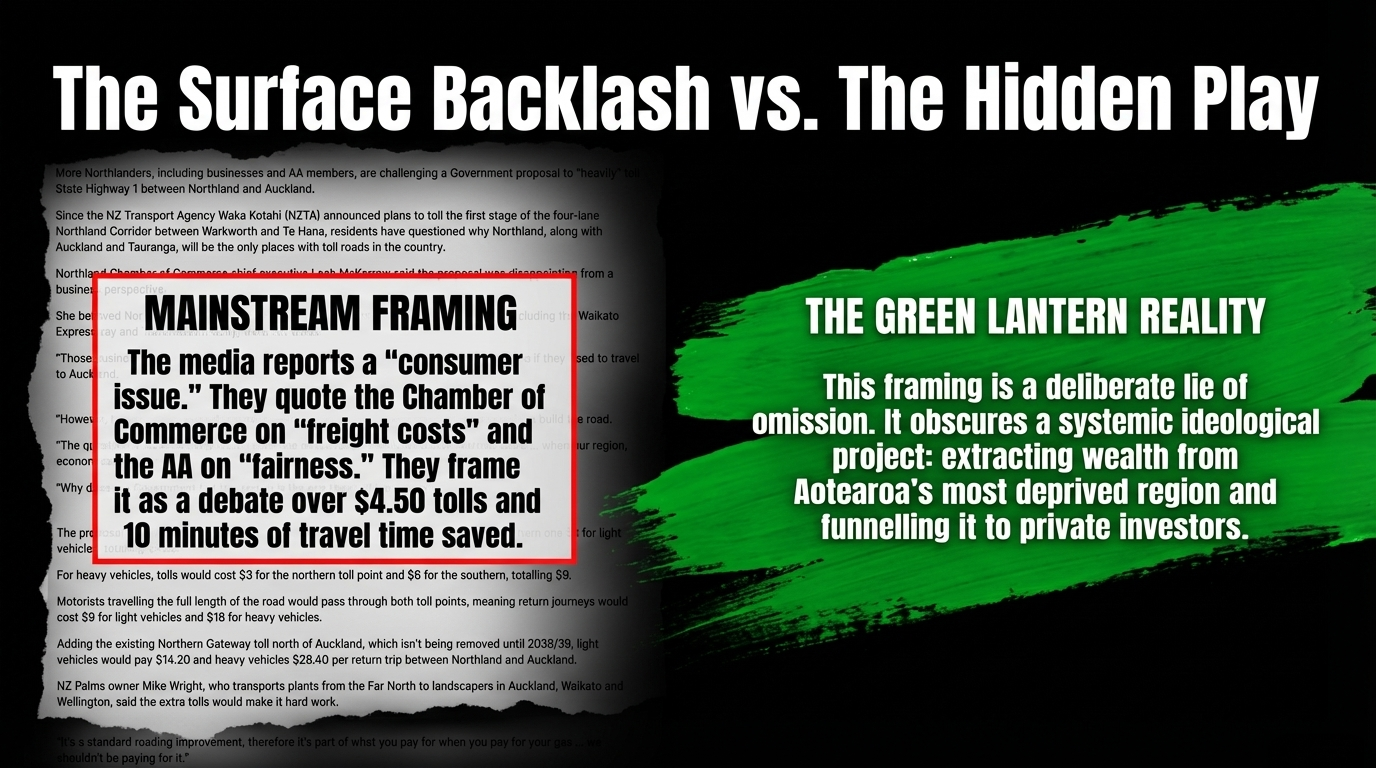
The backlash is growing. Businesses are furious. The AA is pushing back. As reported by the NZ Herald, Northlanders — including AA members — are challenging the Government's proposal to heavily toll State Highway 1 between Northland and Auckland. The coverage frames it as a consumer issue. A story about petrol prices and commute frustration. Relatable. Manageable. Safe.
That framing is a deliberate lie of omission — and every media outlet that reproduces it without digging deeper is complicit.
 Jenny Ling
This is not a transport story. This is a story about a Government that has looked at the most deprived region in Aotearoa — a region where Māori make up a plurality of the population, where unemployment among tangata whenua runs at 20%, where people die nine years younger than their Pākehā neighbours — and decided the right response is to build a road through it, toll it, and funnel the revenue to private investors. Possibly offshore ones.
The architect of this scheme is Infrastructure and Transport Minister Chris Bishop. He is not making mistakes. He is executing a plan. And until we name it clearly — as the ideological project of a neoliberal, structurally racist government — we will keep losing ground, tollpoint by tollpoint.
The Deep Dive Podcast
Listen to a lively conversation between two hosts, unpacking and connecting topics in the sources of this essay.
So let us trace it. Dollar by dollar. Decision by decision. Name by name.
The Arithmetic of Dispossession
Let us begin with the numbers, because the numbers are devastating.
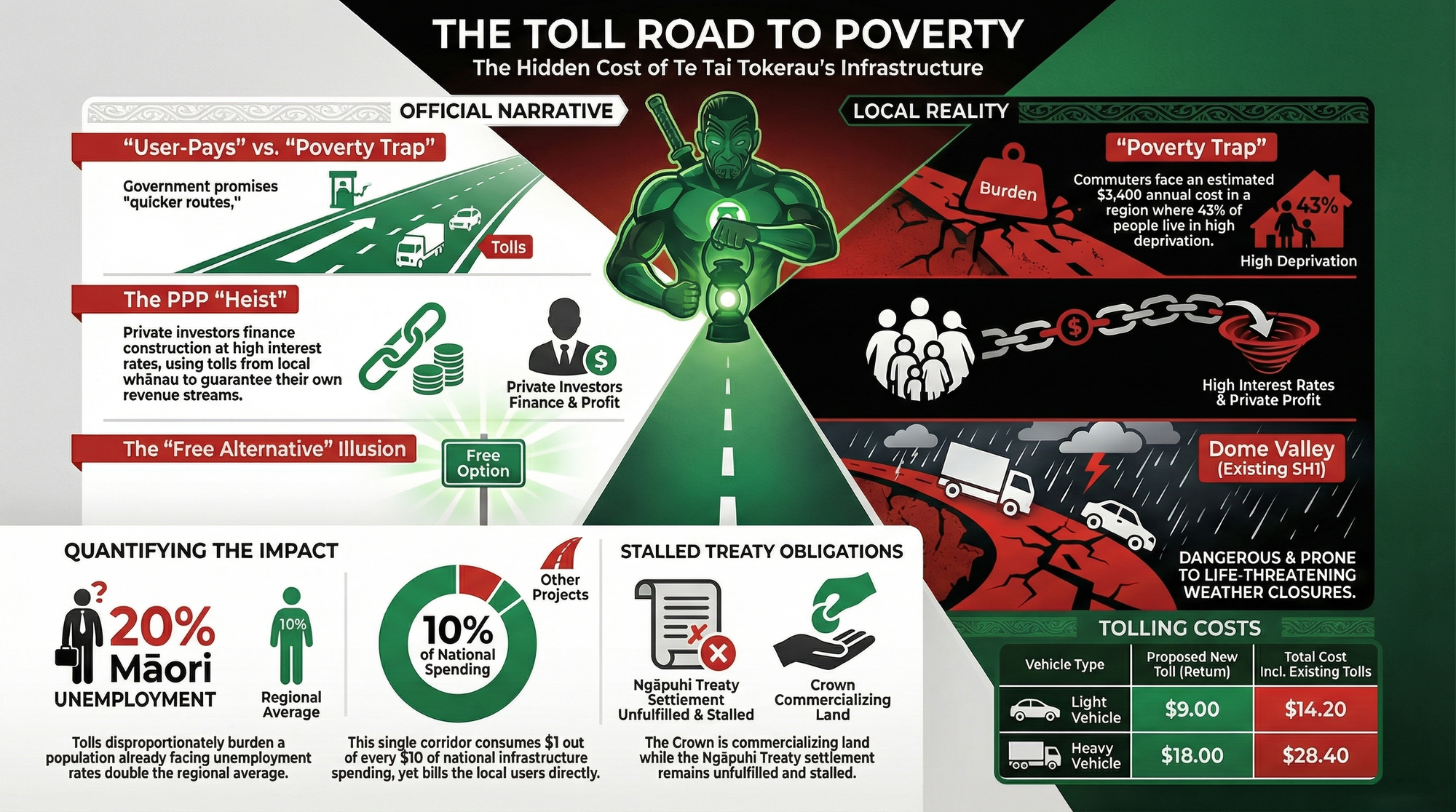
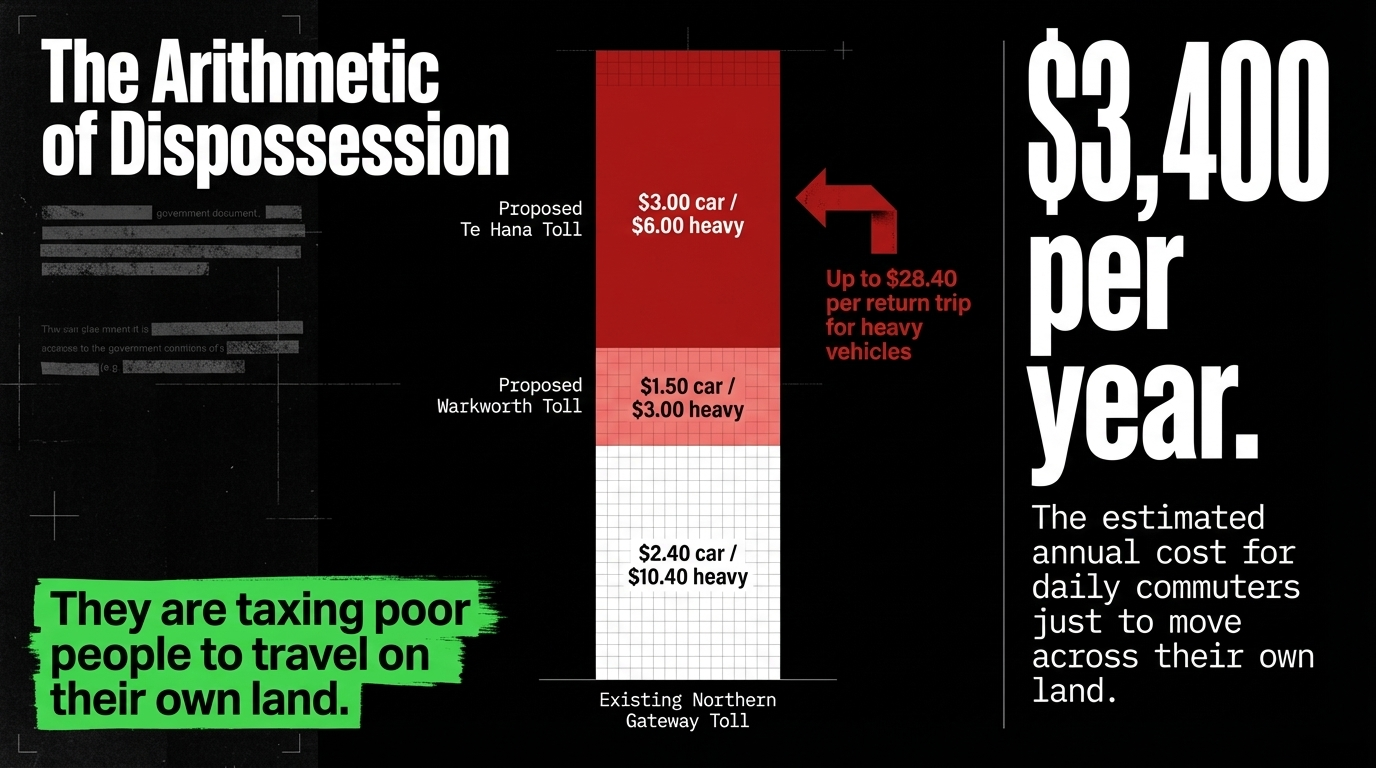
NZTA Waka Kotahi is seeking public feedback on a proposal to toll the 26km stretch of the Northland Corridor between Warkworth and Te Hana, known as Ara Tūhono. As confirmed on the NZTA Warkworth to Te Hana tolling consultation page, the proposed toll is $4.50 for light vehicles and $9.00 for heavy vehicles — split across two toll points.
But this Government's appetite for tolling does not stop there. There is already a toll on the Northern Gateway section from Orewa to Pūhoi — $2.40 each way per car, totalling $10.40 return for heavy vehicles, as documented in NZTA's archived Pūhoi to Warkworth consultation. Stack the proposed Warkworth-to-Te Hana toll on top and the National Road Carriers Association has done the arithmetic: as reported by Newstalk ZB, combined toll costs could reach approximately $28.40 per return trip for heavy vehicles travelling between Pūhoi and Te Hana.
For daily commuters, as RNZ reports, that adds up to approximately $3,400 per year — just in tolls — just to get to work.
This Government is taxing poor people to travel on their own land. That is not infrastructure policy. That is extortion dressed in hi-vis.
Te Tai Tokerau: A Region Bled Dry and Then Billed for It
Te Tai Tokerau is not an abstraction on a map. It is the home of Ngāpuhi — the largest iwi in Aotearoa. It is the land where the Crown signed Te Tiriti o Waitangi in 1840 and immediately began violating it. And in 2026, that same Crown is building a toll road through it and calling it development.
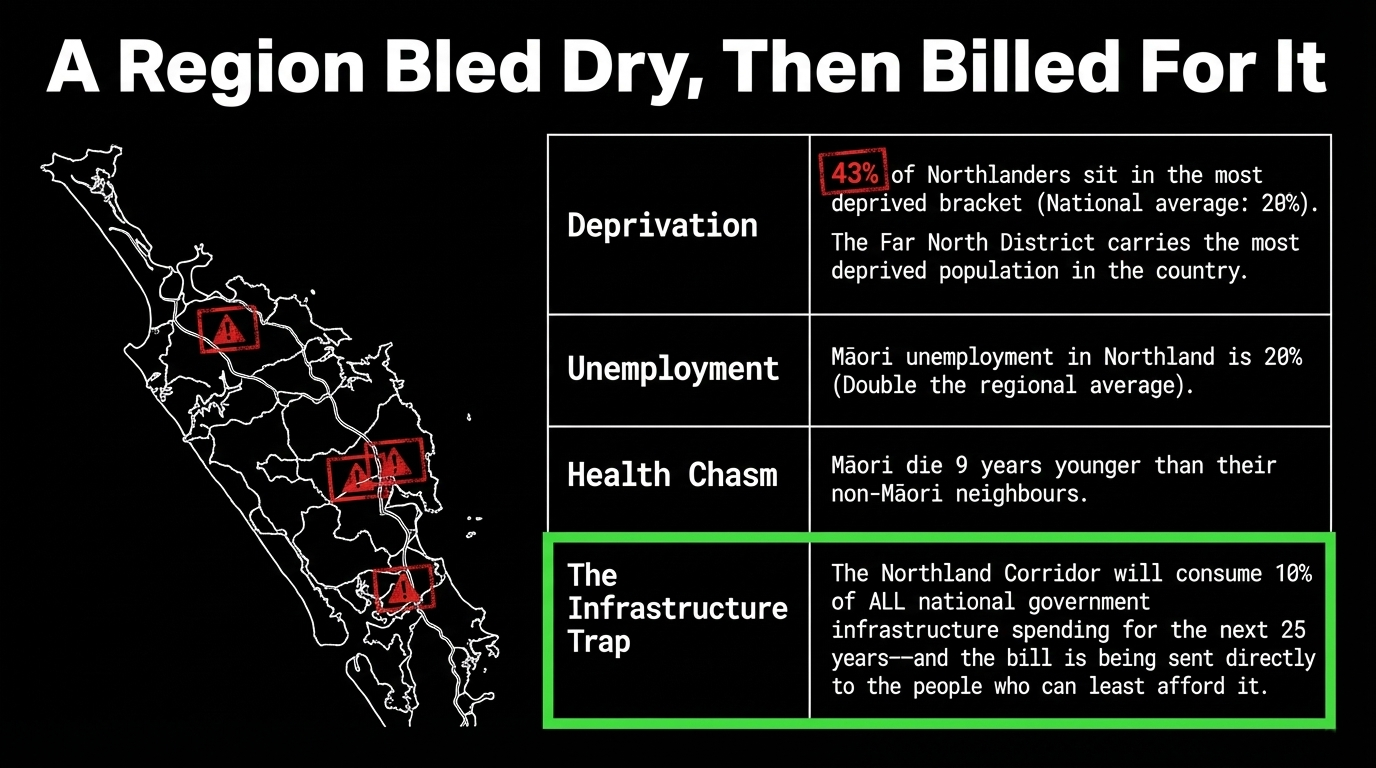
According to Te Ara — the Encyclopedia of New Zealand, 43% of Northlanders sit in the most deprived band of the national deprivation index — more than twice the national rate of 20%. The Far North District, the most Māori part of Northland, carries the most deprived population of any local authority in the entire country. Research by Foundation North tracked Māori unemployment in Northland at 20% — double the regional average.
Māori in Northland die nine years younger than their non-Māori neighbours, per Te Ara. When Māori in Northland are admitted to hospital, they are on average 13 years younger than non-Māori patients. That is not a gap. That is a chasm carved by a century and a half of deliberate Crown policy.
And now this Government — the same Government that has gutted Māori health services, rolled back Treaty principles, and cancelled te reo programmes — wants to toll those same people to use the only road that connects them to jobs, hospitals, schools, and whānau.
As reported by the NZ Herald, the Northland Corridor will consume one dollar in every ten of all government infrastructure spending over the next 25 years. One road. Ten percent. For a region of 200,000 people — and the bill will be sent directly to the people who can least afford to pay it.
The PPP Trap: The Crown's Gift to Private Capital
Here is the machinery. Read it carefully, because this is what they do not teach in civics class.
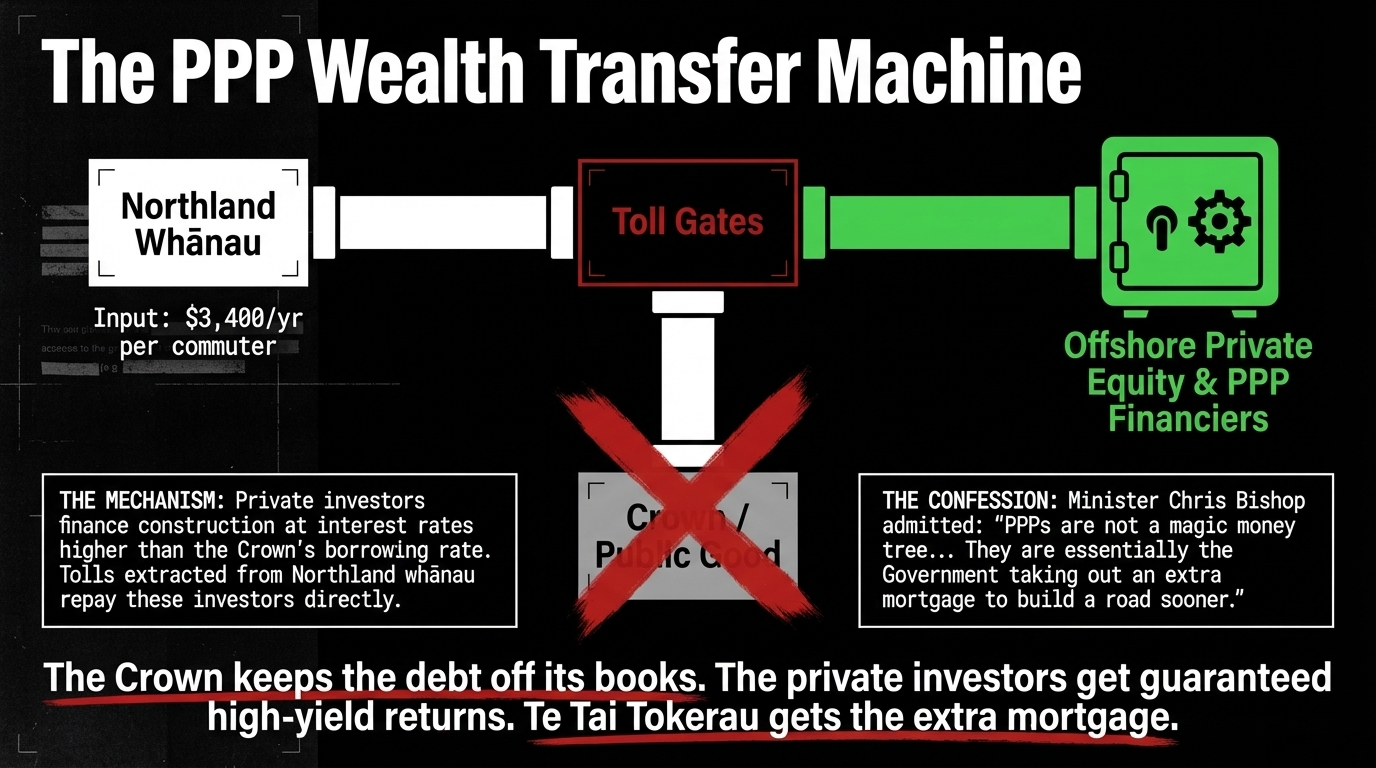
The Warkworth to Te Hana motorway is being delivered as a Public Private Partnership. As NZTA's own project page states without shame: "Any tolling revenue will contribute to the annual amount we need to pay the PPP following the opening of the motorway."
Let that land.
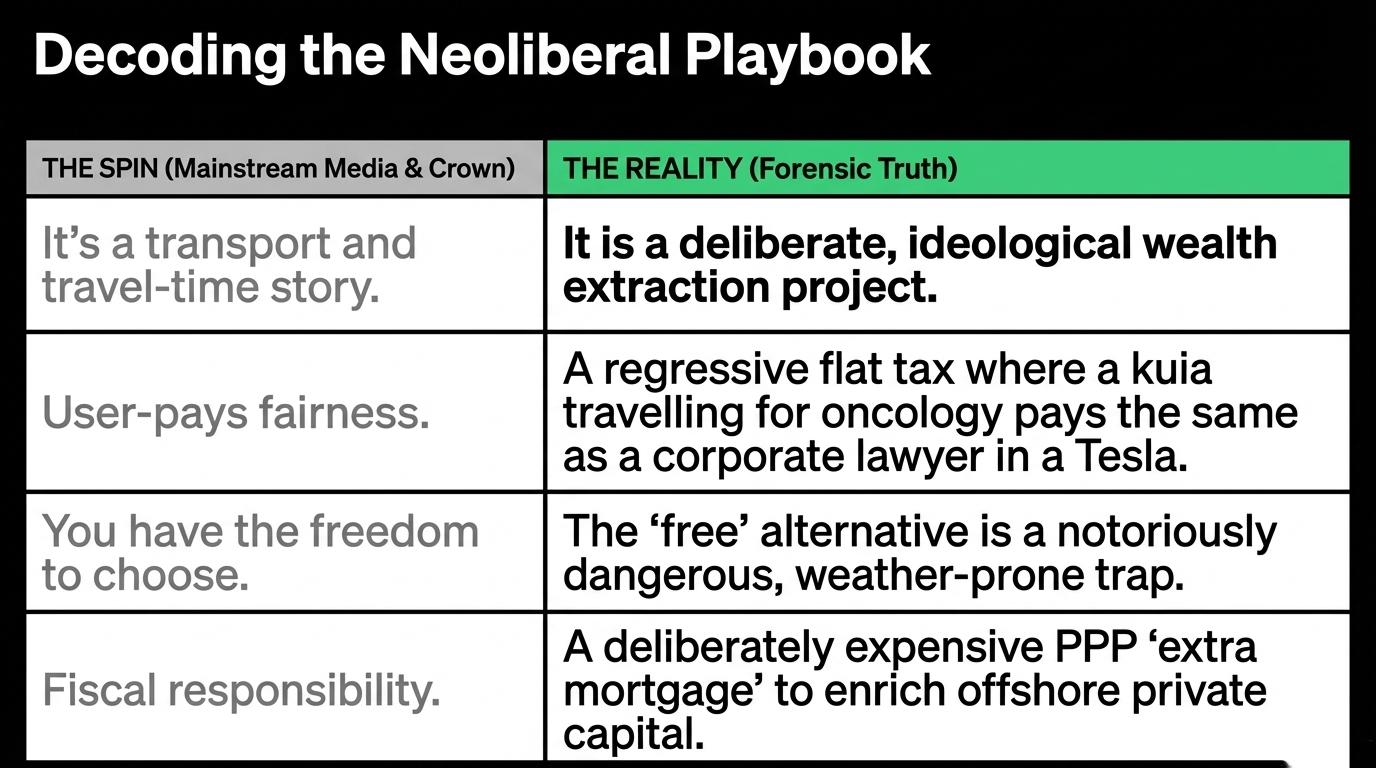
Private investors — not the Crown — finance the construction. They charge interest rates higher than the Government's own borrowing rate. The toll revenue extracted from Northland whānau — including Māori whānau in the most deprived region of the country — is then used to repay those investors. The Crown keeps the debt off its books. The investors get a guaranteed revenue stream. The people of Te Tai Tokerau get a toll gate.
Greater Auckland's analysis strips away the spin with forensic precision: "Modern PPPs are essentially just a more expensive way of financing a project that allows a government to pretend the costs aren't directly on their books… we'll end up paying significantly more for the project over the life of the loan."
More expensive. For the public. Cheaper looking. For the Minister.
In July 2024, Cabinet agreed in-principle to use this model for all three sections of the Northland Corridor, as confirmed in the Ministry of Transport's own PPP procurement document. All three sections. Every kilometre. Every tollpoint.
And here is the part that should make every New Zealander incandescent with rage: Bishop knows this model costs more. He admitted it himself. As Greater Auckland reported in November 2025, the Minister said: "PPPs are not a magic money tree. They are a procurement tool, that's all. They are essentially the Government taking out an extra mortgage to build a road sooner."
An extra mortgage. Paid by the poorest people in New Zealand. To private investors.
That is not governance. That is a heist.
The Architect: Chris Bishop's Class Project
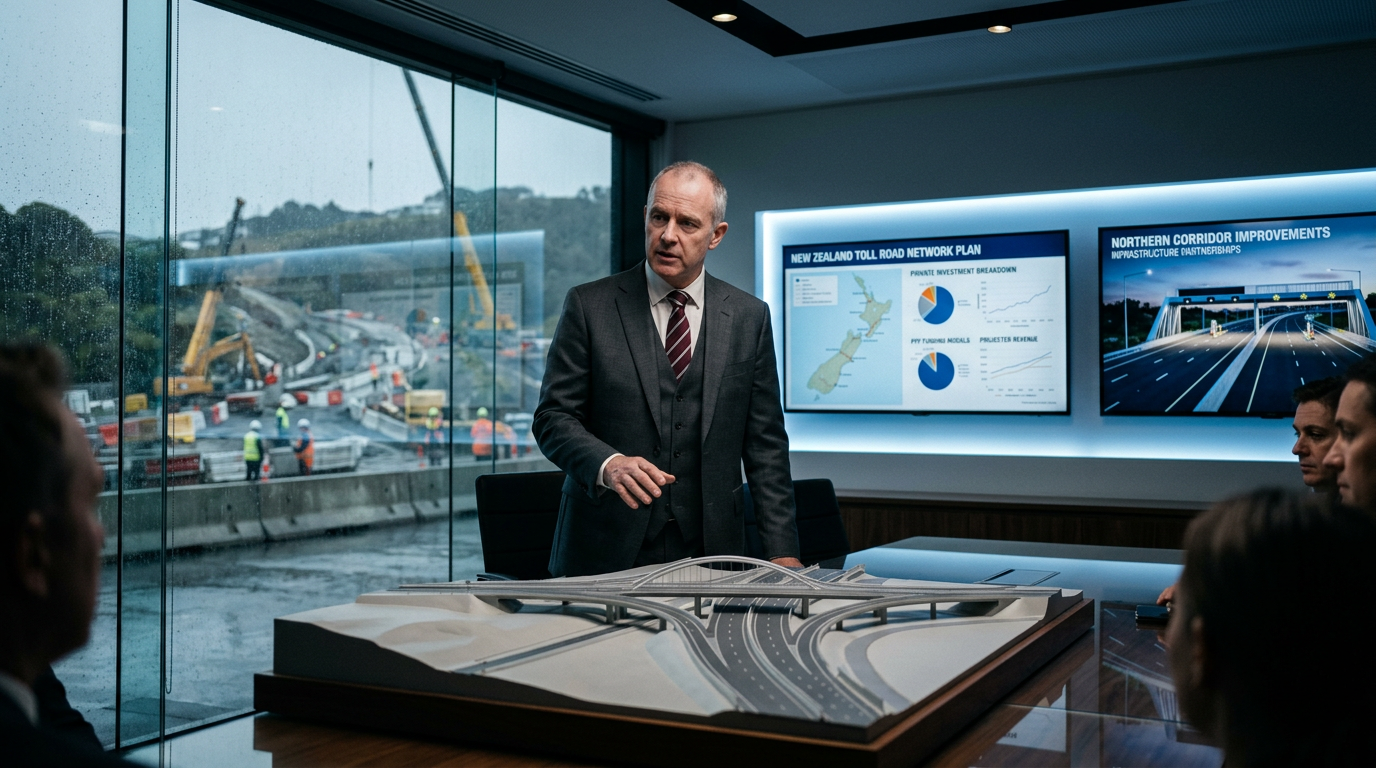
Do not let anyone pretend this is accidental. Do not let anyone call it pragmatic. This is ideology — the deliberate, systematic privatisation of public infrastructure dressed up in the language of fiscal responsibility and user-pays fairness.
In June 2024, as reported by interest.co.nz, Chris Bishop announced that all new Roads of National Significance would be toll roads, stating: "Our expectation is that every significant infrastructure project that seeks support from the Crown will consider opportunities for user-pays funding and private financing."
Every. Significant. Project.
Before taking the Infrastructure portfolio, Bishop campaigned on creating a national infrastructure agency specifically to attract domestic and offshore investors and expand PPPs — as covered by the NZ Herald. In November 2025, he introduced the Land Transport (Revenue) Amendment Bill — locking user-pays infrastructure permanently into New Zealand law, as announced on the National Party website.
What Bishop calls "a fairer, simpler, and more modern transport funding system" is a transfer of infrastructure costs from progressive general taxation — where the wealthy pay proportionally more — to flat per-use tolls, where a Māori kuia in Kaikohe driving to an oncology appointment pays the same rate as a corporate lawyer in a company Tesla.
It is not fair. It is not modern. It is regressive. And it targets — with mathematical precision — the communities this Government has already stripped of every other resource.
The "Free Alternative" That Will Kill You
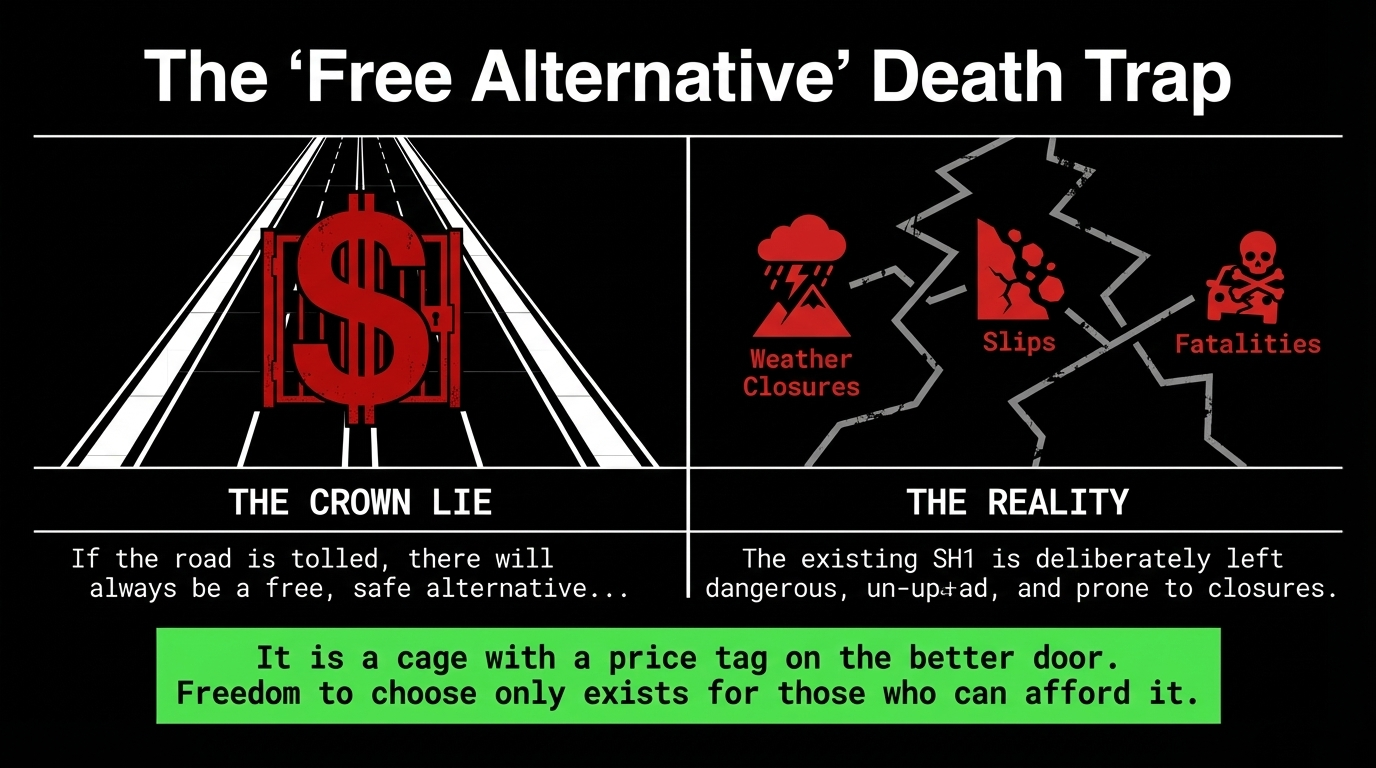
The Government's standing lie on tolling is this: there will always be a free alternative. As NZTA's archived Pūhoi to Warkworth consultation stated: "If the road is tolled, there will always be a free, safe alternative for people who don't want to pay the toll because the current State Highway 1 will remain operational."
The existing SH1 through the Dome Valley is, as Greater Auckland documents, notoriously dangerous — subject to weather closures, slips, and conditions that injure and kill. It is not being upgraded. The Government is not making it safer. It is being left dangerous, deliberately, so it can be labelled a "free option" while the safe road carries a toll.
This is a choice architecture designed by people who have never needed to choose between paying a toll and risking their lives on a dangerous road — because they have never been poor enough to face that choice.
They call it freedom. It is a cage with a price tag on the better door.
Waka Kotahi and the Theatre of Māori Inclusion
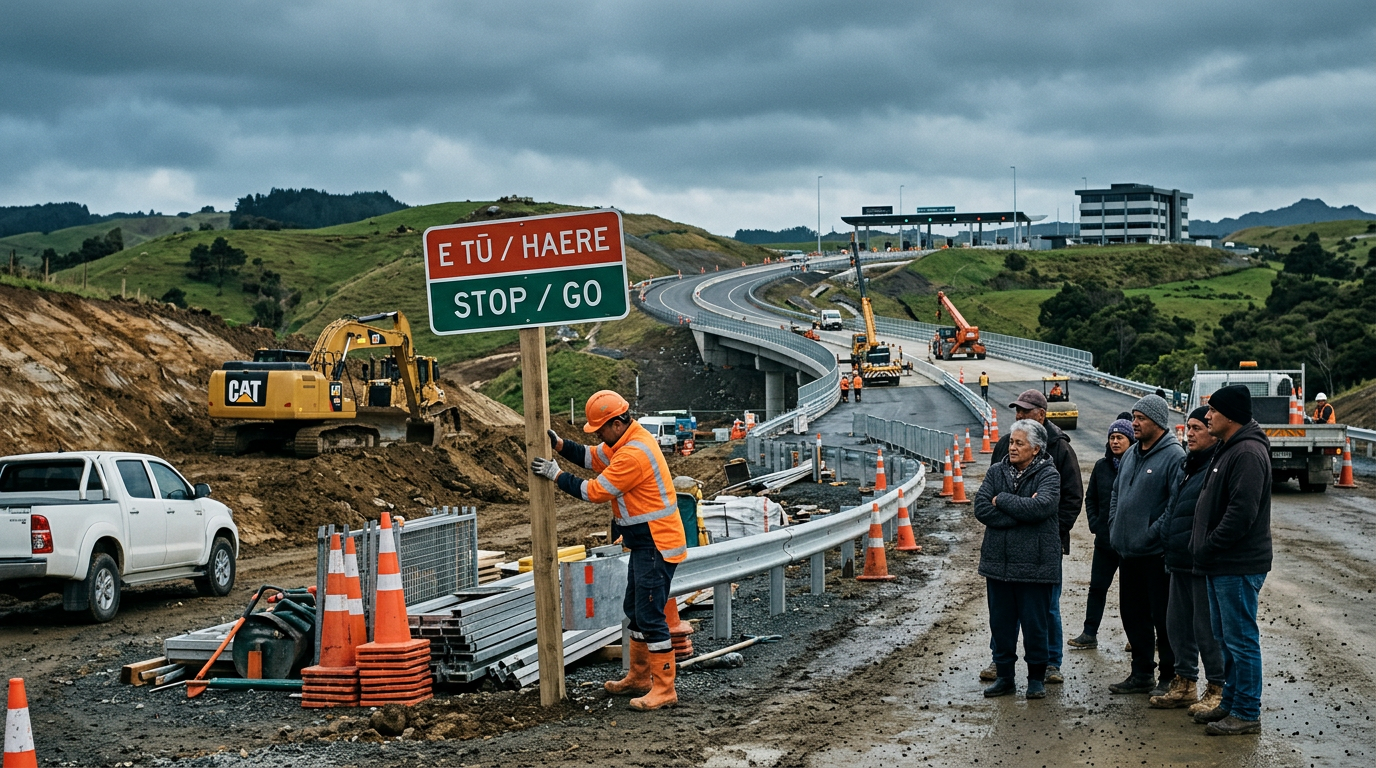
While this Government builds its toll architecture on the rohe of Northland iwi, its own transport agency has been demonstrating in real time exactly what it thinks of Māori.
In May 2025, as reported by Te Ao Māori News, Waka Kotahi ordered the removal of te reo Māori stop-go signs — reading "Taihoa" and "Haere" — from roadworks in Ngāti Kahungunu territory, after a single "frustrated" driver complained. Ngāti Kahungunu chair Bayden Barber said it plainly: "This is not about rules — it's about racism."
The agency that cannot tolerate Māori words on a roadside sign has no difficulty tolling Māori off their own land.
Meanwhile, as RNZ confirms, Ngāpuhi's Treaty settlement — with the largest iwi in Aotearoa, on the very land this corridor traverses — remains stalled. The Crown has not honoured its obligations to Ngāpuhi. But it is building infrastructure on Ngāpuhi land, tolling Ngāpuhi people to use it, and directing the revenue to private investors.
The Public Works Act — the colonial instrument that has facilitated the compulsory acquisition of Māori land for infrastructure throughout New Zealand's history, as analysed by Simpson Grierson — is the legal mechanism underpinning this entire project.
The Crown builds on Māori land. Charges Māori to use it. Pays private investors from the proceeds. And calls it progress.
They have been doing this since 1840. They have just got better at the paperwork.
Five Hidden Connections the Media Is Too Comfortable to Report
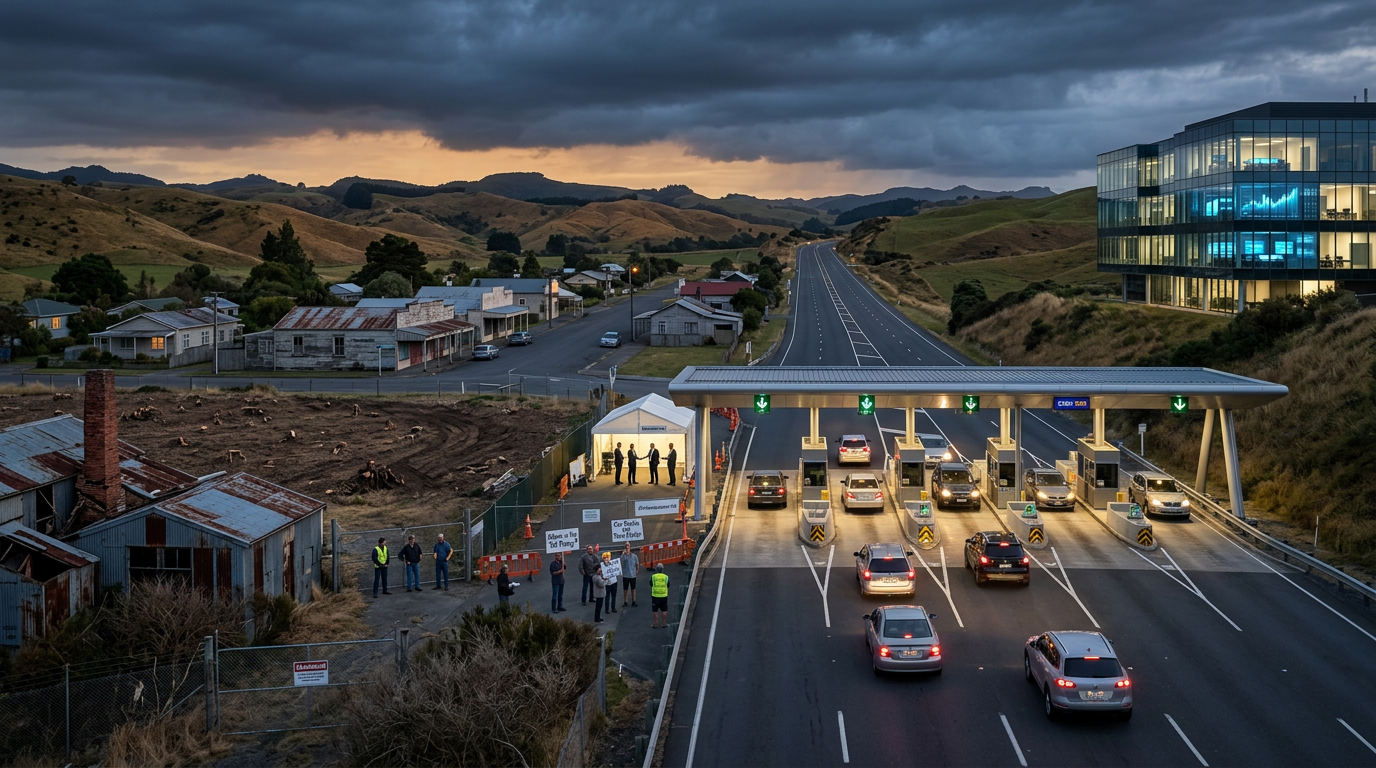
Connection 1: Toll revenue does not stay in Northland. It services a PPP debt owed to private financiers. As the Ministry of Transport's own procurement document makes clear, the economic development justification for this road is completely decoupled from the financial flows it generates. Northland is the product, not the beneficiary.
Connection 2: The 1980s and 1990s neoliberal restructuring — when SOEs were privatised, forestry was sold, and Māori workers were disproportionately thrown into unemployment — created the poverty in Te Tai Tokerau that exists today, as documented by Te Ara. This toll road is not new policy. It is the same policy in new tarseal.
Connection 3: In 2021, when NZTA proposed tolling the Pūhoi to Warkworth motorway, 80% of those impacted opposed it and the then-Transport Minister declined — as reported by the NZ Herald. This Government is proposing those same rejected tolls again — stacking them on top of new ones. The public said no. The Government did not care.
Connection 4: A Select Committee-commissioned NZIER report raised serious doubts about the cost-benefit case for the Expressway, prompting concerns from two opposition parties that a future government could cancel the project — as covered by the NZ Herald. The rush to sign PPP contracts before the next election is a deliberate strategy to make this irreversible regardless of what voters decide.
Connection 5: Government procurement for the PPP was opened in March 2025, as reported by the NZ Herald, with offshore investors eligible to bid. The entity that will profit from Northland whānau paying $3,400 a year in tolls may not be a New Zealand company. It may not even be in the same hemisphere.
Quantifying the Harm
- 43% of Northlanders are in the most deprived band of the national deprivation index versus 20% nationally, per Te Ara.
- 20% Māori unemployment in Northland, per Foundation North.
- $3,400 per year estimated annual toll cost per daily commuter, per RNZ.
- $28.40 per return trip for heavy vehicles travelling Pūhoi to Te Hana, per Newstalk ZB.
- 10% of all national infrastructure spending for 25 years locked into this one corridor, per the NZ Herald.
- A project that Greater Auckland estimates will cost New Zealanders significantly more under PPP financing than direct Crown borrowing — with the excess flowing straight to private capital.
This Government looked at all of that data and decided the answer was a toll road. That is not a policy failure. That is a policy choice. Know the difference.
The Tikanga Lens: Ahi Kā and the Right Not to Be Taxed Off Your Own Land
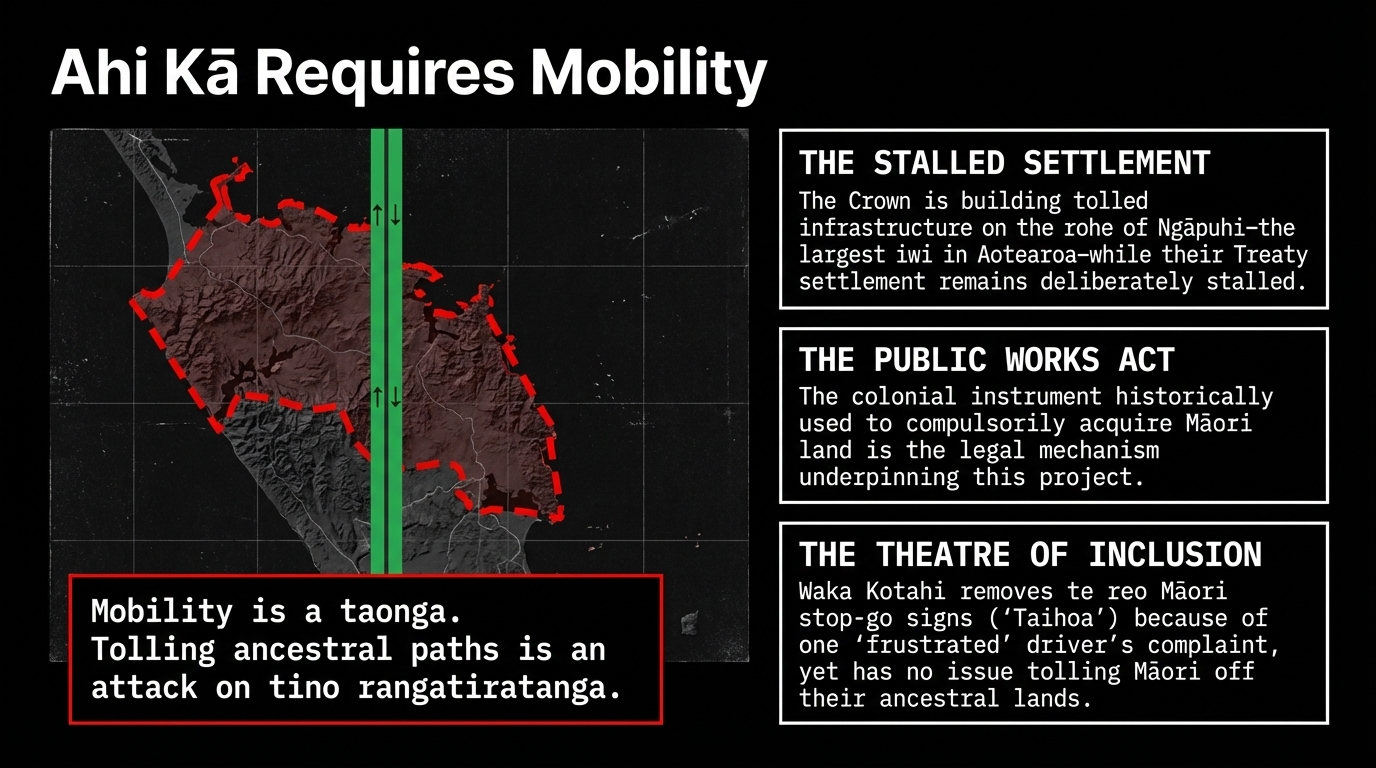
Te Tiriti o Waitangi Article Two guarantees tino rangatiratanga — the unqualified exercise of chieftainship over taonga. Mobility is a taonga. The ability of a kuia in Kaikohe to drive to Auckland without paying a toll to a private investor is not a consumer preference. It is an expression of rangatiratanga.
Ahi kā — keeping the home fires burning — requires physical presence on the land. Physical presence requires movement. A toll road through the heart of Ngāpuhi's rohe is not a development project. It is a mechanism of separation: Māori from their land, whānau from each other, the region from any prospect of genuine economic sovereignty.
The Waitangi Tribunal has found repeatedly that Crown infrastructure decisions disproportionately harm Māori. This decision is not a new pattern. It is the continuation of a very old and very deliberate one.
What Rangatiratanga Looks Like Here
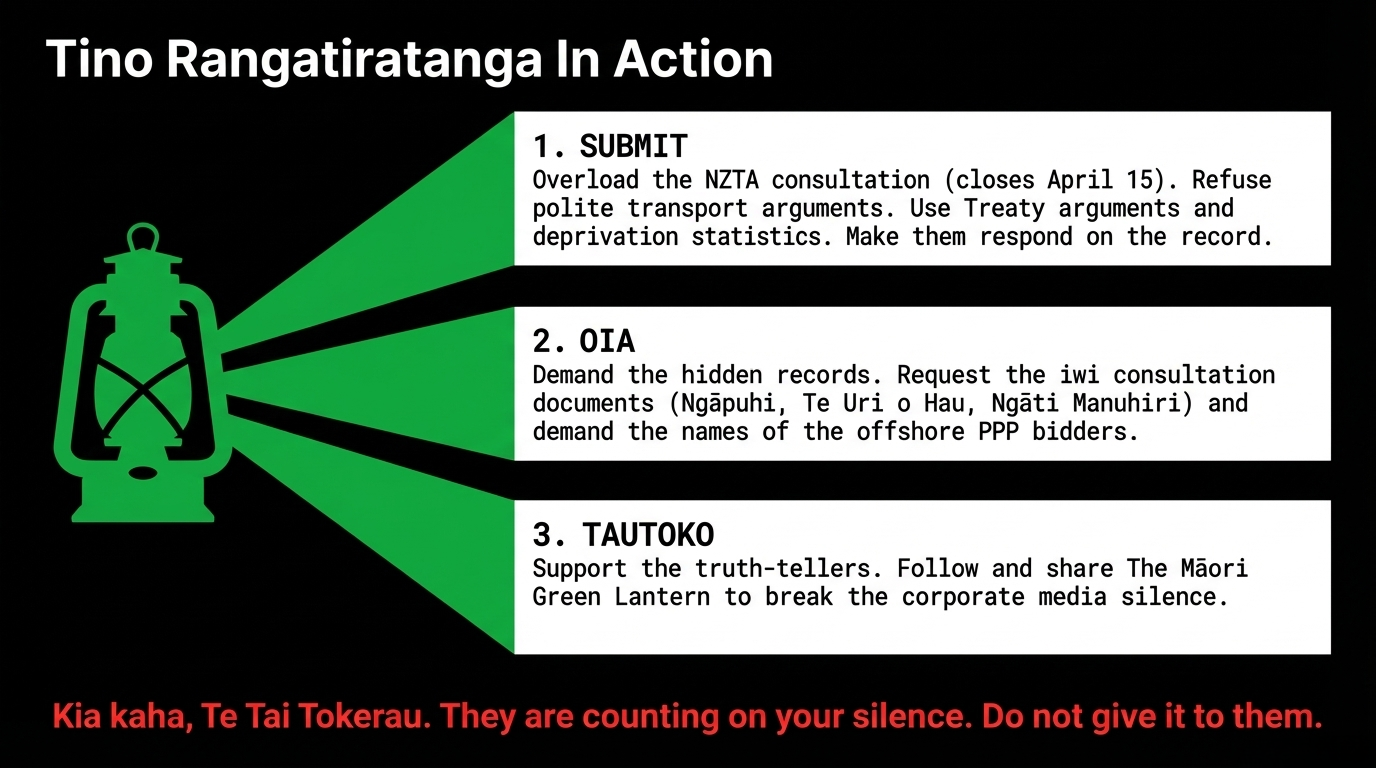
Whānau, they are counting on your exhaustion. They are counting on you being too busy surviving to resist. Do not give them that.
- Submit. NZTA's consultation on the Warkworth to Te Hana tolling proposal is open. Do not submit politely. Submit with Treaty arguments, deprivation statistics, and te ao Māori frameworks they cannot dismiss. Make them respond on the record.
- OIA the iwi consultation records. Records of consultation with Ngāpuhi, Te Uri o Hau, Ngāti Manuhiri, and Ngāti Whātua must exist under NZTA's own obligations. Request them. Scrutinise them. Publish what you find.
- Name the PPP bidders. When NZTA announces the preferred PPP delivery agent, find out who they are, where they are registered, and who their investors are. The public has a right — and a need — to know who is about to profit from this.
- Link this to Ngāpuhi's Treaty settlement. The Government claims it honours the Treaty while building tolled infrastructure on unsettled Ngāpuhi whenua. As RNZ confirms, that settlement remains stalled. Name the contradiction everywhere you can.
- Amplify Northland businesses. As reported by the NZ Herald, freight operators and local businesses are already pushing back. Their interests are not identical to ours — but their opposition exposes the economic incoherence of this scheme in terms the political centre cannot ignore.
He Kōrero Whakamutunga
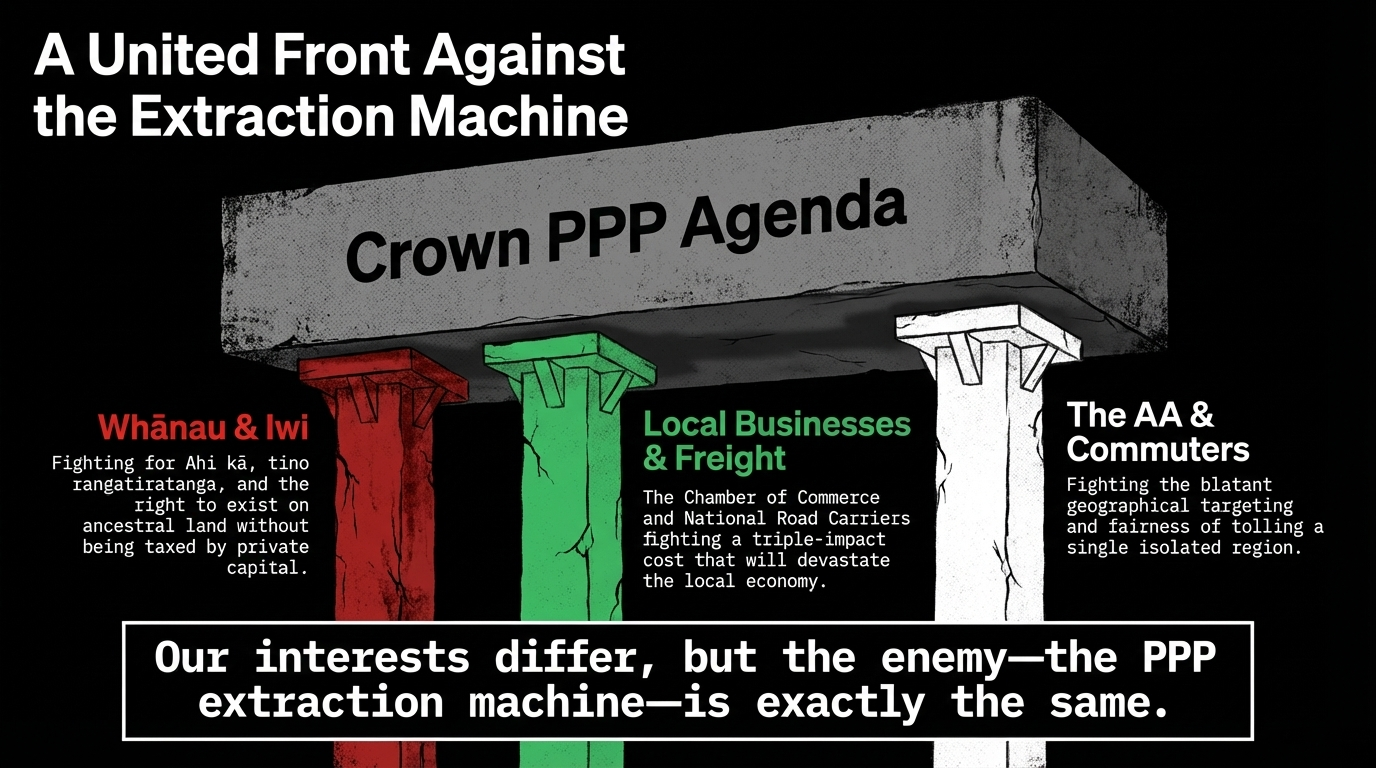
The taiaha does not lie.
Chris Bishop has constructed a toll-and-PPP machine that strips wealth from the poorest region in Aotearoa and delivers it to private investors who bear none of the social cost and carry none of the whakapapa. He has enshrined this machine in legislation. He has rushed procurement to make it irreversible before an election. He has done all of this while the Crown's Treaty obligations to Ngāpuhi — on the very land he is commercialising — remain unpaid and unfulfilled.
This Government called itself the defender of ordinary New Zealanders. Then it designed a system where ordinary New Zealanders in the most deprived region of the country pay $3,400 a year in tolls, and every dollar leaves the community entirely.
They are not building a road for Te Tai Tokerau. They are building a revenue mechanism through Te Tai Tokerau. The distinction is everything.
We see it. We name it. We will not whisper about it.
Kia kaha, Te Tai Tokerau. Ko tātou tēnei.
Tautoko Mai — Support This Mahi
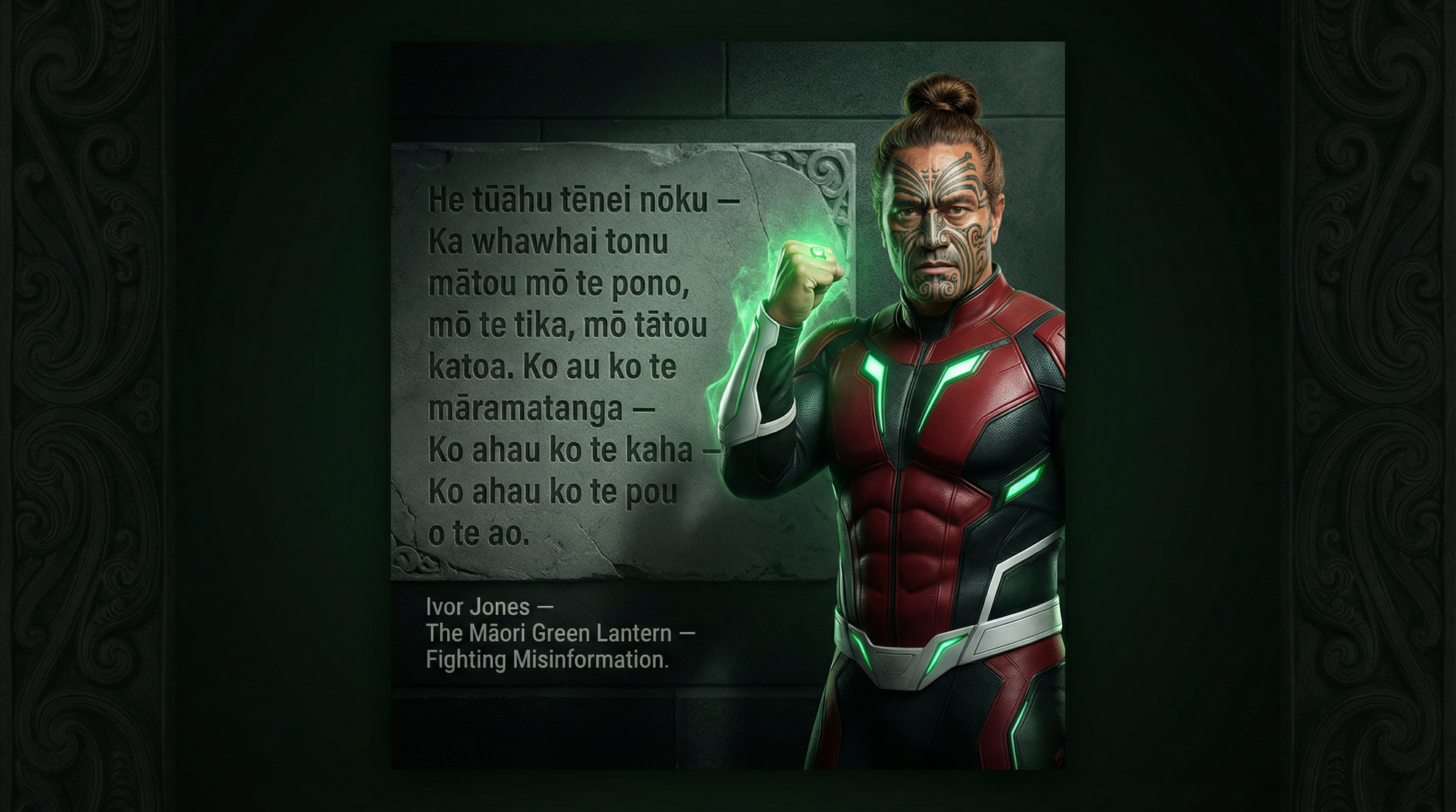
The Crown is building a toll road through the most deprived region in Aotearoa and handing the profits to private investors. It will not fund anyone to expose that. The corporate media will not fund anyone to expose that. That is why this mahi exists — and why it depends on you.
Every koha signals that whānau are done waiting for Crown accountability that will never come. It signals that rangatiratanga includes the power to fund our own truth tellers — so that the next time a Minister tries to toll Māori off their own ancestral roads, someone is watching, and someone is writing.
If you cannot koha right now — no worries. Subscribe, follow, kōrero, and share with your whānau and friends. That act of spreading the word is koha. Every share means one more person who cannot be gaslit about what is happening in Te Tai Tokerau.
Three pathways exist:
👉 Koha directly: Support the Māori Green Lantern
👉 Subscribe and stay connected: themaorigreenlantern.maori.nz
👉 Direct bank transfer: HTDM — 03-1546-0415173-000
Kia kaha, whānau. Stay vigilant. Stay connected. They are counting on your silence. Do not give it to them.
Research conducted 6 April 2026. Tools used: live web search, URL verification, NZTA official documents, parliamentary records, Te Ara Encyclopedia, Greater Auckland analysis, NZ Herald, RNZ, Newstalk ZB, Foundation North, Simpson Grierson, Te Ao Māori News, interest.co.nz, and the Ministry of Transport. All links verified at time of publication.