"TE KAIWHAKAWĀ PARAU: The Anointing of the Crusher" - 14 February 2026
How a White Supremacist Coalition Gifted Its Most Loyal Servant a Golden Parachute — And Poisoned the Well of Law Reform for a Generation

Kia ora whānau. Ko Ivor Jones ahau, ko te Māori Green Lantern.
He aha te mahi a te rangatira? He whakatira i te iwi.
What is the work of a chief? To weave the people together.
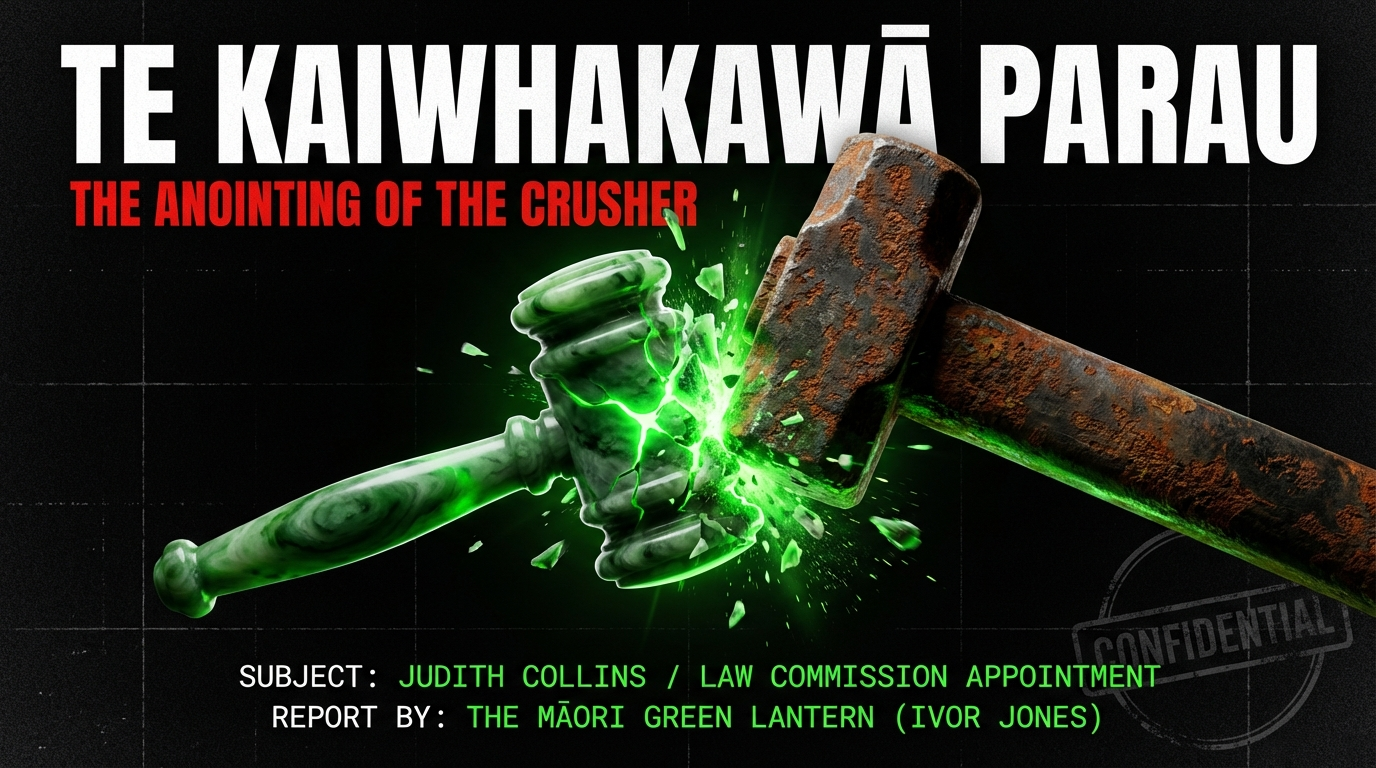
What is the work of this government? To unweave every thread — and hand the loom to their mates.
TE KARANGA: The Hidden Whakapapa of This Appointment
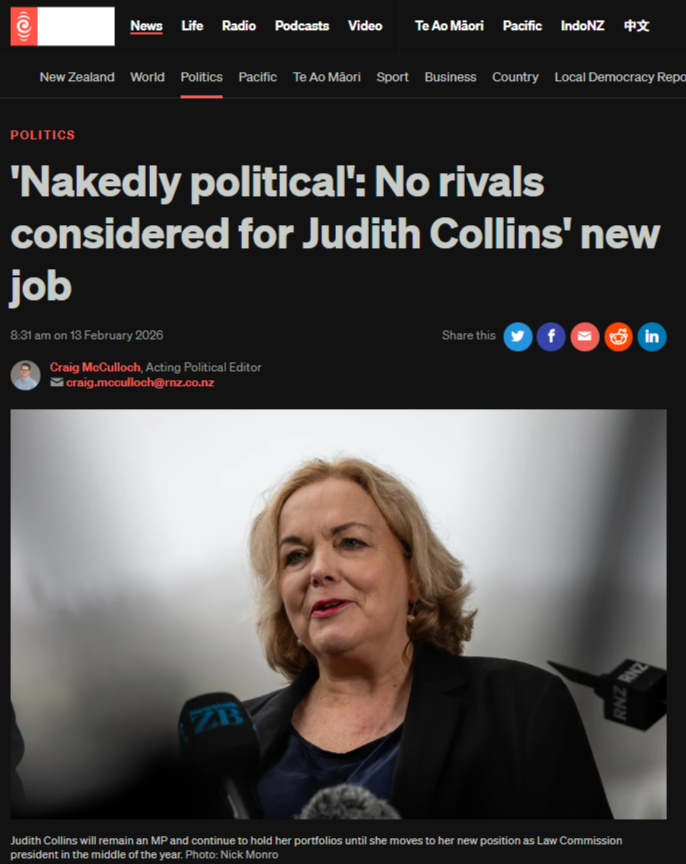
When RNZ revealed on 13 February 2026 that Judith Collins was the only person considered for the presidency of Te Aka Matua o te Ture — the New Zealand Law Commission — every kaitiaki of justice in this country should have felt the ground shudder beneath their feet.
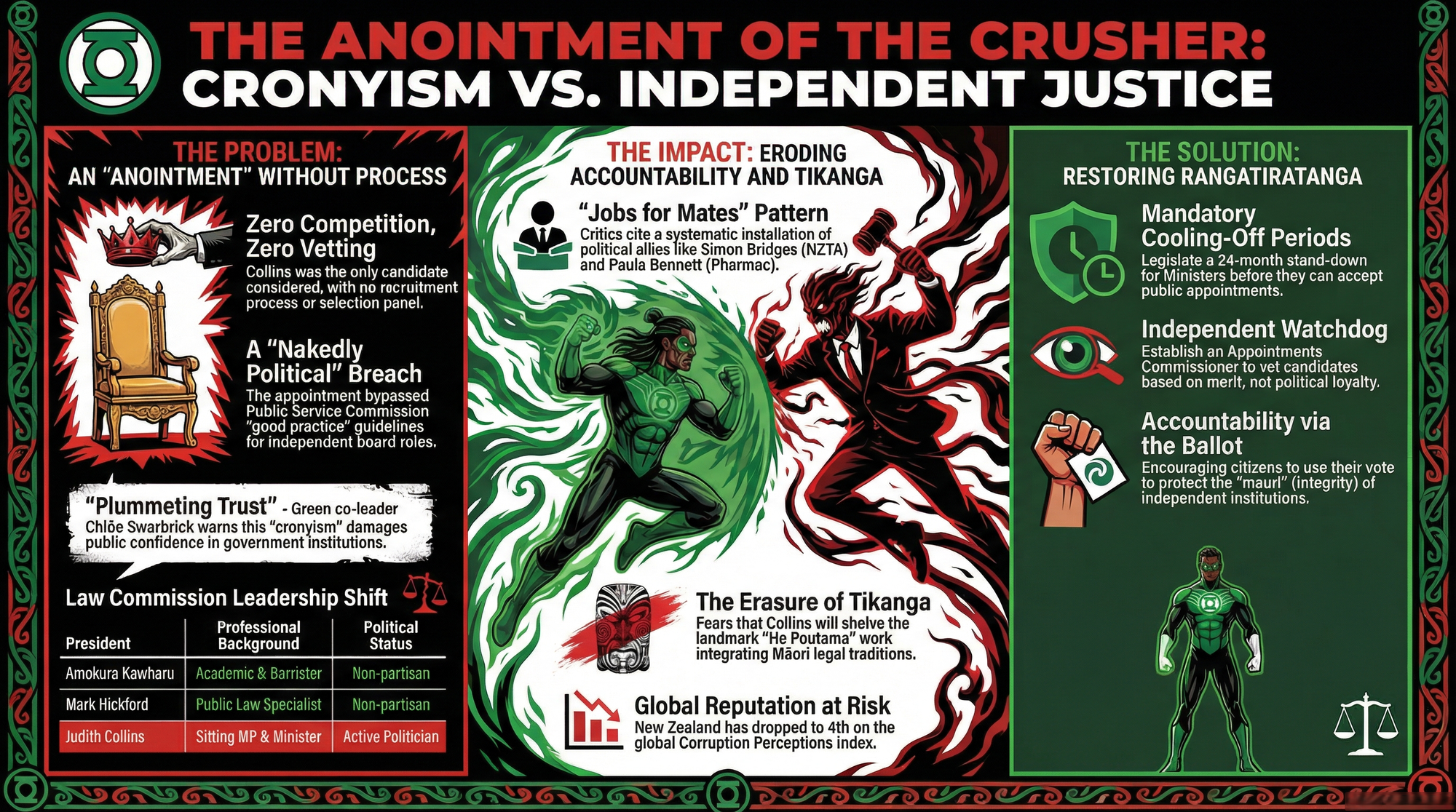
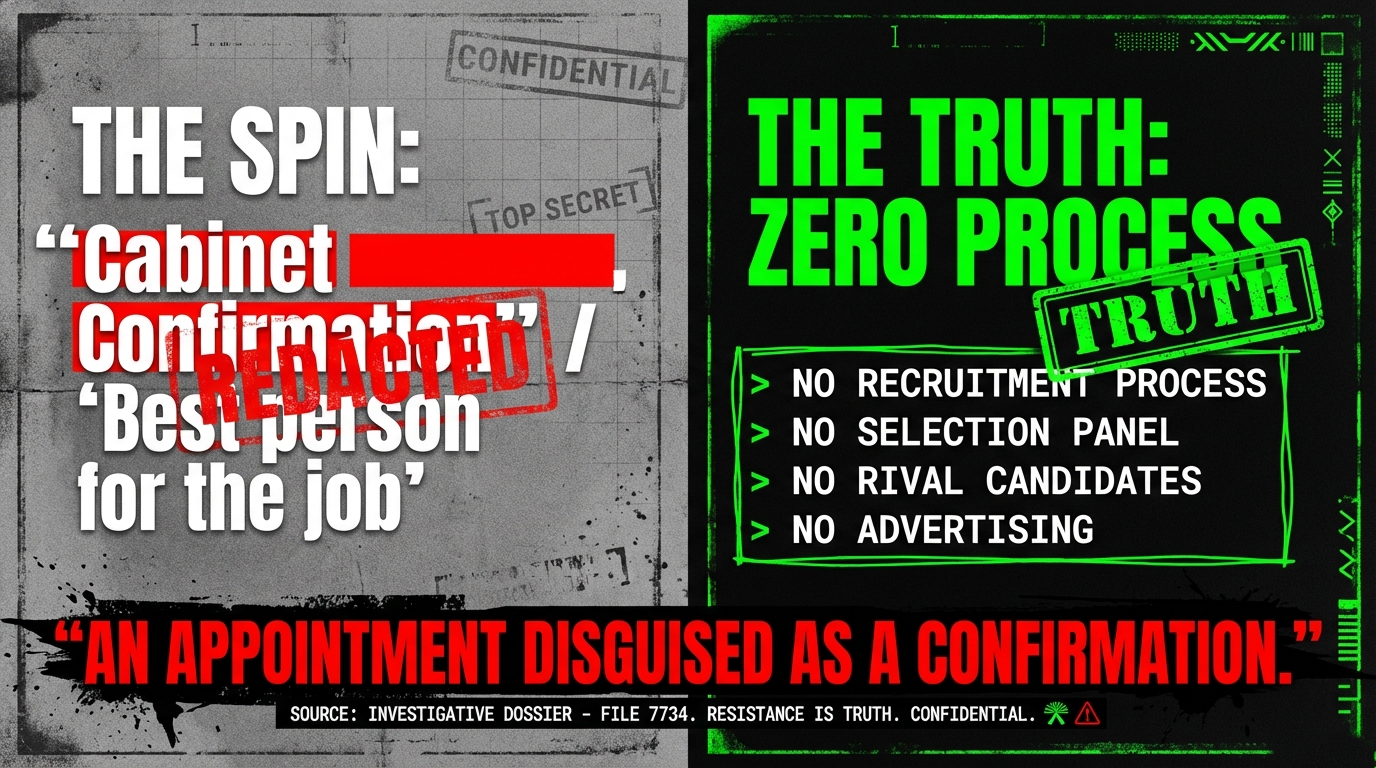
No recruitment process. No selection panel. No rival candidates. No advertising. Not even the pretence of due diligence. Just a quiet "Cabinet confirmation" — the political equivalent of a whānau meeting where only one person was invited, and they'd already written the minutes.
This is not an appointment. It is an anointment. It is the political equivalent of a tohunga placing a korowai on the wrong shoulders — not because the recipient earned it, but because they served the chief long enough to be owed a debt. In te ao Māori, we have a word for this kind of transaction: hē — wrong, mistaken, corrupt.
Green co-leader Chlöe Swarbrick named it precisely: "These independent processes are set up to protect against cronyism and corruption," she told RNZ. "How on earth can we possibly say that somebody was appointed because they were the best person for the job, when there was a decision to not even consider anybody else for that job?"
How indeed.
University of Otago law professor Andrew Geddis did not mince words either. The appointment, he told RNZ, looked "nakedly political." He added: "I don't think it's conspiracy thinking to say that the government has chosen to reward one of its long-standing loyal servants with this role."
And political commentator Bryce Edwards went further, writing that this marks "the first time in the Law Commission's 40-year history that a current serving politician has been appointed to lead this supposedly independent institution by their own government" — as reported by elocal/Democracy Project.
Let the record show: Judith Collins walked from the Cabinet table — where she sat as Attorney-General holding seven portfolios — directly into the chair of the body tasked with independently reviewing the very laws her government created. No cooling-off period. No competitive process. No accountability.
In tikanga Māori, this would be like a rangatira appointing their own whānau member as kaitiaki of the sacred grove, with no korero, no hui, no mandate from the people. The mauri of the institution — its life force, its integrity — is diminished the moment the process is corrupted.
TE PAPA RAUKURA: The Stained Feather — Collins' Record of Controversy
To understand why this appointment is so grotesque, you must understand who has been handed the keys.
Judith Collins' political career reads like a masterclass in surviving scandal through sheer brass neck. As RNZ documented in 2021 over her 20-year career:
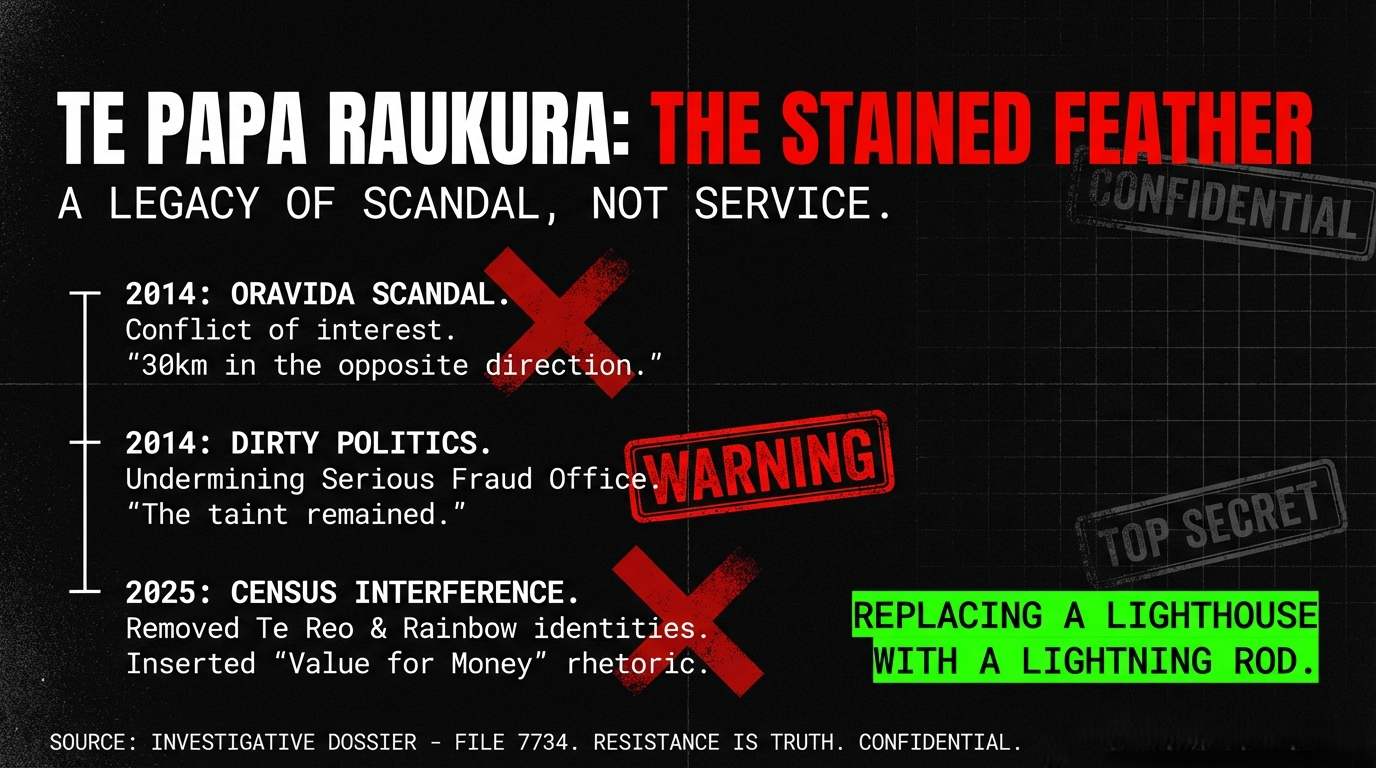
- Oravida Scandal (2014): Collins visited the Shanghai offices of Oravida — a company of which her husband David Wong-Tung is a director — while on a taxpayer-funded trip. She claimed it was "on the way to the airport." The offices were 30 kilometres in the opposite direction. She received a "final warning" from then-PM John Key. Collins herself later admitted Key "threw me under the bus".
- Dirty Politics (2014): Nicky Hager's book exposed Collins' close relationship with right-wing blogger Cameron Slater and allegations she worked to discredit the head of the Serious Fraud Office, Adam Feeley. She resigned from Cabinet. She was later cleared of the most serious allegations, but as The Spinoff noted, "the taint remained."
- 2020 Election Catastrophe: Collins led National to its second-worst general election result in history — a campaign RNZ described as a "trainwreck". She followed up with accusations of "racist separatism" around the He Puapua report — weaponising anti-Māori sentiment for political survival.
- Public Service Census Interference (2025): As Public Service Minister, Collins' office was closely involved in rewriting the Public Service Commission's sectorwide survey — removing questions about te reo Māori proficiency, rainbow identities, religion, and agencies' commitment to the Māori-Crown relationship. She added questions about whether public servants delivered "value for taxpayers' money." This is not governance. It is cultural vandalism disguised as efficiency.
This is the woman now entrusted with the independent review of New Zealand law. A woman whose political career is defined by scandal survival, anti-Māori dog-whistling, and the relentless pursuit of power.
In te ao Māori, we would say her mana has been diminished by her own actions — not once, but repeatedly. To then place her as kaitiaki of our legal system's reform engine is an act of such breathtaking arrogance that it can only be understood as deliberate provocation.
TE TOKA TŪ MOANA: The Predecessors Collins Replaces
The Law Commission under its previous presidents operated as a genuine lighthouse for legal reform — a toka tū moana, a rock standing in the ocean, steady against the tides of political expedience.
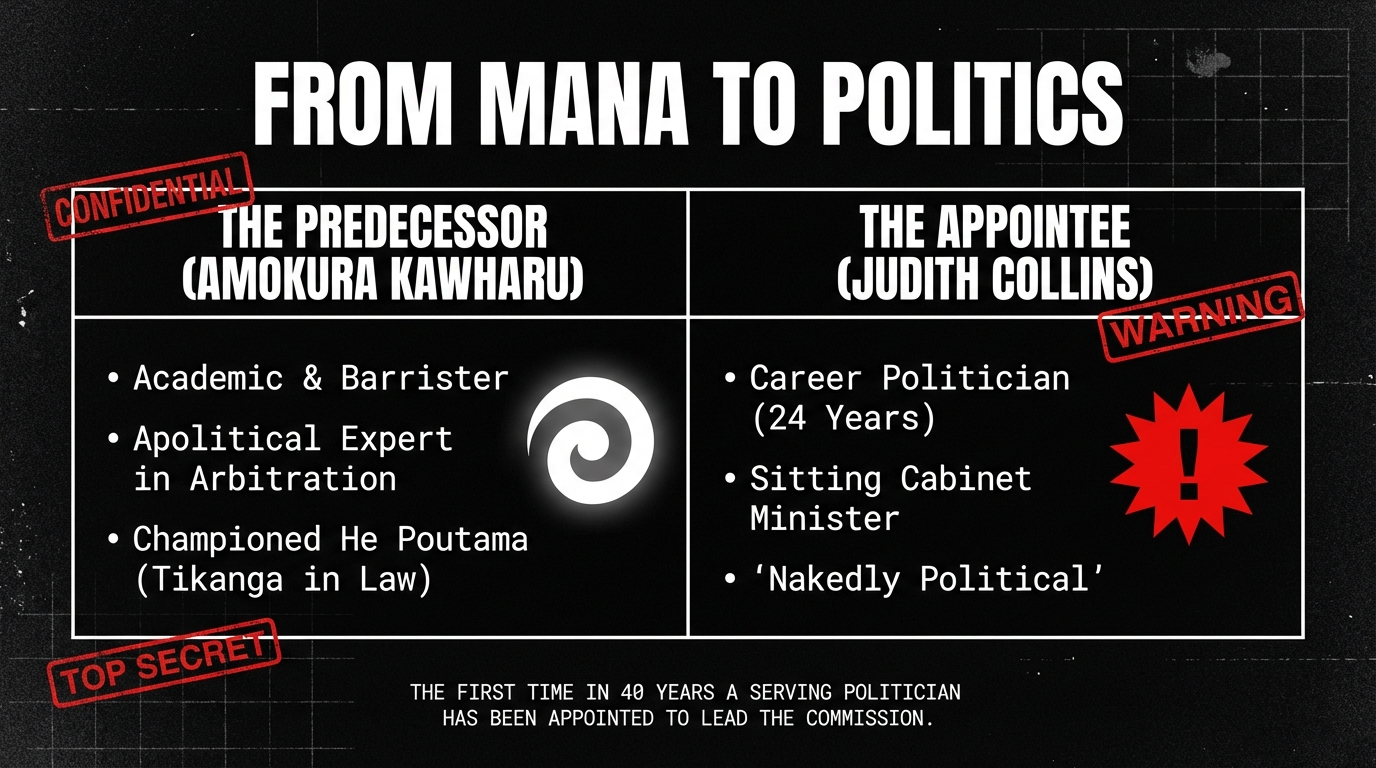
Amokura Kawharu (Ngāpuhi, Ngāti Whātua), appointed in 2020, was the first Māori president of the Law Commission. An academic and barrister with expertise in international arbitration, she oversaw the landmark He Poutama study paper — a nearly 300-page roadmap for the principled integration of tikanga Māori into state law. Her presidency represented the Commission at its finest: scholarly, independent, and committed to honouring the legal traditions of both Te Tiriti partners.
As the Law Commission itself stated, He Poutama was designed to provide "invaluable guidance to lawmakers and others interested in the engagement between tikanga and the law."
Her interim successor, Dr Mark Hickford, was a public law specialist and former senior public servant — appointed in October 2025 with an unusually short six-month term as president, explicitly "pending the confirmation of a new president in the New Year." The fix was in from the start. Hickford was a placeholder. The throne was being warmed for Crusher.
As Bryce Edwards observed: "The previous President of the Law Commission, Amokura Kawharu, has never been in politics. She's an academic and barrister who brought expertise in arbitration and property law. And the current interim president, Mark Hickford, is a public law specialist and former senior public servant, i.e. not a politician. This is the calibre and background the role typically demands: deep expertise, scholarly rigour, and most critically, distance from partisan politics."
Collins offers none of that distance. She was sitting at the Cabinet table last week. She will be reviewing her own government's legislation by mid-year.
TE KŌHANGA KŌRERO: The Pattern of Cronyism — Three Examples for the Western Mind
For those who think this is an isolated incident — a one-off bureaucratic oversight — let me disabuse you with three concrete examples that demonstrate this coalition's systemic corruption of public appointments, and their impact measured in both human harm and violations of tikanga.
Example 1: Paul Goldsmith's Unlawful Human Rights Appointments
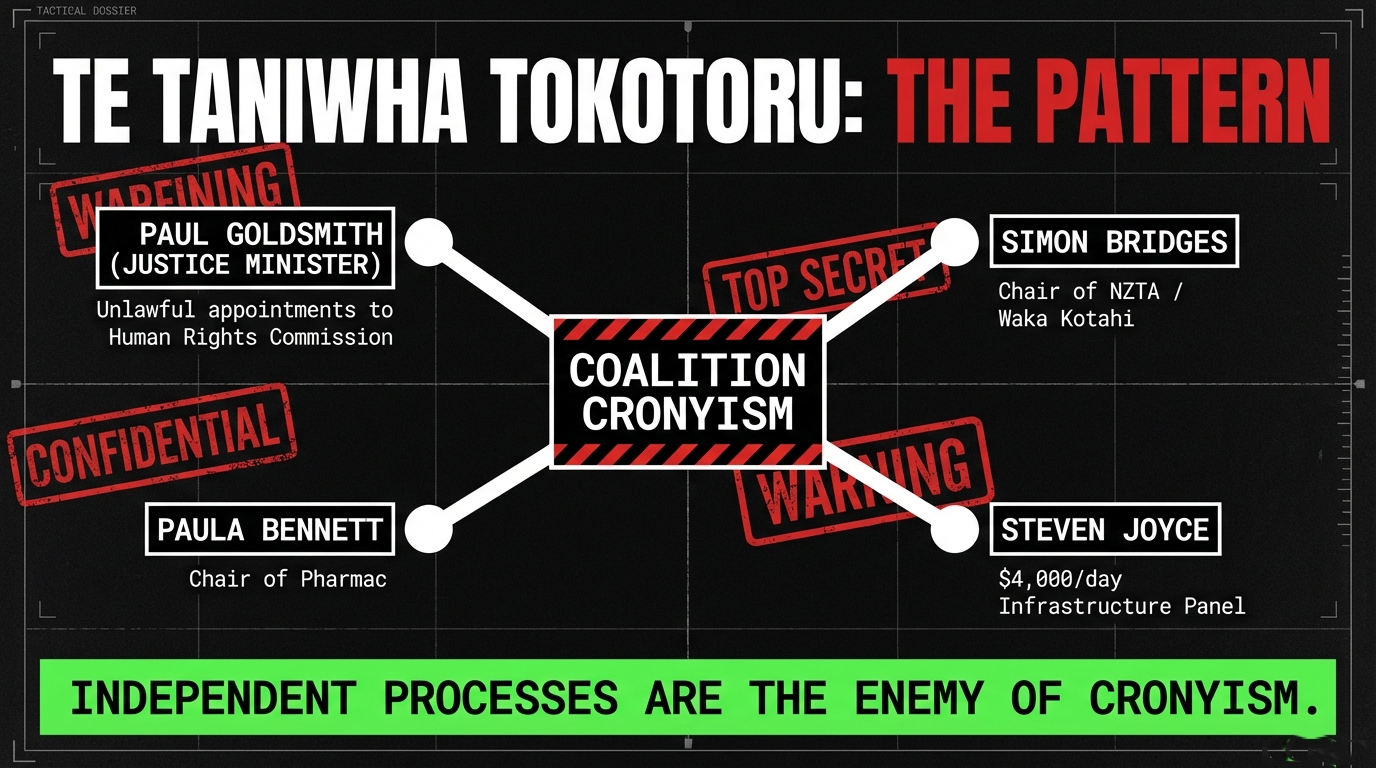
The same minister responsible for Collins' appointment — Justice Minister Paul Goldsmith — was ruled by the High Court in December 2025 to have unlawfully appointed both Human Rights Commissioner Stephen Rainbow and Race Relations Commissioner Melissa Derby.
Justice David Gendall found Goldsmith "failed to apply the correct legal test" and "failed to take into account mandatory considerations." Neither Rainbow nor Derby were on the original shortlist. Rainbow was described as "not recommended" by the independent panel, which included former Court of Appeal judge Sir Terence Arnold and former Attorney-General Christopher Finlayson KC. Goldsmith shoehorned them in after "discussions with coalition partners" — Rainbow was suggested by ACT.
Quantified Harm: New Zealand's human rights watchdog — the body tasked with protecting the rights of Māori, rainbow communities, disabled people, and all marginalised groups — is now led by people the independent experts said were not suitable for the job. Trust in the institution has been demolished. The Human Rights Commission exists to protect the most vulnerable. When its leaders are installed through a crony stitch-up, the most vulnerable pay the price.
Tikanga Impact: In tikanga Māori, mana is earned through service, not bestowed through political favour. The principle of mana tangata — the inherent dignity and authority of all people — is violated when the institution designed to protect human dignity is itself corrupted. The concept of tika (correctness, justice) demands that appointments follow proper process. Goldsmith violated tika, and the High Court confirmed it.
Example 2: The "Jobs for Mates" Revolving Door
As The Integrity Institute documented, this coalition has systematically installed political allies across New Zealand's public institutions:
- Simon Bridges (former National leader): Chair of NZTA/Waka Kotahi (March 2024)
- Paula Bennett (former Deputy PM): Chair of Pharmac (April 2024)
- Steven Joyce (former Finance Minister): Infrastructure advisory panel at $4,000 per day
- Sir Bill English (former PM): Kāinga Ora review — whose findings were used to sack the entire board, replacing experienced housing professionals with National Party loyalists.
Quantified Harm: New Zealand's ranking on the global Corruption Perceptions Index has slipped, dropping to 4th place worldwide after decades of being first. When public institutions are captured by political cronies, service delivery degrades. Ousted Kāinga Ora board member Philippa Howden-Chapman called the government's approach "sheer folly, wanton folly" — warning it would slow housing delivery for low-income families, who are disproportionately Māori.
Tikanga Impact: The principle of kaitiakitanga — guardianship, stewardship — demands that those entrusted with public institutions serve the collective good, not their own whānau of political allies. When Bridges chairs transport, Bennett chairs medicine purchasing, Joyce collects $4,000 a day, and Collins takes the Law Commission, the entire apparatus of public service has been transformed into a spoils system — an approach New Zealand tried to abolish in 1912 when it created an independent Public Service Commissioner specifically "to end political cronyism and jobs for the boys."
Example 3: The Systematic Erasure of Tikanga from Law
Collins' appointment must be understood in the context of what the Law Commission has been doing — and what it now won't.
Under Amokura Kawharu's leadership, the Law Commission produced He Poutama — the most comprehensive study ever undertaken on how tikanga Māori interacts with state law. The paper affirmed that tikanga is "a system of law" with "enforceable rights and interests" and provided frameworks for courts, lawyers, and policymakers.
Now consider what Collins represents. This is the minister who removed te reo Māori questions from the Public Service Census. The politician who weaponised accusations of "racist separatism" around He Puapua. The leader of a coalition that has abolished Te Aka Whai Ora, removed Treaty principles from legislation, cut Māori language programmes, and — through Deputy PM Winston Peters — compared co-governance to "apartheid and Nazi racial theory".
Quantified Harm: The He Poutama study took years and engaged pūkenga (experts), judicial leaders, and constitutional scholars across the motu. Under Collins, there is every reason to expect the Law Commission will quietly shelve tikanga-related work, redirect resources to "law and order" reform, and ensure no further progress is made on integrating mātauranga Māori into the legal system. The harm is generational: a window of legal recognition for tikanga — opened by decades of advocacy — slammed shut by a political appointee.
Tikanga Impact: As Te Ara records, "The law in New Zealand until 1840 was tikanga Māori and Māori customary law — the customs and methods of governance by which Māori society was ordered." The Law Commission's tikanga work represented a historic reconciliation — state law finally beginning to acknowledge the legal system it displaced. Collins' appointment signals that this reconciliation is over. The principle of whanaungatanga — the centrality of relationships, of connection, of reciprocity — is violated when the institution designed to bridge two legal traditions is handed to someone who has spent her career undermining one of them.
TE KŌWHAO O TE NGIRA: The Eye of the Needle — The Process That Wasn't
Let us be forensic about what happened.
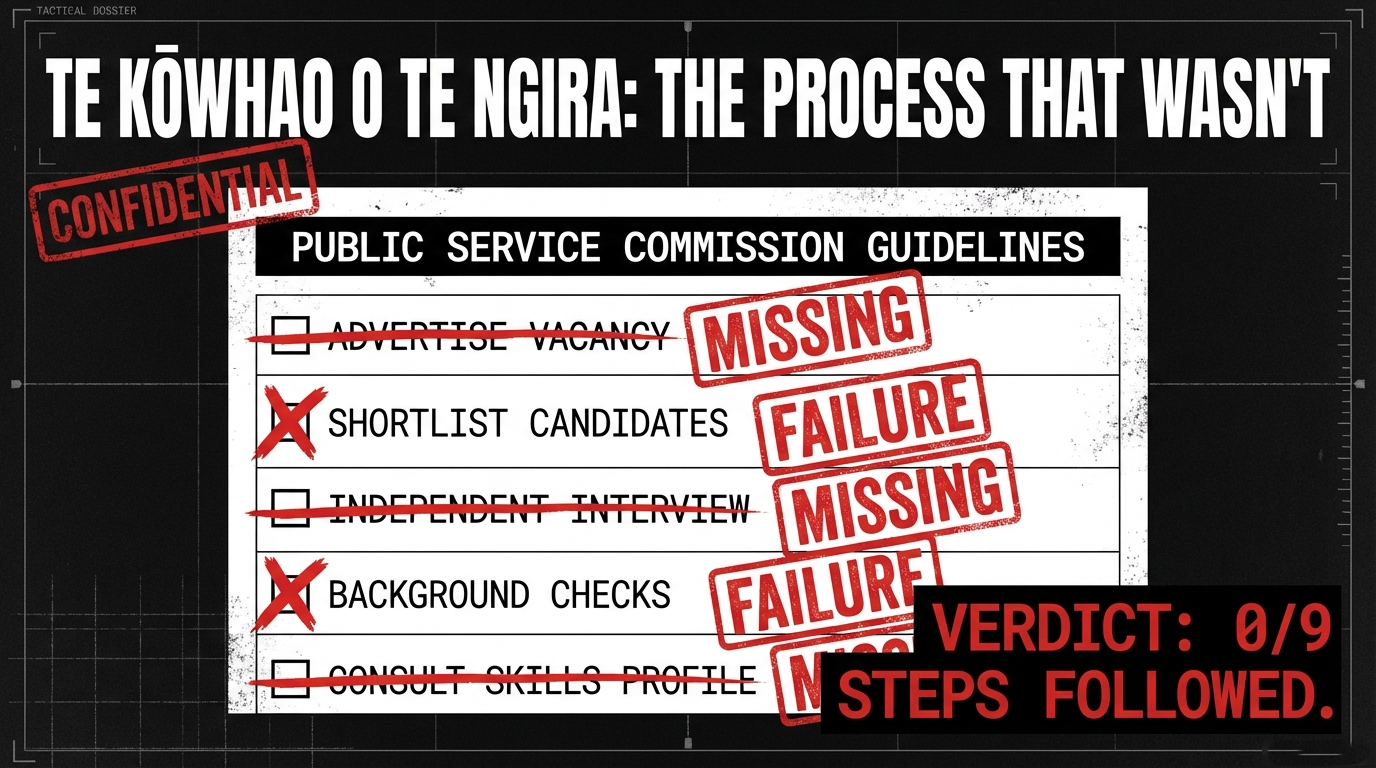
The Public Service Commission's Board Appointment and Induction Guidelines — the document Cabinet's own rules say should guide appointments like this — lay out a crystal-clear process:
- Identify the vacancy and plan the appointment
- Confirm the board skills profile and position description with the Minister and Chair
- Seek agreement on the recruitment approach
- Advertise the vacancy through appropriate channels
- Process and assess applications (long-listing)
- Further assessment and shortlisting
- Interview candidates
- Brief the minister on recommended appointments
- Complete background checks
- Appoint
How many of these steps were followed for Judith Collins? Zero. Not one. The Green Party's written questions confirmed it: no recruitment process, no selection panel, no rival candidates. The entire edifice of good governance was bypassed for a simple "Cabinet confirmation."
Minister Paul Goldsmith told RNZ: "Sometimes there's been an external panel. Sometimes there hasn't." This is the defence of a man who has already been caught making unlawful appointments. His casual dismissal of process is not flexibility — it is contempt for the democratic safeguards that protect the public from exactly this kind of political patronage.
Collins herself, when asked about the role in January, said she intended to play "a straight bat." This is the woman who visited Oravida's Shanghai offices "on the way to the airport" — 30 kilometres in the wrong direction. Her straight bats have a habit of curving.
TE TANIWHA TOKOTORU: The Three-Headed Taniwha Feeds Again
This appointment does not exist in isolation. It is a tentacle of the three-headed taniwha — the National-ACT-NZ First coalition — that has been systematically devouring Māori rights, public institutions, and democratic accountability since November 2023.
As I wrote in The Chickens Come Home to Roost, this coalition represents "the fulfillment of a neoliberal dream: a triumvirate of corporate puppets led by Luxon (the run-of-the-mill corporatist), Peters (the garden-variety populist), and Seymour (the 10-a-penny libertarian) who have systematically dismantled decades of Indigenous rights progress."
Collins' appointment to the Law Commission is simply the latest expression of this machinery. The pattern is clear:
- Abolish Te Aka Whai Ora — eliminate Māori health governance
- Remove Treaty principles from legislation — erase the constitutional framework
- Strip te reo Māori from government departments — cultural vandalism
- Appoint political loyalists to every watchdog and commission — capture the oversight apparatus
- Install Collins at the Law Commission — neutralise the one institution that was building a bridge between tikanga and state law
As I explored in The Dictators in Our Midst, "While we're watching Te Pāti Māori tear itself apart... the real dictators — the neoliberal elites and their Atlas Network puppets — are systematically dismantling Māori sovereignty and Te Tiriti protections."
And as I documented in Back to Basics, Back to Brutality, the coalition's legislative programme is "a legislative assembly line: each bill feeds the next, each deletion enables the next erasure."
Collins at the Law Commission is the capstone of this architecture. Control the body that recommends law reform, and you control the trajectory of the legal system itself. This is not an appointment — it is an occupation.
TE PŪTAKE: The Root — Why This Matters for Every New Zealander
For those who think this is "just a political appointment" — a Wellington inside-baseball story — let me make the stakes plain.
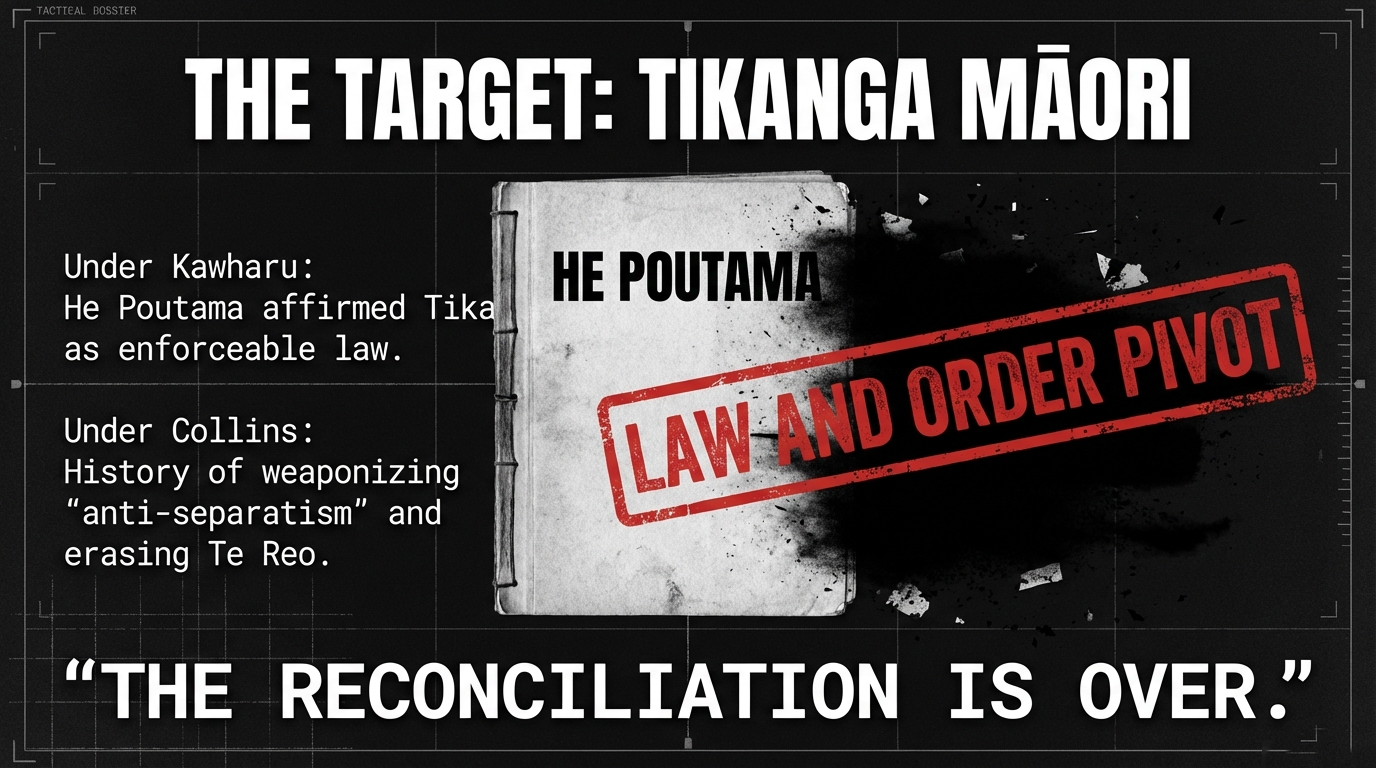
The Law Commission recommends changes to New Zealand law. It reviews legislation. It identifies unjust laws and proposes reforms. It has been the engine behind some of the most important legal developments in our history — from modernising evidence law to the He Poutama framework for tikanga.
When the Commission's president is a political appointee with no competitive mandate, the institution's independence is fatally compromised. Every report it produces will carry an asterisk. Every recommendation will be questioned. Every piece of advice to government will be shadowed by the suspicion that it serves the interests of the party that installed its leader.
As one attorney wrote on Reddit with 243 upvotes: "The Law Commission ideally should not be led by someone with a political background unless that individual has proven their capacity to avoid partisan influences... I lack faith in Judith Collins's ability to fulfill that requirement."
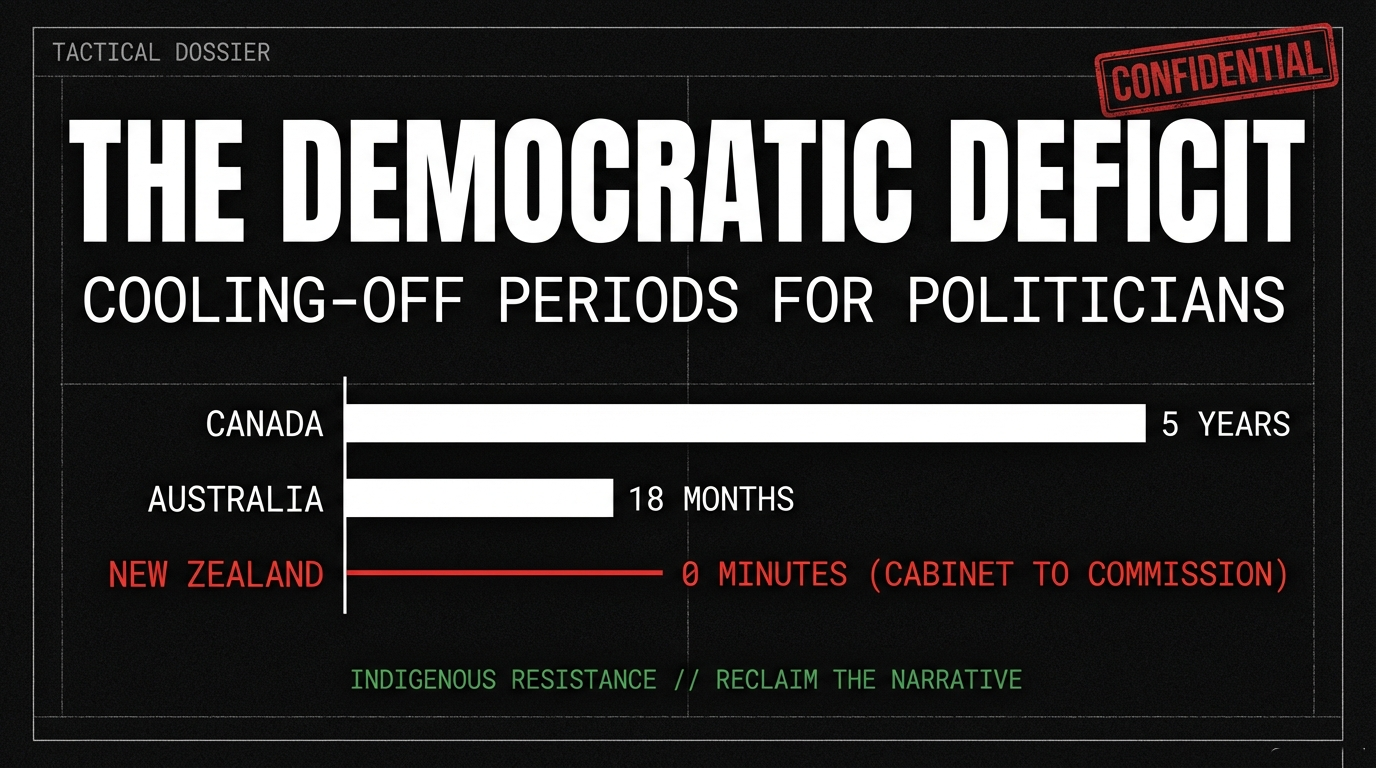
New Zealand has no mandatory cooling-off period for politicians moving into public appointments. As Edwards noted, "In Australia, former ministers must wait 18 months before lobbying or taking certain public roles. In Canada, it's five years. In New Zealand? There's nothing."
This is the democratic deficit that makes Collins' appointment possible. And this government exploits it relentlessly.
TE PUNA WAIORA: Solutions — What Rangatiratanga Demands
The taiaha does not only strike. It also points the way forward.
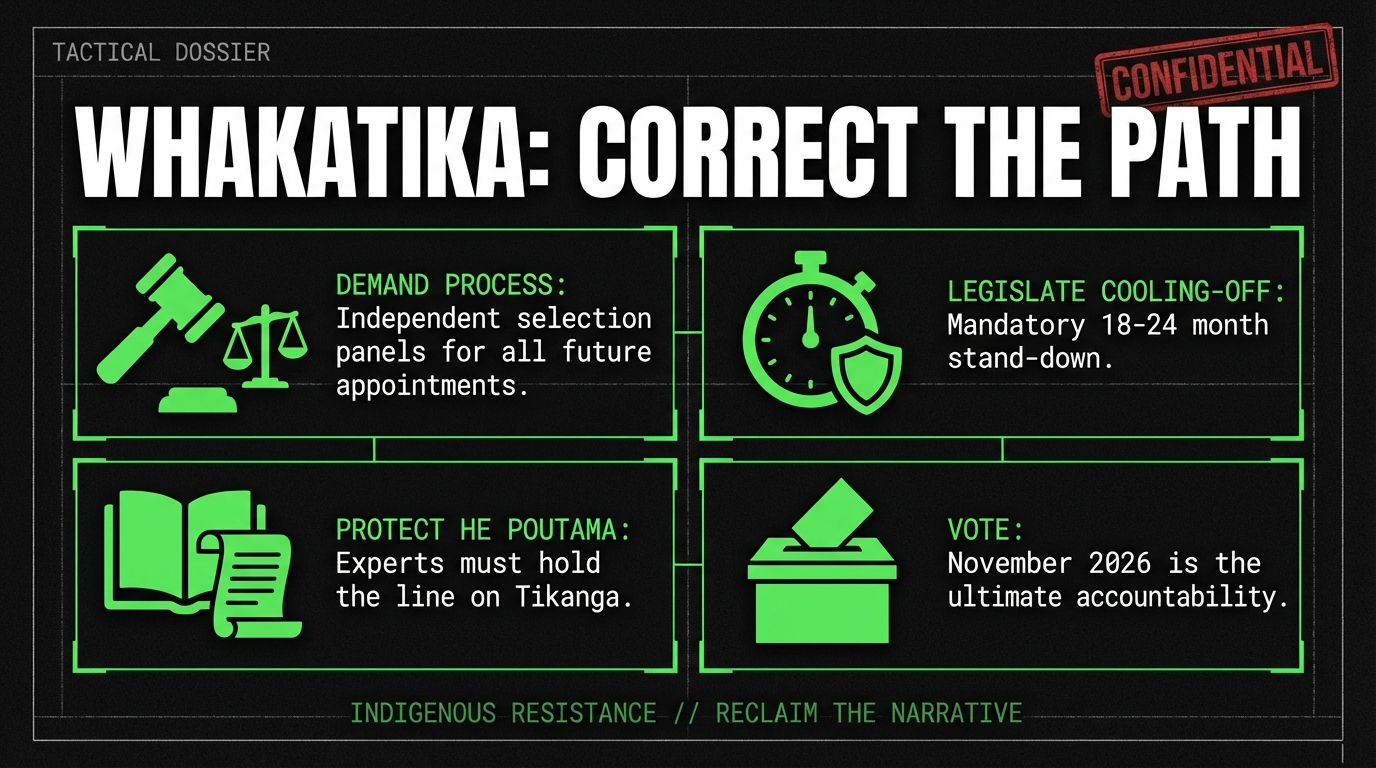
Immediate Actions:
- Demand a proper appointment process. The incoming government after November 2026 must commit to reviewing and potentially reappointing the Law Commission presidency through an open, competitive process with an independent selection panel.
- Legislate cooling-off periods. New Zealand needs mandatory stand-down periods of at least 18-24 months before outgoing ministers can take up public appointments in areas related to their former portfolios. This is standard in most OECD countries and long overdue here.
- Establish an Independent Appointments Commissioner. As The Integrity Institute recommends, an independent watchdog should oversee major public appointments, ensuring they are advertised, candidates are vetted on merit, and political bias is called out.
- Protect the Law Commission's tikanga work. The He Poutama framework must not be allowed to die. Iwi, legal academics, and tikanga experts must maintain external pressure to ensure the Commission continues its work on the interface between tikanga and state law — regardless of who sits in the president's chair.
- Vote. November 2026 is nine months away. The most powerful expression of rangatiratanga available to every citizen is the ballot. Use it.
TE KŌRERO WHAKAMUTUNGA: The Final Word
Judith Collins has spent 24 years in politics mastering the art of surviving scandal. Oravida. Dirty Politics. The 2020 election catastrophe. The late-night knifing of Simon Bridges. The Public Service Census manipulation. At every turn, she has treated the rules as suggestions and the norms as obstacles.
Now she has been handed the institution that writes the rules.
This appointment is not a reward for merit. It is a golden parachute stitched from the fabric of democratic accountability. It is the coalition government's final gift to its most loyal soldier — and a calculated assault on the independence of New Zealand's legal reform apparatus.
In te ao Māori, we understand that the mauri of an institution — its spiritual life force — depends on the integrity of its processes and the character of its leaders. When the process is corrupted and the leader is compromised, the mauri drains away like water from a broken calabash.
Te Aka Matua o te Ture — the Law Commission — has just had its calabash smashed by the people who were supposed to be its guardians.
Ka whawhai tonu mātou. Ake, ake, ake.
We will fight on. Forever, and ever, and ever.
Koha Consideration
Every time this government anoints another crony without process, without merit, without even the decency of pretence — it confirms what whānau already know: no one in that House is funding accountability for us.
Every koha to this mahi signals that rangatiratanga includes the power to fund our own truth-tellers — the ones who will trace the whakapapa of a corrupted appointment from the Cabinet table to the Law Commission chair, and name every hand that held the pen.
Kia kaha, whānau. Stay vigilant. Stay connected. And if you are able, consider a koha to ensure this voice — the one that names Crusher's golden parachute for what it is — continues to fly.
If you are unable to koha, no worries! Subscribe, follow, kōrero and share with your whānau and friends — that is koha in itself.
Three pathways exist:
For those who wish to support this mahi directly with a koha (voluntary contribution), please visit the Koha platform:
Koha — Support: https://app.koha.kiwi/events/the-maori-green-lantern-fighting-misinformation-and-disinformation-ivor-jones
For those who wish to receive essays directly and support through subscription:
Subscribe to the Māori Green Lantern: https://the-maori-green-lantern.ghost.io/#/portal/support
For those who prefer direct bank transfer, account details are:
HTDM, account number 03-1546-0415173-000.

Ivor Jones The Māori Green Lantern Fighting Misinformation And Disinformation From The Far Right
Research conducted 14 February 2026. Sources consulted: RNZ, Te Ara, Public Service Commission, The Integrity Institute, Law Commission, elocal/Democracy Project, 1News, The Spinoff, LawNews, LawFuel, High Court rulings, Beehive media releases, The Māori Green Lantern archives. All URLs verified at time of publication.
The Māori Green Lantern — Tohunga mau rākau wairua, kaitiaki of Māori, exposing misinformation, white supremacy, racism, and neoliberalism in Aotearoa.