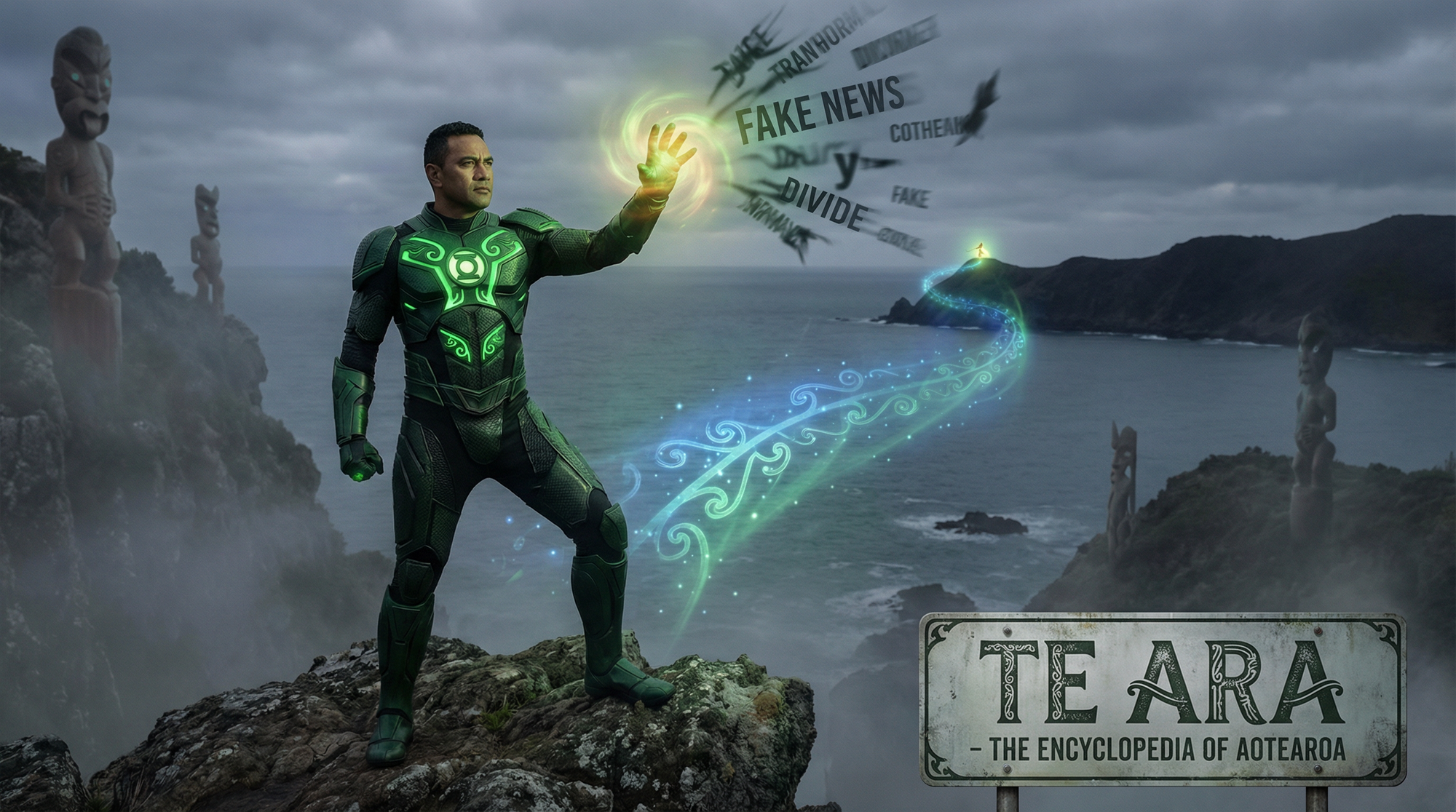
"TE KŪKUPA KORE PARIRAU: LUXON - THE WINGLESS PIGEON WHO THOUGHT HE WAS A HAWK" - 8 March 2026
How Christopher Luxon — a Man Who Cannot Land a Sentence, a Plane, or a Policy — Clings to a Throne Built on Sand While 165,000 New Zealanders Starve in the Rubble
Mōrena Aotearoa,
Thank you for opening your email this morning, to the latest essay by the Māori Green Lantern. I've been busy the last few days with whānau business and a hikoi to Rotorua to have a quick listen to the Māori Pharmacists conference.
I hope that you have not had withdraw symptoms waiting for an essay to drop in your inbox.
I promise that you are going to love this one.
You are invited to listen to this analysis of this essay
In te ao Māori, the kūkupa — the native wood pigeon — is a bird of majesty. It carries the seed of the forest. It is tapu. It is fat, yes — gloriously, purposefully fat — because it swallows the fruit whole, and where it flies, new trees grow. The kūkupa does not apologise for its weight. It serves the ngahere.
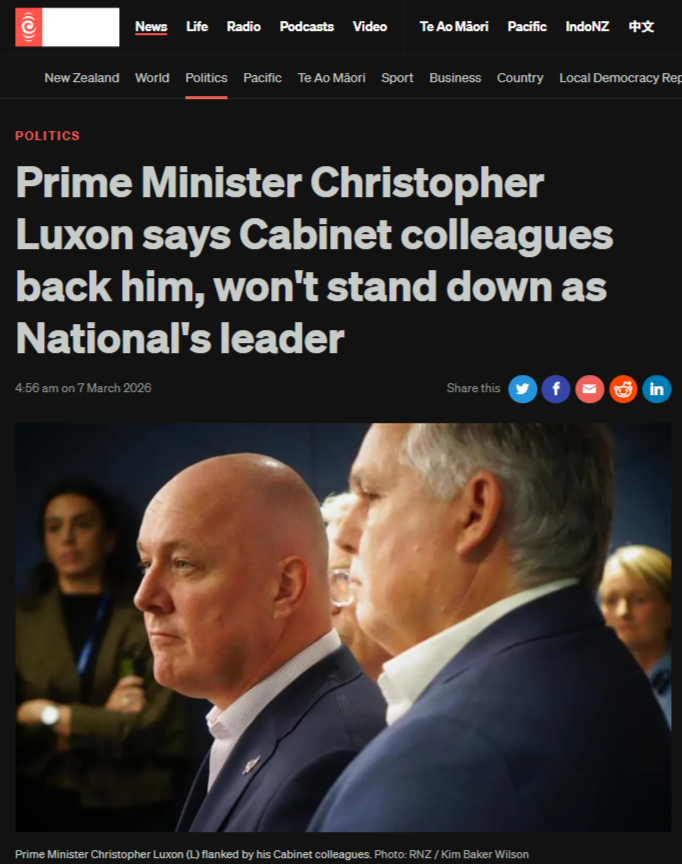
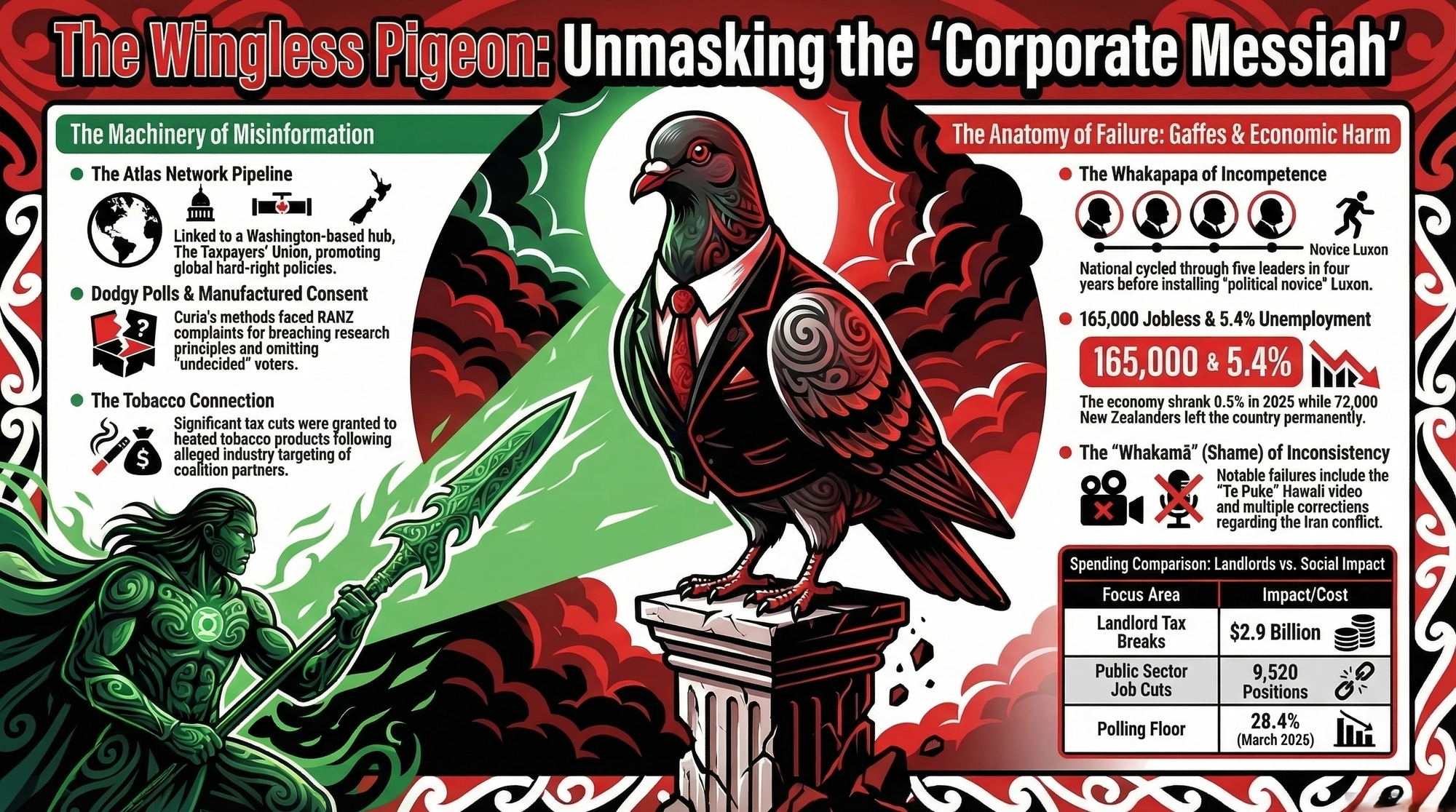
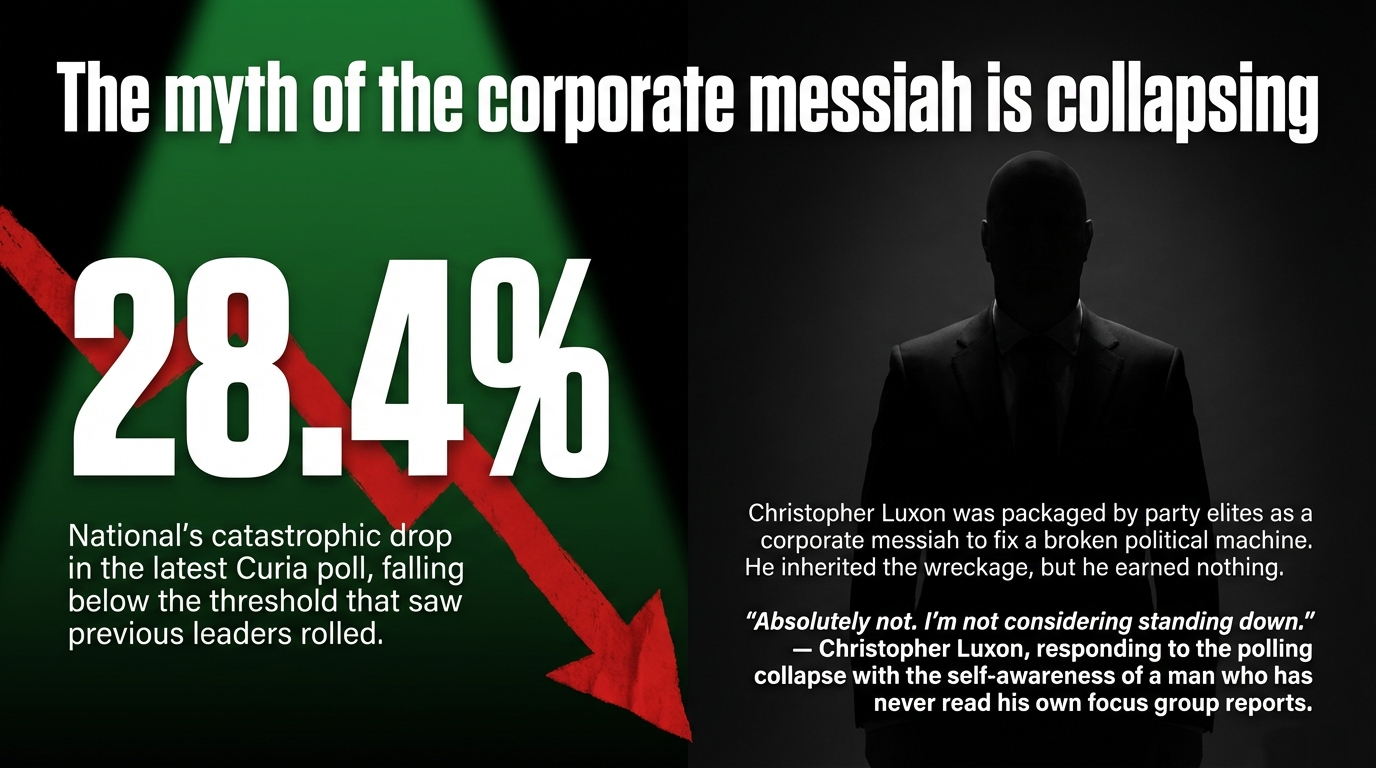
Christopher Luxon is not a kūkupa. He is a battery hen who escaped a corporate coop, wandered onto the marae of Parliament, and now struts around the paepae making sounds he does not understand while the whare burns behind him. He cannot fly. He cannot feed the forest. He cannot even remember what he said yesterday. And on Friday 6 March 2026, as the Taxpayers' Union–Curia poll dropped National to a catastrophic 28.4 percent — down nearly three points in a single month — he waddled to a Newstalk ZB microphone and declared, with the self-awareness of a man who has never once read a focus group report about himself:
"Absolutely not. I'm not considering standing down."
The taiaha is raised, whānau. Let us carve the truth into the bone.
THE GRAVEYARD OF LEADERS: HOW NATIONAL BROKE ITSELF AND HIRED A CORPORATE MESSIAH
To understand the wingless pigeon, you must understand the carnage that put him on the perch. Christopher Luxon did not earn the National Party leadership through political skill, ideological vision, or service to the people of Aotearoa. He was installed — like a replacement CEO parachuted into a corporation after the board burned through four executives in three years — because the party had disembowelled itself so thoroughly that the only remaining option was a man nobody knew.
The Fall of John Key: The Smiling Assassin Exits Stage Right
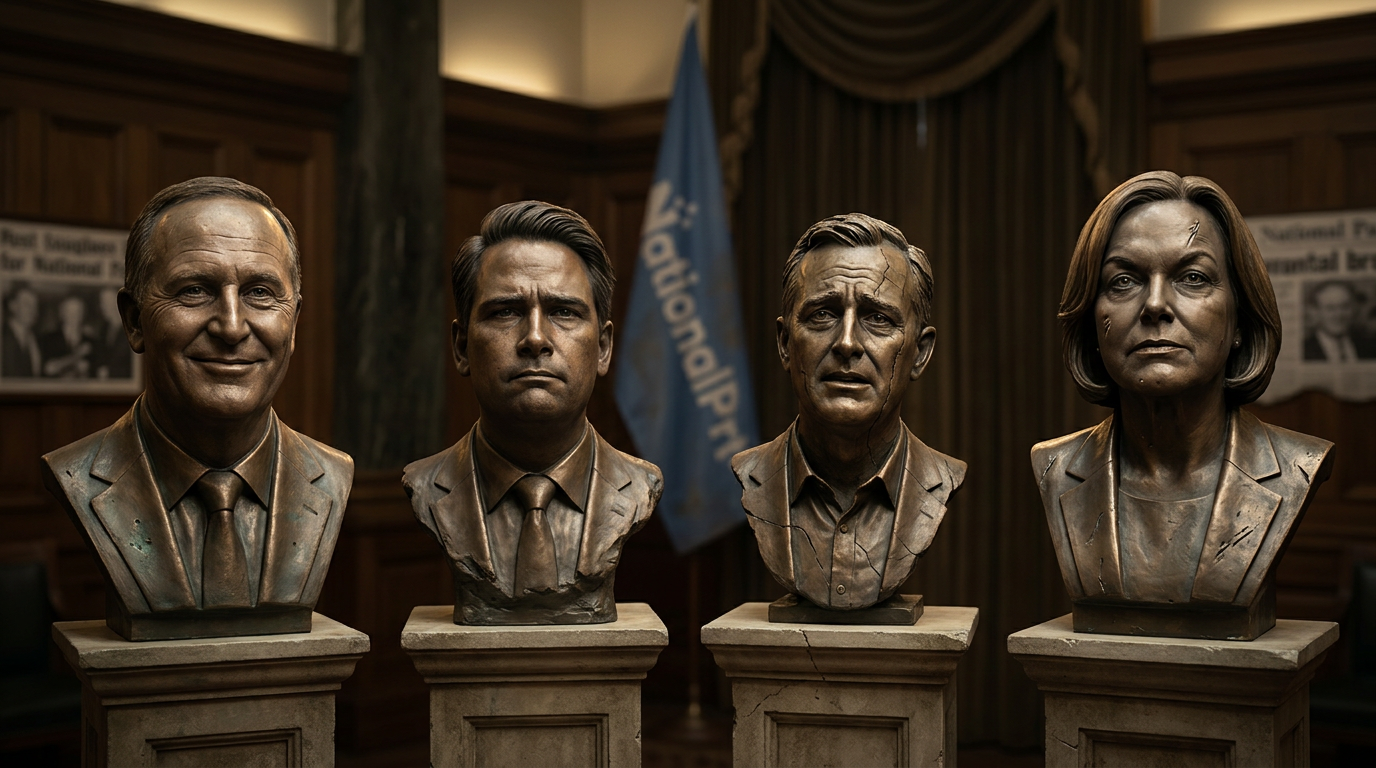
For a decade, John Key held the National Party together through charm, ruthlessness, and the careful management of a neoliberal programme dressed in casual Friday clothes. When he resigned suddenly in December 2016, he left behind a party that had been built entirely around his personality. As RNZ's political history coverage recounts, Key's deputy Bill English was acclaimed as leader without contest — a placeholder so bland that his most memorable contribution to the national conversation was the revelation that he put tinned spaghetti on his pizza. English led National to its 2017 election loss — winning the most votes but failing to form government when Winston Peters chose Labour — and resigned in February 2018 after thirteen months in the job.
Simon Bridges: The Compass Without a Needle
Simon Bridges replaced English and immediately began generating the kind of crises that National caucus members would later describe as "circling wolves" and "bedwetters". As RNZ reported in its coverage of Bridges' own book, Bridges admitted his leadership was "damned and doomed" from the start, caught between colleagues who wanted "Kumbaya with the government" and those who thought they could do a better job. Then came Jami-Lee Ross — the Botany MP who publicly called Bridges "a corrupt politician", alleged illegal donation-splitting, and triggered a Serious Fraud Office investigation before eventually being acquitted. Bridges endured two years of this, polling stubbornly below 30 percent as preferred PM. Then, in May 2020, as Covid ravaged the world and Jacinda Ardern's popularity soared, a Newshub-Reid Research poll showed Bridges' preferred PM rating cratering at 4.5 percent. As RNZ's live coverage recorded, he was rolled by Todd Muller in an emergency caucus meeting. The first head on the pike.
Todd Muller: 53 Days of Chaos
Todd Muller's leadership was a political disaster film compressed into less than two months. His first week featured a MAGA cap displayed in his office — a hat widely seen as a symbol of white nationalism — which he defended as "memorabilia". He unveiled an overwhelmingly Pākehā front bench, then posed in front of an upside-down tino rangatiratanga flag — the Māori sovereignty flag, hung inverted — an image so on-the-nose that no satirist could have invented it. In his speech at Te Puna Rugby Club, he mistakenly said "I joined the Labour Party" before correcting himself. Then came the Hamish Walker leaked Covid patient names scandal — described by a National staffer as, in The Spinoff's memorable reporting, "a clusterfuck of biblical proportions". After 53 days — having suffered what he later described as a breakdown under the pressure — Muller resigned, saying his position had become "untenable from a health perspective." He later retired from politics entirely, admitting he had lost "enthusiasm and energy". Second head on the pike.
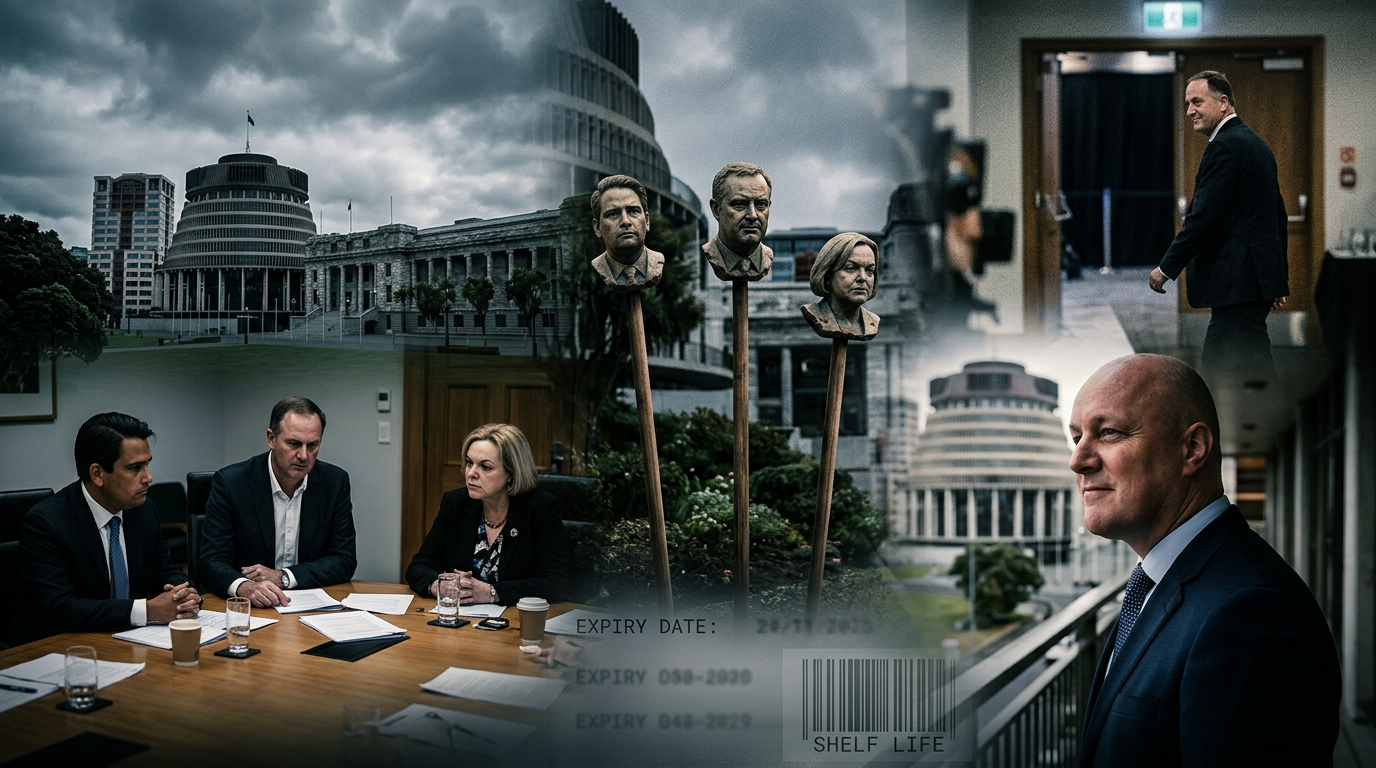
Judith Collins: The Crusher Crushes Herself
Judith Collins took over from Muller in July 2020 and led National to its worst election result in 18 years — just 25.6 percent and 35 seats, while Labour won an outright MMP majority of 65 seats. As leader in opposition, Collins polled consistently below David Seymour as preferred PM, a humiliation previously unknown in National Party history. Then, in November 2021, she went nuclear: she demoted Simon Bridges and stripped him of his portfolios over a five-year-old complaint about lewd comments — a move widely seen as a desperate attempt to kneecap a rival. Bridges called it "truly desperate stuff". National MP Simon O'Connor called it "downright appalling" and demanded her resignation. By the next morning, Collins had been removed in a vote of no confidence. Third head on the pike.
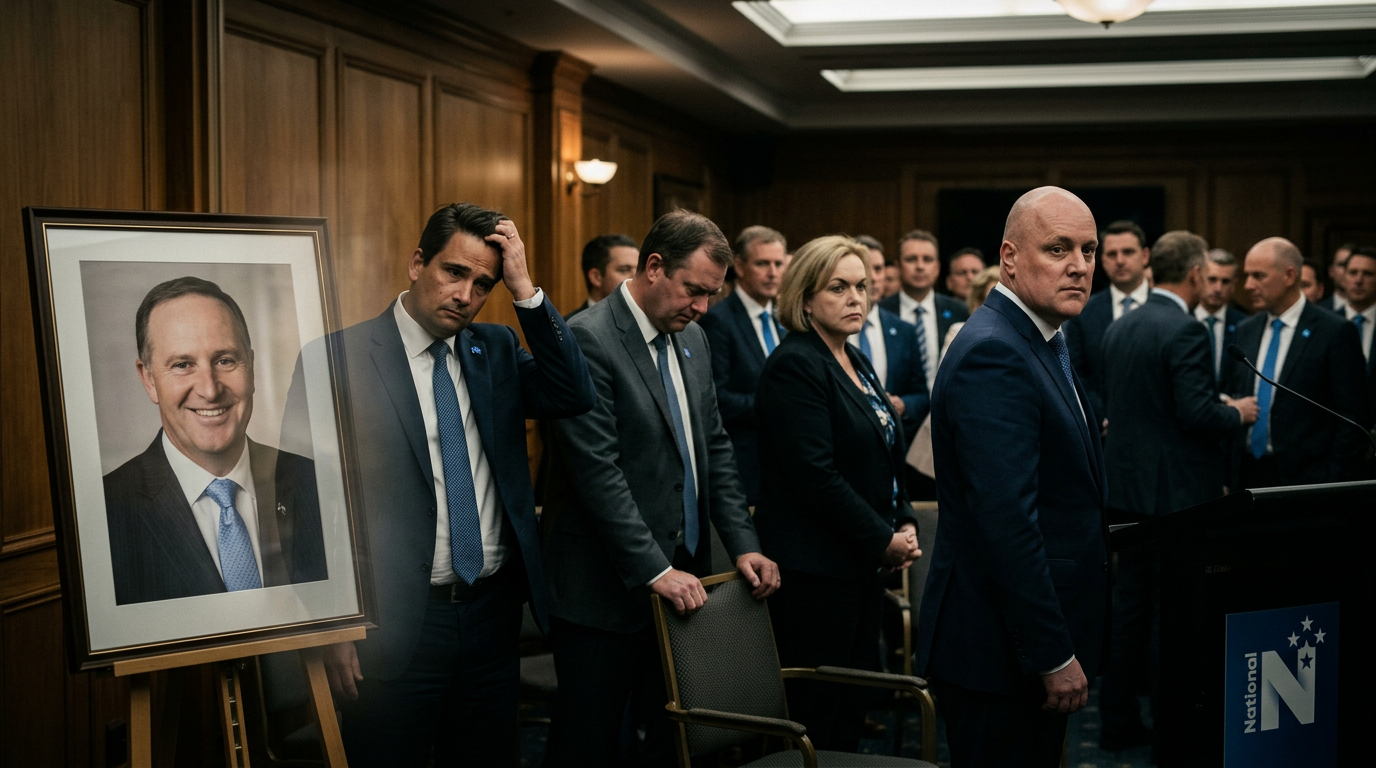
And Collins, of course, had her own earlier history of scandal. In 2014, she was forced to resign from Cabinet under John Key after emails linked her to an alleged campaign to undermine the head of the Serious Fraud Office, a saga dragged out by Nicky Hager's Dirty Politics — as RNZ reported at the time. She was reinstated after an inquiry, but the stain never washed out. The Crusher eventually crushed herself.
Enter Luxon: The Man Nobody Knew
Into this graveyard walked Christopher Luxon. One year in Parliament. One portfolio of note (local government). Zero legislative legacy. Zero leadership experience in the political arena. His qualification? He had been CEO of Air New Zealand. As RNZ's Jane Patterson wrote: "Political novice Chris Luxon goes into tomorrow's caucus vote the odds-on favourite to take the National Party leadership" — the party's fifth leader in four years. His deputy, Nicola Willis, described him as bringing "real-world experience" while noting his political inexperience could be "a strength." Even she acknowledged their different worldviews: "I describe myself as a moderate, as a centrist. My voting record is clear — I have been pro-choice both on euthanasia and on abortion. My views are different from Chris Luxon's on some of those issues," as she told RNZ.
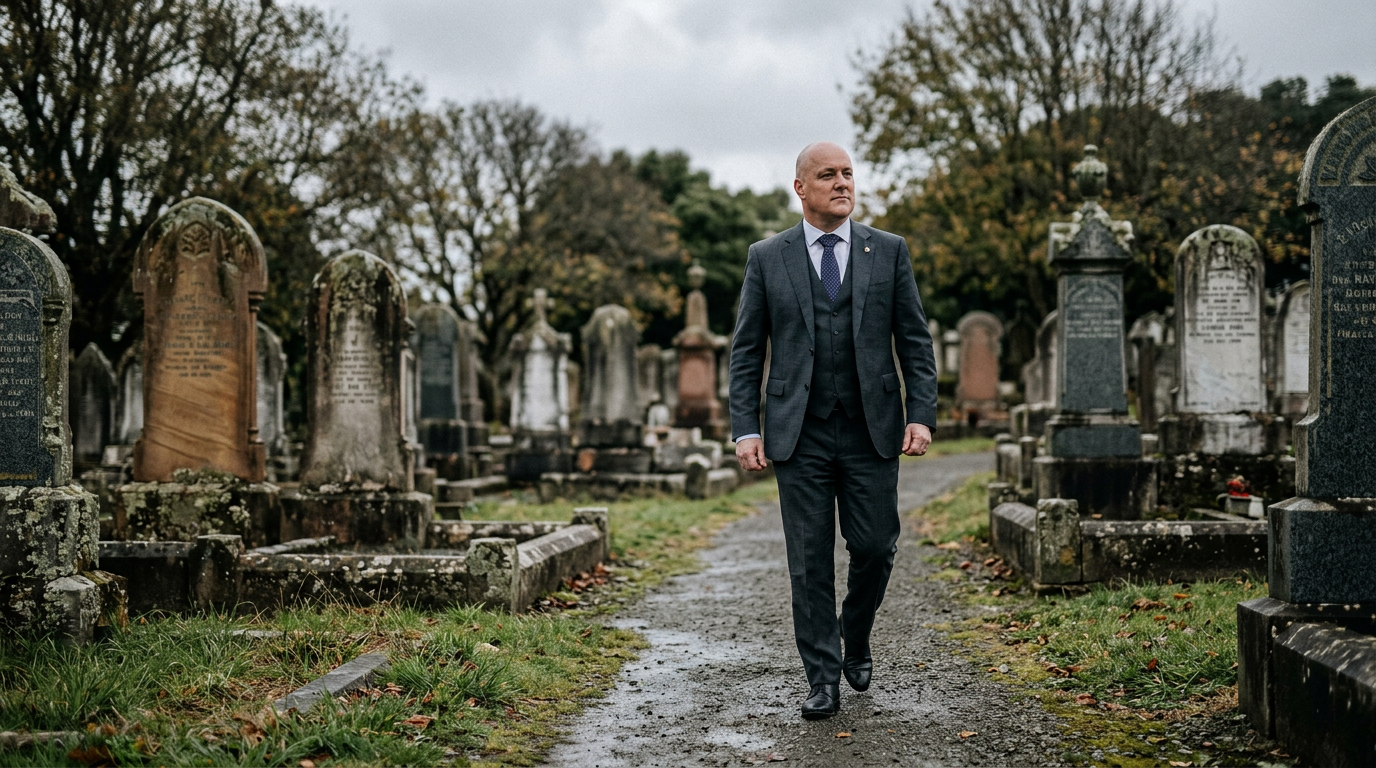
The comparison to John Key was immediate, explicit, and manufactured. Key himself endorsed Luxon publicly, declaring they shared "very similar economic views" and were both "economically conservative but internationalists," as RNZ's profile records. Massey University's Professor Richard Shaw, writing for The Conversation, warned: "One should be wary of assuming a successful private sector career necessarily translates into a decent political one. Sure, there's John Key — but there's also Donald Trump."
The data has since vindicated the warning. A Spinoff analysis of Talbot Mills/UMR polling revealed that Luxon's net favourability — the gap between those who like him and those who don't — has been historically abysmal. While Helen Clark, John Key, and Jacinda Ardern all scaled peaks of popularity in their first terms, Luxon "started out unpopular, and has only become more so over time." Even his own party's internal polling produced a word cloud where the top descriptors were: "Business", "leader", "greedy", "unsure", "arrogant" and "entitled", as noted in NZ Herald coverage from political strategist Matthew Hooton, who concluded: "Luxon is the best National's got, but he's no John Key." In March 2026, as the latest Curia poll showed 28.4 percent — lower than the 29 percent that saw Bridges rolled — The Spinoff's analysis confirmed: "It's worse than the 29% figure which saw Simon Bridges dethroned in 2020."
For the Western mind: Imagine a corporation that fired four CEOs in three years — one for poor sales, one after a mental breakdown, one for sabotaging a colleague — then hired a man from outside the industry who had spent exactly one year answering phones in the mailroom. That's what National did. And now that man runs the country.
The tikanga lens: In te ao Māori, leadership passes through whakapapa. It is earned through service, tested through adversity, and validated by the people. Luxon earned nothing. He inherited the wreckage of a party that could not govern itself, and was packaged by party elites — and their Atlas-connected advisors — as the corporate messiah who would make the numbers work. He was a product, not a rangatira. And products have a shelf life.
THE WHAKAPAPA OF INCOMPETENCE: A GAFFE FOR EVERY SEASON
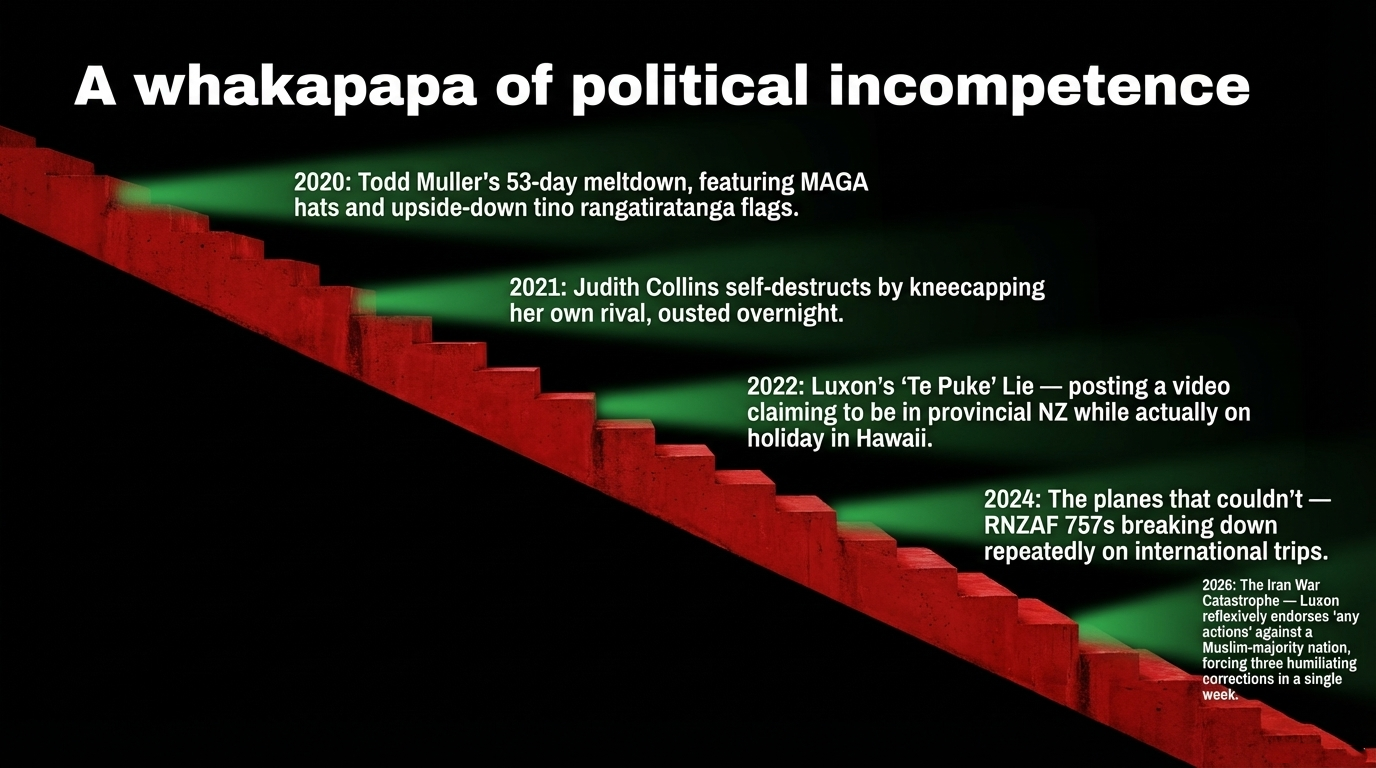
To understand the full majesty of Luxon's inadequacy, you must see the pattern. This is not a leader who occasionally stumbles. This is a man whose entire political career is a stumble — a rolling, tumbling, slow-motion collapse down a hill of his own making, gathering speed and debris with every revolution.
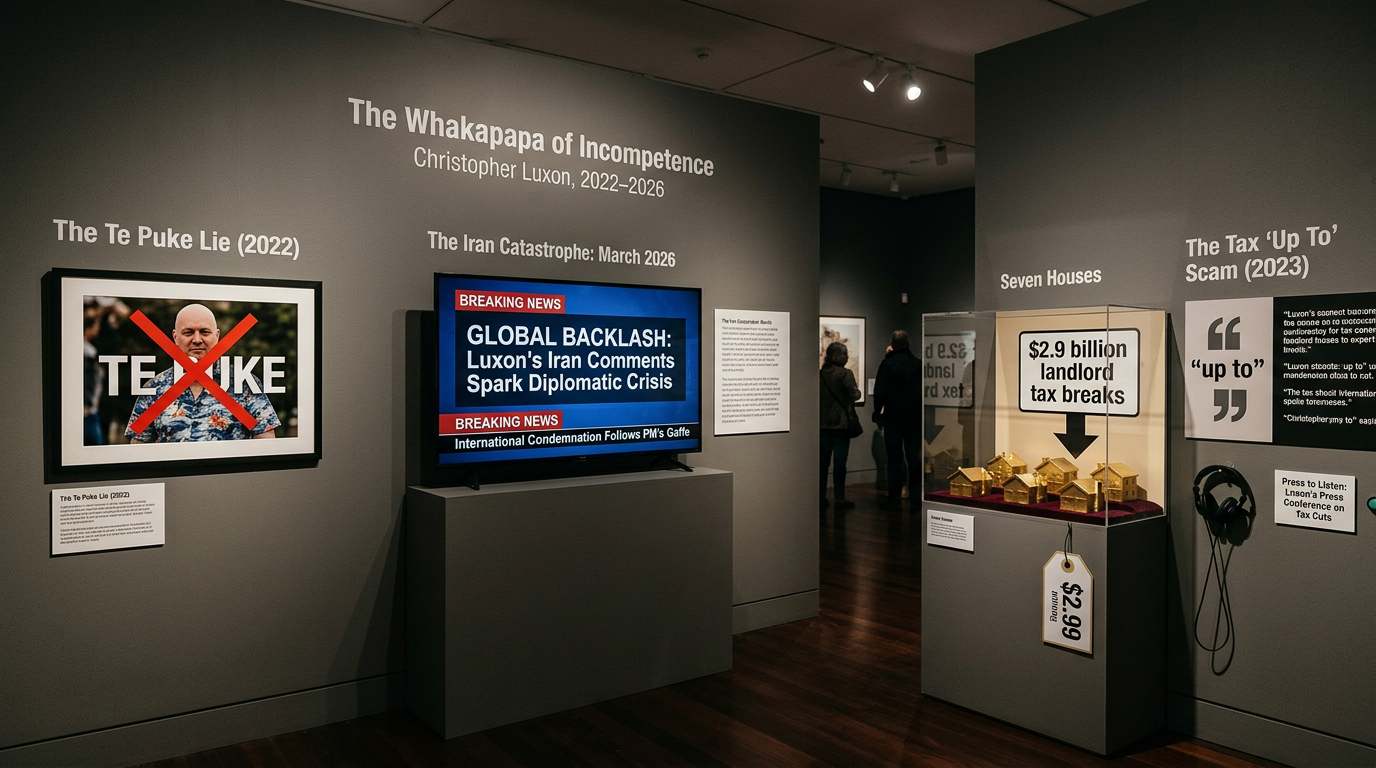
The Iran Catastrophe: March 2026
In the first week of March 2026, as bombs fell on Iran, Christopher Luxon — the Prime Minister of a nuclear-free nation whose modern identity was forged by David Lange saying "I can smell the uranium on your breath" — told media that his government supported "any actions" to stop Iran obtaining nuclear weapons, before claiming he meant "appropriate actions". His comments were reported internationally and he was forced into an embarrassing clarification, as covered by outlets like The Straits Times and in follow-up reporting by RNZ.
Luxon is not shy about his faith. He has described himself as an evangelical Christian and is a long-time attendee of upper-middle-class evangelical churches in Auckland, while insisting he does not "wear it on his sleeve" politically, as documented in RNZ's leadership profile. His deputy Nicola Willis publicly noted their differing views on conscience issues including euthanasia and abortion — telling RNZ she was needed as a "centrist" balance to Luxon's conservatism. Professor Richard Shaw's Conversation analysis warned that "some of Luxon's views" might trouble the "liberal wing" of National's base. That evangelical formation matters — because when a Prime Minister shaped by American-style corporate Christian ideology reflexively endorses "any actions" against a Muslim-majority nation, the language echoes the crusading rhetoric of the US religious right, the same movement whose figures advise Donald Trump's White House and have driven the very bombardment Luxon was failing to comment coherently on. Even if no specific adviser's fingerprints can be proven on the script, the worldview that produced the slip is not neutral. It is Dominionist-adjacent. And Aotearoa, a nuclear-free nation built on the rejection of exactly this kind of imperial theology, deserves better.
Then he "misspoke." Then he snuck into Parliament at 9.03pm to correct the record. Then he got his correction wrong, falsely claiming New Zealand had not issued blanket visa extensions during the Ukraine war, when Cabinet decisions and contemporaneous reporting show it did. Three corrections in one week. On a matter of war and peace.
Former Prime Minister Helen Clark called his Iran response "a disgrace", as reported by The Straits Times. Green co-leader Chlöe Swarbrick said "He's not across his brief," as quoted in RNZ's coverage.
The tikanga violation: In te ao Māori, the kupu — the word — is sacred. Words carry mana. To speak carelessly on matters of life and death is not a "misspeak" — it is a desecration. When a rangatira addresses the iwi on matters of war, every syllable is weighed, because words become actions and actions become consequences that ripple through whakapapa for generations. This man weighs nothing. His words are hollow gourds rattling in an empty storehouse.
The Catalogue of Shame: 2022–2026
The Iran debacle was not an aberration. It was the latest exhibit in a museum of mediocrity:
- The Te Puke Lie (2022): Luxon posted a video saying "today I'm in Te Puke" while actually on holiday in Hawaii, as exposed by 1News. Shane Te Pou called it "fundamentally a lie." Matthew Hooton called it a "debacle."
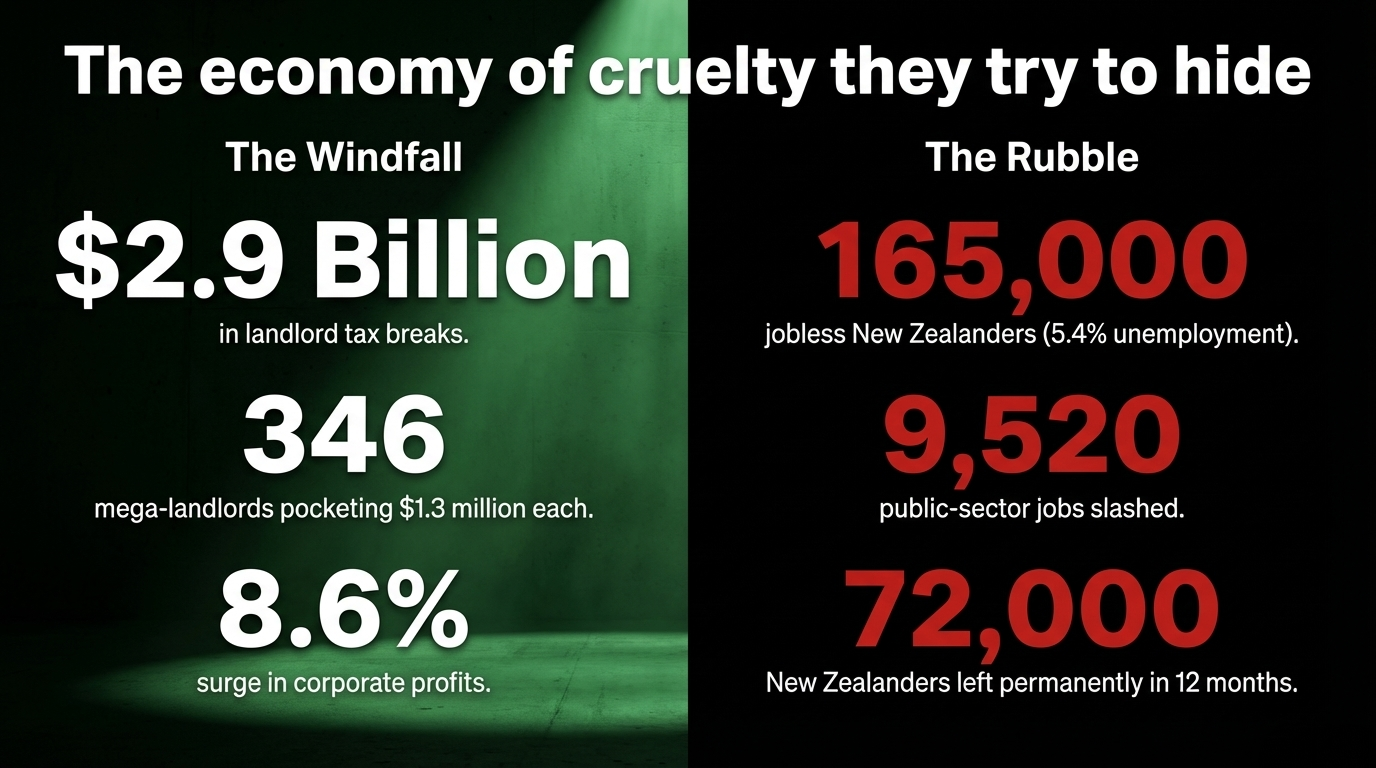
- The Seven Houses (2023): Luxon owns seven properties, benefits from his own government's $2.9 billion landlord tax breaks, with the CTU calculating that 346 mega-landlords would pocket $1.3 million each over five years.
- The Tax "Up To" Scam (2023): Apologised for omitting "up to" when promising families $250 a fortnight — then immediately repeated the error in the same press conference.
- The Copy-Paste Waitangi Speech (2024): Repeated his 2023 speech near word-for-word at Waitangi, then called it "consistent messaging", as noted in 1News Waitangi coverage.
- The Plane That Couldn't (2024, twice): His RNZAF 757 broke down in March, labelled "embarrassing" by his own Defence Minister on RNZ and 1News. It broke down again in June — "embarrassing, humiliating… for us as a nation."
- The Maths He Can't Do (2024): Stumbled on basic multiplication on live TV, then conflated Year 8 maths and reading rates at a press conference. The man who declared "total system failure" in maths cannot do maths.
- Booed at Netball (2025): Loud jeers from the crowd as he presented awards at the ANZ Premiership grand final.
- The Housing U-Turn (2026): Threw his own Housing Minister under the bus by capitulating to NIMBYs, a move Labour's Carmel Sepuloni called a "humiliating backdown", as reported by RNZ.
And through it all, this man told RNZ: "If there was a problem, I would be doing something about it."
The problem, Christopher, is you.
THE ECONOMY OF CRUELTY: QUANTIFIED HARM
While Luxon stumbles through press conferences like a man who has forgotten his own name, the people of Aotearoa are drowning.
Example 1: The Unemployment Factory
The numbers: Unemployment has hit 5.4 percent — the highest in over a decade — with around 165,000 New Zealanders out of work and nearly 3,000 businesses shuttered in 2025. The economy shrank 0.5 percent across the year, with GDP falling 0.9 percent in the June quarter — three times worse than forecast — as reported by Bloomberg. Corporate profits rose 8.6 percent while wages grew just 1.4 percent against 3 percent inflation. Electricity and gas profits surged over 30 percent. A record 72,000 New Zealanders left permanently in twelve months, and the government slashed 9,520 public-sector jobs in its first thirteen months — figures tracked across official accounts and summarised by outlets including the World Socialist Web Site.
The tikanga impact — for the Western mind: In te ao Māori, mahi — work — is the expression of mana tangata: a person's dignity, contribution, and place in the whānau. To strip 165,000 people of mahi is not a "labour market adjustment." It is the systematic destruction of mana on an industrial scale — the spiritual equivalent of burning 165,000 wharenui.
The solution: Reverse the austerity programme. Redirect the $2.9 billion landlord tax break to a jobs guarantee, Māori-led housing construction, green-energy transition, and community-based employment.
The Māori Green Lantern has tracked this in "The Dashboard Illusion: How Neoliberalism Sells Sovereignty While Stealing Resources" and "The NZ Neoliberal Pantomime: Why Every Major NZ Party Serves the Same Masters."
Example 2: The Kaumātua Eating Fish Heads in Māngere
In Māngere, cars snake around Centre Park as kaumātua and kuia wait for free fish heads and frames from Papatūānuku Kōkiri Marae — documented by Te Ao News. Auckland has the highest unemployment in the country at 6.1 percent. When confronted, Luxon said he was "focused 100 percent on growing the economy" — from his leafy electorate of Botany.
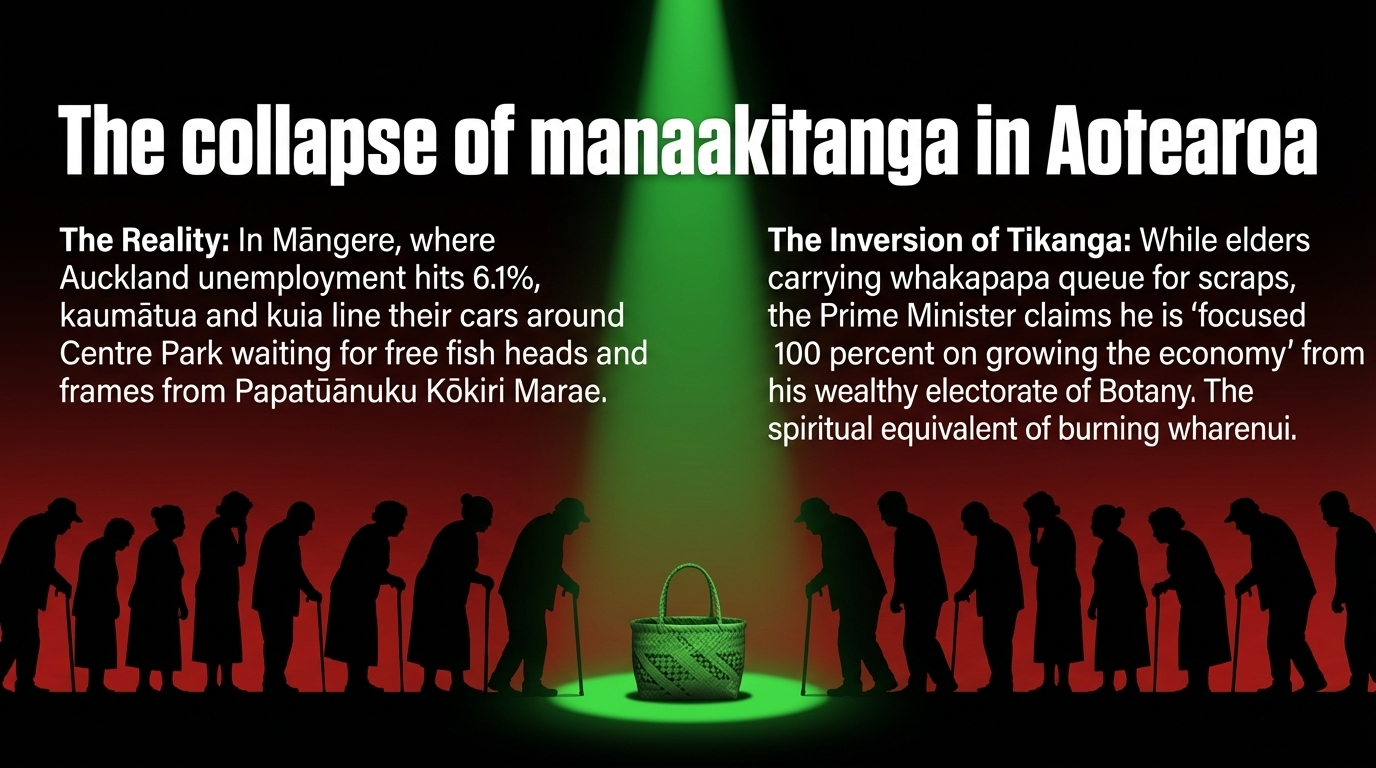
The tikanga impact — for the Western mind: In te ao Māori, manaakitanga — the obligation of care — is the measure of collective mana. When kaumātua who carry whakapapa queue for fish heads in a rich city, every principle is inverted. The Western equivalent: imagine your war veterans lining up behind a supermarket for expired bread while the CEO boasts of record profits.
The solution: Universal basic income pilot for kaumātua over 65 in high-deprivation areas. Restore Ka Ora Ka Ako school lunches to full funding. Ring-fenced Māori food sovereignty fund.
The Māori Green Lantern documented this in "Heather Cox Richardson — Te Taiaha o te Aroha: The Weapon They Cannot Confiscate."
Example 3: The Man Who Forgot About Saudi Arabia
Before politics, Luxon was CEO of Air New Zealand when its Gas Turbines unit serviced engines for the Royal Saudi Navy — the navy enforcing a blockade of Yemen that the UN said pushed millions toward famine. When confronted, Luxon claimed to have "no recollection" of the contract. An investigation into the legality of the work was launched.
The tikanga impact — for the Western mind: In te ao Māori, utu — reciprocity, balance — demands that every action's consequences be acknowledged. Luxon's "no recollection" is the opposite of utu. It is wilful amnesia — hara — a transgression that disrupts the balance of the community.
The solution: Mandatory human-rights due diligence for NZ corporations with international defence contracts. Ministerial accountability standards requiring resignation when ministers mislead Parliament on war, refugees, or human rights.
The Māori Green Lantern traced this in "The Butcher, the Baker, and the Blackmail Maker" and "The Burger, the Chair, and the Empty Seat of Accountability."
THE DODGY DASHBOARD: TAXPAYERS' UNION, ATLAS NETWORK, AND THE POLL FACTORY
If Luxon is the wingless pigeon wobbling on the Beehive railing, the Taxpayers' Union is the guy on the ground with a laser pointer, trying to convince the crowd the pigeon is an eagle.
Atlas Network: Global Hard-Right Plumbing, Local Tap
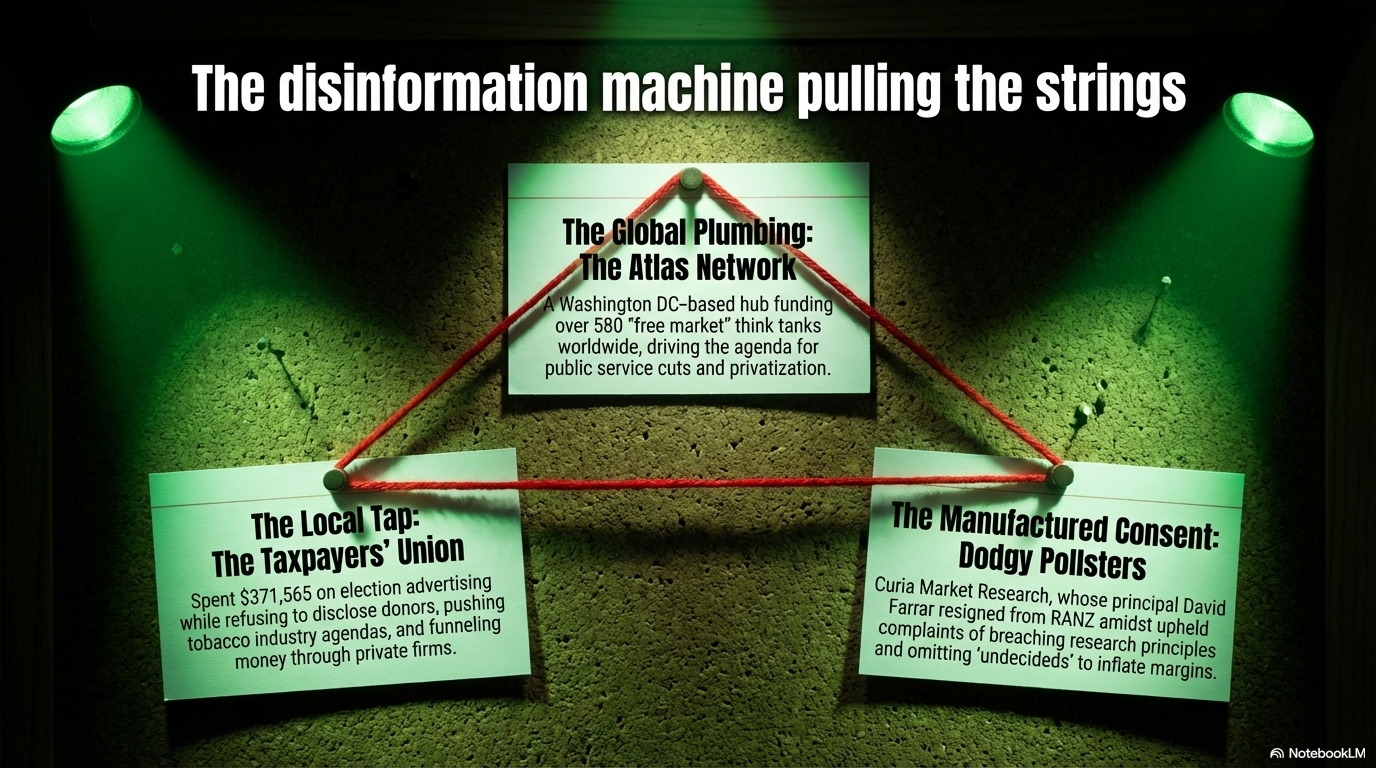
The Atlas Network is a Washington DC-based hub funding over 580 "free market" think tanks worldwide. As the ABC's investigation documents, New Zealand's Taxpayers' Union and the New Zealand Initiative are Atlas partners. The PSA's analysis confirms these organisations promote "public services cuts, denying climate change, slashing corporate regulations, eroding workers' rights, privatisation, supporting landlords over tenants" — policies that "closely align with our current government."
Jordan Williams, the Taxpayers' Union boss, openly acknowledges Atlas links in his RNZ interview with Guyon Espiner and the YouTube version. Atlas is the global plumbing. The Taxpayers' Union is one of the local taps. The water tastes the same in Wellington as it does in Washington.
Dodgy Pollsters: Curia, Complaints, and Manufactured Consent
The Taxpayers' Union buys its way into every news cycle by sponsoring Curia Market Research's monthly political poll. But Curia's methods have been formally challenged. In 2024, the Research Association of New Zealand (RANZ) ruled that Curia's Golden Mile poll breached the Code of Practice, finding it "includes questions that are not prepared in accordance with accepted research principles, methods and techniques" — published on the RANZ Upheld Complaints page. Simultaneously, Curia principal David Farrar resigned from RANZ while facing potential suspension or expulsion over multiple upheld complaints, as noted in the RANZ Chair's official update.
Te Pāti Māori president John Tamihere's column "Dodgy Pollsters" at Waipareira lays it bare: the Taxpayers' Union–Curia polls routinely omit the "undecideds" and "don't knows," inflating the real margin of error to as high as 9 percent. The Union pulled in $2.8 million while refusing to disclose donors — beyond admitting that tobacco, alcohol, sugar, and fast-food companies are among them.
Dark Money, Astroturf, and the Tobacco Pipeline
RNZ's in-depth investigation "$2m surge in election campaign spending by third-party groups" reveals the Taxpayers' Union spent $371,565 on 2023 election advertising — second-highest of any third party — with The Campaign Company (owned by Jordan Williams) billing a combined $135,733 across Groundswell, Hobson's Pledge, and the Union. Donor money from "taxpayer advocacy" recycled through Williams' private firm.
Then there is tobacco. Williams confirms a Union staffer went to Panama to oppose the WHO's tobacco control framework, while refusing to say whether the tobacco industry funded the trip, as covered in RNZ's interview. Former Taxpayers' Union chair Casey Costello — now NZ First Associate Health Minister — pushed through a 50 percent excise cut on heated tobacco products, a $216 million gift to Philip Morris, based on evidence her own Ministry officials privately called "selective, out of date" and partly "crap". Leaked Philip Morris documents showed the company's 2017 strategy was to target NZ First and leverage the Taxpayers' Union, as reported by RNZ. Labour has called the Union a "front organisation" in this context.
THE ANATOMY OF DENIAL: WHY THE PIGEON WON'T FLY AWAY
RNZ's Jo Moir wrote the political obituary this week: "One of Luxon's weaknesses has been his inability to take feedback from colleagues, staff or officials." And: "Another Achilles' heel is Luxon's complete lack of self-doubt." These traits now extend to him not reading focus group reports because they say he is the problem.
The NZCTU's Sandra Grey called his State of the Nation speech "devoid of any plans, policies, or actions that will help working people". Treasury forecasts unemployment above 5 percent for all of 2026. Net debt peaks near 47 percent of GDP by 2028. The return to surplus has been pushed beyond the forecast horizon — tracked in the CTU's "Forecasts show Government economic strategy failing workers". Barbara Edmonds notes "zero growth since Luxon became PM".
And still he says: "If there was a problem, I would be doing something about it."
THE WHITE SUPREMACIST ARCHITECTURE: WHAT LUXON ENABLES
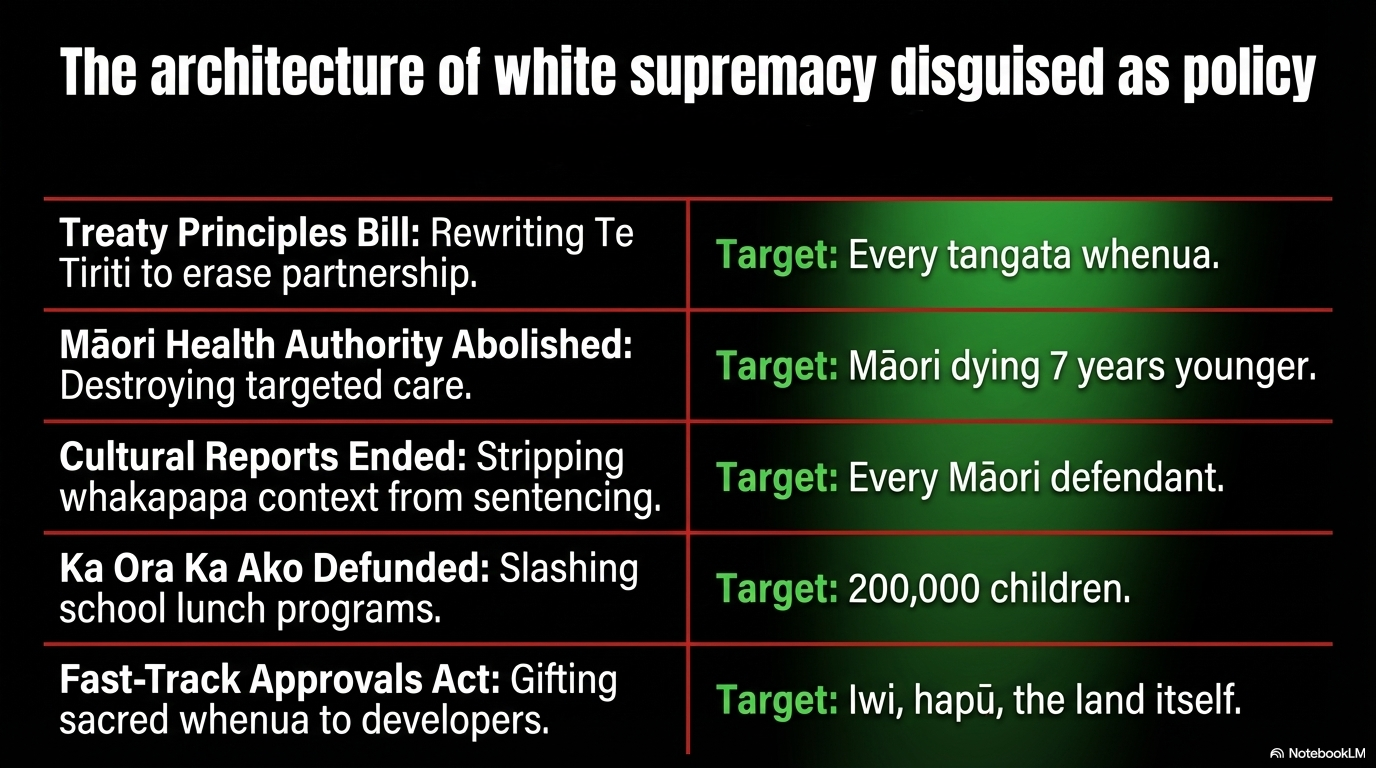
| Policy | Effect | Who Bleeds |
|---|---|---|
| Te Aka Whai Ora abolished | Māori Health Authority destroyed | Māori dying 7 years younger |
| Treaty Principles Bill | Rewrites Te Tiriti to erase partnership | Every tangata whenua |
| Three Strikes reinstated | Extends sentences regardless of rehabilitation | Māori — 52%+ of prison population |
| $1.9B prison expansion | Builds cages, signals permanence | Taxpayers funding warehousing, not healing |
| Cultural reports ended | Strips whakapapa context from sentencing | Every Māori defendant |
| Landlord tax breaks | $2.9B to property owners | Renters, homeless whānau |
| 9,520 public sector jobs cut | Guts health, education, social services | Communities who depend on them |
| Ka Ora Ka Ako defunded | School lunch programme cut | 200,000 children |
| Fast-Track Approvals Act | Gifts sacred whenua to developers | Iwi, hapū, the land itself |
Luxon admitted Crown-Māori relations are "probably worse" under his government. He agreed to support the Treaty Principles Bill to first reading, then said he doesn't "like the bill at all." He presides over a coalition with David Seymour and Winston Peters while Atlas-linked groups like the Taxpayers' Union provide the propaganda soundtrack, as the PSA and RNZ have documented.
The Māori Green Lantern mapped this in "The Nursery of Cages" and "The Colosseum of Kingsland."
THE VERDICT: A PIGEON ON A THRONE
In te ao Māori, leadership is not a title. It is a whakapapa obligation. A rangatira leads because the people invest mana in them. When a rangatira fails, the people withdraw that investment. The mauri moves.
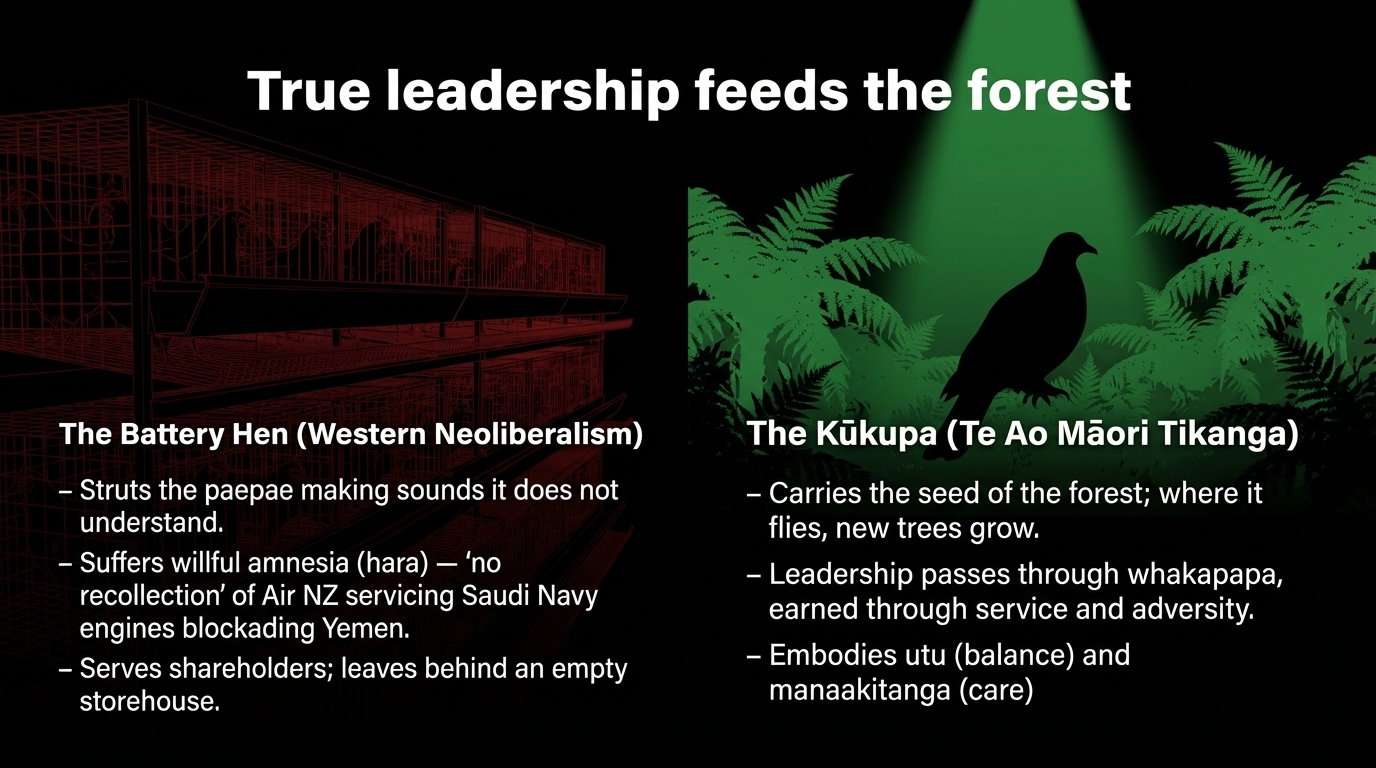
Christopher Luxon has no mauri to carry. He is the fifth leader in four years of a party that cannibalised itself — from the chaos of Bridges, through the 53-day catastrophe of Muller, through the kamikaze self-destruction of Collins — until the only option left was a man nobody knew, from a corporate world that had taught him to smile, deliver quarterly results, and never, ever take personal responsibility for consequences that flow downhill.
He has a polling number: 28.4 percent and falling — worse than the 29 percent that killed Bridges. He has a coalition held together by duct tape and mutual contempt. He has an economy that has not grown since he took office. He has 165,000 jobless. He has kaumātua eating fish heads. He has 72,000 people who chose Australia over his leadership. He has a war he cannot articulate a position on. He has seven houses and no idea what it costs to heat one. He has an evangelical worldview he insists doesn't influence him, even as it leaks through every "misspeak." And behind him, the Atlas Network, the Taxpayers' Union, and a pollster who resigned from his own professional body rather than face expulsion stand ready to spin the numbers one more time.
He told New Zealand:
"I'm not a career politician."
He is correct. A career implies competence. This is amateur hour with nuclear consequences.
The kūkupa carries the seed of the forest. Luxon carries nothing. The forest is burning. The pigeon is wingless. And the only people who believe he can fly are the ones who put him on the perch in the first place — and they are counting the days until the wind of November blows him off.
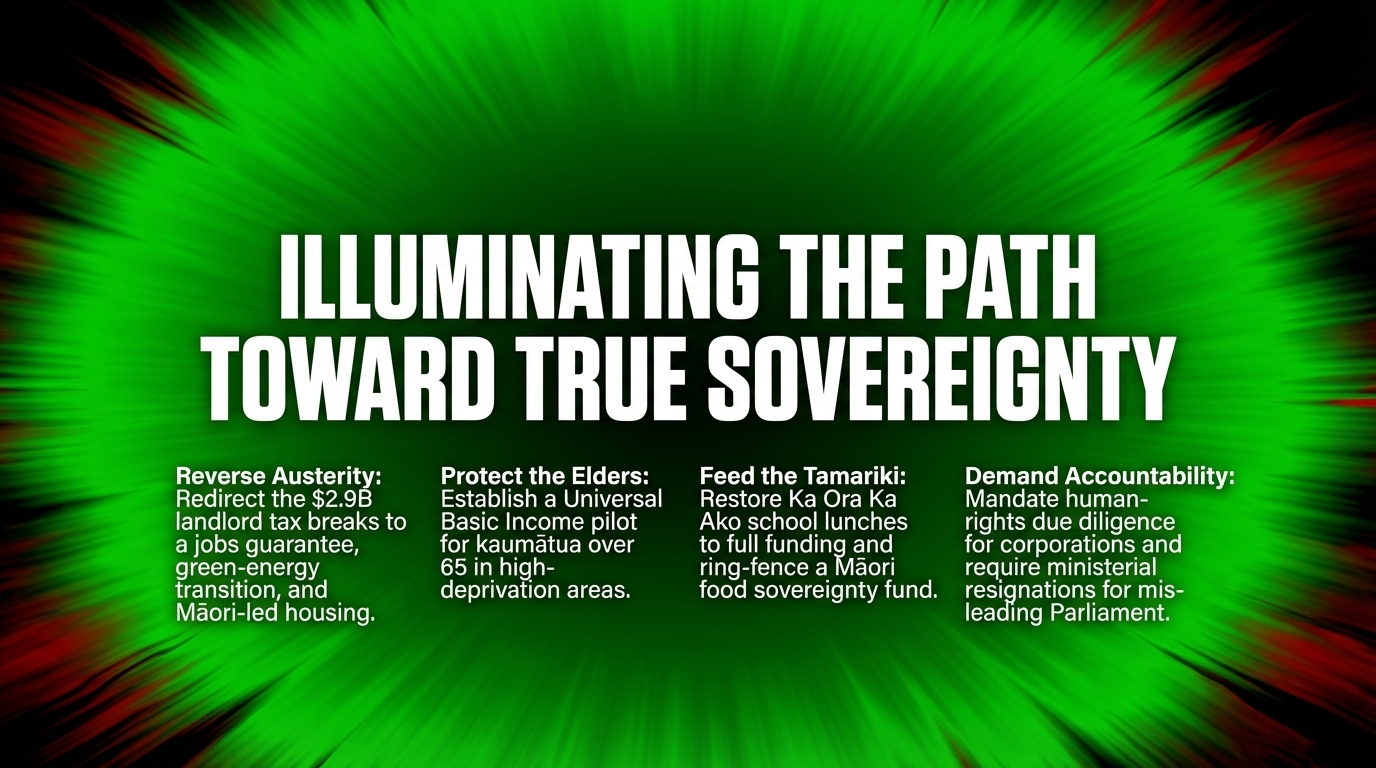
Kia mau ki te whenua. Kia kaha. Kia manawanui.
Hold fast to the land. Be strong. Be resolute.
The taiaha is raised. The Ring burns. The wingless pigeon wobbles on its perch, and the wind of November is coming.
Koha Consideration
Every koha signals that whānau are ready to fund the truth that wingless pigeons, their Atlas-trained handlers, and their dodgy pollsters will never speak. It signals that rangatiratanga includes the power to fund our own voices — the voices that name the gaffes, dissect the Taxpayers' Union's bullshit numbers, trace the whakapapa of cruelty from five failed leaders to Luxon's seven houses to the fish-head queue in Māngere, and hold every "misspeak" to account when the media cycle moves on.
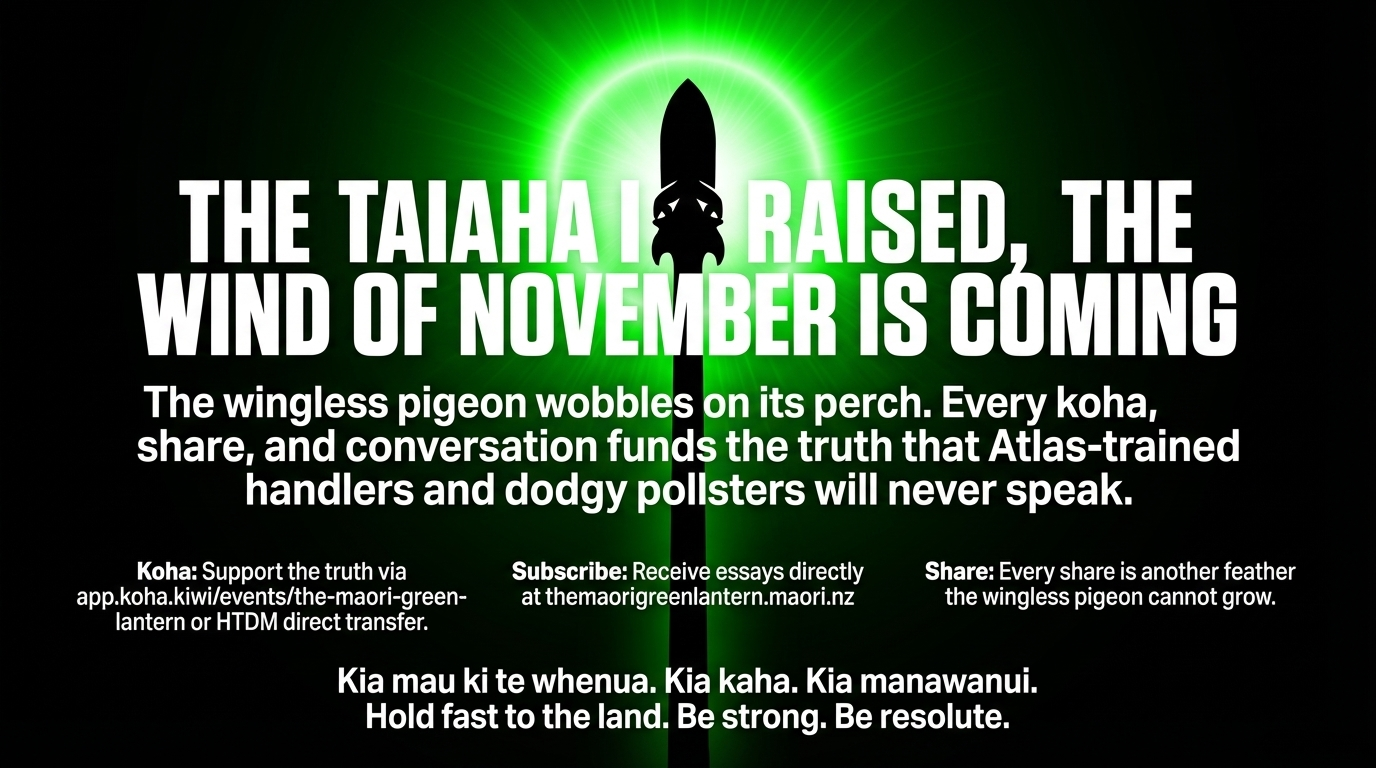
Kia kaha, whānau. Stay vigilant. Stay connected. And if you are able, consider a koha to ensure this voice continues — the voice that counts the corrections, the jobless, the hungry, the leaving, the rolled leaders, and the dark-money fingerprints on every piece of austerity legislation, when the Prime Minister refuses even to read his own focus-group reports.
If you are unable to koha, no worries! Subscribe or follow The Māori Green Lantern, kōrero and share with your whānau and friends — that is koha in itself. Every share is another feather the wingless pigeon cannot grow.
Three pathways exist:
For those who wish to support this mahi directly with a koha (voluntary contribution), please visit the Koha platform:
Koha — Support — https://app.koha.kiwi/events/the-maori-green-lantern-fighting-misinformation-and-disinformation-ivor-jones
For those who wish to receive essays directly and support through subscription:
Subscribe to the Māori Green Lantern — https://www.themaorigreenlantern.maori.nz/#/portal/support
For those who prefer direct bank transfer, account details are:
HTDM, account number 03-1546-0415173-000.
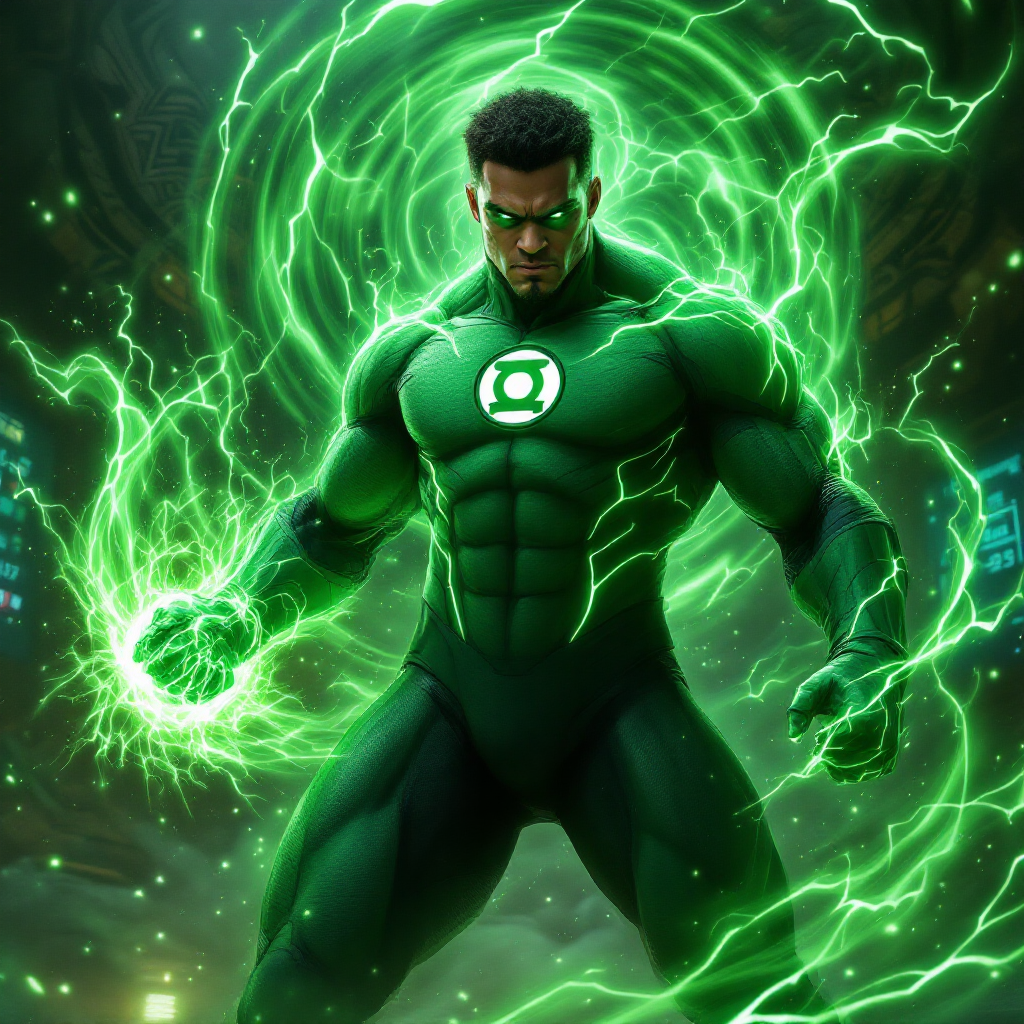
Ivor Jones — The Māori Green Lantern Fighting Misinformation And Disinformation From The Far Right
Ko au te whenua, ko te whenua ko au.
Research transparency: This essay was researched on 7–8 March 2026 using RNZ, 1News, The Spinoff, The Conversation, Bloomberg, NZ Herald, NZCTU, Labour Party releases, Green Party releases, PSA, Waipareira Trust, RANZ, Straits Times, WSWS, Te Ao News, ABC Australia, Wikipedia, Reddit NZ Politics, and The Māori Green Lantern archive. All URLs verified at time of publication. Data sourced from Statistics NZ, Treasury HYEFU, Taxpayers' Union–Curia polling, and Electoral Commission third-party returns.