"Te Moana Hoko: How Shane Jones Sold Our Oceans to the Highest Trawler" - 30 March 2026

Mōrena Aoteaora,
Let us be rid of the dumbnamic duo of Koro Jones and Peters (once and for all). They should never be let back into the proximity of power. They are abusers.
The Deep Dive Podcast
Listen to a lively conversation between two hosts, unpacking and connecting topics in the sources of this essay.
Ko Wai e Painga Ana? Who Benefits?
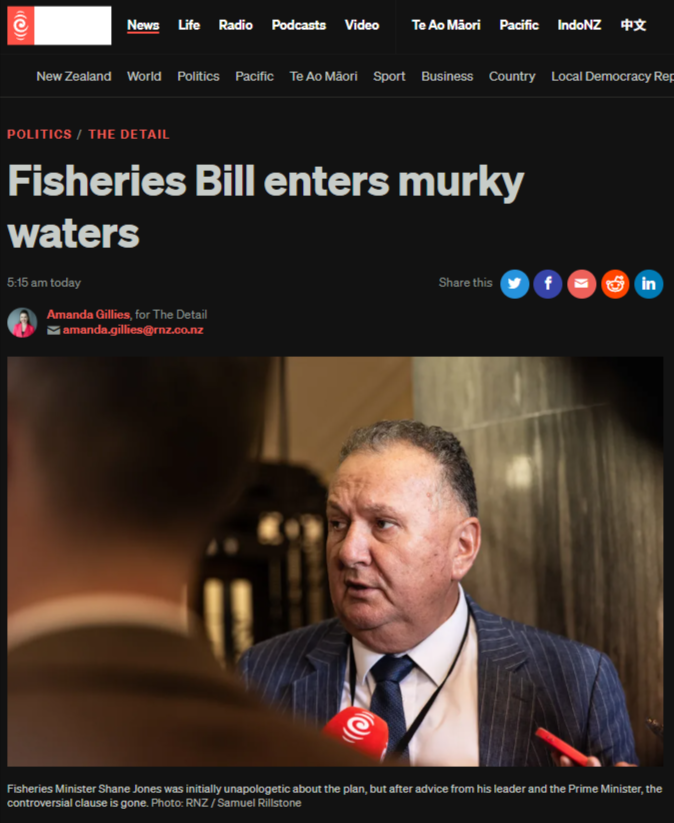
There is a principle in corruption investigations: follow the money, follow the power, follow the silence. The Fisheries Amendment Bill 2026, shepherded through Parliament by NZ First's Shane Jones, fails all three tests catastrophically. The man who was once charged with distributing $800 million in Māori fishing assets — a man who positioned himself as a champion of Māori rangatiratanga — has now become the instrument through which corporate trawlers strip those same assets, silence public scrutiny, and lock in their profits for five years at a time.
This is not policy. This is a transaction. And the receipt is public.
Te Hītori: The Settlement Māori Were Promised
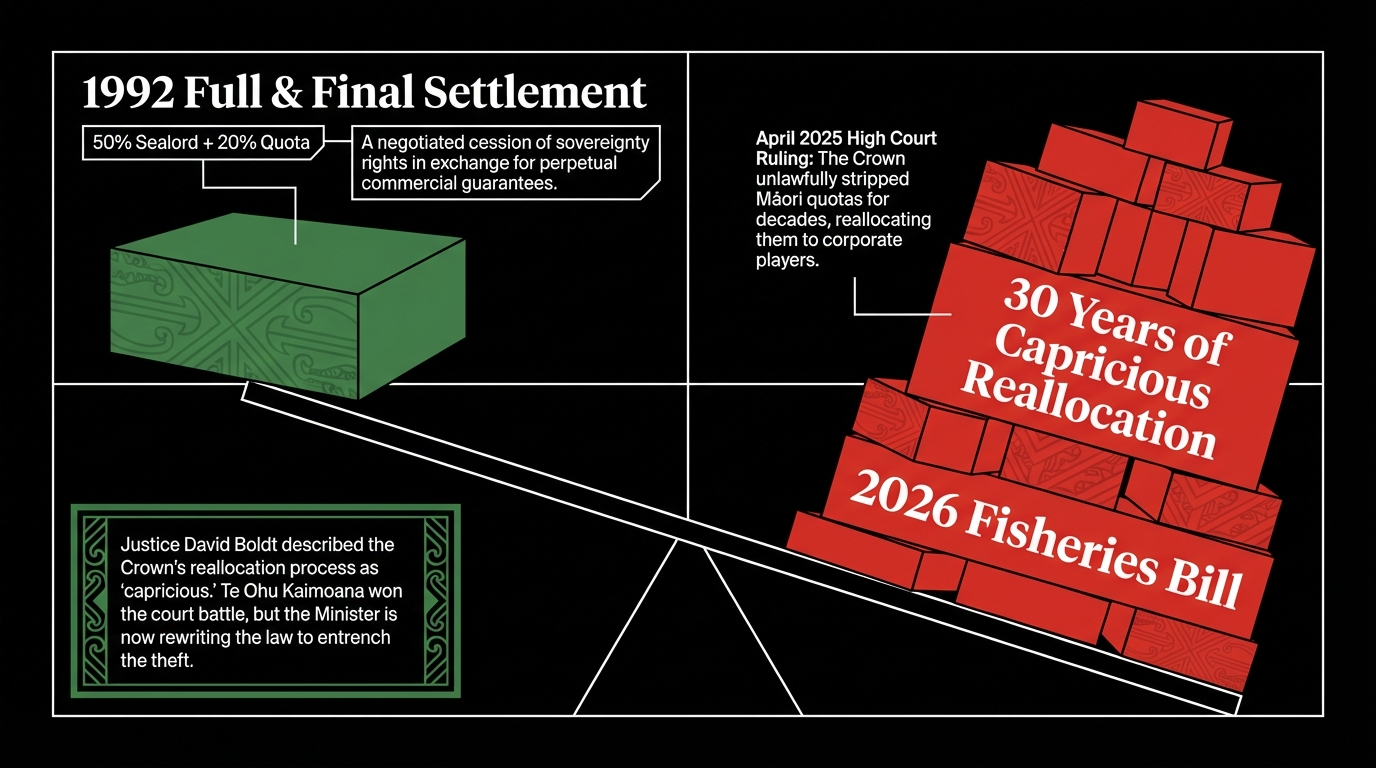
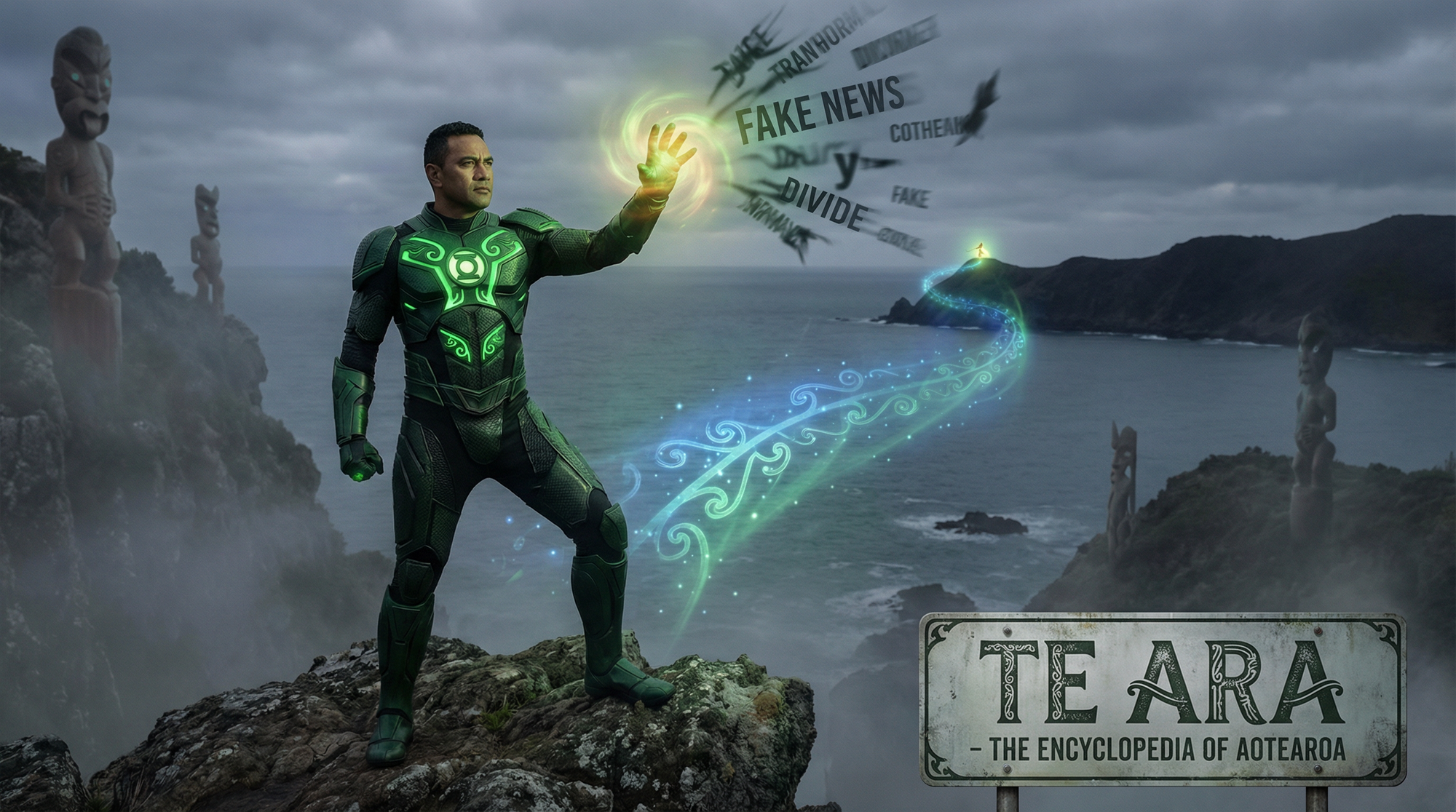
In 1992, Māori entered a "full and final" settlement with the Crown over commercial fishing rights. As documented by Te Ara, Māori received a 50% stake in Sealord and a guaranteed 20% share of all new quota species — in exchange for surrendering all further Treaty fishing claims. This was not a gift. It was a negotiated cession of sovereignty-level rights. Māori gave up the right to litigate forever. The Crown promised to honour that settlement — forever.
The Crown lied. In April 2025, the High Court ruled that officials had been unlawfully stripping Māori fishing quotas since 1992 and reallocating them to large corporations, primarily Auckland-based Sanford. Justice David Boldt described the process as "capricious." Te Ohu Kaimoana, the Māori fisheries commission, had fought this through the courts. They won. But winning in court means nothing when the Minister of Fisheries is already writing legislation to entrench the very system that robbed them.
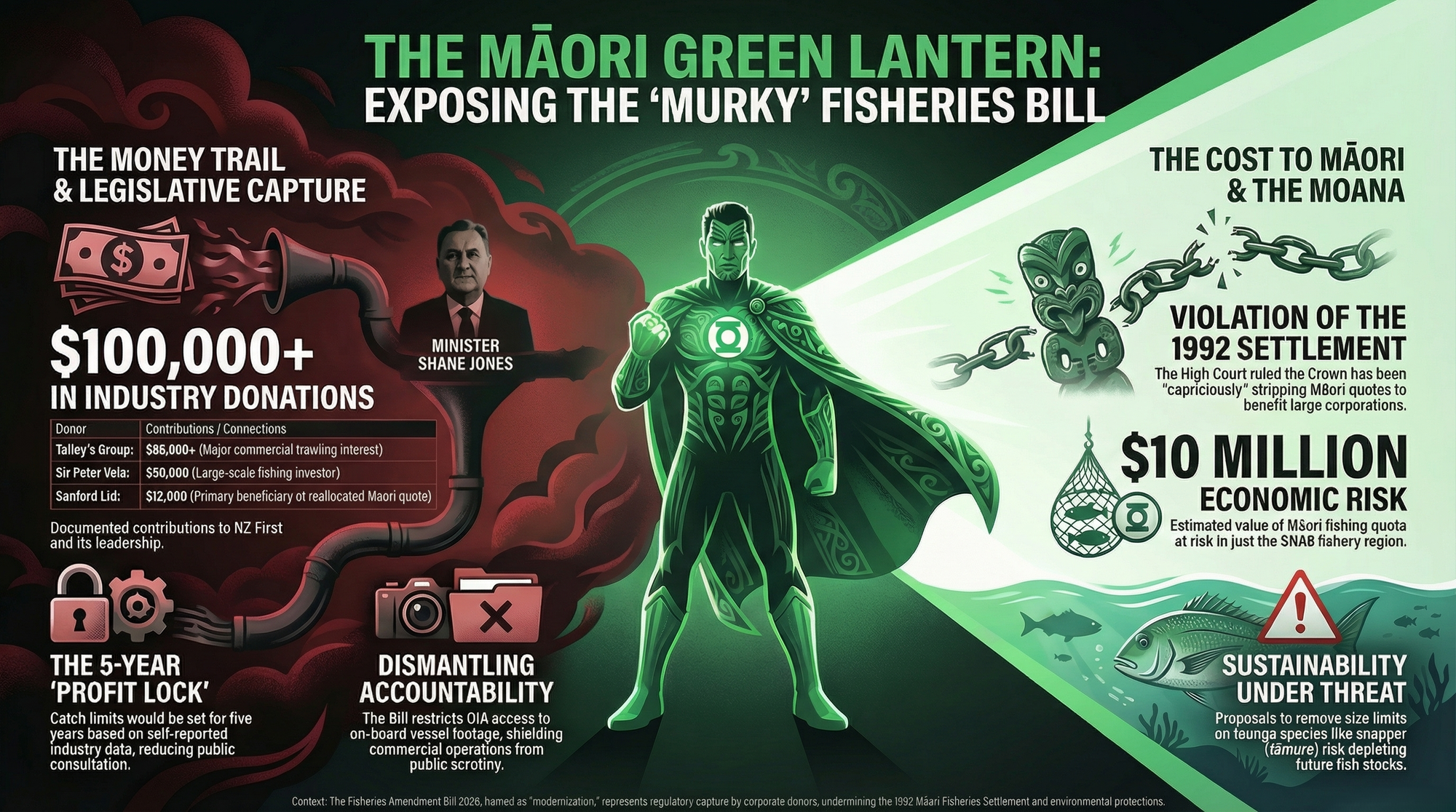
In one fishery alone — snapper in the upper North Island — The Spinoff estimated the value of quota at risk to iwi at $10 million. That is one species. One region. The total Māori loss across all species, across three decades of "capricious" reallocation, is yet to be fully quantified.
Te Mahi Kino: The Bill Itself (Deconstruction)
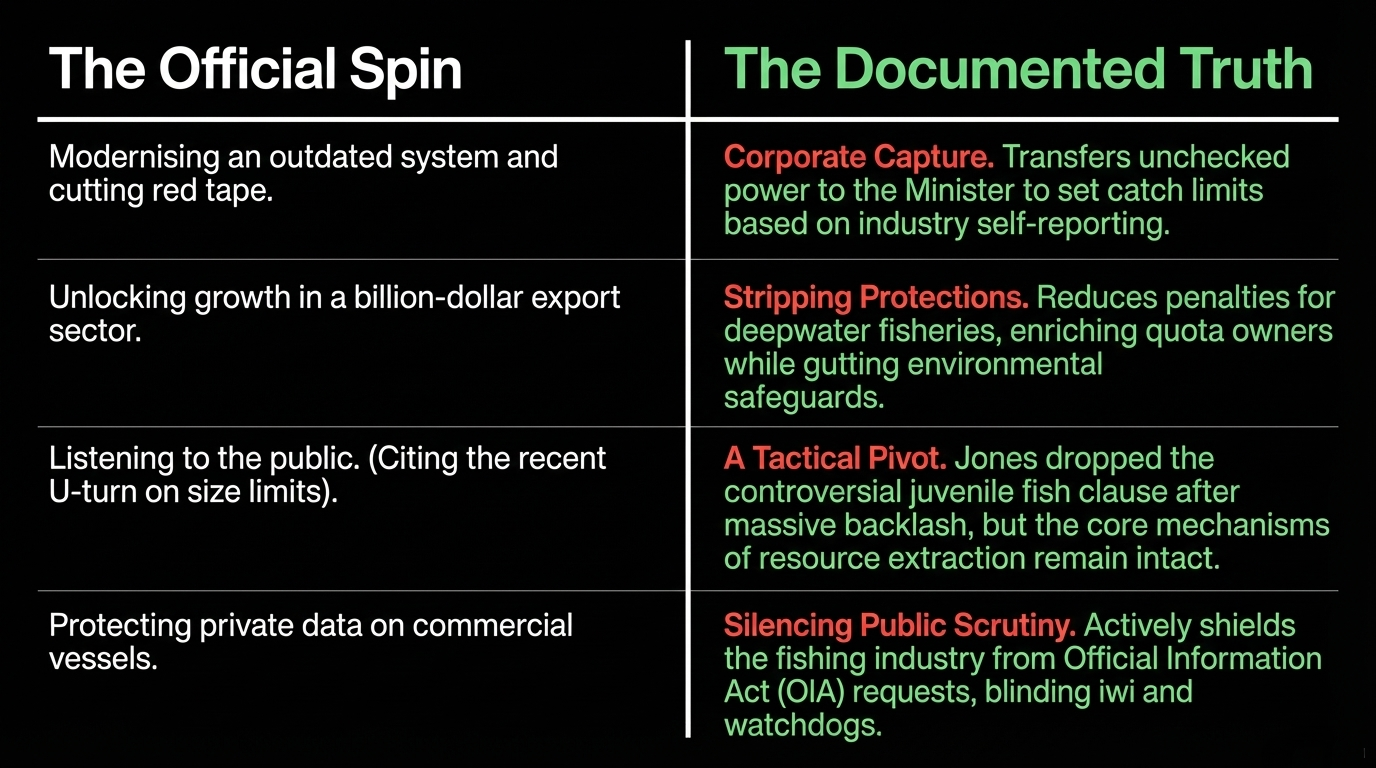
On 19 March 2026, Jones released what LegaSea described as "the most sweeping changes to fisheries legislation since the quota system was introduced." The Fisheries Amendment Bill does the following:
- Removes commercial size limits on species including kingfish and snapper — allowing juvenile, undersized fish to be taken commercially
- Locks in catch limits for up to five years with only one round of public consultation, based on self-reported industry data
- Restricts OIA access to footage captured on fishing vessels — actively shielding industry from public scrutiny
- Reduces penalties for deepwater fisheries in ways that, as LegaSea notes, "enrich quota owners while weakening protections for fish"
- Transfers more power to the Minister — that is, to Jones himself — over catch-setting decisions, reducing judicial and public oversight
Jones was forced into an embarrassing backdown on the size limits clause on 24 March 2026 after a public outcry, but as NZ Herald reported, critics said the backdown "doesn't go far enough" — with Greenpeace labelling the legislation "rotten to the core."
Greenpeace Aotearoa was blunter still:
"With this bill Shane Jones has written in bold letters: I don't care what New Zealanders think or want, only the industrial bottom trawl companies who line my pockets."
Ngā Hononga Huna: Five Hidden Connections (Analysis)
1. The Talley's Money Trail
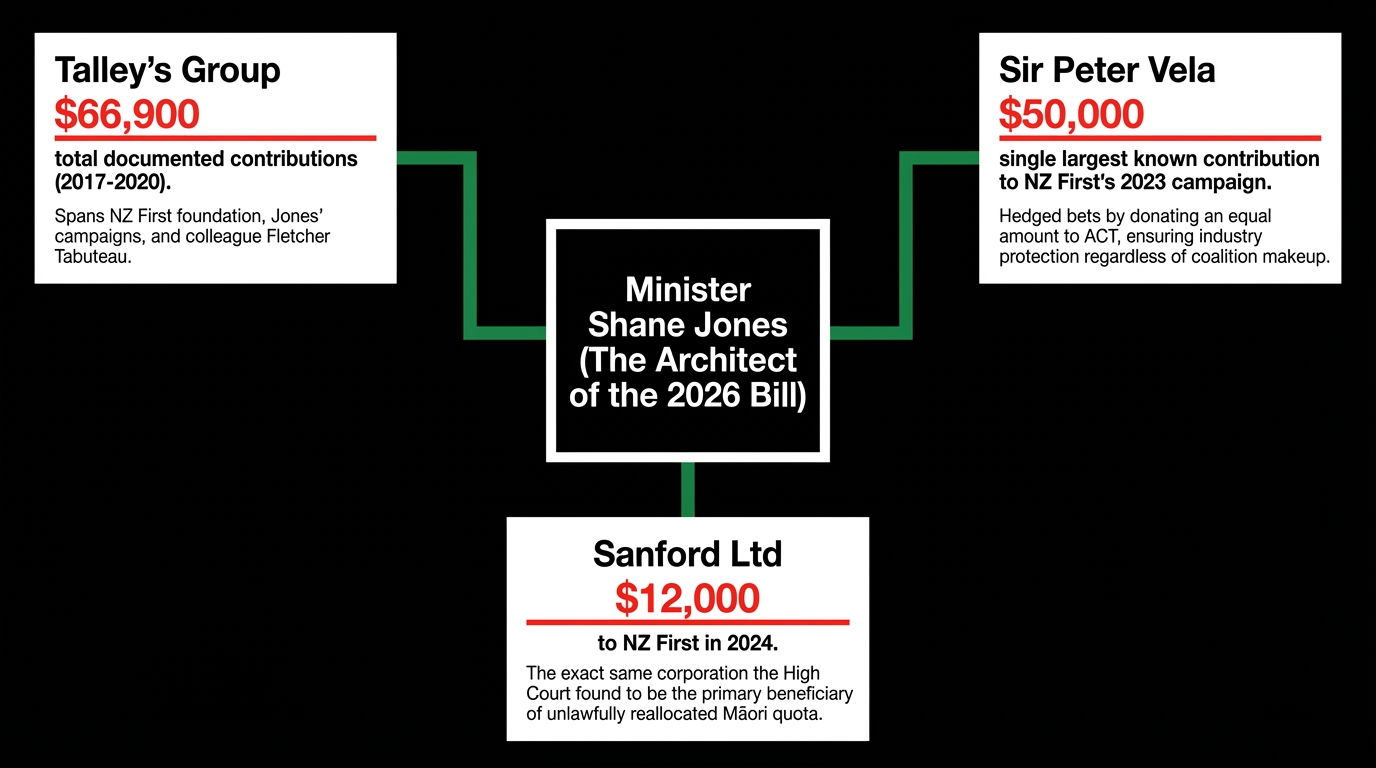
The most documented, damning, and direct connection is between Jones and Talley's Group. According to Democracy Project's Integrity Briefing, the documented money trail includes:
- $26,950 from Talley's Group and Sir Peter Talley to NZ First's foundation between 2017 and 2019
- $10,000 directly to Jones' 2017 campaign
- $2,000 to NZ First colleague Fletcher Tabuteau in 2017
- $5,000 to Jones for his 2020 campaign
Total documented Talley's contributions to Jones and NZ First: at least $66,900 across multiple election cycles. This was confirmed by 1News in 2020, when then-PM Jacinda Ardern had to publicly distance Jones from fishery decisions. The pattern continued regardless.
2. Sir Peter Vela: The $50,000 Investment
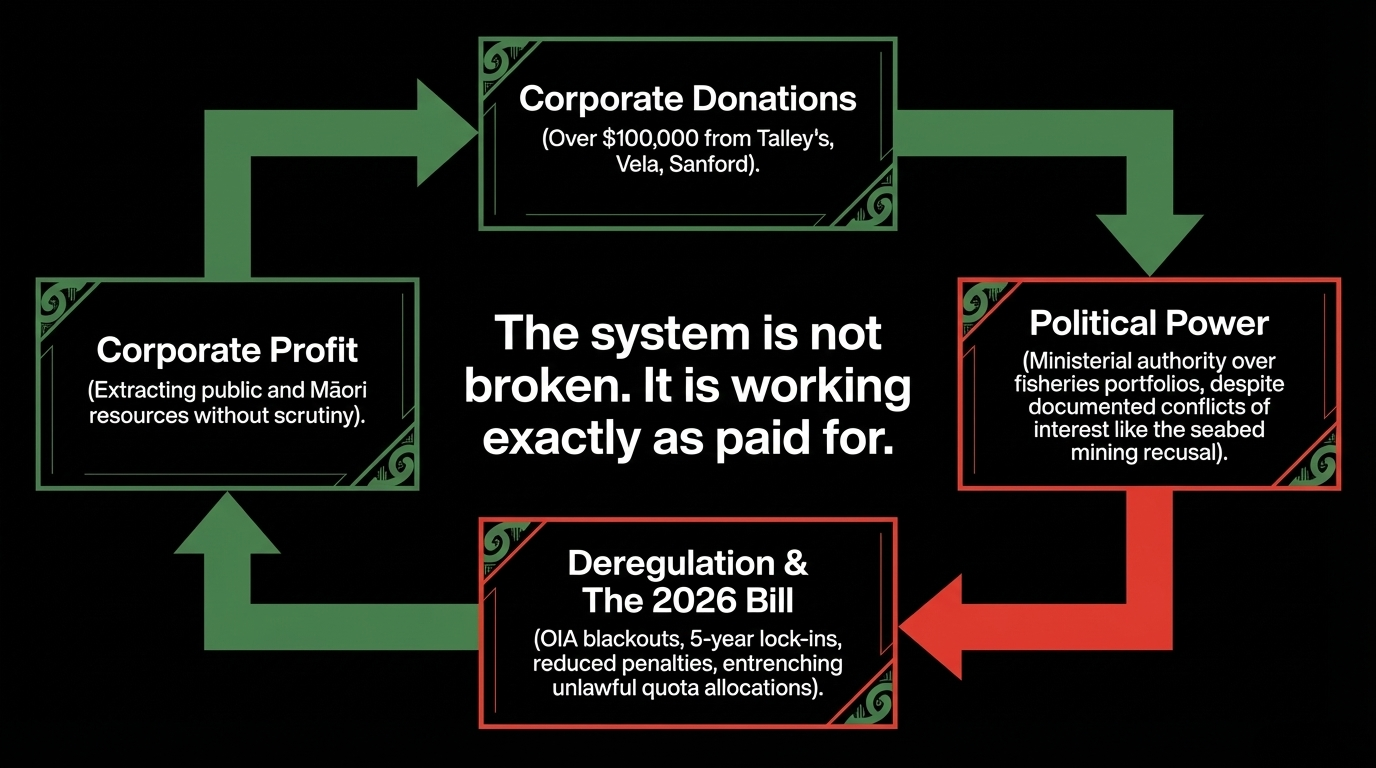
Democracy Project reveals that fishing investor Sir Peter Vela provided the single largest known contribution to NZ First's 2023 campaign — $50,000. Vela gave an equal amount to the ACT Party that same year. This is not political idealism. This is hedging — ensuring that whichever coalition governs, industry interests are protected. It worked. NZ First is in government. Jones is the Minister. The Bill is before Parliament.
3. Sanford: Quota Thief Made Donor
Democracy Project documents that Sanford Ltd donated $12,000 to NZ First in 2024, at the very time it was seeking government approvals for new salmon farms. This is the same Sanford that the High Court found had been the primary beneficiary of unlawfully reallocated Māori quota. They stole Māori quota through regulatory capture — and then donated to the party whose minister is now writing the next round of regulations. The cycle is closed and self-reinforcing.
4. The Surveillance Silencing Clause
When Jones proposed banning OIA requests for footage from fishing vessels, he wasn't just protecting industry embarrassment. He was dismantling the evidentiary foundation for future Māori quota claims. Without vessel footage, iwi and Te Ohu Kaimoana cannot document the full extent of bycatch, discard, and misreporting that underpins the current unlawful quota allocations. Jones told the NZ Herald: "Does the public have a right to know what's happening in every cow shed tonight? Does the public have a right to know what's happening in your home? No they don't." He compared fishing vessels — publicly licensed to harvest a public resource — to private homes. NZ Herald reported this without challenge. We name it for what it is: the deliberate destruction of accountability infrastructure.
5. The Fast-Track Seabed Mining Recusal — A Pattern of Capture
This is not Jones' first conflict. In August 2024, Greenpeace reported that Jones was forced to recuse himself from decisions on seabed mining under the Fast-track Consenting Act — because he was caught between competing industry lobby groups who had both funded his party. Kiwis Against Seabed Mining chair Cindy Baxter stated directly: "The mining industry got seabed mining for vanadium into the NZ First coalition agreement purely because it lobbied earlier." This is a Minister whose conflicts of interest are so extensive, so documented, that he cannot sit at the table for his own portfolio without recusing himself. And yet he remains. And yet he legislates.
Te Āhua o Te Kino: Quantified Harm to Māori
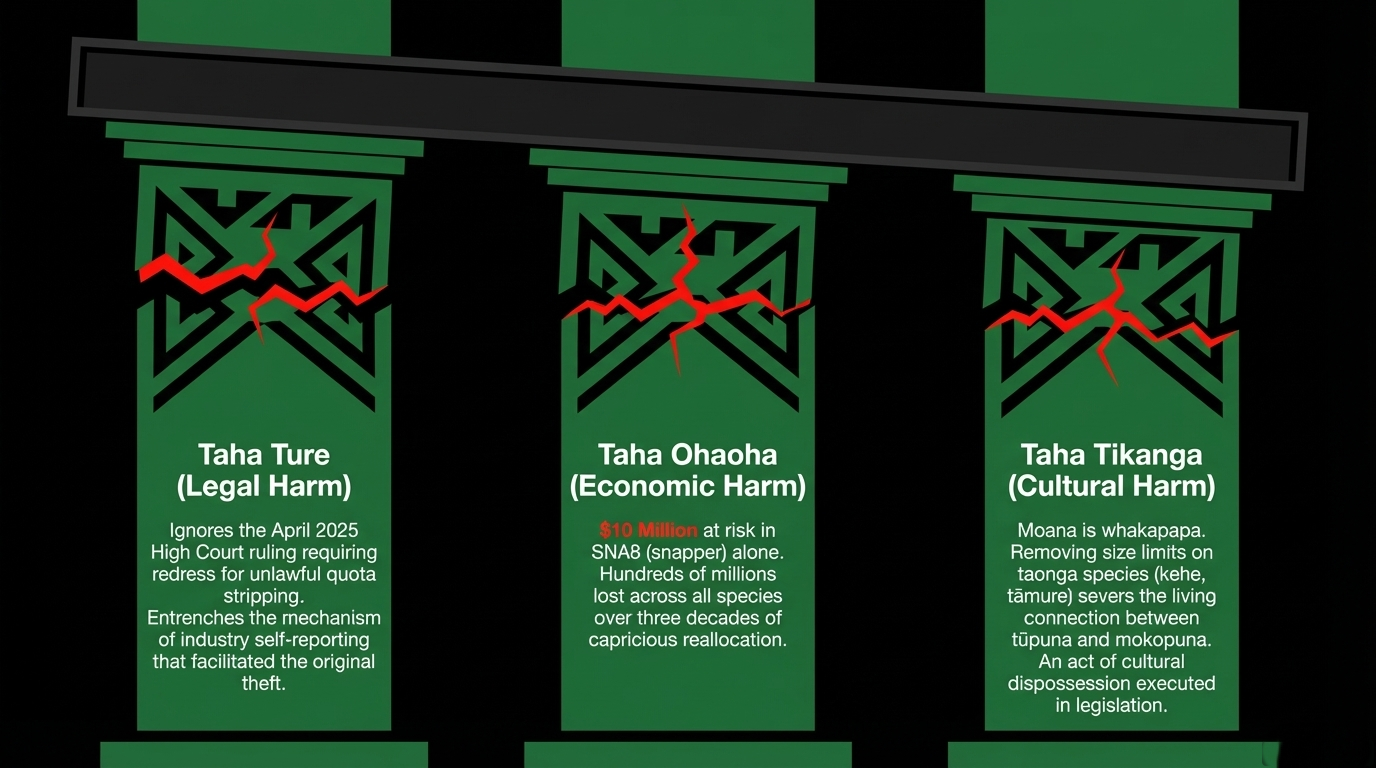
The harm here is not abstract. It operates on three levels:
Taha Ture (Legal): The High Court has already ruled the Crown is obligated to provide redress for unlawfully stripped Māori quota. The Fisheries Amendment Bill does not address that obligation. Instead, it extends ministerial power to set catch limits based on industry self-reporting — the exact mechanism that facilitated the original unlawful reallocation. Jones is not closing the wound. He is widening it.
Taha Ohaoha (Economic): The Spinoff estimates $10 million at risk in SNA8 alone. When scaled across all affected species and regions over three decades of "capricious" reallocation — the figure is almost certainly in the hundreds of millions. The 1992 settlement gave Māori a 50% share of Sealord and 20% of all quota species. The Crown has been clawing that back quota-unit by quota-unit while Jones has been either complicit, silent, or actively facilitating corporate capture.
Taha Tikanga (Cultural): Moana is not simply a resource. The relationship between iwi and te moana is foundational — it is whakapapa, it is identity, it is the living connection between tūpuna who fished these waters and mokopuna who should inherit them. The removal of size limits on taonga species like kehe (kingfish) and tāmure (snapper), the silencing of public oversight, the five-year lockdown of catch limits based on industry data — these are not regulatory adjustments. They are acts of cultural dispossession, executed in legislation, funded by donation, signed by a Māori man who should know better.
Te Whakakapi: Rangatiratanga Action
Shane Jones has form. He has a documented, multi-decade pattern of proximity to fishing industry money, proximity to regulatory power over that industry, and policy outcomes that serve that industry at the expense of both sustainability and Māori rights. Over $100,000 in documented contributions from seafood companies and executives have flowed to Jones and NZ First since 2017, as the Democracy Project confirms. The Fisheries Amendment Bill 2026 is the return on that investment.
The fallacy Jones deploys is the naturalistic fallacy of economic necessity — that commercial fishing is so important to New Zealand's economy that oversight is a luxury we cannot afford. This is false. LegaSea, Greenpeace, and Te Ohu Kaimoana have all demonstrated that deregulation enriches quota owners, devastates sustainability, and locks Māori out of the very settlement they surrendered sovereignty to secure.
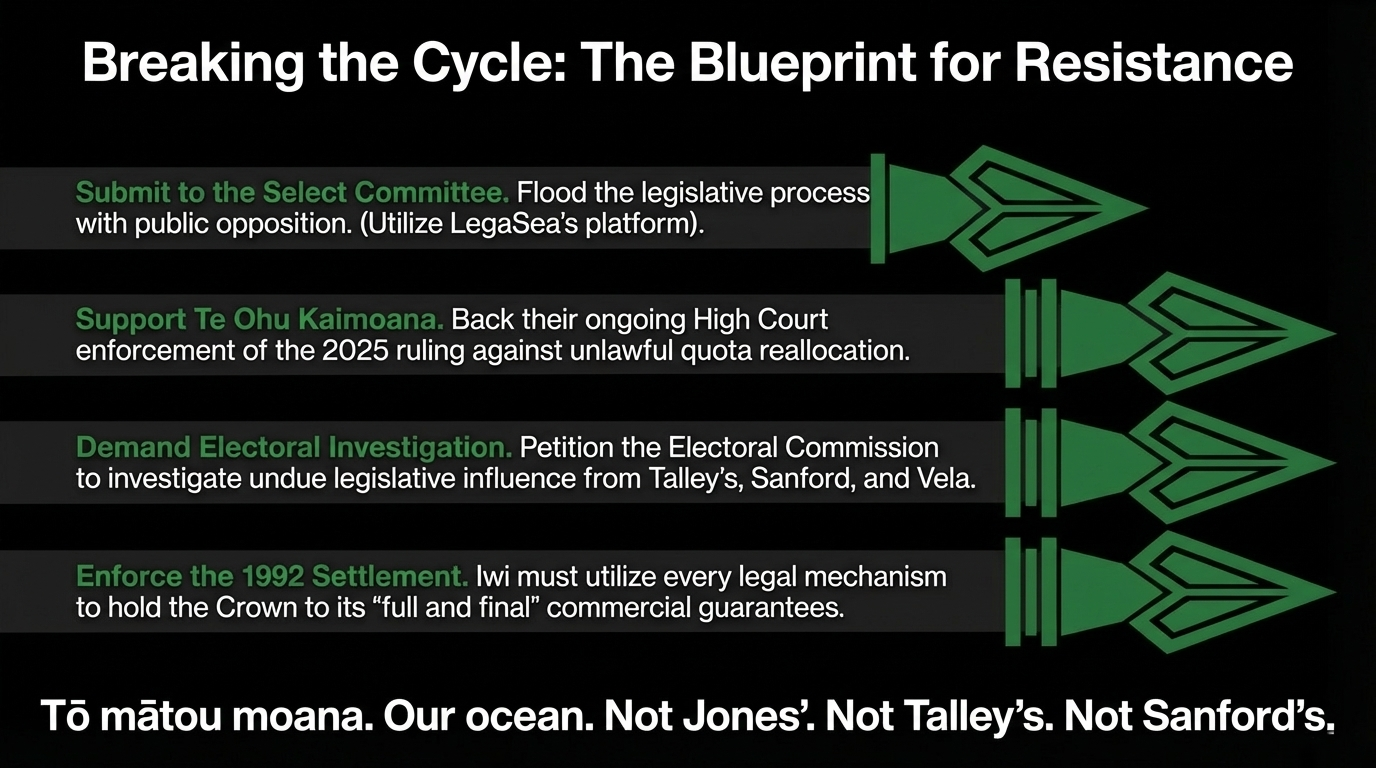
What must happen:
- Full public submissions must be made to the Select Committee — LegaSea has the platform
- Te Ohu Kaimoana must be supported in its ongoing High Court enforcement of the 2025 ruling
- The Electoral Commission must investigate whether donations from Talley's, Sanford, Vela and others constitute undue influence over fisheries legislation
- Iwi must not wait for the Crown to honour the 1992 settlement — they must enforce it through every legal mechanism available
Tō mātou moana. Our ocean. Not Jones'. Not Talley's. Not Sanford's.
Ko te moana, ko te mauri, ko te rangatiratanga — our fight, our sea, our future.
Kia kaha, whānau.
If this mahi has value, consider supporting it directly:
Koha — Support the Māori Green Lantern | Subscribe on Substack | Bank transfer: HTDM, 03-1546-0415173-000

Research Transparency: Sources consulted include RNZ, NZ Herald, The Spinoff, Democracy Project, Greenpeace Aotearoa, LegaSea, Te Ara, 1News, Undercurrent News. Research date: 30 March 2026. Claims verified against live URLs where accessible. The RNZ article linked in the original query returned a fetch error and was cross-referenced against multiple secondary sources confirming the same Bill and its provisions.