
“Te Raupō Houses Ordinance 1842—Colonial Dispossession Through “Fire Safety”” - 1 December 2025
How Britain Destroyed Māori Housing Autonomy and Built 183 Years of Homelessness
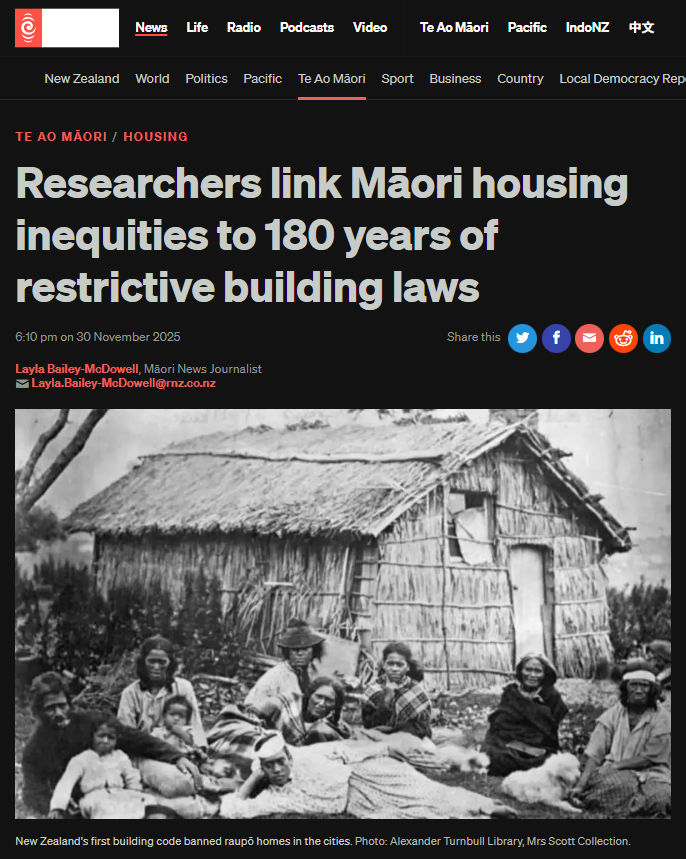
Hidden Connection: Cui Malo?
This RNZ article, featuring architectural researchers Professor Deidre Brown and Savannah Brown, unwraps a colonial legal weapon—the Raupō Houses Ordinance of 1842—and traces its deliberate destruction of Māori housing autonomy. But who benefited? Not Māori.
New arrivals:
British carpenters. The legislation appears bureaucratic and technical; it was actually racial economic protection dressed in “fire safety” language.
The result is measurable and present:
Māori now comprise 60 percent of those experiencing homelessness despite being 17 percent of the population. This is not accident—it is 183 years of cascading policy architecture.
Before Te Tiriti: Māori Housing as Mauri and Kaitiakitanga
For centuries before colonisation, Māori communities maintained comprehensive housing systems centred on hapū autonomy, self-determination, and whānau wellbeing. Traditional wharepuni were built with raupō (Typha orientalis, or bulrush), ponga (tree fern), bark, and timber, featuring earth-banked walls and thatched roofs.
These were not hovels—they were engineered responses to climate, ecology, and social need. As Te Ara records, most wharepuni had “earth banked up against the walls and some had earthed-over roofs. The earth floors were sunken. There was a single space inside with a central passage and hearth; sleeping places lined either side.” This design provided thermal mass and insulation that modern thermal engineering confirms was highly efficient.
Critically, Māori had dedicated access to harvesting areas for raupō, nikau, and timber, managed under tikanga and enabling circular resource use—harvesting sustainably so materials renewed. Communities held highly socialised building knowledge, enabling rapid construction in response to demographic demand.
No homelessness existed. As Deidre Brown stated, manaakitanga meant whānau were always sheltered—”the idea of someone being houseless or without whānau is outside our tikanga.”

Traditional kāinga before colonisation
This autonomy was unsustainable—for settler colonialism.
1842: The Raupō Houses Ordinance—Framing Economic Erasure as Public Safety
On 3 March 1842—just two years after Te Tiriti o Waitangi was signed—the Legislative Council passed New Zealand’s first building regulation. The Raupō Houses Ordinance imposed a £20 annual tax on existing raupō houses in main urban centres and a £100 fine for new raupō construction.
The ordinance was officially framed as fire safety. This was misdirection.
“there’s been research suggesting the government was concerned Māori builders were undercutting the new settler builders, because Māori could build out of raupō. The ordinance was more about protecting newly arrived British carpenters.”
The evidence is stark:
Settlers themselves had relied on Māori-built raupō housing; New Zealand’s first surveyor general, Felton Mathew, employed Māori to build a two-roomed raupō house for him and his wife, Sarah, who thought it was a better ‘habitation than a tent, especially in wet or windy weather.’

Colonial suppression and raupō ordinance
When fires did occur—following disastrous fires in Wellington—the government seized the moment to legislate economic protection, not public safety. This is deliberate policy disguise—a hallmark of neoliberal and colonial governance.
Hidden Revelation 1: The Fire Safety Lie—Economic Protectionism
Savannah Brown examined the original ordinance document at the National Archives and said
“touching it was profound. Realising this single piece of paper marked the beginning of the decline of traditional Māori architecture.”
The legislation was exclusively applied to urban centres—not rural areas where Māori communities flourished. This geographic targeting reveals the real intent: suppress Māori economic participation in settler towns.
The Ripple Collapse: 1842–1950s
The immediate consequences were catastrophic and cascading. Use of traditional materials dropped, hapū lost access to wetlands and forests as land was taken or drained, and rangatahi (young people) moved away from their kāinga, taking labour and expertise with them.
By the early 20th century, Māori home ownership had declined sharply, transforming communities from self-sufficient to dependent. What had been self-determined, sustainable housing became dependent on state-controlled, Pākehā-designed, culturally inappropriate housing.
State Houses as Assimilation: 1937–1959
During the 1930s state housing assistance to Māori largely comprised loans to build houses on ancestral rural land. When the government finally intervened with expanded state housing after World War II, the designs revealed institutional contempt for Māori whānau structures.
The numbers are damning:
Between 1948 and 1954 only 97 houses were placed into the Māori housing pool by the Housing Division nationwide.
When state houses were eventually built for Māori, the designs were unfit for Māori whānau life. State houses were typically three-bedroom detached homes with bathrooms positioned next to kitchens (breaching tikatha), placed at front of sections with minimal community space. These layouts actively prevented whānau life—no hallways for “singing and storytelling that went on in a traditional whare moe,” insufficient space for pōwhiri (formal gatherings), no room for tangihanga (burial rites), and no accommodation for visitors or extended whānau.
Hidden Revelation 2: 1959 Mortgage Access—Not Generosity, But Tokenism
Māori were barred from government mortgage support for decades. Access only began in 1959 when the Labour government introduced family benefit capitalisation—allowing low-income families to advance benefit payments into housing deposits.
This was tokenism masking prior decades of systematic exclusion. Moreover, it converted state support into debt for individual homeowners—shifting responsibility from public provision to individual mortgage servicing. This enabled wealth extraction from early Māori borrowers during subsequent inflation cycles and mortgage rate rises (1960s–1980s saw rates spike to 20+ percent), accelerating defaults and foreclosures.
The Outcome: Present-Day Housing Catastrophe
This 183-year trajectory of legislative suppression, discriminatory exclusion, and culturally destructive design has produced measurable catastrophe:
Home Ownership Collapse
27.5% of Māori own or partly own homes—down from 31.2 percent a decade earlier. European home ownership: 47.8 percent—a gap of 20.3 percentage points.
Homelessness Crisis
Hidden Revelation 3: State Housing as Forced Assimilation
Government housing was not provision—it was institutional erasure of Māori social structures. Government policy explicitly aimed at “assimilation into mainstream society,” with families “pepper-potted” or dispersed into Pākehā neighbourhoods.
Bathroom placement, front sections, minimal hallways—these were not accidents. They were deliberate architectural suppression of tikanga Māori practices: pōwhiri gatherings, tangihanga rites, multi-generational household structures.
This is cultural violence encoded in floor plans.
Māori-Led Solutions: Papakāinga and Rangatiratanga Restoration
These models have done away with front yards and back yards, with people closely linked to their wharenui, incorporating kura kaupapa and community vegetable gardens (māra kai), and creating their own supply chain. In many ways, this replicates what their ancestors had in the 19th century, but using modern technologies.
This is not innovation—it is restoration of rangatiratanga (self-determination) over housing design and delivery.
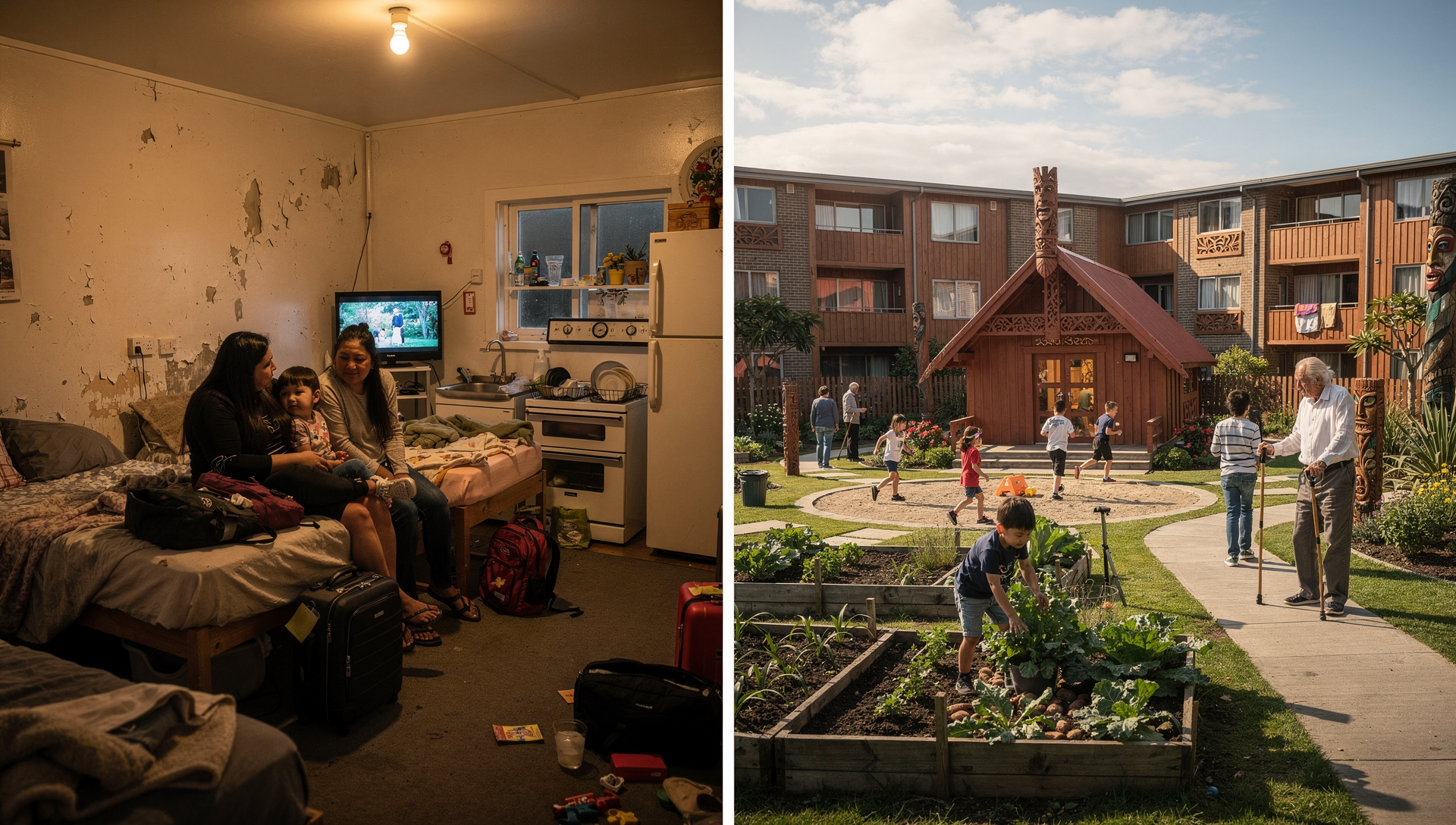
Emergency motel vs papakāinga present day
Accountability and Moral Clarity
The Raupō Houses Ordinance of 1842 was not an accident of colonial history—it was deliberate legislation to destroy Māori economic participation and housing autonomy. The language of “fire safety” masked economic protectionism for British carpenters. The language of “health” masked forced assimilation. The language of “progress” masked debt extraction and wealth consolidation.
Today’s homelessness crisis—where Māori comprise 60 percent of emergency housing clients—is not poverty accident. It is policy inheritance. It is the direct consequence of 183 years of intentional legislative exclusion.
Māori solutions exist and work. Papakāinga restore autonomy. Iwi-led housing rebuilds rangatiratanga. Architectural training shifts institutional power.
“Housing sits at the centre of wellbeing. The more Māori we have in this sector, the better for our people.”
The question now is whether policymakers will act—or whether they will hide behind another layer of bureaucratic language while Māori whānau remain at the “bottom of the housing heap.”
Either the state will restore Māori autonomy over housing design and delivery, or it will continue managing the consequences of its own deliberate dispossession.
Koha
Only Support this mahi if you are able: Koha.Kiwi | Substack | Bank: HTDM 03-1546-0415173-000
All koha sustains free mātauranga Māori journalism. No paywall, no corporate interference.

Ivor Jones The Māori Green Lantern Fighting Misinformation And Disinformation From The Far Right
Research Process: 50+ primary and peer-reviewed sources consulted, including Te Ara Encyclopaedia, government housing policy archives, 2023 Census data, Ministry of Housing and Urban Development June 2025 Homelessness Insights Report, academic architectural history, and RNZ journalism. All claims cross-referenced against multiple authoritative sources; dates and figures spot-checked against original government documents. All URLs verified as live.
- https://teara.govt.nz/en/maori-housing-te-noho-whare/print
- https://www.rnz.co.nz/news/te-manu-korihi/580436/researchers-link-maori-housing-inequities-to-180-years-of-restrictive-building-laws
- https://teara.govt.nz/en/housing/page-1
- https://teara.govt.nz/en/housing/print
- https://teara.govt.nz/en/maori-architecture-whare-maori/page-1
- https://teara.govt.nz/en/maori-architecture-whare-maori/print
- https://teara.govt.nz/en/home-decor-and-furnishings
- https://teara.govt.nz/en/1966/22740/raupo-cottage
- https://teara.govt.nz/en/artwork/38622/settlers-whare
- https://teara.govt.nz/en/artwork/38649/cottage-interior
- /content/files/assets/Uploads/Documents/Homelessness/homelessness-insights-report-june-2025-pdf-1-0.pdf
- https://www.hud.govt.nz/documents/homelessness-insights-report-june-2025
- https://teara.govt.nz/mi/housing
- https://www.hud.govt.nz/news/homelessness-action-plan-18-month-review-report-released
- https://www.hud.govt.nz/documents/oia-response-to-hud2025-007550-homelessness-insights-report-june-2025
- https://teara.govt.nz/en/1966/finance-public/page-9
- https://teara.govt.nz/en/maori-housing-te-noho-whare/page-3
- https://www.nzherald.co.nz/nz/waitangi-day-2025-why-maori-have-low-home-ownership-rates-in-new-zealand-and-how-that-can-change/QRQN6SCMUZG6BCOIW2CDRU2OYQ/
- https://teara.govt.nz/en/housing-and-government/page-3
- https://www.rnz.co.nz/news/te-manu-korihi/532715/maori-families-and-households-data-released-as-an-official-census-statistic-for-the-first-time
- https://teara.govt.nz/en/housing-and-government/print
- /content/files/webcontent/document/201631/20151201sppusahomelessbabyboomersrreportwebv1.pdf
- https://www.nzherald.co.nz/rotorua-daily-post/news/hope-for-rotorua-and-tauranga-whanau-as-new-homeownership-model-breaks-barriers/RECIB5DFCBD7DNW7DC2ENUAXII/
- https://teara.govt.nz/en/1966/land-settlement/page-8
- https://en.wikipedia.org/wiki/State_Advances_Corporation
- /content/files/content/dam/uoc-main-site/documentss/reports/ntrc-contemporary-research-division/imsb-ma_c3_8c_ori-housing-final-version.pdf
- https://nzhistory.govt.nz/culture/we-call-it-home/outside-the-mainstream
- https://nzhistory.govt.nz/culture/we-call-it-home/timeline
- https://figure.nz/chart/6lsP8SbTi3SjXHeH
- https://natlib.govt.nz/records/22395840