"Te Rerenga o te Kūkupa - Luxon and the Final Flight of the Wingless Pigeon" - 8 March 2026
“He iti te mokoroa, nāna te rākau i kakati.” — The small grub fells the great tree.

Mōrena ano Aotearoa,
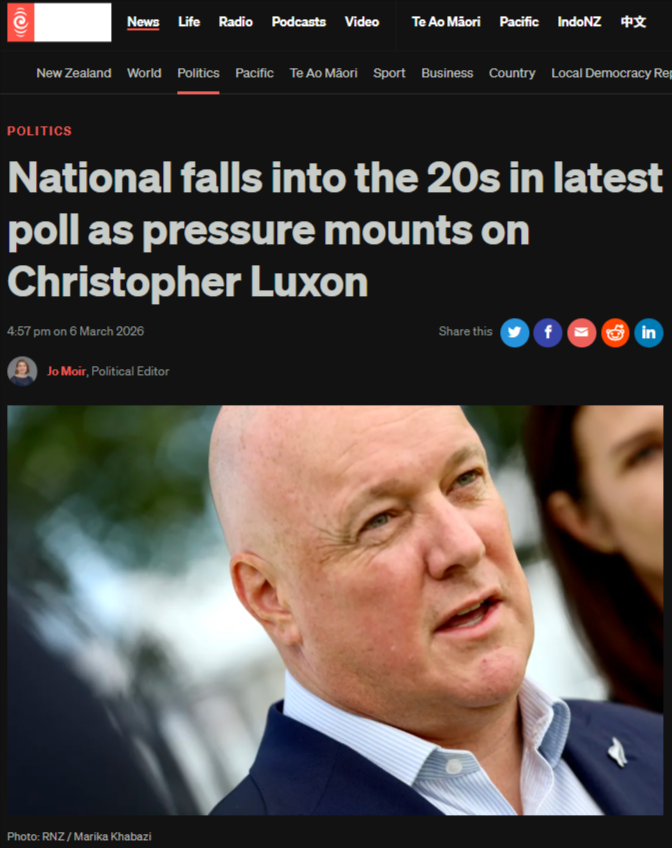
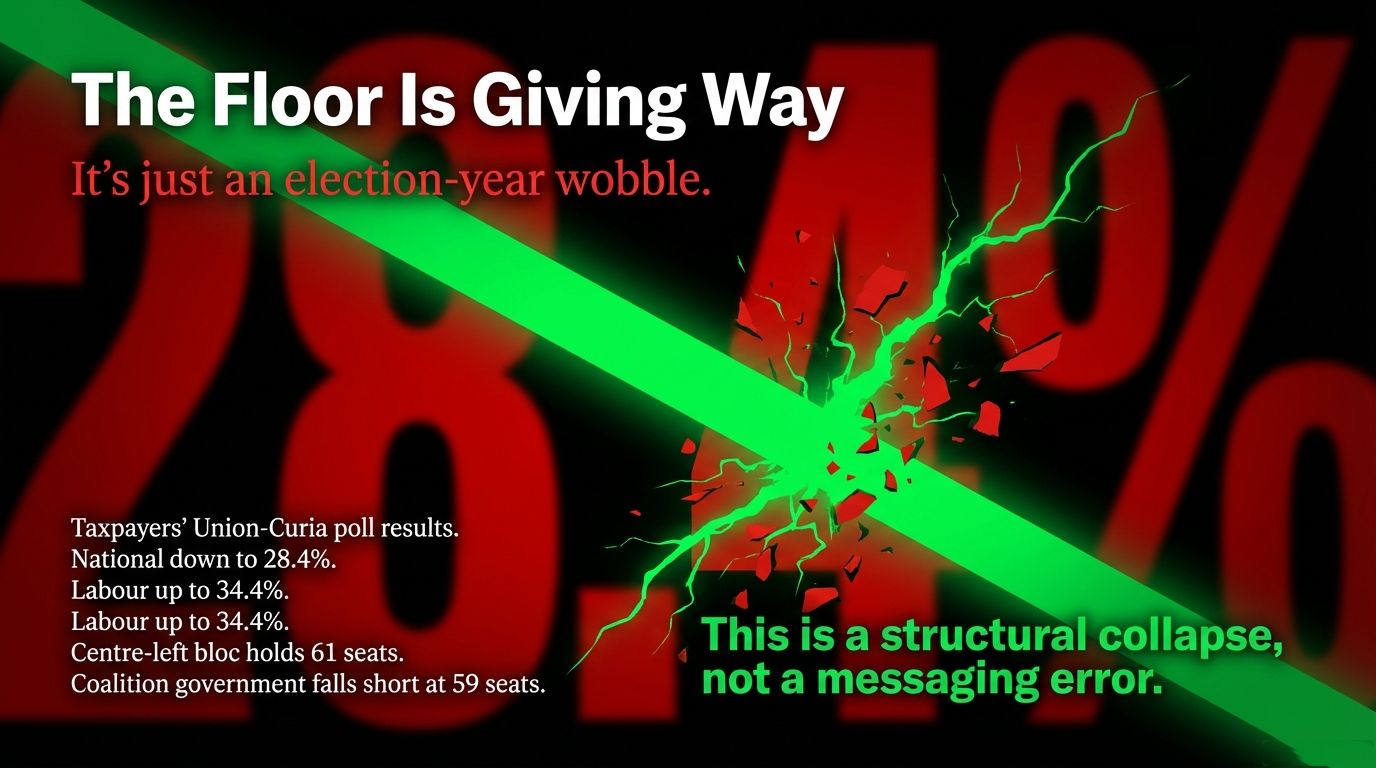
Christopher Luxon is not being brought down by a single scandal, a single enemy, or even a single bad week. He is being hollowed out. Hollowed out by a caucus that no longer trusts his instincts, by coalition partners who can smell weakness, by a public that has stopped hearing authority when he speaks, and by a pattern that is now too obvious to deny: when the pressure rises, Luxon miscarries the moment. The latest Taxpayers’ Union-Curia poll did not merely show National slipping. It put National on 28.4%, behind Labour on 34.4%, and on those numbers the governing bloc would fall short of power while the centre-left would scrape to 61 seats, as reported by RNZ. That is not a wobble. That is the sound a governing party makes when the floor begins to give way.
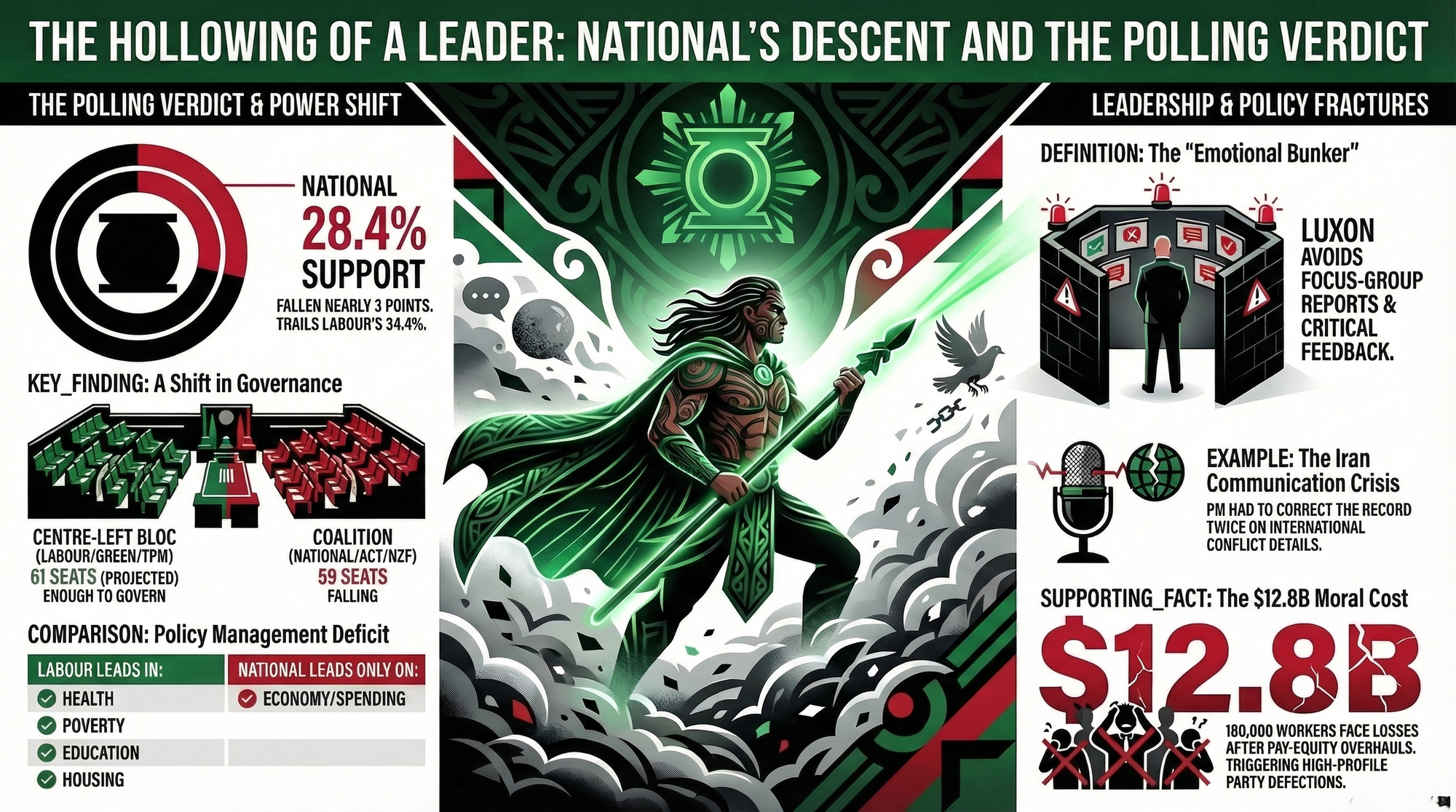
The conventional reading is too shallow. Commentators will say this is about messaging, optics, and the usual election-year nerves. That is comforting nonsense. What is happening to Luxon is deeper than presentation. It is about credibility, internal authority, and the collapse of belief among the very people who are supposed to carry him to the next election. Once a leader starts looking brittle in front of the public, evasive in front of the media, and strangely insulated from bad news inside his own operation, the problem is no longer tactical. It is structural. And structural failures do not get solved with a brighter smile, a tidier line, or one more reset.
When the Leader Stops Hearing
The most revealing reporting of the week did not come from the poll itself. It came from Jo Moir’s analysis of what it would actually take for Luxon to quit. Moir reported that if anyone could persuade him to step aside, it would be Sir John Key, because Key and Luxon are close and have usually checked in almost weekly, as reported by RNZ.
But the real bombshell sat beneath that:
Moir reported that one of Luxon’s weaknesses is his inability to take feedback from colleagues, staff, and officials, and that this has at times extended even to Key, as reported by RNZ. More than that, she reported his “complete lack of self-doubt” has recently extended to him not reading focus-group reports because much of the criticism says Luxon himself is the problem, as reported by RNZ.
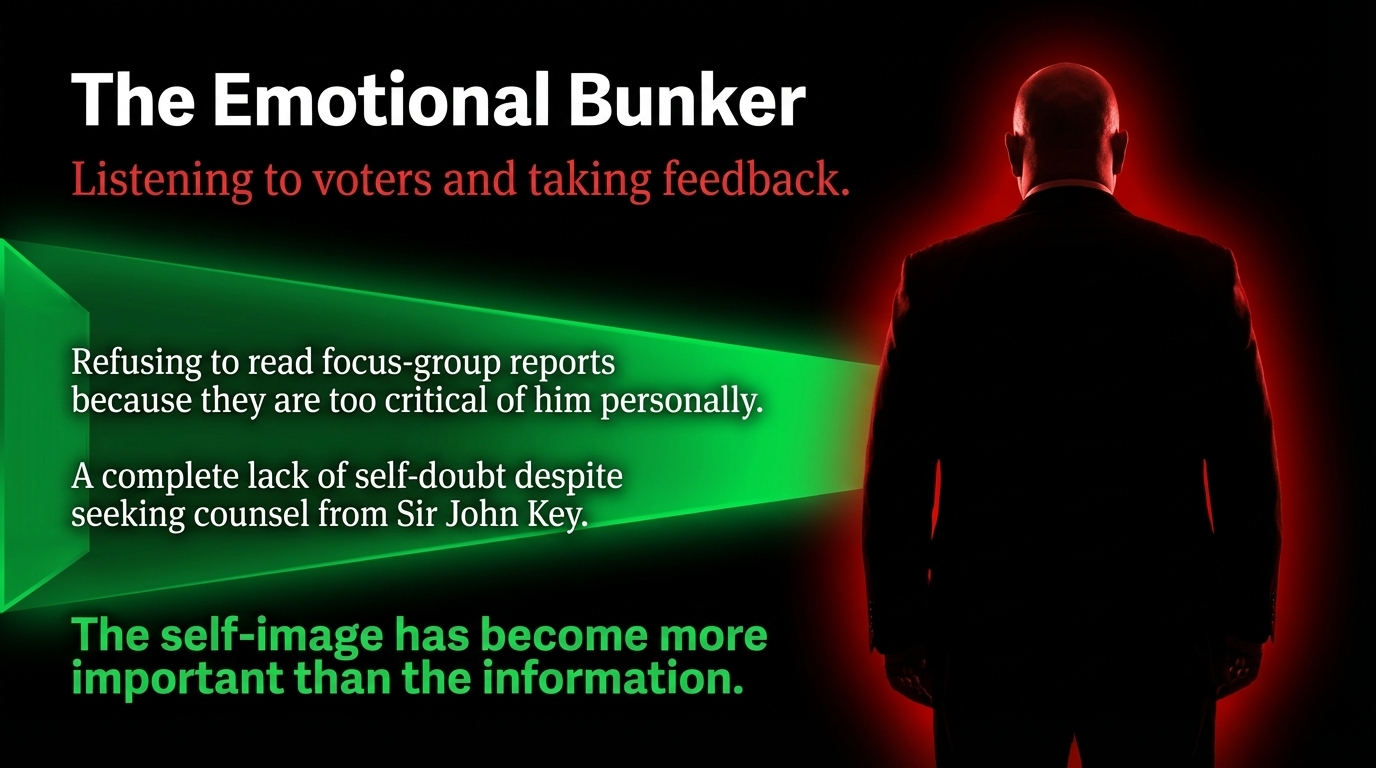
Sit with that for a moment. A Prime Minister is facing public slippage, internal chatter, coalition strain, and mounting evidence that voters are not buying what he is selling. And the reporting says he may be refusing to read the focus-group reports because they are too critical of him personally. That is not normal political stubbornness. That is a leader building an emotional bunker around himself. It is what happens when the self-image becomes more important than the information. Every failing government eventually develops its own house style of denial. This appears to be Luxon’s: if the message is painful, question the messenger; if the evidence is ugly, avert your eyes; if the polls are brutal, insist the “real” ones say something kinder.
Iran Was Not a Gaffe. It Was a Reveal.
The poll landed after a week that stripped Luxon bare. RNZ reported that the survey came at the end of a week in which Luxon had to correct the record twice after misspeaking on the US-Israel attack on Iran, and that this had prompted chatter in caucus and among coalition partners that he was struggling to articulate the government’s message, as reported by RNZ. One of those episodes was especially bad. RNZ reported that during Question Time, Luxon said he understood visa extensions were being granted automatically to people affected by the Iran war, even though Immigration Minister Erica Stanford had already said any extensions would be handled case by case, as reported by RNZ. RNZ then reported that Luxon later corrected the record, only to make another incorrect claim about the absence of a blanket extension for Ukrainians, despite Cabinet papers showing otherwise, as reported by RNZ.

That matters because it goes beyond the usual “misspoke” excuse politicians reach for when they want to downgrade a failure of judgment into a failure of wording. A prime minister can survive the occasional verbal stumble. What becomes dangerous is the pattern: speaking too fast on serious matters, not knowing the operational detail behind what is being said, then correcting the correction and digging deeper into the hole. On domestic politics you may survive that with a grin and a diversion. On war, visas, and international crisis, it lands differently. It makes people wonder whether the problem is not merely that Luxon says the wrong thing, but that he does not fully grasp the weight of the thing he is saying. Once that doubt sets in, it poisons everything else.
The Polling Excuse Tells on Him
There was another line this week that deserves far more scrutiny than it has received. Luxon said he was “absolutely not” considering standing down, said all his ministers backed him, and said the only polling he took note of was National’s own internal polling “processed in the United Kingdom,” as reported by RNZ. But RNZ also reported that Curia — the same outfit that delivered National’s ugly 28.4% result — is National’s internal party pollster, as reported by RNZ.
That contradiction is revealing. Either Luxon is leaning on some mysterious secondary operation to soothe himself against the evidence piling up in plain sight, or he is trying to create enough fog around “the real numbers” that he can perform confidence he does not genuinely feel. Neither possibility is reassuring. A leader in command says: the number is bad, we hear it, we will respond. A leader losing command starts talking about other numbers, better numbers, truer numbers, numbers somewhere else. The most dangerous story a party can tell itself is that the public is wrong and the private spreadsheets know better. Politics is littered with the wreckage of leaders who mistook curated internal comfort for actual consent.
Jackie Blue and the Cost of Moral Injury
If Luxon’s defenders want to insist this is only about communication, Jackie Blue has already wrecked that alibi. The former National MP quit the party and joined the Opportunity Party this week, saying the government’s handling of pay-equity changes was her breaking point, as reported by 1News and RNZ. Blue said she had belonged to National for 50 years, as reported by 1News. When a fifty-year loyalist publicly walks, that is not background noise. That is a moral event inside a political organisation.
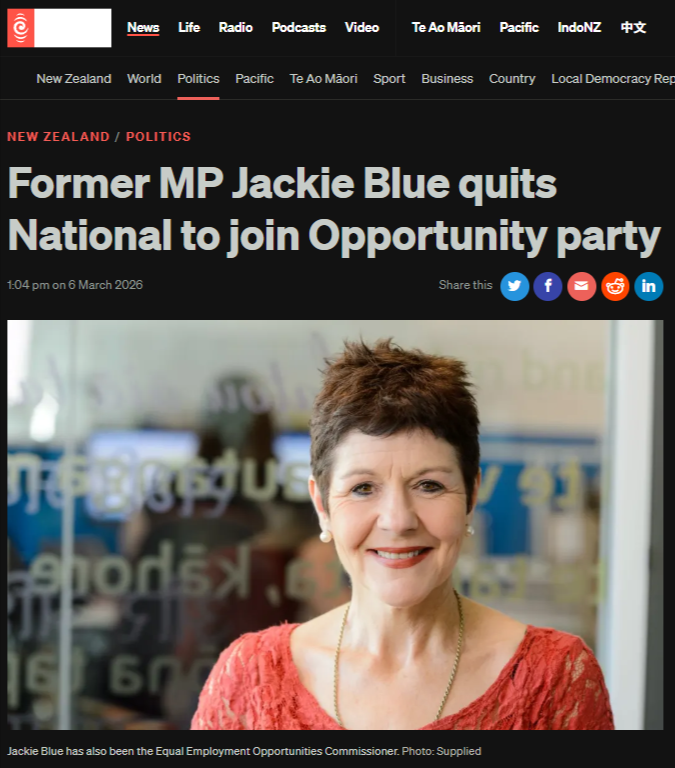
Blue did not leave over tone. She left over substance. She called the Equal Pay Amendment Act 2025 “a hatchet job on 180,000 workers” and said she would “never forget or forgive” what the government had done to low-paid workers, mostly women, as reported by 1News and RNZ. That anger is rooted in fact. RNZ reported that the bill was passed under urgency in May 2025 and that 33 current claims would be dropped and restarted, as reported by RNZ. Later, Nicola Willis confirmed the changes created $12.8 billion in savings over the forecast period, as reported by 1News and RNZ. RNZ also reported that around 180,000 workers pursuing pay-equity claims could face significant losses from the overhaul, as reported by RNZ.
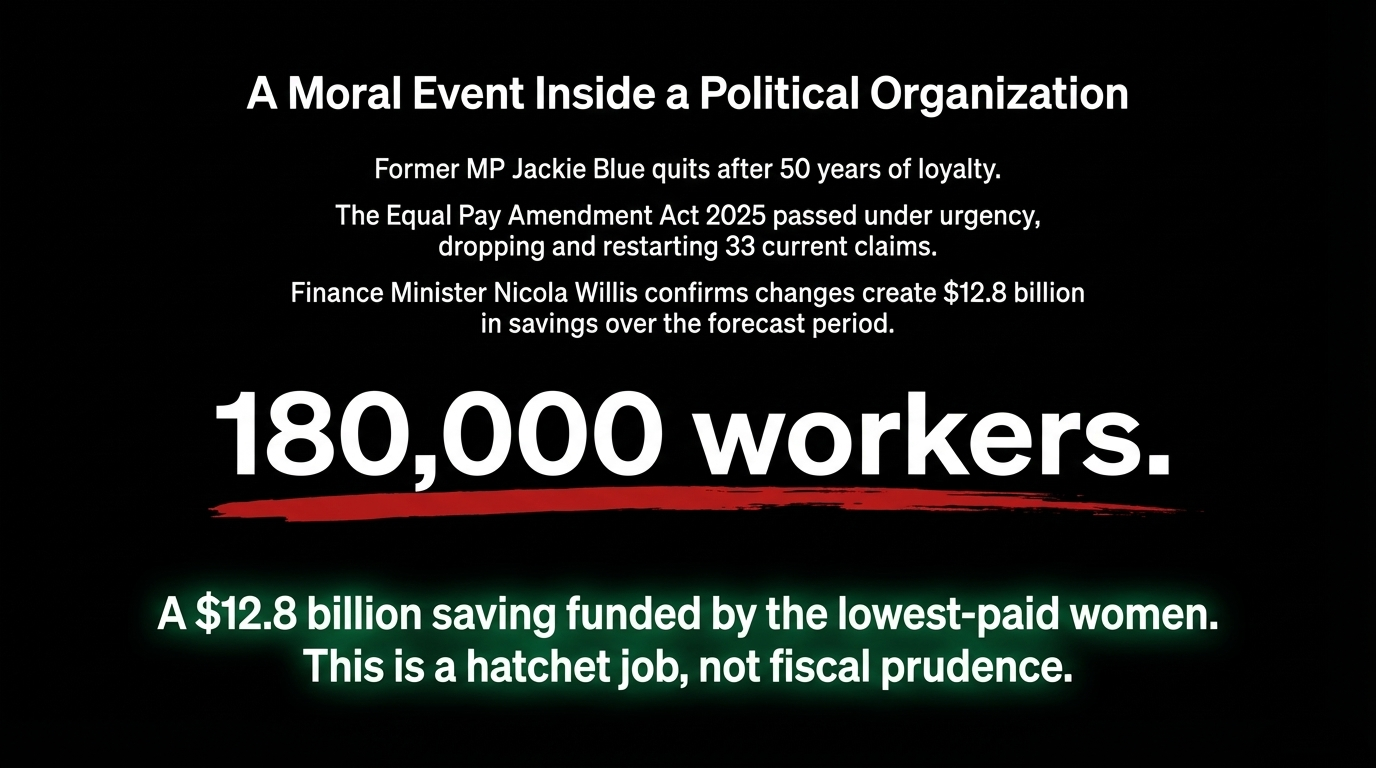
That is where the deeper damage sits. Governments can survive being disliked for doing hard things. What they struggle to survive is being seen to have done something mean, unfair, and unnecessary to people who were already underpaid, and then using the fiscal gain elsewhere. Once voters begin to experience a government as cold rather than competent, cruel rather than disciplined, the whole emotional contract changes. Jackie Blue’s resignation matters because it turns that public sentiment into an internal indictment. It says this was not only condemned by unions, Labour, and the usual critics. It was condemned from inside National’s own whakapapa.
The Coalition Smell Weakness
Winston Peters’ public reaction to the poll was only five words — “It is not good, is it?” — but it was enough, as reported by RNZ. On the same numbers, New Zealand First sat on 9.7% and ACT on 7.5%, as reported by RNZ. That arithmetic matters because every point National loses strengthens the bargaining power of the smaller parties around it. A weak senior partner does not calm a coalition. It invites extraction.
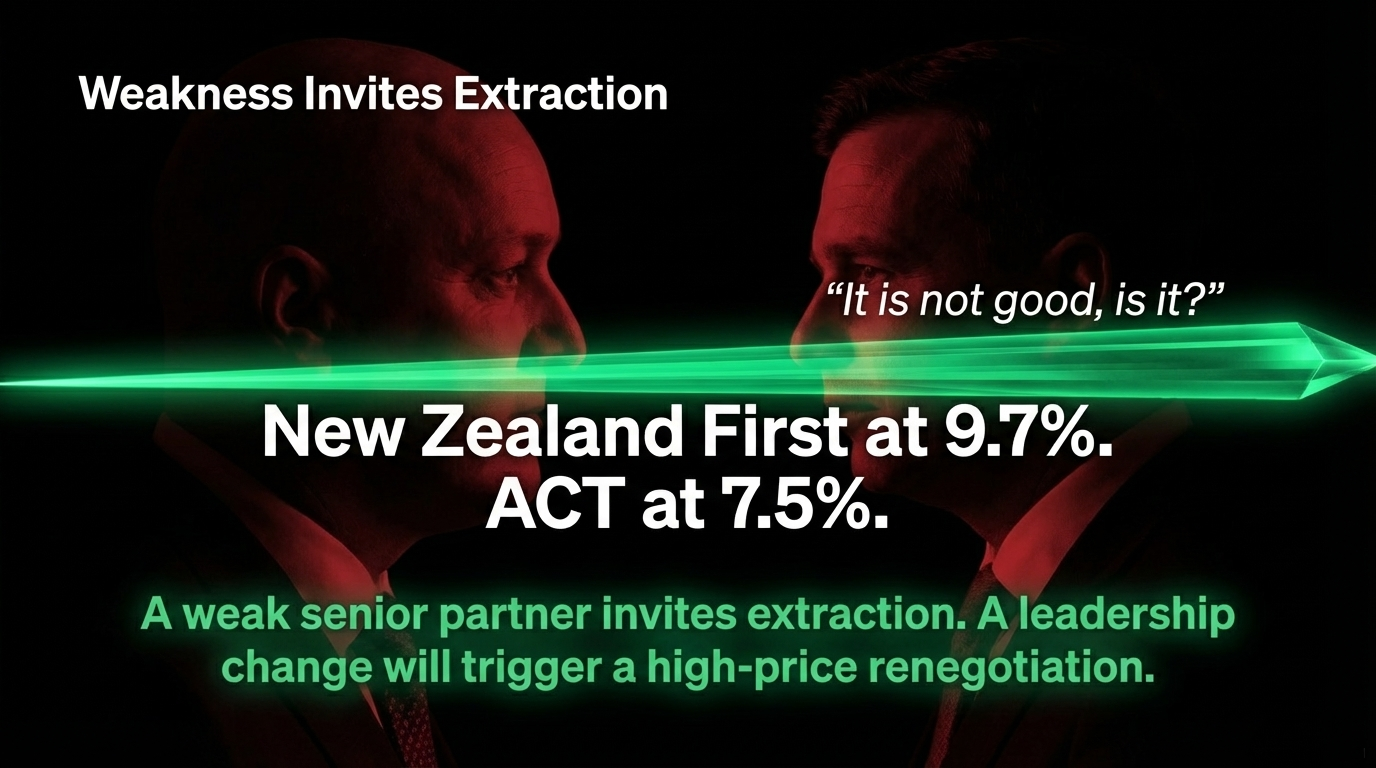
Jo Moir’s analysis made the stakes plain. She wrote that if National changed leader, Peters and Seymour would not tolerate changes to the coalition agreements already made by Luxon, and that if a fresh leader wanted to revisit any of those commitments it would be “game-on” for New Zealand First and ACT to renegotiate and ask a high price, as reported by RNZ. That is the hidden trap waiting beneath every fantasy of a clean leadership reset. Replacing Luxon may help National’s TV appearances. It may even produce a small sugar hit in the polls. But it would also reopen power relations inside the coalition at the precise moment National is least able to dictate terms. ACT would demand ideological continuity. Peters would demand leverage. And both would know National had come to them weaker than before.
The Empty Chair Problem
Then there is Chris Bishop. RNZ reported that Bishop had boarded a flight to India and would not be in Wellington for the caucus meeting unless he returned early, as reported by RNZ. That one detail captures National’s predicament almost perfectly. The leader looks wounded. The chatter is real. But the most obvious replacement is not even physically present at the centre of the drama.
That matters because leadership spills are not driven by vibes. They are driven by logistics, numbers, nerve, and timing. A bad poll creates permission for movement, but not movement itself. To cut a leader loose, a party needs a successor who is ready, supporters who are committed, and a credible argument that the damage of acting is lower than the damage of waiting. Right now National appears to have concern without cohesion. Plenty of people may be thinking the same dark thoughts, but until one person can gather those thoughts into a fact on the floor of caucus, Luxon remains alive. That does not make him safe. It makes him suspended.
What Happens Next
Here is the hard prediction. Luxon probably does not go immediately. Everything in the verified reporting points to a man who still believes he can push through the storm. He has said he is “absolutely not” considering standing down, said he has the skills to lead, and claimed the full support of his team and caucus, as reported by RNZ. Moir’s reporting suggests the deeper obstacle is not doubt but the absence of it, as reported by RNZ. Leaders like that rarely walk because the numbers turn ugly. They walk only when reality is forced into the room by people they can no longer ignore.
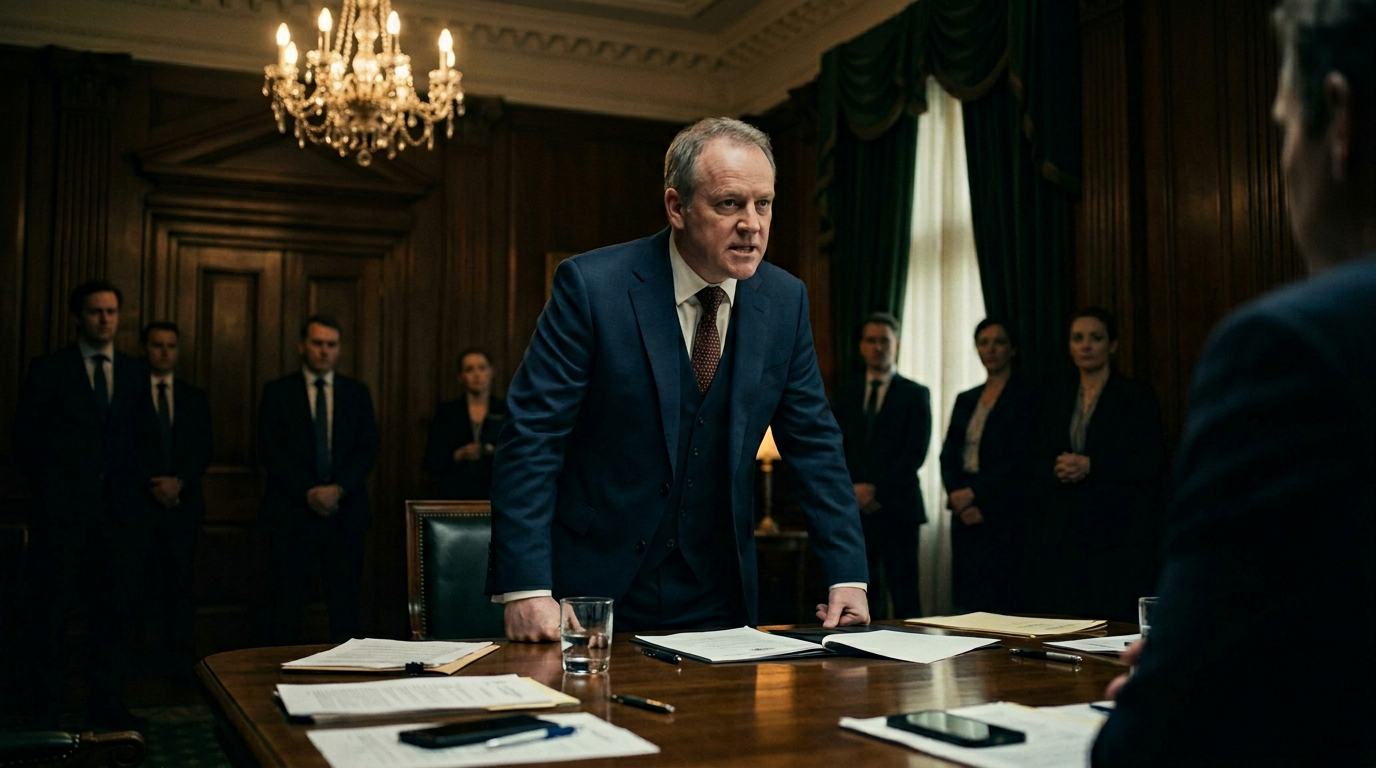
So the likeliest short-term outcome is not a weekend resignation or an immediate caucus execution. It is a slower bleed. Luxon survives the first panic, fronts up, repeats that he has support, blames overexcited media, and carries on. But survival is not recovery. If National stays stuck in the high 20s, if he continues to buckle under pressure, and if coalition partners keep subtly distancing themselves, then the question changes from whether he is a drag to when the drag becomes intolerable.
That is why the strongest forecast remains this:
Luxon is more likely than not to be removed before the 2026 election, but National is still more likely than not to lose even if it makes the switch. A replacement — probably Bishop, because he remains the most saleable senior figure — may stop the immediate rot, but it will not reverse the deeper political damage. The government has already told too many people who it is. It has already used urgency too casually, contempt too freely, and discipline too selectively. Leaders can be changed. Political meaning is harder to scrub off.
The Main Vine
Kia mau ki te aka matua, kei mau ki te aka taepa. Hold fast to the main vine, not the hanging vine.

The hanging vine is the comforting fiction that National’s trouble is one man, one mouth, one sequence of messy interviews. The main vine is the truth underneath: this government has combined managerial arrogance with policy cruelty, and now acts shocked that the public mood has turned against it. The pay-equity changes were not an accident. The use of urgency was not an accident. The constant assumption that presentation can rescue substance was not an accident. They are all pieces of the same governing character, as shown in the reporting on the pay-equity overhaul by RNZ, the fiscal savings confirmed by 1News and RNZ, and the latest collapse in confidence recorded by RNZ.
The boardroom mind always thinks the crisis is one of delivery. Speak better. Smile more. Tighten the lines. Reassure the market. But people are not shareholders and a country is not a quarterly report. Sooner or later the public stops mistaking polish for authority. Sooner or later the numbers stop being a warning and start becoming a verdict. National at 28.4% is not just a bad poll. It is the sound of a mask slipping.
Ka tū te taiaha. Ka mau te rākau. Ka ora te iwi.
The taiaha stands. The weapon holds. The people live.

Ivor Jones The Māori Green Lantern Fighting Misinformation And Disinformation From The Far Right