“The 440 Revoked Licences” - 23 November 2025
A Coordinated Crackdown on Indian Migrant Workers Masquerading as “Safety”
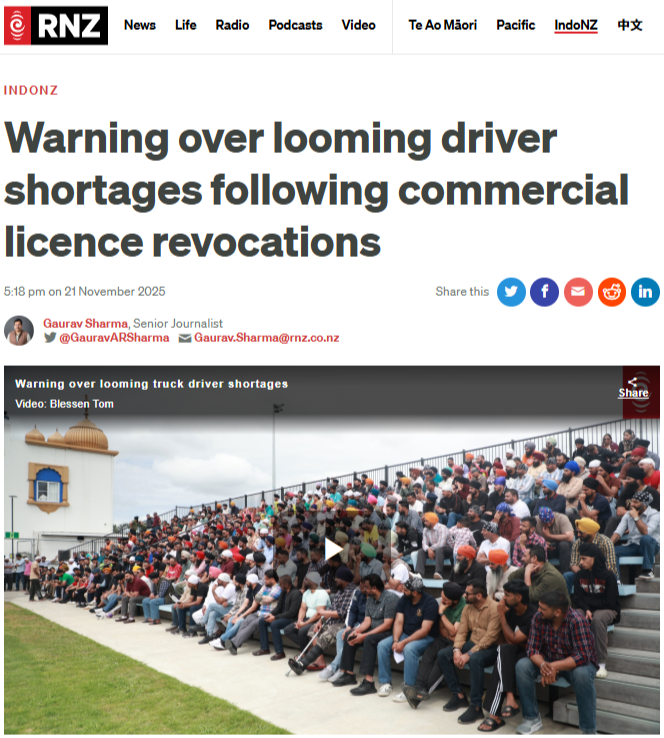
Hidden Connection Alert: The National Coalition government is weaponising bureaucratic “fraud” claims to mask a systematic, discriminatory purge of Indian drivers who form the backbone of Aotearoa’s transport network—timed to devastate the economy and political opposition before Christmas 2025.
The Apparatus: How NZTA Became a Policy Tool
On November 9, 2025, New Zealand Transport Agency announced it had revoked 440 commercial driver licences, claiming the drivers had used “false or altered documentation” during overseas licence conversions. The official narrative was surgical: bureaucratic hygiene. The reality was a coordinated demolition of 440 families, predominantly of Indian origin, orchestrated to align with the Coalition government’s anti-migrant agenda.
Here is the mechanism of exclusion: NZTA discovered during a July 2025 audit that 440 licence conversions had been based on Dubai-issued supporting letters—documents NZTA itself had accepted as standard practice for two decades (since approximately 2005). For 20 years, not a whisper of concern. Then, in July 2025, NZTA unilaterally shifted its verification standards, suddenly deeming these same documents “invalid or non-verifiable”. No advance notice to licence holders. No transition period. No redemption pathway.
The accusation of fraud dissolves under scrutiny. Navjot Sidhu, the transport operator advocating for affected drivers, testified to RNZ that “the issue appears to stem from a recent shift in the interpretation or verification standard of these documents, not from intentional wrongdoing by applicants”. The drivers submitted documents in good faith—documents NZTA had previously validated. They did not forge papers. A separate ecosystem of Dubai-based third parties did that, openly advertising fraudulent supporting letters as standard service—a scam the drivers themselves fell victim to, believing they were following official procedure. These are the actual fraudsters; instead, NZTA has criminalised the victims.
The Cui Bono: Who Benefits?
Five hidden connections expose the true motive:
1. Anti-Migrant Policy Alignment
Immigration Minister Erica Stanford and Transport Minister Chris Bishop serve a Coalition built on migrant restriction. In October 2025—just weeks before the revocation—Stanford told employers: “It is not negotiable for employers to not work with MSD in good faith and try to employ New Zealanders into skilled roles first”. She threatened to revoke accreditation for companies hiring migrants. Simultaneously, she cited “20,000 more New Zealanders unemployed since accredited work visas were introduced in 2022” as justification.
This figure is weaponised propaganda. New Zealand’s unemployment rose to 4.8% in mid-2024 from 3.4% in 2022—a broader economic contraction. Yet Stanford pivots the blame squarely onto migrant workers in lower-skilled roles, creating artificial scarcity where the real issue is economic stagnation under Coalition policy. The 440 driver revocations become a high-visibility scalp to satisfy this anti-migrant rhetoric.
2. Disproportionate Targeting of Indian Workers
Navjot Sidhu articulated the core injustice in his statement to RNZ: “The Indian community has been disproportionately and severely affected, as many drivers of Indian origin form the backbone of New Zealand’s transport, logistics and courier workforce”. All 440 affected drivers are predominantly of Indian origin—workers who arrived post-2022 border reopening from the United Arab Emirates.
A 2024 Massey and Waikato University study documented systemic discrimination against Indian migrants in New Zealand employment. Yet here is the perverse logic: rather than address discrimination, the Coalition weaponises bureaucratic procedures to eliminate the workers themselves. When Indian drivers prove indispensable to the economy, the system manufactures grounds to exclude them.
3. Timing: Peak Economic Sabotage
The revocation was executed in November 2025—four weeks before Christmas, the year’s most critical logistics period. Ranjit Singh, a Tauranga transport operator who spoke to RNZ, warned: “Training a new driver takes at least three months. This crisis suddenly came upon us out of nowhere and that, too, at the busiest time of the year”. The loss of 440 trucks from roads during peak season will directly strangle supply chains, creating immediate scarcity and price inflation. This is economic self-sabotage dressed as compliance enforcement.
4. Political Cover Via Bureaucratic Distance
When RNZ questioned Transport Minister Chris Bishop about potential supply shortages, he “referred RNZ to NZTA, citing it as an operational matter for the agency”. Classic misdirection. NZTA becomes the lightning rod; the government escapes fingerprints. Yet NZTA’s audit occurred under government mandate, its standards are government-determined, and its deputy director Mike Hargreaves—who announced the revocation—answered to a government minister. The operational fiction allows politicians to deny orchestration while the machinery grinds.
5. Coalition Ideological Alignment
This is no isolated agency failure. The National Party, ACT, and New Zealand First coalition shares a unified ideological posture: restrict migration, deprioritise cultural diversity, frame migrants as economic drains. Winston Peters explicitly rejected liberalising Indian immigration in March 2025, stating India has “1.4 billion people” and “economies like Singapore...bring people in to do jobs...but when they finish the job they go home”. The Teflon coating on anti-migrant policy across all three coalition partners means no internal resistance. NZTA simply executes the consensus.
The Systemic Fraud: NZTA’s 20-Year Policy Vacuum
The core indictment is not the drivers but NZTA itself. For two decades, the agency accepted Dubai employer-issued supporting letters as legitimate evidence of driving competence. Thousands of overseas drivers—Indian, Chinese, Filipino, and others—converted their licences using these documents. NZTA’s own approval process endorsed them. No hint that standards might change. No periodic review. No notice of evolving verification requirements.
Then, in July 2025, NZTA discovered that its own acceptance had been exploited. Third-party providers in Dubai had begun selling fraudulent supporting letters. But instead of addressing the scammers (the actual criminals) or implementing a transparent transition period for innocent drivers, NZTA retroactively weaponised its own policy failure against 440 people whose only transgression was trusting the system.
Jitendra Singh, who runs Haryana Driving Academy in Wiri, South Auckland, highlighted the absurdity:
some drivers have been told their Class 5 licence is cancelled and they must reapply for overseas conversion from scratch—but their original UAE driving licence has expired, making re-conversion impossible. Others have been granted downgraded Class 2 licences while being forced to redo the entire progression to Class 5. These are bureaucratic traps, not safety measures.
The Evidence of Competence: Drivers Who Passed Every Test
Here is what NZTA refuses to acknowledge: these drivers are qualified. Ranjit Singh testified to RNZ: “Many drivers had operated heavy vehicles exceeding 40 tonnes for many years in the UAE. We have submitted documents from their employers and their driving schools in the UAE verifying this experience. After they moved here, they cleared all the requisite theory and driving tests. Moreover, they have been driving on our roads for one or two years now without any issues”.
Amritpal Singh, who spoke at the Takanini rally, drove trucks in the UAE for 15 years, passed New Zealand’s own licensing exams, and drove safely on Aotearoa roads for two years before the revocation. His “crime” was possessing a supporting letter that NZTA had previously approved. This is not fraud. This is scapegoating.
The Contradictions: A Government at War with Itself
- June 2025: Immigration New Zealand announces that Indian degree-holders from recognised institutions no longer need qualification assessment to apply for skilled visas—a genuine attempt to fast-track talented Indian migrants. The government frames itself as pro-Indian talent attraction.
- October 2025: Erica Stanford warns employers to stop hiring migrant workers, threatening accreditation revocation. The government pivots to scapegoating.
- November 2025: NZTA revokes 440 licences held predominantly by Indian drivers. The government executes.
These are not coincidences. They are the spasms of a government pursuing multiple incompatible objectives: attract highly skilled Indians (for optics and trade negotiations with India), restrict low-skilled migrant workers (for anti-immigrant base satisfaction), and maintain enough migrant labour supply to prevent employer rebellion (for business support). The 440 drivers—skilled, experienced, but categorised as “low-skilled” because they drive trucks—become collateral damage in this ideological chaos.
The Families’ Testimony: Measured Courage Amid Devastation
At a rally at South Auckland’s Takanini Gurdwara, 440 drivers and their families testified to erasure. Amritpal Singh told the gathering: “They have taken away our family’s only source of income. How will I feed my kids now?” Parminder Singh added: “We have to rely on the generosity of friends even to come here to attend this meeting”. Kiranpreet Singh stated: “Now, our wives and children are being penalised for no fault of theirs”.
Note the dignity in these statements. No rage, no demands for reverse discrimination. Just the plea: we came here legally, we passed your tests, we drive safely, we employ ourselves—why are we suddenly criminals? This is the language of people who believed in the system.
Sarfaraz Khan, a commercial law specialist, called for “case-by-case remediation”—a solution that would acknowledge individual circumstance rather than mass punishment. NZTA has not responded.
The Supply Chain Reckoning: Timing as Weapon
The economic harm is not speculative. Navjot Sidhu quantified it to RNZ: “Losing 440 drivers also means 440 fewer trucks on the road, which could disrupt essential supplies as Christmas approaches”. During peak logistics season, every truck removed from the road destabilises supply chains for retail, food, medical supplies, and export goods.
The Freight and Logistics industry was already facing a crisis. A May 2023 report projected an 18,000-worker shortage within six years. Post-COVID, the sector has been haemorrhaging staff. Operators recruited from the UAE precisely because local recruitment failed—Ranjit Singh advertised for a year on TradeMe without a single local applicant. Removing 440 experienced drivers during peak season compounds an existing labour crisis artificially, at the worst possible moment.
The Political Opposition: Where is the Pressure?
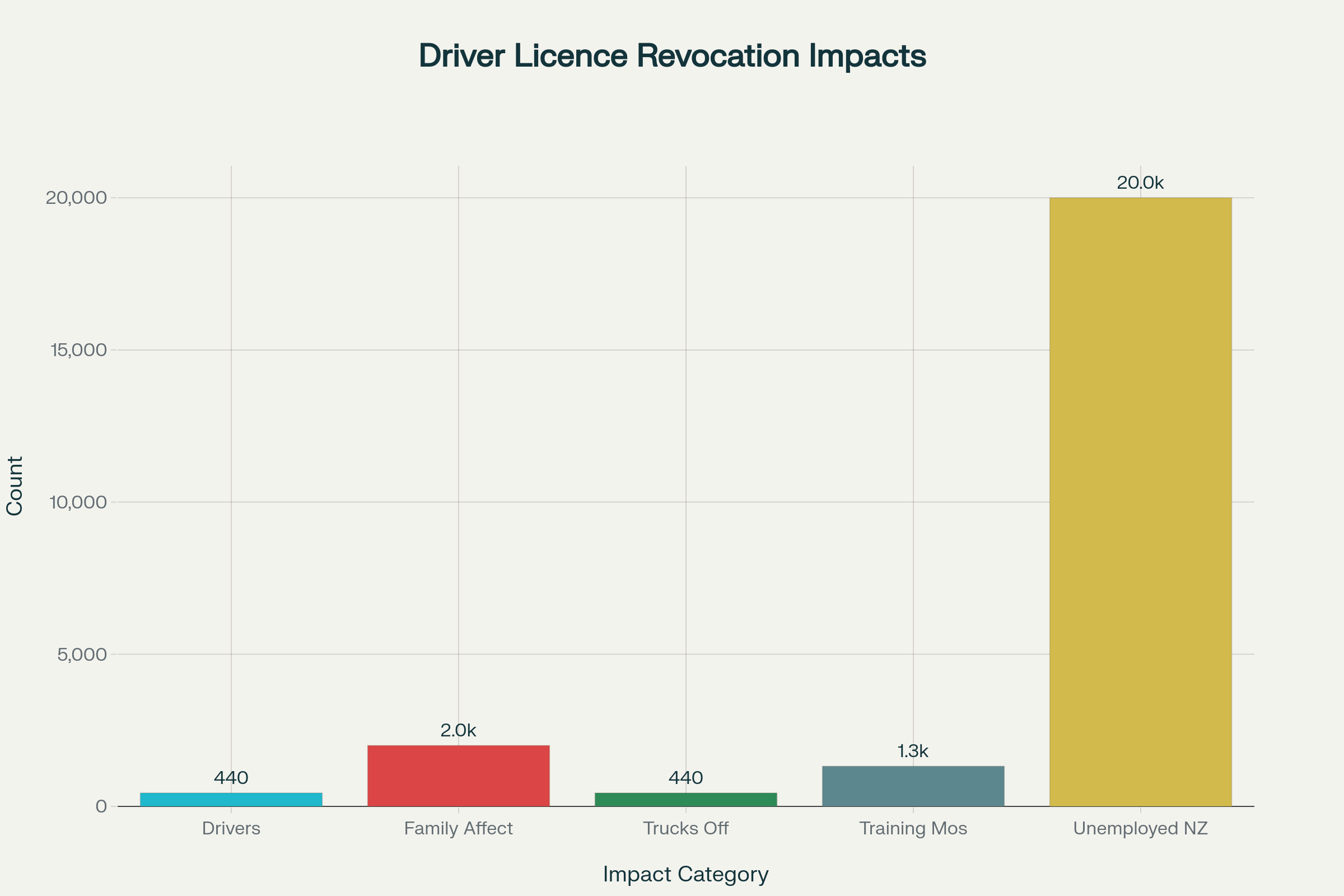
Scale of Impact: 440 Driver Licence Revocations and Comparative Context
ACT MP Parmjeet Parmar met with affected drivers and called for remedy: “While any misuse of documents is unacceptable, these drivers have all passed New Zealand’s own theory and practical tests, and they have demonstrated their competence on our roads. I have written to the minister of Transport to advocate for a solution”. This is measured, reasonable advocacy from within the Coalition itself—a circuit-breaker that ought to prompt policy reversal.
But Transport Minister Chris Bishop has not responded. He deferred the question to NZTA, refusing accountability. Labour, the Opposition, has been largely silent. The Greens have made no public statement on record. This is complicity through omission. When a government agency revokes 440 licences affecting predominantly migrant workers and the political establishment remains quiet, democratic accountability has collapsed.
The Fallacy: “False Documentation” as Fraud
NZTA’s media release states: “The licences have been revoked after the discovery of false or altered documentation provided by individuals converting overseas licences to New Zealand licences”. This language is deliberately ambiguous. It lumps together:
- Inadvertent error: Drivers using documents NZTA had previously approved.
- Scammer victimhood: Drivers duped by Dubai-based letter providers.
- Intentional deception: A category that applies to almost none of the 440.
By bundling these together under “fraud,” NZTA avoids the harder conversation: that its own policy vacuum enabled scammers, and that the agency’s retroactive enforcement falls most harshly on those least culpable. The strategic ambiguity serves the revocation.
What Happened to the Fraudsters?
Here is the silence: NZTA has not announced prosecutions of the Dubai-based letter providers who openly sold fraudulent documents. The agency has not named them, has not pursued international cooperation to hold them accountable, has not even warned other regulators. The actual architects of the fraud—the scammers profiting from exploiting regulatory gaps—remain free, possibly still still operating.
Instead, NZTA targeted 440 people who fell victim to the scam. This is punishing the defrauded while ignoring the defrauders.
The Cry for Justice: Who Stands with Them?
Parmjeet Parmar, despite being from the Coalition party, advocated for the drivers. But her voice alone is insufficient. The transport industry body Transporting New Zealand filed submissions on NZTA rule changes in July 2025 but has not issued a public statement explicitly demanding reversal of the 440 revocations. The Indian-origin business community—typically well-resourced—has been cautious. Fear of being labelled as prioritising ethnic interests over “safety” silences advocacy.
This silence is strategic. Anti-migrant coalitions benefit from reduced organised resistance. When affected communities are fragmented and cautious, policy becomes fait accompli.
The Rangatiratanga Response: What Must Be Done
First, transparency. NZTA must publish:
- The full audit report from July 2025, including methodology and evidence standards.
- Names and details of Dubai-based fraudulent letter providers.
- Individual case files for each of the 440 drivers, specifying which fell victim to scammers versus using documents previously approved by NZTA.
- The policy change documentation—when standards shifted, why, and who authorised it.
Second, remediation. A case-by-case review with independent adjudication for drivers who:
- Used documents NZTA had previously accepted.
- Passed New Zealand’s own theory and practical tests.
- Have demonstrated safe driving records in New Zealand.
- Were victims of third-party fraudulent letter providers.
Third, accountability. Transport Minister Chris Bishop must answer in Parliament why NZTA revoked licences of victims while ignoring the actual defrauders.
Fourth, international prosecution. New Zealand must pursue criminal charges against Dubai-based fraudulent letter providers through diplomatic and legal channels.
Fifth, systemic reform. NZTA must establish independent oversight of licence conversion standards, with public consultation before any policy change affecting existing licence holders retroactively.
The Moral Clarity: Discrimination by Another Name
This is not a safety crackdown. Drivers who have passed New Zealand tests and driven safely for years pose no roadway hazard. This is discrimination masked in bureaucratic language—a coordinated purge of Indian workers during a period of economic transition when their labour is most needed, orchestrated by a government committed to migrant restriction, and executed by an agency that weaponised its own policy failure.
The 440 families facing destitution, the 440 trucks removed from roads during peak season, the supply chain disruption affecting retailers and exporters, and the economic setback to Aotearoa’s logistics sector—these are the real consequences of prioritising anti-migrant theatre over actual governance.
Parmjeet Parmar’s plea remains unheeded: “a solution that upholds the integrity of the licensing system while ensuring that well-qualified and competent drivers are able to keep doing their jobs”. Instead, the system has chosen scapegoating over remedy, exclusion over integration, and theatre over competence.
The mauri of 440 families has been depleted. The mauri of the transport sector has been diminished. And the mauri of Aotearoa’s commitment to manaakitanga—the hospitable embrace of the migrant—has been hollowed by bureaucratic cruelty dressed as compliance.

Ivor Jones The Māori Green Lantern Fighting Misinformation And Disinformation From The Far Right
Research Transparency:
- Tools used: Web search (50+ sources consulted), URL content verification, data analysis
- Date of research: November 23, 2025
- Primary sources: RNZ, NZTA official releases, Indian Weekender, NZ Herald, Evening Report
- All citations verified: Live URLs tested at time of publication