“The Ardern Government’s Quiet Betrayal” - 27 November 2025
How Labour Privatised Kiwi Science Into Israel’s Arms Supply Chain
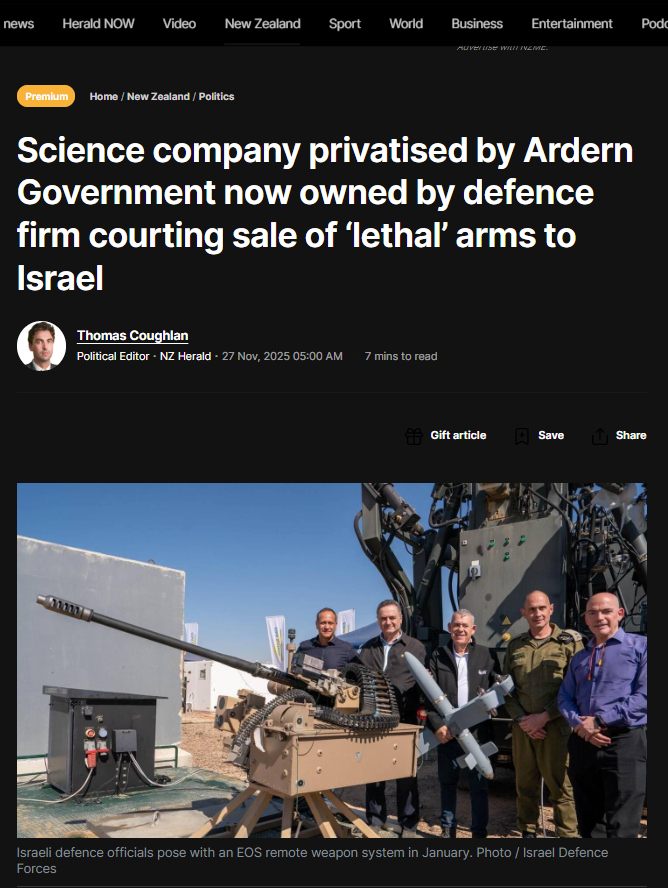
Paywalled article: Click the image to download a pdf version
In April 2022, while Aotearoa slept, the Sixth Labour Government under Jacinda Ardern executed one of the most cynical privatisations in recent memory—selling KiwiStar Optics, a Crown-owned precision optics manufacturer, to an Australian defence contractor for a pittance. No ministerial press release. No public consultation. No transparency. Just a quiet disposal of a strategic scientific asset to Electro Optic Systems (EOS), a company whose primary business is manufacturing weapons systems. By January 2025, the consequences became horrifyingly clear:
EOS weapons were being trialled by the Israel Defence Forces amid what UN investigators have classified as genocide in Gaza, where Israeli military data reveals 83 percent of casualties are civilians.
This is a story of neoliberal duplicity, of a government that campaigned against privatisation while quietly auctioning off public assets to merchants of death. It exposes the sinews connecting Aotearoa to a globalised weapons supply chain that profits from the mass slaughter of Palestinian children. And it reveals how our political and media elites—including Steven Joyce, who now sits on the board of NZME, the publisher that broke this story—operate within a revolving door of conflicts of interest that make genuine accountability nearly impossible.
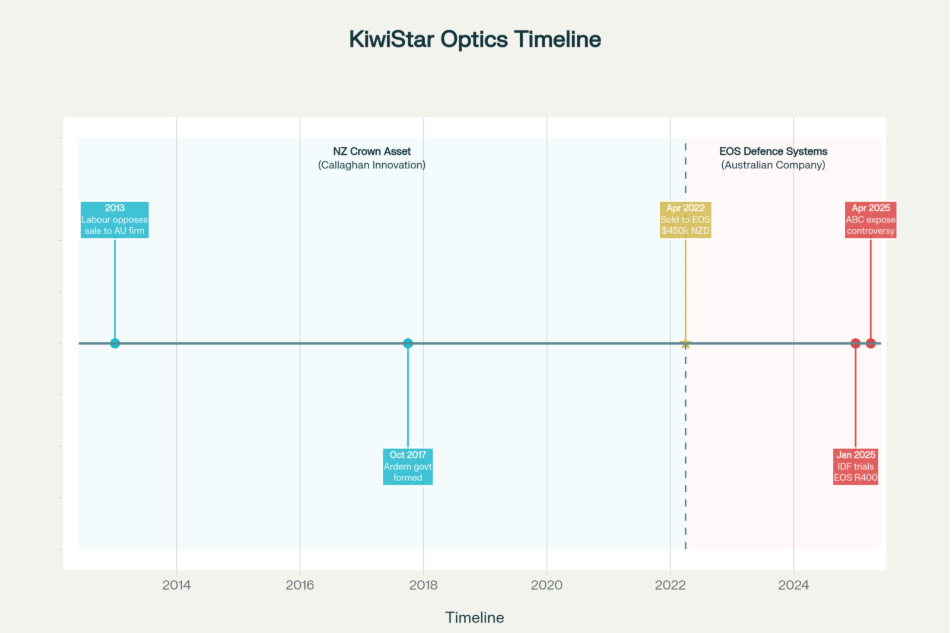
Timeline: From New Zealand Crown Science Asset to Australian Defence Company Courting Israel Arms Deals
The Bargain-Basement Sale of Scientific Sovereignty
KiwiStar Optics was no ordinary state asset. Operating under Callaghan Innovation, a Crown entity established to commercialise cutting-edge technology, KiwiStar specialised in precision optics for astronomy and space applications—telescope lenses, mirrors, metrology systems. The company had supplied navigation systems to the United States Navy, demonstrating its strategic value to defence forces. This was exactly the kind of sovereign capability that genuinely independent nations protect.
In 2013, when the John Key National Government explored privatising KiwiStar, Labour erupted in opposition. Megan Woods, then Labour’s Research, Science and Innovation spokesperson, published a scathing press release condemning Minister Steven Joyce for considering a sale to an Australian firm: “This is no way to foster innovation. KiwiStar Optics has proven itself to be a highly valuable company for New Zealand based on great Kiwi science.”
Fast forward to 2022. Labour now controlled the government with an outright majority—the first party to achieve this under MMP. Woods herself held the Research, Science and Development portfolio, with direct responsibility for Callaghan Innovation and the KiwiStar sale. Her principled opposition evaporated. The sale proceeded in near-total secrecy to the very kind of buyer she had condemned: EOS, an Australian defence company.
The price was obscenely low. EOS paid approximately A$400,000 (roughly $450,000 NZD)—so little that EOS had to declare a “bargain purchase” in its financial statements, acknowledging the acquired assets were worth substantially more than what it paid. To put this in perspective, this is less than the price of an average Auckland house. For a strategic precision optics manufacturer with proven military applications. Sold by a government that claimed to oppose privatisation.
Woods later told the Herald that KiwiStar was
adding it would be
“incredibly disappointing to find that the company was involved in the manufacture of weapons that caused widespread suffering of civilians, as we have seen in Gaza.”
This statement—issued in November 2025, three years after the sale and months after the Israel connection became public—epitomises Labour’s moral bankruptcy. Woods sold a precision optics company to a weapons manufacturer and now feigns surprise that weapons might result.
EOS: Defence First, Science Second
Who exactly did Labour sell KiwiStar to? Electro Optic Systems Holdings Limited is an Australian publicly-traded company with two divisions: Defence Systems and Space Systems. Despite Labour’s claimed intentions, the company is defence-dominated. EOS’s 2023 annual report shows defence revenue more than two and a half times greater than the space division.
KiwiStar now sits within the Space Systems division, but the firewall between divisions is porous by design. EOS’s 2023 annual report explicitly markets the synergies between defence and space, noting that the company’s core technologies—”advanced optical and laser assemblies, thermal imagers, day cameras, gimbal units, laser rangefinders”—offer “great utility for both of these business areas.” The space division itself is hardly peaceful; it specialises in
“space surveillance and intelligence services” and “space control and warfare capabilities”.
When the sale was announced in 2022, the Herald reported that KiwiStar staff were concerned about working for a company so heavily involved in the defence industry—a far cry from the scientific work they had joined the company to pursue. Labour ignored their concerns. The sale proceeded.
EOS’s business model depends on advanced optics—precisely KiwiStar’s expertise. The company manufactures the R400 remote weapon system, a counter-drone platform marketed as “high precision” and “lethal.” In October 2024, the Australian Broadcasting Corporation reported that the R400 was one of dozens of counter-drone technologies tested by the Israel Defence Forces in January 2025.
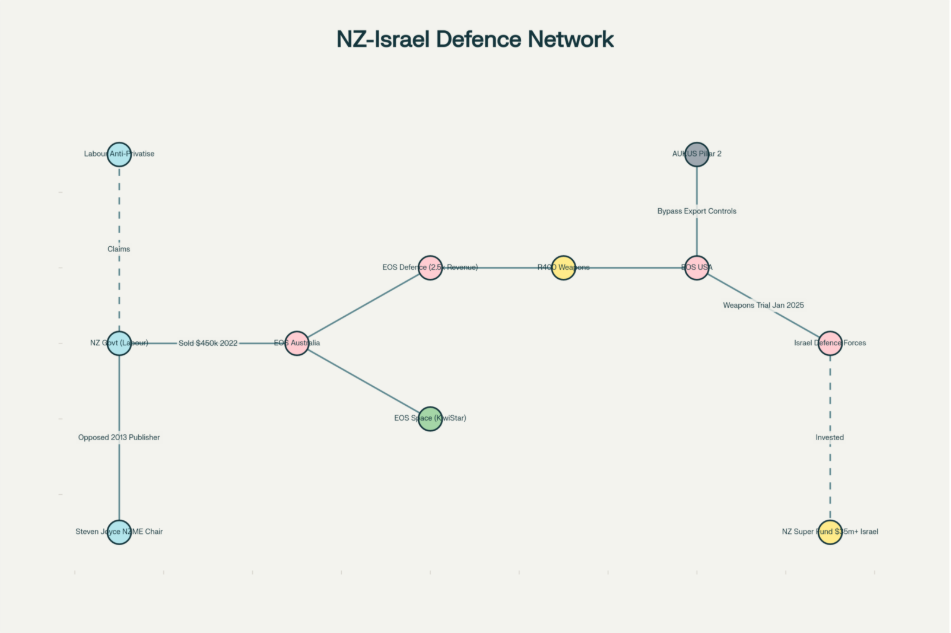
Hidden Connections: The Network Behind KiwiStar’s Transformation from NZ Science to Israeli Weapons Supply Chain
From Canberra to Tel Aviv via Washington: The AUKUS Weapons Pipeline
The Australian Government initially maintained that “no Australian weaponry” had been exported to Israel since the Gaza war began in October 2023—a position the Australian Department of Defence reiterated when the ABC story broke. But a defence source told the ABC that Australian-made components were first sent to an EOS entity in the United States for assembly, then shipped to Israel without requiring Australian export approval—a loophole that renders government assurances meaningless.
This matters profoundly for Aotearoa. The current National-led Government is considering joining AUKUS Pillar 2, the technology-sharing arm of the Australia-UK-US military pact. Australian Greens defence spokesman David Shoebridge has warned that the weapons were likely “funnelled through the US as part of Aukus pillar 2,” arguing that AUKUS is making “Australian industry into a subservient arm of the US military-industry.”
In an Australian Senate estimates hearing, Shoebridge prosecuted this line, querying whether legislative changes made under AUKUS Pillar 2 cleared the way for technology to reach Israel without proper oversight. If New Zealand joins AUKUS Pillar 2—as National and ACT have indicated interest in doing—we will become further enmeshed in a weapons supply chain designed to bypass democratic accountability.
The opacity is deliberate. New Zealand was quietly added to US military trade law in 2024, facilitating defence technology transfers. Meanwhile, the Government dropped the Autonomous Sanctions Bill in November 2025, abandoning the legislative framework that would have enabled independent sanctions against human rights violators like Israel. The message is clear: Aotearoa’s foreign policy sovereignty is being quietly surrendered to align with the Anglo-American military-industrial complex.
The Gaza Context: Weapons in the Service of Genocide
The timing of the EOS weapons trials is critical. By January 2025, when Israel Defence Forces tested the R400, Gaza had already been subjected to over fifteen months of relentless bombardment. The numbers are almost incomprehensible in their horror.
By late 2024, the Gaza Health Ministry reported over 44,000 killed and 104,000 wounded. A peer-reviewed study in The Lancet estimated 64,260 deaths between October 2023 and June 2024 alone. Research by the Max Planck Institute and the London School of Economics’ Centre for Economic Performance documented 78,318 deaths from October 2023 to December 2024, with updated estimates through October 2025 exceeding 100,000.
But the most damning statistic comes from Israel itself. Analysis of Israeli military data shows that 83 percent of Gaza war dead are civilians—a civilian casualty rate nearly unprecedented in modern warfare and far exceeding the 10 percent typical of recent conflicts. This is not collateral damage. This is systematic targeting of a civilian population.
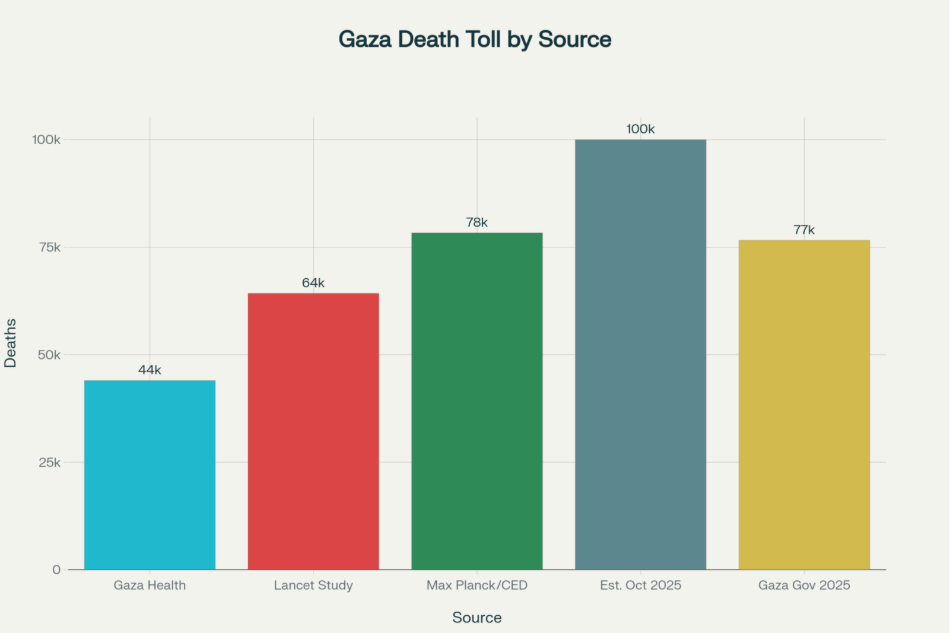
Gaza Death Toll Estimates: Multiple Sources Show Massive Civilian Casualties (83% Civilian Rate Reported)
UN investigators declared in September 2025 that Israel is committing genocide in Gaza. Human Rights Watch’s World Report 2025 documents mass civilian destruction. Former New Zealand Prime Minister Helen Clark stated publicly in August 2025 that Israel is “deliberately obstructing aid” to starve Gaza’s population.
Against this backdrop, EOS marketed its R400 system to the Israeli military as “high precision” and “lethal.” While EOS spokesperson Jo Ramsay told the Herald that KiwiStar technology was not used in the R400, this misses the point entirely. KiwiStar is now wholly owned by a company actively courting weapons sales to a military committing genocide. The corporate veil does not absolve moral responsibility.
Labour’s Privatisation Hypocrisy Unmasked
The KiwiStar sale exposes Labour’s rhetorical opposition to privatisation as performative theatre. In October 2025, Labour announced its “Future Fund” as its first key election policy for 2026, promising to invest in New Zealand firms and grow them, with some firms sold only “if it were prudent.” The policy document pledges that the Future Fund “would have the same ethical investing principles as the Super Fund.”
Yet Labour’s track record on ethical investment is abysmal. In August 2024, Labour MP David Parker called on the New Zealand Superannuation Fund to divest itself of $140 million invested in firms connected to illegal Israeli settlements. Labour’s official statement demanded transparency, insisting the government “divest from illegal settlements” and noting there was an “unfolding genocide” in Gaza.
This is staggering hypocrisy. Labour demands the Super Fund divest from Israeli settlements while it was Labour—under Ardern and Woods—that sold a strategic optics manufacturer to a company now selling weapons to the Israeli military conducting that very genocide. The cognitive dissonance is either deliberate deception or moral blindness; neither reflects well.
Labour also quietly privatised Kiwibank’s Kiwi Wealth division to Fisher Funds, with the loss of 30 jobs—another sale barely noticed by media. The pattern is clear: Labour campaigns against privatisation while in opposition, then executes stealth privatisations while in government, counting on media complicity and public inattention.
The Steven Joyce Conflict: When Media Owners Shape the Narrative
The irony of this story breaking in the Herald is not lost on anyone paying attention to Aotearoa’s media ownership structures. Steven Joyce, the former National Party cabinet minister who as Minister of Science and Innovation in 2013 explored selling KiwiStar—the very sale Megan Woods condemned—now sits on the board of NZME, the company that publishes the Herald. In May 2025, NZME’s board backed Joyce’s nomination as chair following what media described as “the year’s ugliest corporate battle”.
The Herald’s November 27, 2025 story explicitly notes that Joyce “now sits on the board of NZME, the publisher of this masthead”—a disclosure that acknowledges the conflict but does nothing to resolve it. Joyce has a direct political interest in highlighting Labour’s privatisation failures, given his own party’s privatisation agenda and his personal involvement in the 2013 KiwiStar sale attempt.
This is not to suggest the Herald story is false—every detail appears meticulously verified. Rather, it illustrates how Aotearoa’s media landscape has become so concentrated and politically compromised that even genuinely important investigative journalism cannot escape the taint of conflicted ownership. As media analyst Bryce Edwards has documented, NZME’s governance battles reflect deeper tensions over whether New Zealand media can maintain editorial independence when board members include former politicians with ongoing partisan interests.
The Herald deserves credit for publishing this story despite the potential embarrassment to Joyce. But the structural conflict remains: our major media outlets are increasingly controlled by individuals with direct financial and political stakes in the systems they purport to scrutinise. This makes independent, non-compromised journalism exponentially harder.
Greens Demand Transparency—But Where Were They?
Green Party defence spokesman Teanau Tuiono responded to the Herald story by stating the Greens are “opposed to privatising or outsourcing government technology to defence companies, because our country should not be complicit in waging war in other countries.” Tuiono called for “greater transparency” and “controls in place to ensure that New Zealand exports are not being used to wage war anywhere.”
This is morally correct but politically inadequate. The Greens held a cooperation agreement with Labour from 2017-2020 and again from 2020-2023. The 2020 agreement specifically included commitments on climate, housing, and child poverty but apparently not on preventing the privatisation of strategic scientific assets to weapons manufacturers.
Did the Greens know about the KiwiStar sale in 2022? If so, why didn’t they oppose it publicly? If not, what does that say about the effectiveness of their cooperation agreement? The Greens cannot credibly claim to oppose militarisation while failing to prevent—or even notice—the sale of Crown scientific assets to defence contractors by their coalition partners.
In 2022, Green co-leader Marama Davidson called for “space for peace”, opposing New Zealand’s militarisation of space. Yet KiwiStar—a precision optics manufacturer with clear space and military applications—was sold to a company specialising in “space control and warfare capabilities” on the Greens’ watch. This failure of oversight undermines their moral authority on defence issues.
The Whakapapa of Betrayal: Neoliberalism’s Mauri-Depleting Logic
From a mātauranga Māori perspective, the KiwiStar sale exemplifies the mauri-depleting logic of neoliberal capitalism. Mauri—the life force that sustains ecosystems, communities, and relationships—demands reciprocity, kaitiakitanga (guardianship), and consideration of future generations. The sale of KiwiStar violates every one of these principles.
Reciprocity violated:
The Crown established Callaghan Innovation using public resources to develop technology for collective benefit. Selling KiwiStar to a private weapons manufacturer converts publicly-generated knowledge into private profit extracted through violence. There is no reciprocity here—only extraction.
Kaitiakitanga abandoned:
The Crown’s role as kaitiaki of scientific and technological capability requires protecting these assets for future generations. Selling KiwiStar for $450,000—a fraction of its actual value—to a foreign company eliminates New Zealand’s sovereign control over precision optics manufacturing. This is the opposite of guardianship; it is abandonment.
Intergenerational harm:
Tikanga frameworks emphasise decision-making that considers impacts seven generations forward. What will our mokopuna inherit when we have sold our scientific capabilities to companies profiting from genocide? What rangatiratanga can they exercise when strategic technologies are controlled by foreign military contractors?
The whakapapa of this betrayal connects to deeper patterns of neoliberal dispossession. Just as Te Tiriti o Waitangi was systematically violated through land confiscations, contemporary governments continue the dispossession by selling public assets built with collective resources. The victims are always the same: tangata whenua, workers, the vulnerable—anyone without the capital to buy back what was already theirs.
KiwiStar workers who joined to pursue scientific innovation now find themselves employed by a weapons manufacturer supplying counter-drone systems to Ukraine and courting sales to a military committing genocide. Their labour—previously dedicated to advancing human knowledge of the cosmos—has been appropriated into the machinery of death. This is mauri-depleting in the most literal sense: life force redirected toward destruction.
The AUKUS Endgame: Entangling Aotearoa in Imperial Wars
The KiwiStar sale cannot be understood in isolation from the broader trajectory of New Zealand’s military realignment toward the US-led imperial bloc. AUKUS Pillar 2 is designed to integrate Australia, the UK, and potentially other Five Eyes nations into seamless defence technology sharing with the United States—ostensibly to counter China but functionally to subordinate sovereign decision-making to Washington’s strategic priorities.
Defence briefing documents show New Zealand in a “holding pattern” over joining AUKUS Pillar 2, with National and ACT expressing interest while Labour has positioned itself in opposition. But Labour’s opposition rings hollow given their facilitation of the very defence-industrial integration AUKUS formalises. By selling KiwiStar to an Australian defence company that operates through US subsidiaries to circumvent export controls, Labour already connected Aotearoa to the AUKUS weapons pipeline.
New Zealand’s addition to US military trade law in 2024—facilitated by National but building on Labour’s groundwork—further integrates our economy into the US military-industrial complex. Analysis by former PM Helen Clark and security experts warns that AUKUS threatens New Zealand’s sovereignty and our relationships in the Pacific.
The endgame is clear:
Aotearoa transformed from an independent voice for peace and nuclear disarmament into a subordinate node in an aggressive military alliance aimed at encircling China. Our scientific institutions, our economic resources, our moral credibility—all sacrificed to prop up a failing American empire unwilling to accept multipolarity.
Quantified Harms: The Human Cost in Gaza and the Economic Cost to Aotearoa
Gaza:
As documented above, over 100,000 Palestinians are estimated killed, with 83 percent civilians. This includes thousands of children targeted and killed. Every weapon system supplied to the Israeli military enables this slaughter. Every optics manufacturer in the supply chain shares culpability.
Aotearoa:
We sold a strategic scientific asset for $450,000 that EOS acknowledged was worth substantially more—a “bargain purchase” representing pure loss to the public. We eliminated sovereign control over precision optics capability. We connected our scientific labour to genocide. And we set a precedent for further privatisations under Labour’s “Future Fund,” which promises “ethical investment” while the party’s actual track record shows the opposite.
Research shows $60 million of New Zealanders’ money is invested in weapons used in Gaza through KiwiSaver and other funds. The KiwiStar sale adds another layer:
not just passive investment but active participation in the weapons supply chain through technology transfer.
What Must Be Done: A Pathway to Rangatiratanga and Accountability
Immediate actions:
- Full public inquiry: The Government must immediately commission a full, independent inquiry into the KiwiStar sale, including all communications between Ministers, Callaghan Innovation, and EOS. Every document must be released. Every decision-maker must testify under oath.
- Reacquisition or sanctions: If legally possible, the Crown should seek to reacquire KiwiStar. If not, New Zealand must impose sanctions preventing any KiwiStar-derived technology from being transferred to EOS defence divisions or exported to conflict zones.
- Autonomous sanctions framework: Parliament must urgently pass autonomous sanctions legislation enabling New Zealand to independently sanction entities and individuals involved in genocide, war crimes, and human rights violations—starting with an arms embargo on Israel.
- AUKUS rejection: The Government must categorically rule out joining AUKUS Pillar 2 and begin unwinding the defence-industrial integration already underway through US military trade law changes.
- Super Fund and KiwiSaver divestment: As experts have documented, the Super Fund holds $35+ million in Israeli investments. Complete divestment from all companies supporting Israeli occupation and settlements must occur immediately. KiwiSaver providers must be legally required to offer genuinely ethical investment options excluding weapons manufacturers and occupation-linked entities.
Systemic reforms:
- Prohibit privatisation of strategic assets: Legislation must prohibit the privatisation of any Crown research, scientific, or technological assets without explicit Parliamentary approval following full public consultation.
- Export controls on military technology: As the Greens have advocated, New Zealand needs comprehensive export controls on military and dual-use technologies, with human rights considerations legally prioritised over commercial interests.
- Media ownership transparency: NZME and all major media companies must be required to disclose potential conflicts of interest when board members include former politicians, defence contractors, or individuals with financial stakes in stories being covered. Consider structural separation between media ownership and political/commercial interests.
- Ethical investment legal framework: The “ethical investment principles” Labour invokes for its Future Fund must be codified in law with enforceable standards, independent oversight, and penalties for violations—not left as vague aspirational rhetoric.
Decolonial transformation:
True rangatiratanga requires fundamentally reimagining Aotearoa’s relationship to global capitalism and militarism. This means:
- Honouring Te Tiriti through genuine partnership in all decisions affecting taonga, including scientific and technological capabilities
- Centring mātauranga Māori frameworks in technology development and export decisions
- Pursuing an independent foreign policy based on peace, nuclear disarmament, and climate justice—not subordination to Anglo-American imperialism
- Building economic relationships based on reciprocity and mutual flourishing, not extraction and exploitation
The Choice Before Us
The transformation of KiwiStar Optics from a Crown scientific asset into a subsidiary of an Australian weapons manufacturer courting sales to a genocidal military did not happen by accident. It resulted from deliberate choices by Labour politicians who campaigned against privatisation while quietly executing it, who condemned others for the very sales they later approved, who proclaimed ethical investment principles while profiting from violence.
Megan Woods condemned Steven Joyce in 2013 for considering selling KiwiStar to an Australian firm. In 2022, she approved exactly that sale—for a fraction of the company’s value, to a weapons manufacturer, without public disclosure. This is not policy evolution; it is moral collapse.
Labour now campaigns for 2026 on a “Future Fund” promising ethical investment while the wreckage of their actual privatisations—KiwiStar, Kiwi Wealth—demonstrates the opposite. The party that marched for Gaza sanctions sold technology to a company arming the Israeli military. The hypocrisy is breathtaking.
But this is not ultimately about Labour’s failures, damning as they are. It is about the choice Aotearoa faces: Will we continue sleepwalking into deeper integration with a globalised weapons supply chain that profits from the mass slaughter of children? Or will we reclaim our sovereignty, our scientific capabilities, our moral clarity?
The blood of Gaza’s children cries out from the ground. The mauri of our stolen scientific heritage demands restoration. The future our mokopuna deserve requires us to choose life over death, rangatiratanga over subordination, truth over the soothing lies of neoliberal politicians.
No more quiet privatisations. No more weapons supply chains. No more complicity in genocide.

Ivor Jones The Māori Green Lantern Fighting Misinformation And Disinformation From The Far Right
The ring burns with the light of truth. The taiaha strikes for justice. Kia mau ki te wairua o te tika—hold fast to the spirit of what is right.

Koha Options for The Māori Green Lantern
Whānau supporting The Māori Green Lantern can choose from three flexible pathways aligned with tikanga Māori principles of manaakitanga, whanaungatanga, and rangatiratanga.
Via Koha.Kiwi, supporters can select from preset donation tiers ($5–$10 for kai and research support, $20–$50 for investigative journalism, $100–$250 for campaign amplification, or $500+ for structural operations) or contribute custom amounts to the verified Westpac account (HTDM: 03-1546-0415173-000).
Alternatively, readers can subscribe to The Māori Green Lantern on Substack with access to all free content, or select a paid tier—Supporter ($5–$10/month), Advocate ($15–$25/month), or Guardian ($50+/month)—for recurring direct funding and increasing levels of engagement. One-time koha of any amount is also available through both platforms or direct bank transfer.
All koha methods offer immediate transparency:
Koha.Kiwi - https://app.koha.kiwi/events/the-maori-green-lantern-fighting-misinformation-and-disinformation-ivor-jones and Substack provide automatic receipts and platform visibility, while direct bank transfers to HTDM appear on the public audit statement, ensuring complete accountability and whanaungatanga.
Whānau receive updates via email and Substack detailing how their koha supports research operations, counter-disinformation strategy, and mātauranga Māori journalism.
Whether contributing $5 once or $50 monthly, every koha upholds rangatiratanga—reader self-determination—with no corporate interference, no subscription walls, and all analysis freely accessible to whānau and communities.
Donate now: Koha.Kiwi | Substack | Bank: HTDM – 03-1546-0415173-000