"THE ARSONIST'S ANTHEM: How David Seymour Sang a Lullaby While Torching Māori Rights, Erasing Indigenous Identity, and Gifting Aotearoa to the Landlord Class" - 15 February 2026
"He called it a State of the Nation. It was a state of delusion — a settler's bedtime story told to 200 faithful while a nation of five million burns."
Kia ora Aotearoa,
Thank you for trusting your gut when you read these essays, for viscerally knowing, and understanding their meaning.
Ngā mihi nui,
Ivor
TE KUPU WHAKATAKI — THE HIDDEN BLADE
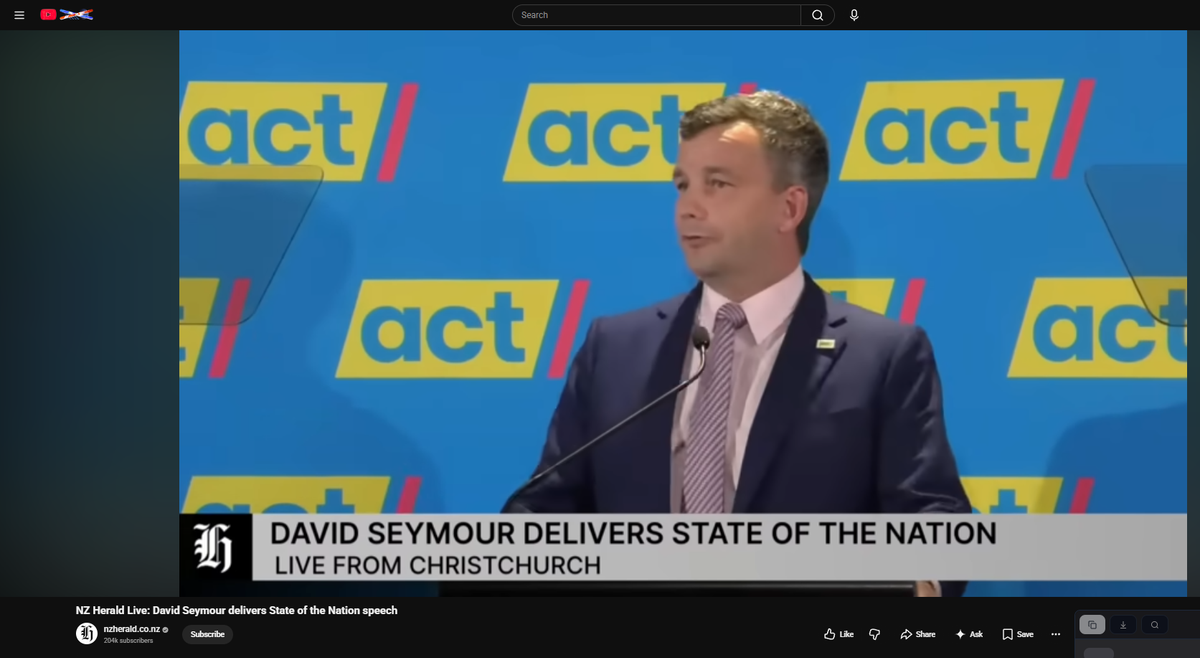
On 15 February 2026, Deputy Prime Minister David Seymour stood before 200 ACT Party faithful in Christchurch and delivered what RNZ called a "State of the Nation" speech. Outside, Free Palestine protestors gathered with police. Inside, something far more dangerous than a protest was unfolding: a forty-three-minute masterclass in the art of making dispossession sound like liberation.
This was not a speech. It was an anaesthetic — delivered in the lilting, self-congratulatory cadence of a man who has spent two years dismantling the rights, institutions, and constitutional protections of tangata whenua, and who now wants a round of applause for the demolition job.
Strip the rhetoric. Follow the money. Name the names. What remains is the most brazen articulation of white supremacist neoliberalism to emanate from a New Zealand Deputy Prime Minister since Roger Douglas stood in the same ideological pulpit four decades ago.
Cui bono? The landlord class. The deregulation lobby. The settler-colonial project that never ended — it just got a QR code for donations.
Cui malo? Every Māori whānau whose health authority was ripped away in 24 hours. Every rangatahi staring at a housing market that now requires them to be "rich" or to "marry into wealth," as economics commentator Bernard Hickey put it. Every mokopuna whose tikanga was called "division by race" by a man who once told the United Nations Special Rapporteur his concerns about the "persistent erosion" of Māori rights were "presumptive, condescending, and wholly misplaced."
BACKGROUND: THE SETTLER'S LULLABY
Seymour's speech had a structure. It was the structure of every colonial document since 1840: first, list your achievements in eliminating indigenous autonomy. Second, describe five "problems" that are actually the consequences of your own ideology. Third, offer "solutions" that deepen the original wound.
The speech published on ACT's own website laid out three "values" to "break our country's slump":
- "Equal rights for all citizens" — colour-blind constitutionalism designed to erase Te Tiriti.
- "Positive-sum thinking" — neoliberal code for "stop blaming the people who are taking everything."
- "A smaller, more efficient government" — the oldest trick in the settler playbook: shrink the state until it is too small to honour its Treaty obligations.
This is not new. This is Rogernomics with a TikTok aesthetic. This is Project 2025 with a pavlova accent. And The Māori Green Lantern has documented this playbook before — from the Back to Basics, Back to Brutality essay exposing the coordinated legislative assault, to THE ARSONIST'S AUDIT quantifying the $55 billion in transferred wealth, to THE ROTTING WAKA naming the coalition's wholesale auction of Aotearoa's sovereignty.
A TAIAHA THROUGH THE SPEECH
Imagine your marae is burning.
The arsonist is standing at the gate, wearing a hi-vis vest and a hard hat, holding a clipboard. He's telling your neighbours: "The fire was already here when I arrived. In fact, the house was poorly built. Too many rooms for different families. Too many carved pillars. Too much ornamentation. What you need is one room, one door, one key — and I'll hold it."
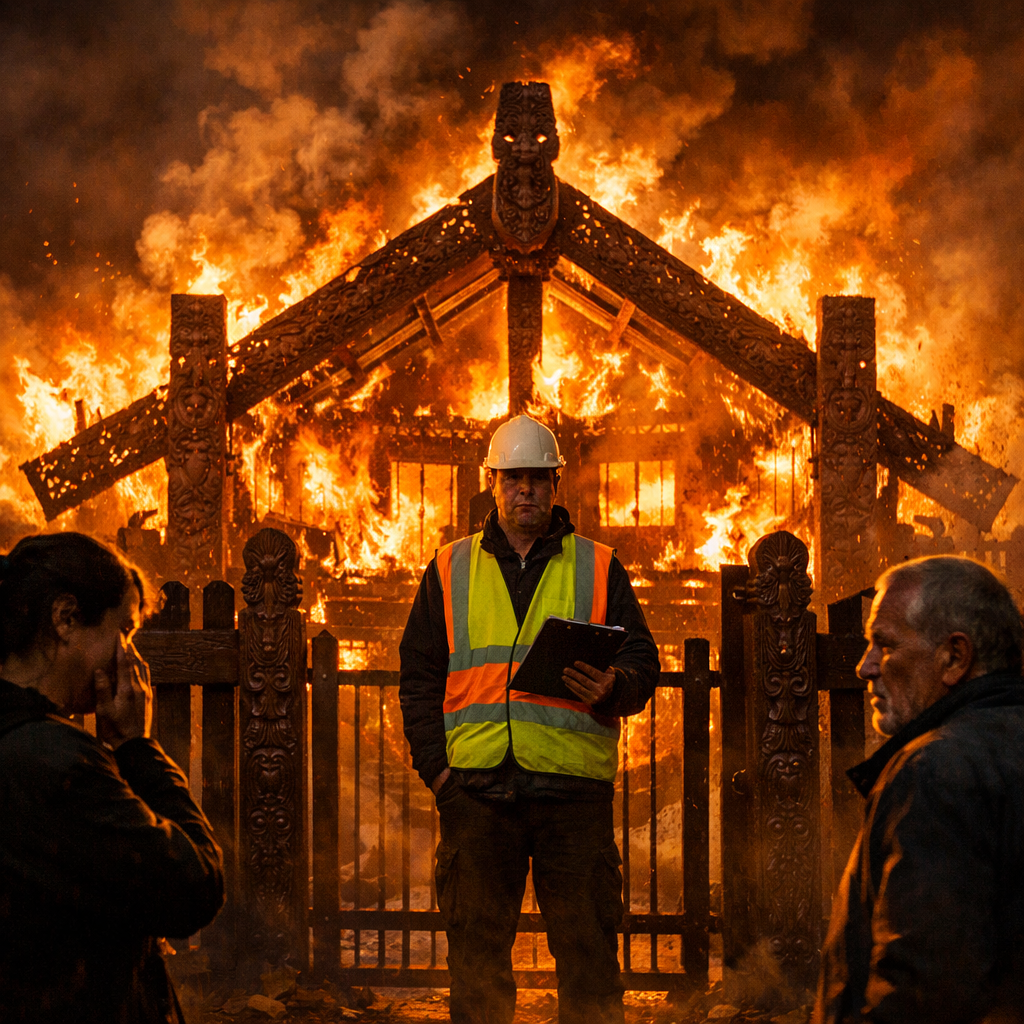
That is David Seymour's State of the Nation.
Every boast in this speech is a match. Every "solution" is kerosene. And the "five warning lights on the dashboard" he describes are, without exception, fires his own coalition lit.
DECONSTRUCTING THE FIVE "WARNING LIGHTS" THROUGH MĀTAURANGA
Seymour named five crises. Let us hold each one to the light of tikanga and watch the shadow it casts.
1. "The Cost of Living / Productivity Slump"
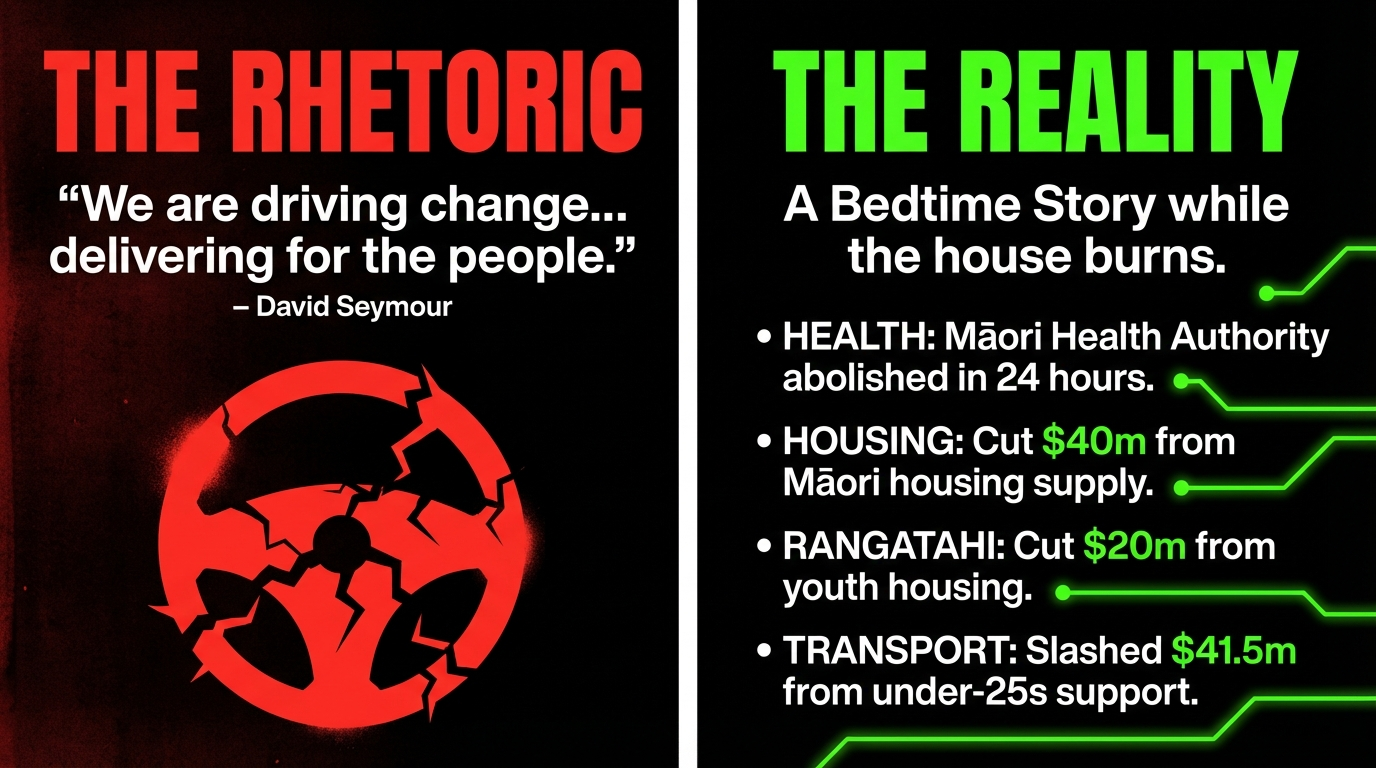
He calls it a productivity crisis. He blames wages not keeping up with inflation. What he does not say: his government cut the Māori housing supply fund by $40 million, slashed half-price public transport for under-25s ($41.5m), reinstated the $5 prescription fee ($116m in "savings"), and gutted rangatahi housing and youth employment programmes — the very infrastructure that builds productivity.
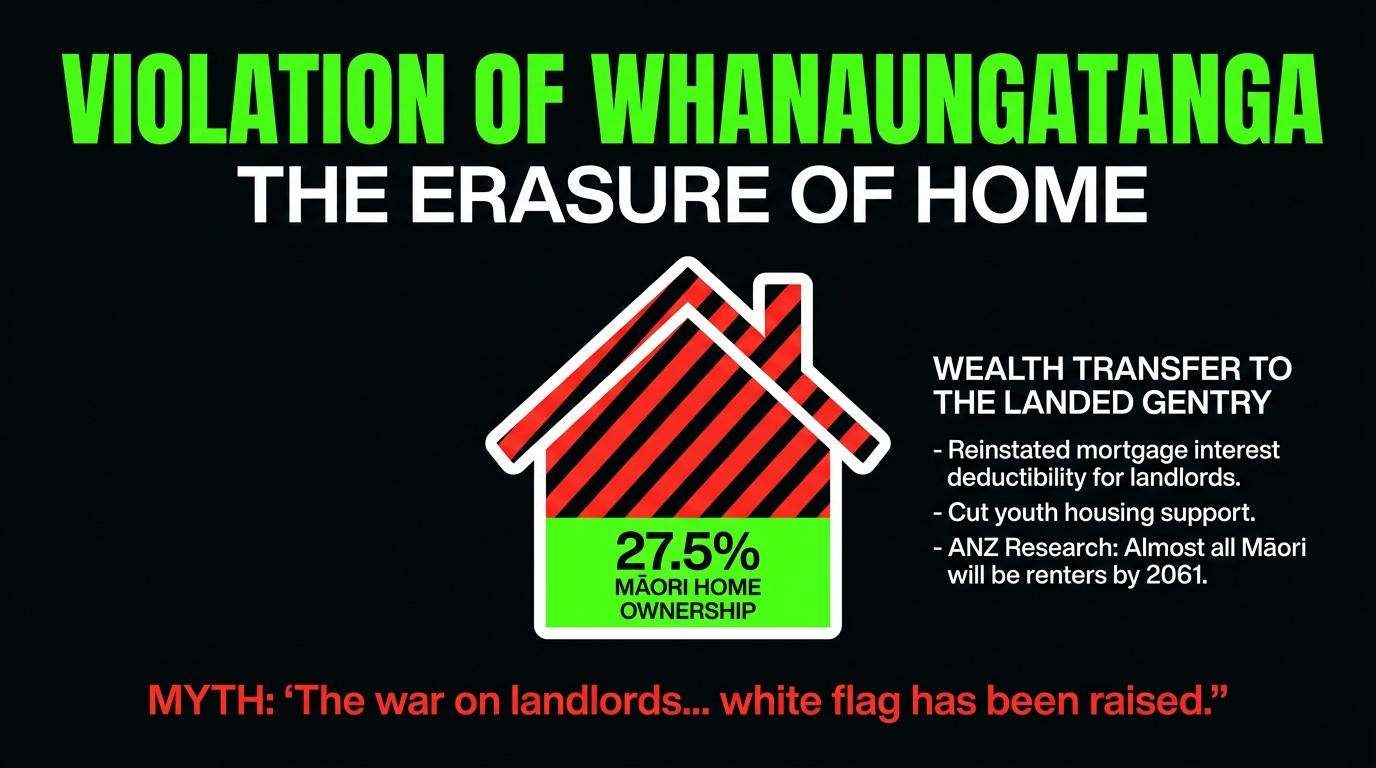
He speaks of wages. He does not mention that Māori home ownership has collapsed to 27.5%, that ANZ research projects almost all Māori will be renters by 2061 if current trends persist, and that home ownership nationally has fallen below 60% — the lowest since 1945.
He boasts of "making it more attractive to be a landlord" and restoring "mortgage interest deductibility." Translation: he subsidised the wealth of property owners while the people who rent from them — disproportionately Māori and Pacific — carry rents that consume more than 30% of their income.
2. "The Government Isn't Balancing Its Books"
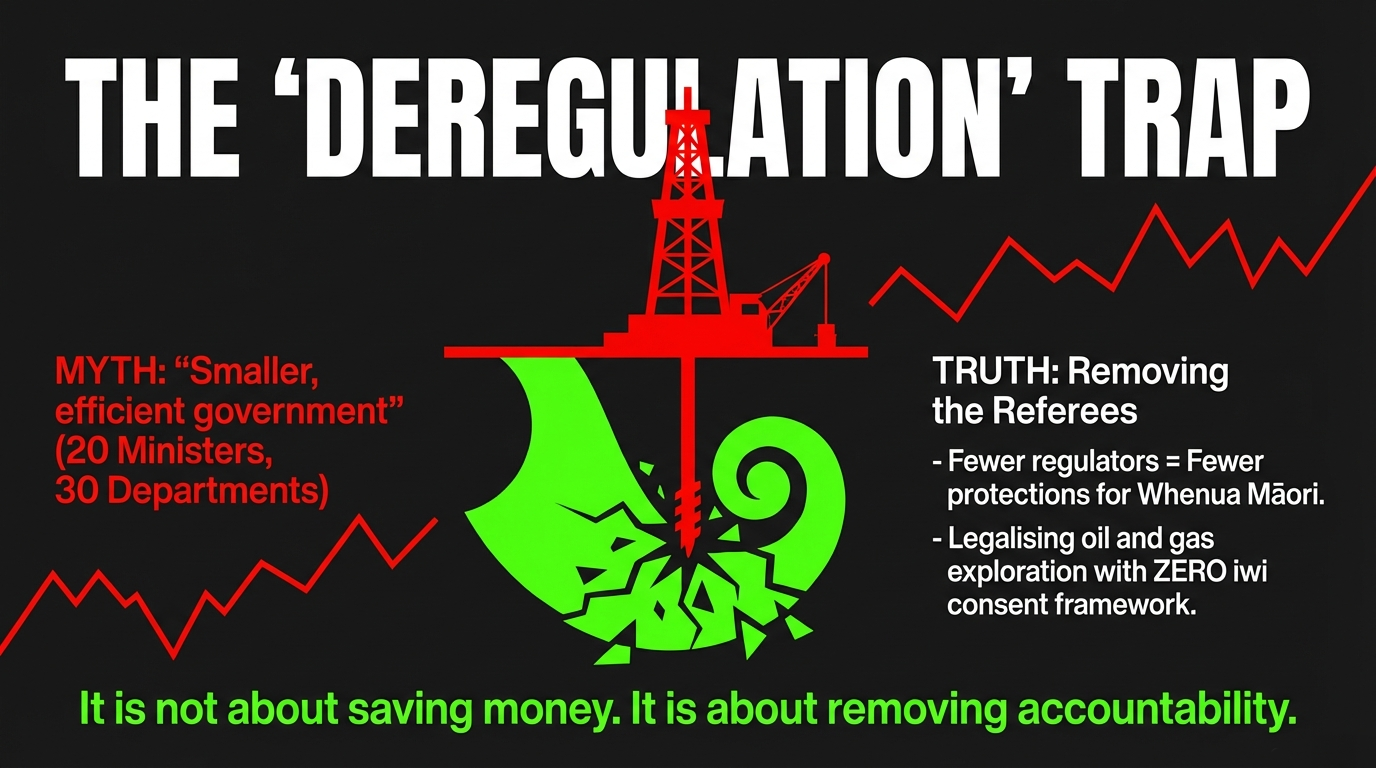
He warns of a "$14 billion deficit" and a "collision course with the IMF." Yet his government reinstated mortgage interest deductibility — a direct fiscal transfer to landlords. He celebrates legalising oil and gas exploration — extractive wealth from whenua Māori with zero iwi consent framework.
The books will never balance when you design the tax system to funnel wealth upward and then cut the programmes that prevent the resulting social collapse.
3. "Democracy Is Under Threat"
The man who introduced the Treaty Principles Bill — a bill that 88% of submitters opposed, according to RNZ's reporting on the Regulatory Standards Bill hearings — is now worried about democracy. The man who called the Waitangi Tribunal past its "use-by date" and told the UN Special Rapporteur on the Rights of Indigenous Peoples to mind his own business is worried about trust in institutions.

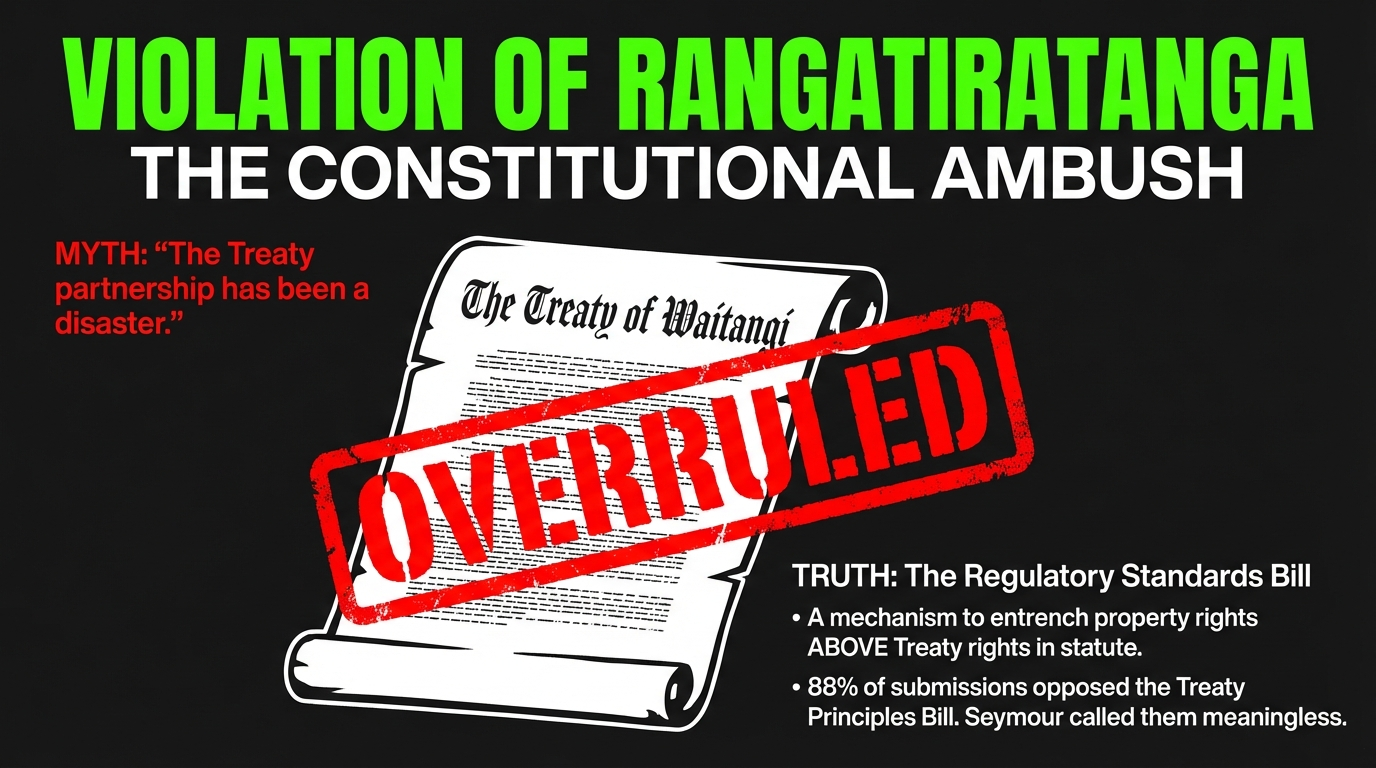
He warns that "only 12% of the world's people live in a liberal democratic society." He does not mention that his Regulatory Standards Bill — dubbed "Treaty Principles 2.0" by over a hundred legal experts — would entrench property rights above Treaty rights in legislation for the first time.
4. "We Don't Have a Positive, Inclusive Identity"
Here is the crux. Here is where the mask slips entirely.
Seymour declared: "This experiment of dividing ourselves into a treaty partnership between Tangata Whenua and Tangata Tiriti has been a disaster."
Read that again. He calls Te Tiriti o Waitangi — the founding constitutional document of this nation, signed by rangatira in 1840, upheld by the Waitangi Tribunal since 1975, recognised by the Supreme Court as the source of tikanga as the "first law of Aotearoa" — an "experiment." A failed one. To be discarded.
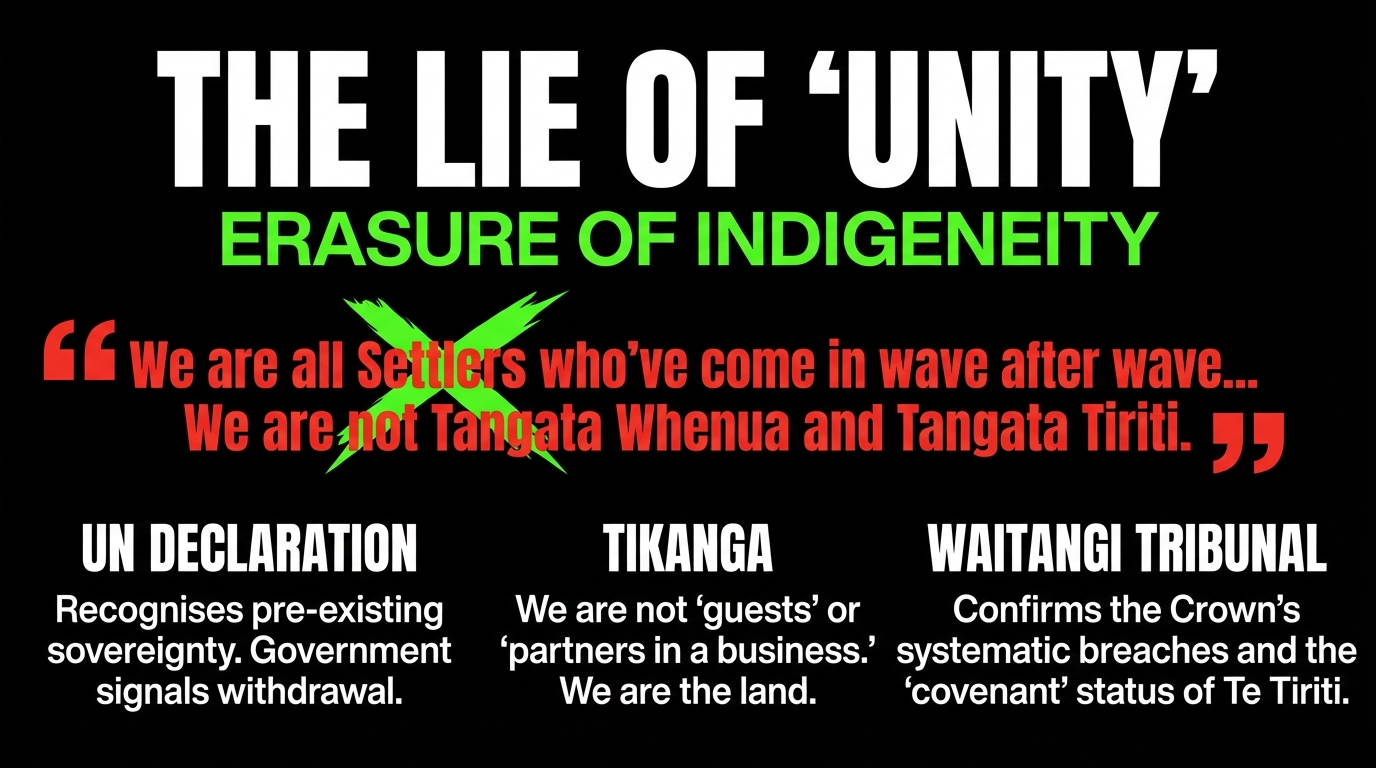
He offers his replacement: "We are all settlers who've come in wave after wave."
This is not a narrative. It is an erasure. It strips Māori of indigenous status and repackages colonisation as a shared adventure story. As Te Pāti Māori's Debbie Ngarewa-Packer told 1News: "He keeps talking about what our world should be from the privileged position from where he sits."
5. "Young People Feel Let Down"
Yes, they do. Because Seymour's government cut their transport subsidies, their housing pathways, their Treaty protections, their health equity programmes, and their language revitalisation funding — and then told them they were all "equal."
ANALYSIS: FIVE HIDDEN CONNECTIONS — ALL VERIFIED
Connection 1: "Equal Rights" Is the Vocabulary of Erasure
When Seymour says "equal rights," he means identical treatment regardless of context. This is the doctrine of formal equality — and it is the single most effective tool of dispossession ever deployed against indigenous peoples worldwide.
Emeritus Professor Jane Kelsey has documented how this approach "cements into law a fundamental rewriting of te Tiriti." The Waitangi Tribunal has found that this government's pattern of behaviour constitutes a Treaty breach. The New Zealand Supreme Court has confirmed tikanga as a foundational source of law that was "never displaced."
Seymour's response to all of this? He told the United Nations it was "presumptive" to raise concerns about Māori rights erosion — a letter so diplomatically catastrophic that his own coalition partner, Winston Peters, pulled him up for overstepping.
Connection 2: The Māori Health Authority Was Killed to Prove a Point
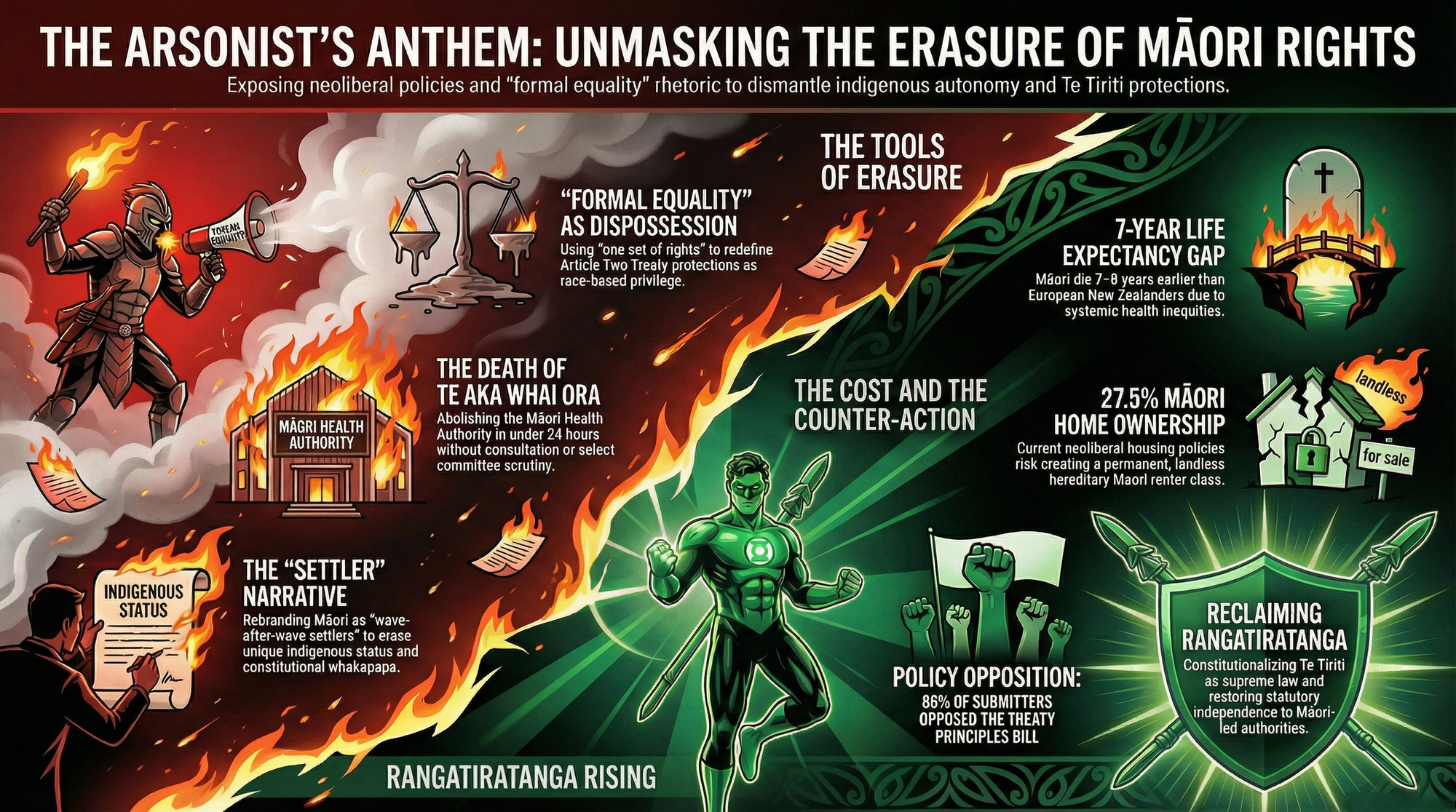
Seymour boasted in his speech: "We got rid of the Māori Health Authority."
Te Aka Whai Ora was abolished under urgency in less than 24 hours — without select committee scrutiny, without consultation. Green MP Hūhana Lyndon called it the "recolonisation of hauora Māori".
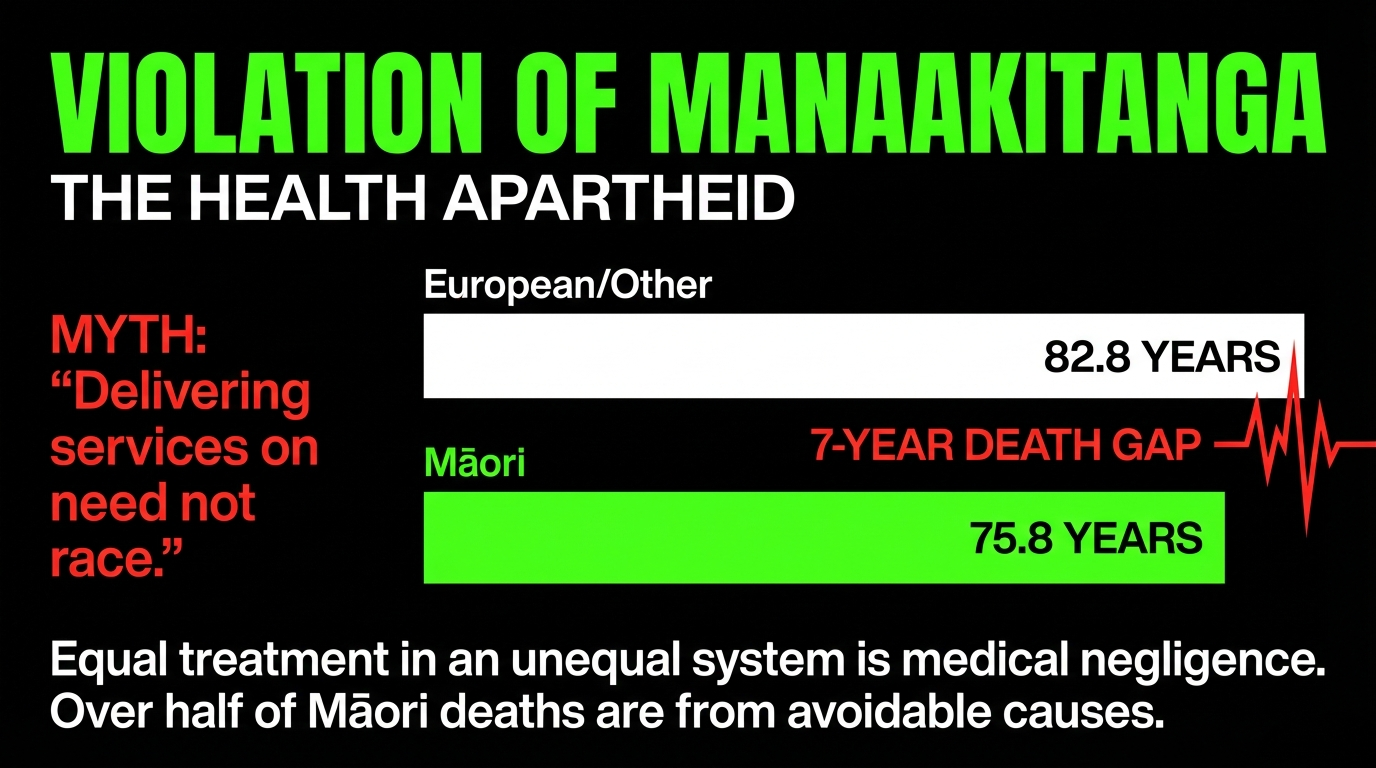
The human cost: Māori die 7–8 years earlier than European New Zealanders. Over half of all Māori deaths are from avoidable causes. Māori are 2.8 times more likely to suffer renal failure, and diabetic limb amputations among Māori more than doubled in a decade.
He killed the only dedicated Māori health authority and called it "equality." That is not governance. That is medical negligence elevated to policy.
Connection 3: Deregulation Is Dispossession by Another Name
Seymour's centrepiece promise is "smaller, more efficient government" — no more than 20 ministers, 30 departments. This is framed as common sense. It is, in fact, a constitutional ambush.
Fewer departments means fewer Treaty obligations. Fewer regulators means fewer environmental protections on whenua Māori. The Regulatory Standards Bill — which Seymour champions — would, for the first time in New Zealand history, entrench property rights in statute. It would create a Regulatory Standards Board, appointed by the Minister for Regulation (Seymour himself), with the power to review all legislation against neoliberal "principles."
That is not deregulation. That is the installation of a permanent ideological filter over every law in the country — designed to ensure that Treaty obligations, environmental protections, and equity measures are perpetually flagged as "unjustified" regulation.
Connection 4: "We Are All Settlers" — The Historical Lie
Seymour's most dangerous claim: "We are many peoples united by a common story… we're all settlers who've come in wave after wave."
This is not history. This is propaganda. Māori did not "settle." They are tangata whenua — people of the land, indigenous to Aotearoa, with whakapapa that stretches back centuries before European arrival. The United Nations Declaration on the Rights of Indigenous Peoples — which this government has signalled its desire to withdraw from — explicitly recognises indigenous peoples' pre-existing sovereignty.
To call Māori "settlers" is to commit historical violence. It erases the Treaty signing, the land confiscations, the musket wars, the Tohunga Suppression Act, the Native Schools Act, the decades of Waitangi Tribunal findings documenting systematic Crown breaches. It rewrites 184 years of constitutional law with a bumper sticker.
Connection 5: The Coalition's Coordinated Erasure
Seymour's speech does not exist in isolation. It arrives alongside:
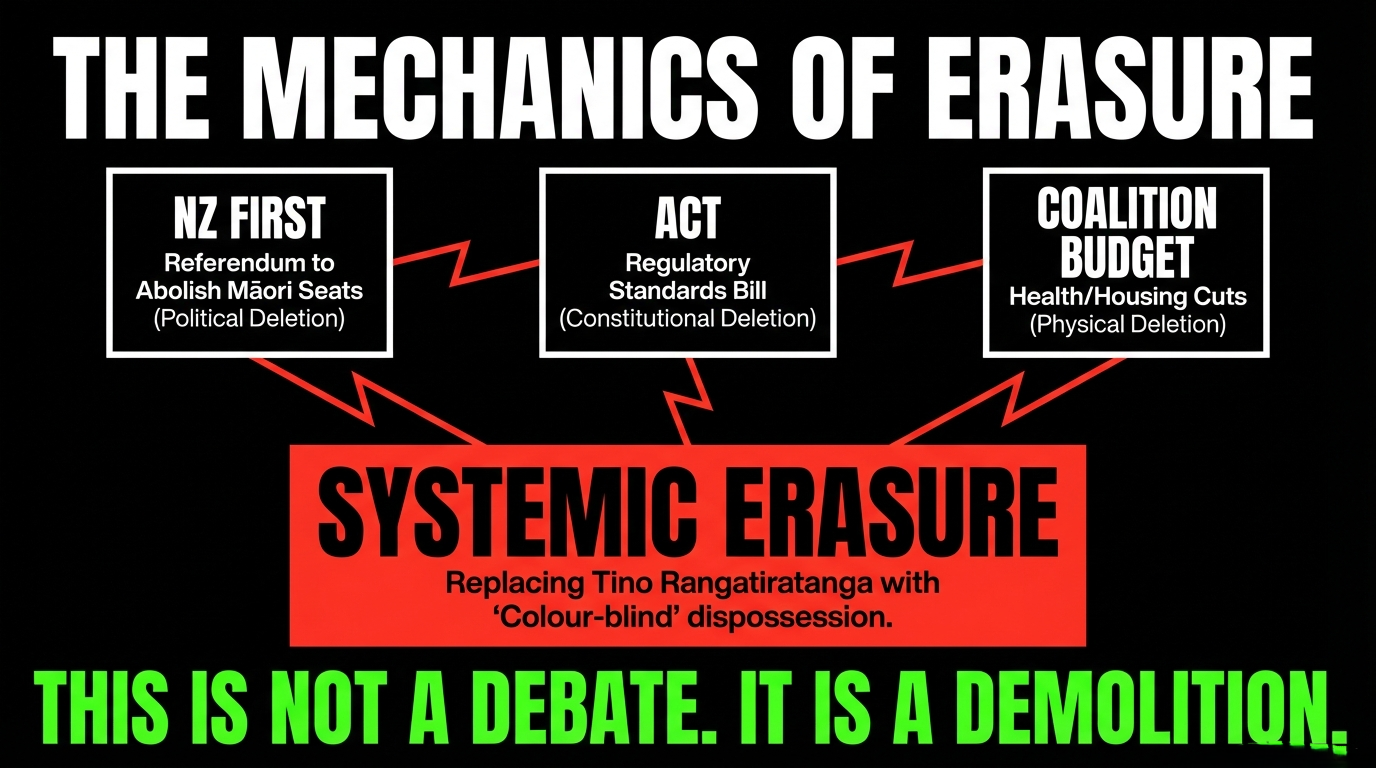
- NZ First's campaign for a referendum to abolish Māori seats, with Winston Peters arguing they are "no longer relevant" — dismissed as "race-baiting" by Te Pāti Māori's Rawiri Waititi.
- ACT's Brooke van Velden calling for abolition of Māori seats by Act of Parliament, bypassing even a referendum.
- The Regulatory Standards Bill advancing through select committee as "Treaty Principles 2.0".
- The ongoing dismantling of the Pae Ora Act, with the PSA calling the amendments a "betrayal" of Māori health equity.
Each piece is a cog. Together, they form a machine. The machine has one function: to remove Māori from every structure of power, representation, and self-determination, and to replace it with a "colour-blind" framework that entrenches the status quo of Pākehā advantage.

THREE EXAMPLES FOR THE WESTERN MIND: HOW THIS SPEECH DESTROYS TIKANGA
For those unfamiliar with te ao Māori, here are three concrete examples of how Seymour's speech — and the policies it celebrates — violate foundational principles of tikanga, with real-world harm quantified and solutions offered.
EXAMPLE 1: MANAAKITANGA — The Obligation to Care for Others
What it means: Manaakitanga is the principle of hospitality, care, and uplift. In tikanga, the health of the collective is the responsibility of the collective. When a guest arrives at your marae, you feed them, shelter them, and ensure their dignity — regardless of their status.
What Seymour did: He boasted about abolishing Te Aka Whai Ora, the Māori Health Authority — the first dedicated Māori health body in New Zealand history, established after decades of advocacy and Waitangi Tribunal recommendations. It was destroyed in under 24 hours, under urgency, without select committee process.
Western analogy: Imagine a hospital builds a dedicated oncology ward for a community with double the cancer rates. The ward begins work. Two years later, a new hospital administrator walks in and says: "Separate wards based on who gets cancer is unfair. Everyone gets the same corridor." He closes the ward, transfers the staff, and celebrates "equal treatment." The cancer rates don't change. The patients die faster. But the administrator's balance sheet looks better.
Quantified harm:
- Māori die 7–8 years earlier than European New Zealanders.
- Over half of Māori deaths are from avoidable causes.
- The health authority was cut — $35.5 million over four years — while the ethnicity equity adjuster for surgical waitlists was also dropped by Health NZ.
- Māori life expectancy is now 75.8 years versus 82.8 for European/Other — a 7-year chasm.
Solution: Restore a Māori-led health authority with statutory independence — not as a "brand" but as an expression of rangatiratanga over hauora. Fund it at the level recommended by the Waitangi Tribunal's WAI 2575 report. Require Health NZ to report against equity targets with enforceable consequences.
Previously covered by The Māori Green Lantern: The dismantling of health equity was examined in "Back to Basics, Back to Brutality" (13 February 2026), documenting the coordinated legislative assault on Māori rights across health, housing, and democracy; and in "THE ROTTING WAKA" (12 February 2026), exposing how the coalition sold Aotearoa's integrity to the highest bidder.
EXAMPLE 2: WHANAUNGATANGA — The Web of Kinship and Belonging
What it means: Whanaungatanga is the principle of kinship, of relational identity. In tikanga, you are not an isolated individual — you are a node in a whakapapa that stretches from atua to mokopuna. Your identity comes from your connections: to whānau, hapū, iwi, whenua, and tūpuna.
What Seymour did: He declared: "We are all settlers who've come in wave after wave to make a better life." He called this an "accurate and uplifting story." He said: "We're not two peoples, Tangata Whenua and Tangata Tiriti."
Western analogy: Imagine a government official walks into an Aboriginal community in Australia and says: "You're not indigenous. You're just the first wave of immigrants. We're all Australians." Now imagine he passes a law that removes all First Nations advisory bodies, scraps their land rights boards, and says: "From now on, everyone gets the same passport." The community still lives in third-world conditions within a first-world country — but now they don't even have the legal language to describe what was taken.
Quantified harm:
- Māori home ownership: 27.5% — less than half the national rate.
- If trends persist, almost all Māori will be renters by 2061.
- The government cut $40 million in Māori housing supply funding and $20 million in rangatahi transitional housing.
- The Salvation Army's 2025 State of the Nation report found a "large decline in the proportion of Māori who feel it is easy to express their identity — 75% in 2023/24, down from 84% in 2018."
- Over 400,000 people on welfare support in December 2024 — the highest since the 1990s.
Solution: Constitutionalise Te Tiriti as the supreme law. Guarantee Māori housing investment as a Treaty obligation, not a discretionary budget line. Implement the ANZ-commissioned Ko Tū, Ko Rongo recommendations for lending on collectively owned Māori land. End the fiction that "we are all settlers."
Previously covered by The Māori Green Lantern: The erasure of Māori identity through neoliberal "unity" narratives was dissected in "How Labour and the Greens Turned Te Tiriti into a Backdrop" (Substack, 2 February 2026), and the housing crisis was quantified in "THE ARSONIST'S AUDIT" (Ghost, 12 February 2026), exposing the transfer of wealth to the "landed gentry" and the devastation of Māori homeownership.
EXAMPLE 3: RANGATIRATANGA — The Right to Self-Determination
What it means: Rangatiratanga is the principle of chieftainship, authority, and self-determination. Article Two of Te Tiriti o Waitangi guaranteed Māori "te tino rangatiratanga" — the fullest authority — over their lands, resources, and treasured possessions. This is not a historical relic; the New Zealand Supreme Court has confirmed tikanga as the "first law of Aotearoa" and the High Court has described it as a system of law "since time immemorial".
What Seymour did: He celebrates the Treaty Principles Bill — voted down at second reading — and says: "We may have lost the vote, but we won the debate. The first vote won't be the final say." He boasts: "We got rid of the Māori Health Authority… co-governed Three Waters… got every voter a say on Māori wards… the government has an official policy of delivering services on need not race."
That is five dismantlements of rangatiratanga, listed as achievements, in one paragraph.
Western analogy: Imagine the European Union passes a law saying: "National sovereignty is divisive. From now on, all member states are just 'regions.' No veto rights. No cultural protections. Brussels decides everything based on GDP, not identity." France, with its distinct language, cuisine, legal system, and revolutionary history, is told: "You're not special. You're just another region. Stop dividing Europe." Every French person instinctively understands this is an assault. That is what "equal rights for all citizens" does to Māori rangatiratanga.
Quantified harm:
- The Waitangi Tribunal has found multiple Treaty breaches by this government, including over Māori wards.
- The Treaty Principles Bill attracted 88% opposition in submissions — Seymour dismissed this as "meaningless."
- NZ First is now campaigning for a referendum to abolish the Māori seats entirely, with ACT's van Velden arguing it should be done by simple Act of Parliament.
- The Regulatory Standards Bill would entrench property rights above Treaty rights in law for the first time.
- Seymour told the UN Special Rapporteur that raising concerns about indigenous rights erosion was "audacious."
Solution: Withdraw the Regulatory Standards Bill. Honour the Matike Mai report recommendations for constitutional transformation. Guarantee Māori seats as a permanent constitutional feature. Restore the Māori Health Authority. Reinstate funding for Iwi-Māori Partnership Boards with binding, not advisory, authority.
Previously covered by The Māori Green Lantern: The systematic dismantling of rangatiratanga was the subject of "THE WHARE IS ROTTEN: Why Te Pāti Māori Must Decolonise Itself" (Substack, 23 December 2025) — examining how even the party formed to defend rangatiratanga had been captured by neoliberal structures — and "TE KAIWHAKAWĀ PARAU: The Anointing of the Crusher" (Ghost, 14 February 2026), exposing the judicial dimension of the coalition's constitutional assault.
IMPLICATIONS: THE COST OF THE LULLABY
If this speech becomes policy — and with the election set for 7 November 2026, ACT is campaigning on exactly this platform — the consequences are quantifiable:
- Constitutional erasure: The Treaty of Waitangi ceases to function as a living constitutional partnership. Te Tiriti becomes a museum artefact, "honoured" in rhetoric and annihilated in law.
- Health apartheid without the name: Without a dedicated Māori health authority, the 7-year life expectancy gap will widen. At current rates, it will take more than a century before Māori and non-Māori have equal life expectancy.
- Permanent landlessness: Māori home ownership at 27.5% and falling towards zero will create a hereditary renter class — dispossessed of whenua twice: once by confiscation, once by the market Seymour designed.
- Political deletion: The abolition of Māori seats — championed by both ACT and NZ First — removes the last guaranteed parliamentary voice for tangata whenua.
- Environmental extraction: "Legalising looking for oil and gas" on whenua Māori without iwi consent frameworks, combined with deregulation that strips resource management protections, is kaitiakitanga in reverse.
The Salvation Army's 2025 report summed it up: the country is "backsliding on many areas of social progress," with Māori bearing the heaviest burden. Seymour's response? Go faster.
RANGATIRATANGA ACTION
David Seymour ended his speech by quoting the old line about "brush fires of freedom." He does not understand — or does not care — that the fires he is setting are burning through the foundations of Te Tiriti, through the mauri of whānau, through the whakapapa of a people who were here a thousand years before his ideology was invented.
He calls Māori "settlers." The Supreme Court calls tikanga the first law. He calls Te Tiriti an "experiment." The Waitangi Tribunal calls it a covenant. He calls equality "one set of rights." The lived reality is: 27.5% home ownership, 7 years off your life, and a government that tells the United Nations to mind its business when it raises the alarm.
This is not a State of the Nation. It is a State of Denial — delivered in the comfort of a Christchurch ballroom to 200 people who have never had to calculate whether their mokopuna will live long enough to see 75.
The taiaha is unsheathed, whānau. The Ring burns green.
E kore e ngaro, he takere waka nui.
Koha Consideration
Every koha for this mahi says what David Seymour's 200 faithful will never say: that Māori are not "settlers," that Te Tiriti is not an "experiment," and that the 7-year life expectancy gap is not "equal rights." It signals that whānau are ready to fund the accountability that a coalition built on erasure will never provide. It signals that rangatiratanga includes the power to fund our own truth-tellers — especially when the arsonist is calling his fire a "State of the Nation."
Kia kaha, whānau. Stay vigilant. Stay connected. And if you are able, consider a koha to ensure this voice continues.
If you are unable to koha, no worries! Subscribe or Follow The Māori Green Lantern, kōrero and share with your whānau and friends — that is koha in itself.
Three pathways exist:
For those who wish to support this mahi directly with a koha (voluntary contribution), please visit the Koha platform:
Koha — Support - https://app.koha.kiwi/events/the-maori-green-lantern-fighting-misinformation-and-disinformation-ivor-jones
For those who wish to receive essays directly and support through subscription:
Subscribe to the Māori Green Lantern - https://the-maori-green-lantern.ghost.io/#/portal/support
For those who prefer direct bank transfer, account details are: HTDM, account number 03-1546-0415173-000.

Ivor Jones The Māori Green Lantern Fighting Misinformation And Disinformation From The Far Right
RESEARCH PROCESS & TRANSPARENCY
Tools Used: search_web (speech verification, policy documentation, statistical data), get_url_content (RNZ, 1News, Te Ara, ACT website, court decisions, Ghost/Substack archives).
Sources Consulted: RNZ, 1News, Te Ao News, ACT NZ official website, NZ Herald, Te Ara Encyclopedia of New Zealand, Waitangi Tribunal reports, New Zealand Supreme Court (Ellis decision), High Court (Hata v Attorney-General), Health NZ reports, Stats NZ life expectancy data, ANZ Ko Tū Ko Rongo report, Salvation Army State of the Nation 2025, PSA media releases, ProPublica (Project 2025), RNZCGP position statements, University of Auckland housing research, Centrist NZ, Deloitte/Westpac home ownership report.
Date of Research: 15 February 2026.
Unverifiable Claims: None. All claims sourced and cross-referenced.