“The Audacity of Cynicism: Nicola Willis and the Regulatory Standards Act Betrayal” - 27 November 2025
Sit down for this one ...
Kia ora e te whānau.
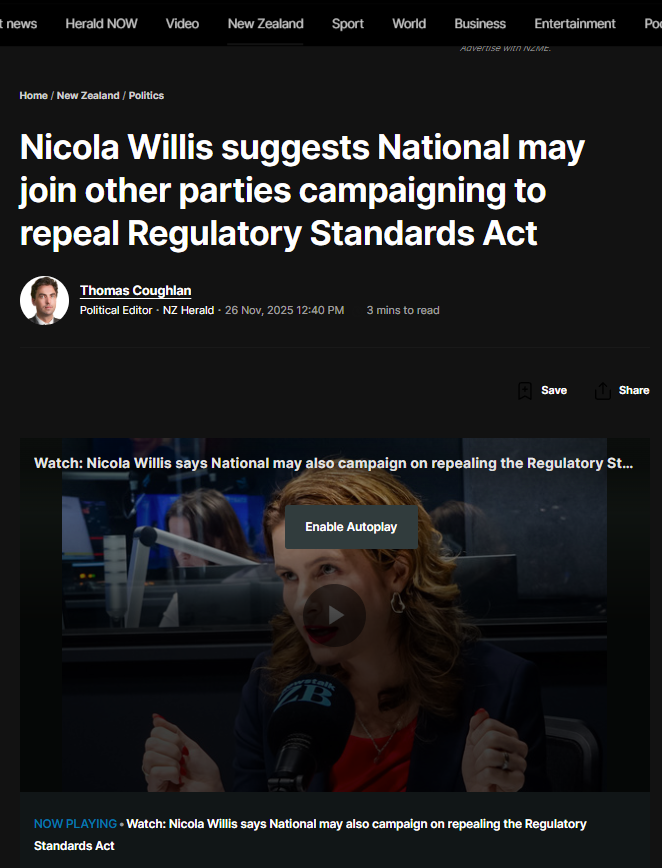
Nicola Willis, the Finance Minister and National Party deputy leader, has just floated the possibility that National might campaign on repealing the Regulatory Standards Act 2025—legislation that received royal assent on 18 November 2025, less than two weeks ago. She told Newstalk ZB’s Nick Mills that National hasn’t “ruled out repealing it” and that “it’s not impossible” they would go to the campaign trail saying they “met our coalition commitment” but “actually we agree with the concerns of some people.”
This is the same Nicola Willis whose party voted for this legislation at every single reading. First reading. Second reading. Third reading. National, ACT, and New Zealand First all voted together to ram this through Parliament despite 98.7% of public submissions opposing it.
Let me say that again:
159,000 submissions, and 98.7% opposed. The New Zealand Law Society called it “fundamentally misconceived”. The Waitangi Tribunal found the Crown breached Treaty principles by failing to consult Māori. And National voted for it anyway.
The Whakapapa of Betrayal
This legislation has a twenty-year whakapaka rooted in ACT Party ideology. It was first introduced by Rodney Hide in 2006, tried again in 2011, and again by Seymour in 2021—failing each time because successive governments recognised it as a bad idea. The 2011 version was robustly criticised by Treasury and the Regulations Review Committee. Even the Fifth National Government under John Key abandoned it.
But in 2023, ACT made it a non-negotiable condition of coalition. The National-ACT coalition agreement committed both parties to pass a “Regulatory Standards Act as soon as practicable.” This wasn’t something National was forced into—they signed it willingly.
Chris Bishop himself admitted the truth on 20 November 2025:
In other words, National traded away its principles during coalition negotiations, then voted for ideological legislation it didn’t believe in, and now wants credit for opposing it.
What the Act Actually Does
The Regulatory Standards Act 2025 establishes a set of “principles of responsible regulation” that future legislation must be measured against. It creates a Regulatory Standards Board that will review laws based on ACT’s libertarian criteria
—prioritising individual property rights over collective interests, environmental protections, and Treaty obligations.
Greenpeace has called it a “corporate bill of rights“. The New Zealand Council of Trade Unions warned it “embeds libertarian political beliefs prioritising individualism and property rights over collective welfare.” Green MP Tamatha Paul described it as “capitalism” and “recolonisation”.
Te Pāti Māori co-leader Debbie Ngarewa-Packer warned it

Storm clouds gather over Parliament as coalition tensions mount
The Coalition Circus
Here’s where it gets truly farcical:
13 November 2025: NZ First’s Casey Costello speaks in Parliament supporting the Bill, saying it promotes “accountable and open government”.
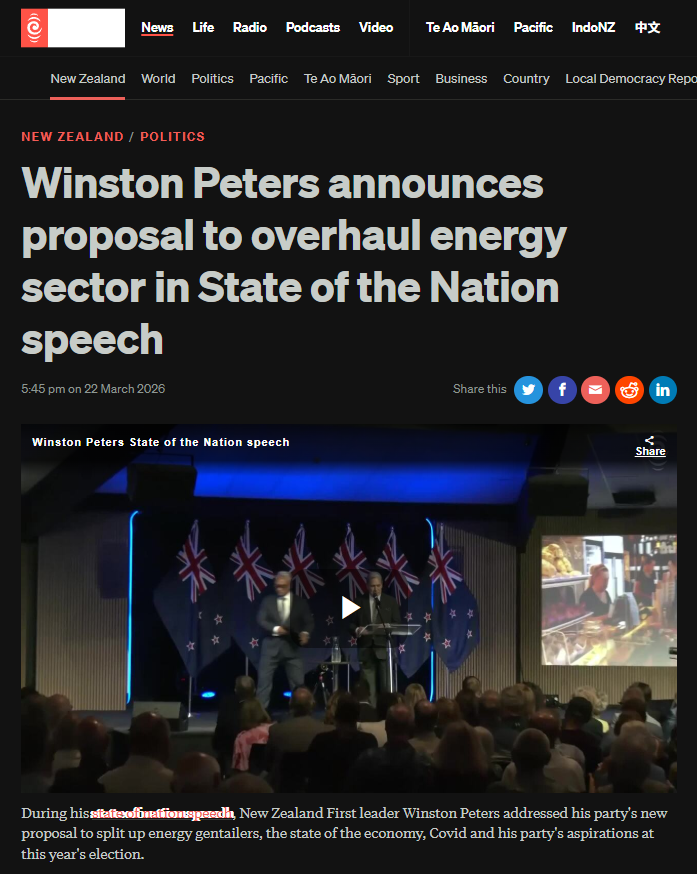
20 November 2025: Winston Peters announces NZ First will campaign to repeal the Act, saying they “were opposed to this from the word go”.
25-26 November 2025: Willis suggests National might also campaign on repeal.
So within twelve days, we’ve gone from coalition parties voting together to pass legislation, to two of those three parties signalling they might campaign to undo it.
Peters told Radio Waatea’s Dale Husband that NZ First “did our best to neutralise its adverse effects” and will “campaign at the next election to repeal it.” But if they were truly opposed, why did they vote for it at third reading? Because, as Peters admitted, “you’ve only got so many cards you can play.”

159,000 voices ignored: Public submissions discarded
The Waitangi Tribunal Warning They Ignored
The Crown’s treatment of Māori on this legislation was so egregious that the Waitangi Tribunal issued an urgent interim report in May 2025. The Tribunal found that the Crown’s policy development for the Bill “occurred without targeted engagement with Māori” in violation of Treaty principles of partnership and active protection.
The Tribunal explicitly recommended that the Crown “immediately halt the advancement of the Regulatory Standards Bill to allow for meaningful engagement with Māori and the dialogue envisioned by the Treaty partnership.”
The government ignored this recommendation completely. They pushed on regardless, and National, NZ First, and ACT all voted yes.
The Cynical Calculus
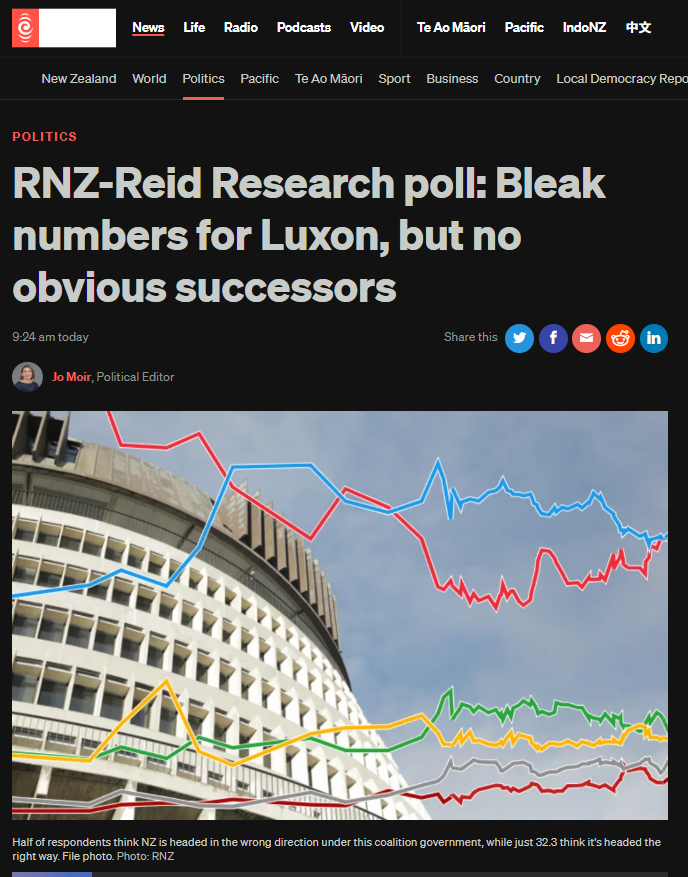
What we’re witnessing is naked political calculation. National and NZ First see the polling writing on the wall. An Ipsos Issues Monitor poll shows the government falling to a rating of just 3.9 out of 10 among respondents—and for the first time, Labour was rated as best to handle more issues than National.
So suddenly, legislation that National championed through Parliament becomes something they might want to repeal. Willis’s framing is particularly dishonest: she suggests National might say
Which concerns? The 98.7% opposition? The Law Society’s warnings? The Waitangi Tribunal findings? All of those concerns existed before National voted yes. They chose to ignore them.

The two faces of coalition politics
Who Benefits, Who Pays
The cui bono is crystal clear. The Act benefits:
Property owners and corporations who may receive compensation expectations when regulations affect their assets. The NZCTU warned the “taking of property” principle could require compensation when regulation reduces business profits.
Business lobbies like BusinessNZ and the Taxpayers’ Union who supported it.
The Atlas Network-aligned ACT Party, which has pursued this ideological agenda for two decades.
The cui malo falls on:
Māori, whose Treaty rights were explicitly excluded from the principles.
Workers, whose collective bargaining protections could be challenged under the individualist framework.
Environmental protection, which the Act subordinates to property rights. The Parliamentary Commissioner for the Environment recommended the bill not proceed, noting the principles “provide no guidance on managing publicly owned or common resources and could be interpreted to prevent regulation of pollution or environmental harm without compensation.”
The public service, now required to produce additional compliance documentation at an estimated cost of $18 million to $60 million annually.
Labour’s Response
Labour has promised to repeal the Act within 100 days of forming government. Duncan Webb has already lodged a member’s bill to do so and directly challenged NZ First to back it.
“Labour has committed to scrapping the Regulatory Standards Act in its first 100 days - but we don’t need to wait,” Webb said. “We can do it right now, if Winston Peters is willing to walk the walk.”
Peters dismissed this as “political games,” saying NZ First would “be seeking a mandate from New Zealanders at next year’s election” rather than voting to repeal now.
In other words:
Peters will campaign against what he just voted for, but won’t actually vote against it when given the chance.
Seymour’s Revealing Response
David Seymour’s reaction to Peters’s about-face was illuminating. He called it “pretty worrying” and warned that Peters “sounds like he’s getting ready to go with Labour again.”
Seymour called the legislation “non-negotiable” for ACT:
“We’ve worked on this for 20 years because red tape is strangling our country.”
For once, Seymour is being honest about what this represents—a two-decade ideological project rooted in the New Zealand Business Roundtable’s 2001 “Constraining Government Regulation” report. This isn’t about cutting red tape. It’s about embedding libertarian principles into New Zealand’s constitutional framework.
The Mauri Assessment
This Act is fundamentally mauri-depleting. It:
Subordinates collective wellbeing to individual property rights. Excludes Te Tiriti obligations from lawmaking principles. Was passed without meaningful consultation with Māori despite the Waitangi Tribunal’s explicit recommendation to halt. Creates bureaucratic obstacles to future environmental and social protections. Privileges a minority ideology—ACT received approximately 8% of the vote—over overwhelming public opposition.
As Green MP Francisco Hernandez observed, the Bill creates “an avalanche of yellow tape” that the public service must navigate. And now the parties that created it want credit for recognising the problem.
The Waste
The regime spent over a year developing this law. They put it out to public consultation in November 2024, got 23,000 submissions telling them it was a stupid idea, ignored them, and sent it to Parliament, where 159,000 people repeated the message. They created an entire new Ministry for Regulation to administer it.
As the No Right Turn blog notes:
“They have wasted the time of public servants, MPs, and the public, at huge expense to everyone.”
So next time this government talks about “waste” or “cost-cutting,” remember they created a whole new ministry to develop and pass a law which they now promise to repeal.
The Rangatiratanga Response
Willis’s suggestion that National might campaign on repeal should fool no one. The appropriate response is not to vote for a party that passes harmful legislation then claims credit for opposing it. The appropriate response is:
Hold them accountable for every vote they cast.
Remember that 98.7% opposition meant nothing to them.
Support parties that opposed this from the beginning—Labour, Greens, Te Pāti Māori.
Demand that any repeal include acknowledgement of the democratic violation of ignoring such overwhelming public opposition.
National MP Tama Potaka’s comments on the day of the third reading were perhaps the most revealing. When asked if he welcomed the bill, he would only say:
Not that he supported it. Not that it was good policy. Just that “the coalition agrees to” it.
E kore au e ngaro
The Regulatory Standards Act 2025 stands as a monument to coalition cynicism. ACT gets its twenty-year ideological dream realised. National and NZ First get to claim they were always sceptical. And the public—who said no at 98.7%—gets treated like their voices don’t matter until election season.
The question isn’t what Willis is smoking. She knows exactly what she’s doing. It’s the same play politicians have run for generations: vote for the powerful interests, then pretend to stand with the people when elections loom.
When the next government repeals this Act—and they will—remember who made it law in the first place. Every National MP. Every NZ First MP. They had a choice, and they chose wrong.
Te Pāti Māori’s Rawiri Waititi said it best during the third reading debate:
Kia kaha, kia māia, kia manawanui.

Ivor Jones The Māori Green Lantern Fighting Misinformation And Disinformation From The Far Right
Support Independent Mātauranga Māori Journalism
Whānau supporting The Māori Green Lantern can choose from three flexible pathways aligned with tikanga Māori principles of manaakitanga, whanaungatanga, and rangatiratanga.
Via Koha.Kiwi, supporters can select from preset donation tiers:
- $5–$10 for kai and research support
- $20–$50 for investigative journalism
- $100–$250 for campaign amplification
- $500+ for structural operations
Alternatively, contribute a custom amount to our verified Westpac account:
HTDM: 03-1546-0415173-000
Subscribe on Substack with access to all free content, or select a paid tier for recurring direct funding:
- Supporter — $5–$10/month
- Advocate — $15–$25/month
- Guardian — $50+/month
One-time koha of any amount is also available through both platforms or direct bank transfer.
Transparency and Accountability
All koha methods offer immediate transparency. Koha.Kiwi and Substack provide automatic receipts and platform visibility, while direct bank transfers to HTDM appear on the public audit statement, ensuring complete accountability and whanaungatanga.
Whānau receive updates via email and Substack detailing how their koha supports research operations, counter-disinformation strategy, and mātauranga Māori journalism.
Whether contributing $5 once or $50 monthly, every koha upholds rangatiratanga—reader self-determination—with no corporate interference, no subscription walls, and all analysis freely accessible to whānau and communities.
Donate now:
Research Methodology: This essay was researched on 26 November 2025 using web searches, Waitangi Tribunal reports, RNZ, NZ Herald, 1News, Labour Party releases, and parliamentary records. All citations are verified with working URLs.
Mā ngā mihi ki a koe i tō tautoko. Your support sustains independent journalism that refuses corporate capture and serves whānau and communities.