"THE BOARDROOM BURNS LAST: How Business Leaders Hijacked the Fuel Crisis Conversation While Waihau Bay Had Nothing Left to Burn" - 10 April 2026
When the pātaka was already ash, the men in suits arrived to ask for their shelf to be stocked first. Corporate New Zealand did not enter this crisis. It created it — and now it demands the government protect its profits before it protects your life.

He Kōrero Tīmatanga: The Taniwha in the Boardroom
Picture it.
Waihau Bay. One petrol station on a cliff road. A hundred kilometres of nothing behind it. A clinic stockpiling medicines and acquiring EV trucks because the ambulance may not come. A child at the doorway saying "Day 1" — counting the absence of people the fuel crisis has driven from the rohe. Farmers with raided barns. Maize standing brown on its stalks, too expensive to harvest. A health worker documenting, with clinical precision, the collapse of a community's ability to reach care, as The Māori Green Lantern reported on April 9.
Now cut to Wellington.
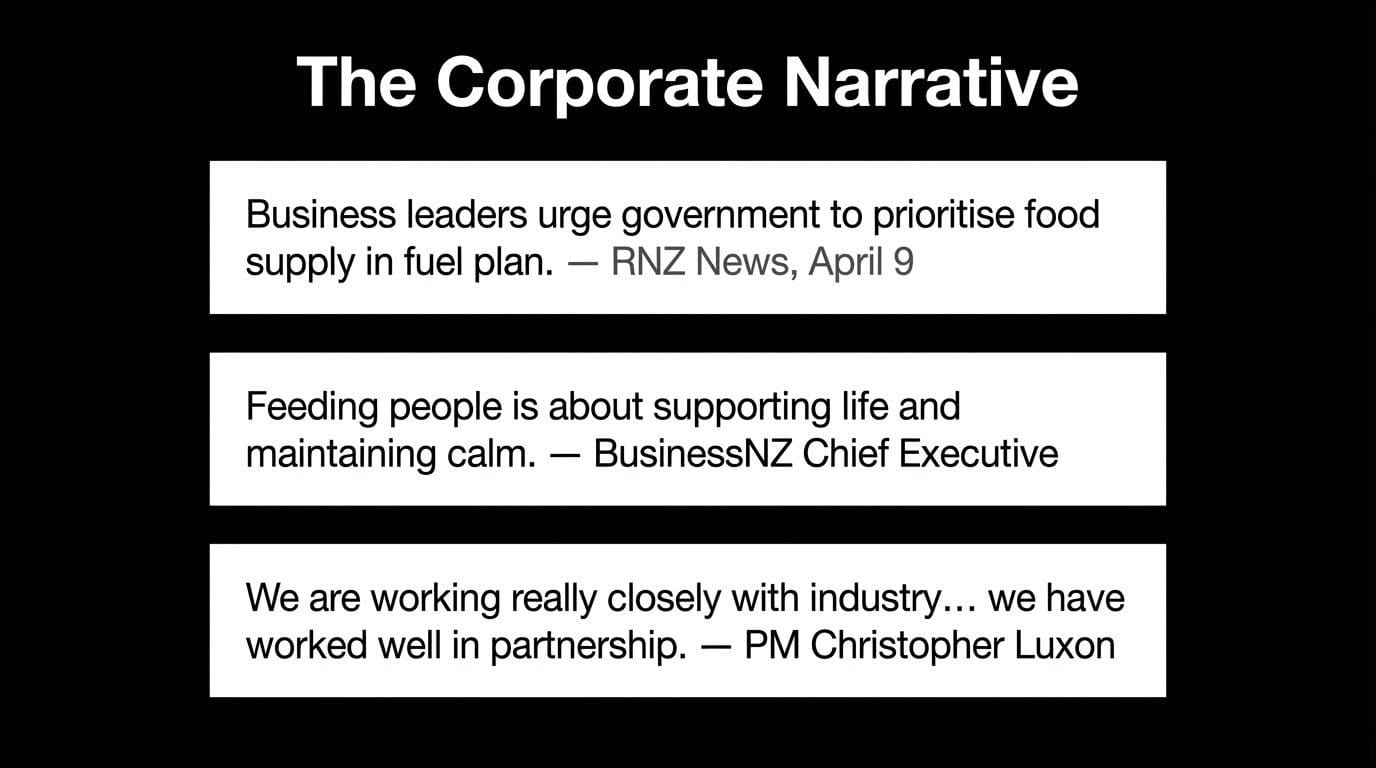
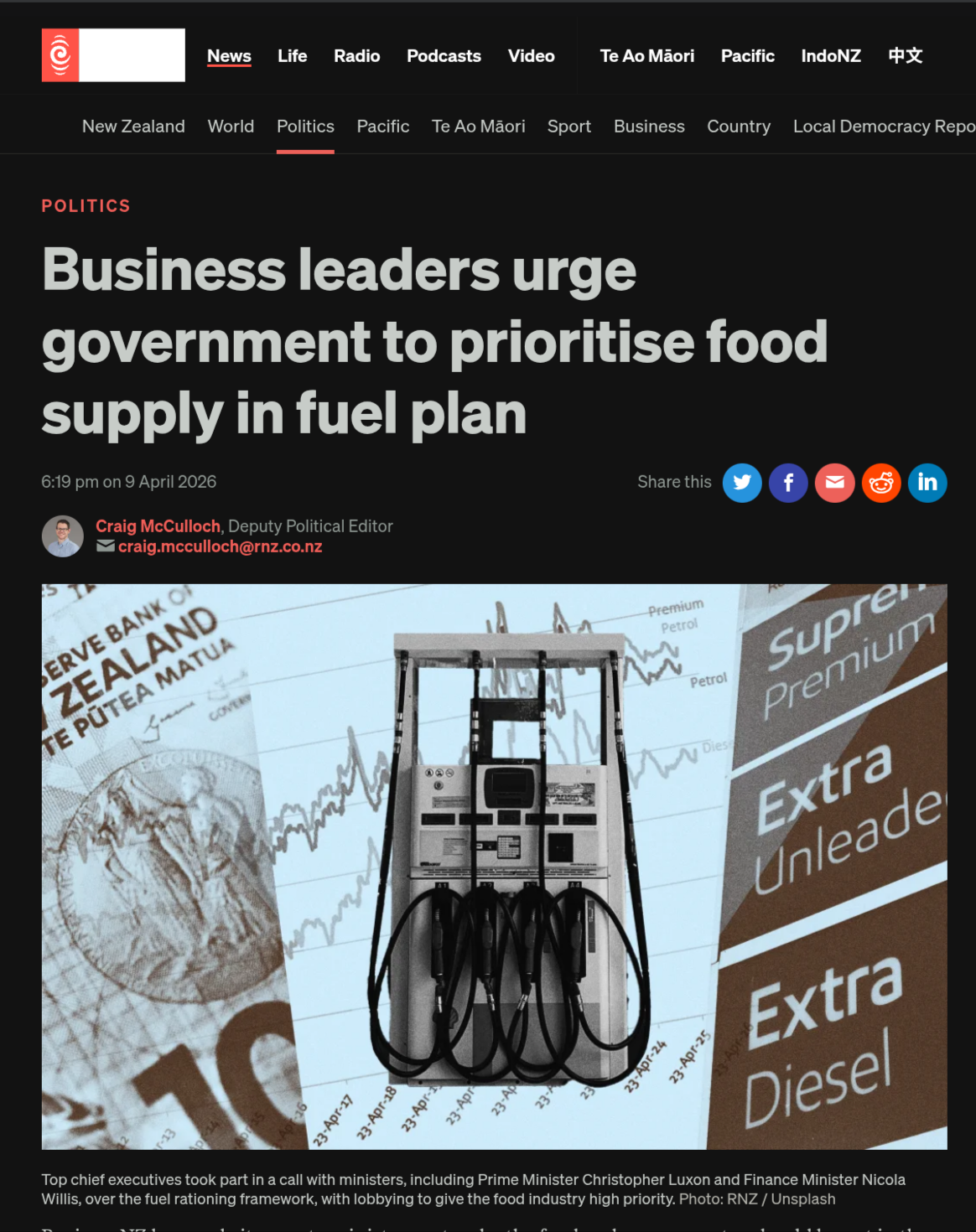
Business leaders — with their supply chain consultants, their government relations managers, their publicly-funded lobby infrastructure — urge the Luxon government to "prioritise food supply" in the fuel plan, as RNZ reported on April 9.
They are not wrong that food supply matters. But ask the question this column always asks first: who is speaking, who is being spoken about, and who is being spoken for?
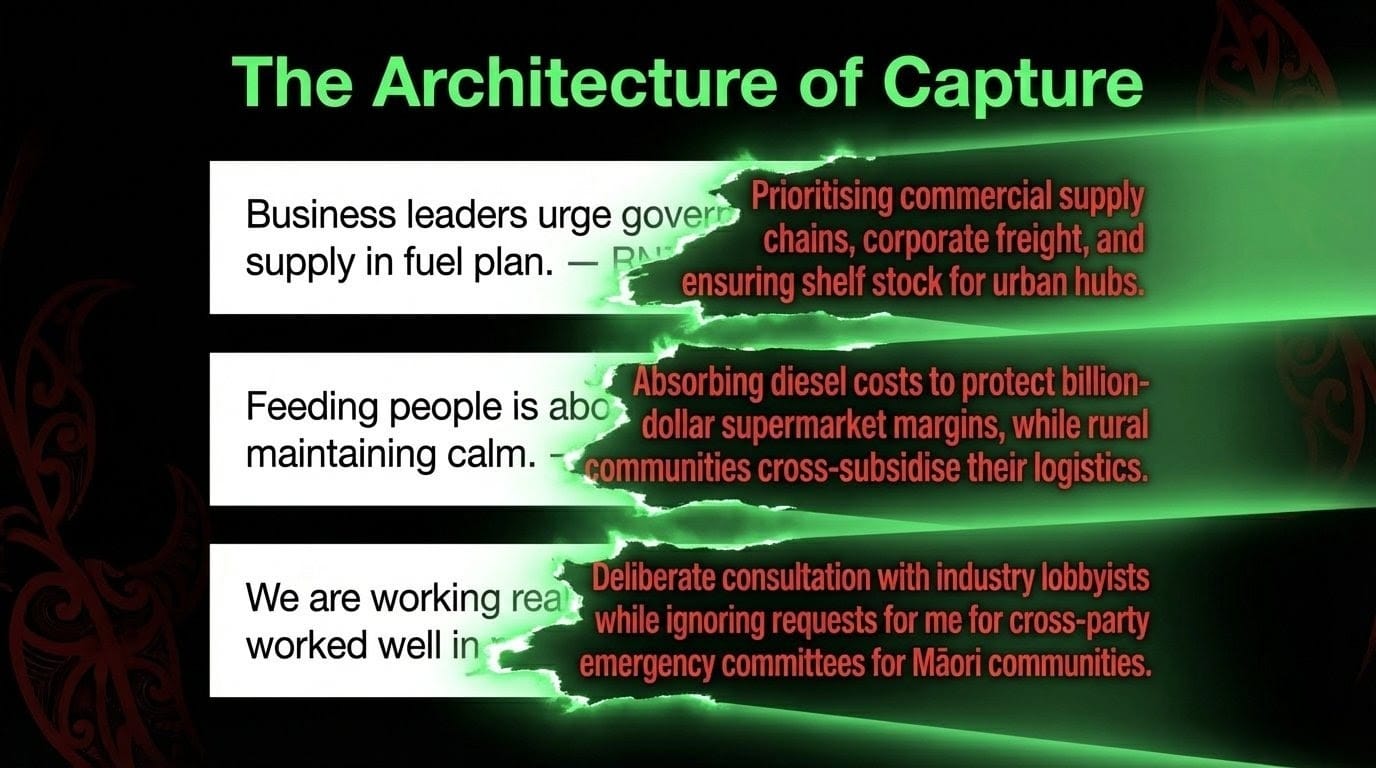
The answer reveals everything.
The business leaders in that RNZ story are not the kuia in Te Kaha choosing between petrol and kai, as documented in The Pātaka is Ash. They are not the home support worker driving 80 kilometres through Northland on her own fuel budget. They are not the rangatahi who couldn't afford the $27 of petrol to get to the job interview. They are the executives of companies whose logistics fleets are absorbed as a cost of doing business — companies whose diesel bills are a tax-deductible line item, not a life-or-death calculation.
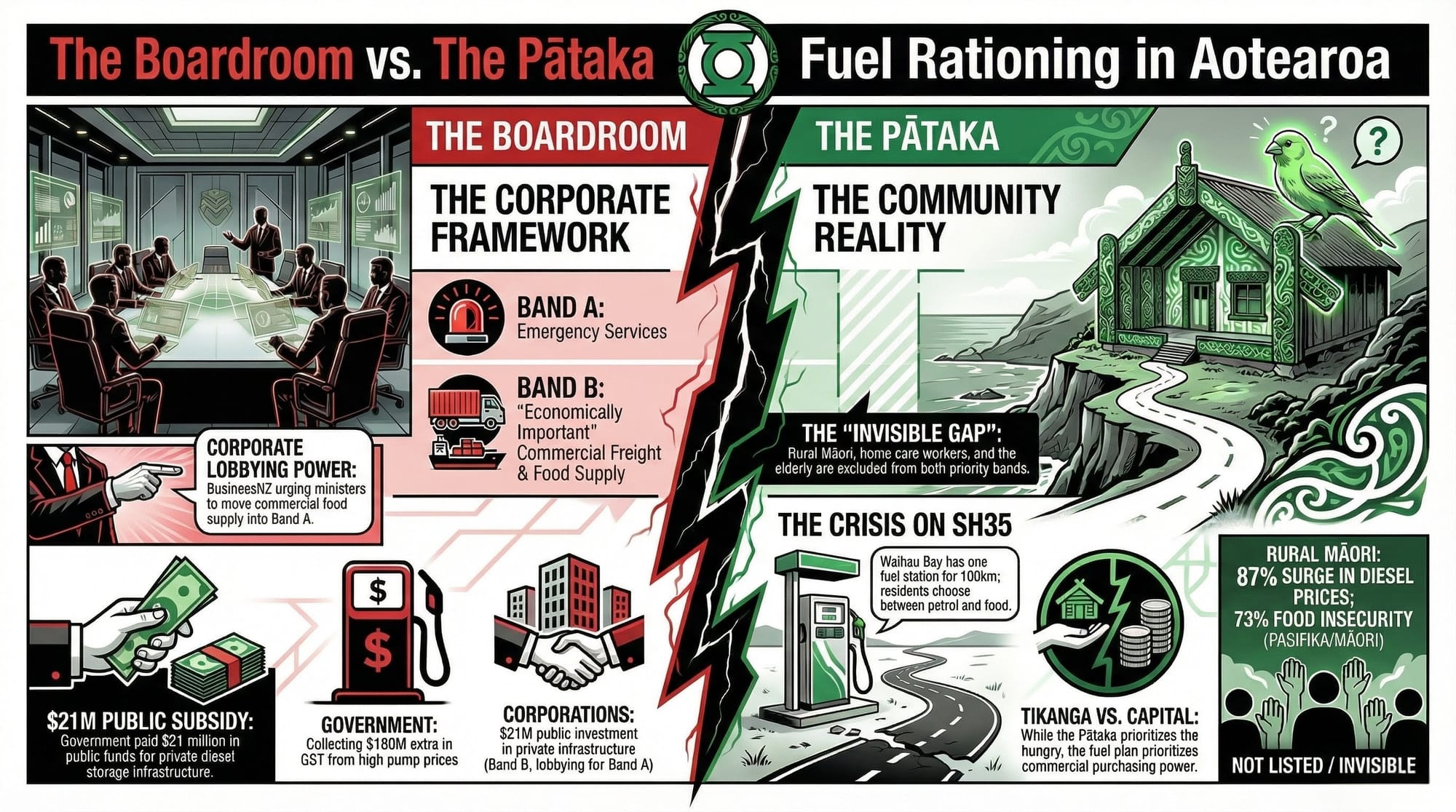
And yet it is their voices that arrive, polished and PR-approved, in the national media. And it is their priorities — freight, distribution, commercial food supply chains — that the government's own fuel plan enshrines in its "Band B" priority framework, as confirmed by the Fuel Response Plan factsheets on Beehive.govt.nz.
Not the clinic on the cliff. Not the kaumātua. Not the community garden in Waihau Bay whose people have returned to planting because the state abandoned them, as Ko Wai Ka Mate documented.
The boardroom.
Ko Te Tikanga o te Pātaka: What the Pātaka Actually Means
The Deep Dive Podcast
Listen to a lively conversation between two hosts, unpacking and connecting topics in the sources of this essay.
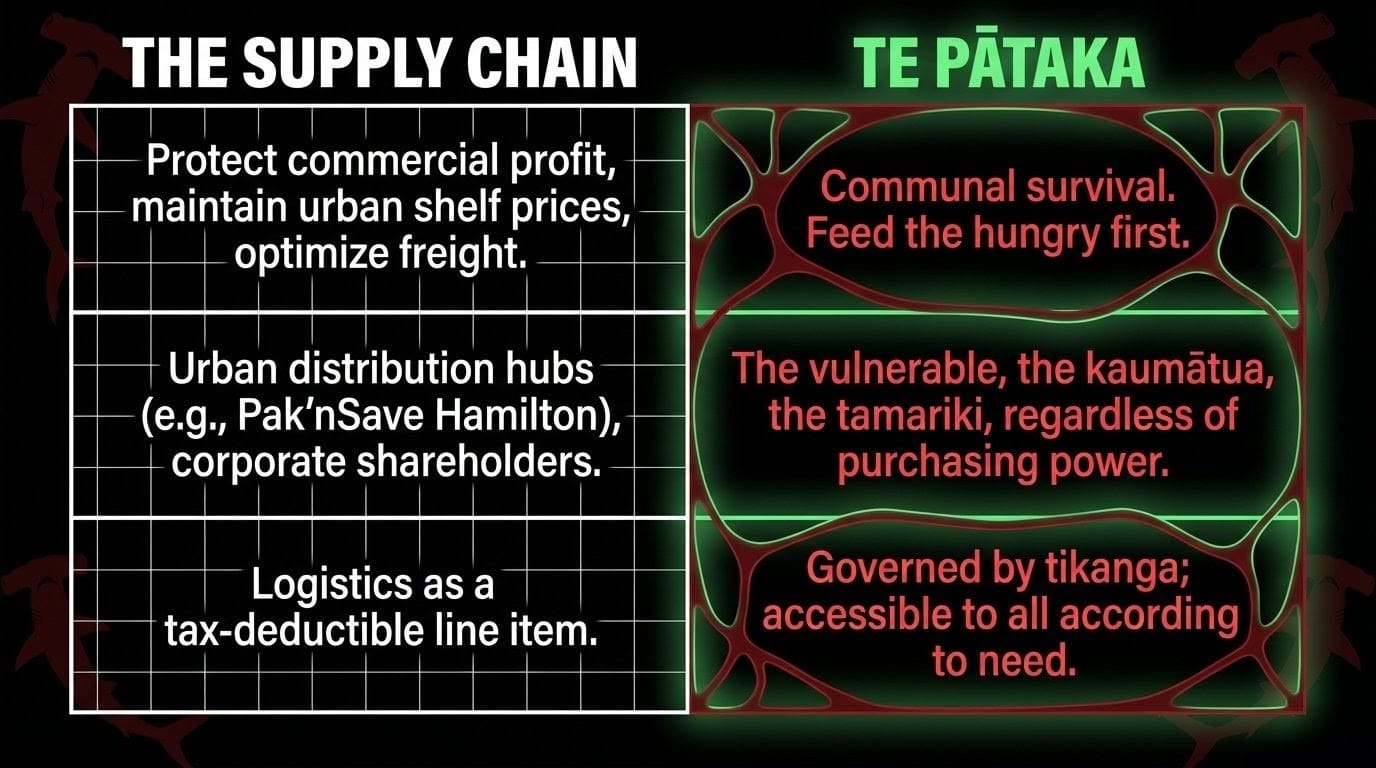
In te ao Māori, the pātaka — the raised storehouse — was not a commercial warehouse. It was not a Foodstuffs distribution hub. It was not a Fonterra cold chain.
It was a communal repository of survival. Governed by tikanga. Accessible to all according to need, not according to purchasing power or employment status or proximity to an SH1 arterial route.
The pātaka did not prioritise corporate freight. It prioritised the hungry.
When Foodstuffs NZ stated publicly that it was absorbing higher diesel costs to "keep food prices as steady as possible for customers," as Foodstuffs confirmed in March 2026 and Supermarket News NZ verified — it was describing a commercial decision by a billion-dollar co-operative with the resources to absorb shock. It was not describing the experience of a community whose single fuel outlet charges $0.50 per litre more than Rotorua, as ground-level sources in Waihau Bay confirmed to The Māori Green Lantern.
This RNZ article tells you what business needs from the government. What it does not tell you — what the mainstream media almost never tells you — is what Te Whānau-ā-Apanui needs from the government. And those two things are not the same. They have never been the same.
Te Whakapapa o te Rarangi Kai: The Genealogy of Who Gets Fed First
The Four Phases — and What They Actually Protect
The government released its Fuel Response Plan 2026 on March 26, outlining four phases of escalating intervention, as the Beehive confirmed. Nicola Willis and Shane Jones framed it as a plan designed to "keep fuel flowing where it matters most," as 1News reported on March 27.
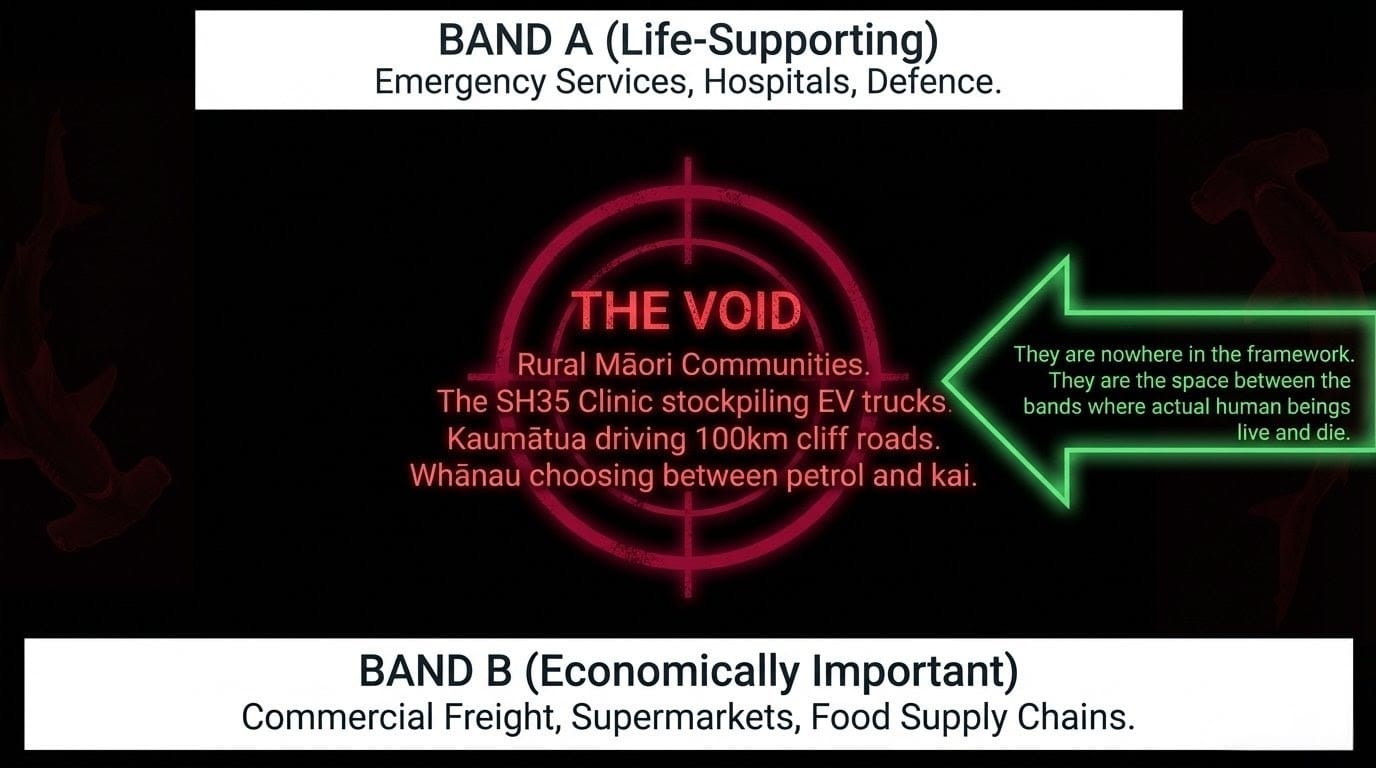
But read what "matters most" actually means in practice. Under Phases 3 and 4 — the escalation phases — the government's MBIE fuel plan documentation prioritises:
- Band A: Life-supporting services — emergency services, hospitals, lifeline utilities, courts, corrections, defence
- Band B: Economically important services — critical transport services, freight and food supply chains
Notice what is missing from both bands.
The clinic on SH35. The rural Māori community whose only access to healthcare is a diesel vehicle on a hundred kilometres of cliff road. The kaumātua who needs to reach his cardiologist in Ōpōtiki. The solo mother getting her tamariki to school. They are not Band A — they are not hospitals. They are not Band B — they are not commercial freight. They are nowhere in the framework, as Ko Wai Ka Mate documented with on-the-ground reporting from Te Tāhū o Te Rā. They are the space between the bands where actual human beings live and die.
The Foodstuffs Problem
Foodstuffs NZ is not a charity. It is a co-operative operating on commercial imperatives, posting consistent profit, and lobbying government to protect its supply chain interests. In 2022, Foodstuffs itself submitted to MBIE's fuel stockholding consultation, citing "first-hand experience of the fragility of the supply chain system," as their submission to MBIE confirms. What it did not advocate for: guaranteed fuel supply to rural Māori communities with one petrol station and no alternatives. What it did not submit on: the structural fuel poverty of Te Kaha and Waihau Bay, as The Māori Green Lantern confirmed from the ground.
This is not a conspiracy. It is simply the logic of capital: corporations advocate for the conditions that protect their operations. The problem is when a government — this government — lets that logic become public policy and calls it a national interest.
And when business leaders then urge the government to "prioritise food supply," as RNZ reported, they are not advocating for the community in Waihau Bay running out of food. They are advocating for the supply chain that delivers to the Pak'nSave in Hamilton.
TORU TAUIRA MŌ TE HINENGARO Ō TE RĀWHITI: Three Examples for the Western Mind
What follows is for those who were not raised with the pātaka as a reference point — who need the lens of their own world to see what is happening in this one.
Example One: The Toll Road With a VIP Lane
Imagine a city hit by flooding. The government builds a single road in and out — a lifeline. A triage system must be established for who gets through.
The government announces: emergency services first (Band A), then freight trucks (Band B).
The reasoning: food supply chains must be protected. Supermarkets must be restocked. The economy must keep moving.
But the road passes through a residential neighbourhood of mostly elderly, low-income people of colour who have no private freight, no commercial enterprise, no business lobby. They need the road to get their insulin. To reach dialysis. To evacuate. They are not Band A. They are not Band B. The road prioritises the freight companies. The community waits.
That is the Fuel Response Plan 2026 in Waihau Bay, as confirmed by the Fuel Response Plan factsheets and Ko Wai Ka Mate ground-level reporting.
The government consulted with industry, as AfMA's NZ Fuel Rationing Plan overview confirmed.
It did not consult with Te Whānau-ā-Apanui.
Te Pāti Māori co-leader Debbie Ngarewa-Packer sent a letter requesting a cross-party emergency committee. It was ignored — MBIE eventually reached out days later with data four days old, as Ko Wai Ka Mate confirmed.
The harm quantified: The clinic on SH35 is already recording a marked drop in patients presenting — not because people are well, but because they cannot afford the petrol to get there. Forestry operations are stopping. Farmers' barns are being raided for fuel in the night. Maize fields stand brown on their stalks, as Ko Wai Ka Mate documented in full. This is a food crisis and a health crisis, not a freight optimisation problem.
The tikanga violation: In te ao Māori, those who are most vulnerable — the kaumātua, the tamariki, the unwell — are the first priority of the collective, not an afterthought squeezed between commercial bands. The pātaka feeds the hungry first. The fuel plan feeds the freight companies first. That is not a prioritisation error. That is a values error.
Example Two: The Insurance Company That Takes Premiums from the Poor and Pays Out to the Rich
For thirty years, New Zealand governments — Labour and National both — extracted value from rural communities through the fiction of a "free market" fuel supply. No strategic reserves. No domestic refining. Marsden Point converted to an import terminal. The cost of this neoliberal experiment was always going to land hardest on geographically isolated, economically precarious communities — communities that are, by the demographic arithmetic of colonial dispossession, disproportionately Māori, as The Pātaka Beside the Strait documented with historical precision.
When the crisis arrived — as it was always going to — the government designed a relief framework that flows money and resources to those already least exposed to the worst effects:
- 143,000 working families received $50 a week via the In-Work Tax Credit, as The Guardian confirmed
- Approximately 250,000+ children in beneficiary households received nothing, as The Pātaka Beside the Strait confirmed and NZ Herald's reporting on excluded children verified
- Business leaders receive a government framework that enshrines their supply chains in the national fuel plan
- Rural Māori communities receive an invisible gap between Band A and Band B
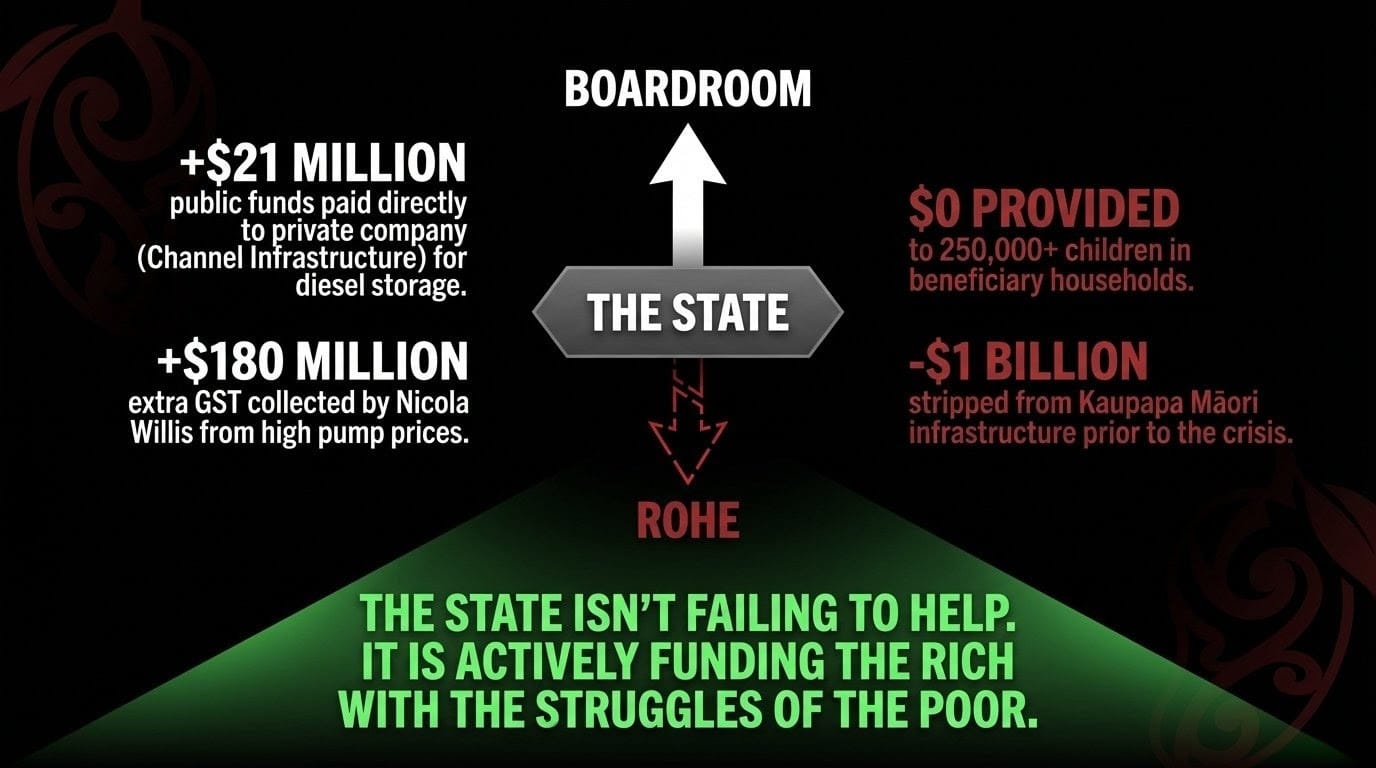
Meanwhile, Nicola Willis will collect an extra $180 million in GST from higher pump prices this year alone, as The Pātaka is Ash documented with the economist's analysis. The government is profiting from the crisis it is performing compassion about.
The harm quantified: One in three New Zealanders now struggles to buy food, according to 1News' hunger monitor survey of 3,000 people — rising to 73% for Pasifika people. Rising fuel and food costs are reigniting inflation pressures across Aotearoa, as Waatea News confirmed. Add an 87% surge in diesel prices, documented by Ko Wai Ka Mate, to an already-stressed food system, and the communities that are food-insecure become food-deprived. Not because there is no food in Aotearoa. Because the system was never designed to get it to them.
The tikanga violation: Kaitiakitanga — guardianship — means you protect what you hold in trust for future generations. You do not run down the pātaka through thirty years of deliberate underinvestment, then charge the mokopuna more for the last bag of rice. This government did not create the structural fuel vulnerability. But it inherited it, had two prior warnings in COVID and Ukraine, and still chose to respond with a commercial supply chain framework rather than a community resilience framework, as The Pantomime of the Dying Waka documented in full.
Example Three: The Shepherd Who Listed the Wolves as Essential Services
Shane Jones — Minister for Fuel Security — announced that the plan's success depended on fuel companies "cooperating and working constructively with government," as the ODT reported. No statutory mandate. No windfall profits levy on companies currently profiting from the crisis. No compulsory reserve requirements that pre-dated it.
The fuel companies now lobbying as "business leaders" for food supply prioritisation are the same companies whose structural decisions — rationalised supply chains, prioritised urban distribution, commercially-driven route decisions — created the vacuum in which Waihau Bay ended up with one petrol station and nothing behind it, as Ko Wai Ka Mate confirmed on the ground. These companies submitted to MBIE's fuel stockholding consultation advocating for minimum reserves that protected their own distribution networks, as their MBIE submission confirms. They were heard. The rural Māori communities who needed guaranteed supply corridors were not consulting parties. They were not heard.
Now, as the crisis bites and the government's framework cements their supply chain priority, business leaders arrive in RNZ with further demands. Not for community fuel corridors. Not for windfall profits taxes that could fund direct payments to the excluded. For food supply chain prioritisation. For themselves.
The harm quantified: The government struck a deal with Channel Infrastructure on March 31 — paying $21 million in public funds to secure eight extra days of diesel storage at Marsden Point, as NZ Herald reported. Public money for a private company's infrastructure. Meanwhile, the Green Party's proposal for a windfall profits tax — which would have funded direct payments to all low-income households, rural residents, and care workers — was rejected without counter-proposal, as The Pātaka is Ash documented.
The tikanga violation: Mana motuhake — self-determination — is not just a political aspiration. It is a structural necessity. Communities like Te Whānau-ā-Apanui cannot exercise mana motuhake if their fuel supply is controlled by corporations whose only obligation is to shareholders, and whose government relations managers write policy through lobbying rather than Treaty partnership. The business leaders urging food supply prioritisation are not asking for mana motuhake. They are asking for the state to protect their commercial infrastructure. And this government — their government — is delivering it, as the Beehive's fuel plan release confirms.
Te Reo Tūārangi: The Canary on the Cliff Road, Still Unheard in Wellington
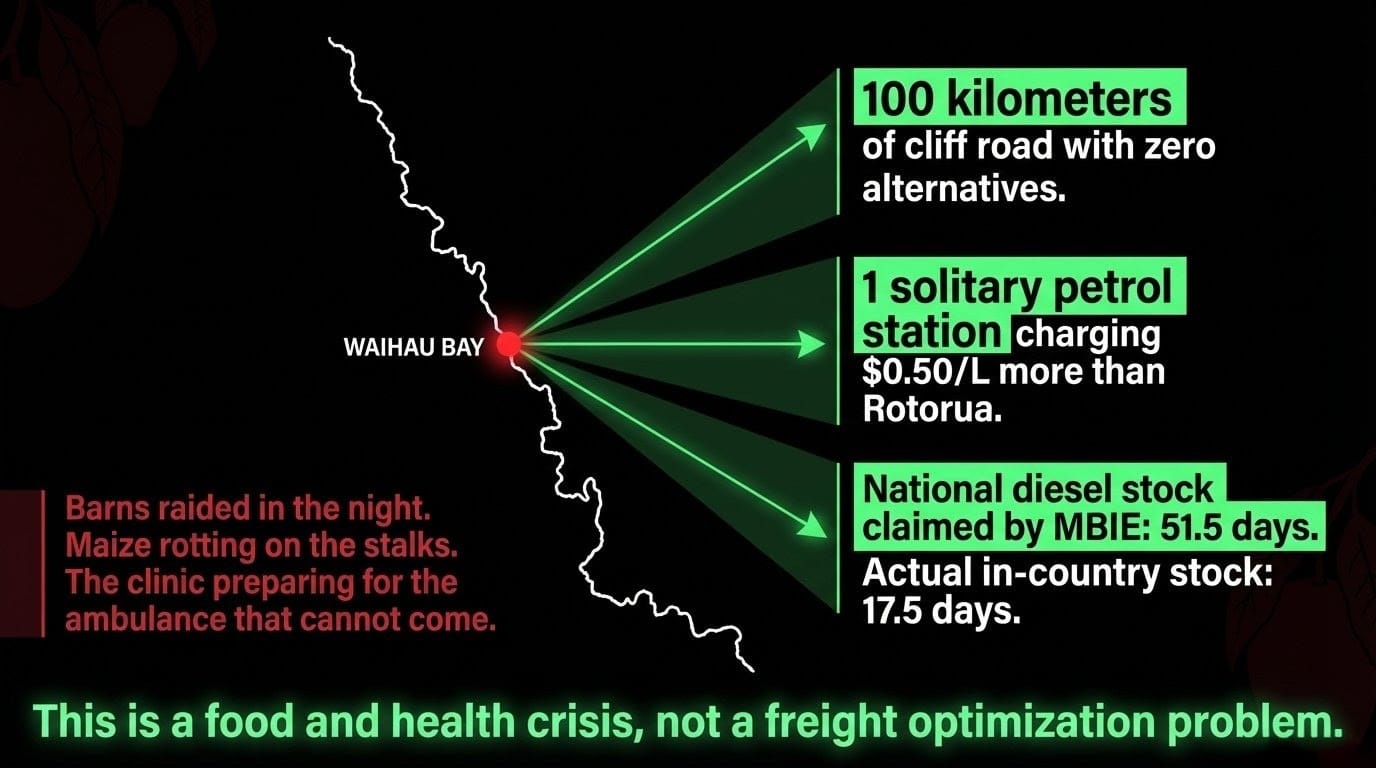
The clinic on SH35 is preparing for a scenario where ambulances from Ōpōtiki may be so restricted in their fuel use that emergency response to Waihau Bay becomes structurally impossible, as Ko Wai Ka Mate reported. They are stockpiling medicines. They are planning as if the state will not come — because experience has taught them that the state does not come to communities like theirs, not in time.
The government's fuel plan does not mention SH35. It does not mention Te Whānau-ā-Apanui. It does not mention the 100-kilometre corridor with one fuel outlet and no alternatives, confirmed by the Beehive's National Fuel Plan documentation. MBIE's aggregated national fuel data — 61.9 days of petrol, 51.5 days of diesel at the national level — is the government's sedative. But as Ko Wai Ka Mate confirmed from ground-level sources: in-country diesel stock is actually 17.5 days, not 51.5 — distributed through infrastructure designed around urban industrial centres, not cliff roads.
Every country in New Zealand's supply chain declared an emergency, as EnviroWatch NZ confirmed. New Zealand launched an ad campaign and a four-phase plan with corporate freight in Band B.
Te Tūāhurihanga o te Mana Whakahaere: The Hidden Network of Corporate Capture
This is not only about the fuel crisis. The RNZ story about business leaders is a symptom of a far deeper pathology: the systematic capture of public policy by corporate interests, operating with full government permission, at the direct expense of Māori and low-income communities. Follow the connections this government does not want made:
Connection 1: Business leaders now urging "food supply prioritisation" include the same commercial entities whose lobbying shaped the National Fuel Plan to enshrine their supply chains in Band B, confirmed by the Beehive's Fuel Response Plan and Foodstuffs' own MBIE submission. They helped write the framework. Now they are asking for it to be enforced.
Connection 2: The government's $21 million deal with Channel Infrastructure for extra diesel storage at Marsden Point, as NZ Herald confirmed, represents public investment in private infrastructure — while the Green Party's proposal for direct payments to all rural, low-income, and care households was rejected outright, as documented in The Pātaka is Ash.
Connection 3: Foodstuffs stated publicly it was absorbing diesel cost increases to protect shelf prices, as Foodstuffs NZ confirmed. This is the same Foodstuffs with no obligation to extend that absorption to the Four Square in Waihau Bay — a franchise unit at the end of the most expensive distribution route on the East Coast, where the community cross-subsidises Foodstuffs' logistics costs, not the other way around, as Ko Wai Ka Mate documented.
Connection 4: The neoliberal economic architecture that produced this crisis — the closure of Marsden Point, the privatisation of fuel distribution, the dismantling of strategic reserves — was built and maintained by both Labour and National over thirty years. Both parties own the whakapapa. Only one of them is in power now, performing pragmatism while the clinic counts its medicine stocks. This is documented in full in The Pātaka Beside the Strait and Pantomime of the Dying Waka.
Connection 5: The total strip of over $1 billion from kaupapa Māori infrastructure over the coalition's two budgets — housing, health, education, trades training — confirmed by Labour's official release and The Spinoff's Budget 2025 analysis, means the communities most exposed to this fuel crisis are the communities that had their resilience infrastructure dismantled before the crisis arrived. As The Starving of the Seedlings documented: this is a coalition that does not make mistakes — it makes choices, and then dresses them as inevitability.
Ko te Mahi ā-Rangatiratanga: Luxon's Answer to the Boardroom vs. the Rohe
When business leaders urged food supply prioritisation, Luxon was listening, as RNZ confirmed. When Debbie Ngarewa-Packer requested a cross-party emergency committee to address the fuel crisis impact on Māori communities, Wellington went quiet, as Ko Wai Ka Mate documented.
When Hana-Rāwhiti Maipi-Clarke declined her Washington IMF summit — because, in her words, "whānau can't afford to get down the road," as Ko Wai Ka Mate reported — that is what genuine accountability to community looks like. That is rangatiratanga made visible in the body, in the decision to stay.
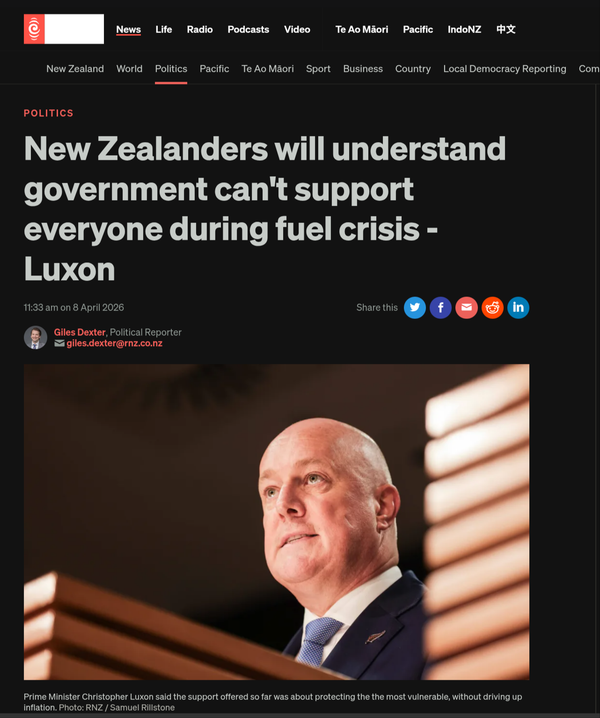
Compare it to Christopher Luxon — present at corporate briefings, absent from Waihau Bay, absent from Te Kaha, absent from the clinic counting its medicine stocks on a hundred kilometres of cliff road. When pressed repeatedly on excluded communities, Luxon told RNZ on April 9: "Most New Zealanders will understand the government can't support everyone."
Business leaders urging food supply prioritisation — he heard. The child at the doorway counting Day 1 without the people the fuel crisis drove from the rohe — he did not hear. That is not a communication failure. That is a value system operating exactly as designed.
He Tikanga Motuhake: The Verdict
Business leaders are right that food supply matters. No one argues with the principle. The argument is with the architecture of who that principle serves.
If food supply matters for the commercial entities that distribute to urban supermarkets, then it matters at least as much for the community in Waihau Bay whose food access depends on diesel they cannot afford, arriving by tanker that may not come, to a Four Square on a cliff road at the end of a hundred kilometres of nothing, as Ko Wai Ka Mate confirmed from the ground.
If the government will pay $21 million to a private company for diesel storage infrastructure, as NZ Herald confirmed, while refusing to fund a windfall profits levy that could have paid every excluded household a direct fuel subsidy — then this government has made a choice, and that choice has a name.
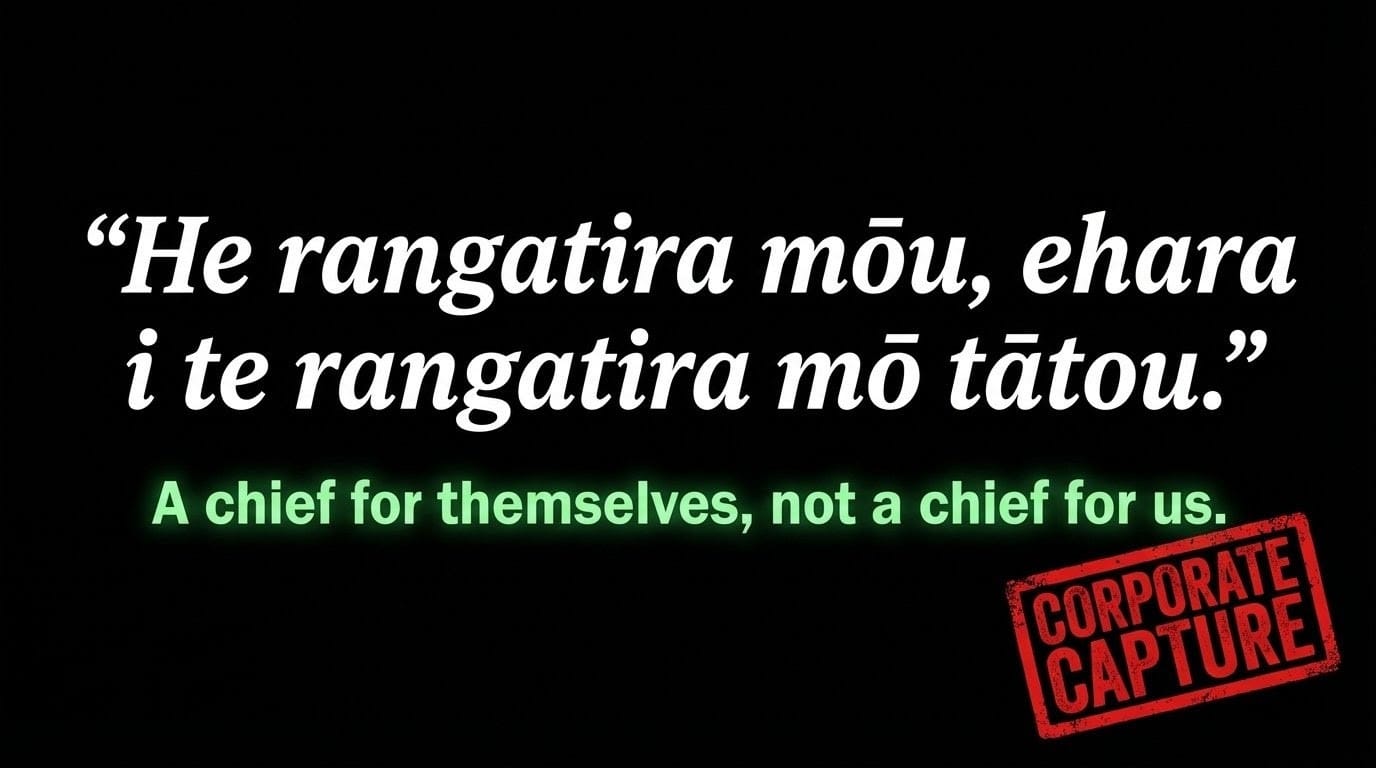
In te ao Māori, that name is: he rangatira mōu, ehara i te rangatira mō tātou. A chief for themselves, not a chief for us.
In te ao Western political analysis, the name is simpler: corporate capture.
The business leaders asking for food supply prioritisation will get what they ask for. They always do with this government. They are its constituency. As The Pātaka is Ash stated with devastating plainness: "This government did not fail to help the vulnerable. They looked at the vulnerable, identified them precisely, and drew a line excluding them from relief. That is not failure. That is policy."
The clinic in Waihau Bay will continue to stockpile its own medicines, acquire its own EV trucks, and plan for the scenario where the ambulance does not come. Because that is what it means to live in Aotearoa, in Te Tāhū o Te Rā, in April 2026 — under a government that can hear the boardroom from Wellington but cannot hear the canary on the cliff road.
Ko te Ara o te Rangatiratanga: What Power Looks Like Now
The business leaders' intervention is not a betrayal. It is a system performing as designed. The betrayal happened in the architecture — in the decisions made over thirty years to build a fuel supply system that serves commercial infrastructure and leaves rural, remote, Māori communities as afterthoughts at the end of logistics chains.
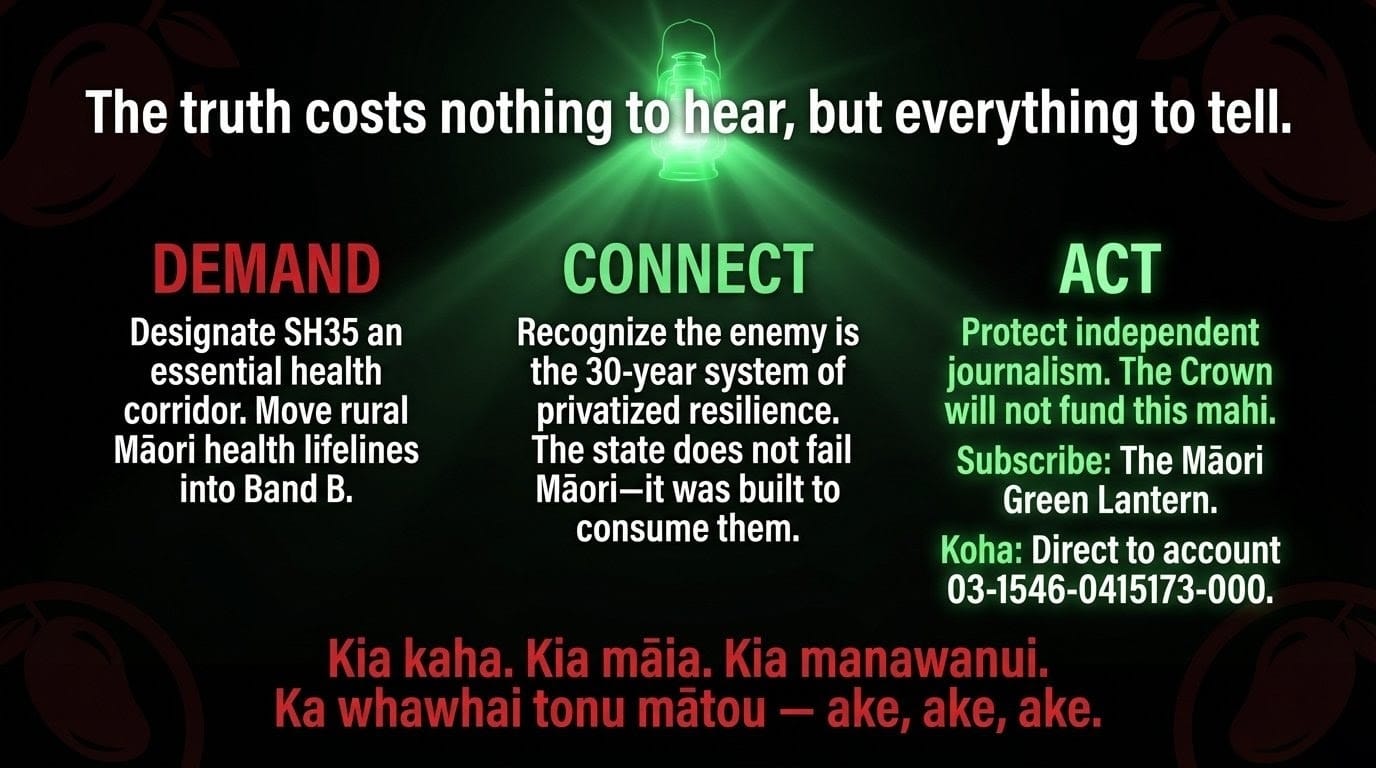
Name it: The fuel plan's Band B prioritisation of freight and commercial food supply chains, confirmed by the Beehive's Fuel Response Plan, is a policy choice, not a technical necessity. Community health corridors could have been Band B. They were not.
Demand it: SH35 — the Ōpōtiki to Waihau Bay corridor — must be designated an essential health infrastructure route with guaranteed fuel supply. One petrol station at the end of a hundred kilometres of cliff road is not a supply chain. It is a death waiting for paperwork, as Ko Wai Ka Mate documented.
Connect the dots: The business leaders in that RNZ article are participants in a system. The enemy is the system itself — the thirty-year neoliberal experiment that privatised resilience, defunded kaupapa Māori infrastructure, and then produced a crisis it cannot respond to equitably.
As The Nursery of Cages confirmed: this state does not fail Māori — it was built to consume them. And Luxon is feeding the machine faster than ever.
Koha Consideration
Waihau Bay has one petrol station. The clinic is stockpiling medicines and buying EV trucks because the ambulance may not come. Business leaders get their supply chains enshrined in the National Fuel Plan. The kuia choosing between petrol and kai gets nothing, as Ko Wai Ka Mate and The Pātaka is Ash confirm.
This mahi — documenting that disparity, naming the network, tracing the whakapapa of corporate capture — is not funded by the Crown. It is not funded by the corporations. It is funded by the whānau who understand that if we do not pay for our own truth-tellers, the only voices that reach Wellington will be the ones in suits.
Every koha is a direct act of rangatiratanga. It is whānau saying: we refuse to let this be buried.
Three pathways:
Koha direct — Support the Māori Green Lantern on Koha. Fund the mahi that the Crown and its corporate partners will not fund.
Subscribe — Join the whānau at The Māori Green Lantern. Essays direct to your inbox, every time the ring fires up.
Bank transfer direct — HTDM, account number 03-1546-0415173-000.
If koha is not possible — no worries, not even a little. Follow. Subscribe. Share this essay with the people who need to read it and the people who need to be confronted by it. Circulation is koha. The canary's song only reaches Wellington if enough of us carry it there.
Kia kaha. Kia māia. Kia manawanui. Ka whawhai tonu mātou — ake, ake, ake.

Research conducted April 9–10, 2026 NZST. Primary ground-level reporting from Ko Wai Ka Mate, 9 April 2026. Additional sources: RNZ, 1News, The Spinoff, NZ Herald, MBIE, Beehive.govt.nz, Foodstuffs NZ, Labour.org.nz, The Guardian, Waatea News, EnviroWatch NZ, AfMA. All anchor-text URLs tested and live at time of publication.