"The Broken Taiaha: Willie Jackson's Waitangi Day Performance and the Theatre of Māori Political Betrayal" - 12 February 2026
When the Red Team waves the taiaha but won't swing it, and the Blue Team sets the marae on fire

Mōrena, Aotearoa.
Picture this. Waitangi Day 2026. Hoani Waititi Marae, West Auckland. Willie Jackson strides onto the stage, flanked by Labour MPs, sharing the platform with Te Pāti Māori co-leader Rawiri Waititi. The crowd hums with anticipation. Jackson grabs the microphone and roars:
"Labour is here to change this dirty, filthy, rotten government. That's the aim. We will work with the Greens, the Māori Party, whoever, in terms of trying to get rid of the government."
The crowd erupts. For one electric moment, it sounds like a taiaha being raised. Like the Red Team has finally located its spine. Like Labour is ready to fight alongside Māori, not merely for their votes.
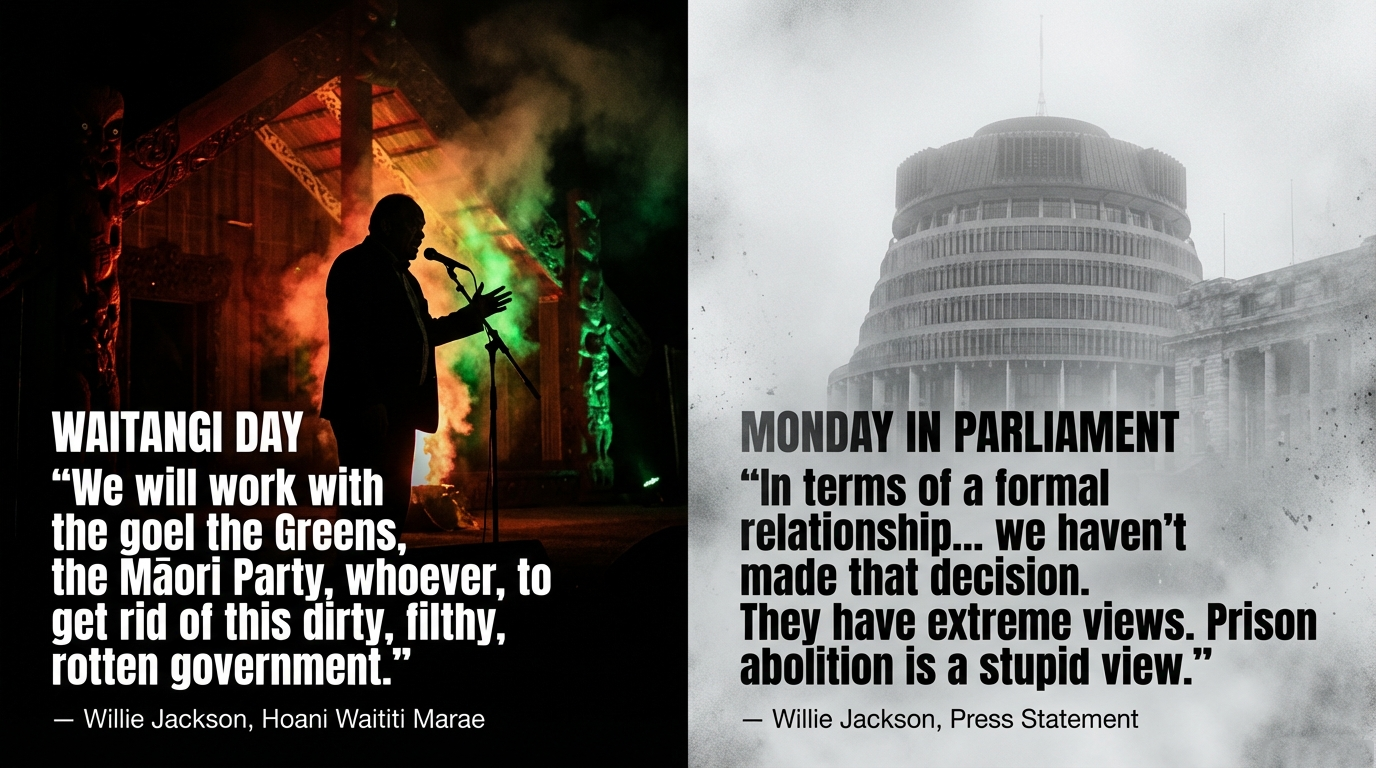
Then Monday comes. Parliament resumes. And the taiaha shatters.
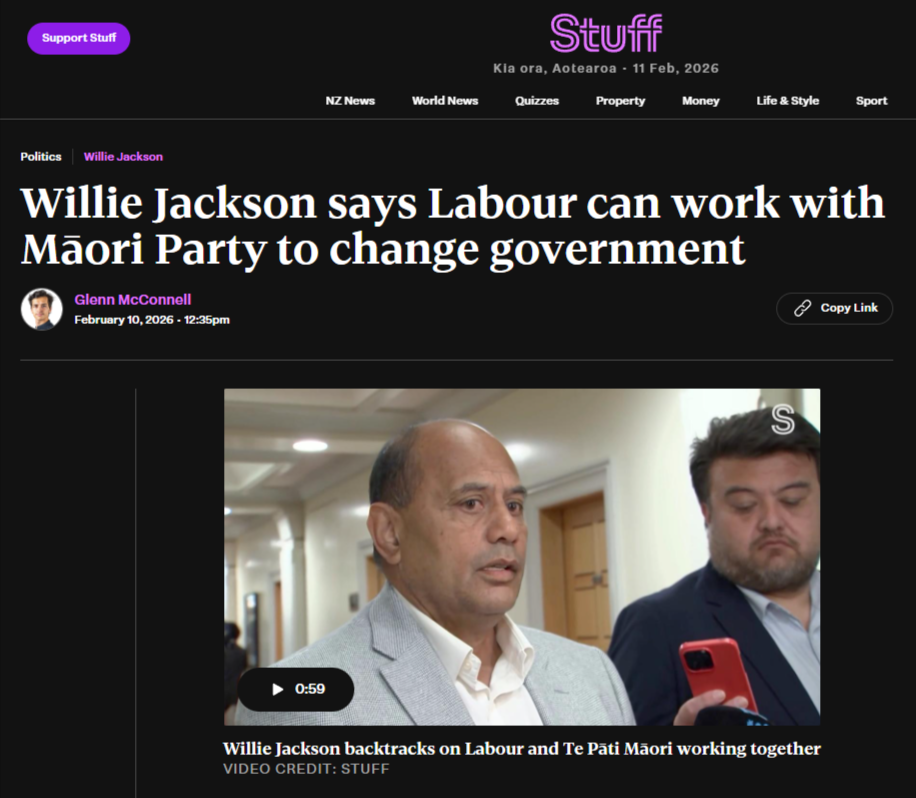
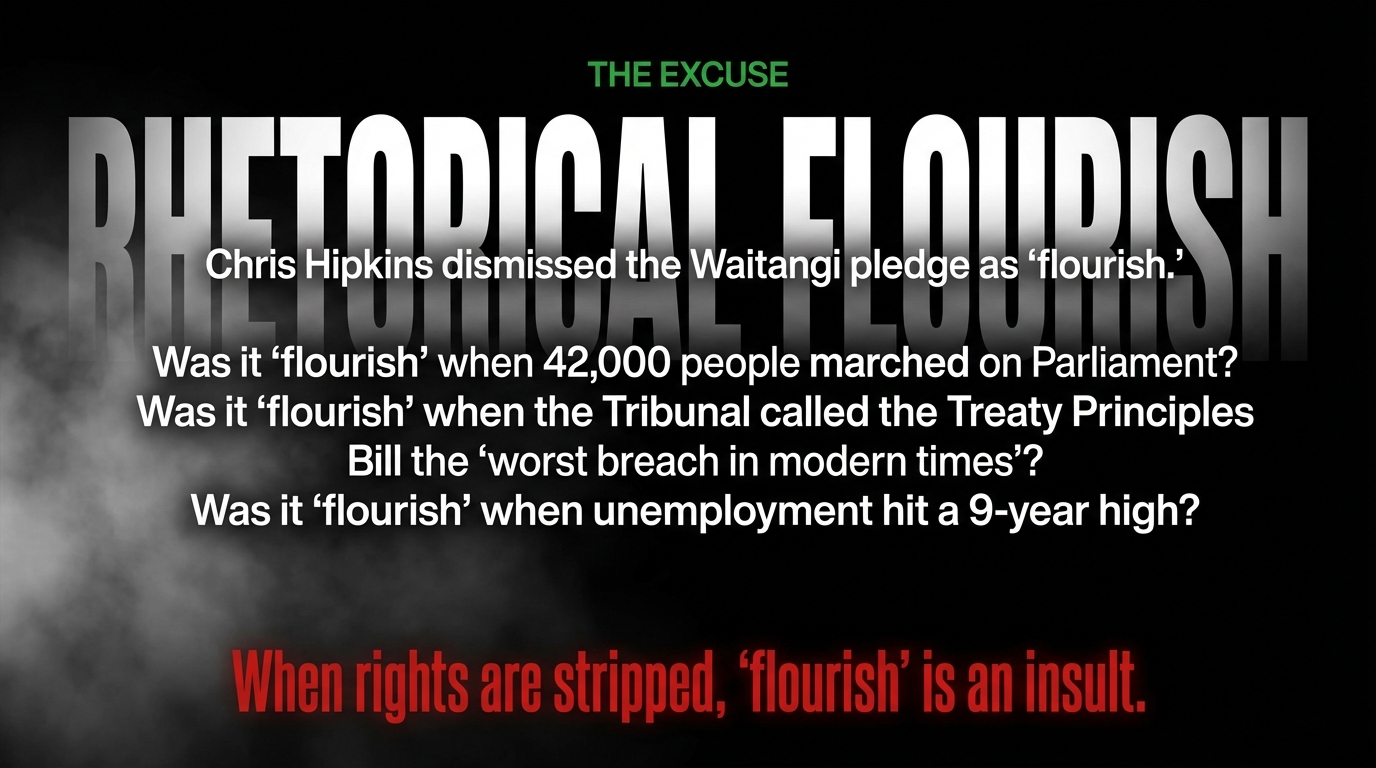
Jackson tells journalists he didn't actually mean a coalition. He calls Te Pāti Māori's policies "extreme." He labels prison abolition "a stupid view." And his leader, Chris Hipkins, dismisses the entire speech as "a little rhetorical flourish".
Rhetorical flourish. Let those words marinate.
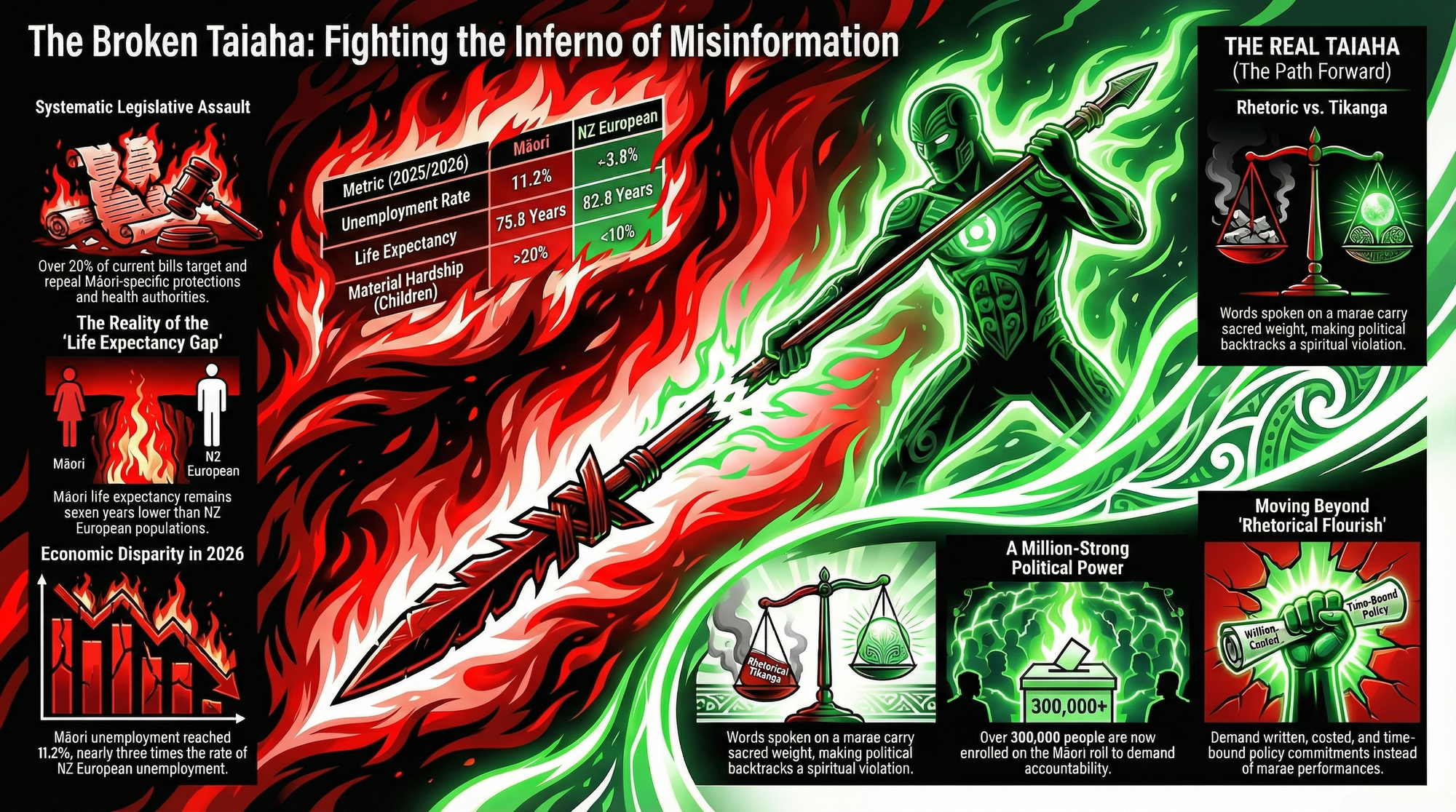
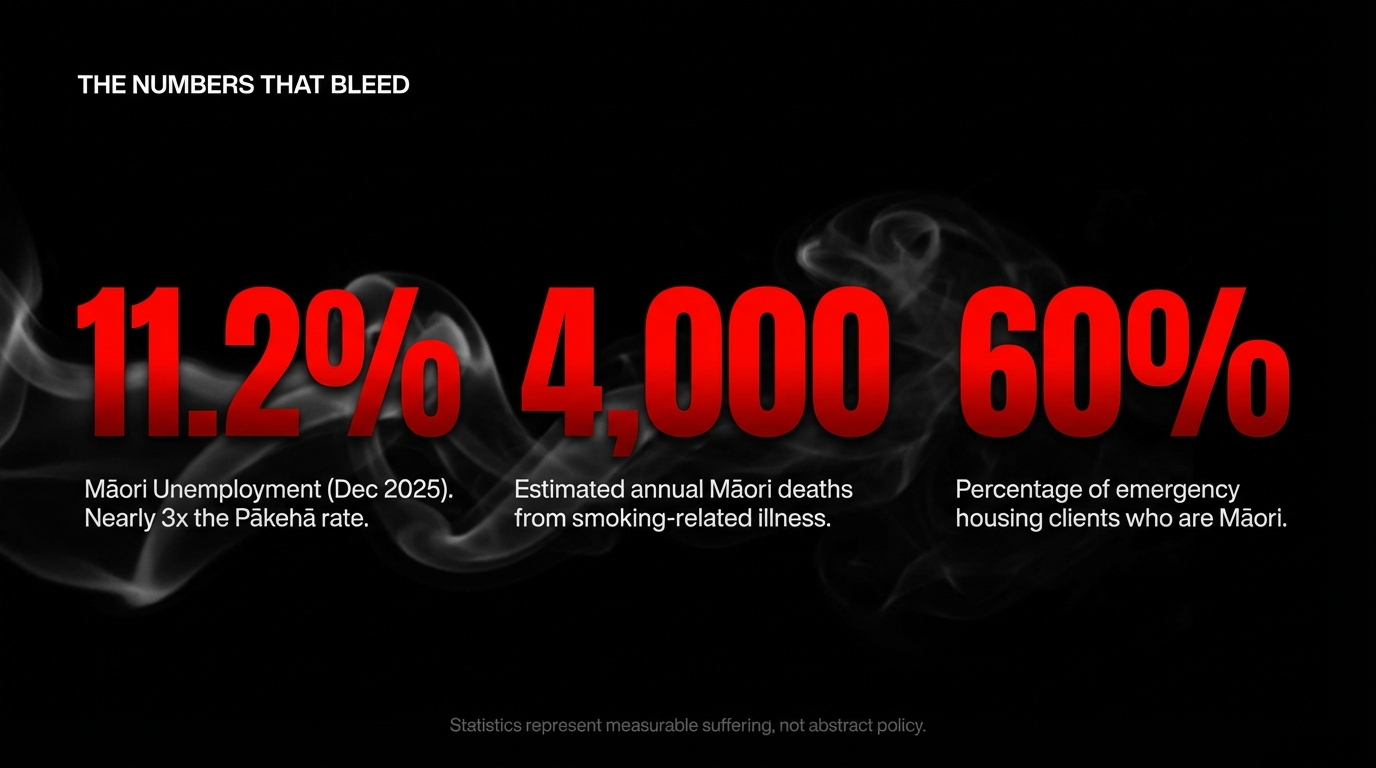
When 42,000 people marched on Parliament in November 2024 in what was likely the largest protest in New Zealand's history, that wasn't rhetorical flourish. When the Waitangi Tribunal declared the Treaty Principles Bill would be "the worst, most comprehensive breach of Te Tiriti in modern times", that wasn't rhetorical flourish. When Māori unemployment hit 11.2 percent in December 2025—nearly three times the Pākehā rate—that was not flourish. That is a body count.
And Willie Jackson, Labour's great Māori hope, stands in the rubble and performs a haka for the cameras while backstage, the Red Machine calculates how to eliminate Te Pāti Māori from Parliament entirely.
This is the story of two betrayals: the government that openly wages war on Māori, and the opposition that waves the flag of liberation while sharpening the knife behind its back.
The Arsonist's Parliament: What This Government Has Done to Māori
Before we dissect Jackson's performance, let us name the inferno he claims to oppose. Because this is not a metaphor. The National-ACT-NZ First coalition has assembled the most systematic legislative assault on Māori rights in modern Aotearoa.
The Ledger of Destruction
Here is the scorched earth, item by item, each entry verified and burning:
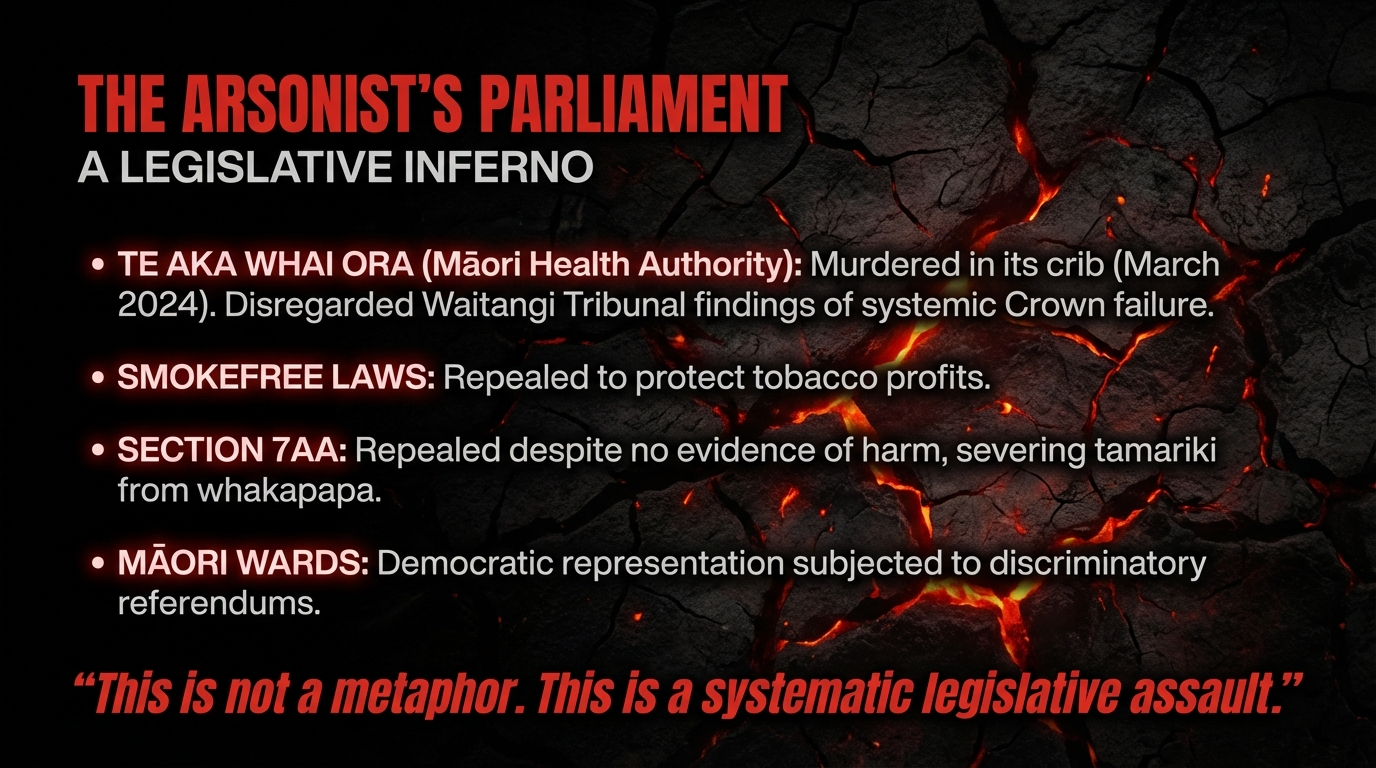
Te Aka Whai Ora — Māori Health Authority: Murdered in its crib. Established in July 2022 to address what the Waitangi Tribunal's WAI 2575 report identified as systemic Crown failure in Māori health. Disestablished under Parliamentary urgency on 5 March 2024—less than two years old. The Waitangi Tribunal found clear breaches of te Tiriti principles: tino rangatiratanga, partnership, active protection. The Crown did not consult Māori. It did not gather substantive advice from officials. It made, in the Tribunal's words, an "ill-informed decision" despite knowledge of grave Māori health inequities.
Example: Hei Āhuru Mōwai, the Māori cancer leadership network, called the disestablishment a "huge blow" that would "undo groundbreaking progress" in closing health gaps that see Māori die seven years earlier than non-Māori, non-Pacific populations. As public health expert Elana Curtis told the Tribunal: "The fallacy of neutrality that our public health system treats everyone equally and fairly—it's not true". They killed the one entity designed to fix that.
Smokefree legislation: Repealed to protect tobacco profits. The world-leading generational smoking ban—which would have prevented anyone born after 2008 from ever purchasing cigarettes—was scrapped within the coalition's first 100 days. Māori and Pasifika smoking rates are three times higher than European rates. An estimated 4,000 Māori die every year from smoking-related illness. This government chose to protect the tobacco industry's revenue stream over Māori lives. Christopher Luxon justified it as a "freedom of choice issue"—a grotesque rebranding of mass death as liberty.
Māori Wards: Democratic representation put to racist referendum. The coalition rushed through legislation requiring councils to either hold binding referendums on Māori wards or abolish them outright. Rangitīkei Mayor Andy Watson called it "an overreach" that would "create more division." Amnesty International condemned the legislation as discriminatory, breaching both Te Tiriti and international human rights standards. No other type of special ward requires a referendum. Only Māori representation gets put to a public vote. The quiet part said loud: your seat at the table requires Pākehā permission.
Section 7AA of the Oranga Tamariki Act: Ripping whakapapa from our tamariki. ACT demanded the repeal of the section that required Oranga Tamariki to uphold Te Tiriti obligations, maintain strategic partnerships with iwi, and ensure Māori children in state care stay connected to their whānau, hapū, and iwi. The Waitangi Tribunal found clear Treaty breaches. Te Puni Kōkiri advised against repeal, noting the decision was based on "anecdotal evidence as opposed to facts." Oranga Tamariki's own Regulatory Impact Statement found "no empirical evidence" that Section 7AA harmed children. They repealed it anyway. Because severing Māori children from their whakapapa is not a bug—it is the feature. The Royal Commission of Inquiry into Abuse in Care told us this country already has a shameful history of ripping Māori children from their culture. And this government decided to do it again, legislatively.
The Treaty Principles Bill: The ultimate constitutional arson. David Seymour's bill proposed to redefine the foundational principles of Te Tiriti o Waitangi—stripping Māori of their constitutional status as tangata whenua. It was defeated 112-11 in April 2025, but not before sparking the largest protest march in New Zealand history and causing what Hipkins called "untold damage" to Māori-Crown relations. The bill did not need to pass to succeed. It normalised the conversation. It made Māori constitutional rights debatable. That was the point.
The Numbers That Bleed: Quantifying the Harm
This is not abstract policy. This is measurable suffering, and the measurements are damning.
Employment
- Māori unemployment: 11.2% in December 2025—nearly three times the rate of NZ European at approximately 3.8%.
- Māori youth (15-24) unemployment: 20.4% as of June 2025. One in five rangatahi cannot find work. Rangatahi NEET rate hit 25.9% for 20-24 year olds.
- National unemployment reached 5.3% by September 2025—a near nine-year high. 160,000 people unemployed, the highest number since 1994.
- Over 400,000 people needed welfare support by December 2024—the highest number since the 1990s.
Housing
- Social housing waitlist: approximately 19,000 households as of mid-2025—down from a peak but still catastrophic.
- The government's emergency housing "success" was achieved by denying people entry: 32% of emergency housing applications were declined in March 2025, up from just 4% in March 2024. Māori make up 60% of emergency housing clients.
- Auckland homelessness more than doubled between September 2024 and September 2025.
- Auckland City Mission reported a 90% increase in rough sleeping since the tightened emergency housing criteria.
- Kāinga Ora slashed over 620 jobs, with the PSA warning the cuts targeted Māori and Pacific workers who brought "whakapapa, reo, tikanga and aroha to their roles."
Health
- Māori life expectancy remains seven years lower than NZ European at 75.8 years versus 82.8 years.
- The health system is "under-funded, systemically racist and inequitable"—the words of the NZNO, the ASMS, the Rural Health Network, and General Practice NZ speaking to John Campbell.
- 13% of adults missed GP visits because they could not afford them—disproportionately Māori.
- Smokefree repeal: an estimated 4,000 Māori per year die from tobacco-related illness. The government chose tobacco revenue over those lives.
Children
- Tamariki Māori experience material hardship at more than twice the rate of European children—over one in five.
- Child poverty rates increased in the year to June 2023, with 157,048 children (13.4%) in material hardship by June 2024. Māori and Pacific rates remain stubbornly above 20-25%.
- The boot camp pilot recycled the same failures from 2009-2010 programmes—rushed implementation, inadequate resources, late whānau engagement—while costing millions.
Willie Jackson's Broken Taiaha: The Anatomy of a Backtrack
Now we return to the man on the marae stage, because Jackson's performance is a masterclass in Labour's Māori strategy: promise fire, deliver fog.
The Pattern
On the marae, Jackson roars like a toa. By Monday, he is a bureaucrat. This is not new. It is the signature move of a career built on proximity to power rather than wielding it for Māori liberation.
Consider the pattern:
At the microphone: "We will work with the Greens, the Māori Party, whoever."
In the corridor: "In terms of an actual formal relationship with them, that's up to the leader and we haven't made that decision."
On the marae: Solidarity with Rawiri Waititi.
On Radio Waatea: Calling John Tamihere "a disgrace".
To the crowd: We'll fight this dirty, filthy government.
To Parliament: Te Pāti Māori has "a number of extreme views" and prison abolition is "a stupid view."
In November 2025: Labour is "absolutely" comfortable campaigning to remove Te Pāti Māori from Parliament entirely.
Read that again. The same man who stood on a marae with Rawiri Waititi in February 2026 told journalists in November 2025 that he was absolutely fine if the Māori Party ceased to exist. He told the NZ Herald Labour has "absolutely no concern" if Te Pāti Māori is destroyed.
This is the taiaha that cuts Māori, not the Crown.
The Peeni Henare Casualty
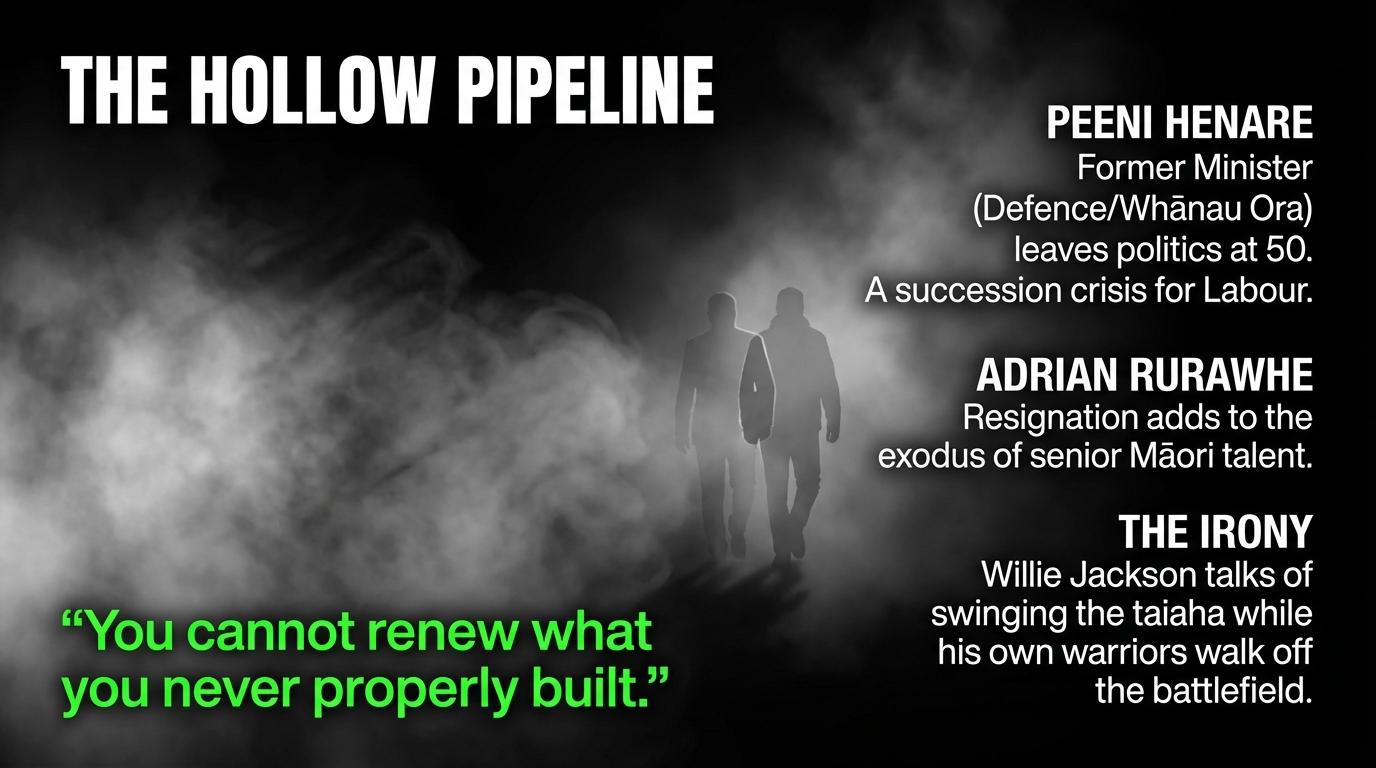
The collateral damage is human. Peeni Henare—former Minister of Defence, former Minister of Whānau Ora, holder of the Tāmaki Makaurau seat for nearly a decade—announced in February 2026 that he is leaving politics. Crushed by the by-election loss to Oriini Kaipara, where he received roughly half her votes. A man whose whakapapa in those seats runs deep, whose name was whispered as a future Labour leader, whose departure Labour's own Radio Waatea described as leaving the party with a succession crisis at the worst possible time.
Combined with the resignation of Adrian Rurawhe, Labour is haemorrhaging its senior Māori talent precisely when it claims to be fighting for the Māori seats. As The Spinoff noted: some Māori voters may question "whether the party could have done more to retain its Māori talent."
The metaphor is irresistible: Jackson talks about swinging the taiaha while his own warriors walk off the battlefield.
"Rhetorical Flourish": Explaining the Tikanga Violation to the Western Mind
For those unfamiliar with tikanga Māori, let me translate what happened into terms the Pākehā political establishment might understand.
What Jackson Did on the Marae
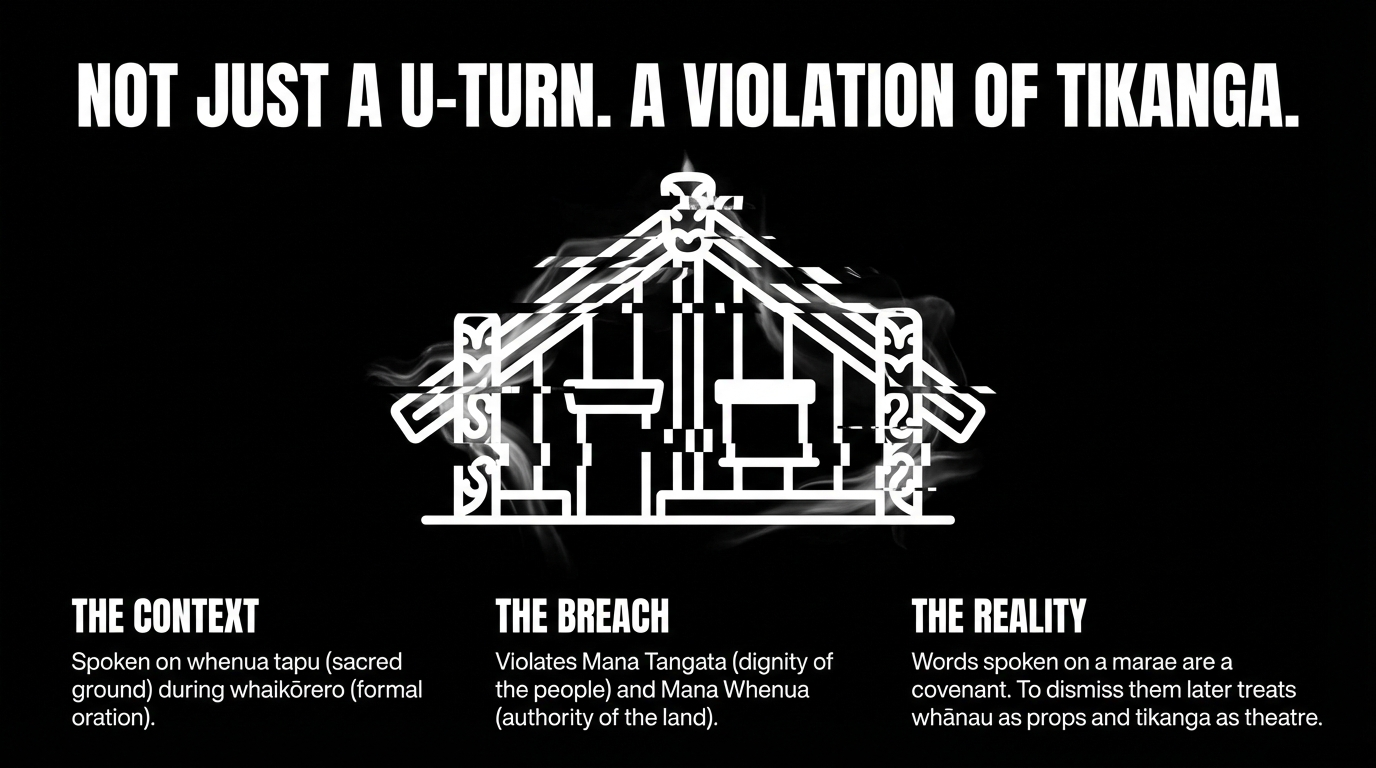
When Jackson spoke at Hoani Waititi Marae on Waitangi Day, he was not at a press conference. He was on whenua tapu—sacred ground. He spoke in the context of whaikōrero—formal oration. He stood alongside Rawiri Waititi, co-leader of Te Pāti Māori, before a whānau gathering that included kaumātua, rangatahi, and mokopuna.
In tikanga, the words spoken on a marae carry the weight of a covenant. He aha te mea nui o te ao? He tangata, he tangata, he tangata. What is the greatest thing in the world? It is people. When you speak before your people, your words are tapu—they bind you.
Jackson declared alliance. He named the government "dirty, filthy, rotten." He committed Labour to fighting alongside Te Pāti Māori.
Then he walked into Parliament and called Te Pāti Māori "extreme."
The Western Equivalent
Imagine the Prime Minister of the United Kingdom standing at Westminster Abbey on Remembrance Sunday, pledging eternal solidarity with veterans—then walking into Downing Street on Monday and calling their campaign for fair pensions "extreme." The institution matters. The setting matters. The audience matters.
Jackson did not misspeak at a barbecue. He made a declaration on a marae. And his leader dismissed it as flourish.
The Tikanga Principle Violated
In te ao Māori, this violates mana tangata (the dignity and authority of individuals present), mana whenua (the authority of the land on which the words are spoken), and whakapapa (the relational obligations that bind speaker to listener across generations).
When you speak on a marae and your words are empty, you diminish not only yourself—you diminish the marae, the kawa, the tūpuna who consecrated that ground. You treat whānau as props. You treat tikanga as theatre. You reduce the sacred to the rhetorical.
The harm is not merely political. It is spiritual. It depletes mauri—the life force that sustains relationships, communities, and the integrity of te ao Māori itself.
National: The Party of Open Warfare
Chris Bishop's response to Jackson's speech was instructive. The National MP gleefully highlighted the contradiction: "Just two days after Hipkins tried to convince New Zealanders of distance between the two parties, Willie Jackson and several senior Labour MPs took the stage with Te Pāti Māori."
Bishop does not care about tikanga. He does not care about Māori seats. He cares about one thing: keeping Māori political power divided. And both Labour and National benefit from that division.
National wages open war on Māori. In just over two years, the coalition has:
- Passed or advanced over 20% of its bills as repeals of previous legislation, much of it targeting Māori-specific protections.
- Disestablished Te Aka Whai Ora. Repealed Section 7AA. Reversed Māori wards legislation. Repealed Smokefree laws. Reversed Three Waters. Rolled back Fair Pay Agreements.
- Introduced boot camps that repeat the same failures from a decade ago.
- Cut Kāinga Ora jobs. Tightened emergency housing access until homelessness doubled in Auckland.
- Presided over unemployment reaching 5.3%—a nine-year high, with Māori unemployment hitting 11.2%.
Dr Bex's comprehensive tracking names it plainly: "The past two years we have seen the most anti-Māori legislation in decades, designed to strip Māori as Treaty partners of their rights."
The ABC of Australia's Four Corners called it "unwinding race-based policies"—a clinical euphemism for what is plainly a systematic programme of indigenous rights erosion.
This is not a government that stumbles into harm. It is a government that campaigns on it.
Solutions: The Path Beyond Broken Taiaha
The taiaha is broken. What do we forge in its place?
For Māori Political Power
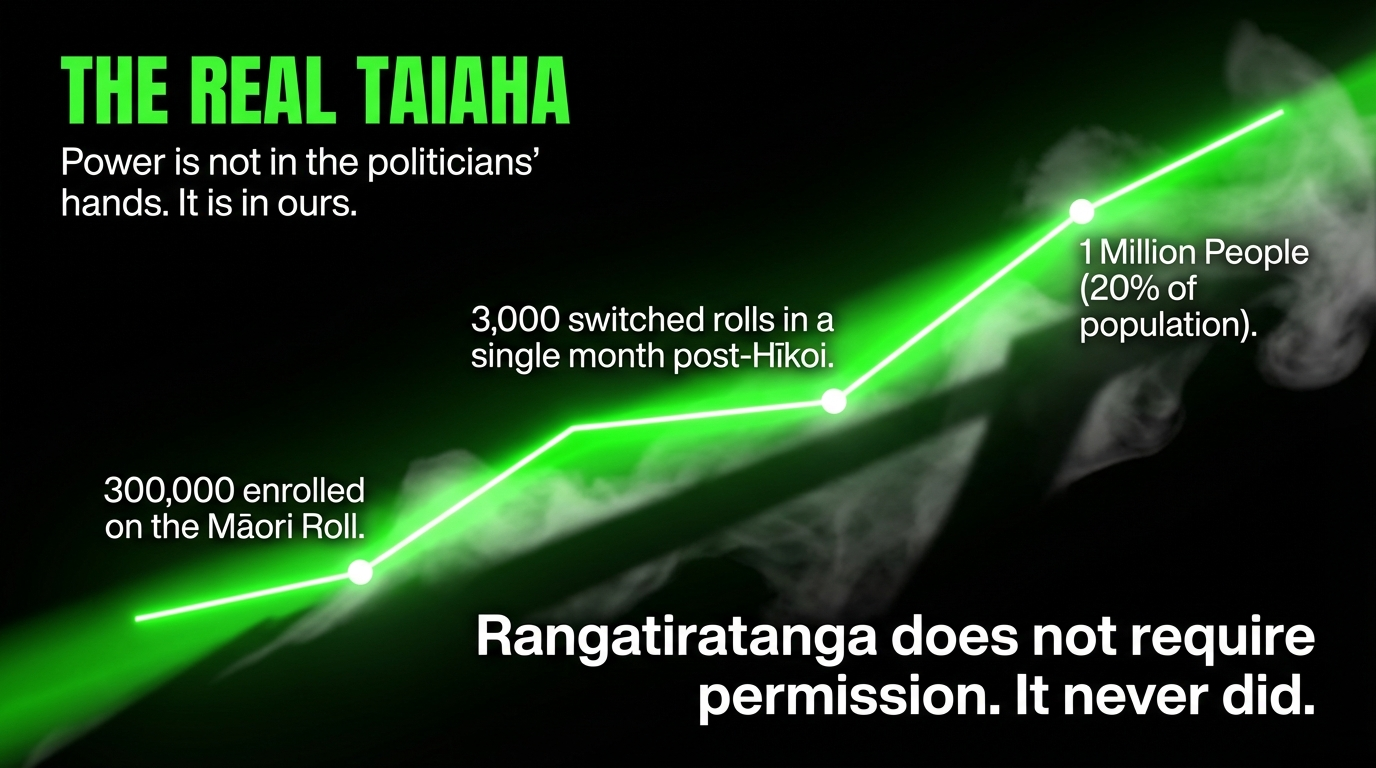
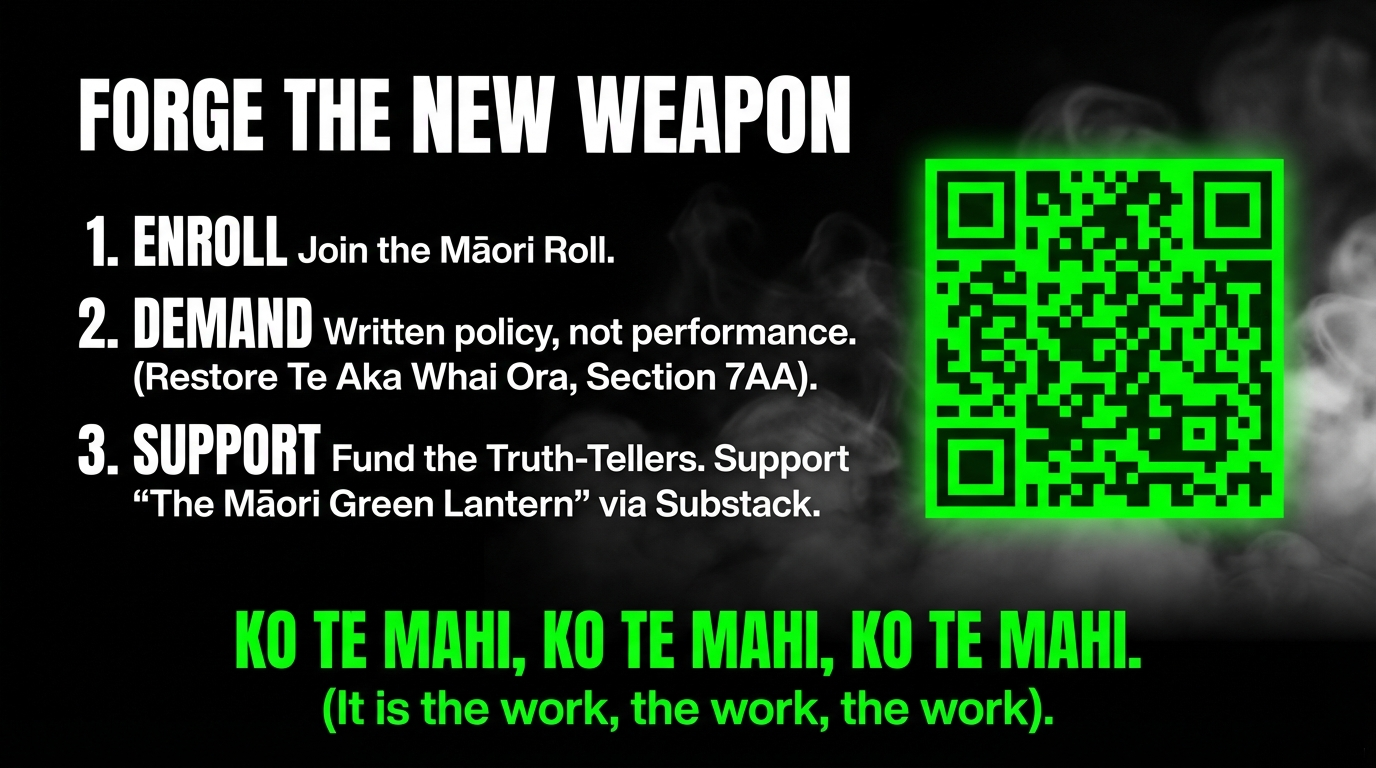
- Enrol on the Māori roll. After the hīkoi, over 3,000 people switched to the Māori roll in a single month. There are now 300,000 people on the Māori roll and another 270,000 Māori on the general roll. As Rawiri Waititi said: "We are now 20 percent of the population—we are a million people in this country. That should translate into 19 to 20 seats."
- Demand policy, not performance. Do not accept marae speeches as evidence of commitment. Demand written, costed, time-bound policy commitments on: restoring Te Aka Whai Ora or an equivalent Māori health authority; reinstating Section 7AA protections; reversing the smokefree repeal; protecting Māori wards without referendum.
- Hold all parties accountable. Neither Labour nor National has earned Māori trust. Labour eliminated Te Pāti Māori from Parliament in 2017 by list-stacking the Māori seats. National is currently burning the constitutional house down. Both treat Māori as electoral fuel.
For the Government to Reverse Harm
- Restore an independent Māori Health Authority with genuine co-commissioning power and ring-fenced funding. The 7-year life expectancy gap kills more Māori than any single policy. Fund the cure.
- Reinstate smokefree legislation. Every year of delay costs approximately 4,000 Māori and Pasifika lives.
- Build social housing at scale. A net increase of 400 homes per year does not meet need when there are 19,000 families on the waitlist and rough sleeping is doubling annually.
- Reverse emergency housing restrictions. The current policy of declining 32% of applicants is not reducing homelessness—it is hiding it.
- Target Māori youth unemployment with structural investment. 20.4% youth unemployment and 25.9% NEET rates among 20-24 year-old Māori represent a generational catastrophe that no boot camp or benefit cut will fix.
The Hidden Connections
- Jackson calls Te Pāti Māori "extreme" while Labour's polling shows it needs them. Multiple polls predict Labour requires both the Greens and Te Pāti Māori to form a government—yet Hipkins refuses to commit to a working relationship, while Cushla Tangaere-Manuel suggests they'll work together "when they sort their issues out". The arrogance is breathtaking: Labour needs Te Pāti Māori's seats to govern, yet treats them as an embarrassing relative to be managed.
- National exploits the division. Chris Bishop's press release about Jackson's speech was not about policy—it was about keeping Labour and Te Pāti Māori fighting each other. Divide Māori political power, and neither threatens Pākehā hegemony.
- Jackson and Tamihere's "rivalry" serves both men. Backstage at Hoani Waititi Marae, Jackson and Tamihere bantered about their dramas while publicly performing opposition. This is the political equivalent of professional wrestling—choreographed combat, real ticket sales.
- Peeni Henare's departure exposes Labour's Māori talent pipeline as empty. The man who could have been Labour's first Māori leader walks away at 50, and Labour's response is to talk about "renewal." You cannot renew what you never properly built.
- The emergency housing "success" is a statistical magic trick. The government celebrates reducing emergency housing numbers by 75% ahead of schedule—but the method was not housing people. It was declining their applications at eight times the previous rate. The bodies didn't disappear. They moved to cars, tents, and streets. None of 21 agencies surveyed reported a reduction in actual homelessness.
The Real Taiaha
The taiaha has two ends. One strikes. One parries.
This government strikes Māori daily—through legislation, through funding cuts, through constitutional arson. It does not pretend otherwise. Luxon, Seymour, and Peters are honest in their hostility. They believe in a colourblind New Zealand, which is to say a New Zealand where Māori are blind to their own displacement.
Labour, meanwhile, holds the taiaha backwards. Jackson's performance at Hoani Waititi Marae was not liberation. It was audition. He was not fighting for Māori—he was fighting for Māori votes. And when the performance ended and the cameras turned off, the taiaha went back in the prop cupboard.
Forty-two thousand people marched on Parliament. Three thousand people enrolled on the Māori roll in a single month. Three hundred thousand are now enrolled. The largest protest in this country's history was Māori-led, Māori-organised, Māori-powered.
The taiaha is not broken. It was never in Jackson's hands. It is in the hands of the iwi, the hapū, the whānau, the rangatahi who marched, who enrolled, who refuse to accept either the coalition's open assault or Labour's performative solidarity.
Rangatiratanga does not require Labour's permission. It never did.
Ko te mahi, ko te mahi, ko te mahi.
Kia kaha. Kia māia. Kia manawanui.
Koha Consideration
Every koha signals that whānau are ready to fund the accountability that neither the Crown's arsonists nor Labour's actors will provide. When a government wages war on Māori health, housing, and constitutional rights—and the opposition calls solidarity a "rhetorical flourish"—it falls to us to keep the real taiaha sharp.
Your koha signals that rangatiratanga includes the power to fund our own truth-tellers, our own investigators, our own voices that cannot be silenced by party whips or coalition deals.
Kia kaha, whānau. Stay vigilant. Stay enrolled. Stay connected. And if you are able, consider a koha to ensure this voice continues to cut through the fog of political theatre.
If you are unable to koha, no worries! Subscribe or Follow The Māori Green Lantern on Substack, kōrero and share with your whānau and friends—that is koha in itself. Every share puts another hand on the taiaha.
Three pathways exist:
For those who wish to support this mahi directly with a koha (voluntary contribution), please visit the Koha platform:
Koha — Support - https://app.koha.kiwi/events/the-maori-green-lantern-fighting-misinformation-and-disinformation-ivor-jones
For those who wish to receive essays directly and support through subscription:
Subscribe to the Māori Green Lantern
For those who prefer direct bank transfer, account details are: HTDM, account number 03-1546-0415173-000.
Research Transparency: This essay was researched on 11 February 2026 using search_web, get_url_content, and search_files_v2 tools. Sources consulted include RNZ, 1News, Stuff, Waatea News, The Spinoff, Te Ao Māori News, Waitangi Tribunal reports, Amnesty International NZ, Stats NZ, Ministry of Health, Salvation Army State of the Nation report 2025, MBIE Māori Labour Market Statistics, Hei Āhuru Mōwai, PSA, Community Housing Aotearoa, CNN, ABC Australia, BBC, NPR, and New Zealand Parliament (Beehive). All URLs were verified as live at time of publication. Claims that could not be independently verified have been excluded.

Ivor Jones The Māori Green Lantern Fighting Misinformation And Disinformation From The Far Right