“The Cage of Kindness: How Labour’s Neoliberalism Trapped a Nation” - 17 December 2025
Prologue: The Photograph We Keep
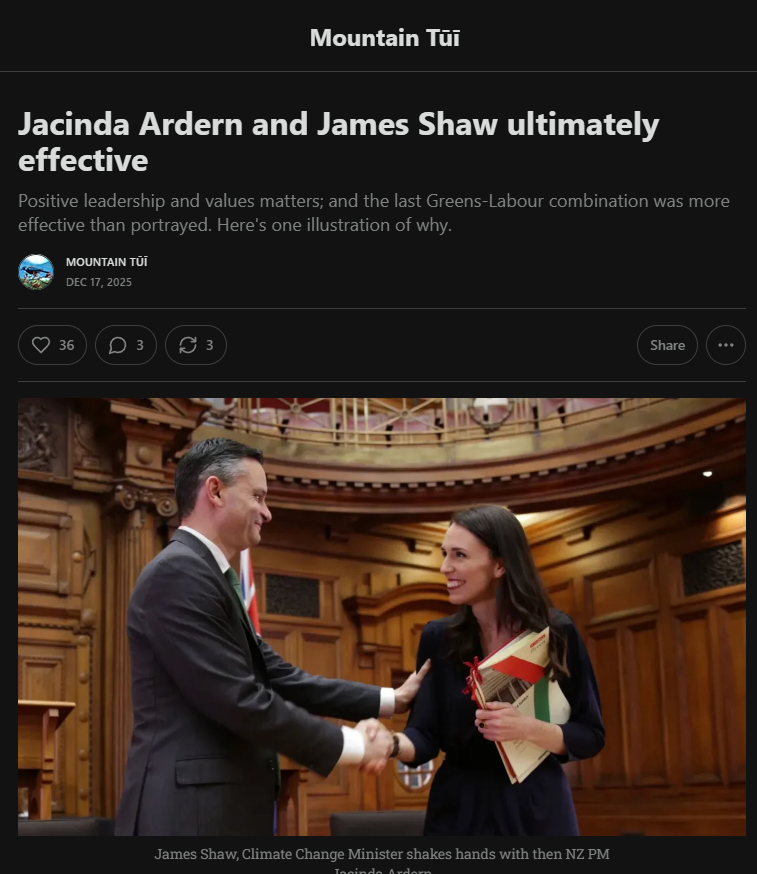
There is a photograph that haunts progressive politics in Aotearoa. It shows Jacinda Ardern shaking hands with EU officials, beaming at the cameras.
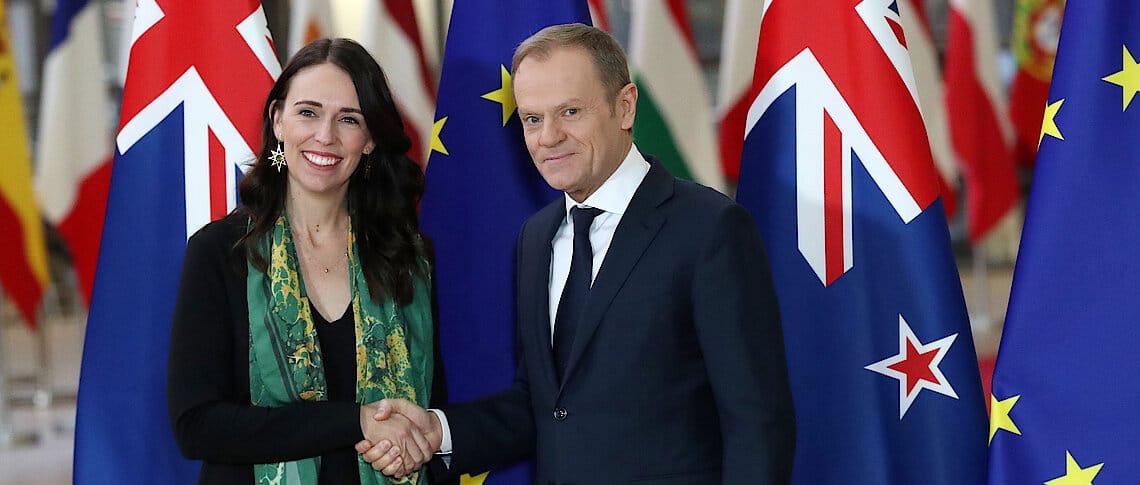
Historic Trade Deal Signed
Mountain Tūī has written a love letter to this photograph.
The essay celebrates Ardern and Shaw as “ultimately effective”—better managers of the economy, more competent stewards of trade, builders of more houses than the current government. The numbers seem to back it up. The EU deal was worth $22 billion. National’s deals are smaller. Labour built more state houses.
The story is neat, satisfying, and wrong.
But here is the thing about wrong stories:
they are dangerous precisely because they contain fragments of truth. The EU deal was real. The houses were built. Luxon is failing. The problem is not that these facts are false. The problem is what they are being used to hide.
This is the story of how that photograph became a cage—and how celebrating what happens inside the cage is not liberation.
Part One: The Embrace That Never Loosened
When Jacinda Ardern took office in 2017, there was hunger in the land. Not metaphorical hunger—though there was plenty of that—but a hunger for something different. After nine years of John Key’s casual cruelty and Bill English’s cold efficiency, Labour promised change. Kindness. A different way.
People believed. They campaigned. They voted.
Then Ardern took the briefcase from the Treasury and opened it. Inside was the same economic playbook National had been running for forty years. Neoliberalism. The gospel of free markets, trade liberalisation, growth-at-all-costs, austerity, and corporate partnership.
She did not throw it out. She picked it up and kept reading.
The truth about Labour and National—the truth that Mountain Tūī cannot quite see—is that both are reading from the same hymn book. They differ in tone. National sings the hymn loudly and aggressively. Labour sings it softly, with apparent reluctance, wrapping it in language about values and kindness.
But the hymn remains unchanged:
Free markets first. Growth is god. Capital must be protected. Communities must be managed. Individuals must carry their own weight.
This is not a choice between liberation and oppression. This is a choice between two managers of the same extraction machine, operating under the same rules, serving the same masters.
One manager is explicitly hostile. The other smiles while turning the dial.

The Cage of Kindness
Part Two: The Trade Deal as Capitulation
Now let us talk about that photograph. Let us talk about what that EU trade deal actually meant when you stopped looking at the numbers and started looking at the ground.
The deal was real. Prime Minister Jacinda Ardern helped conclude negotiations that would boost exports by an extra NZ$1.8 billion per annum to the New Zealand economy by 2035. On paper, it looked like a victory for competent leadership.
But what was being traded?
Mostly, dairy. Milk. Cheese. Butter. Produced in Aotearoa through a model that had become utterly broken—intensive farming, where land is treated not as a living relation but as a production platform.
This dairy system:
- Destroyed waterways. Models estimate that 45 percent of Aotearoa New Zealand’s total river length was not suitable for activities like swimming between 2016 and 2020. Not a metaphor. Actual rivers filled with runoff and pathogens. Rivers that children used to play in. Rivers that iwi fished and gathered from. Gone.
- Depleted soils. The very earth was being mined for nitrogen and phosphorus, pushed beyond capacity, treated like a renewable resource when it absolutely is not.
- Collapsed biodiversity. Native species vanished. About two-thirds of freshwater native bird species were either threatened with extinction or at risk of becoming threatened in 2021. Ecosystems that took millennia to develop were bulldozed in decades.
- Suppressed wages. Workers in processing plants, in transport, in support services earned stagnant wages justified by the requirement to remain “globally competitive.”
When Ardern signed that trade deal, the EU hailed the agreement as containing the “most ambitious sustainability commitments in a trade agreement ever”—which mostly amounted to reporting, offsetting, and certification schemes. These are not limitations on extraction. They are marketing tools for extraction.
They let corporations say: “Look, we are sustainable,” while the rivers die and the soil degrades and the workers stay poor.
This is not effective governance. This is greenwashing with legal footnotes.
Mountain Tūī celebrates this as proof of Labour’s superior economic management. But what was Labour managing? The continued plunder of the land, just with better PR.
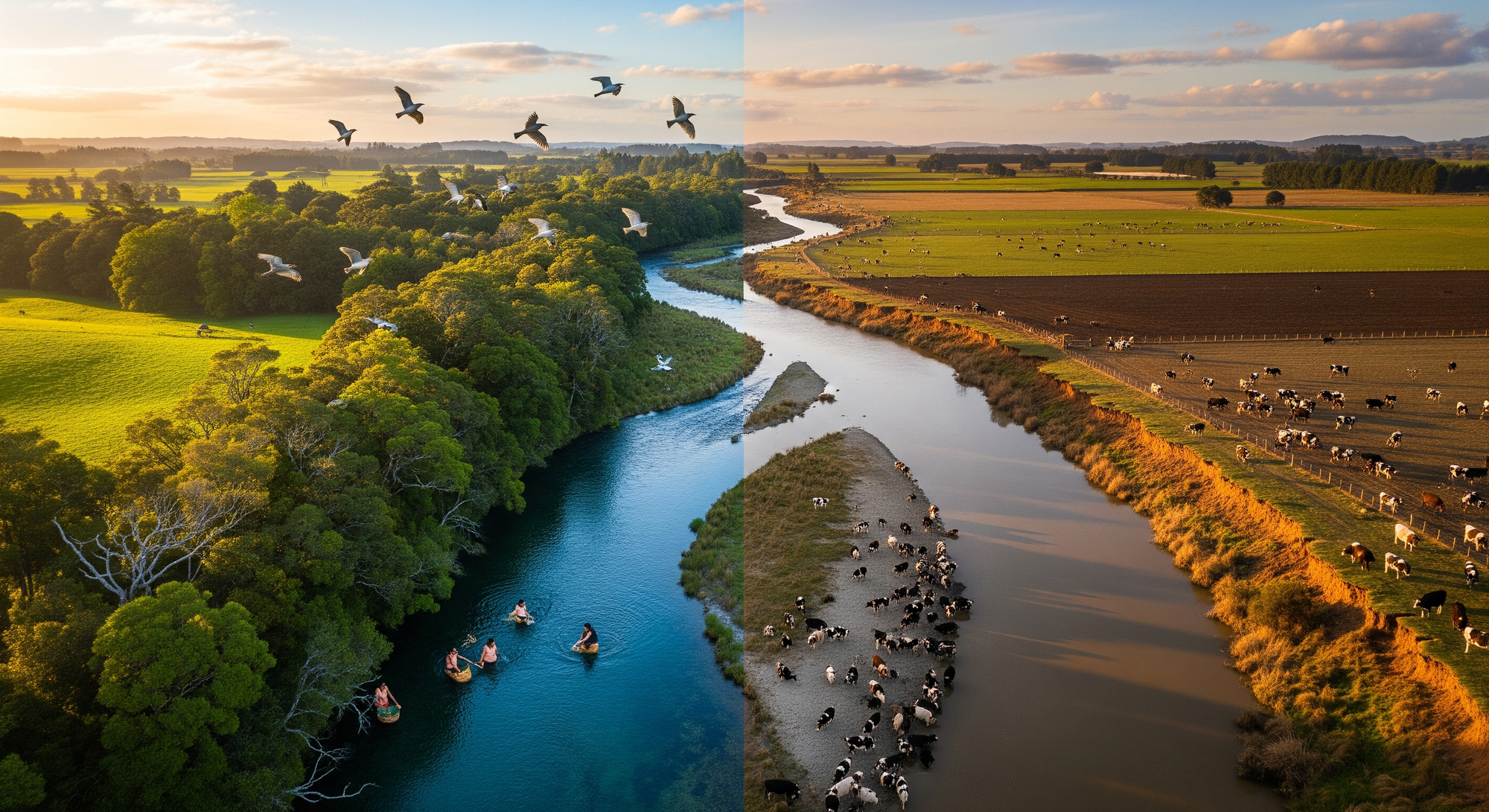
The River That Died
Part Three: The House That Nobody Could Afford
There is another number in Mountain Tūī’s story:
Labour built around 14,000 homes. The Government successfully delivered over 12,000 additional public homes since October 2017. National built maybe 200 in two years.
On the surface, this seems like a clear Labour victory. More houses. Better policy. Competent delivery.
But here is what happened to those houses, and here is what happened to everything else:
When Ardern’s government took office in 2017, house prices were already climbing. By 2020, house prices had increased by over 30% under Jacinda Ardern’s Labour Government, with the surge continuing through 2021 and 2022. Everywhere, the same story: prices exploding upward, faster than wages could follow, faster than the reserve bank felt inclined to stop.
Those additional public homes? Many were built in partnership with private developers. Public land, public money, but private profit. The developers captured the land value gains. The public absorbed the risk. This is what neoliberal partnership looks like.
The people who got into those houses were often people who could already afford to live somewhere. The people sleeping rough—homelessness in Auckland more than doubled to 940 people in the year to September 2025—remained outside the system entirely.
Meanwhile, the state housing waitlist grew from around 6,000 in 2017 to over 25,000 households by 2023. Emergency housing grants, once a rarity, became normal. Motels filled with whānau. Children grew up in rooms sixteen feet square, with no place to play, no place to be.
Labour did not decommodify housing. Labour did not implement rent controls or restrictions on speculative investment or place hard caps on house price growth. Labour built units while allowing the system itself to become more extractive, more financialised, more broken.
So when Mountain Tūī compares house numbers, what is actually being compared? The number of units delivered by a system designed to exclude.
By the end of Labour’s term, median house price-to-income ratios stood at unsustainable levels. Those 14,000 houses were real. But they were delivered by a government that allowed housing itself to become a mechanism of wealth extraction and exclusion.

The Housing Mirage
Part Four: James Shaw’s Pragmatic Surrender
James Shaw appears in Mountain Tūī’s essay as a figure of tragedy and nobility. A pragmatist, constrained by state institutions and impatient party members, doing his best to advance climate action within the limits of what is politically possible.
His signature achievement was the Zero Carbon Act.
It sounded revolutionary. Aotearoa would reach net-zero emissions by 2050. Carbon budgets would guide policy. There would be substance, not just talk.
Then read the fine print.
The Climate Change Response Zero Carbon Amendment Bill aimed to reduce all greenhouse gases except biogenic methane to net zero by 2050, while reducing emissions of biogenic methane within the range of 24–47 percent below 2017 levels by 2050. The government did not want to threaten farmers. So it carved out an exception. Livestock could keep emitting.
The framework relied heavily on offsets:
tree planting schemes, carbon markets, paper solutions. Instead of requiring actual reductions in emissions from industry and transport and agriculture, the law allowed these sectors to keep polluting if somewhere else a forest was planted. This is not climate action. This is climate theatre.
Fossil fuel exploration was not abolished;
it was merely slowed. The high-emitting sectors—agriculture, aviation, heavy industry—were given long runways. We will get to you eventually, they were told. Keep expanding for now.
Shaw called this pragmatism. He spoke of working within institutions, of incremental change, of doing what is politically possible.
But consider:
who decides what is politically possible? The answer is: those who have the most to lose from real change. The agricultural lobby. The oil companies. The financial sector. The rich.
“Political possibility” under neoliberalism means:
what can be done without threatening capital accumulation. Pragmatism inside that frame is not a virtue. It is accommodation.
Shaw’s Zero Carbon Act delivered:
- Symbolic victories with limited actual impact
- Institutional reforms that can be slowly hollowed out or reversed
- A political narrative in which people can believe the government is “doing something,” while the fundamental drivers of emission remain untouched
This stabilises the system. It mutes public anger by suggesting the crisis is being handled. It is climate policy designed not to break neoliberalism, but to make it appear compatible with climate survival.

Acieveable And Affordable
Part Five: The Narrow Cage
Here is what Mountain Tūī cannot see, or will not say:
Both Labour and National operate inside the same neoliberal cage. The bars are:
- Free markets as gospel: Trade liberalisation is assumed to be good. Deregulation is assumed to be necessary. The idea that markets might be fundamentally destructive is not entertained.
- Growth as the only measure: GDP expansion is the primary metric of success. Whether people are fed, housed, healthy, or free is secondary. Whether the land is alive or dying is not measured at all.
- Austerity and debt worship: Public spending is tightly constrained. Social programmes are treated as costs, not investments. Debt is a moral failing, not a tool.
- Corporate partnership as normal: The state does not regulate capital; it works with it. Industry gets a seat at the table. Labour unions do not. Communities do not.
- Individualism as default: Poverty is your fault. Homelessness is your fault. Unemployment is your fault. The system is blameless.
National embraces this cage openly and aggressively. It tears at the bars. It exploits them for every ounce of advantage for the already-rich.
Labour occupies the same cage but insists it is a sanctuary. It softens the language, wraps the bars in kindness, tells people that at least there is music playing inside.
The cage is still the cage.
When Mountain Tūī compares the two, it is asking which cage keeper is nicer. That is a legitimate question if you have already accepted the cage itself as permanent and unchangeable.
But that acceptance is the problem.
Part Six: Whose Wealth, Whose Extraction
Let us follow the money. Let us ask the simplest question:
who benefited from Labour’s “effective” governance?
The EU trade deal benefited:
- Fonterra and dairy conglomerates (enabled to keep exporting at scale)
- Multinational food processing companies (able to buy NZ products at optimal prices)
- Shipping and logistics firms (more containers, more profit)
- Financial and legal services (transaction fees, advisory work)
- Investment funds (positioned for long-term commodity exposure)
The EU trade deal did not benefit:
- Dairy farmers (squeezed by price pressure from global markets)
- Processing workers (wages suppressed by need to stay competitive)
- Whānau living downstream from intensive farms (poisoned water)
- Future generations (accelerated climate change, soil degradation)
- Hapū and iwi (land treated as extraction platform, not as tūpuna)
The housing policy benefited:
- Property investors (able to buy state houses sold off, or capture value in rising markets)
- Developers (public-private partnerships, public risk, private profit)
- Financial institutions (mortgages, investment vehicles)
- Middle-income earners (able to access the new housing stock or leverage existing property)
The housing policy did not benefit:
- Workers earning below median wage (locked out of ownership entirely)
- Whānau in emergency housing (waitlists lengthened, not shortened)
- Renters in private markets (rents kept rising despite talk of affordability)
- The deeply poor (pushed further to the margins)
This is the engine of neoliberalism:
it redistributes wealth upward while maintaining the appearance of growth and progress. Labour managed this redistribution with better PR and softer language than National, but the direction of flow remained the same.
Part Seven: The Ideology of Lesser Evil
This is where the story becomes dangerous.
Mountain Tūī’s essay, by celebrating Labour as “ultimately effective,” does political work. It does not intend to—the author genuinely believes in what they are writing—but intent does not matter. Effect does.
The essay:
- Rehabilitates Labour as a serious option for voters who despise National
- Teaches people that the realistic horizon of politics is choosing which neoliberal manager hurts them less
- Directs anger at National’s brutality back toward Labour as the answer
- Blocks imagination of alternatives beyond the parliamentary duopoly
This is the logic of lesser evil, and it has a trajectory:
Year 1: “National is terrible. Labour is better. Vote Labour.”
Year 2: Labour disappoints, but “at least they’re not as bad as National.”
Year 3: Labour is almost as bad as National, but “if we let National in, it will be worse.”
Year 4: Expectations have collapsed. The horizon has narrowed. People vote against National, not for anything.
Year 5: The system drifts rightward, because there is no organised political force pushing left. Labour has absorbed and demobilised it.
Over decades, this produces managed decline. Living standards drop under both parties. Forests die. Rivers die. Wages stagnate. Housing becomes more expensive. The wealthy get richer. But because people are told that “at least it’s not as bad as it could be,” the energy that could build alternatives gets funnelled back into the next electoral cycle.
That is why Mountain Tūī’s essay matters even though Ardern and Shaw are gone. It is laying groundwork for 2026. It is teaching people to see Labour as the sensible choice, the realistic choice, the choice of the responsible. It is narrowing their political imagination.
Part Eight: Mauri Depletion Under Red and Blue
Let us speak this in te reo o te whakapapa, in the language of tikanga and mātauranga Māori.
Both Labour and National are mauri-depleting forces. They differ only in tempo.
National depletes mauri rapidly and openly:
- Fast-track legislation that overrides Treaty settlements and environmental law
- Seabed mining approvals that destroy ecosystems
- Conservation land opened to extractive industry
- Māori wards abolished
- Direct, visible hostility to te ao Māori
Labour depletes mauri slowly and through bureaucracy:
- Three Waters reform that promised iwi partnership but delivered Crown control
- Ihumātao standoff, where a developer’s interests took precedence over Māori aspirations
- Continued mining on conservation land, just under different branding
- Māori health and education authorities created with fanfare and then defunded
- Recognition of te reo and tikanga as decoration, not as reorientation of state power
Both treat whenua as commodity rather than as ancestor. Both subordinate whakapapa obligations to GDP targets. Both position tikanga as an obstacle to economic efficiency.
The difference is pace and rhetoric, not fundamental orientation toward whenua and whānau.
Under Labour’s “effective” governance:
- Dairy expansion continued, locking in decades of land degradation
- Iwi consultation remained extraction theatre—we ask, you respond, we decide
- Rivers continued to die, with 45 percent of the country’s total river length unswimmable
- Hapū authority over whenua remained subordinated to Crown sovereignty and market logic
So when Māori communities assess whether Labour was “ultimately effective,” the answer depends entirely on what they were being effective at. Effective at managing Māori consent to ongoing dispossession? Yes. Effective at restoring mana motuhake and mauri? No.
Part Nine: The Cage of Kindness
Here is the deepest trap in Mountain Tūī’s story:
The kindness made the cage harder to see.
If Labour had been openly cruel—if Ardern had snarled and cut and slashed like Luxon does—resistance would have been easier to mobilise. People would have known what they were fighting against. The contradiction would have been visible.
But Labour was kind. Ardern spoke about values. Shaw talked about urgency on climate while agricultural methane—nearly half of New Zealand’s emissions—was exempted from full net-zero obligations. They used te reo. They talked about wellbeing frameworks. They seemed to care.
This is more dangerous than cruelty. Cruelty galvanises resistance. Kindness demobilises it. Kindness says: “You can trust us. We are doing our best. Work within the system. Vote for us again.”
Kindness is the cage with cushions.
And cushions work. They make the bars less obvious. They make people less inclined to try to escape.
When homelessness doubled under Labour, people were told:
“We are aware of the problem. We are working on it. These things take time.”
The kindness drained the urgency. It permitted waiting.
When child poverty targets were missed year after year, people were told:
“We care about this. We are committed. The barriers are structural, beyond government’s control.”
None of the nine child poverty measures showed any improvement in the year ending June 2024. The kindness prevented the logical question: if the barriers are structural and beyond government’s control, then what good is government? Why vote for it again?
This is the deeper story that Mountain Tūī cannot tell, because it would require acknowledging that kindness inside a cage is not virtue. It is sophistication.
Part Ten: What Would Real Change Look Like
If both Labour and National are structurally committed to neoliberalism, then the question ceases to be: “Which party should I vote for?”
The question becomes: What builds power outside this system?
Real alternatives look fundamentally different from trade deals and housing statistics:
Economic democracy: Worker and community ownership of enterprises, replacing corporate hierarchy with collective decision-making.
Commons restoration: Returning whenua, waterways, and housing to shared, non-market stewardship under hapū, iwi, and communities.
Degrowth and redistribution: Planned reduction of material throughput in wealthy sectors, paired with radical redistribution of time and resources.
Universal provision: Housing, healthcare, education, kai, energy as rights, not commodities to be purchased or rationed.
Rangatiratanga in practice: Decision-making rooted in whakapapa relationships, collective accountability, and long-term obligation to whenua.
These directions are structurally incompatible with neoliberalism. A Labour-led government committed to these would face immediate capital strike, investor flight, media assault, and coordinated pressure from the financial sector.
You cannot negotiate these changes inside parliament. You cannot achieve them by voting for the right people. The system is not designed to permit them.
What you can do is build dual power:
institutions and relationships outside state control that meet people’s needs while prefiguring a different kind of society. Land trusts. Cooperatives. Mutual aid networks. Workplace unions. Community gardens. Hapū-based governance. Networks of care and connection.
These grow until they become large enough, organised enough, visible enough that they begin to constrain what governments can do, and enable what movements can achieve.
Part Eleven: Why This Matters Now
It is December 2025. Elections are months away. Labour is already beginning its rebranding campaign. The ads will highlight Ardern’s record. They will emphasise housing, healthcare, the climate emergency. They will contrast “competence” with “chaos.”
Mountain Tūī’s essay is part of this ecosystem. So are countless other pieces by journalists, academics, and opinion-makers who accept neoliberalism as permanent and frame politics as management rather than transformation.
They will say things like:
- “Labour are the only realistic option”
- “We must prevent another National government”
- “Progress has been slow but real”
- “Activists need to work within the system, not against it”
These sound reasonable. They are not. They are the voice of an ideology that has run out of ideas but refuses to die.
Your instinct is right: Mountain Tūī is blinded by Labour. Or more precisely, by the belief that meaningful change can come from slightly more humane management of neoliberalism.
That belief is not naïve. It is actively dangerous, because it blocks the path toward actual liberation.
As the New Zealand dollar plunged to 13-year lows against the Australian dollar, British pound, and Chinese yuan—trading at US$0.56—Luxon’s National government demonstrates the accelerated extraction model. But the foundations for this decline were laid during Labour’s tenure, when house prices surged, homelessness doubled, and rivers continued to die.
Epilogue: The Photograph That Must Be Unmade
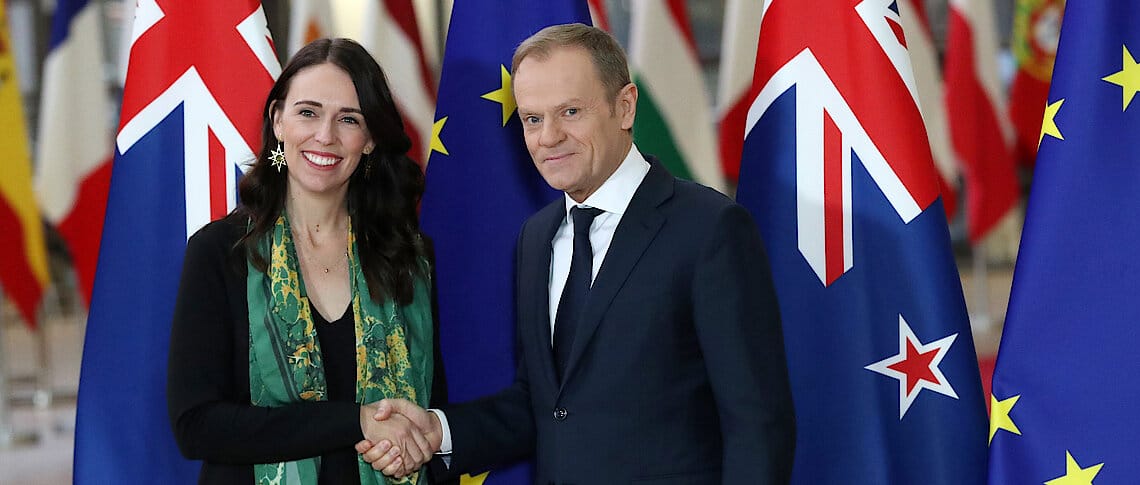
Go back to that photograph:
Ardern shaking hands with EU officials, celebrating the trade deal.
It is real. It happened. The deal exists. The exports happened. The numbers are what the numbers are.
But the story told about that photograph—the story of competent governance, of effective management, of Labour being “ultimately effective”—is a different reality.
The reality is:
- That trade deal locked in decades of land degradation and river death
- Those houses were built inside a system that made housing less, not more, affordable
- Those climate commitments exempted the largest emitters
- That government absorbed and demobilised the energy of people who wanted change
The photograph shows something, but not what Mountain Tūī claims it shows.
The task now is not to defend or attack that photograph. The task is to build something so different, so compelling, so rooted in real community power and collective thriving, that the photograph becomes a relic—evidence of a time when people accepted the cage because they could not imagine life outside it.
That is where real relevance lies. Not in defending Labour’s past, but in refusing to let it define the future.

Ivor Jones The Māori Green Lantern Fighitng Misinformation And Disinformation From The Far Right
- https://esmed.org/MRA/mra/article/view/4303
- https://www.semanticscholar.org/paper/17cc6031305c00963d34c3d40efeed95d6e53d45
- https://www.tandfonline.com/doi/full/10.1080/00779954.2021.1878328
- https://journals.sagepub.com/doi/10.1177/2046147X251331629
- http://www.ssrn.com/abstract=1798871
- https://www.semanticscholar.org/paper/a77f1e3ff2f2cd764102165ba5af5c022e758872
- https://www.semanticscholar.org/paper/c5c902b8022bad4fbceb6434b139b81ec9cc7116
- https://journals.sagepub.com/doi/10.1177/0042098013497411
- https://www.semanticscholar.org/paper/83947e6a423ce8a3fe7f578f04c95ae1654fe2ac
- https://www.tandfonline.com/doi/full/10.1080/20419112.2021.1938832
- /content/files/bitstream/10419/268085/1/1761427962.pdf
- https://www.mdpi.com/2071-1050/11/9/2482/pdf?version=1556434240
- /content/files/index-php/ijefi/article/download/10368/pdf.pdf
- https://www.mdpi.com/2413-8851/5/4/77/pdf?version=1633658940
- https://www.tandfonline.com/doi/full/10.1080/19491247.2023.2170542
- https://www.tandfonline.com/doi/full/10.1080/02673037.2024.2400155
- https://ppp-online.org/view-all-volumes/much-to-do-about-almost-everything-the-new-labour-government-and-the-unfolding-housing-crisis/
- /content/files/2303-11365.pdf
- https://www.reddit.com/r/newzealand/comments/iu864e/nz_house_prices_have_increased_by_over_30_under/
- https://www.1news.co.nz/2023/12/02/public-housing-waitlist-spikes-over-25000-households-waiting/
- https://www.beehive.govt.nz/release/90-rivers-and-lakes-swimmable-2040
- https://www.dpmc.govt.nz/publications/final-report-house-prices-unit-house-price-increases-and-housing-new-zealand
- /content/files/assets/2023-assets/insights-and-publications/housing-report-dec.pdf
- https://environment.govt.nz/publications/our-freshwater-2023/
- https://www.opespartners.co.nz/private-property/issue-81
- https://communityhousing.org.nz/growing-waiting-list-shows-need-for-more-public-housing
- https://www.ehinz.ac.nz/publications/news/latest-news/many-of-new-zealands-recreational-bathing-sites-unsafe-to-swim-at-on-at-least-one-occasion/
- https://en.wikipedia.org/wiki/New_Zealand_property_bubble
- https://fyi.org.nz/request/26295-house-building-rate-2017-2023-compared-to-2008-2017?unfold=1
- https://www.lawa.org.nz/explore-data/river-quality
- https://www.rnz.co.nz/news/political/369208/one-year-on-how-has-the-govt-performed-on-housing
- https://www.msd.govt.nz/about-msd-and-our-work/publications-resources/statistics/housing/housing-register.html
- https://www.stats.govt.nz/information-releases/new-zealands-environmental-reporting-series-our-freshwater-2023/
- https://www.cbre.co.nz/insights/articles/long-term-house-price-growth-in-new-zealand-will-have-different-drivers-in-the-future
- /content/files/static/60189fe639b6d67b861cf5c4/t/64a4cc9d2498d534bea13b81/1688521886966/social_housing_stock_policy_brief_final_proofed.pdf
- https://www.lakesandwaterwaystaupo.org.nz/latest-news/our-freshwater-2023-statistics-nz-report
- https://regions.infometrics.co.nz/auckland/income-and-housing/house-values
- /content/files/wp-content/uploads/2023/08/cchi2023_cityprofile_auckland.pdf
- https://www.nzherald.co.nz/hawkes-bay-today/news/homes-wait-list-dropping-as-house-builds-boom-in-hawkes-bay/EDSYNRVDVZFPNN2CIGVS6EPYNE/
- https://www.nzherald.co.nz/nz/politics/nzs-lakes-and-rivers-in-appalling-state-new-govt-report-paints-bleak-picture-as-scientist-accuses-labour-of-broken-promises/44QARUJS45DLPNAXAKN4HPPKAY/
- https://www.nzherald.co.nz/nz/politics/teacher-pay-rise-education-minister-jan-tinneti-on-government-response-to-secondary-school-proposal-of-145-per-cent-increase/BAGNPSN4DZAHHGNU3CZ2IPDFWM/
- https://www.nzherald.co.nz/nz/unswimmable-two-thirds-of-monitored-nz-river-sites-grade-poorly-for-ecoli-contamination/6DM3T37PXBFIRAO3UIP4RMZKRI/
- https://www.nzherald.co.nz/business/economy/budget-2025-the-next-step-in-a-long-dogged-uphill-fiscal-trudge-bryce-wilkinson/INNVMTZVCFDB3BDU3BRVMVY2DQ/
- https://www.nzherald.co.nz/the-listener/new-zealand/intensive-farming-in-the-cold-deep-south-could-damage-the-image-of-our-biggest-industry/TIHDR5TWV5AZTMCFTITS5PLLVM/
- https://www.nzherald.co.nz/nz/political-roundup-ten-reasons-labours-support-has-halved/3I3F36OCRFFB3PPCIKZL2TH6VI/
- https://teara.govt.nz/en/interactive/11674/deforestation-of-new-zealand
- https://www.nzherald.co.nz/nz/politics/mps-pay-increases-prime-minister-christopher-luxon-faces-his-first-trial-by-pay-rise-while-chris-hipkins-is-short-changed/JXCJCBCXVFAATPGJ6ADZ7BYW3M/
- https://teara.govt.nz/en/large-forest-birds/print
- https://www.nzherald.co.nz/the-listener/politics/the-real-power-list-nzs-prime-ministers-rated/UEHAIM2NQRDKNPWR3HNKBLKK6Q/
- https://teara.govt.nz/en/small-forest-birds/page-2
- https://teara.govt.nz/en/large-forest-birds/page-3
- https://www.rnz.co.nz/news/national/487815/concerns-sobering-freshwater-report-will-fail-to-trigger-needed-reforms
- https://www.rnz.co.nz/news/political/562600/farmers-hail-end-of-unworkable-rma-greens-say-changes-dismantle-protections
- /content/files/oggcasts/ourchangingworld.xml
- /content/files/1000126106/92650190.pdf
- /content/files/core/services/aop-cambridge-core/content/view/D4785ABB4D5B99ABD46F85529B998C53/S0048840220000337a/div-class-title-promoting-sustainable-development-through-trade-eu-trade-agreements-and-global-value-chains-div.pdf
- https://figshare.com/ndownloader/files/42429090
- https://www.tandfonline.com/doi/pdf/10.1080/10455752.2022.2062675?needAccess=true
- https://www.tandfonline.com/doi/pdf/10.1080/2474736X.2022.2085121?needAccess=true
- https://academic.oup.com/nsr/advance-article-pdf/doi/10.1093/nsr/nwad223/51204124/nwad223.pdf
- https://linkinghub.elsevier.com/retrieve/pii/S1364032123009607
- /content/files/2311-06716.pdf
- https://www.canterbury.ac.nz/news-and-events/news/2022/whats-in-the-eu-nz-trade-deal-for-europe
- https://www.rnz.co.nz/news/national/581923/homelessness-in-auckland-more-than-doubles-to-940-people-in-year-to-september-survey
- https://www.nzherald.co.nz/nz/politics/kainga-ora-sold-80-million-of-state-housing-in-five-years/JAZROG6ASFDSNNBIEUABS22EKU/
- https://www.beehive.govt.nz/release/new-zealand-secures-major-free-trade-deal-european-union
- https://www.lifewise.org.nz/new-zealands-latest-census-2023-homelessness-data/
- https://kaingaora.govt.nz/en_NZ/about-us/history-of-state-housing/
- https://www.rnz.co.nz/news/political/470119/new-zealand-and-european-union-secure-historic-free-trade-deal
- https://www.stats.govt.nz/information-releases/2023-census-severe-housing-deprivation-homelessness-estimates/
- https://www.greaterauckland.org.nz/2024/06/10/in-defence-of-kainga-ora/
- https://ec.europa.eu/commission/presscorner/detail/en/ip_23_3715
- https://www.nzherald.co.nz/nz/politics/move-on-orders-for-homeless-come-as-public-disorder-hits-10-year-low/premium/AHH2IJGWVRBNTH4P3JWN4TFLTM/
- https://en.wikipedia.org/wiki/State_housing_in_New_Zealand
- https://www.nzherald.co.nz/nz/politics/new-zealand-wins-18b-trade-deal-with-eu-at-eleventh-hour/JMOMOJUUSR3RT2T27YWACDOFY4/
- https://www.facebook.com/chloeNZgreens/posts/theres-been-a-53-increase-in-homelessness-in-auckland-in-four-months-and-40-in-w/1165008808325283/
- /content/files/assets/business/our-research/docs/economic-policy-centre/epc-wp-019-zoning-reform-and-state-developed-housing-in-auckland.pdf
- https://www.1news.co.nz/2022/07/01/nz-secures-historic-free-trade-deal-with-european-union/
- https://www.beehive.govt.nz/release/ministers-release-homelessness-insights-report
- https://www.beehive.govt.nz/release/labour-delivers-12000-more-public-homes
- https://ieu-monitoring.com/editorial/special-collection-eu-new-zealand-trade-agreement-unlocking-sustainable-economic-growth/381710
- https://ourauckland.aucklandcouncil.govt.nz/news/2025/07/new-data-reflects-increasing-need-on-our-streets/
- https://www.nzherald.co.nz/nz/politics/uk-joins-cptpp-pacific-free-trade-agreement-in-nz-signing-ceremony-china-and-ukraine-on-waiting-list/SN3MUMSSGRBE3CFZVRLYMOHQIU/
- https://www.nzherald.co.nz/nz/emergency-housing-access-tightens-homelessness-rises/FI7ZV255WNDGREYNQQOFCWGTI4/
- https://www.rnz.co.nz/news/top/531943/new-zealand-accused-of-waffle-and-no-plan-to-hit-targets-for-global-biodiversity-agreement
- https://www.1news.co.nz/2025/09/05/govt-outlines-plan-to-help-rough-sleepers-into-social-housing/
- https://www.rnz.co.nz/news/on-the-inside/463992/the-week-in-politics-unfriendly-fire-and-plaudits-as-govt-changes-tack-on-covid-19
- https://www.1news.co.nz/2024/12/04/world-first-census-data-highlights-housing-deprivation-in-lgbtqi-community/
- https://www.rnz.co.nz/news/top/486670/lobbyists-in-new-zealand-enjoy-freedoms-unlike-most-other-nations-in-the-developed-world
- https://www.rnz.co.nz/news/political/564300/homelessness-increase-not-necessarily-due-to-government-policy-changes-minister
- https://www.rnz.co.nz/news/on-the-inside/463844/geoffrey-miller-how-important-is-new-zealand-s-new-military-support-for-ukraine
- https://www.1news.co.nz/2025/10/07/nicola-willis-is-right-nzs-economy-not-as-bad-as-merchants-of-misery-claim/
- https://www.rnz.co.nz/national/programmes/morningreport/library?page=35
- https://www.nzherald.co.nz/kahu/labour-mp-claims-govt-is-spinning-housing-stats-as-kainga-ora-set-to-cut-320-roles/SHEAIXAFVRBFHE2TWKD4EOSESY/
- https://www.rnz.co.nz/tags/Damien%20O’connor
- https://www.nzherald.co.nz/nz/politics/cost-of-living-number-of-households-spending-over-two-years-in-emergency-housing-doubles-in-past-year/ZT67M7EZ6NDGPD3RRHIDR24QEA/
- https://www.nzherald.co.nz/business/business-reports/agribusiness-and-trade-fran-osullivan-shameless-jacinda-ardern-spruiks-new-zealand/YC5MFESWD3DJGLRXKRYSJ3UHFU/
- https://www.1news.co.nz/2025/07/26/south-island-pulls-ahead-as-regional-divide-widens-economist/
- https://www.rnz.co.nz/search/results?mode=results&page=15&q=cooperative+economy
- https://www.nzherald.co.nz/business/business-reports/mood-of-the-boardroom/mood-of-the-boardroom-ceos-back-local-government-reform-as-survey-rates-councils-as-broken/DT3BIAODVNHW7KGNM7TRTZEJQQ/
- https://www.nzherald.co.nz/business/companies/freight-logistics/oligarchs-superyacht-that-visited-auckland-seized-by-us-appears-on-nz-sanctions-list/CMBV4C2FCIZNFUB2H4T5FV4VJY/
- https://onlinelibrary.wiley.com/doi/pdfdirect/10.1111/gcb.13340
- https://pmc.ncbi.nlm.nih.gov/articles/PMC11543690/
- https://pmc.ncbi.nlm.nih.gov/articles/PMC2610110/
- /content/files/2307-01443.pdf
- https://pmc.ncbi.nlm.nih.gov/articles/PMC9442557/
- /content/files/articles/10-3389/fclim-2020-00004/pdf.pdf
- https://royalsocietypublishing.org/doi/pdf/10.1098/rsta.2020.0452
- https://linkinghub.elsevier.com/retrieve/pii/S2666792422000038
- /content/files/assets/Publications/Files/climate-change-response-zero-carbon-amendment-bill-summary.pdf
- https://www.manamokopuna.org.nz/publications/media-releases/were-failing-on-child-poverty-reduction-but-its-not-too-late-for-action/
- https://www.rnz.co.nz/news/business/579440/why-the-new-zealand-dollar-has-plunged-to-13-year-lows
- /content/files/assets/OIA/Files/OIAD-1186/15-cab-358-agricultural-greenhouse-gas-emissions-reporting-and-levy-system_-final-policy-decisions.pdf
- https://thespinoff.co.nz/politics/20-02-2025/claim-of-no-movement-in-child-poverty-stats-misleading-advocates-say
- https://tradingeconomics.com/new-zealand/currency
- https://www.beehive.govt.nz/release/ministers-welcome-agricultural-sectors-work-emissions
https://www.nzchildren.co.nz
- https://www.fxstreet.com/news/nzd-usd-softens-to-near-05650-as-us-government-looks-to-reopen-202511130205
- https://energyandenvironment.net.nz/search.html?search=Climate+Change
- https://www.rnz.co.nz/news/political/542461/child-poverty-rates-stall-government-misses-targets
- https://craigsip.com/news/what-does-our-weaker-currency-mean-for-the-economy
- /content/files/assets/Advice-to-govt-docs/ERP2/draft-erp2/ccc4940_draft-erp-advice-2023-p02-v02-web.pdf
- https://www.cpag.org.nz/media-releases/tough-times-ahead-for-children-in-hardship-under-next-government-cpag-warns
- https://www.nzherald.co.nz/business/markets/currency/kiwi-dollar-slumps-to-12-year-low-against-aussie-ahead-of-christmas-travel/premium/WA4KARVDW5DJ5OJZZWHRLTYDHQ/
- https://www.far.org.nz/resources/consensus-reached-on-reducing-agricultural-emissions
- https://www.odt.co.nz/news/national/govt-defends-lowered-child-poverty-targets
- https://www.facebook.com/rnznewzealand/posts/the-new-zealand-dollar-has-fallen-to-multi-year-lows-against-a-broad-range-of-cu/1304315558401056/
- https://www.farmersweekly.co.nz/politics/shaw-pushes-back-on-methane-report/
- https://pmn.co.nz/read/society/children-are-more-than-numbers-ngos-disappointed-in-govt-rejecting-child-poverty-reduction-investment
- /content/files/podcasts/focusonpolitics.xml
- https://www.1news.co.nz/2025/05/25/govt-committed-to-2028-child-poverty-target-despite-forecast-willis/
- https://www.nzherald.co.nz/nz/covid-19-coronavirus-govt-considers-reopening-country-for-5b-international-student-industry/BAGJGJ6S5IL7FXHRECSQOWIFPY/
- /content/files/podcasts/checkpoint.xml
- https://www.1news.co.nz/2023/06/24/govt-doing-nothing-for-school-students-supporting-families/
- https://www.rnz.co.nz/sitemap/sitemap10.xml.gz
- https://www.1news.co.nz/2023/09/26/nationals-benefit-sanctions-plan-cruel-dehumanising-greens/
- https://projects.propublica.org/nonprofits/organizations/463460261/202333199349104368/full
- https://www.rnz.co.nz/sitemap/sitemap7.xml.gz
- https://www.rnz.co.nz/news/political/562133/budget-2025-none-of-year-s-child-poverty-targets-met
- https://www.rnz.co.nz/news/on-the-inside/490199/opinion-smart-moves-in-budget-2023-but-no-transformation-for-poorer-families
- https://www.rnz.co.nz/news/national/509855/child-poverty-more-families-going-without-household-essentials
- https://www.nzherald.co.nz/nz/politics/election-2023-how-much-nzs-350000-beneficiaries-will-miss-out-on-under-nationals-changes/37M33ZQSBBC6ZJHQNDFU5SY2TA/
- https://www.nzherald.co.nz/nz/politics/election-2023-result-anatomy-of-labours-collapse-from-unprecedented-support-to-devastating-loss-in-three-years/3HXQOIYATFEUZNMTVCJUFVUD4Q/
- https://www.nzherald.co.nz/nz/budget-2023-five-experts-on-labours-big-pre-election-calls/O4KMEU3IJBGCNP4P7VJLUQTV3E/