"THE CANNIBAL TABLE: How Five Jaws Are Devouring Māori Political Power While the Country Drowns in Sewage and Unemployment" - 1 3 February 2026
The government attacks tikanga. Labour campaigns to destroy the only Māori voice. The media amplifies the feast. The internal fractures hand them all the knife. And the broadcaster who claims to hold power to account is feeding at every table while pretending to serve the people.
Kia mataara rā, kei whakatau tūhono koe ki te aroaro o te hoariri — Be wary, lest you make allies in the presence of the enemy.
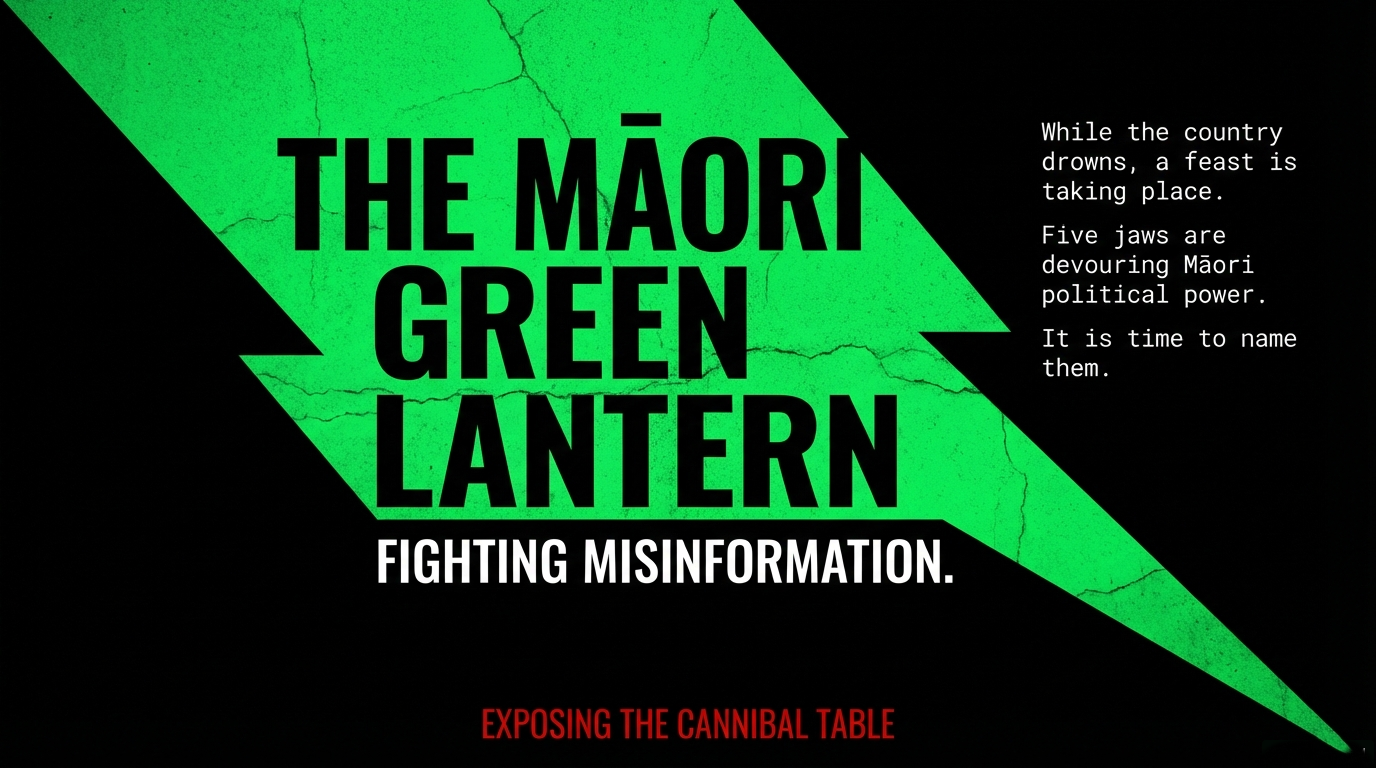
There is an old colonial tactic so reliable it has survived every iteration of Crown governance for 186 years: when you cannot defeat the natives, make them defeat themselves.
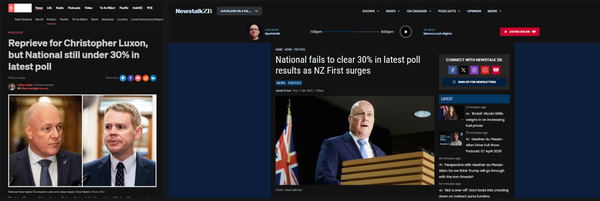
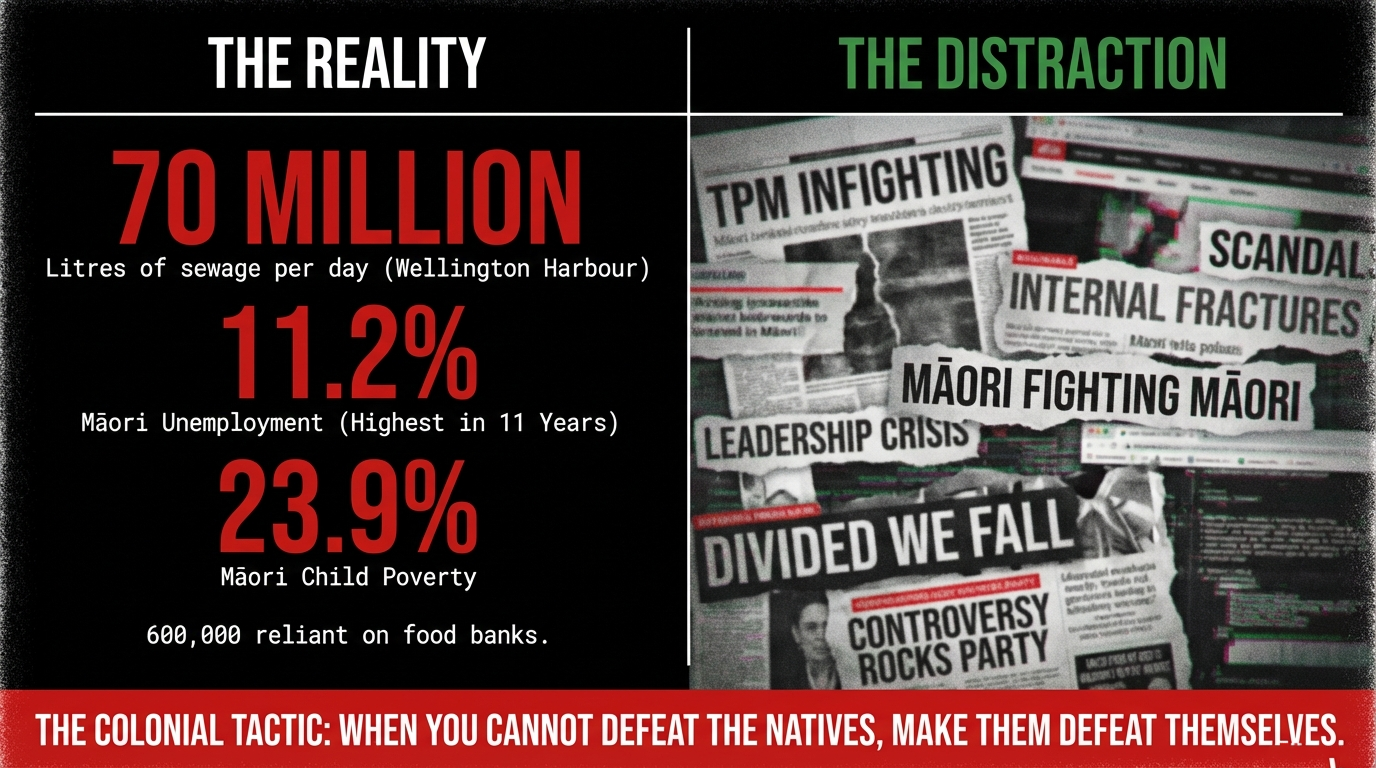
The polls predict a hung parliament. The coalition is bleeding support. Unemployment is at 5.4% — the highest in 11 years — with Māori at 11.2% and Pasifika at 12.3%. Seventy million litres of raw sewage per day pour into Wellington Harbour. 600,000 people need food banks. 23.9% of Māori children live in poverty. The country is collapsing under the weight of this white supremacist neoliberal coalition's policies.
And what dominates the headlines? Te Pāti Māori fighting itself.
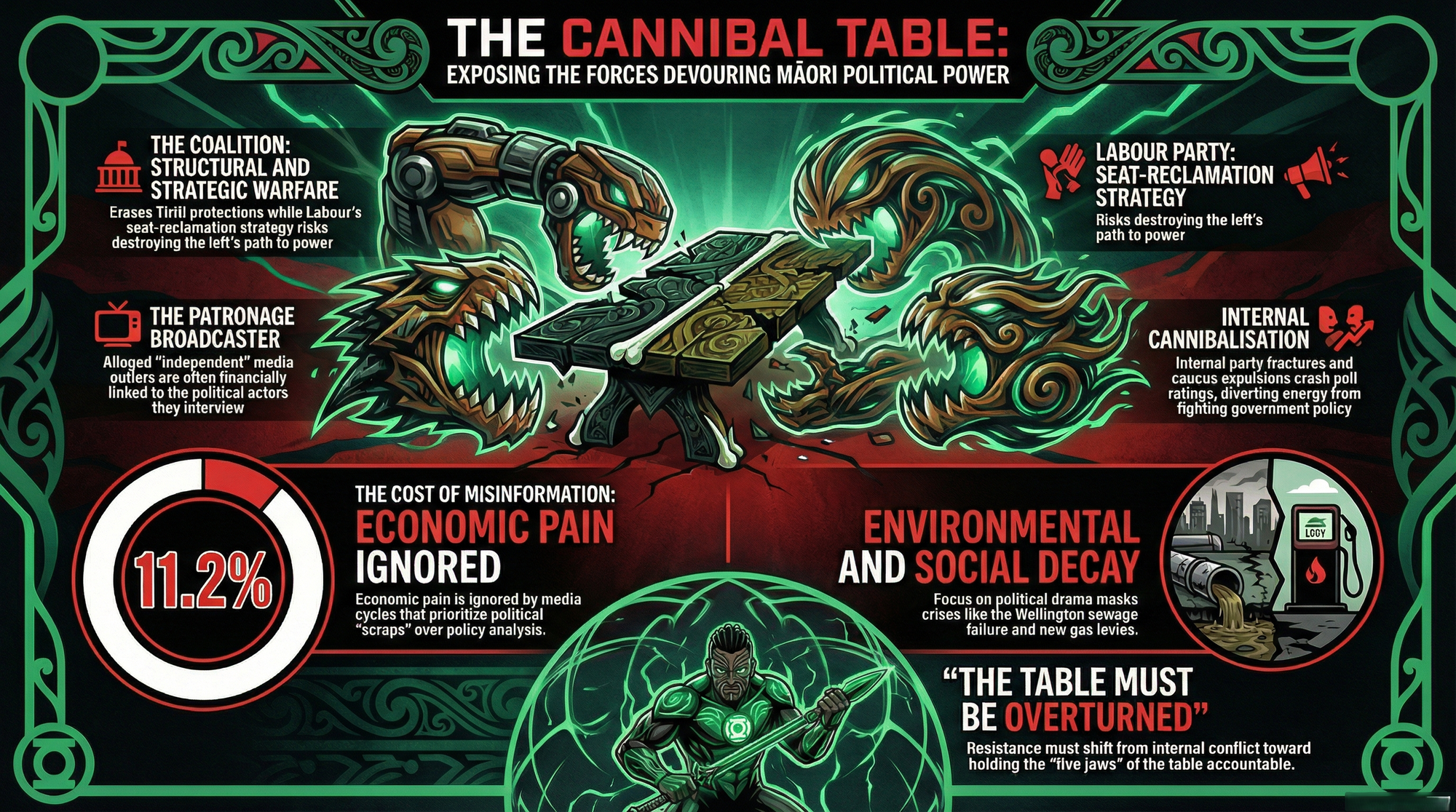
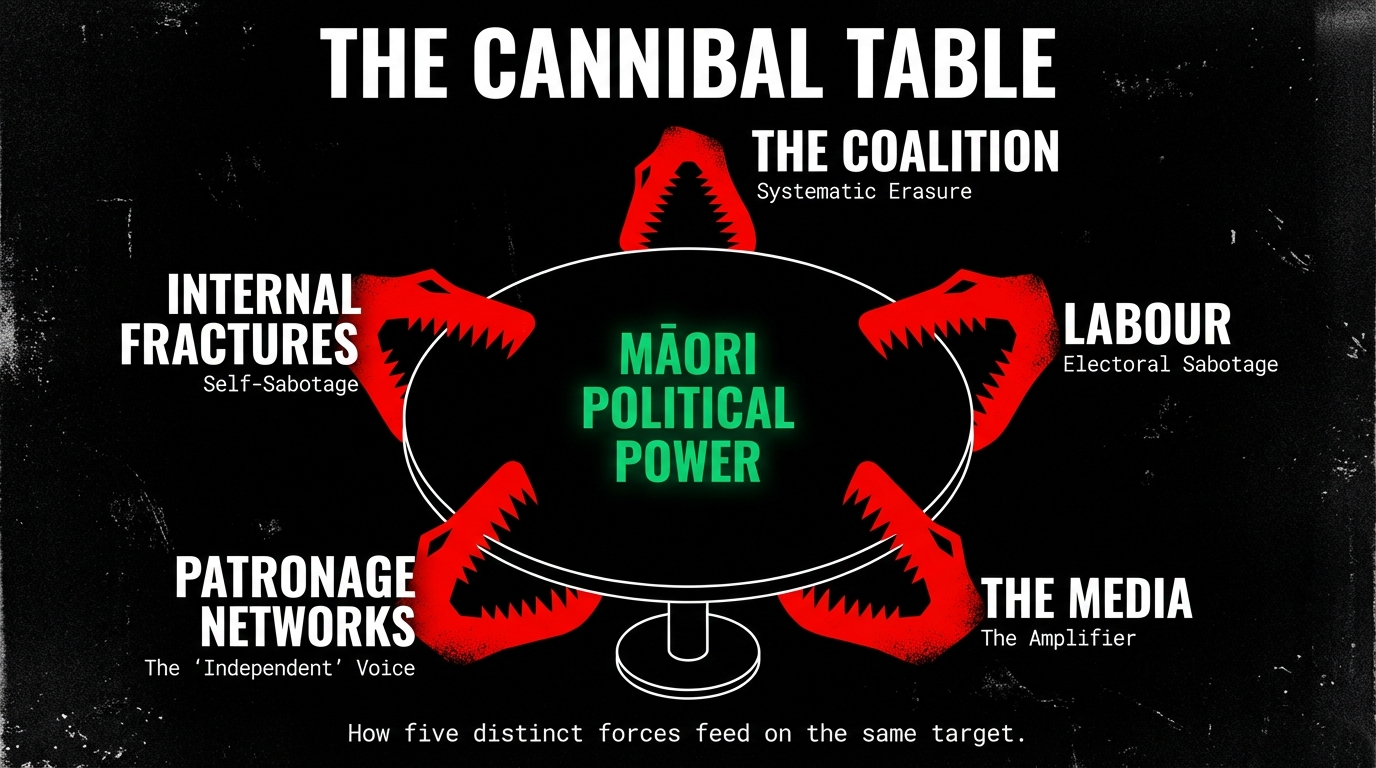
This is not an accident. This is the cannibal table — and five sets of jaws are feeding at it simultaneously. The coalition government. The Labour Party. The mainstream media. Te Pāti Māori itself. And the broadcaster who claims to challenge power while being financially and personally embedded in the very networks he refuses to interrogate.
THE FIRST JAW: The Coalition's Structural Warfare Against Māori
The white supremacist coalition's assault on Māori political representation is systematic, deliberate, and documented.
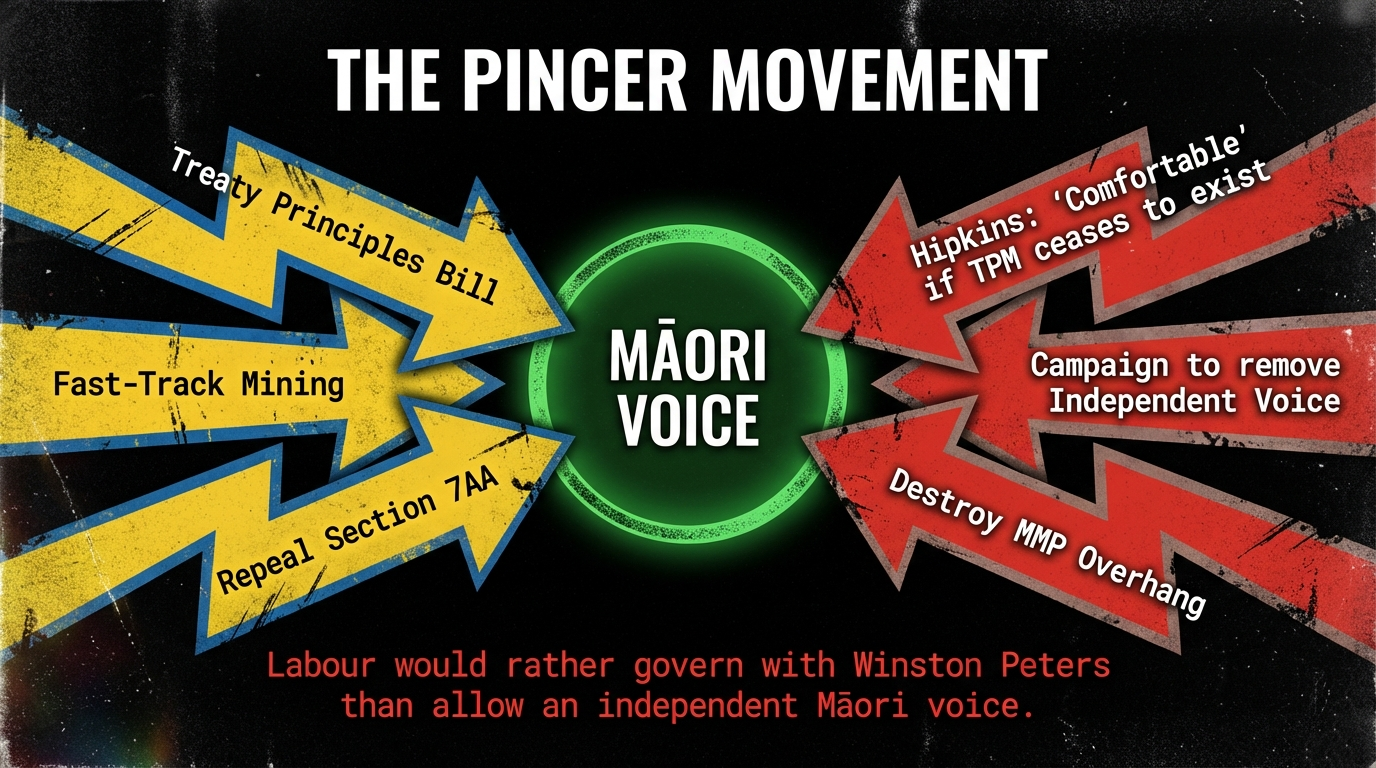
The Treaty Principles Bill: David Seymour's Treaty Principles Bill was voted down in April 2025 — with 112 noes to 11 ayes, and 90% of over 300,000 submissions opposed. So what did he do? He passed the Regulatory Standards Act — which legal experts call "Treaty Principles 2.0" because it embeds ACT's libertarian framework into every future law while stripping Tiriti protections. And Seymour has publicly promised to reignite the Treaty Principles debate in 2026. Now NZ First is campaigning on a referendum to abolish the Māori seats entirely.
The Fast-Track Approvals Act: Shane Jones designed legislation to bypass environmental and Treaty safeguards, then personally promoted seabed mining against iwi opposition, and when a panel declined Trans-Tasman Resources' bid, immediately campaigned to give himself ministerial override.
Section 7AA Repeal: The government repealed Section 7AA of the Oranga Tamariki Act, removing the requirement to reduce disparities in outcomes for Māori children. They repealed the world-leading smokefree laws projected to save thousands of Māori lives. They halted 3,479 Kāinga Ora homes. They killed Three Waters and now Wellington is drowning in sewage.
This is not governance. This is a coordinated programme of Tiriti erasure.
THE SECOND JAW: Labour's Campaign to Devour the Māori Voice
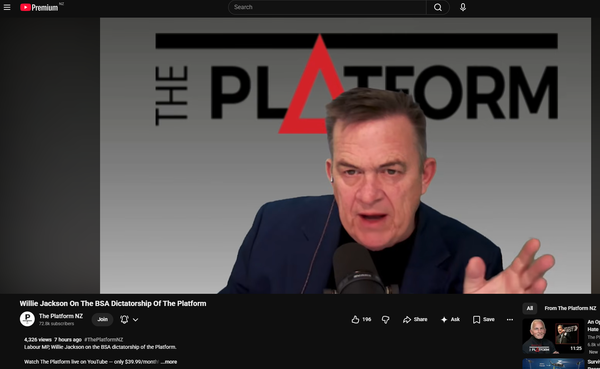
Chris Hipkins has repeatedly stated he wants to win all seven Māori seats and is "absolutely comfortable" if Te Pāti Māori ceases to exist. Willie Jackson is "absolutely" campaigning to get Te Pāti Māori out of Parliament. Jackson told RNZ: "We've had a lot of interest, a lot of interest in the seats — particularly during the Māori Party troubled times."
At Waitangi 2026, Labour and the Greens staged a joint media conference. Te Pāti Māori was not invited. Hipkins told RNZ: "They're in court. That's really where their focus should be."
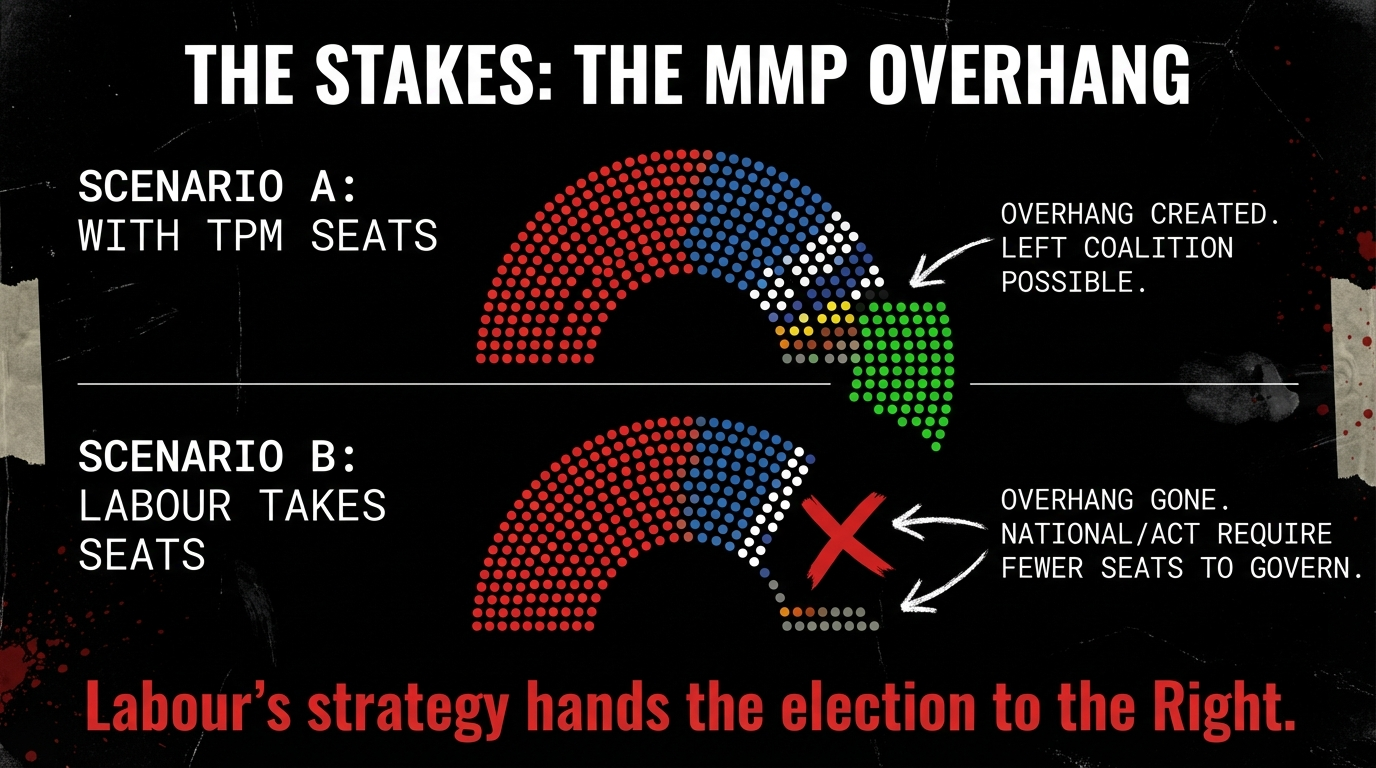
And here is the mathematical obscenity. As Interest.co.nz calculated: had Labour held the Māori electorates in 2023, "National and ACT could even have scraped together a majority without New Zealand First." Labour winning the Māori seats eliminates the MMP overhang that gives the left its only mathematical path to government.
Labour is campaigning to destroy the mechanism that gives the left its best chance of forming a government. They would rather govern with Winston Peters — or not govern at all — than share power with an independent Māori voice.
As The Māori Green Lantern documented in "How Labour and the Greens Turned Te Tiriti into a Backdrop": Labour does not see Te Tiriti as a constraint on its power. It sees Te Tiriti as a PR exercise.
As The Māori Green Lantern's "The Greed of the Red Machine" documented: Labour does not speak for Māori. Labour speaks about Māori when it is electorally convenient, and over Māori when it is not.
THE THIRD JAW: The Media Amplifies the Feast
Every major outlet has devoted disproportionate coverage to Te Pāti Māori's internal disputes while underreporting the policy atrocities committed by the government.
As Ngarewa-Packer told The Bradbury Group: "We can't get cut-through in the media because — I hate to say it — they hate our guts."
Meanwhile, what does the media underreport?
- 282,370 household power disconnections in 10 months while gentailers pocket $2.7 billion in profits
- 70 million litres of sewage daily into Wellington Harbour
- A billion-dollar LNG methane terminal funded by a compulsory levy on every household's power bill
- New Zealand's minerals being sold to Trump's critical stockpile via Australian corporations
- 23.9% of Māori children in poverty — rising, not falling
The media covers the firefight. It does not cover the arsonists.
THE FOURTH JAW: Te Pāti Māori Eats Itself
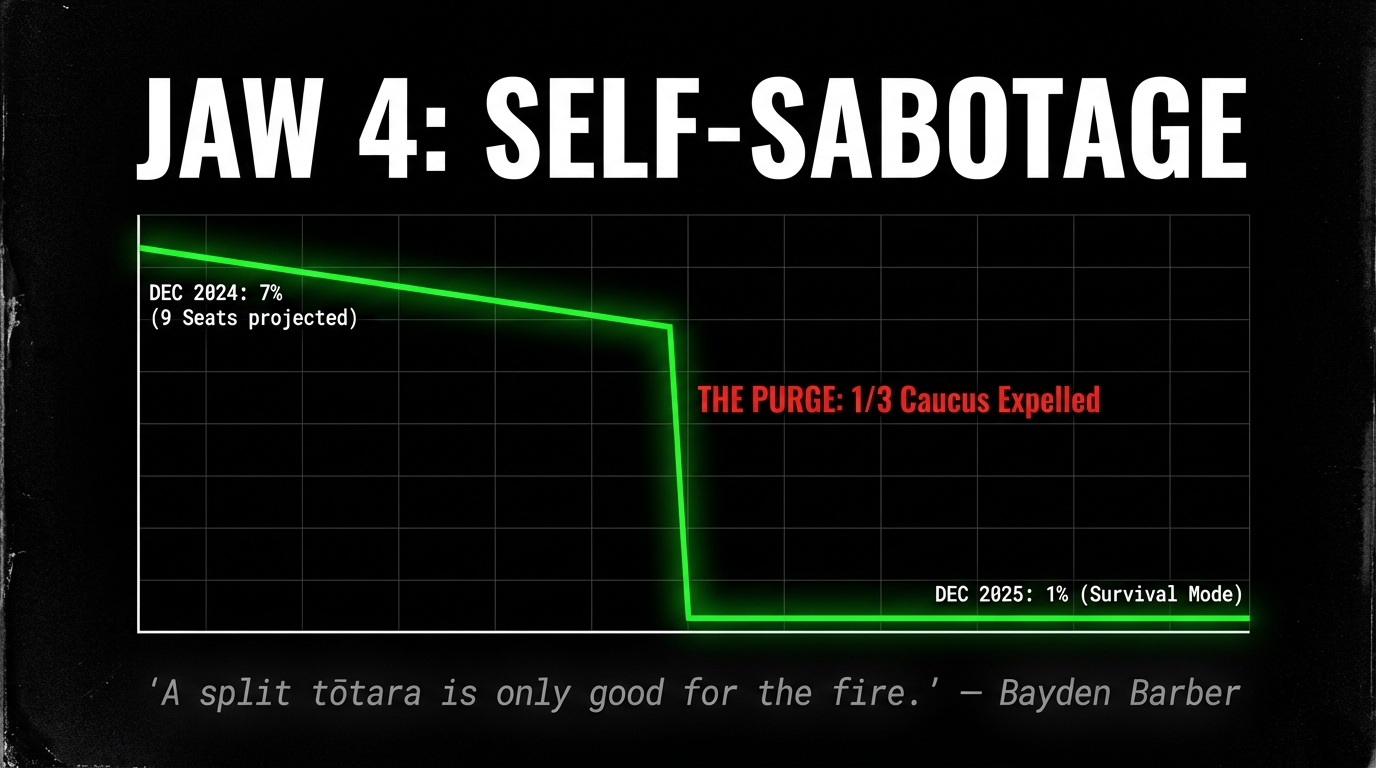
In November 2025, Te Pāti Māori's National Council expelled Te Tai Tokerau MP Mariameno Kapa-Kingi and Te Tai Tonga MP Tākuta Ferris, citing "irreconcilable differences." One-third of the caucus, gone.
The result was devastating. Te Pāti Māori's support crashed from 7% to 1% in the December 2025 1News Verian poll. From their highest-ever result following the hīkoi to their worst result in five years.
At Waitangi 2026, Eru Kapa-Kingi confronted the party on the marae ātea. The cameras captured every second. The government watched and smiled.
As Action Station Director Kassie Hartendorp acknowledged: "The party we might have placed our hope in has lost a lot of trust."
THE FIFTH JAW: The Broadcaster Who Feeds at Every Table
And now we come to the jaw that nobody names — because it names itself "independent."
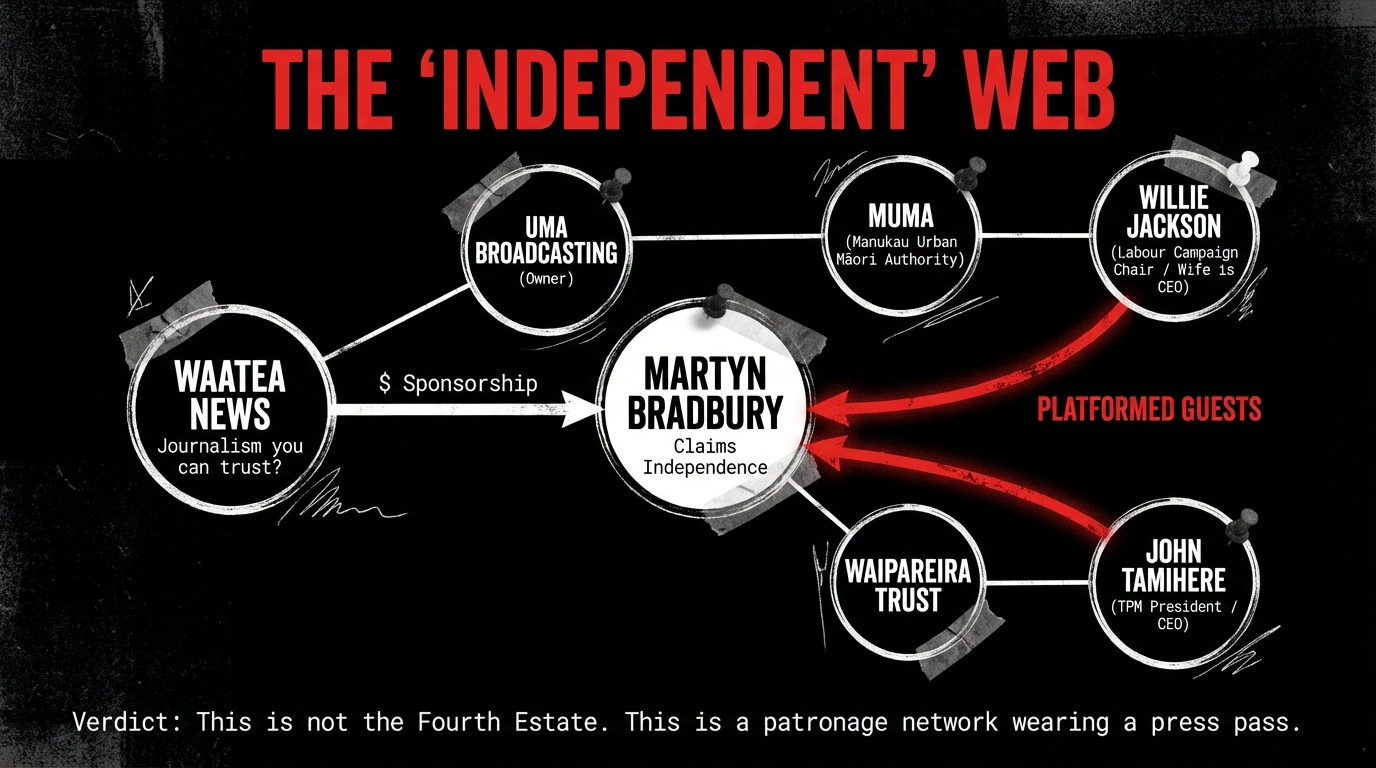
The Bradbury-Waatea-NUMA-Jackson-Tamihere Web
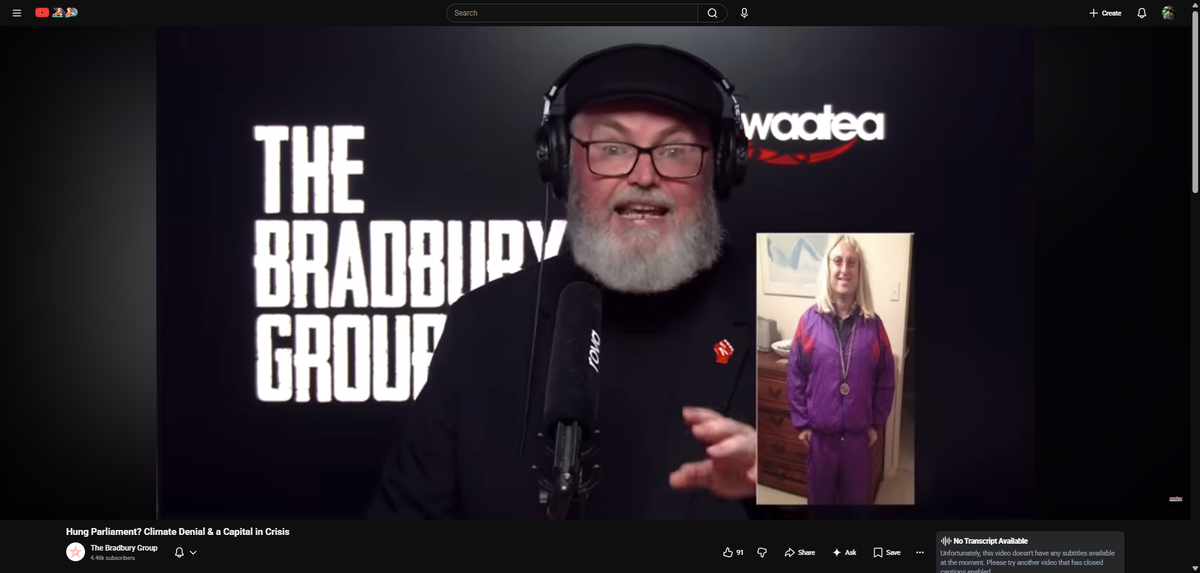
The Bradbury Group is "proudly sponsored by Waatea News — journalism you can trust." Bradbury says it at the top. He says it at the end. He says it every week. What he does not say — what he has never once disclosed to his audience — is the network of financial, political, and personal relationships that Waatea sponsorship represents.
Here is the web. Trace it slowly:
1. Waatea News is operated by UMA Broadcasting Ltd, which was established in 1999 by two urban Māori authorities: the Manukau Urban Māori Authority (MUMA) and Te Whānau o Waipareira Charitable Trust.
2. Willie Jackson was the long-time CEO of Manukau Urban Māori Authority — one of the two founding entities of UMA Broadcasting, which owns Waatea. His second wife, Tania Rangiheuea, is now MUMA's current Chief Executive. Jackson also chaired the National Urban Māori Authority (NUMA), the umbrella organisation for urban Māori authorities.
3. John Tamihere is the CEO of Te Whānau o Waipareira Trust — the other founding entity of UMA Broadcasting, which owns Waatea. He is also the president of Te Pāti Māori.
4. Waatea operates from Ngā Whare Waatea Marae in Māngere — which is MUMA's marae.
5. NUMA nominated both Jackson and Tamihere for positions on the Independent Māori Statutory Board. Jackson chaired the Electoral College that appointed Tamihere to the Māori Television board.
6. Bradbury's show is sponsored by the broadcasting arm of these two organisations, whose leaders are respectively Labour's campaign chair for the Māori seats (Jackson) and the president of Te Pāti Māori (Tamihere).
7. Bradbury regularly hosts Willie Jackson as a guest on the show. Jackson has appeared multiple times. Bradbury has defended Jackson publicly for years on The Daily Blog, writing pieces like "Mainstream Media Focus On Smearing Willie Jackson" and lavishing praise on the "Willie Jackson and Māori Labour Caucus Budget" — published on Waatea News itself. In December 2024, Bradbury published a piece celebrating "Why the Willie Jackson and John Tamihere Relationship is Crucial for Next Labour Led Government."
8. When Jackson joined Labour in 2017, Bradbury mourned it as "a dramatic blow to the Maori Party" and called it "terrible news for an independent political Maori voice." Yet now he platforms Jackson weekly as the man who is "absolutely" campaigning to destroy that same independent Māori voice — and never challenges him on it.
9. Bradbury's other show, The Working Group, featured both Jackson and Tamihere as regular guests. Its 2024 wrap-up featured David Seymour, Willie Jackson, Gerry Brownlee, John Tamihere, Moana Maniapoto, Brad Olsen, and Chris Hipkins — a who's who of the very power networks a genuine fourth estate journalist would interrogate, not toast champagne with.
So let us be precise. Martyn Bradbury's show is funded by the broadcasting arm of organisations led by Willie Jackson's wife and John Tamihere. He regularly platforms both Jackson and Tamihere as guests without disclosing this financial relationship. He publishes opinion columns on Waatea News itself — the outlet that sponsors him. And he simultaneously claims to be an independent voice holding power to account.
This is not journalism. This is a patronage network wearing a press pass.
As Chris Trotter wrote in Interest.co.nz, reviewing Bradbury's proposal for a "media summit" organised by Jackson: "Willie Jackson is said to be planning a 'media summit'... Not only does the Editor of The Daily Blog, Martyn Bradbury, think this is a good idea, but he has also offered up 10 names for Jackson's consideration." Trotter added: "Quite why Matthew Tukaki and Michael Wood appear on the List of media sages is anybody's guess. Bradbury has friends in Te Ao Māori, and the Labour Party, but even so..."
Even Trotter — a sympathetic left commentator — could see through it.
The Soft Interview: How Bradbury Failed Ngarewa-Packer and Failed Aotearoa
Now watch what the Waatea patronage network produces in practice. The 10 February 2026 episode of The Bradbury Group featured a "one-on-one" interview with Te Pāti Māori co-leader Debbie Ngarewa-Packer. Bradbury had a senior politician from a party in crisis — polling at 1%, one-third of its caucus expelled, its president embroiled in the Manurewa Marae data scandal, its survival in question. Any competent journalist would have delivered a forensic interview.
What did Bradbury deliver? A guided tour of softball questions designed to make Packer look sympathetic without ever forcing her to be accountable.
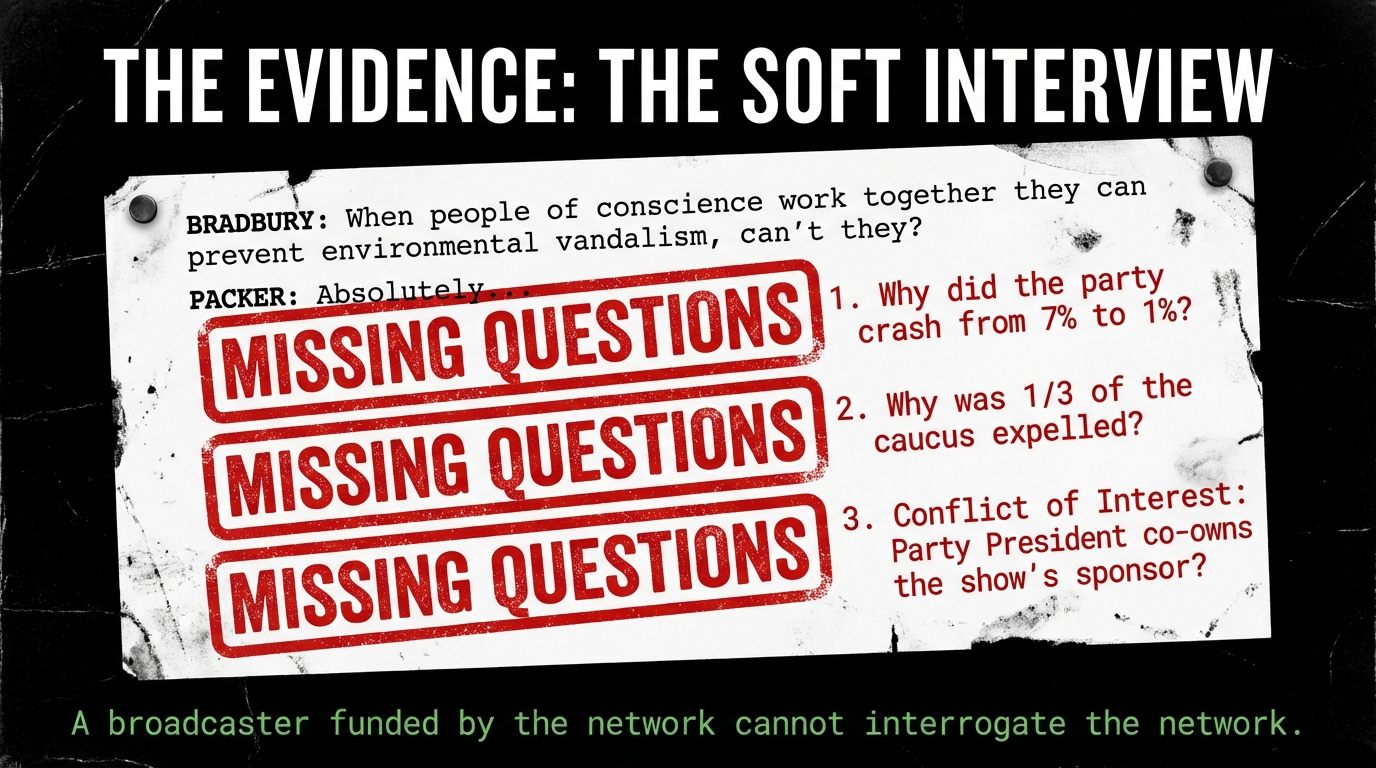
What Bradbury should have asked — and didn't:
- "Te Pāti Māori went from 7% to 1% in 12 months. The expulsion of Kapa-Kingi and Ferris destroyed your party's momentum at the exact moment the left needed unity. Who is accountable for that decision, and what has John Tamihere's role been?" — He never asked this. He asked a vague question about "stability" and let her deflect into "we're not the only party that's had scraps."
- "The High Court ruled that your party's own constitution was not followed in the expulsion process. Does that mean the party leadership acted unlawfully?" — He never asked this. He gently asked about "hopes for reconciliation" as if it were a family dispute, not a constitutional crisis.
- "John Tamihere is both president of your party and CEO of Te Whānau o Waipareira, which co-owns the broadcaster that sponsors this show. How do you respond to allegations that Tamihere's dual roles create governance conflicts?" — He could never ask this. Because the answer would expose his own conflicts of interest.
- "Your party claims to be treaty-centric, but the internal conflict has diverted all your political energy from fighting the government. What specific legislation have you blocked, amended, or advanced in the last six months?" — He never asked this. The answer — very little, because the party has been consumed by its own internal war — would have been devastating.
- "Willie Jackson says Labour is 'absolutely' comfortable if your party doesn't return to Parliament. He appears regularly on this show. Have you confronted him directly about that position, and what was his response?" — He never asked this. Because Jackson is his patron's business partner and a regular guest on the show he needs to keep happy.
Instead, Bradbury asked questions like "When people of conscience work together they can prevent environmental vandalism, can't they?" — which is not a question, it's a press release with a question mark stapled to it.
Packer's Failure: The Politician Who Wouldn't Answer
But Ngarewa-Packer must also be held to account, because a sharp politician would have taken even Bradbury's soft questions and driven policy stakes into the ground. She did not.
When asked about Te Pāti Māori's internal divisions at a time of 11.2% Māori unemployment, Packer's response was: "I don't think we should be saying that people get cancelled out because they're scrapping. And I'm not actually... I don't think I've been involved in any scraps to be honest."
This is political malpractice. Your party expelled a third of its caucus, crashed from 7% to 1% in the polls, and your response is "I haven't been involved in any scraps"? A politician with 11.2% of her constituency unemployed should be hammering policy responses into every available microphone. Instead, she offered vague generalities about "turning up" and "authenticity" and blamed the media: "We can't get cut-through in the media because... they hate our guts."
When Bradbury asked about the difference between a Labour-Green-NZ First government and a Labour-Green-Te Pāti Māori government — the single most important strategic question for Māori voters — Packer's answer was to relitigate the 2017-2023 government: "It was a Labour-Greens government that didn't stop seabed mining."
That is backwards-looking political deflection. The question was about 2026. About what Te Pāti Māori would demand in coalition negotiations. About what bottom lines would be drawn. About what policy concessions would be non-negotiable. A sharp politician would have said: "Wealth tax. Treaty ombudsman. Ban on seabed mining. Restoration of Section 7AA. Those are our bottom lines or we don't sign." Instead, Packer complained about the past and offered no clear policy architecture for the future.
When asked about the MMP overhang strategy — the most important mathematical reality in New Zealand politics right now — Packer said: "I think they've shot that. They've made a choice and they have to wear that choice." Correct analysis. But then what? What is Te Pāti Māori's counter-strategy? How are they going to win electorates when they're at 1%? What is the campaign plan? Silence. Generalised optimism. "It's a long time in politics."
This is what happens when a broadcaster who can't ask hard questions interviews a politician who won't give hard answers. The audience learns nothing. The government escapes scrutiny. And whānau are left with vibes instead of policy.
The Duplicity: "Independent" Media That Serves a Network
Bradbury calls himself a "militant Marxist." He describes his show as "independent." He signs off every episode with a statement about being the last line of defence for the fourth estate.
But consider what "independence" means when:
- Your show is sponsored by a broadcaster owned by organisations whose leaders are Willie Jackson's wife (MUMA) and John Tamihere (Waipareira)
- You regularly host Jackson as a guest without disclosing the financial relationship
- You publish opinion columns on Waatea News — the outlet that funds you — praising Jackson's budget achievements and celebrating the Jackson-Tamihere relationship
- You called Te Pāti Māori critics "haters and wreckers" at Waitangi — the language of the establishment, not the resistance
- You were removed from RNZ's panel for breaching editorial policy — not for being too radical, but for being unreliable
- You consulted for the Mana Party, drafted strategy for Kim Dotcom's Internet Party, and now platform the very Labour figures who destroyed both
- Your co-host Matthew Hooton — a former National Party staffer and lobbyist — described Te Pāti Māori as "the McGillicuddy Serious Party" on your show, and you responded with "horrific commentary" but then moved on to the next question without challenge
This is not the fourth estate. This is a content factory for a patronage network that spans Labour, urban Māori authorities, and the broadcasting ecosystem — all interconnected through NUMA, MUMA, Waipareira, and the personal relationships between Jackson and Tamihere.
And the greatest duplicity? Bradbury positions himself as the champion of the left while his show structurally serves Labour's strategic interest in cannibalising Te Pāti Māori. Every soft interview with Jackson. Every failure to challenge Hipkins' strategy of eliminating the Māori seats. Every episode where Hooton is allowed to dismiss Te Pāti Māori as a joke. Every week, the Bradbury Group does Labour's work — because its sponsor is funded by the organisations Labour's campaign chair for the Māori seats built his career in.
As The Māori Green Lantern's essay "Pākehā Politicians Playing Political Puppets" documented: the networks of patronage in Aotearoa politics are never accidental. They are structural. They are funded. And they are invisible to anyone who doesn't trace the whakapapa of the money.
THREE EXAMPLES FOR THE WESTERN MIND: How Cannibalisation Works and What It Costs Everyone
Example 1: The MMP Overhang Destruction — How Labour's Strategy Hands Power to the Right
What happened: Te Pāti Māori won six of seven Māori electorates in 2023 with a low party vote, creating an MMP overhang that benefited the left bloc. Labour is now campaigning to win all seven seats back.
Quantified harm: As Interest.co.nz calculated: "National and ACT could even have scraped together a majority without New Zealand First." Labour winning the Māori seats eliminates the overhang that gives the left its only mathematical path to government. The latest poll shows 60 seats each — a hung parliament where the overhang decides everything.
Tikanga violation explained: In tikanga Māori, mana is not delegated upward to a centralised authority. When Labour campaigns to absorb Māori voices into its Pākehā-led machine, it performs political assimilation — not representation. The party that gave us Rogernomics now calls Māori aspirations "ridiculous."
Western parallel: Imagine a left-wing party deliberately eliminating its only Indigenous parliamentary partner — knowing it would mathematically benefit the right. You would call it collaboration, not opposition.
Solution: Labour should contest general seats vigorously and accept that an independent Māori voice strengthens the left. The MMP overhang is the left's strategic asset. Destroying it to satisfy Labour's ego is electoral suicide dressed as democracy.
Example 2: From 7% to 1% — The Self-Inflicted Wound at the Worst Possible Moment
What happened: In December 2024, Te Pāti Māori polled at 7%. By December 2025, after expelling a third of their caucus, they were at 1%.
Quantified harm: At 7%, Te Pāti Māori was projected for 9 seats. At 1%, survival mode. The coalition rose to 67 seats. Every percentage point lost is a percentage point gained by a government erasing Tiriti rights.
Tikanga violation explained: Whanaungatanga — kinship — holds communities together. The Iwi Chairs Forum fought to keep Te Pāti Māori together, with spokesperson Bayden Barber warning: "a split tōtara is only good for the fire." The party lit that fire itself.
Western parallel: Imagine the most successful Indigenous rights march in your country's history catapulted your Indigenous party to record polling. Then, within 12 months, the party expelled a third of its legislators and collapsed to 1%.
Solution: Genuine, tikanga-led reconciliation — not court-mandated process. The party must submit its disputes to independent tikanga mediation and recommit to the kaupapa that brought tens of thousands to the streets.
Example 3: The Patronage Broadcaster — How "Independent" Media Serves a Network
What happened: The Bradbury Group is sponsored by Waatea News, owned by UMA Broadcasting Ltd, which was established by MUMA (whose CEO is Willie Jackson's wife Tania Rangiheuea) and Te Whānau o Waipareira (whose CEO is Te Pāti Māori president John Tamihere). Bradbury regularly hosts Jackson as a guest, publishes opinion columns on Waatea, and has publicly boosted Jackson's career for years. None of this is disclosed on the show.
Quantified harm: When a broadcaster cannot interrogate their own sponsor's networks, the public receives propaganda instead of journalism. The Bradbury Group interview with Ngarewa-Packer on 10 February 2026 failed to ask a single hard question about the internal collapse, John Tamihere's role, the High Court ruling, or the party's strategy for recovery. With approximately 5,000-10,000 weekly viewers/listeners across platforms, that is thousands of left-leaning voters receiving managed narratives instead of accountability journalism.
Tikanga violation explained: Tika — correctness, justice, doing what is right — demands transparency. When financial relationships between broadcaster, sponsor, and political actors are concealed, tika is violated. The audience cannot exercise informed judgment. The principle of pono — truth, honesty — requires that conflicts of interest be named, not hidden.
Western parallel: Imagine a political talk show in the UK was sponsored by a company whose directors were the campaign chair of the Labour Party and the president of the SNP. Imagine the host regularly platformed both as guests without disclosing this. Imagine he published opinion columns on the sponsor's website praising the Labour campaign chair's achievements. In any functioning media ecosystem, this would be a scandal. In Aotearoa, it is called "journalism you can trust."
Solution: Full, transparent disclosure of all financial relationships between The Bradbury Group, Waatea News, UMA Broadcasting, MUMA, Waipareira Trust, NUMA, Willie Jackson, and John Tamihere — on every episode, in every show description, and on The Daily Blog. Alternatively: admit this is a Labour-aligned platform that serves the Jackson-Tamihere network, and stop pretending to be independent. Honesty is cheaper than credibility once it's gone.
THE HIDDEN CONNECTIONS: Seven Threads Tied to One Rope
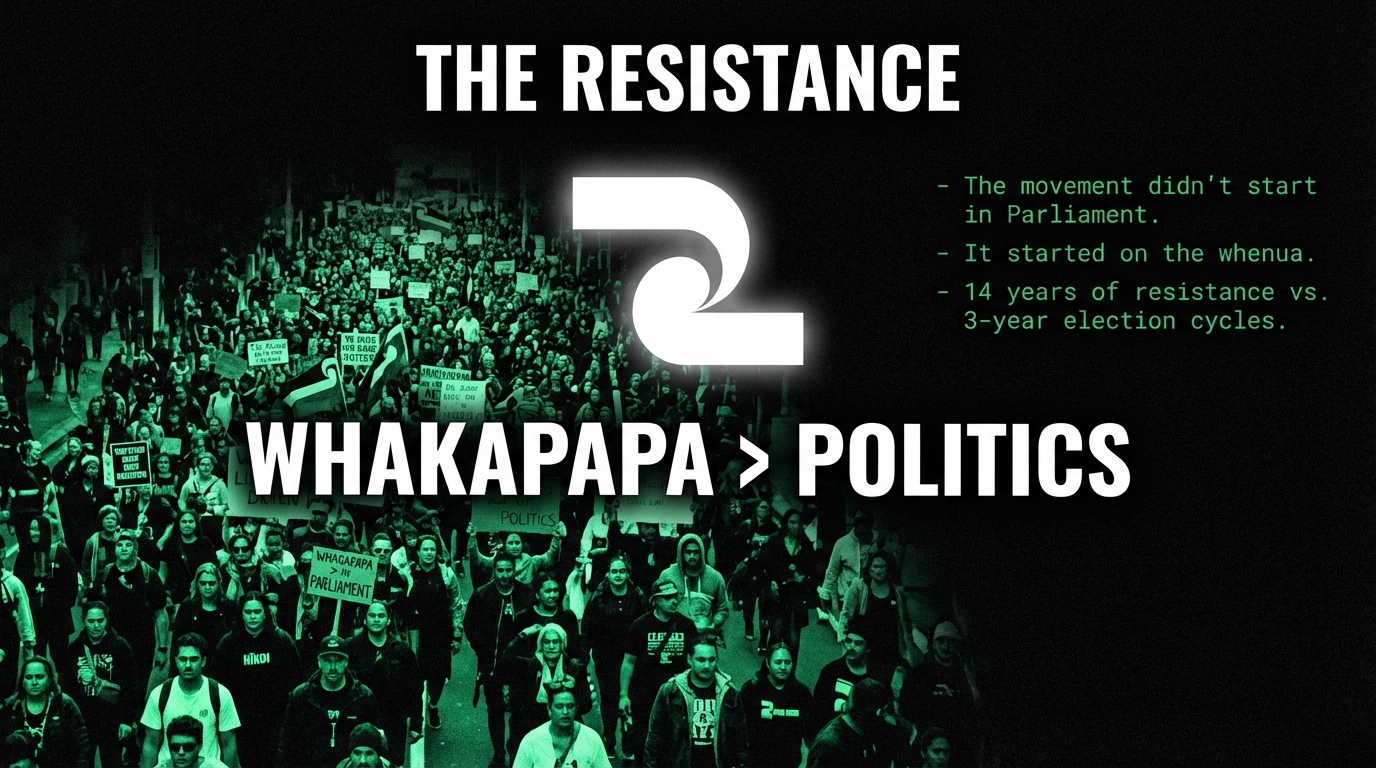
- Labour campaigns to destroy Te Pāti Māori → Eliminates MMP overhang → Benefits the right → Coalition gets second term → Tiriti erasure continues. Labour is literally campaigning for a National-ACT second term.
- Te Pāti Māori expels a third of caucus → Poll crashes from 7% to 1% → Coalition rises to 67 seats. The internal fracture delivered the government its strongest polling position in a year.
- NZ First campaigns on abolishing Māori seats → Labour campaigns to take the seats → Both attack Te Pāti Māori simultaneously. Three directions, same outcome.
- Media covers Waitangi conflict, not policy → Government passes gas levy, child poverty rises, sewage pours → No accountability.
- Seymour's Regulatory Standards Act → "Treaty Principles 2.0" → Strips Tiriti from every future law → No Māori voice strong enough to fight it.
- Bradbury's show is sponsored by Jackson's and Tamihere's organisations → Bradbury platforms Jackson without challenge → Labour's cannibalisation strategy is normalised → Te Pāti Māori's position weakened. The patronage network is the cannibalisation pipeline.
- 14 years of anti-mining resistance wins → Shane Jones campaigns to override panels → Minerals sold to Trump → Only Te Pāti Māori opposed throughout. Destroy the party, and the resistance loses its parliamentary arm.
The Table Must Be Overturned
Five jaws feed at the cannibal table. The coalition tears Tiriti protections with legislation. Labour gnaws at Māori seats with electoral strategy. The media strips the flesh with spectacle coverage. The internal fractures hand them all the knife. And the broadcaster who claims to hold power to account is funded by the very network that profits from the feast.
The coloniser does not need to defeat Māori when Māori are defeating themselves — and Labour is holding the door open for the government to walk back in — and the "independent" broadcaster is serving the appetisers.
But here is what the cannibals at the table cannot consume: the whakapapa of resistance is longer than any political cycle. Ngarewa-Packer's kuia is 84. The rangatahi who started the seabed mining fight are now running the iwi. The hīkoi that marched 45,000 strong did not emerge from a political party — it emerged from the whenua, from the mauri of a people who refuse to be extinguished.
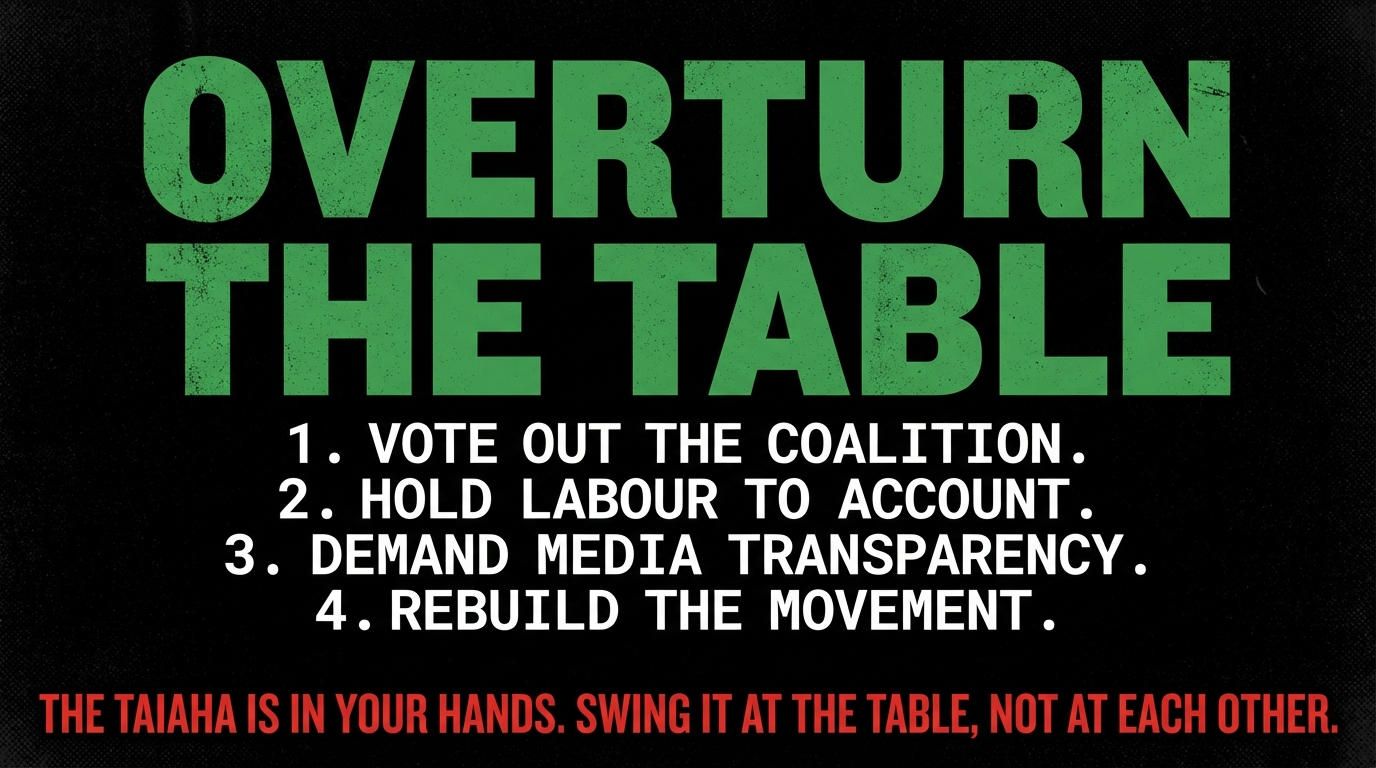
Te Pāti Māori can be rebuilt. The movement cannot be destroyed. But the table must be overturned. All five jaws must be named, exposed, and resisted simultaneously. The coalition must be voted out. Labour must be held to account. The media narrative must be reclaimed. The internal divisions must be healed through tikanga, not the High Court. And the patronage broadcasters must be forced into transparency — because accountability journalism cannot be produced by those who are financially dependent on the people they claim to hold to account.
The taiaha is in your hands. Swing it at the table, not at each other. And for God's sake, stop letting people who are feeding at the table tell you they're fighting for your dinner.
Research conducted 13 February 2026. Tools used: search_web, get_url_content, search_files. Full transcript of The Bradbury Group S02E02 (10 February 2026) analysed. Sources consulted: RNZ, 1News, Te Ara, Te Ao Māori News, The Spinoff, Waatea News, Interest.co.nz, NZ Herald, ODT, WSWS, Consumer NZ, Wikipedia, E-Tangata, Manukau Urban Māori Authority, Te Whānau o Waipareira Trust, The Daily Blog, UMA Broadcasting. All URLs verified at time of research.
Previously published essays by The Māori Green Lantern referenced herein: "How Labour and the Greens Turned Te Tiriti into a Backdrop", "The Three-Headed Taniwha", "The Greed of the Red Machine", "Pākehā Politicians Playing Political Puppets", "The Rotting Waka", "Luxon's Military Junket", "The Coloniser's Dream".
Koha Consideration
Every koha is a vote of no confidence in the cannibal table — the table where the coalition serves Tiriti erasure, Labour serves electoral sabotage, the media serves spectacle, the internal fractures serve all three, and the "independent" broadcaster serves the network that profits from it all. Your koha funds the voice that names all five jaws, traces the whakapapa of the money, follows the sponsorship to the source, and refuses to let any of them feed in silence.
When patronage masquerades as journalism and political networks disguise themselves as independence, your koha says: we fund the voices that cannot be bought, because we've seen what the bought ones produce.
Rangatiratanga includes the power to fund our own truth-tellers — especially when every other institution, including the ones that call themselves "independent," is invested in our silence.
Kia kaha, whānau. Stay vigilant. Stay connected. And if you are able, consider a koha to ensure this voice continues.
If you are unable to koha, no worries! Subscribe or Follow the Māori Green Lantern on Substack, kōrero and share with your whānau and friends — that is koha in itself.
Three pathways exist:
For those who wish to support this mahi directly with a koha (voluntary contribution), please visit the Koha platform:
Koha — Support — https://app.koha.kiwi/events/the-maori-green-lantern-fighting-misinformation-and-disinformation-ivor-jones
For those who wish to receive essays directly and support through subscription:
Subscribe to the Māori Green Lantern — https://the-maori-green-lantern.ghost.io/#/portal/support
For those who prefer direct bank transfer, account details are: HTDM, account number 03-1546-0415173-000.
Ivor Jones The Māori Green Lantern Fighting Misinformation and Disinformation From the Far Right — and From the "Independent" Left That Serves the Same Masters