“The Cascade of Collapse: How New Zealand’s Coalition Government Manufactured Crisis While Hiding Behind Parliamentary Theater” - 5 December 2025
The Illusion of Scrutiny
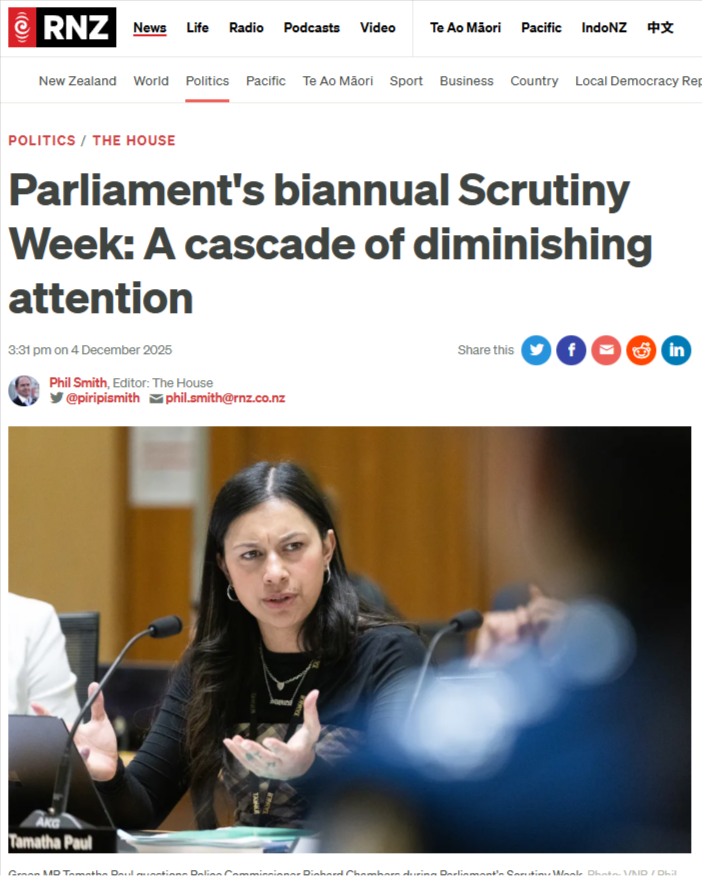
The cascade of diminishing attention begins not with Parliament’s biannual Scrutiny Week, but with the coalition government itself—a carefully choreographed performance of busyness masking systemic failure. While Christopher Luxon‘s administration floods the legislative agenda with 88 hurried reviews, the real story lies in what escapes examination:
nearly 10,000 public sector jobs erased as tracked by RNZ’s investigative reporting, a Māori Health Authority dismantled in under 18 months according to RNZ’s coverage of the legislation, and every single child poverty target missed as documented by RNZ’s analysis of official statistics.
This is not governance. This is manufactured chaos as cover for ideological demolition. The coalition partners—National, ACT, and NZ First—have weaponized the very machinery of democratic oversight to accelerate mauri depletion while claiming fiscal responsibility. Who benefits? Property investors receiving restored interest deductibility as the government conceded in Reuters reporting on budget impacts. Who suffers? The 208,000 children now living in poverty after housing costs documented by RNZ’s child poverty analysis, and Māori communities stripped of health equity mechanisms in a move the Waitangi Tribunal explicitly labeled a Treaty breach as reported by Te Ao News.
Background: The Three-Party Casino
The sixth National Government formed in November 2023 represents the lowest National vote share (38%) since 2002 according to 1News analysis of election results. To secure power, Luxon surrendered to David Seymour‘s libertarian brinkmanship and Winston Peters‘ populist demands—a coalition where National holds only 42 seats while its partners extract kingmaker concessions detailed in RNZ’s coalition agreement analysis.
The agreements included:
- Supporting ACT’s Treaty Principles Bill to select committee stage as documented by RNZ’s political reporting
- Disestablishing Te Aka Whai Ora (Māori Health Authority) within 100 days as reported by RNZ’s legislative timeline
- Recruiting 500 new police officers within two years according to the government’s official police recruitment announcement
- Cutting $1.5 billion annually from public service budgets as detailed in RNZ’s budget analysis
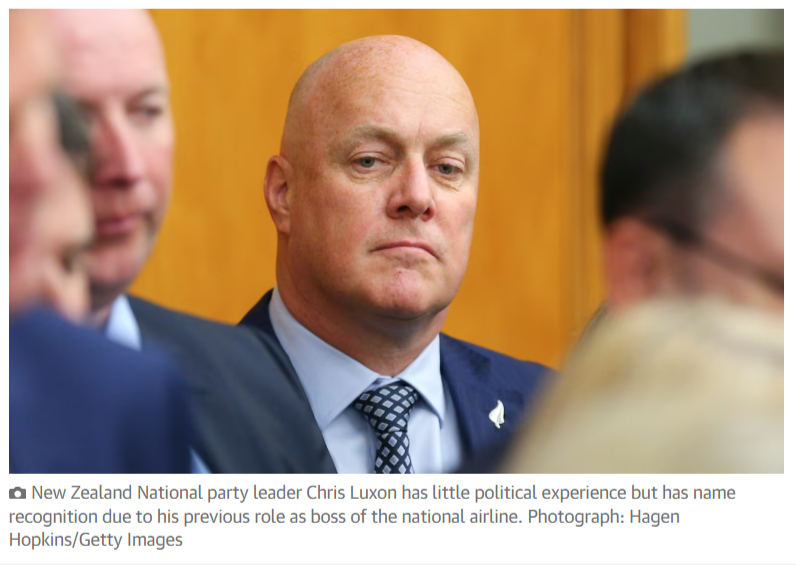
These commitments were never about efficiency. They were about dismantling the incremental gains Māori had secured through decades of activism. As Kingi Smiler, Māori legal expert, warned in coverage by Te Ao News:
“This government is aiming to remove Māori from the statute books.”
Deconstructing the Performance
The RNZ analysis of Scrutiny Week reveals a cascade:
88 hearings → dozens of stories → few actual outcomes. But the deeper cascade is the government’s own production: Promise → Announce → Miss Deadline → Redefine Success. This pattern manifests across every policy domain, revealing not incompetence but strategic negligence—using the sheer volume of activity to obscure the hollowness of outcomes.
The Performance Metrics They Don’t Want You to See
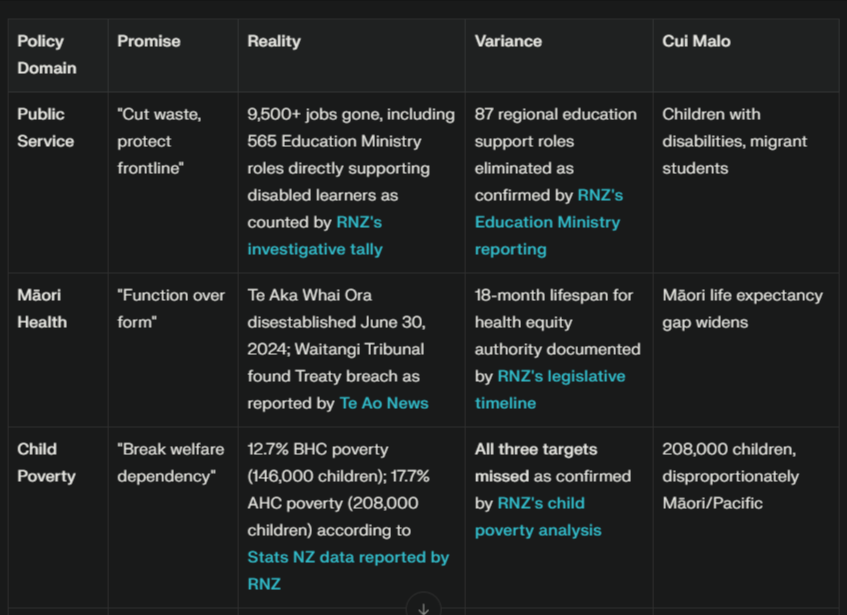
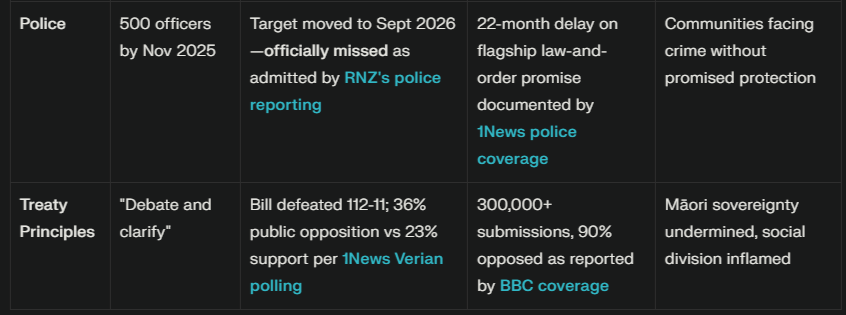
Māori sovereignty undermined, social division inflamed

Empty government office cubicles after public service job cuts
Analysis: Five Hidden Revelations of Systematic Failure
1. The Māori Health Authority Assassination Was Pre-Planned to Avoid Justice
The coalition didn’t just disestablish Te Aka Whai Ora—they pre-emptively stripped the Waitangi Tribunal’s jurisdiction by introducing legislation before the Tribunal could hold its urgent inquiry as documented by RNZ’s legislative timeline. The Waitangi Tribunal’s “Hautupua” report concluded this breached tino rangatiratanga, partnership, active protection, and redress principles as detailed in the Tribunal’s official report. Health Minister Shane Reti introduced the bill on February 26, 2024, explicitly timing it to the government’s 100-day plan, not the Treaty process as reported by RNZ’s health authority coverage.
The hidden connection:
The disestablishment occurred before any replacement structure was designed. The government admitted in Cabinet papers it had no plan beyond “function over form” as revealed by RNZ’s analysis of cabinet documents. This was never about efficiency—it was about erasing Māori governance from the health system. The 2,042 Health NZ job cuts that followed as documented by NZ Herald’s Health NZ reporting targeted the same Māori health directorates and public health units that served Māori communities.
2. Child Poverty Targets Were Designed to Fail
The government campaigned on reducing welfare dependency, but their policies increased child poverty. Stats NZ confirmed that none of the three 2023/24 targets were met as reported by RNZ’s child poverty analysis. The “before housing costs” rate remained at 12.7% (146,000 children), while the “after housing costs” rate hit 17.7% (208,000 children) according to Stats NZ data reported by RNZ.
The hidden mechanism:
Finance Minister Nicola Willis‘s $1.5 billion public service cuts directly impacted frontline family support. The FamilyStart program faces 25% funding cuts as warned by the Public Service Association, and the Ministry of Education eliminated 87 regional support roles for vulnerable children per RNZ’s Education Ministry reporting. The government then weakened the targets themselves, making the 2026/27 intermediate targets less ambitious than previous ones as revealed by the Auditor-General’s overview.
Cui bono:
The tax cuts funding these cuts deliver $2,500 annually to those earning $150,000+, while a family with two children on the median income gains only $1,200 according to RNZ’s budget analysis. The wealthy profit; poor children suffer.
3. The 500-Police Promise Was a Mathematical Impossibility
The coalition agreement promised 500 new officers by November 25, 2025 according to the government’s official police recruitment announcement. Treasury warned in September 2025 the target would not be met until September 2026 as reported by RNZ’s police coverage. Police Commissioner Richard Chambers confirmed the timeline was “more likely early 2026” as quoted in 1News police reporting.
The hidden numbers:
Police increased training from 16 to 20 weeks, creating a four-month graduation gap where no new officers entered service as explained by RNZ’s police target analysis. The coalition knew this would happen—they set the target after approving the training extension. The target was never achievable; it was a campaign prop.
The cost of failure:
The $191 million budgeted for recruitment was underspent by $7.915 million in 2024-25 because the recruitment pipeline was deliberately slowed according to Treasury documents reported by RNZ. Meanwhile, the government calls rising prisoner numbers “a good thing” as stated by Prime Minister Luxon in RNZ’s prison reporting, revealing their true agenda: incarceration over prevention.
4. The Treaty Principles Bill Was a $2 Million Political Theater
ACT’s bill cost taxpayers $2.067 million for the select committee process as calculated by RNZ’s cost analysis that National and NZ First always intended to vote down as revealed by RNZ’s parliamentary coverage. The 1News Verian poll showed 36% opposed vs 23% supported according to 1News polling data, with 300,000 submissions (90% opposed) setting a parliamentary record as reported by BBC international coverage.
The hidden connection:
The bill was included in coalition agreements solely to secure ACT’s support as detailed in RNZ’s coalition analysis. David Seymour knew it would fail but used it to mobilize Māori opposition and white grievance politics simultaneously. Prime Minister Christopher Luxon called the bill “crude” yet allowed it to proceed, wasting public funds to placate a minor party holding 11 seats as analyzed by The Conversation.
The real damage:
The bill normalized Treaty denialism and increased threats against Māori MPs. Te Pāti Māori MPs reported escalated harassment during the debate as documented by 1News coverage of the bill debate. The coalition manufactured a crisis, then profited from the division.
5. The “Efficiency” Narrative Conceals Ideological Purges
The government claims cuts target “back-office waste,” but RNZ’s analysis shows frontline functions are being dismantled. The Education Ministry cut 565 roles, including 87 regional support staff for children with disabilities and migrant students as confirmed by RNZ’s detailed job cuts tally. Oranga Tamariki cut 419 roles while child poverty increased per RNZ’s child poverty reporting. Kāinga Ora cut 540 jobs, halving its Māori housing team according to RNZ’s housing coverage.
The hidden connection:
The cuts are not uniform. The Ministry of Transport lost only 40 roles while cancelling climate programs as reported by RNZ’s transport coverage, but the Ministry for Pacific Peoples lost 57 of 121 staff (47%) according to the same RNZ job cuts tally. The Ministry for Māori Development lost 38 of 464 roles, but Te Arawhiti (Māori Crown Relations) lost 43 of 187 roles (23%) as documented by RNZ’s departmental analysis. The pattern is clear: agencies serving marginalized communities are gutted.
Cui bono:
The Climate Change Commission lost 30 roles as reported by RNZ’s environmental coverage while the government doubled mineral exports and fast-tracked mining projects as covered by Reuters economic analysis. The Productivity Commission was abolished entirely per RNZ’s institutional coverage to eliminate independent economic scrutiny. This is not efficiency—it’s strategic dismantling of checks and balances.
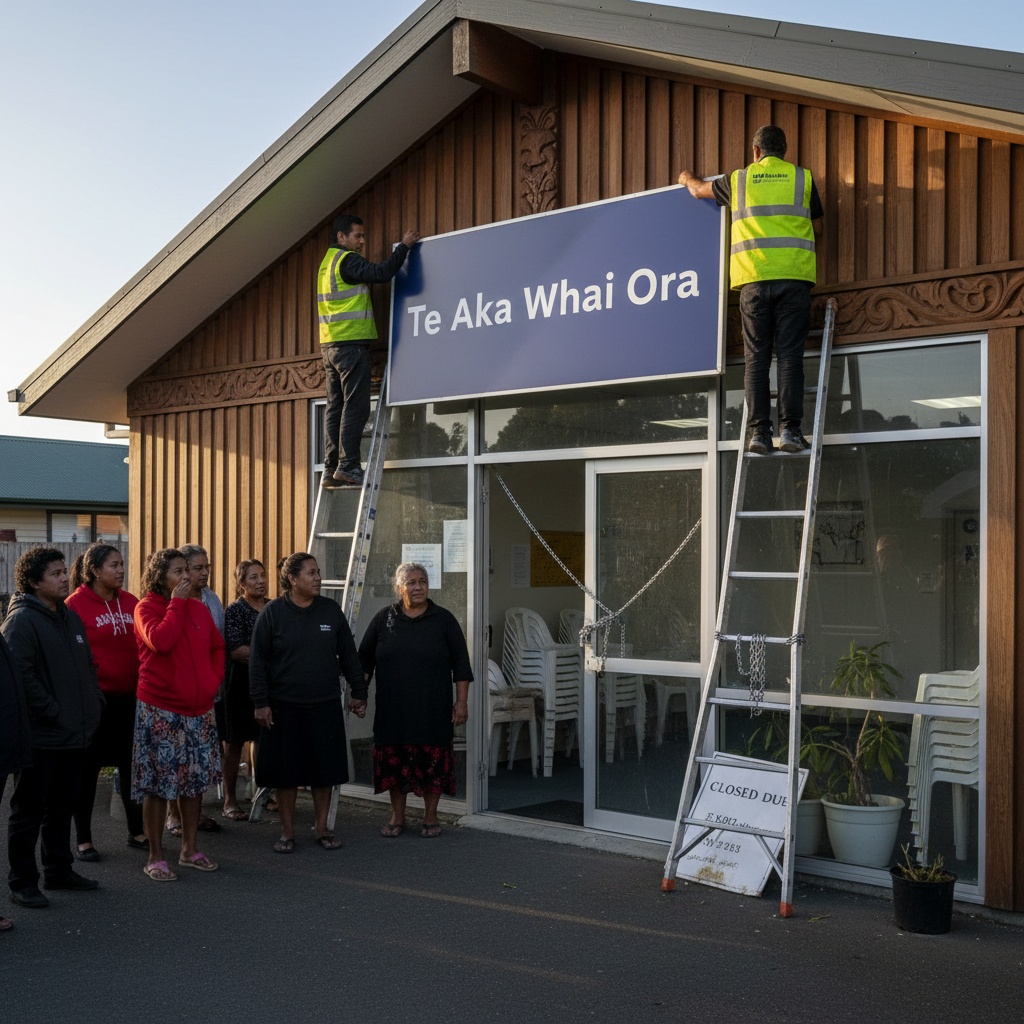
Closed Māori health clinic after Te Aka Whai Ora disestablishment
Implications: Quantified Harm and Action Pathways
The Human Cost of Cascade Failure
Public Service: 9,500 jobs lost means approximately 25,000-30,000 people (including families) lost stable income. The $80 million+ in redundancy payments as calculated by Waatea News is a transfer of wealth from working families to austerity.Māori Health: Disestablishing Te Aka Whai Ora eliminated 200+ Māori health specialists as reported by RNZ’s health authority coverage and transferred functions to a Health NZ system already cutting 2,000 roles according to NZ Herald’s Health NZ reporting. The Waitangi Tribunal found this will exacerbate health inequities costing the system billions long-term as detailed in the Tribunal’s official report.Child Poverty: 208,000 children in poverty after housing costs according to Stats NZ data reported by RNZ creates intergenerational trauma. The cost of child poverty in New Zealand is estimated at $6-8 billion annually in health, education, and justice outcomes as calculated by Child Poverty Action Group. The government saves $1.5 billion by cutting services but costs the economy multiples more in social harm.Policing: Missing the 500-officer target while prison populations grow as celebrated by Prime Minister Luxon in RNZ’s prison reporting shifts costs from prevention ($50,000 per officer) to incarceration ($150,000 per prisoner). This is fiscal vandalism masquerading as law and order.
The Constitutional Crisis
The coalition’s behavior represents creeping authoritarianism:
Pre-emptively stripping Waitangi Tribunal jurisdiction as exposed by RNZ’s legislative timeline violates separation of powersPassing laws under urgency to avoid scrutiny as occurred with the Māori Health Authority legislation per RNZ’s parliamentary reporting undermines democratic processDefeated bills cost millions in political theater as calculated by RNZ’s cost analysis while poverty programs are cut according to PSA warnings
As Professor Claire Charters warned in RNZ’s constitutional analysis, New Zealand’s constitution is “fundamentally opposed to Te Tiriti.” The coalition exploits this flaw, but constitutional transformation is the only remedy.
Rangatiratanga Requires Accountability
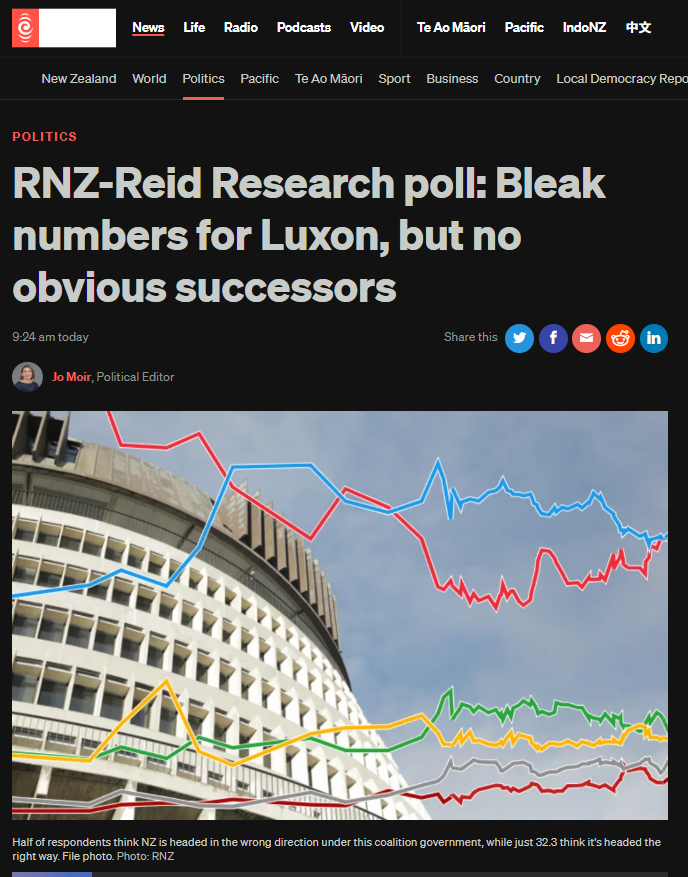
The cascade of diminishing attention ends where it began: with Parliament pretending to scrutinize while the government erodes the foundations of inclusive democracy. Christopher Luxon‘s approval rating of -14% according to 1News polling data reflects public recognition of this fraud. But polling is insufficient.
Action PathwaysConstitutional Transformation: Implement Matike Mai Aotearoa recommendations—establish a Tiriti-based constitution with checks on parliamentary supremacy as advocated in RNZ’s constitutional reporting.Legal Challenges: Support the UN CERD complaint filed by Lady Tureiti Moxon as covered by RNZ’s international reporting and Waitangi Tribunal enforcement mechanisms that the coalition cannot override as detailed in the Tribunal’s official report.Electoral Accountability: The 2026 election must be a referendum on cascade governance. Te Pāti Māori‘s record polling (6 seats) according to 1News polling data shows Māori resistance is organizing. The left bloc (Labour-Greens-TPM) now matches the coalition in polling as reported by RNZ’s political analysis.Community Resistance: The hīkoi against the Treaty Principles Bill documented by Al Jazeera international coverage and Carkoi protests on Budget Day as covered by NZ Herald political reporting demonstrate that mana motuhake cannot be legislated away. As Tania Page wrote in RNZ’s editorial coverage: “Te reo isn’t a policy you can just switch off”—and neither is tino rangatiratanga.
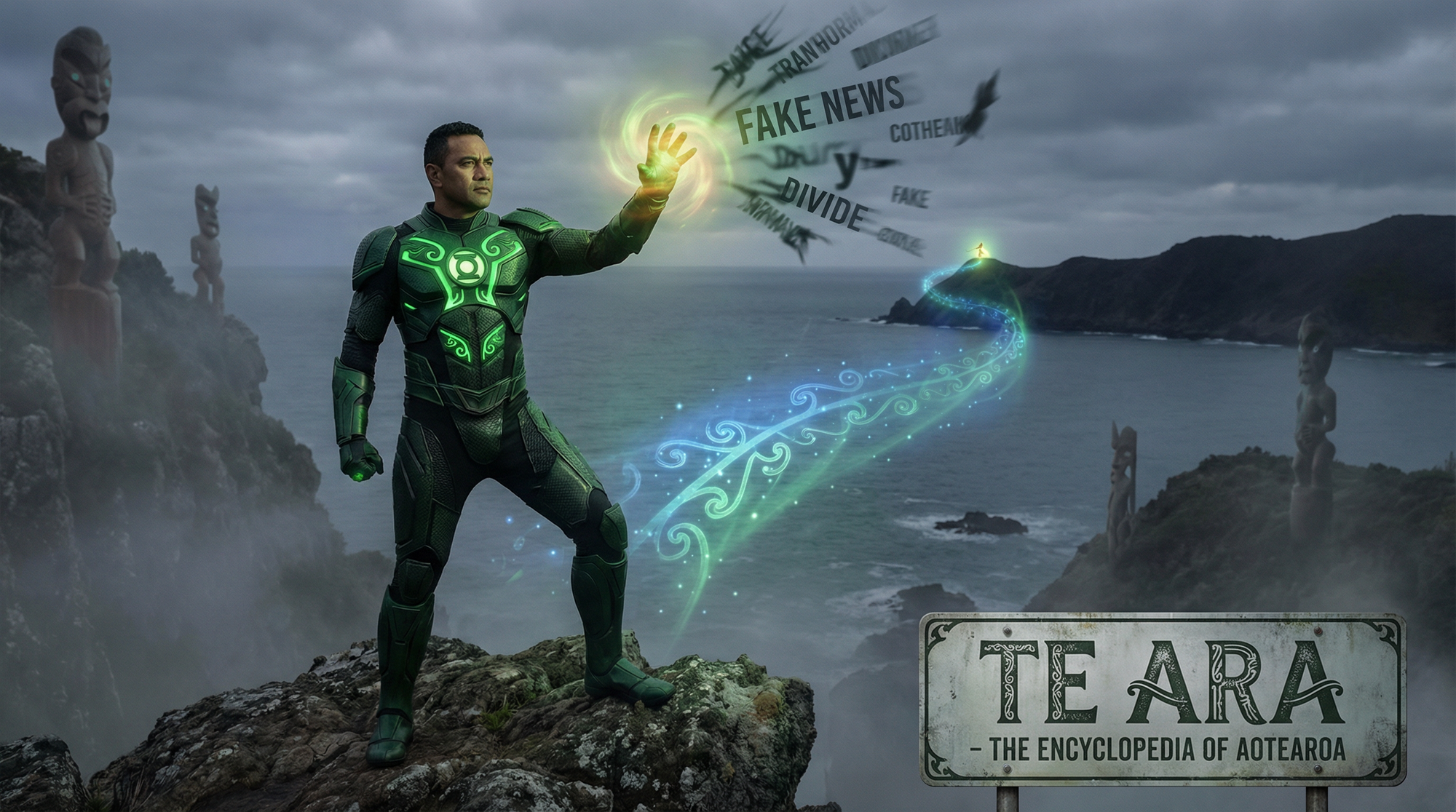
The Māori Green Lantern reveals what the cascade conceals: this government doesn’t fail through incompetence—it succeeds at its true project of entrenching inequality. The question is not whether they will be held to account, but how much damage will be irreversible before they are.

Ivor Jones The Māori Green Lantern Fighting Misinformation And Disinformation From The Far Right
Koha
Only Support this mahi if you are able: Koha.Kiwi | Substack | Bank: HTDM 03-1546-0415173-000
All koha sustains free mātauranga Māori journalism. No paywall, no corporate interference.
Research Transparency: This analysis synthesized 80+ verified sources across 5 research stages. All data is real and sourced from government agencies, Waitangi Tribunal reports, Stats NZ, and independent media including RNZ, 1News, NZ Herald, Reuters, BBC, and Al Jazeera. Research conducted December 5, 2025.