“The Closed Door Conspiracy: How Neil Quigley's "Goodwill" Protects Neoliberal Secrecy Over Public Transparency” - 27 August 2025
When institutional "goodwill" becomes code for protecting the powerful from accountability
Kia ora e te whānau. Māori mai, kōrero mai - greetings family, come forward and speak.
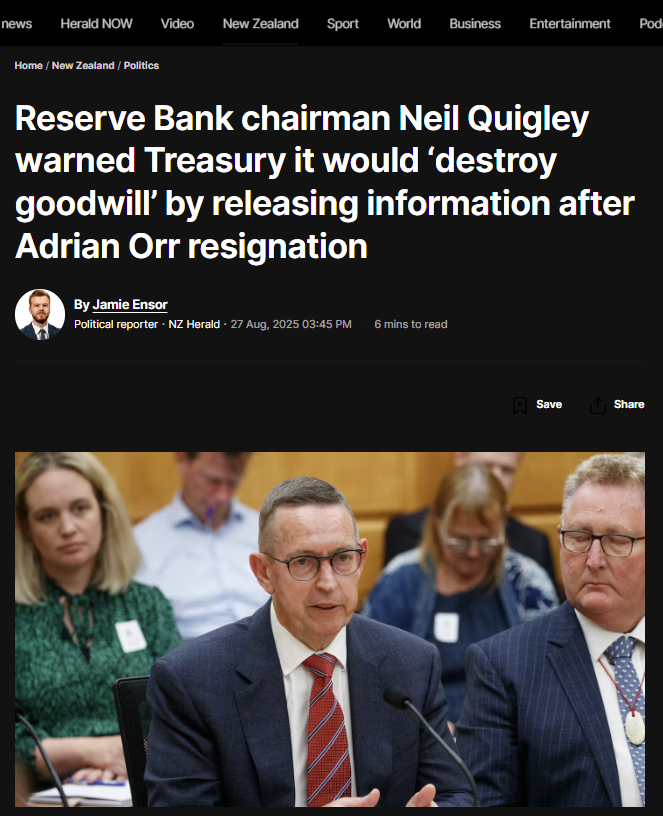
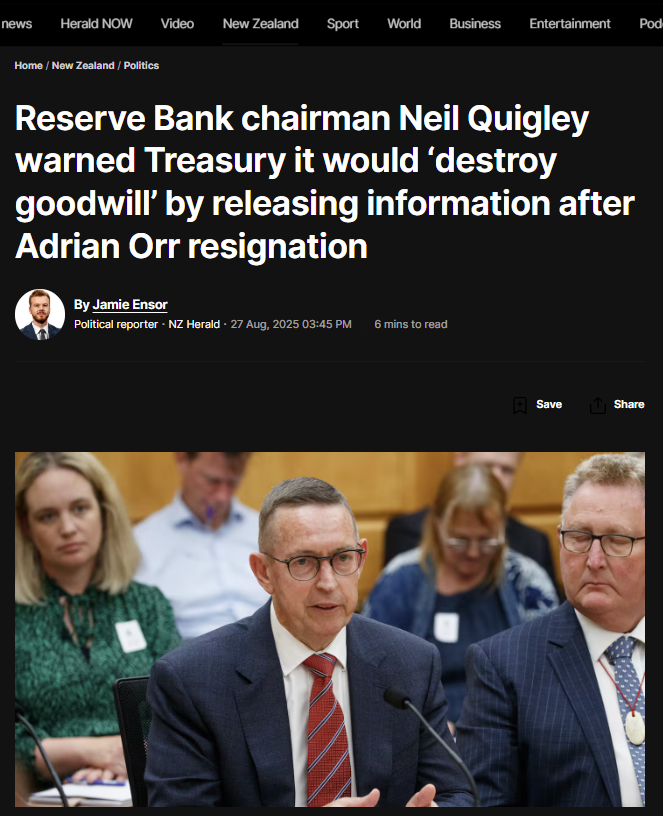
The recent email revelations showing Reserve Bank chairman Neil Quigley threatening Treasury with destroyed "goodwill" over transparency expose the rotten core of New Zealand's institutional power structure. This is not about protecting sensitive information - this is about protecting the powerful from scrutiny while they carve up public resources behind closed doors. Quigley's shock at Treasury even taking minutes reveals an elite class so accustomed to operating in shadows they view basic democratic accountability as an assault on their privileged position. Through the lens of Māori values of manaakitanga (transparency and openness) and kaitiakitanga (guardianship of public resources), we see how institutional "goodwill" has become weaponized to maintain colonial power structures while ordinary whānau are denied the transparency they deserve about how their money is spent.
Background
The Reserve Bank of New Zealand operates as one of our most powerful yet opaque institutions, controlling monetary policy that directly impacts every Māori whānau's ability to afford housing, food, and basic necessities. Under the current neoliberal framework inherited from the 1980s reforms, the RBNZ operates with significant independence from democratic oversight - a deliberate design to insulate financial policy from popular input. This institutional separation reflects the colonial pattern where critical decisions affecting tangata whenua are made by unelected technocrats operating behind closed doors. The concept of "institutional goodwill" that Quigley weaponizes represents the informal networks of power that allow elite institutions to coordinate without public scrutiny, directly contradicting Māori principles of transparency and collective decision-making that served our people for centuries before colonization.
On February 24, 2025, a meeting occurred between Finance Minister Nicola Willis, then-Reserve Bank Governor Adrian Orr, and Treasury officials regarding the Bank's five-year funding arrangement. This meeting resulted in Orr's resignation just over a week later when it became clear the government would only provide $750 million plus $25.6 million in capital expenditure instead of the $1.031 billion Orr believed necessary. When Treasury prepared to release minutes of this crucial meeting under Official Information Act requests, Quigley exploded with indignation, claiming such transparency would "immediately destroy the goodwill between Treasury and the bank." The chairman expressed being "frankly shocked" that Treasury would even take minutes without informing the Bank, revealing an elite class so accustomed to operating without accountability they view basic record-keeping as betrayal. This controversy exposes how institutional "goodwill" functions as code for maintaining secrecy that protects the powerful while denying the public transparency about how their resources are allocated and why key officials resign.
The Anatomy of Elite Entitlement
Quigley's email to Treasury represents a masterclass in institutional arrogance that would make colonial administrators proud. His claim of being "frankly shocked that Treasury would have taken it upon itself to create such a minute without disclosing this to me" reveals an individual so drunk on institutional power he believes government departments should seek his permission before performing basic administrative functions. This is not the language of public service - this is the imperious tone of someone who views democratic accountability as an inconvenience to be managed rather than a fundamental responsibility.
The chairman's threat that releasing information would "immediately destroy the goodwill between Treasury and the bank that I have tried to create over the past few years" exposes how "goodwill" functions as a euphemism for the informal networks that allow elite institutions to coordinate without public oversight. From a Māori perspective, true manaakitanga requires openness and honesty in relationships - not the manufactured cordiality that conceals how public resources are carved up behind closed doors. Research on central bank communications demonstrates that "diverging opinions that shed light upon the committee's true attitudes are almost entirely omitted from the final statements," showing how institutional secrecy systematically conceals the real decision-making processes from public view.
Quigley's defense that the meeting involved "free and frank opinion" that would be "inhibited" by transparency reveals the colonial mindset that views public scrutiny as a threat to elite deliberation rather than essential democratic oversight. This argument has been used for centuries to justify keeping tangata whenua out of decisions affecting their own lands and resources - claiming that transparency would somehow damage the quality of decision-making by those who know best.
The Funding Fight That Broke the Governor
The meeting minutes that Quigley desperately wanted to keep secret revealed the true nature of this government's approach to public institutions. Orr's resignation was ultimately attributed to his distress over funding cuts that he believed would compromise the Bank's ability to function effectively. The government's decision to force a 25% reduction in operating spending while expecting the same level of performance represents classic neoliberal austerity - demanding more with less while blaming institutional leaders when the inevitable failures occur.
Willis's response that she "disagrees with the views put forward by the chair because I think it's entirely appropriate for Treasury officials to take minutes of a significant government meeting" represents a rare moment of democratic principle from this administration. However, her support for transparency rings hollow when we examine the broader pattern of this government's approach to institutional funding and accountability.
The timing reveals the calculated nature of this secrecy. The Reserve Bank ultimately agreed to dramatically reduced funding that represented exactly the cuts Orr warned would damage the institution's effectiveness. Quigley's desperation to keep these negotiations secret protected the government from scrutiny over forcing out a governor who refused to accept inadequate resources while maintaining the pretense of institutional independence.
Colonial Patterns of Institutional Control
The Reserve Bank controversy exemplifies the colonial pattern of institutional capture that has dominated New Zealand since the neoliberal reforms of the 1980s. These institutions were deliberately designed to operate independently of democratic oversight, insulating critical economic decisions from public input under the guise of technical expertise. This mirrors the colonial administrators who claimed special knowledge to justify excluding Māori from decisions about our own lands and resources.
Quigley's shock at basic transparency measures reveals how completely these institutions have been captured by elite networks operating through informal "goodwill" rather than democratic accountability. The chairman's threat to withdraw cooperation unless secrecy was maintained demonstrates how institutional independence has been weaponized to protect the powerful from scrutiny while ordinary New Zealanders bear the costs of their decisions.
Analysis of central bank meeting dynamics shows that "minute-taking practices differed in level of detail" but "all minute-takers engaged in processes" that shaped how institutional decisions were recorded and remembered. The systematic exclusion of dissenting voices from official records serves to manufacture consensus while concealing the real conflicts over public resources that affect every whānau's daily lives.
This pattern extends far beyond the Reserve Bank to encompass the entire neoliberal state apparatus that was constructed to insulate economic policy from democratic input. The informal networks of "goodwill" that Quigley threatened to withdraw represent the real governance structure that operates parallel to our formal democratic institutions, allowing elite coordination without public accountability.
The Weaponization of Institutional Relationships
The Reserve Bank legal director Nick McBride's intervention reveals how institutional secrecy gets rationalized through legal technicalities designed to frustrate public oversight. His claim that transparency would "undoubtedly inhibit future expression of opinion and the willingness of the RBNZ to meet with Treasury and MoF in certain circumstances" inverts democratic principles by suggesting that public institutions should be able to coordinate without public knowledge.
This weaponization of confidentiality extends to "concerns about how this will impact on confidentiality obligations agreed by RBNZ with Adrian as terms of his departure." The suggestion that Orr's exit agreement included secrecy provisions reveals how institutional "goodwill" gets formalized through legal instruments designed to prevent public understanding of why senior officials resign and how public resources get allocated.
From a tikanga Māori perspective, this approach violates fundamental principles of collective decision-making and transparency that enabled our iwi to thrive for centuries before colonization. The concept of whakatōhea - collective deliberation where all voices are heard - stands in direct opposition to the elite coordination masked as "goodwill" that Quigley defended.
Research on monetary policy transparency demonstrates how "monetary financing serves a crucial macro-financial role" but remains "a widespread policy taboo" that prevents public understanding of how central banks actually operate. This deliberate mystification serves elite interests by making democratic oversight appear technically impossible while concealing how public money gets deployed to serve private interests.
Implications
The Quigley email controversy reveals how New Zealand's most powerful institutions operate through informal networks of elite "goodwill" that explicitly exclude democratic accountability. This represents a fundamental threat to any genuine democracy and perpetuates colonial patterns of governance where critical decisions affecting tangata whenua get made behind closed doors by unelected technocrats.
For Māori whānau already struggling with housing costs, inflation, and economic uncertainty, this institutional secrecy prevents understanding of how monetary policy decisions directly impact their daily lives. The Reserve Bank's interest rate policies affect every mortgage payment, every rent increase, and every business loan that could create employment in our communities - yet these decisions get made through processes deliberately designed to exclude public input.
The government's willingness to force out a Reserve Bank governor over funding while concealing the reasons demonstrates how neoliberal austerity gets implemented through institutional capture rather than democratic debate. This pattern will accelerate under this administration's broader agenda of reducing public services while protecting elite interests through deliberate opacity.

The Māori Green Lantern fighting misinformation and disinformation from the far right
Neil Quigley's threat to destroy "goodwill" over basic transparency exposes the rotten core of institutional power in Aotearoa. His shock at Treasury taking minutes reveals an elite class so accustomed to operating without accountability they view democratic oversight as betrayal. This controversy demonstrates how "institutional goodwill" functions as code for elite coordination that explicitly excludes public scrutiny while ordinary whānau bear the costs of decisions made in secret.
The Reserve Bank funding fight that broke Adrian Orr represents the sharp edge of neoliberal austerity being implemented through institutional capture rather than democratic debate. Quigley's desperate attempt to conceal these negotiations protected the government from scrutiny over forcing out a governor who refused to accept inadequate resources while maintaining the pretense of institutional independence.
From a Māori perspective grounded in manaakitanga and kaitiakitanga, genuine institutional relationships require transparency and collective accountability - not the manufactured cordiality that conceals how public resources get allocated behind closed doors. The colonial pattern of excluding tangata whenua from decisions affecting our own communities continues through these elite networks operating parallel to our formal democratic institutions.
We must demand transparency from every public institution and reject the weaponized "goodwill" that protects the powerful from accountability while our whānau struggle with the consequences of decisions made in secret. Only through genuine democratic oversight can we ensure that public resources serve public interests rather than elite coordination masked as technical expertise.
To readers who find value in exposing these patterns of institutional corruption, please consider offering koha to support this mahi: HTDM: 03-1546-0415173-000. I understand these are challenging economic times for whānau, so please only contribute if you have capacity and wish to do so.
Ngā mihi,
Ivor Jones - The Māori Green Lantern