“The Coalition's Classroom Warfare: How Stanford and Collins Are Weaponising Teacher Poverty” - 14 August 2025
Exposing the neoliberal assault on education through manufactured crisis and colonial divide-and-conquer tactics
Kia ora koutou katoa,
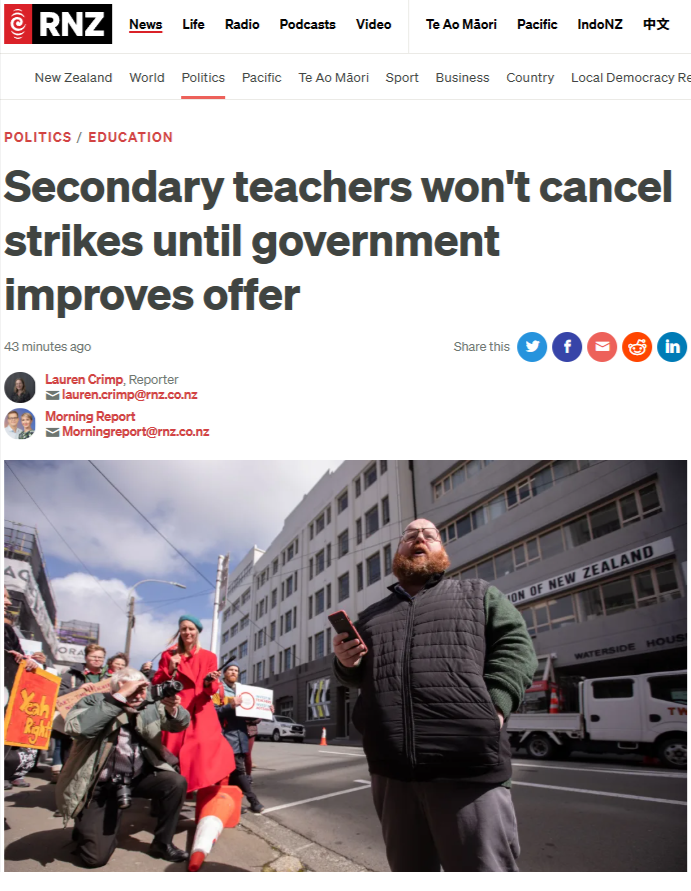
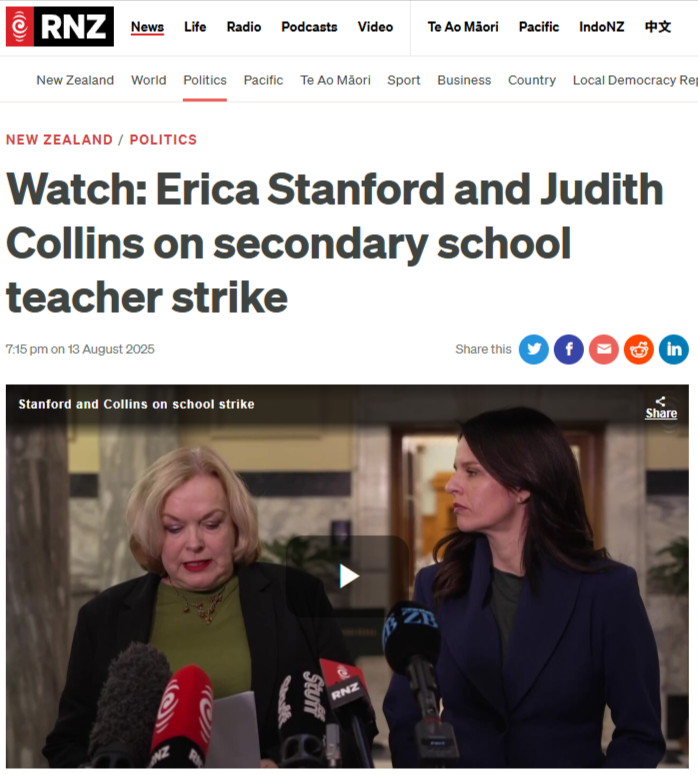
The secondary teachers strike on August 20th, 2025 represents more than a labour dispute - it exposes the Coalition Government's deliberate strategy to undermine public education through manufactured austerity and colonial divide-and-conquer tactics. When Education Minister Erica Stanford and Public Service Minister Judith Collins dismissed the PPTA's rejection of a meager 1% pay offer as a "political stunt," they revealed the true nature of their neoliberal agenda: portraying teachers as greedy opportunists rather than addressing the systematic devaluation of education that threatens Māori and working-class communities most severely.
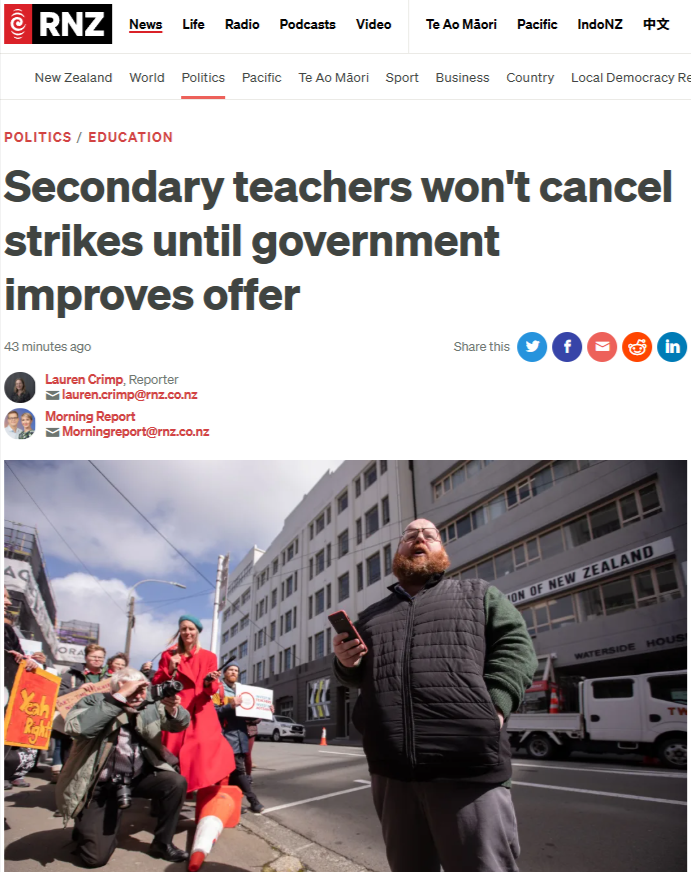
This manufactured crisis didn't emerge in a vacuum. Secondary teachers haven't received a meaningful pay rise since July 2021, while facing the most significant curriculum changes in decades. Meanwhile, New Zealand faces a shortage of 800 secondary teachers, with regions serving predominantly Māori communities hit hardest. The Coalition's response? Blame teachers for caring about their profession and students' futures.
The current dispute centres on the Government's insulting 1% annual pay offer - described by the PPTA as "the lowest increase in a generation." This offer comes as teachers face massive curriculum overhauls, increased non-contact time obligations, and a cost-of-living crisis that particularly impacts Māori whānau in education.
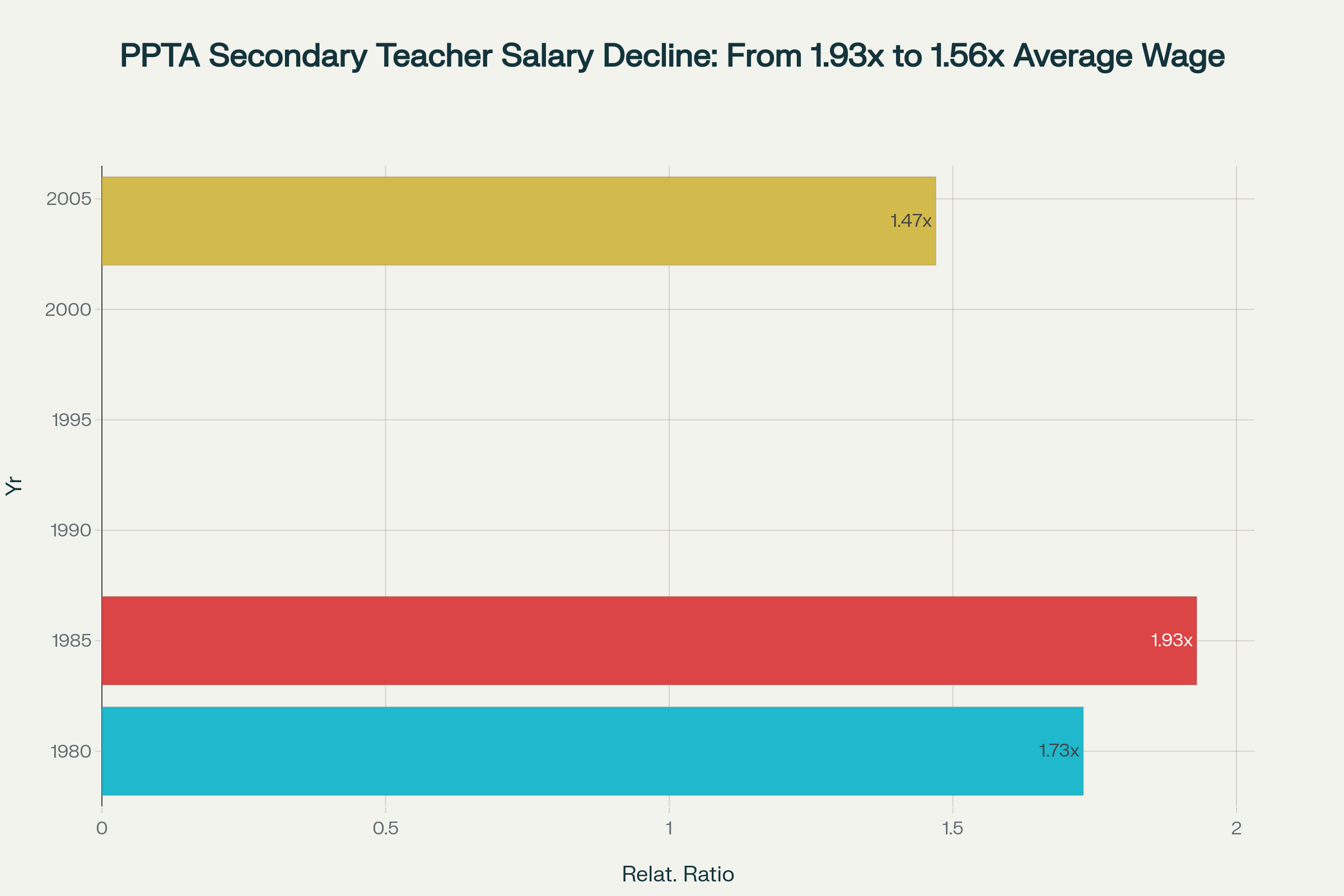
PPTA data shows secondary teacher salaries have fallen from 1.93 times average wage in 1985 to just 1.56 times in 2024 - requiring an 11% increase to restore buying power
reveals the shocking reality behind this dispute: secondary teacher salaries have plummeted from 1.93 times the average wage in 1985 to just 1.56 times in 2024. This dramatic decline coincides precisely with neoliberal reforms that began systematically dismantling public education in the 1990s. The data shows teacher salaries crashed to just 1.32 times average wages during the mid-1990s National government, creating devastating teacher shortages that forced temporary boosts.
The pattern is clear: conservative governments deliberately undervalue teachers, create crises, then position themselves as saviours while implementing privatisation agendas.
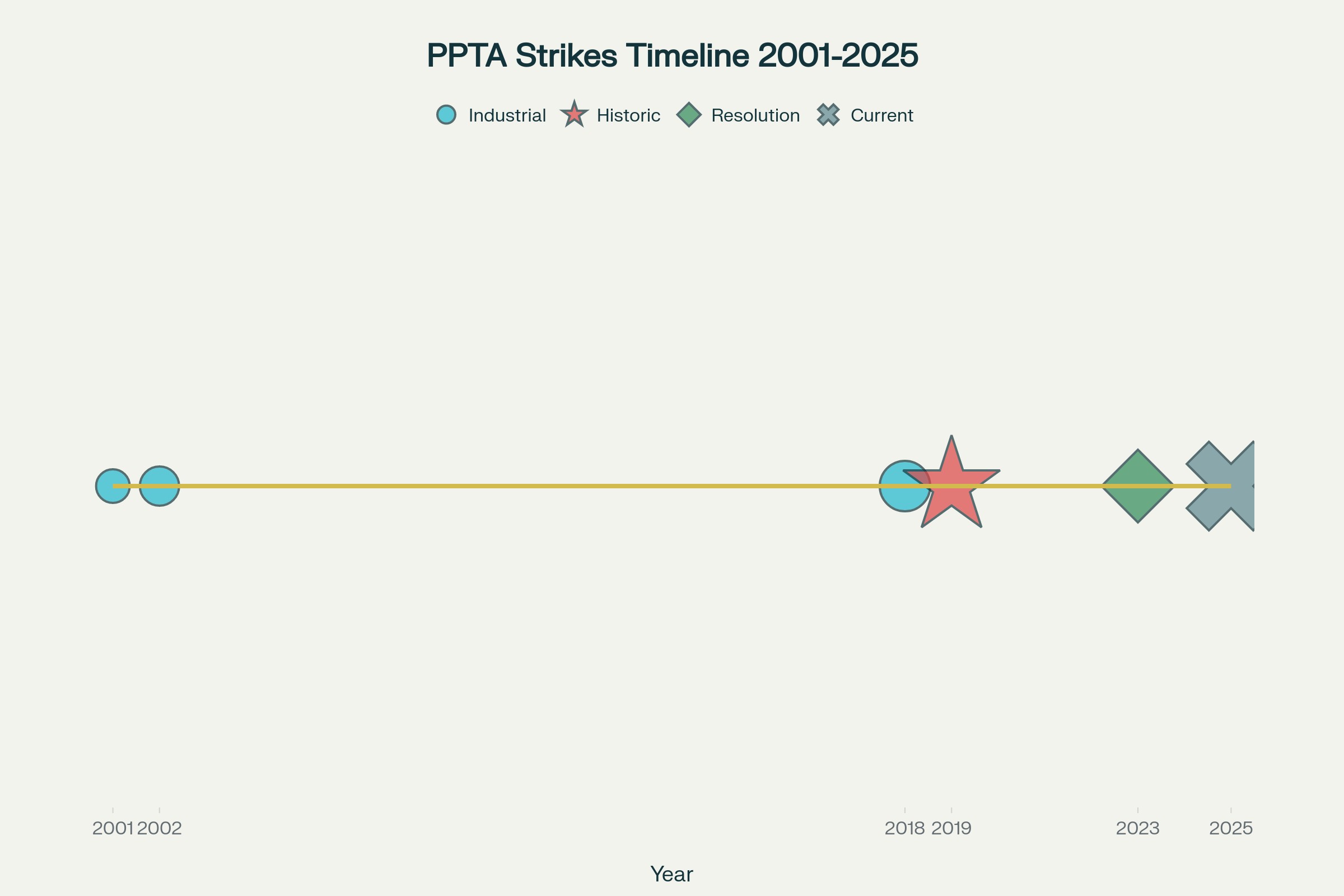
Secondary teacher strikes have intensified under neoliberal governments, from sporadic action in early 2000s to systematic resistance against austerity
demonstrates how strike frequency has intensified under neoliberal governments, culminating in the historic 2019 combined strike with primary teachers - the largest education strike in New Zealand's history.
This isn't about teacher greed. It's about a coordinated assault on public education that disproportionately harms Māori learners, who rely most heavily on well-funded, professionally staffed schools to overcome structural inequalities.
Deconstructing the Coalition's Rhetoric
Stanford's dismissal of teacher concerns as having "an air of premeditation" reveals typical neoliberal projection. Of course, the strike was premeditated - that's how democratic unionism works. What's actually premeditated is the Coalition's systematic underfunding designed to create the conditions for privatisation.
Collins' characterisation of strikes as "yearly attacks on students" inverts reality with Orwellian precision. The real attack on students comes from teacher shortages forcing schools to cancel specialist subjects and combine classes. Collins, whose neoliberal credentials include describing obesity as "generally a weakness" requiring "personal responsibility," applies the same victim-blaming logic to education: blame teachers for systemic underfunding.
The timing of this dispute is particularly cynical. Teachers are implementing the Government's own massive curriculum changes while being told they're not worth fair compensation. This creates a deliberate double-bind: teachers must either accept poverty wages or be portrayed as sabotaging the Government's reform agenda.
The Hidden Privatisation Agenda
Behind the rhetoric lies a coordinated privatisation strategy. Stanford's deflection of charter school questions to David Seymour while claiming responsibility for "transformational change" reveals how National uses ACT as a fig leaf for unpopular privatisation policies. The Coalition allocated $153 million for charter schools while offering teachers insulting 1% increases.
Budget 2025's education cuts tell the real story: $614 million redirected from "underperforming" initiatives, including axing the Kāhui Ako school clustering scheme that supported collaborative Māori education approaches. Meanwhile, government subsidies for private schools increased by 11%, raising annual spending to $46.2 million.
This follows a global pattern of neoliberal education destruction documented by researchers worldwide. Studies show neoliberal policies systematically "obliterate academic practice" and reduce education to "market calculations that seek to manipulate and exploit profit." The Coalition's strategy mirrors international privatisation playbooks: underfund public services, create dysfunction, then present private alternatives as salvation.
The Pay Equity Betrayal
The Coalition's most devastating attack came through retroactively cancelling all pay equity claims, including the teachers' claim covering over 90,000 educators. This wasn't just policy change - it was theft of years of collaborative work between unions and government.
The new pay equity rules make claims virtually impossible, requiring 70% female workforces for 10 years and eliminating valid comparators. For teaching - a female-dominated profession historically undervalued precisely because it's "women's work" - this effectively removes any path to fair compensation.
Collins' role in this betrayal connects to her decades-long neoliberal crusade. Her political philosophy combines "old-school pragmatic National conservatism and a dose of ideological neoliberalism," shaped by admiration for Don Brash's divisive "Orewa speech" that condemned "racial separatism." This worldview sees collective action for fair pay as threatening individual responsibility.
The Māori Impact
This assault on education disproportionately devastates Māori communities who have fought for decades to secure quality education despite systematic racism. Teacher shortages are most severe in regions with significant Māori populations, including Northland, Bay of Plenty and Taranaki.
The destruction of pay equity claims represents a particular betrayal of Māori educators and whānau. Female-dominated professions like teaching have been historically undervalued precisely because colonial capitalism devalues care work associated with women and indigenous communities. By eliminating pay equity pathways, the Coalition entrenches colonial wage hierarchies that keep Māori whānau struggling financially despite their essential contributions to our communities.
Budget cuts to Māori education initiatives including $36.1 million from kaupapa Māori and Māori medium education, plus the destruction of Kāhui Ako collaborative networks, systematically undermines Māori educational sovereignty. This aligns with the Coalition's broader anti-Māori agenda that portrays any support for indigenous rights as "separatism."
Manufacturing Crisis for Profit
The Coalition's strategy follows a classic neoliberal playbook: create crisis through underfunding, blame public servants, then impose market solutions. Teacher demand projections show a shortage of 1,250 teachers in 2025, yet the Government offers poverty wages while spending millions on privatisation schemes.
This manufactured scarcity serves multiple purposes: it justifies charter school expansion, enables the importation of unqualified "emergency" teachers, and weakens union bargaining power through desperation. Schools are already hiring people without teaching qualifications under Limited Authority to Teach provisions, a concerning trend that undermines professional standards.
The psychological warfare is equally calculated. By timing the dispute to coincide with exam periods and portraying teachers as harming students, the Coalition exploits parental anxiety to divide communities against educators. This classic divide-and-conquer tactic mirrors international privatisation strategies that pit "consumers" against "providers" to justify market interventions.
The International Context
New Zealand's education attack follows global patterns of neoliberal destruction. Research documents how "neoliberal managerialism diminishes scholarship, education, students, and academic staff" by "denigrating academic practices and reducing their worth to market calculations."
International studies reveal neoliberal education policies "foster liberalisation instead of human rights" and "propagate privatisation instead of universal education," creating systems that exclude the very communities they claim to serve. The Coalition's policies mirror failed privatisation experiments in Chile, the UK, and parts of the United States that have increased inequality while destroying teaching as a profession.
The timing isn't coincidental. Winston Peters' recent speech attacking Labour as focused on "race, culture wars, rainbow wars, and Marxist ideals" while supporting "the most right-wing, pro-privatization, pro-neoliberalism government that New Zealand has seen in at least 30 years" reveals the ideological coherence behind these attacks.
Implications for Our Communities
This manufactured crisis threatens to destroy public education as a pathway for Māori and working-class advancement. When teachers can't afford to live in the communities they serve, when schools can't attract qualified staff, when privatisation siphons resources from public education, our most vulnerable tamariki suffer most.
The broader implications extend beyond education. The Coalition's attack on teachers represents a test case for dismantling all public services through manufactured austerity and cultural warfare. If they can successfully portray teachers - among New Zealand's most respected professionals - as greedy and disruptive, they can justify attacking any public service workers.
The destruction of collective bargaining and pay equity rights signals a broader assault on worker organisation that threatens all unions and professional associations. This connects to international trends toward authoritarianism that use economic crisis to justify attacks on democratic institutions.
For Māori communities specifically, this represents continuation of colonial education policies designed to deny indigenous peoples access to quality education while forcing assimilation to Pākehā economic priorities. The Coalition's broader anti-Māori agenda uses education attacks to undermine rangatiratanga and cultural sovereignty.

The Māori Green Lantern fighting misinformation and disinformation from the far right
The Coalition's response to secondary teachers' justified demands for fair pay reveals their true agenda: dismantling public education through manufactured crisis and cultural warfare. Stanford and Collins' dismissive rhetoric masks a coordinated assault on professional education that will devastate Māori and working-class communities most dependent on strong public schools.
This isn't about budget constraints - it's about ideological commitment to privatisation and colonial control. The same government that finds $153 million for charter schools and 11% increases for private school subsidies claims it can't afford fair wages for qualified teachers implementing their own curriculum changes.
The teachers' strike represents resistance to this broader attack on public education and democratic values. Their struggle connects to global movements defending public services against neoliberal destruction. When teachers fight for fair pay, they fight for the future of public education and the communities it serves.
We must recognise this dispute for what it truly is: a test of whether New Zealand will maintain its commitment to quality public education or surrender to privatisation profiteers who see our children's futures as profit opportunities. The choice couldn't be clearer - and the stakes couldn't be higher.
Ngā mihi nui to readers who find value in my content. If you have the capacity and wish to support this mahi with a koha, it would be deeply appreciated: HTDM: 03-1546-0415173-000. These are tough economic times for whānau, so please only contribute if you're able to do so.
Kia kaha, kia māia, kia manawanui
Ivor Jones, The Māori Green Lantern
References