“The Colonial Pension Crisis: How Neoliberalism Forces Elders to Work Until Death” - 29 June 2025
When the System Breaks Down, Māori Whānau Bear the Burden
Kia ora e hoa mā - Greetings to you all.
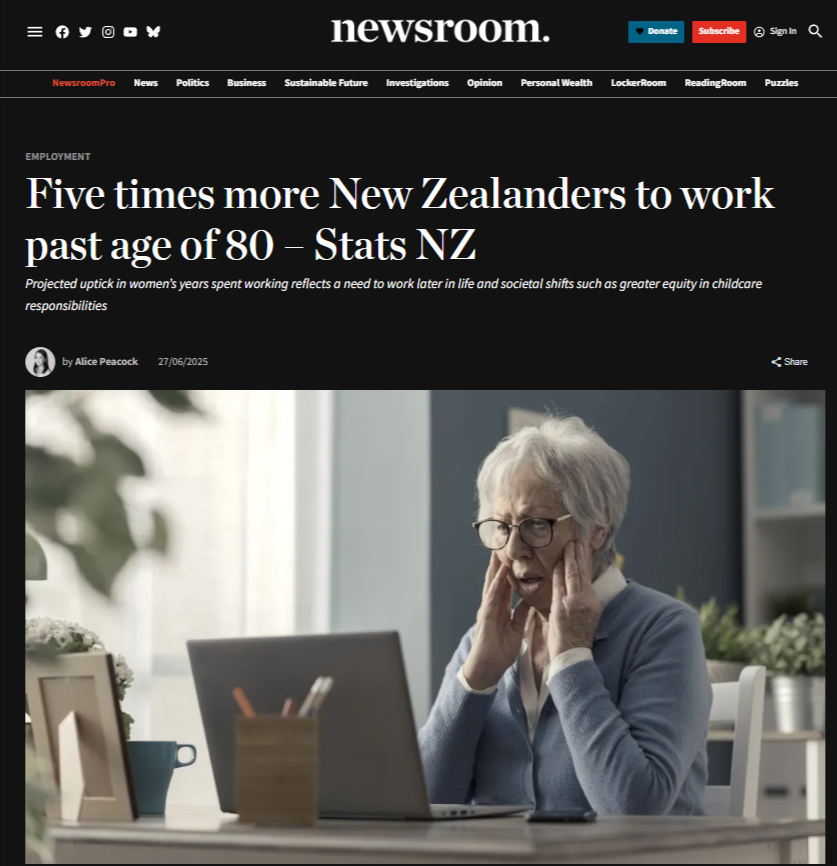
As Stats NZ reveals five times more New Zealanders will work past 80, we must ask whose labour is being extracted to prop up a failing economic system built on white supremacy.
The recent Statistics New Zealand data revealing that five times more New Zealanders will work past age 80 by 20781 represents more than demographic trends - it exposes the fundamental violence of a neoliberal economic system that forces our elders to labour until death while the wealthy accumulate unprecedented riches. This essay examines how this projected increase in elderly workers reflects the systematic failure of New Zealand's economic model and argues that only a comprehensive wealth tax can break the cycle of exploitation that condemns our most vulnerable to endless toil.
Background Context
The Statistics New Zealand projections paint a stark picture of New Zealand's economic future. By 2078, around 44,000 people over age 80 are expected to participate in the workforce, compared to just 9,000 in 20241. This represents a 389 percent increase in workers over 80, who will constitute 1 percent of the total workforce. The median age of the workforce is projected to rise from 41 years in 2024 to over 45 by the late 2060s.
Professor Paul Spoonley notes that 24 percent of people aged 65 and over are already in paid work - the highest rate in the OECD and more than double Australia's proportion1. This statistic reveals that New Zealand's elderly workforce participation is already at extreme levels by international standards, yet the projections suggest this will intensify dramatically.
Understanding this crisis requires examining how neoliberal reforms have systematically dismantled the economic security that previous generations enjoyed. The wealth tax proposed by the Green Party represents the only mechanism capable of addressing the structural inequalities that force elders into perpetual labour while the ultra-wealthy accumulate ever-greater riches.
Unpacking the Elder Labour Exploitation Crisis
The Statistics New Zealand data reveals profound gender disparities that illuminate how differently neoliberalism impacts men and women. While average working life for women is expected to grow from 43 years to 46.1 years and weekly hours from 33.4 to 35.6, men's working years show slower growth from 48.5 to 49.3 years while weekly hours drop from 40.4 to 38.81.
Jake Lilley from financial mentorship trust FinCap reports that women are twice as likely to seek financial mentoring, with relationship breakdowns driving many women to seek support when closer to retirement age1. This reflects how women's economic security has been systematically undermined by decades of unpaid care work and gender pay gaps that compound over lifetime earnings.
Retirement Commissioner Jane Wrightson acknowledges that while this shift may reflect women working later into life, it's also driven by societal changes such as greater equity in childcare responsibilities and flexible working arrangements1. However, this analysis obscures the harsh reality that many women work not by choice but by necessity, forced to continue labouring because decades of structural inequality have left them without adequate retirement savings.
Already, one-third of New Zealand's workforce is aged 55 and over, and among New Zealanders aged 65-69, 44 percent still have jobs2. This massive participation of older workers reflects a systematic failure to provide economic security for aging populations.
The Neoliberal Architecture of Elder Poverty
New Zealand's current elder labour crisis cannot be understood without examining how neoliberal reforms fundamentally restructured the economy from the 1980s onwards. The implementation of Rogernomics from 1984-1988 marked a sharp departure from post-war consensus that emphasised heavy interventionism, protectionism, and full employment, instead embracing principles of small government, balanced budgets, and free market policies3.
These neoliberal reforms led to over 111,000 jobs lost between 1986 and 1996, with cuts to welfare benefits creating extra financial pressures on families4. Child poverty rose dramatically after the 1991 budget and persisted, with 28 percent of children in poverty including 20 percent in severe poverty by 20154.
While inequality trends have remained stable since the 1990s, the level of wealth disparity remains considerably higher than before the implementation of neoliberal reforms in 19845. Until then, New Zealand as the so-called "classless society" had the lowest income inequality in the world, with a Gini coefficient of only 0.27, but by 2011 this had reached 0.355.
The systematic dismantling of collective retirement security has forced individuals to bear risks that were previously socialised. This privatisation of risk has created conditions where elders must continue working not by choice but by economic necessity, their labour extracted to sustain a system that concentrates wealth at the top while abandoning those who built the economy.
Wealth Concentration and the Tax Avoidance Machine
While elders face the prospect of working until death, New Zealand's wealth inequality has reached extreme levels that demand urgent intervention. A 2023 Inland Revenue Department report found that the effective tax rate of the wealthiest families in New Zealand is 9.4 percent, less than half the rate of middle wealth New Zealanders at 20.2 percent6.
The 2025 NBR Rich List is now worth more than one hundred billion dollars, while the Government has chosen to cut support to tens of thousands of the lowest income New Zealanders7. This stark juxtaposition reveals how wealth concentration occurs precisely through the impoverishment of working people, including elders forced to continue labouring.
The top 1 percent of the population now owns 16 percent of the country's wealth, while the richest 5 percent owns 38 percent, and half the population earns less than $24,0008. The top 10 percent of New Zealand households hold around 50 percent of New Zealand's total household net worth9.
This extreme concentration occurs while 42 percent of millionaires pay tax at rates below those of the lowest income earners9. The tax system has become fundamentally regressive, allowing the wealthy to avoid their fair share while working people, including elders, bear the burden of funding public services and infrastructure.
The Green Party Wealth Tax Solution
The Green Party's 2025 Budget proposal includes a 2.5 percent wealth tax on net assets over $2 million for individuals or $4 million for couples, alongside a 33 percent inheritance tax after a lifetime threshold of $1 million10. This comprehensive approach represents the only policy mechanism capable of addressing the structural inequality that forces elders to work until death.
The wealth tax would be accompanied by income tax cuts for 95 percent of New Zealanders and would fund an Income Guarantee of at least $385 per week, along with new rates of income tax at 39 percent on income over $120,000 and 45 percent on income over $180,00010. A tax-free threshold on income beneath $10,000 would provide immediate relief to lowest-income earners10.
Green Party co-leader Chlöe Swarbrick argues that "a wealth tax on just the ten wealthiest rich listers alone would pay for free GP care for all New Zealanders"7. This demonstrates how modest redistribution from the ultra-wealthy could fund comprehensive social services that would reduce economic pressure on elders.
Treasury analysis indicates that wealth taxes would reduce inequality because wealth is distributed progressively, and such taxes would provide a potent new source of tax revenue while filling gaps in income taxation11. The tax can be applied to all forms of assets ranging from houses to complex financial instruments, making it relatively straightforward to calculate with reasonable assumptions about non-cash income derived from assets11.

Māori Elder Exploitation and Colonial Wealth Extraction
For Māori whānau, the elder labour crisis represents another dimension of ongoing colonial exploitation. Māori households face persistent income disparities, with peak income occurring earlier than the New Zealand average and at 20 percent lower levels12. At every age level Māori receive much lower average income, $10,000 less per year for those aged 40 to 60 years old, with the total Māori population earning $2.6 billion per year less than they would if they earned the average income for their age12.
Only 37 percent of Māori live in owner-occupied homes compared to 52 percent of the total population12. Home ownership provides crucial wealth accumulation through capital gains and savings from not paying rent, meaning unaffordable housing restricts low-income earners from accessing these financial benefits12.
More than one in four Māori whānau report that their family is doing badly or not well, higher than in 2018, and Māori continue to experience inequities in terms of life outcomes13. These disparities compound over lifetimes, meaning Māori elders face particular vulnerability to forced labour in their later years.
The wealth tax offers a mechanism to address these colonial disparities by redistributing resources from those who have benefited from historical land theft and ongoing economic exploitation to communities who have been systematically excluded from wealth accumulation. Breaking the cycle of Māori poverty requires confronting the structural inequalities that have concentrated wealth in predominantly Pākehā hands.
International Evidence and Neoliberal Failure
New Zealand's elder labour crisis reflects broader patterns of neoliberal failure observed internationally. Leading research shows that while neoliberal policy increased inequality as expected, it also resulted in slower growth, greater income inequality, stagnant wage growth, and decreased labour market mobility14. Starting in 1980 when neoliberal ideology was gaining momentum, the US economy growth rate slowed from an average 3.9 percent annually from 1950-1980 to 2.6 percent since 198014.
The systematic failure of neoliberalism to deliver on its promises of prosperity has left working people bearing the costs while capital owners extract ever-greater returns. Elder labour exploitation represents the logical endpoint of a system that treats human beings as disposable inputs rather than people deserving dignity and security in their later years.
Implications for Community Wellbeing and Economic Justice
The projection of massively increased elder labour participation represents a fundamental assault on concepts of human dignity and intergenerational justice. Retirement Commissioner Jane Wrightson correctly notes that "we must ensure that their participation is by choice, not necessity, and that adequate retirement income systems remain in place for those who cannot or do not wish to continue working"1.
However, current economic structures make choice impossible for most working people. Without fundamental redistribution through wealth taxation, the system will continue extracting labour from elders who have already contributed decades of work to building the economy. This represents a form of economic violence that treats human beings as resources to be consumed rather than people deserving rest and security.
The community impacts extend beyond individual suffering. When elders must continue working past reasonable retirement ages, this displaces younger workers from employment opportunities and prevents the natural intergenerational transfer of knowledge and roles. It creates a society where economic insecurity extends across the entire lifecycle, undermining social cohesion and collective wellbeing.
The Statistics New Zealand projection that five times more people will work past age 80 exposes the fundamental violence of New Zealand's neoliberal economic model. This increase in elder labour participation represents not demographic transition but systematic policy failure that condemns working people to labour until death while the ultra-wealthy accumulate unprecedented riches.
The Green Party's wealth tax proposal offers the only viable mechanism to address this crisis. By redistributing resources from those who have captured excessive wealth to working communities, a comprehensive wealth tax could fund the social services and income support necessary to provide genuine retirement security. This includes not just New Zealand Superannuation but the broader infrastructure of healthcare, housing, and community support that enables dignified aging.
For Māori whānau, who face particular vulnerability due to historical dispossession and ongoing discrimination, the wealth tax represents an opportunity to address colonial inequalities that have concentrated wealth in predominantly Pākehā hands. Breaking the cycle of intergenerational poverty requires confronting the structural inequalities that force Māori elders into continued labour while others enjoy inherited wealth and passive investment returns.
The choice before us is clear: we can continue down the neoliberal path that forces our elders to work until death while billionaires laugh their way to the bank, or we can choose economic justice through wealth taxation that creates genuine security for all our people. The dignity of our elders and the future of our communities depend on making the right choice.
Ngā mihi nui
The Māori Green Lantern
Readers who find value in exposing the violence of elder labour exploitation and advocating for economic justice are invited to consider a koha/donation to support this mahi: HTDM: 03-1546-0415173-000. The MGL understands these tough economic times for whānau so please only contribute if you have capacity and wish to do so.
Ivor Jones The Māori Green Lantern