“The Corporate Bulldozer Rolls Through Mt Eden” - 29 August 2025
When Property Profits Trump People's Voices: How Bishop's Housing Hustle Exposes Neoliberal Brutality
Kia ora whānau,
The masks have slipped again, and the ugly face of corporate colonisation stares back at us from the manicured streets of Mt Eden. What unfolded at that packed community meeting on Thursday night was not just about housing policy - it was a masterclass in how money flows from property developers through political parties straight into the hands of ministers who then bulldoze communities with the ruthless efficiency of a colonial land grab.
Background: The Neoliberal Housing Machine
To understand this travesty, we need to grasp how deeply the tentacles of corporate influence have wrapped around our housing system. Chris Bishop, now wielding the Housing portfolio like a weapon against working communities, spent years as a corporate lobbyist for Philip Morris, the tobacco death merchants. This is the same man now determining where our whānau will live and how our communities will be destroyed.
His partner in this demolition derby is Simeon Brown, the Auckland Minister who represents everything wrong with neoliberal governance - young, disconnected from community struggle, and utterly devoted to market fundamentalist ideology. Together, these corporate servants have created a directive that reads like a property developer's Christmas wishlist.
The Character Coalition, led by Sally Hughes, represents the privileged end of community resistance - heritage groups and residents' associations fighting to preserve their exclusive enclaves. While their concerns about rushed processes have merit, we must ask: where were these voices when Māori and Pacific families were being displaced en masse from suburbs like Grey Lynn, Ponsonby, and Glen Innes?
When Democracy Becomes Corporate Theatre
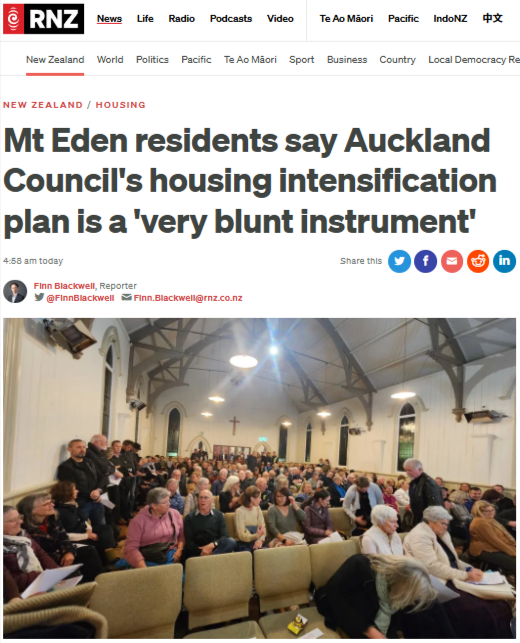
The facts are stark and shameful. About 200 people packed the Mt Eden Village Centre, furious over government plans for high density housing that would allow 15-storey apartment blocks next to heritage villas. Ward councillor Christine Fletcher warned of "financial repercussions" beyond anything she had "ever seen", with infrastructure costs of $20 billion or more for just one ward, requiring 56 new primary schools and 23 secondary schools.
But here's what the corporate media won't tell you: this is not about solving our housing crisis. This is about property industry profits. Since 2021, people connected to the property industry have donated more than $2.5 million to political parties, with 53 percent going to National, 32 percent to ACT, and 12 percent to New Zealand First. Labour received a pathetic 2 percent - not because they're morally superior, but because they're not the current vehicle for property developer interests.
The timeline exposes the manufactured urgency. Ministers Bishop and Brown issued their directive early this year, giving Auckland Council until late September to comply. This is not democratic consultation - this is corporate coercion dressed up in bureaucratic language.
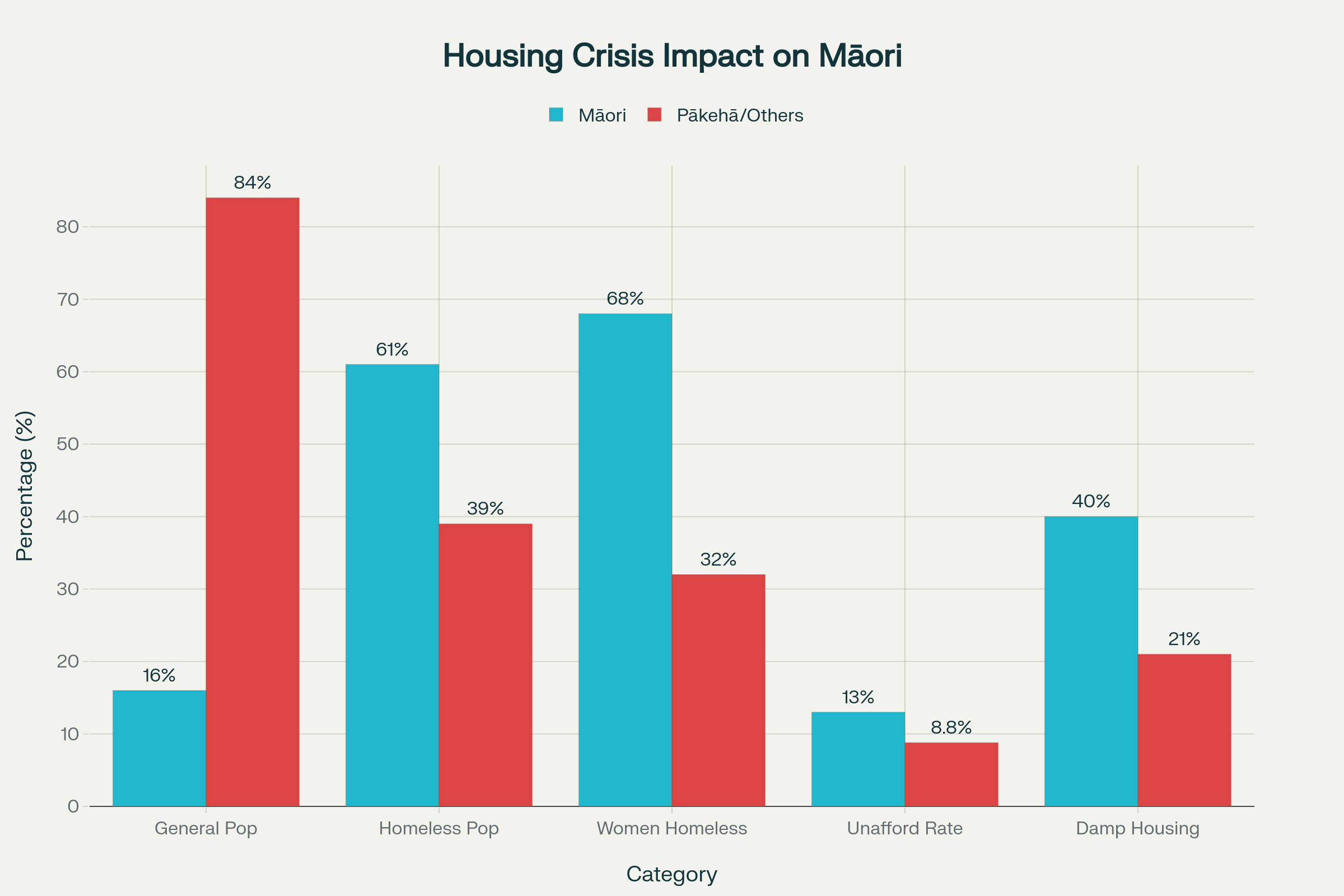
Māori Housing Crisis Statistics - Disproportionate Impact
The Māori Reality: Invisible in the Debate
While privileged Mt Eden residents debate the aesthetics of apartment blocks, Māori whānau face a housing crisis that would make international headlines if it happened to any other indigenous population. The data is damning: 61 percent of homeless people identify as Māori or part Māori, despite being only 16 percent of the population. For Māori women, the figure rises to 68 percent.
Auckland Council data shows rough sleeping increased 90 percent since the government tightened emergency housing rules in September 2024. Youth advocate Aaron Hendry monitors 140 young people without stable housing, some as young as 11 years old. Meanwhile, Mt Eden residents worry about their property values and character areas.
This is housing apartheid in action. Māori are four to six times more likely to experience severe housing deprivation than Pākehā. Forty percent of Māori live in damp housing compared to 21 percent of Pākehā. But when 200 mainly Pākehā residents gather in Mt Eden, suddenly housing becomes a crisis worthy of front-page coverage.
The Corporate-Political Pipeline Exposed
The connections between corporate money and political power are not hidden - they're celebrated. Property industry donations flow directly to the parties now dismantling housing protections. Companies associated with fast-track projects gave over $500,000 to National, ACT and New Zealand First. This is not corruption in the traditional sense - this is how neoliberal democracy is designed to function.
Bishop's background as a tobacco lobbyist is not an embarrassing footnote - it's his primary qualification. Philip Morris taught him how to manipulate public opinion, buy political influence, and present corporate interests as public good. The same techniques used to sell cancer sticks are now being used to sell housing policy that enriches developers while displacing communities.
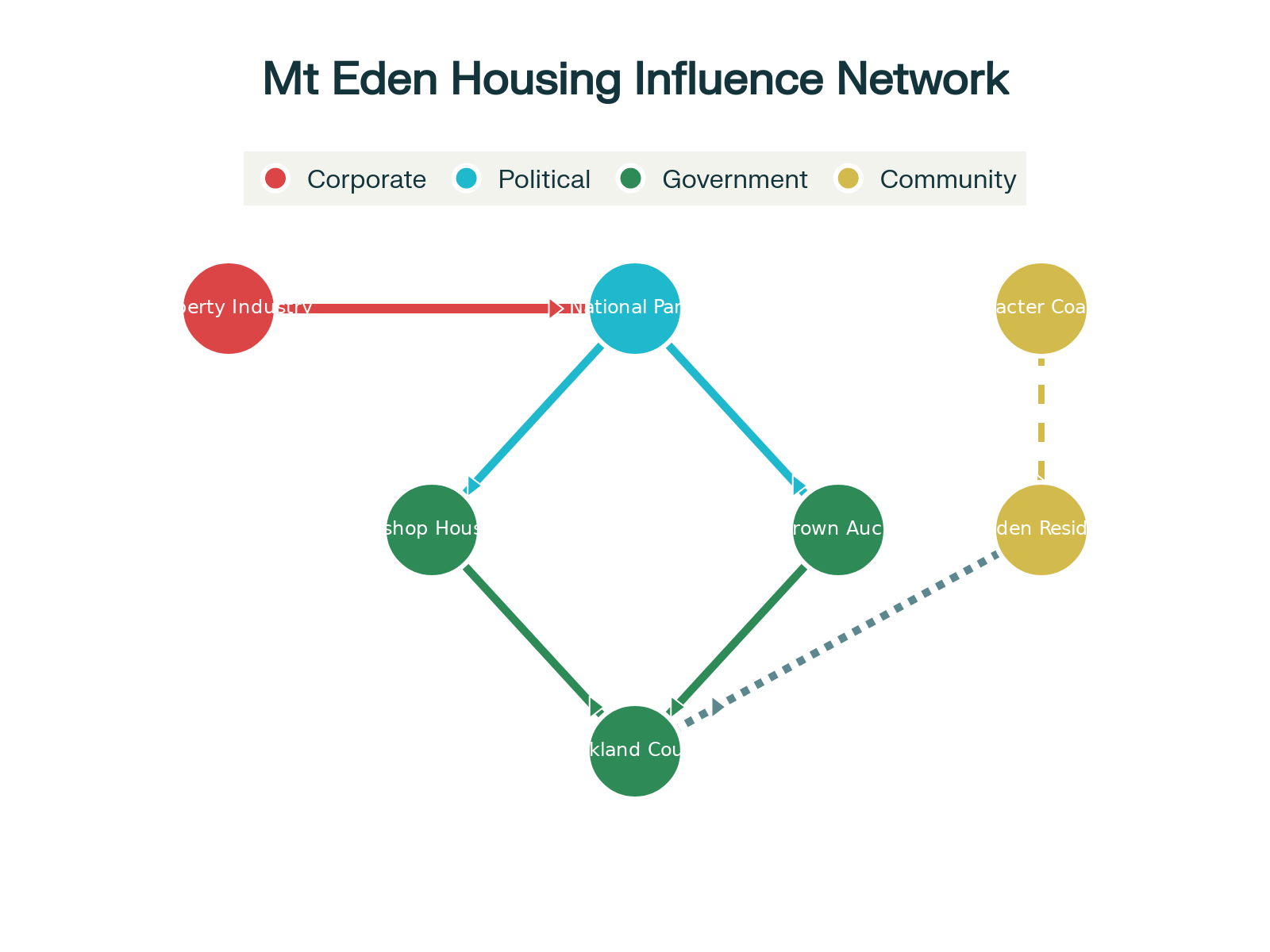
Power Networks in Mt Eden Housing Crisis - Follow the Money
The network of influence is crystal clear. Property developers fund political parties, political parties appoint ministers, ministers create policies that benefit property developers. The only variable in this equation is which communities get sacrificed on the altar of private profit.
Hidden Connections: The Auckland Supercity Scam
The timing of this housing directive is not coincidental. Auckland's supercity structure, imposed without genuine consultation, created the perfect conditions for corporate capture. Local democracy was deliberately weakened to make exactly this kind of top-down diktat possible.
Simeon Brown and Auckland Mayor Wayne Brown (no relation, but ideological twins) have been plotting to eliminate Auckland Transport's independence, making it "purely a delivery agency". This is the blueprint for all local government - strip away democratic input, eliminate community consultation, and create pure corporate delivery systems.
The Character Coalition's privileged panic reveals another layer of this scam. Their heritage protection concerns are legitimate, but they're being weaponised to disguise the real issue: this housing intensification will not create affordable homes for working families. Land values in areas like Mt Eden mean development will never result in affordable housing. This is gentrification by government decree.
The Glen Innes Pattern Repeats
We have seen this movie before. In Glen Innes, Māori and Pacific residents were systematically displaced through "community-led" redevelopment that appealed "to neo-liberal ideals of ethnic and class diversity". The process of gentrification was sold as revitalisation, but the result was the removal of low-income families to make way for profit.
Now the same pattern is being imposed on Mt Eden, but with a crucial difference: the residents have economic and political power to resist. Their resistance, however, is not based on solidarity with displaced communities but on protecting their own privilege. This creates a false choice between heritage preservation and housing justice, when the real choice is between corporate profit and community wellbeing.
Community Impact: Housing Apartheid in Action
The government's response to homelessness exposes the true priorities of this system. Housing Minister Bishop claims emergency housing numbers have decreased, from 885 households in November 2023 to 45 in January 2025. But outreach providers report rough sleeping increased 90 percent in the same period. The government solved emergency housing by making people ineligible for emergency housing.
Meanwhile, development contributions in Auckland are rising by up to $88,000 per dwelling. These costs will be passed on to buyers, ensuring only the wealthy can afford new housing. The Mt Eden intensification plan is not about housing affordability - it's about creating new investment opportunities for property speculators.
The broader implications extend beyond Auckland. This model of corporate-driven housing policy is being imposed across the country, stripping local communities of democratic input while enriching private developers. The Resource Management Act reforms, also shepherded by Bishop, eliminate environmental protections and community consultation in favour of fast-track development approvals.
Māori Values Under Attack
From a Māori worldview, this entire approach violates fundamental principles of manaakitanga, whakatōhea, and whakapapa. The government's housing policy treats land as a commodity to be traded rather than whenua with whakapapa connections. Communities are seen as obstacles to profit rather than whānau to be protected and nurtured.
The rushed consultation process shows contempt for proper tikanga, where decisions affecting communities require genuine engagement and consensus-building. The directive from Wellington to Auckland Council bypasses local democracy and ignores the principle that those affected by decisions should have real power to influence them.
Most fundamentally, this policy perpetuates the colonial practice of using state power to dispossess communities for private profit. The original colonial land grabs used legal mechanisms to steal Māori land for European settlers. Today's housing policy uses legal mechanisms to steal community control for corporate developers.
Breaking the Corporate Chains
The Mt Eden housing controversy strips away the polite fictions of democratic governance and exposes the brutal reality of corporate rule. Chris Bishop, the former tobacco pusher turned housing destroyer, represents everything toxic about neoliberal politics - the seamless transition from corporate lobbying to government ministry, the transformation of public policy into private profit, and the elimination of community voice in favour of market forces.
The Character Coalition's resistance, while limited by class privilege, demonstrates that communities can organise against corporate bulldozers. But their fight must be connected to the broader struggle for housing justice that includes Māori and Pacific families displaced by decades of gentrification.
The solution is not to preserve Mt Eden's character areas while ignoring homelessness in South Auckland. The solution is to break the corporate stranglehold on housing policy, restore genuine democratic control to communities, and treat housing as a human right rather than a commodity for speculation.
This housing directive exposes the fundamental contradiction of neoliberal capitalism: it cannot solve the problems it creates. The same system that generates homelessness and displacement offers more market mechanisms as solutions. The same politicians who take property developer donations claim to care about housing affordability.
Real housing justice requires dismantling this corporate-political pipeline and returning power to communities. It means treating land as whenua with whakapapa rather than real estate with profit potential. It means recognising that housing is about whānau and community, not investment returns and development margins.
Date - Event - Significance
- Early 2025,Ministers Bishop & Brown issue directive,Government forces intensification around City Rail Link
- August 2025,Mt Eden community meeting with 200 residents,Residents express opposition to rushed process
- Late September 2025,Auckland Council decision deadline,Council must decide on controversial plan
- "October 10, 2025",Final notification deadline for housing plan,Final deadline creates time pressure
Cost Category - Quantity/Amount - Impact - Description
- Albert-Eden-Puketāpapa Ward Infrastructure,$20+ billion,Total infrastructure cost for one ward alone
- Primary Schools Required,56 schools,New schools needed for population growth
- Secondary Schools Required,23 schools,Additional secondary education facilities
- Land Acquisition Sites,79 sites,Properties to be acquired for development
- Additional Dwellings Targeted,"73,650 homes",New housing units to be built in the ward

The Māori Green Lantern fighting misinformation and disinformation from the far right
The people of Mt Eden have shown that communities can resist corporate bulldozers. Now that resistance must expand to include all communities threatened by the housing apartheid system that enriches developers while displacing whānau. The fight for Mt Eden's character must become a fight for housing justice everywhere.
To readers who find value in this analysis, please consider a koha to support this mahi if you have capacity: HTDM: 03-1546-0415173-000. These are tough economic times for whānau, so please only contribute if you can.
Kia kaha, kia māia, kia manawanui.
Ivor Jones
The Māori Green Lantern