“The Corporate Coloniser's Latest Legal Charade” - 16 August 2025
When Supreme Court Rivers Meet Coalition Greed
Kia ora e hoa. Another day, another blatant attempt by this colonial government to steal what remains of our tāonga.
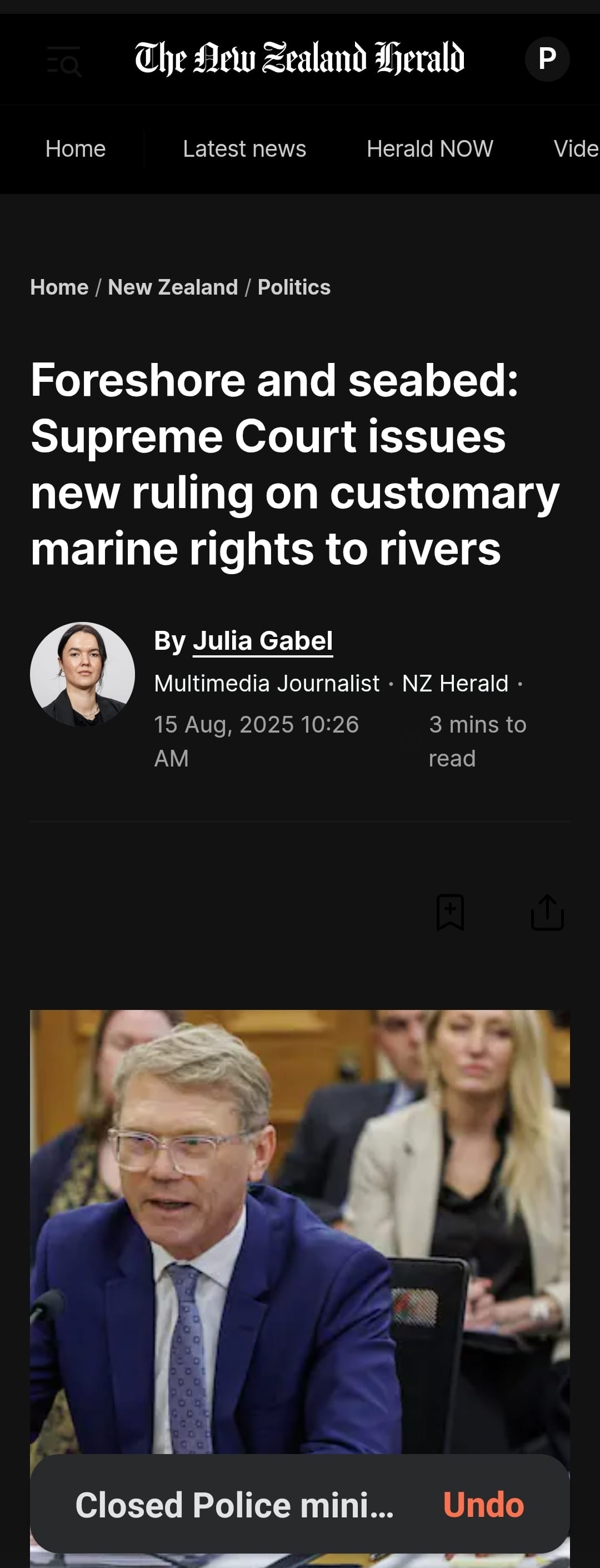
On August 15, 2025, the Supreme Court delivered its second judgment on customary marine title claims in the Eastern Bay of Plenty, ruling that navigable riverbeds can be included in Māori customary marine title orders. But even as our highest court recognises the obvious – that our tīpuna never ceded rights to these waterways – Justice Minister Paul Goldsmith and his coalition cronies push ahead with their legislative vandalism, determined to override judicial decisions that don't serve their corporate masters.rnz+1
This latest Supreme Court ruling specifically addressed the confluence of the Waiōweka and Ōtara rivers near Ōpōtiki, finding that the beds of navigable rivers form part of the common marine and coastal area and recognition orders may extend to them. Yet Goldsmith, like the arrogant colonial administrator he is, dismisses this judicial wisdom and forges ahead with legislation designed to strip away Māori customary rights.courtsofnz+1
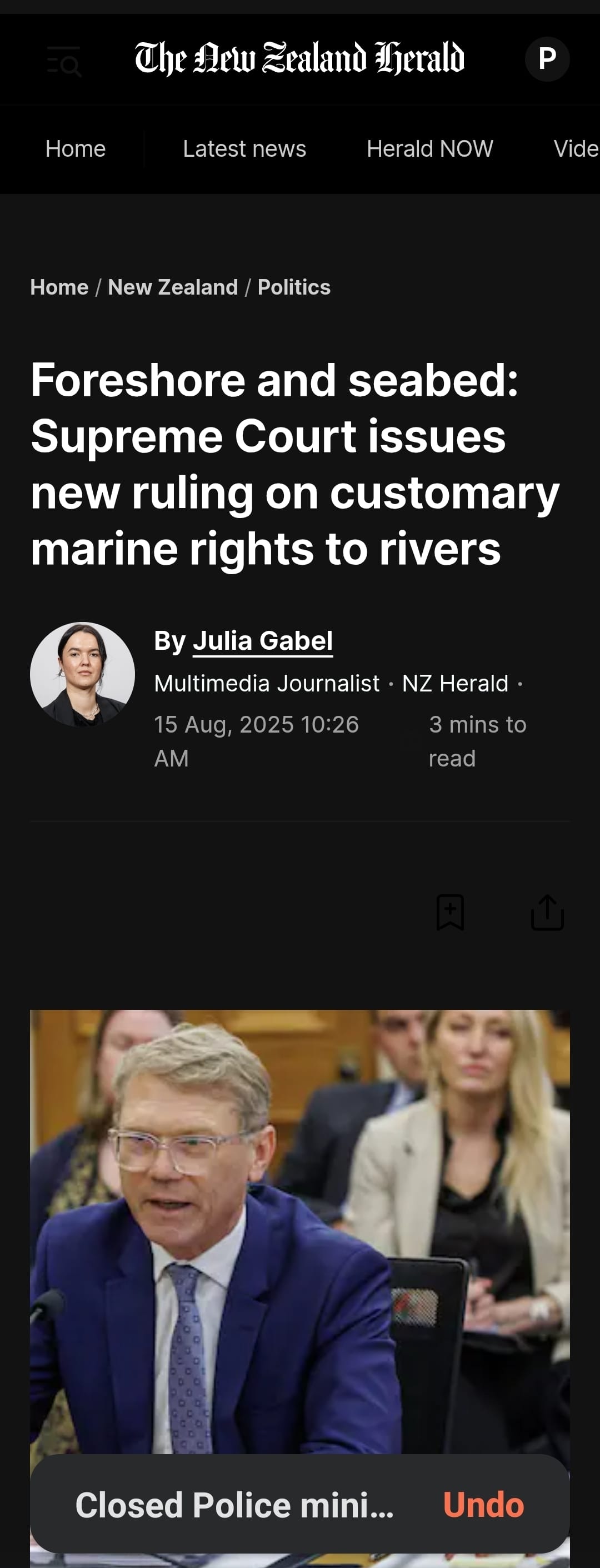
https://www.nzherald.co.nz/nz/politics/foreshore-and-seabed-supreme-court-issues-new-ruling-on-customary-rights/26V2BQMXINCLJG5UP3HRW4MWJY/
Historical Context: The Endless Cycle of Legal Theft
To understand the current shameless power grab, we must revisit the toxic origins of this controversy. In 2003, the Court of Appeal in Ngati Apa v Attorney-General unanimously decided that the Māori Land Court had jurisdiction to determine whether foreshore and seabed had customary land status. This decision was hardly radical – it simply acknowledged what had always been true: that customary property rights continued after 1840 until lawfully extinguished.teara+1
The corporate and political panic that followed was immediate and vicious. Helen Clark's Labour government responded with scaremongering about Māori "taking over" beaches, despite expert assurances that customary title was unlikely to result in exclusive ownership. The real fear, as always, was that Māori control might interfere with resource extraction and commercial exploitation.rnz
The result was the draconian Foreshore and Seabed Act 2004, which vested ownership in the Crown and extinguished Māori customary rights. This naked land grab sparked the largest hīkoi in a generation, with at least 15,000 people marching on Parliament. The political fallout led to Tariana Turia leaving Labour to co-found Te Pāti Māori, transforming New Zealand's political landscape forever.wikipedia+2
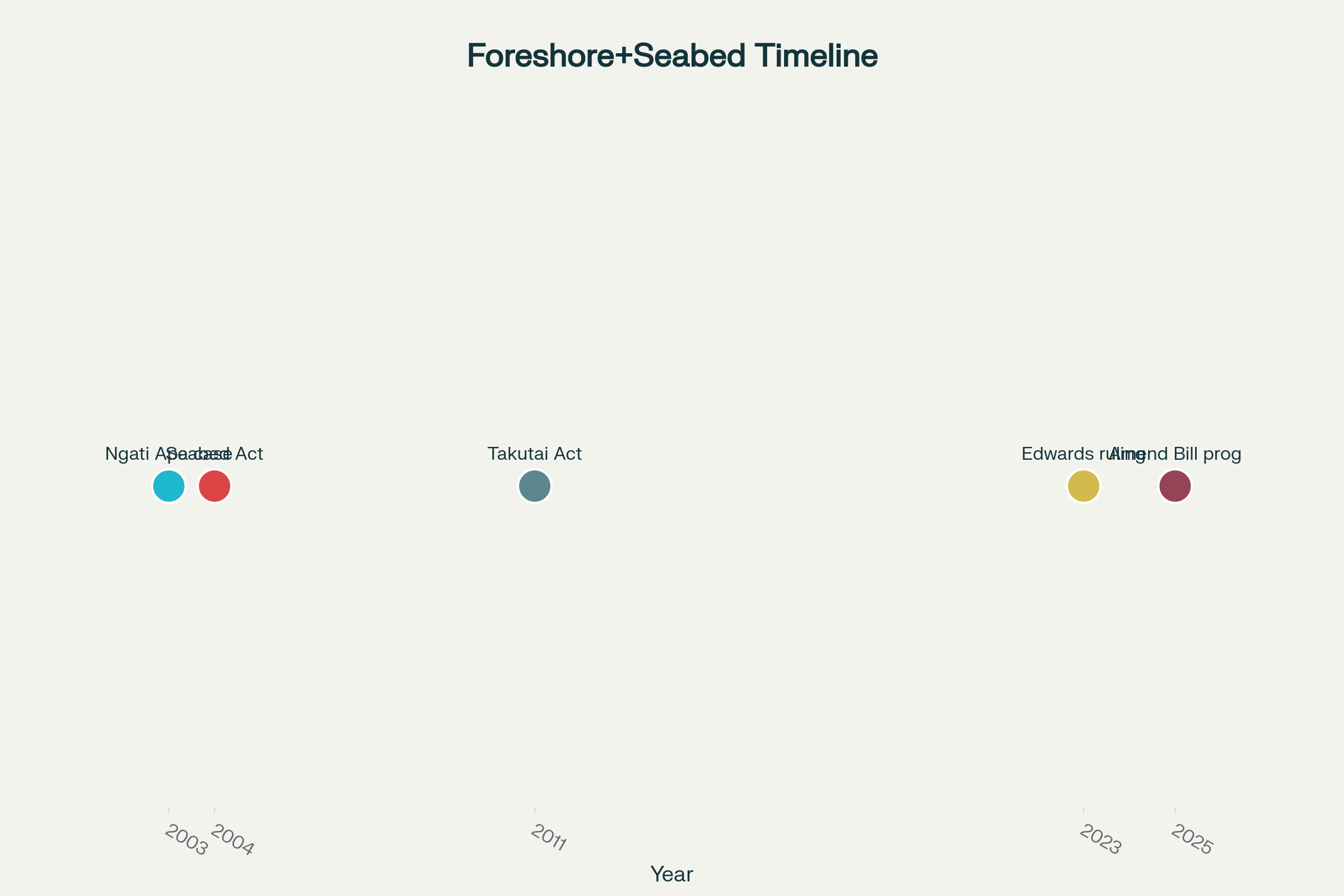
Timeline of New Zealand Foreshore and Seabed Legal Battles (2003-2025)
The False Promise of 2011
The election of John Key's National government brought the Marine and Coastal Area (Takutai Moana) Act 2011, which replaced Crown ownership with a 'no ownership' regime and restored the right of iwi to seek customary rights in court. This was trumpeted as progress, but the reality was a carefully constructed maze of legal hurdles designed to make customary title virtually impossible to achieve.teara
The Act required applicants to prove they had exclusively used and occupied areas from 1840 to the present day without substantial interruption – a test so stringent it effectively barred most legitimate claims. This wasn't an accident; it was deliberate policy to maintain the colonial fiction of terra nullius while appearing to offer justice.wikipedia
Even this grudging concession was too much for the hard right. When the Court of Appeal in 2023 interpreted the test in a way that actually allowed some Māori groups to succeed, the coalition agreement between National and New Zealand First immediately promised to "amend section 58 of the Marine and Coastal Area Act to make clear Parliament's original intent".whakatau
Goldsmith's Colonial Arrogance
Paul Goldsmith epitomises the entitled arrogance of New Zealand's political establishment. This is the same minister who declared in 2021 that colonisation had "on balance" been good for Māori – a breathtaking display of historical ignorance and racist presumption. Now, as Justice Minister and Treaty Negotiations Minister, he wields his dual portfolios like weapons against tino rangatiratanga.rnz
Goldsmith's response to the Supreme Court's December 2024 decision overturning the Court of Appeal was telling. Despite the Court effectively raising the threshold for customary title claims – exactly what his coalition wanted – he confirmed Cabinet had agreed to press ahead with legislative changes regardless. His justification? That "almost 100 percent of the coastline" was being granted customary marine title under the current test – a claim that reeks of manufactured crisis and statistical manipulation.rnz
Even more revealing is Goldsmith's stance on Treaty settlements. He refuses to agree to settlements that include "agree-to-disagree" clauses about sovereignty, calling such provisions "constitutional adventurism." This from a man whose government is engaged in the most radical constitutional adventurism since the 2004 Foreshore and Seabed Act – legislatively overturning judicial decisions whenever they don't serve colonial interests.1news
The Corporate Connection
Behind the political theatre lies the same old story: corporate greed. The marine and coastal area represents enormous economic value – from fishing and aquaculture to seabed mining and renewable energy infrastructure. The 2023 Court of Appeal decision that sparked this latest legislative assault was specifically Edwards v Te Kāhui, dealing with claims in the commercially valuable Eastern Bay of Plenty.richmondchambers
The coalition's determination to override judicial decisions reveals their true priorities. Prime Minister Christopher Luxon, himself a former corporate executive, admits that Crown-Māori relations are "probably worse" under his government, yet continues policies guaranteed to inflame tensions. This isn't incompetence – it's calculated strategy.rnz
The coalition agreement commitment to amend the Marine and Coastal Area Act wasn't about legal clarity or fairness. It was about ensuring that corporate interests face minimal interference from indigenous rights. Every delay in customary title recognition means more time for resource extraction, more consents issued without proper consultation, more wealth extracted from our ancestral waters.nzfirst
The Supreme Court's Limited Resistance
The Supreme Court's August 2025 ruling on navigable rivers offers a rare moment of judicial backbone in an otherwise depressing legal landscape. By finding that navigable riverbeds were not extinguished by previous legislation and can be included in customary marine title orders, the Court acknowledged what should be obvious: that our tīpuna's relationships with waterways didn't magically disappear because colonial legislators wrote words on paper.courtsofnz
The decision specifically addressed the Waiōweka and Ōtara rivers near Ōpōtiki, finding that previous Acts were not sufficiently clear to extinguish customary rights or title to navigable riverbeds. This represents a small but significant pushback against the legal fiction that indigenous rights can be erased through legislative sleight of hand.courtsofnz
However, this judicial resistance remains constrained by colonial legal frameworks. The Court still operates within the assumption that Crown sovereignty is legitimate and that Māori rights exist only to the extent colonial law permits. It's progress within a fundamentally unjust system, but it's not the revolutionary change our people need.
Mana Motuhake and Environmental Kaitiakitanga
The foreshore and seabed controversy isn't just about legal technicalities or property rights – it's about mana motuhake and our responsibilities as kaitiaki. Our coastal and marine areas are taonga that connect us to our whakapapa and impose obligations that stretch across generations. The Waitangi Tribunal has consistently found that the Marine and Coastal Area Act breaches Treaty principles, yet successive governments ignore these findings whenever they conflict with corporate interests.rnz
The environmental stakes could not be higher. Climate change is altering our coastlines, while intensive agriculture, urban development, and industrial activities degrade our marine ecosystems. Māori communities, guided by tikanga and mātauranga, offer sustainable management approaches that prioritise long-term ecosystem health over short-term profit. Yet the colonial legal system consistently prioritises property rights and economic exploitation over environmental protection and indigenous knowledge.
This government's approach to environmental protection perfectly illustrates its priorities. While claiming to support conservation, it systematically undermines Māori environmental management through its attacks on co-governance arrangements and customary rights. The message is clear: environmental protection is acceptable only when it doesn't challenge colonial power structures or corporate interests.
Coalition Politics and Institutional Racism
The current assault on customary marine title emerged directly from coalition politics, specifically National's agreement with New Zealand First to amend the Marine and Coastal Area Act. This wasn't policy driven by evidence or legal principle – it was political horse-trading that treated Māori rights as negotiable commodities.whakatau
Winston Peters and New Zealand First have built their political brand on appealing to anti-Māori sentiment, consistently opposing any recognition of tino rangatiratanga. Their coalition agreement with National ensured that attacks on Māori rights would be a priority from day one. David Seymour's ACT Party adds libertarian ideology to this toxic mix, framing indigenous rights as "racial privilege" that conflicts with their vision of market-driven individualism.aljazeera
The result is a government whose anti-Māori policies aren't incidental to their political project – they're central to it. From scrapping the Māori Health Authority to limiting te reo Māori in government agencies, this coalition systematically dismantles decades of incremental progress toward indigenous rights recognition.lsj
International Context and Indigenous Rights
New Zealand's foreshore and seabed controversy occurs within a global context of indigenous peoples fighting for recognition of their customary rights to traditional territories. From Canada's recognition of Indigenous title in the Tsilhqot'in decision to Colombia's legal recognition of rivers as persons with rights, the international trend is toward greater recognition of indigenous environmental rights.cambridge+1
Yet New Zealand, despite its carefully cultivated international reputation for progressive indigenous rights, moves in the opposite direction. While other nations grapple seriously with decolonisation, this government doubles down on colonial legal structures and actively undermines indigenous rights recognition. The international community should take note: New Zealand's progressive reputation is increasingly at odds with its domestic reality.
The United Nations Declaration on the Rights of Indigenous Peoples recognises indigenous peoples' rights to their traditional territories and resources, including the right to free, prior and informed consent regarding development projects. New Zealand's approach to customary marine title systematically violates these principles, creating legal barriers that make genuine consent impossible while maintaining the fiction of consultation.mdpi
Implications and Resistance
The Supreme Court's August 2025 ruling on navigable rivers, while limited in scope, creates important precedents for future customary title claims. Legal experts suggest the decision could strengthen Māori claims to water above riverbeds as well as management and allocation rights. This has obvious implications for water rights, resource management, and infrastructure development across Aotearoa.nzherald
However, the coalition government's determination to legislatively override inconvenient judicial decisions represents a fundamental threat to the rule of law and constitutional governance. When governments routinely overturn court decisions that recognise indigenous rights, they effectively declare that those rights exist only at the pleasure of colonial majorities. This sets dangerous precedents that extend far beyond foreshore and seabed issues.
The political response to this legislative assault must be uncompromising. The massive hīkoi of 2004 showed that our people will not quietly accept the theft of their birthright. Recent protests against the Treaty Principles Bill demonstrate that resistance remains strong, with tens of thousands willing to take to the streets to defend Te Tiriti o Waitangi.1news
The challenge is connecting this resistance to broader struggles for indigenous self-determination, environmental protection, and economic justice. Customary marine title isn't just about legal technicalities – it's about who controls the resources that sustain life and who has the authority to make decisions about our collective future.
Constitutional Crisis and Democratic Legitimacy
Goldsmith's legislative crusade represents more than policy disagreement – it constitutes a constitutional crisis that strikes at the heart of New Zealand's democratic legitimacy. When a government systematically overrides judicial decisions, ignores Waitangi Tribunal findings, and legislatively extinguishes indigenous rights, it reveals the colonial foundations that underpin the entire political system.
The fiction that New Zealand is a liberal democracy based on the rule of law becomes impossible to maintain when inconvenient court decisions are routinely overturned by parliamentary majorities. This isn't democracy – it's majoritarianism that uses democratic procedures to legitimise colonial domination. As the Waitangi Tribunal has found, the Treaty Principles Bill and related legislation represent "little more than a politically motivated attack on perceived 'Māori privilege'".1news
The government's approach to Treaty settlements provides another example of this constitutional vandalism. Goldsmith's refusal to acknowledge iwi positions on sovereignty effectively makes Treaty settlements impossible for groups that maintain their tino rangatiratanga. This represents a fundamental departure from previous settlement processes and threatens to unravel decades of painstaking negotiation and relationship-building.1news
Economic Justice and Resource Control
Behind every legal and constitutional issue lies the fundamental question of economic control. The marine and coastal area represents billions of dollars in economic value – from fishing quotas and aquaculture licenses to seabed mining rights and coastal development opportunities. Customary marine title threatens this colonial economic model by giving Māori communities some say in how these resources are used.
The corporate interests that benefit from the current system understand exactly what's at stake. Every delay in customary title recognition means more time for resource extraction without proper consultation. Every legislative barrier erected against Māori rights claims protects existing commercial arrangements and ensures that wealth continues flowing to predominantly Pākehā shareholders and overseas investors.rnz
This economic dimension explains why the coalition government remains determined to override even conservative judicial decisions. It's not really about legal interpretation or constitutional principle – it's about maintaining economic arrangements that concentrate wealth and power in colonial hands while keeping indigenous peoples marginalised and dependent.
The Supreme Court's August 2025 ruling on navigable rivers poses a particular threat to these arrangements because rivers are crucial infrastructure for many industries. Recognition of customary title to riverbeds could complicate resource consents, mining operations, hydroelectric development, and agricultural irrigation – exactly the kinds of economic activities that form the backbone of colonial capitalism in Aotearoa.

The Māori Green Lantern fighting misinformation and disinformation from the far right
The Continuing Struggle
Paul Goldsmith and his coalition cronies represent the latest iteration of a colonial project that began in 1840 and continues today. Their legislative assault on customary marine title follows the same pattern as every previous attack on Māori rights: manufacture a crisis, stoke public fear, then use parliamentary majorities to override indigenous rights in the name of protecting "ordinary New Zealanders."
The Supreme Court's recognition that navigable riverbeds can be included in customary marine title orders offers hope that not all colonial institutions have completely abandoned justice. But legal victories within colonial frameworks can only take us so far. Real change requires challenging the fundamental assumptions of colonial power and asserting our tino rangatiratanga across all our traditional territories.
The struggle over customary marine title is ultimately a struggle over who controls Aotearoa's future. Will our coastal and marine areas be managed according to tikanga Māori and mātauranga-based sustainability principles? Or will they continue to be exploited by corporations seeking maximum short-term profit with minimal regard for environmental or cultural impacts?
This government has chosen sides in that struggle, consistently prioritising corporate interests over indigenous rights and environmental protection. Our response must be equally clear: we will not accept the continued theft of our birthright, and we will not be silenced by legal technicalities or parliamentary procedures designed to legitimise colonial domination.
The fight continues, from the courtrooms to the streets to the marae. Our tīpuna never ceded sovereignty over these waters, and neither will we.
Kia kaha, kia māia, kia manawanui.
Ivor Jones (MGL)
Readers who find value in my analysis of these colonial power structures are welcome to consider a koha to support this work: HTDM: 03-1546-0415173-000. The MGL understands these tough economic times for whānau so please only contribute a koha if you have capacity
- https://www.rnz.co.nz/news/te-manu-korihi/570060/supreme-court-gives-green-light-to-riverbeds-inclusion-in-maori-customary-marine-title-orders
- https://www.rnz.co.nz/news/political/569058/government-forges-ahead-with-foreshore-and-seabed-law
- /content/files/assets/cases/2025/mr-2025-nzsc-104.pdf
- https://www.nzherald.co.nz/nz/politics/foreshore-and-seabed-govt-to-pass-marine-and-coastal-areas-legislation-despite-court-ruling/A4UHJTIMORGQNGEMOE5CN3XJRM/
- https://teara.govt.nz/en/law-of-the-foreshore-and-seabed/page-4
- /content/files/law/research/publications/about-nzacl/publications/special-issues/hors-serie-volume-v--2005/erueti.pdf
- https://www.rnz.co.nz/news/political/330148/helen-clark-no-regrets-over-foreshore-and-seabed
- https://en.wikipedia.org/wiki/New_Zealand_foreshore_and_seabed_controversy
- https://www.rnz.co.nz/news/political/515999/maori-seabed-for-shore-two-decades-on-from-the-largest-hikoi-in-a-generation
- https://www.1news.co.nz/2025/01/03/dame-tariana-turia-dies-at-the-age-of-80/
- https://teara.govt.nz/en/law-of-the-foreshore-and-seabed/print
- https://en.wikipedia.org/wiki/Marine_and_Coastal_Area_(Takutai_Moana)_Act_2011
- /content/files/assets/Publications/redacted-macaa-bill-supplementary-analysis-report.pdf
- https://www.rnz.co.nz/news/political/504674/treaty-negotiations-minister-paul-goldsmith-says-govt-focused-on-progressing-settlements
- https://www.1news.co.nz/2025/08/12/we-are-patient-te-whanau-a-apanui-commit-to-wait-after-govt-u-turn/
- https://richmondchambers.co.nz/supreme-court-reshapes-maori-marine-rights-framework/
- https://www.rnz.co.nz/news/political/535365/crown-maori-relations-probably-worse-than-a-year-ago-christopher-luxon-says
- https://www.nzfirst.nz/coalition-agreement
- /content/files/assets/cases/2025/2025-nzsc-104.pdf
- https://www.rnz.co.nz/news/national/499580/takutai-moana-act-breaches-treaty-principles-waitangi-tribunal
- https://www.aljazeera.com/news/2024/11/19/why-are-new-zealands-maori-protesting-over-colonial-era-treaty-bill
- https://lsj.com.au/articles/maori-face-a-reversal-of-rights-under-coalition-government/
- /content/files/core/services/aop-cambridge-core/content/view/8D726FF1F3742082647D2719309530E7/S2398772300001471a/div-class-title-indigenous-title-and-its-contextual-economic-implications-lessons-for-international-law-from-canada-s-span-class-italic-tsilhqot-in-span-decision-div.pdf
- /content/files/core/services/aop-cambridge-core/content/view/43A29974BD5A3E948AB0461003627951/S204710252000014Xa/div-class-title-constitutional-law-ecosystems-and-indigenous-peoples-in-colombia-biocultural-rights-and-legal-subjects-div.pdf
- https://www.mdpi.com/2073-4441/11/3/571/pdf?version=1552993872
- https://www.nzherald.co.nz/kahu/mai-chen-ruling-boost-to-maori-river-claims/ERFX3GSTUWMUSAWCCYB245HMAE/
- https://www.1news.co.nz/2024/08/16/take-a-stand-christopher-calls-for-pm-to-kill-treaty-principles-bill/
- https://www.rnz.co.nz/news/political/523222/overruling-court-on-coastal-rights-risks-new-protests-te-pati-maori-warns
- https://ppl-ai-file-upload.s3.amazonaws.com/web/direct-files/attachments/2123776/3041cef8-6687-4767-8b71-f0200c04a481/Foreshore-and-seabed_-Supreme-Court-issues-new-ruling-on-customary-marine-rights-to-rivers-NZ-Herald.PDF
- https://ppl-ai-file-upload.s3.amazonaws.com/web/direct-files/attachments/images/2123776/2a4c8792-91e0-4d64-bb3f-506bf11fed54/Screenshot_20250816_061917_Brave.jpg
- https://www.nzherald.co.nz/nz/politics/foreshore-and-seabed-supreme-court-issues-new-ruling-on-customary-rights/26V2BQMXINCLJG5UP3HRW4MWJY/
- https://www.nzherald.co.nz/nz/politics/foreshore-and-seabed-supreme-court-issues-new-ruling-on-customary-rights/26
- https://www.semanticscholar.org/paper/903257cc42455a2f1bf9a526a1c50c7d7cd880f5
- https://www.semanticscholar.org/paper/7fe4236f07674865ac5cf40597fb0ae0f6413d12
- https://www.semanticscholar.org/paper/feda36b547d6089803f50f122311e91ea0904c6d
- https://journals.sas.ac.uk/amicus/article/view/5621
- https://www.semanticscholar.org/paper/f27e69c99e24b05825d2f86c0158ba35014093b6
- https://openaccess.wgtn.ac.nz/articles/thesis/New_Zealand_s_Public_Trust_Doctrine/17135234
- https://www.semanticscholar.org/paper/30bd97d9b40bdbf1cb54e14baa9cec7bd7573b0c
- https://downloads.hindawi.com/journals/jmb/2011/241374.pdf
- https://downloads.hindawi.com/journals/jmb/2011/940765.pdf
- /content/files/index-php/sriwijayalawreview/article/download/851/pdf.pdf
- /content/files/articles/shsconf/2018/15/shsconf_icolgas2018_04003.pdf
- http://downloads.hindawi.com/journals/jmb/2011/749131.pdf
- https://downloads.hindawi.com/journals/jmb/2011/273034.pdf
- https://www.nzherald.co.nz/nz/foreshore-and-seabed-supreme-court-finds-court-of-appeal-erred-in-decision-over-customary-rights/5FDCR2DRT5C67ACUBBHJOLACN4/
- https://www.1news.co.nz/2025/07/06/constitutional-adventurism-in-treaty-settlement-sovereignty-clause-minister/
- https://www.1news.co.nz/2024/12/02/customary-marine-title-supreme-court-allows-crown-appeal/
- https://teara.govt.nz/en/law-of-the-foreshore-and-seabed/page-5
- https://www.rnz.co.nz/news/top/526281/treaty-negotiations-minister-defends-5-percent-of-coastline-comment
- https://www.1news.co.nz/2024/08/25/exclusive-meeting-notes-suggest-major-shake-up-for-foreshore-and-seabed-law/
- https://www.rnz.co.nz/news/political/527892/waitangi-tribunal-finds-failings-in-government-s-handling-of-marine-and-coastal-area-act-changes
- https://www.rnz.co.nz/news/political/570060/supreme-court-gives-green-light-to-riverbeds-inclusion-in-maori-customary-marine-title-orders
- https://lawnews.nz/treaty-maori/justice-minister-cautious-about-tikanga-and-the-law/
- https://waitangitribunal.govt.nz/en/news/tribunal-releases-report-on-the-takutai-moana-act-2011
- https://communitylaw.org.nz/community-law-manual/chapter-2-maori-land/takutai-moana-customary-rights-in-the-marine-and-coastal-area-foreshore-and-seabed/
- https://gifforddevine.co.nz/overturning-the-foreshore-and-seabed-decision/
- https://ngaitahu.iwi.nz/opportunities-and-resources/publications/te-karaka/takutai-moana-tk74/
- https://www.semanticscholar.org/paper/54dc0501fcca9df761f9fe9d6be79109ca6d59b5
- https://www.semanticscholar.org/paper/5ecda6369a6ed4cb95c8df86c7dfb03bf83c21ac
- /content/files/index-php/DLJ/article/download/1247/942.pdf
- /content/files/sil/article/download/9223/pdf.pdf
- https://journals.sagepub.com/doi/pdf/10.1177/14614529231187745
- /content/files/core/services/aop-cambridge-core/content/view/43471A21DD0BF3614E8CDDD811A1DF19/S2398772324000096a/div-class-title-on-the-cultural-stakes-of-deep-seabed-mining-div.pdf
- /content/files/data/clanek/12411/iurid_70_1_0159.pdf
- /content/files/journal/index-php/ilr/article/download/71509/39083.pdf
- https://www.tandfonline.com/doi/pdf/10.1080/23311886.2024.2329795?needAccess=true
- https://conbio.onlinelibrary.wiley.com/doi/10.1111/conl.13054
- https://www.mdpi.com/2075-471X/11/2/34/pdf
- /content/files/core/services/aop-cambridge-core/content/view/79CBF3834BD2D5B407B9A60A365746CF/S0021855322000146a/div-class-title-right-to-restitution-under-illegal-contracts-seeking-clarity-in-ghana-div.pdf
- https://www.nzherald.co.nz/nz/hikoi-marchers-buoyed-by-tariana-turias-decision/VGWTXM3WOY7C2NRG6GJFTA6L6M/
- https://www.nzherald.co.nz/kahu/looking-back-the-day-maoridom-descended-on-parliament-in-protest-at-the-foreshore-and-seabed-legislation/UXRLVK6DUBFN7OTMNCZ42RRBSY/
- https://www.nzherald.co.nz/nz/foreshore-acts-future-to-be-known-this-year/6BYJKD3R6LWOOPOTH6YNT3TGZY/
- https://www.1news.co.nz/2023/12/08/how-the-2004-foreshore-and-seabed-hikoi-echoed-in-protests-this-week/
- https://www.1news.co.nz/2024/05/05/new-documentary-dives-into-controversial-2004-foreshore-and-seabed-act/
- https://www.nzherald.co.nz/nz/tariana-turia-to-resign-and-force-byelection/OHPO4B6IDPURNFHUN62F7474RU/
- https://www.nzherald.co.nz/kahu/maori-seabed-for-shore-two-decades-on-from-the-largest-hikoi-in-a-generation/MI7WDK7IMNBN5PKGVWRDZLBXVQ/
- /content/files/public-law/publications/nz-journal-of-public-and-international-law/previous-issues/volume-9-issue-2-december-2012/06-boast.pdf
- https://en.wikipedia.org/wiki/Ngati_Apa_v_Attorney-General
- https://www.culturalsurvival.org/publications/cultural-survival-quarterly/speaking-out
- https://www.semanticscholar.org/paper/58c3468c7d4a968d3eff10c43c521acf460a375c
- https://www.tandfonline.com/doi/pdf/10.1080/13621025.2021.2011142?needAccess=true
- https://onlinelibrary.wiley.com/doi/pdfdirect/10.1111/1475-6765.12043
- /content/files/journals/index-php/mcs/article/download/1141/1369.pdf
- /content/files/student-journals/index-php/NESAIS/article/download/1554/1729.pdf
- https://brill.com/downloadpdf/journals/jhil/23/1/article-p52_4.pdf
- /content/files/10-5771/0506-7286-1995-2-256.pdf
- /content/files/core/services/aop-cambridge-core/content/view/BA4FD6439629F2E9E8EFD659E7479DEA/S0261387522000228a/div-class-title-parliamentary-sovereignty-and-the-protocol-pincer-div.pdf
- /content/files/core/services/aop-cambridge-core/content/view/92B0B97E90E3775C0CEF8AE23EEEEB45/S0021937124001175a/div-class-title-an-exact-union-of-system-bute-s-cabinet-revolution-and-imperial-reform-1762-63-div.pdf
- /content/files/core/services/aop-cambridge-core/content/view/52DCE3F2DFA294E8C9F8FCA40F65ABF5/S0165115322000201a/div-class-title-settler-worldmaking-reconfiguring-the-federation-of-rhodesia-and-nyasaland-1953-62-div.pdf
- https://journals.sagepub.com/doi/pdf/10.1177/14407833231216176
- https://www.tandfonline.com/doi/pdf/10.1080/17449057.2022.2096767?needAccess=true
- https://onlinelibrary.wiley.com/doi/pdfdirect/10.1111/1467-923X.12958
- /content/files/core/services/aop-cambridge-core/content/view/784B3EC65FF4C32314E36D2A92481992/S2045381722000193a/div-class-title-relational-legal-pluralism-and-indigenous-legal-orders-in-canada-div.pdf
- /content/files/student-journals/index-php/NESAIS/article/download/1505/1638.pdf
- https://www.tandfonline.com/doi/full/10.1080/07075332.2021.2024588
- https://onlinelibrary.wiley.com/doi/pdfdirect/10.1111/1467-923X.12985
- https://brill.com/downloadpdf/journals/jhil/24/1/article-p62_3.pdf
- https://www.nzherald.co.nz/nz/politics/foreshore-and-seabed-govt-set-to-overturn-court-of-appeal-judgment/QKETPKTF3NGOBEBT4QTPXXI27E/
- https://www.rnz.co.nz/news/political/529595/minister-meeting-with-ngapuhi-hapu-as-sovereignty-question-lingers
- https://www.1news.co.nz/2025/01/24/pm-told-state-of-the-maori-nation-at-highest-level-of-concern/
- https://www.1news.co.nz/2024/11/14/treaty-principles-bill-passes-first-reading-amid-haka-interruption/
- https://www.rnz.co.nz/news/political/533691/d-day-for-government-s-treaty-principles-bill
- https://www.rnz.co.nz/news/te-manu-korihi/539833/watch-luxon-peters-dismiss-treaty-principles-debate-at-ratana
- https://www.nzherald.co.nz/nz/politics/government-will-not-agree-to-treaty-settlements-that-dispute-crowns-sovereignty-today/IS7IOVPLDVH3PEUTBR46UDZX2U/
- https://www.rnz.co.nz/news/te-manu-korihi/564394/goldsmith-answers-questions-on-progress-of-ngapuhi-and-other-settlements
- https://www.parliament.nz/en/pb/hansard-debates/rhr/document/HansS_20241114_051780000/goldsmith-paul
- /content/files/2407-14623.pdf
- /content/files/sil/article/download/10517/pdf.pdf
- /content/files/ojs/index-php/jurnalIUS/article/download/810/pdf_180.pdf
- https://www.nzherald.co.nz/nz/politics/audrey-young-supreme-court-forces-rethink-on-govt-approach-to-foreshore-and-seabed/TICTH6PRXRGSXFOKRSIPYUHT5M/
- https://www.rnz.co.nz/authors/pokere-paewai
- https://teara.govt.nz/en/1966/maori-wars/page-3
- https://www.rnz.co.nz/news/te-manu-korihi/570132/maori-coastal-rights-supreme-court-decision-could-set-precedent-lawyer
- https://www.simpsongrierson.com/insights-news/legal-updates/supreme-court-resolves-the-test-for-customary-marine-title-under-foreshore-and-seabed-legislation-but-further-changes-in-the-law-are-pending
- /content/files/wp-content/uploads/2023/07/mercury-v-maori-land-court-2023-nzhc-1644.pdf
- /content/files/__data/assets_file/0024/43638/appendix-t-customary-marine-title-applications.pdf
- https://en.wikipedia.org/wiki/Paki_v_Attorney-General_(No_2)
- /content/files/assets/5-The-Courts/high-court/high-court-lists/marine-and-coastal-area-takutai-moana-act-2011-applications-for-recognition-orders/judgment-29-may-2024-2024-nzhc-1373.pdf
- https://www.raineycollins.co.nz/your-resources/articles/article-21-7-22
- https://www.scoop.co.nz/stories/AK2508/S00457/ngati-ira-welcomes-supreme-court-victory-in-customary-marine-title-case.htm