"The Corporate Colonisers Strike Again - Triple-merger of Ministry for the Environment, Transport and Housing and Urban Development" - 3 September 2025
How Luxon and His Cronies Are Weaponising "Efficiency" to Destroy Māori Progress

Kia ora, e hoa mā. Ko Ivor Jones ahau, ko Te Māori Green Lantern.
Today we expose another sickening display of corporate colonisation masquerading as "government efficiency." The proposed triple-merger of the Ministry for the Environment, Transport, and Housing and Urban Development isn't about saving taxpayer money - it's about centralising power in the hands of corporate puppets while systematically dismantling every government service that supports Māori whānau.

Powerful corporate figures conspiring to dismantle public services that support Māori communities
Background: The Neoliberal Playbook Strikes Again
For decades, we've witnessed the same tired playbook: create a crisis, claim the solution is "efficiency," then hand public assets to private interests. The Luxon government's ministry merger represents the latest phase of neoliberal assault on New Zealand's public sector, following the devastating cuts that have already eliminated over 9,500 public service jobs.
The historical context cannot be ignored. Since the 1980s, neoliberal reforms in New Zealand have systematically targeted Māori communities, using economic rationalism to justify the dismantling of social supports. The same colonial mindset that drove land confiscation now drives "efficiency savings" that disproportionately harm tangata whenua.
This merger proposal fits perfectly within Luxon's broader economic agenda, which prioritises corporate tax cuts over public services. The Prime Minister, a former Air New Zealand CEO, brings the same corporate restructuring mentality that devastated workers in the private sector to bear on our public institutions.
The Ministry Merger Conspiracy Exposed
The Herald's revelation of Official Information Act documents exposes the calculated secrecy surrounding these merger plans. Environment Secretary James Palmer, Housing's Acting CEO Brad Ward, and Transport's Acting Secretary Ruth Fairhall all scrambled to reassure staff that it was "business as usual" while their ministries faced the axe.
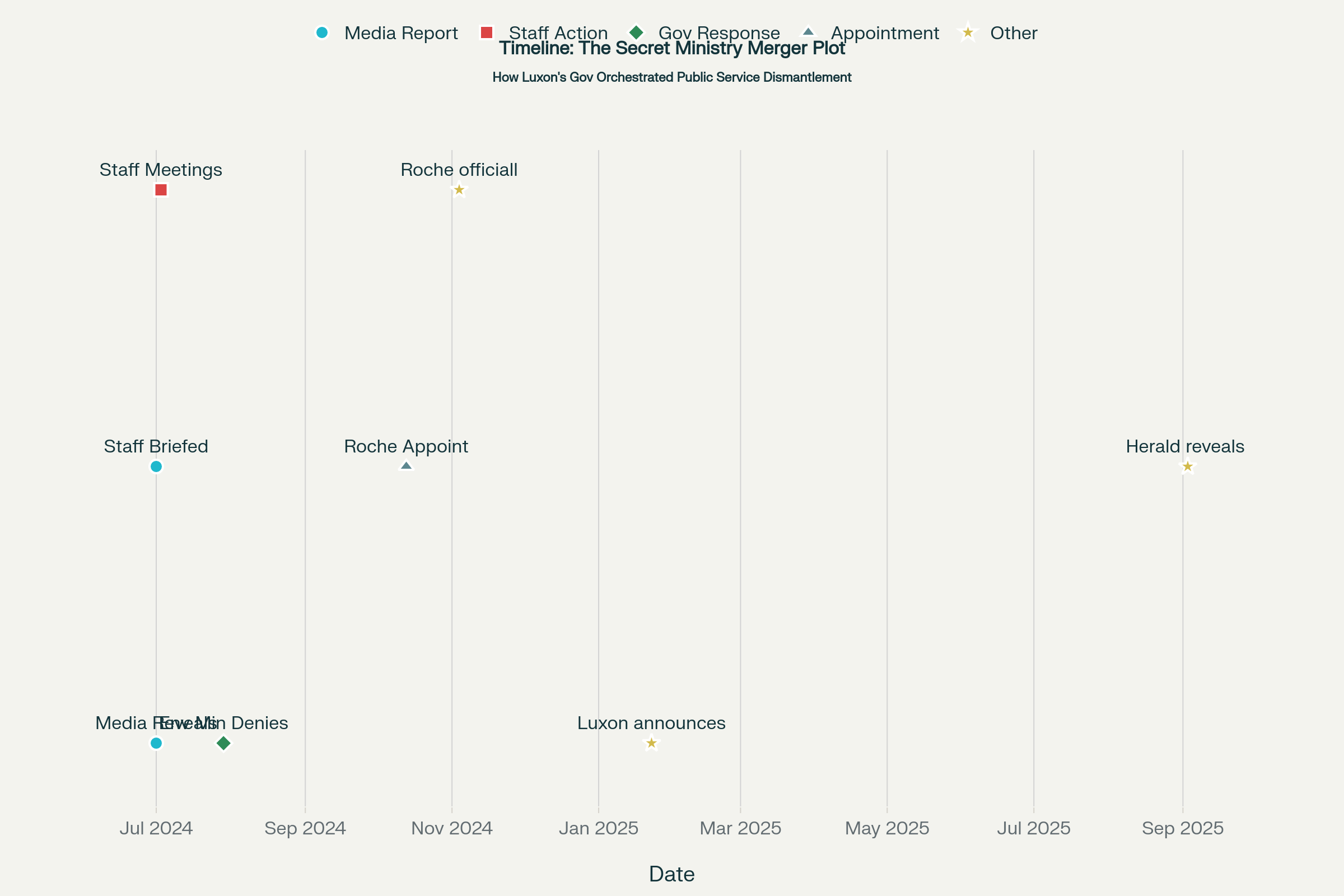
Timeline showing key events in the New Zealand government's secret ministry merger planning from July 2024 to September 2025
The timeline reveals a coordinated campaign of deception. When BusinessDesk first reported the merger speculation on July 1, 2024, ministry leaders immediately went into damage control mode, sending identical "media story this morning" emails to staff. The manufactured urgency and secrecy mirror classic shock doctrine tactics - create confusion and fear to ram through unpopular changes.
Public Service Minister Judith Collins confirmed in July 2024 that there had been "no communications" between her office and the three affected ministries about the merger. This deliberate exclusion of ministers from merger planning raises serious questions about who is really driving these changes and in whose interests.
The Devastating Impact on Māori Communities
The proposed merger targets three ministries crucial to Māori wellbeing and tino rangatiratanga. The Ministry for the Environment oversees co-governance arrangements and Treaty settlement obligations. The Ministry of Transport affects Māori access to employment and services. The Ministry of Housing and Urban Development addresses the housing crisis that disproportionately affects Māori whānau.
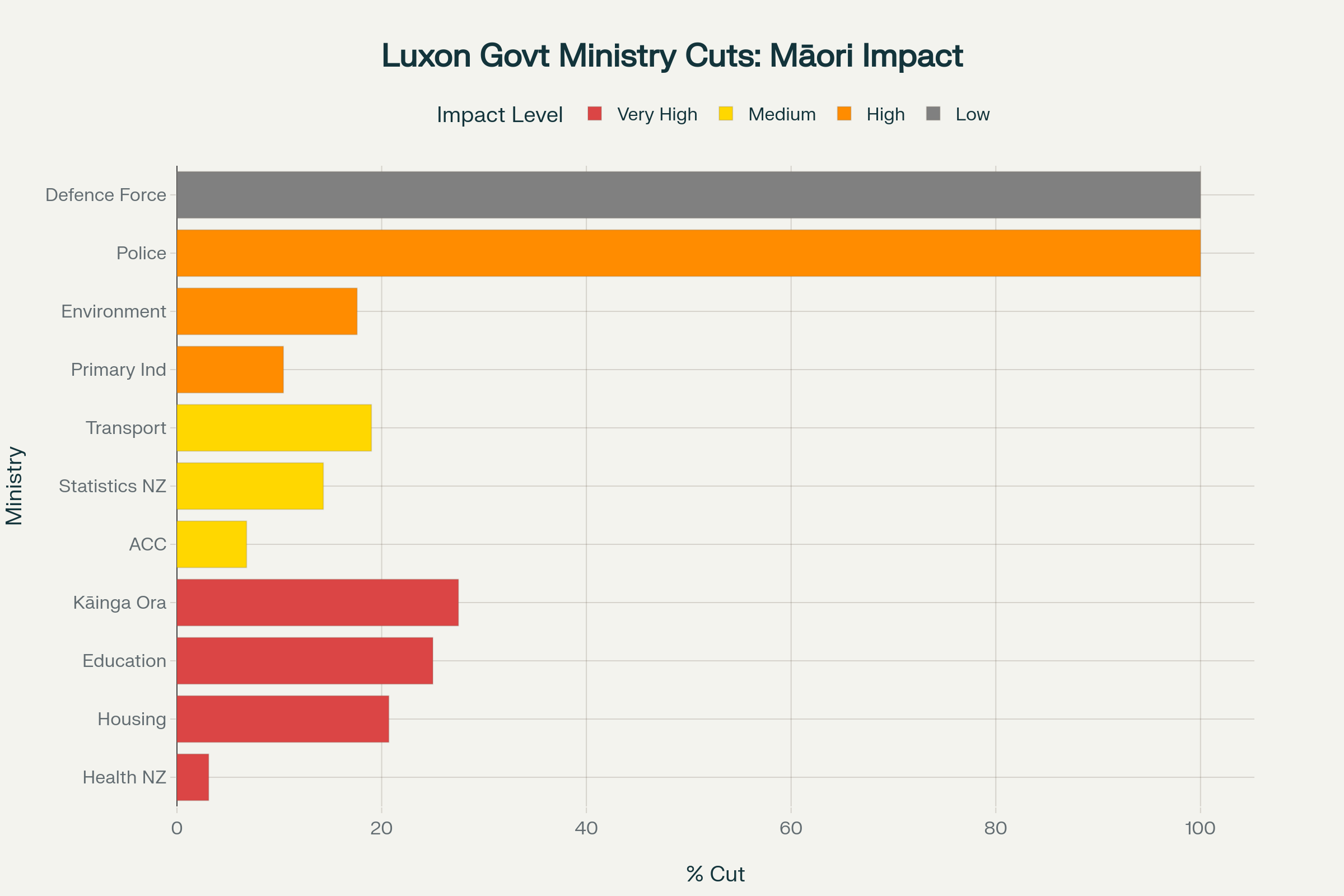
Percentage of jobs cut across New Zealand government ministries under Christopher Luxon's coalition government, color-coded by impact on Māori communities
The data reveals the systematic targeting of services supporting Māori. The Ministry of Education faces 25% cuts, directly impacting Māori education outcomes. Kāinga Ora faces 27.5% cuts, devastating efforts to address Māori homelessness. Health NZ cuts 2,000 jobs, worsening Māori health inequities.
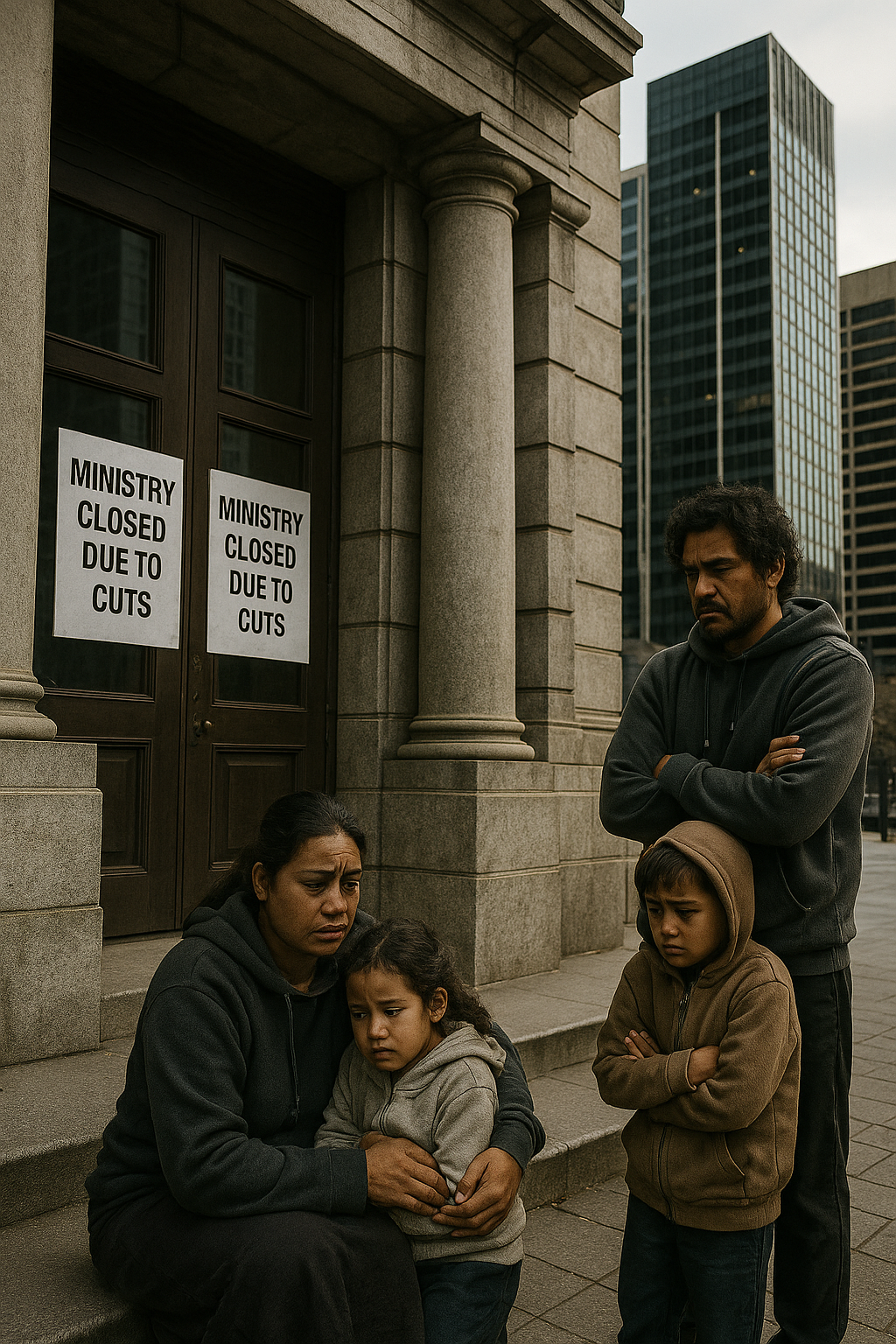
Māori families bearing the brunt of public service cuts while corporate power grows
These cuts represent institutional racism dressed up as fiscal responsibility. When Māori public servants report going home crying due to anti-Māori attitudes in their workplaces, we see the human cost of this corporate colonisation.
The government's attack on co-governance and Treaty partnerships creates an environment where anti-Māori racism flourishes. The merger proposal eliminates institutional knowledge and relationships built up over decades between government agencies and iwi.
The Corporate Power Network Behind the Destruction
The real scandal lies in who benefits from this destruction. Sir Brian Roche, appointed as Public Service Commissioner in October 2024, brings a corporate restructuring agenda that serves private interests, not public good.
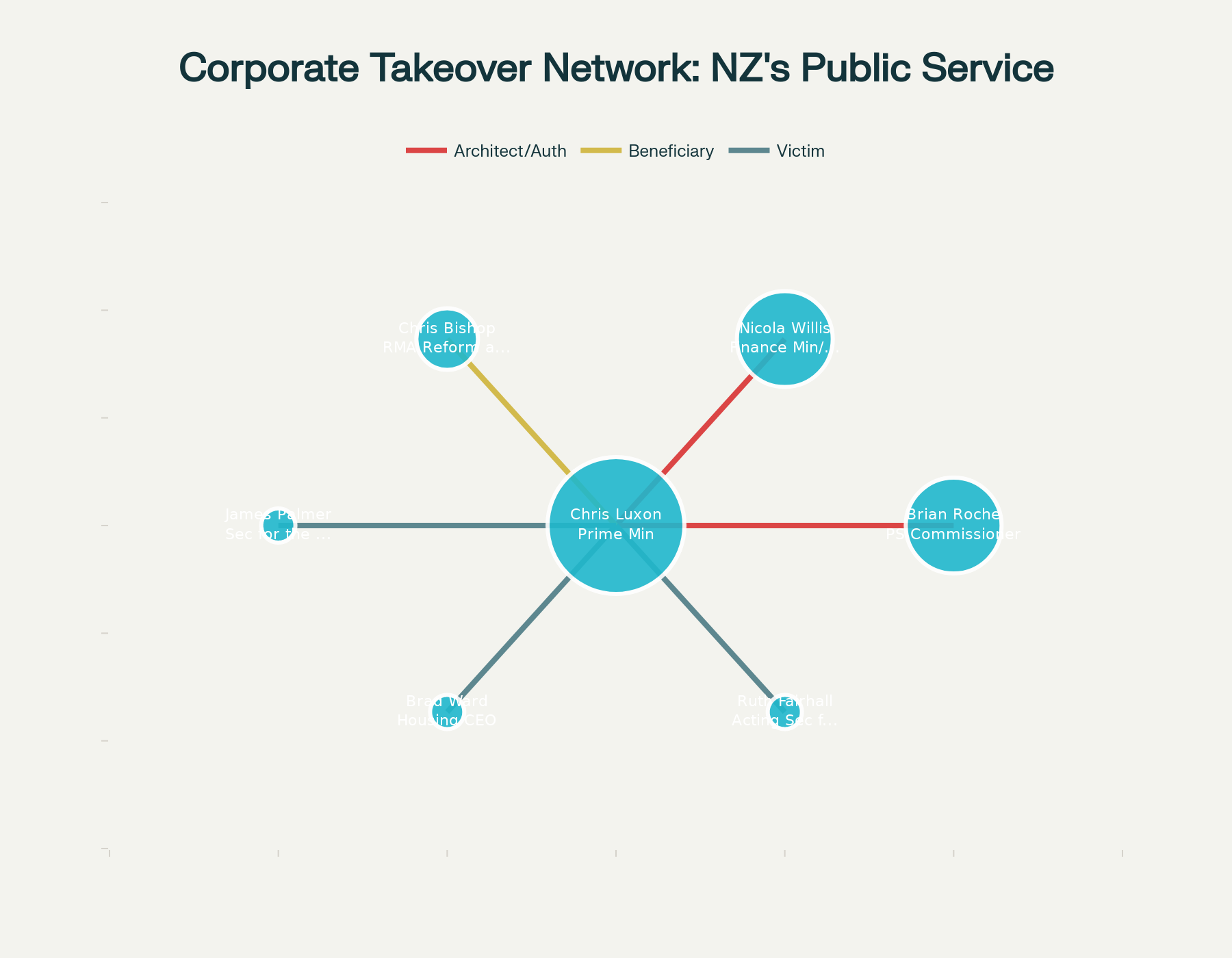
Network diagram showing power relationships and connections between key figures orchestrating New Zealand's ministry mergers and public service cuts
Roche's career trajectory exposes the corporate-political revolving door. From PwC senior partner to NZ Post CEO to Treaty negotiator to Public Service Commissioner, Roche represents the colonising class that profits from dismantling indigenous rights. His role in the 1997 Ngāi Tahu settlement as Crown negotiator shows how the same people who "settled" historical grievances now prevent future ones.
Luxon's background as Air New Zealand CEO reveals his commitment to corporate efficiency over human wellbeing. His government's focus on attracting foreign investment while cutting services to Māori exposes whose interests really matter.
Finance Minister Nicola Willis demands 6.5-7.5% cuts across agencies while the government spends billions on tax cuts for landlords and property speculators. The same people benefiting from housing speculation now cut the agencies meant to address the housing crisis they've created.
Hidden Connections: The Treaty Betrayal Network
The connections run deeper than corporate CV swapping. Roche's role as chief Crown negotiator for Treaty settlements in the 1990s positioned him perfectly to understand how to undermine Māori progress. Having helped design the settlement process, he now knows exactly which pressure points to target.
Chris Bishop's advocacy for property developers through the Fast-track Approvals Bill shows how ministry mergers serve private interests. By consolidating RMA, transport and housing powers under one ministry, Bishop eliminates the checks and balances that protect Māori environmental and cultural interests.
The conflicts of interest around fast-track projects reveal how political donations buy policy outcomes. Companies associated with fast-track projects donated over $500,000 to National, ACT and NZ First, while Māori communities facing environmental destruction have no such access.
The race-baiting campaigns against co-governance create political cover for these corporate handouts. Groups like Hobson's Pledge spread anti-Māori propaganda while the same corporate interests funding these groups benefit from reduced environmental and cultural protections.
The Broader Pattern of Neoliberal Assault
This merger represents one front in a broader war against Māori advancement. The government's attack on pay equity, cuts to Māori health services, and undermining of Treaty partnerships all serve the same agenda - reducing Māori political and economic power.
The science sector mergers announced alongside foreign investment reforms show how "efficiency" becomes a weapon against expertise that might challenge corporate interests. NIWA and GNS scientists studying climate change and environmental impacts face job cuts while mining and drilling projects get fast-tracked approval.
The government's targets focus on measurable outcomes that ignore structural racism. Reducing jobseeker numbers doesn't address why Māori face higher unemployment. Cutting emergency housing doesn't solve why Māori families are homeless. These targets create political theatre while avoiding the systemic changes needed for equity.
The Corporate Media's Complicit Silence
The Herald's belated reporting, over a year after merger planning began, exposes how corporate media serves power rather than democracy. NZME's willingness to publish Hobson's Pledge advertisements while ignoring government secrecy shows whose stories get told and whose get buried.
The sanitised language of "efficiency savings" and "machinery of government changes" obscures the violence being done to Māori communities. When Azaria Howell reports that "nothing's come to Cabinet" about merger proposals, she normalises a process that excludes democratic oversight.
The failure to connect these mergers to broader patterns of racism reflects how white cultural imperialism shapes news coverage. Māori voices warning about Treaty breaches get marginalised while corporate executives pontificating about efficiency get front-page coverage.
Implications for Māori Resistance and Rangatiratanga
These attacks on public services represent a direct assault on tino rangatiratanga. Every cut to environmental protection weakens Māori kaitiakitanga. Every reduction in housing support worsens homelessness among Māori whānau. Every merger that centralises power makes co-governance harder to achieve and maintain.
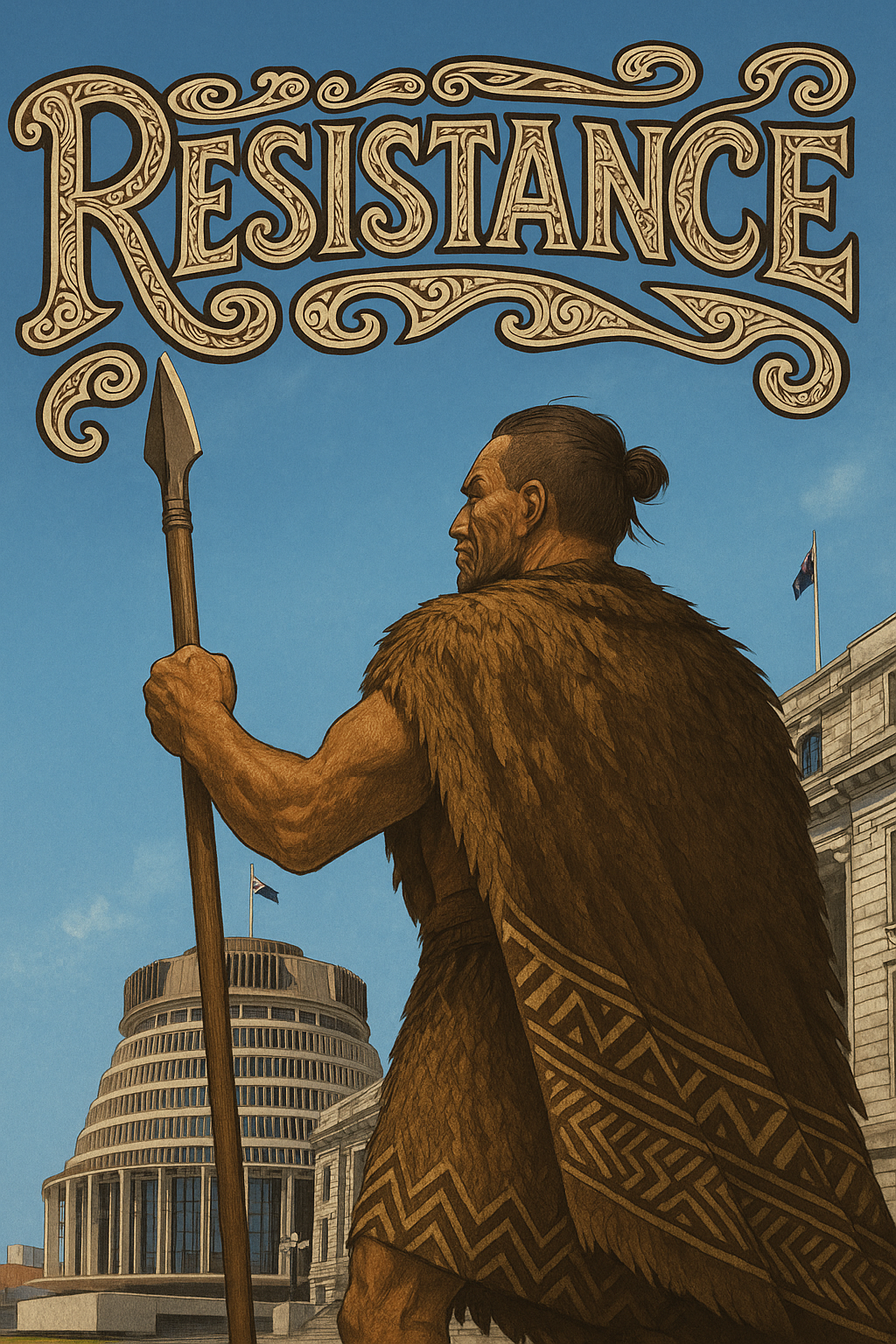
Māori resistance against neoliberal assault on indigenous rights and public services
The Ihumātao resistance provides a model for fighting back against these colonial encroachments. Just as protectors at Ihumātao used kai sovereignty and ahi kā to assert mana motuhake, Māori must resist attempts to centralise government power away from communities.
The hīkoi tradition that challenged land confiscation must be revived to challenge service confiscation. When iwi leaders warned about race-baiting during the Three Waters debate, they identified the same tactics now being used to justify ministry mergers.
The Waitangi Tribunal's findings on health system failures provide a constitutional framework for challenging these cuts. If the Crown has Treaty obligations to protect hauora, then cutting health services breaches those obligations regardless of the fiscal justification.
Māori public servants facing workplace racism need organised support from iwi and community organisations. When the state abandons its Treaty obligations, Māori must strengthen alternative institutions that can provide services and advocacy.
Constitutional Crisis and Settler Colonial Logic
The merger proposal exposes fundamental contradictions in New Zealand's constitutional arrangements. The government claims to honour the Treaty while systematically dismantling the institutional capacity to uphold Treaty obligations. This isn't policy failure - it's settler colonial logic in action.
Local government attempts to deny Treaty obligations show how this logic spreads beyond central government. When Kaipara District Council spends $52,000 on legal advice claiming councils have no Treaty duties, we see the same colonial denial at every level of government.
The Truth and Reconciliation Commission recommended by the Human Rights Commission becomes more urgent as government actions demonstrate continued Treaty breaches. Constitutional transformation can't wait for government permission when that same government actively undermines constitutional obligations.
The anti-racism activism that challenged apartheid sports tours must now challenge apartheid government structures. Just as Bill Andersen linked Māori land rights to workers' rights, contemporary resistance must link Treaty rights to economic justice.

The Māori Green Lantern Fighting Misinformation And Disinformation From The Far Right
The Corporate Colonial Endgame
The ministry merger represents the corporate colonisation of New Zealand's last democratic institutions. By centralising power in the hands of former corporate executives while cutting services to Māori, this government reveals its true priorities. The same white supremacist logic that justified land confiscation now justifies service confiscation.
But resistance continues. Every Māori voice speaking truth to power, every whānau refusing to accept poverty and homelessness as inevitable, every iwi asserting rangatiratanga over their territories - all contribute to the struggle for genuine decolonisation.
The merger proposal will likely proceed regardless of Māori opposition, just as previous governments ignored Māori protests against asset sales and welfare cuts. But each act of colonial violence strengthens the case for constitutional transformation and Māori self-determination.
We must expose these corporate networks, resist these racist cuts, and build alternative institutions based on mana motuhake rather than corporate profits. The fight for our future starts with refusing to accept their version of "efficiency."
Kia kaha, kia maia, kia manawanui. The struggle continues.
He mihi aroha ki a koutou katoa. To readers who find value in this mahi and wish to support The Māori Green Lantern's work exposing colonial capitalism and white supremacy, please consider making a koha to HTDM: 03-1546-0415173-000. I understand these are tough economic times for many whānau, so only contribute if you have the capacity and wish to do so. Every contribution helps keep this critical analysis independent and focused on serving our people rather than corporate interests.
Noho ora mai.
Ivor Jones
Te Māori Green Lantern
Kaitiaki exposing misinformation and neoliberal colonisation