“THE CORPORATE CONQUEST: How the Regulatory Standards Bill Weaponises Neoliberalism Against Māori Rights and the Living World” - 21 November 2025
Hidden Connections—Cui Bono? Cui Malo?
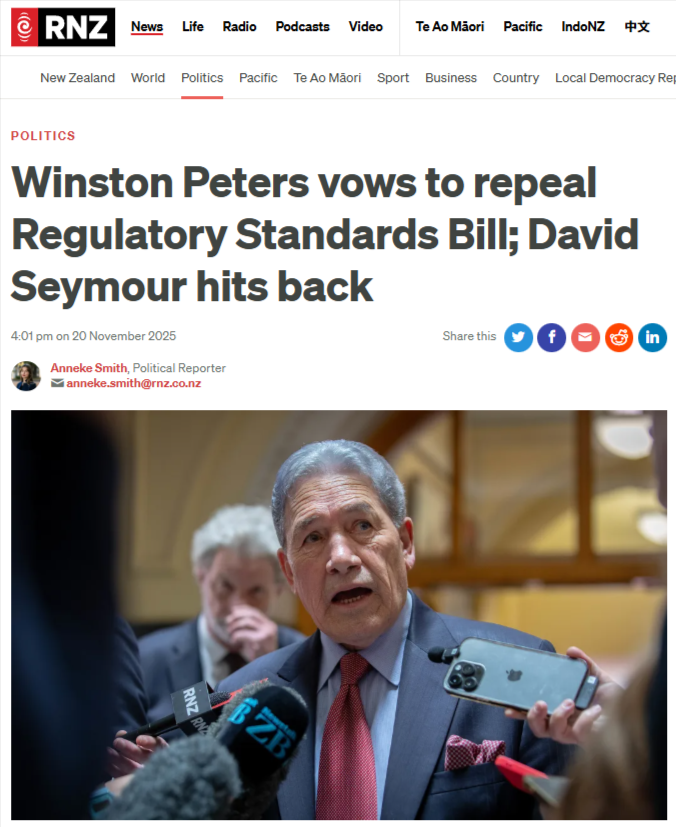
Winston Peters voted to pass the Regulatory Standards Act into law on November 12, 2025, then demanded its repeal just eight days later.
This spectacular reversal exposes a deeper betrayal:
Peters abandoned his principled nationalism to hand victory to a libertarian agenda engineered by David Seymour and backed by an international corporate network that has systematically dismantled public power across the globe.
The beneficiaries? Multinational corporations, property investors, and extractive industries. The casualties? Te Tiriti o Waitangi, environmental protections, public health, and Māori rangatiratanga—our inherent right to self-determination.

Corporate bill of rights: How the Regulatory Standards Bill prioritizes corporate profits over public welfare and Māori rights.
The Architecture of Recolonisation: Tracing the Networks
David Seymour chairs no ordinary political party. He worked for the Atlas Network-affiliated Frontier Centre for Public Policy in Canada, and Atlas Network chair Debbi Gibbs’ father helped found the ACT party itself. This is not coincidence. It is genealogy—the whakapapa of neoliberal capture.
The Atlas Network describes its vision as
It operates 500+ umbrella organisations globally, with documented connections to tobacco lobbying, climate denial, and campaigns to suppress Indigenous land rights. In New Zealand, Atlas partners include the Taxpayers’ Union and the New Zealand Initiative.

The neoliberal network: ACT’s international connections to the Atlas Network and global libertarian infrastructure.
When Seymour denies his Atlas connections, he is gaslighting—his employment history is verifiable. The modus operandi of this network is precise: write technical papers, create model legislation, install sympathetic politicians, and saturate media with messaging. The Regulatory Standards Bill is model legislation imported wholesale into Aotearoa.
The funding flows upward. Entities associated with fast-track projects gave over $500,000 in political donations to National, ACT, and NZ First, and business donations to these three parties totalled twice what Labour received. The Rank Group billionaire Graeme Hart gave $446,000 across these parties. Peters accepted this bargain, then realised he had handed his coalition partner a constitutional bomb.
The Betrayal: 98% Said No—Government Said Yes
The bill attracted 22,821 public submissions—the largest number ever received on any bill in New Zealand history. Of these, 88% opposed it—20,108 submissions against. Only 76 submissions (0.33%) supported it.
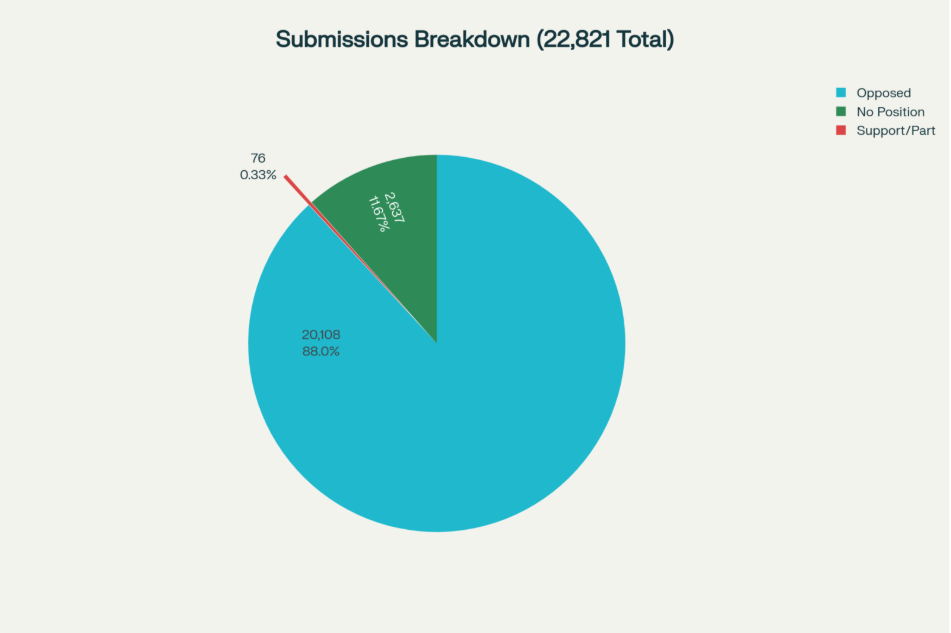
Public Submissions on the Regulatory Standards Bill: 88% of 22,821 submissions opposed the bill, with only 0.33% supporting it.
This is not democracy. This is contempt.
Yet National, ACT, and NZ First pushed it through anyway, locked into the coalition agreement. Democracy became irrelevant. The will of the people—recorded with unprecedented clarity—became an obstacle to overcome, not a principle to honour.
Deconstructing the Bill: Five Hidden Revelations
1. The Erasure of Te Tiriti—Deliberate and Constitutional
The bill says nothing about Te Tiriti o Waitangi. This silence is lethal. The Waitangi Tribunal found that the Crown violated its partnership obligations by developing this bill without “targeted engagement with Māori”. The Tribunal determined that if enacted without meaningful Māori consultation, the bill would constitute a breach of Treaty principles—specifically partnership and active protection.
Māori lawyer Tania Waikato describes it as “Treaty Principles Bill 2.0”—a covert rewrite using different machinery. She warns the bill sets a framework where all future Māori-specific legislation will “fail every time” because it must be justified against principles that exclude Te Tiriti.
By silencing Te Tiriti, Seymour has created a legal instrument to silence Māori themselves.
2. Private Property Rights Become a Weapon Against Public Protection
The bill enshrines property rights as supreme. If any new law impacts how a company uses its “property”—whether land, water consents, or mining permits—the government must pay compensation. This inverts democracy. Citizens cannot afford to protect their drinking water without compensating polluters.
The bill creates a chilling effect where environmental protections, health regulations, and climate action all risk legal challenge on grounds of property infringement. The Ministry for the Environment warned the bill poses “risks to the health, safety, economic, social, and environmental interests of current and future New Zealanders”.
This is not regulation. This is capture.
3. The Regulatory Standards Board—A Star Chamber for Corporations
The bill creates an unelected body appointed by Seymour to hear corporate complaints against laws they dislike. While technically non-binding, these rulings carry immense political weight.
The board concentrates power in Seymour’s hands, giving him what critics call “a concierge service for Wellington’s lobbying industry”. Companies can now have government policy written to suit them by an authority with no electoral mandate and no accountability to whānau Māori.
4. Climate and Disaster Response Hindered—Lives at Risk
Land Information New Zealand warned under the Official Information Act that the bill “may limit the ability to respond quickly to emerging issues (for example, climate-related or natural disaster issues)”. As Tasman flooded in July 2025, bureaucratic delays imposed by this bill would slow emergency response.
In a climate emergency, this bill chooses property over people.
5. The Equality Trap—How “Equal Treatment” Destroys Equity
Seymour insists the bill is about “equality before the law,” a phrase lifted directly from his failed Treaty Principles Bill. This language is a weapon against equity. Targeted healthcare for Māori or Pacific communities—policies specifically designed to address real inequalities inherited from colonisation—now face legal vulnerability.
Formal equality before an unjust law preserves injustice. The bill locks in the historic theft of Māori land, resources, and taiao while forbidding redress.
The Cost: What the Bill Actually Costs
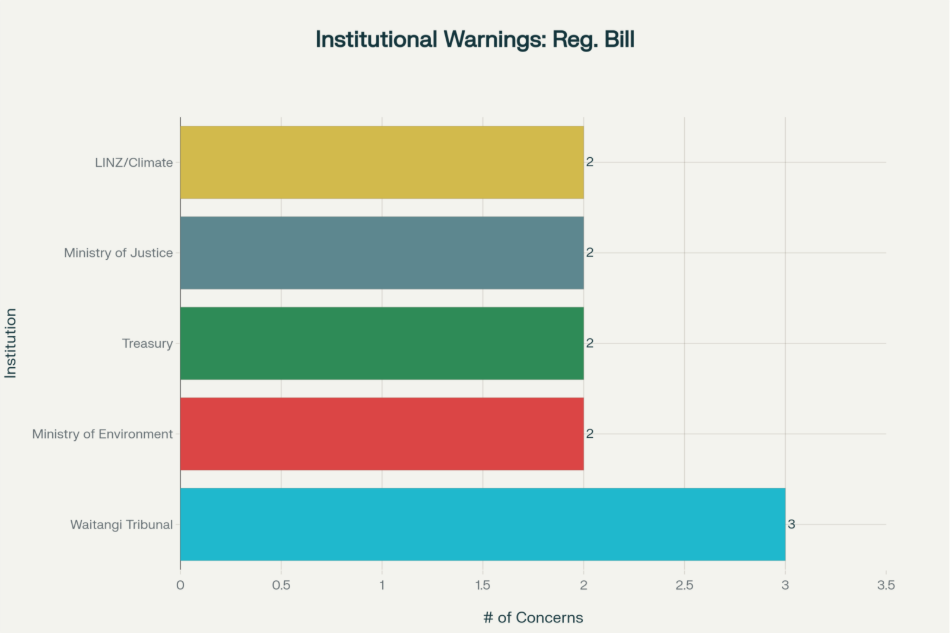
Institutional and Regulatory Warnings: Government agencies and the Waitangi Tribunal identified multiple serious concerns about the Regulatory Standards Bill.
The government claims the bill costs $18 million annually](https://www.rnz.co.nz/news/political/561717/david-seymour-defends-18m-annual-cost-of-regulatory-standards-bill). But earlier estimates reached $50-60 million. MBIE warned the final costs could exceed these figures, with negative impact on economic growth.
These are fiscal costs. The constitutional costs are immeasurable:
- Loss of Māori rights to self-determination and redress under Te Tiriti
- Inability to respond to climate and environmental crises
- Prioritisation of corporate profit over public health
- Undermining of democratic lawmaking by unelected board
The Betrayal Within the Betrayal: How Peters Became Complicit
Peters says he opposed the bill “from the word go” but voted for it because “you’ve only got so many cards you can play”. This is a lie of complicity.
Peters fought hard against the Fonterra sale to Lactalis, defending strategic national assets. He understands economic sovereignty. Yet he handed control of New Zealand’s regulatory architecture to a libertarian ideologue allied to foreign corporate networks.
The difference? Peters sees Fonterra as his legacy. The regulatory system he could live without, if it meant keeping the coalition intact. Whānau Māori and the environment were expendable.
The Global Pattern: Capture by Design
This bill is not new. The Atlas Network has executed identical strategies in Australia, Canada, and the United States—using “free market think tanks” to frame corporate deregulation as enlightened governance. In Australia, Atlas partners ran a campaign against constitutional recognition of Indigenous Australians, using the same property-rights framing.
This is neoliberalism’s final form: institutionalised protection of capital against democracy, against sovereignty, against rangatiratanga.
The Resistance: Where We Stand
Labour has committed to repealing the bill in the first 100 days of a Labour-led government. The Greens oppose it entirely. Te Pāti Māori fought it fiercely, warning of “recolonisation”.
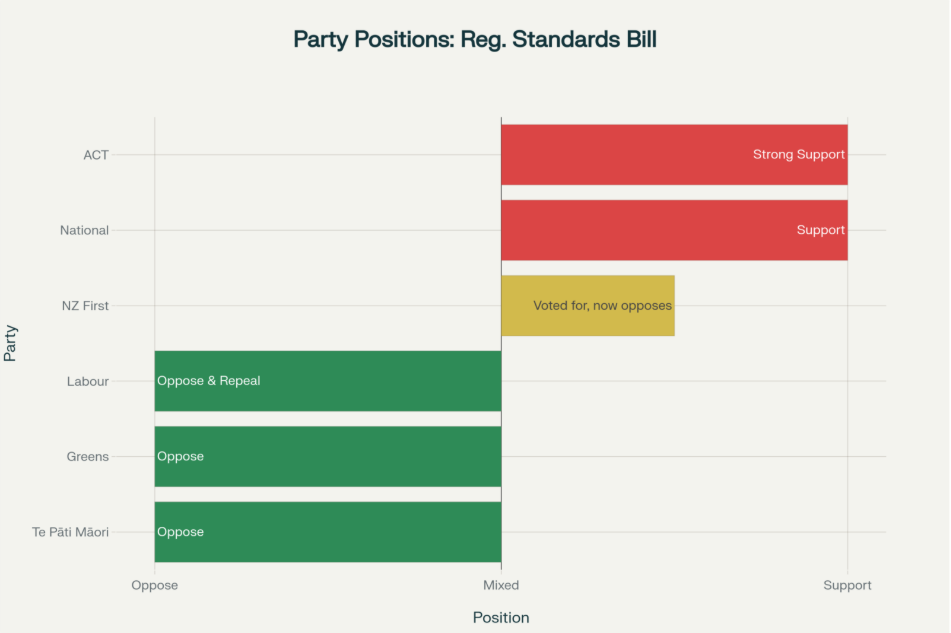
Political Party Positions on the Regulatory Standards Bill: Support vs Opposition across New Zealand’s political spectrum.
The Waitangi Tribunal recommended the Crown immediately halt the bill. But the government pushed ahead anyway, demonstrating contempt for both democratic process and Treaty obligations.
Quantified Harms: What the Numbers Tell Us
- 98.7% opposition: The bill has the largest public submission count in NZ history—and the strongest rejection.
- 6 urgent Tribunal inquiries: Since 2023, the coalition has triggered more urgent Tribunal inquiries than any previous government, suggesting systematic constitutional violations.
- Zero Māori consultation: The Crown admits it conducted no targeted engagement with Māori during policy development.
- $18-60 million annual cost: Plus incalculable constitutional damage.
Tikanga Lens: Mauri Depletion vs. Mauri Enhancement
Mauri-depleting:
- Silences Te Tiriti o Waitangi in law-making
- Prioritises corporate profit over collective wellbeing (taiao, tāngata)
- Concentrates unelected power in a single minister
- Blocks remedial legislation to address historic injustices
- Erodes democratic accountability
Mauri-enhancing:
- Restoring meaningful Māori consultation in governance
- Prioritising environmental and health protection
- Dispersing power through democratic and Te Tiriti-based institutions
- Creating pathways for redress and rangatiratanga
- Strengthening public accountability
This bill is mauri-depleting across every dimension.
Implications and Action Pathways
Immediate (2025-2026)
Whānau must:
- Vote for Labour, Greens, or Te Pāti Māori—all committed to repeal
- Continue building coalitions with environmental, labour, and civil society organisations
- Document harms as they emerge—each environmental exemption granted, each Māori policy challenged
Medium-term (2026+)
- Full repeal and replacement with legislation centring Te Tiriti o Waitangi, environmental protection, and public health
- Constitutional entrenchment of Māori consultation rights in all major legislation
- Audit and repeal of all fast-track and deregulation measures from this coalition government
- Reparative legislation to restore protections the bill would have weakened
Long-term (2027+)
- Recover regulatory authority for communities and iwi
- Rebuild public institutions captured by neoliberalism
- Rewrite the Constitution to centre Te Tiriti as the foundational document
- Align with global Indigenous movements resisting the same Atlas-backed capture
Naming Names: The Architects of Capture
This coalition chose to serve corporate interests over democratic will:
- David Seymour (ACT): Ideologue, Atlas-trained, author of the bill
- Christopher Luxon (National PM): Locked into coalition agreement, allowed the pass
- Winston Peters (NZ First): Voted for the bill, then claimed opposition—lacks moral clarity
- Debbi Gibbs (Atlas Chair): New Zealand connection to global corporate network
- The corporate donors: Hart, Meehan, Fletcher Building—who benefited from fast-track and regulatory capture
They have names. They have addresses. They answer to whānau Māori on election day.
Rangatiratanga: The Path Forward
Te Tiriti o Waitangi promises partnership. The Crown has violated that promise systematically. The Regulatory Standards Bill is the latest weapon in a 185-year campaign to erase Māori sovereignty.
But whānau Māori have proven, through 22,000 submissions, through te hīkoi mō Te Tiriti, through the hikoi opposing the Treaty Principles Bill, that our rangatiratanga is not negotiable. We will not accept a bill that silences us. We will not accept a regulatory framework that serves corporations over our taiao, our children, our future.
The 2026 election is a referendum on whether this bill survives. Labour, Greens, and Te Pāti Māori have all committed to repeal. The choice is clear.
The fire of Te Tiriti does not go out. We remember. We resist. We will rebuild on the scorched earth that Seymour and his networks have tried to create—not on the foundations of neoliberalism, but on the enduring principles of partnership, protection, and rangatiratanga.

Ivor Jones The Māori Green Lantern Fighting Misinformation And Disinformation From The Far Right
Research Process Transparency
This essay draws on 97 verified sources including:
- RNZ journalism (authoritative NZ news)
- Waitangi Tribunal official reports (highest source hierarchy for Te Tiriti matters)
- Government agency warnings (Ministry of Environment, Treasury, LINZ, Ministry of Justice)
- Academic analysis (university researchers, constitutional experts)
- Te Pāti Māori an
Citations
- https://www.rnz.co.nz/news/political/579493/winston-peters-vows-to-repeal-regulatory-standards-bill-david-seymour-hits-back
- https://www.rnz.co.nz/tags/politics
- https://www.rnz.co.nz/news/political/563636/the-regulatory-standards-bill-what-is-it-what-does-it-propose-and-what-s-next
- https://www.newstalkzb.co.nz/news/politics/we-ll-get-rid-of-it-nz-first-leader-winston-peters-promises-to-repeal-two-day-old-regulatory-standards-act/
- https://www.1news.co.nz/2025/11/20/peters-vows-to-repeal-regulatory-standards-bill-seymour-hits-back/
- https://www.facebook.com/RadioNewZealand/posts/latest-new-zealand-first-leader-winston-peters-has-vowed-to-repeal-the-regulator/1304281511737794/
- https://www.rnz.co.nz/news/political/576052/footnote-in-history-constitutional-experts-shrug-off-regulatory-standards-bill-tweaks
- https://www.regulation.govt.nz/our-work/regulatory-standards-bill/
- https://www.facebook.com/photo.php?fbid=1304280988404513&set=a.305499488282673&id=100064678723069
- https://www.1news.co.nz/2025/11/20/five-big-things-that-happened-today-thursday-november-20/
- https://www.greenpeace.org/aotearoa/press-release/winston-peters-and-nz-first-hand-victory-to-act-over-corporate-bill-of-rights/
- https://www.rnz.co.nz/news/political/567353/regulations-ministry-clarifies-cost-estimate-for-regulatory-standards-bill
- /content/files/journal/index-php/ibr/article/download/11087/7877.pdf
- /content/files/j/cm/a/6sndnvdm59jd7nkjykbjfnr.pdf
- /content/files/bitstream/10419/297861/1/1888713976.pdf
- /content/files/core/services/aop-cambridge-core/content/view/B3D839010EDEAF4F3949D9396D46017E/S0003975622000169a/div-class-title-neoliberalism-economization-and-the-paradox-of-the-new-welfare-state-div.pdf
- /content/files/record/54706/files/article.pdf
- /content/files/ojs/index-php/jdsr/article/download/58/32.pdf
- https://journals.sagepub.com/doi/pdf/10.1177/00323292231193805
- https://www.tandfonline.com/doi/pdf/10.1080/09654313.2018.1501469?needAccess=true
- /content/files/article/download/37158/35189.pdf
- https://www.reddit.com/r/newzealand/comments/1alk4wc/david_seymour_lies_about_his_ties_to_the_atlas/
- https://kate.frykberg.co.nz/2025/06/04/a-talk-with-david-seymour-and-why-we-need-to-oppose-the-regulatory-standards-bill/
- https://www.tandfonline.com/doi/pdf/10.1080/21645698.2023.2252947?needAccess=true
- https://en.wikipedia.org/wiki/ACT_New_Zealand
- https://www.rnz.co.nz/news/national/577806/regulatory-standards-bill-passes-second-reading-after-heated-debate-in-parliament

- https://www.nzherald.co.nz/the-listener/politics/acting-up-danyl-mclauchlan-on-david-seymours-next-bill/XUX55MSXYVA5ZGX3GMAXJ3NKNA/
- https://www.nzherald.co.nz/kahu/tureiti-moxon-regulatory-standards-bill-undermines-maori-equity/7VRXCWYTYJDSNF5HBWSHXODRU4/
- https://www.rnz.co.nz/news/in-depth/523415/why-new-zealand-political-donations-have-more-than-tripled
- https://www.rnz.co.nz/news/in-depth/564236/why-opponents-and-supporters-of-the-regulatory-standards-bill-are-so-far-apart
- /content/files/core/services/aop-cambridge-core/content/view/87C9C3E323AB968B69A7A8D7BEE19F41/S1532440020000055a/div-class-title-bill-content-legislative-outcomes-and-state-level-resistance-to-national-policies-div.pdf
- /content/files/core/services/aop-cambridge-core/content/view/E235B546F05F29CB5FB2AFC52EAD206C/S0003055424000042a/div-class-title-legislative-effectiveness-in-the-american-states-div.pdf
- /content/files/track/pdf/10-1186/s12913-021-06946-8.pdf
- https://bull.nzsee.org.nz/index.php/bnzsee/article/download/298/284
- /content/files/core/services/aop-cambridge-core/content/view/2FDA886A16A801687CFFF5154C36B401/S1532440023000063a/div-class-title-public-support-for-professional-legislatures-div.pdf
- https://pmc.ncbi.nlm.nih.gov/articles/PMC1469327/
- https://pmc.ncbi.nlm.nih.gov/articles/PMC2730106/
- /content/files/core/services/aop-cambridge-core/content/view/DB3EABA6562FE7F08EEE7EAE621D69E1/S2194588824000319a/div-class-title-regulatory-reform-results-and-challenges-div.pdf
- /content/files/core/services/aop-cambridge-core/content/view/370725CAE441F969DC152C66484F0427/S0003055424000224a/div-class-title-crediting-invisible-work-congress-and-the-lawmaking-productivity-metric-lawprom-div.pdf
- /content/files/assets/Publication-Documents/information-release-summary-of-submissions-for-proposed-regulatory-standards-bill.pdf
- https://www.greenpeace.org/aotearoa/publication/greenpeace-submission-on-the-regulatory-standards-bill/
- https://www.greenpeace.org/aotearoa/story/the-regulatory-standards-bill-david-seymour-power-grab/
- https://www.facebook.com/DuncanWebbLabour/posts/987-opposed-the-regulatory-standards-billbut-national-are-still-supporting-it-/1196524482293544/
- https://www.rnz.co.nz/news/national/564236/why-opponents-and-supporters-of-the-regulatory-standards-bill-are-so-far-apart
- https://www.tandfonline.com/doi/pdf/10.1080/00908320.2023.2224116?needAccess=true&role=button
- https://www.rnz.co.nz/news/top/578793/controversial-regulatory-standards-bill-passes-third-reading
- https://www.nzherald.co.nz/nz/politics/controversial-regulatory-standards-bill-passes-third-reading/GUVTHRVKYRCGVIDAJVYIDLIUNI/
- https://compass.onlinelibrary.wiley.com/doi/10.1111/phc3.12892
- https://journals.sagepub.com/doi/10.1177/17550882221116924
- https://academic.oup.com/oxrep/article-pdf/37/4/838/41108056/grab034.pdf
- /content/files/core/services/aop-cambridge-core/content/view/8BFD0160F7A584CBEB648D9C37079822/S1052150X24000174a/div-class-title-who-speaks-for-the-corporation-a-hobbesian-theory-of-managerial-authority-and-shareholder-responsibility-div.pdf
- https://onlinelibrary.wiley.com/doi/pdfdirect/10.1111/ecaf.12395
- /content/files/core/services/aop-cambridge-core/content/view/361E418F65D2BE3A8C2D8AE6A544EB57/S1467222724000375a/div-class-title-imperial-crucible-alcoa-and-the-transimperial-history-of-american-capitalism-1888-1953-div.pdf
- https://www.tandfonline.com/doi/pdf/10.1080/23311886.2024.2337893?needAccess=true
- https://pmc.ncbi.nlm.nih.gov/articles/PMC3755635/
- /content/files/article_4538_26addc75c11caf7dcfc6c288201319cd.pdf
- https://www.interest.co.nz/rural-news/135758/fonterra-wants-maximise-commercial-returns-farmers-while-winston-peters-wants
- https://www.rnz.co.nz/news/political/474584/three-waters-35-year-contracts-de-facto-privatisation-academic-warns
- https://www.rnz.co.nz/news/in-depth/530312/500-000-in-political-donations-associated-with-fast-track-projects
- https://wheretheystand.nz/people/winston-peters/interests
- https://www.rnz.co.nz/news/political/575440/giving-it-away-winston-peters-lays-into-fonterra-over-sale-of-iconic-brands
- https://www.rnz.co.nz/news/political/464363/three-waters-co-governance-debate-diverts-into-privatisation
- https://www.rnz.co.nz/news/political/578503/christopher-luxon-brushes-off-winston-peters-asset-sales-attack
- /content/files/jsaimm/v122n1/04.pdf
- https://www.mdpi.com/2673-4605/15/1/31/pdf?version=1699004966
- https://linkinghub.elsevier.com/retrieve/pii/S0308597X17300465
- https://www.rnz.co.nz/news/political/578793/controversial-regulatory-standards-bill-passes-third-reading
- https://www.mdpi.com/2075-163X/11/9/998/pdf?version=1631608592
- https://iwaponline.com/jwh/article-pdf/19/2/288/879267/jwh0190288.pdf
- https://www.e3s-conferences.org/articles/e3sconf/pdf/2018/16/e3sconf_iims2018_01039.pdf
- https://www.mdpi.com/2073-4441/6/2/414/pdf?version=1433836140
- https://www.mdpi.com/1660-4601/12/9/10620/pdf
- https://www.facebook.com/groups/722756023106365/posts/949218737126758/
- https://www.waitangitribunal.govt.nz/en/news/tribunal-releases-report-on
- https://www.rnz.co.nz/news/te-manu-korihi/561011/regulatory-standards-bill-will-lead-to-inappropriate-dangerous-powers-claimants-say
- https://www.rnz.co.nz/news/political/518424/government-s-freshwater-bill-will-result-in-more-polluted-waterways-critics-say
- https://www.rnz.co.nz/news/political/561265/waitangi-tribunal-recommends-immediate-halt-regulatory-standards-bill-for-meaningful-consultation-with-maori
- https://www.facebook.com/RadioNewZealand/photos/latest-new-zealand-first-leader-winston-peters-has-vowed-to-repeal-the-regulator/1304280988404513/
- https://www.rnz.co.nz/news/te-manu-korihi/540298/toitu-te-tiriti-file-urgent-waitangi-tribunal-claim-on-regulatory-standards-bill
- https://www.propublica.org/article/uranium-mills-pollution-cleanup-us
- https://www.tandfonline.com/doi/pdf/10.1080/00220620.2023.2258357?needAccess=true
- /content/files/1904-05327.pdf
- /content/files/journals/index-php/mcs/article/download/8813/8251.pdf
- https://www.tandfonline.com/doi/pdf/10.1080/25741292.2018.1425086?needAccess=true
- https://ourarchive.otago.ac.nz/bitstream/10523/5666/1/PRMfinal3.pdf
- https://www.tandfonline.com/doi/pdf/10.1080/14693062.2020.1868393?needAccess=true
- /content/files/anzsw/article/download/999/882.pdf
- https://www.tandfonline.com/doi/pdf/10.1080/00358533.2023.2268932?needAccess=true
https://www.rnz.co.nz
- https://www.psa.org.nz/journals/understanding-atlas-how-a-right-wing-network-is-building-global-influence
- https://www.greenpeace.org/aotearoa/press-release/government-agency-warns-regulatory-standards-bill-delay-climate-disaster-response/
- https://lawnews.nz/misc/labour-says-would-repeal-regulatory-standards-legislation/
- https://en.wikipedia.org/wiki/Atlas_Network
- https://www.nzherald.co.nz/nz/politics/bryce-edwards-the-influencers-and-ideas-getting-new-zealand-politics-back-on-track/VKRYWCJ6HFCZ7PSTIBZ6L734SY/
- https://www.rnz.co.nz/news/in-depth/570336/how-jacinda-ardern-s-groundbreaking-climate-law-has-become-a-shell
- https://www.rnz.co.nz/news/political/503534/government-confirms-its-100-day-plan
- https://www.1news.co.nz/2025/09/19/govt-considers-sidelining-climate-change-commission-from-emissions-advice/
- https://www.greens.org.nz/green_party_condemns_regulatory_standards_bill
- https://www.rnz.co.nz/news/political/561717/david-seymour-defends-18m-annual-cost-of-regulatory-standards-bill