“The Corporate Coup: How ACT’s Regulatory Standards Bill Weaponizes “Quality” to Dismantle Māori Rights” - 25 November 2025
98.7% of New Zealanders said no. The Waitangi Tribunal said halt. The Crown ignored both and delivered a corporate wishlist disguised as “good lawmaking.”
The Regulatory Standards Act 2025 is now law, and the stench of constitutional vandalism hangs over Parliament. On November 18, 2025, Christopher Luxon’s coalition rammed through legislation that 98.7% of 159,000 submitters opposed—the highest number of submissions ever received on any bill in New Zealand’s parliamentary history. Three days after the Waitangi Tribunal issued an urgent finding that progressing the bill would breach Te Tiriti o Waitangi, the Crown introduced it anyway. This is not democracy. This is a corporate-funded demolition of constitutional protections, and David Seymour’s ACT Party—bankrolled by billionaires and business elites—is holding the wrecking ball.
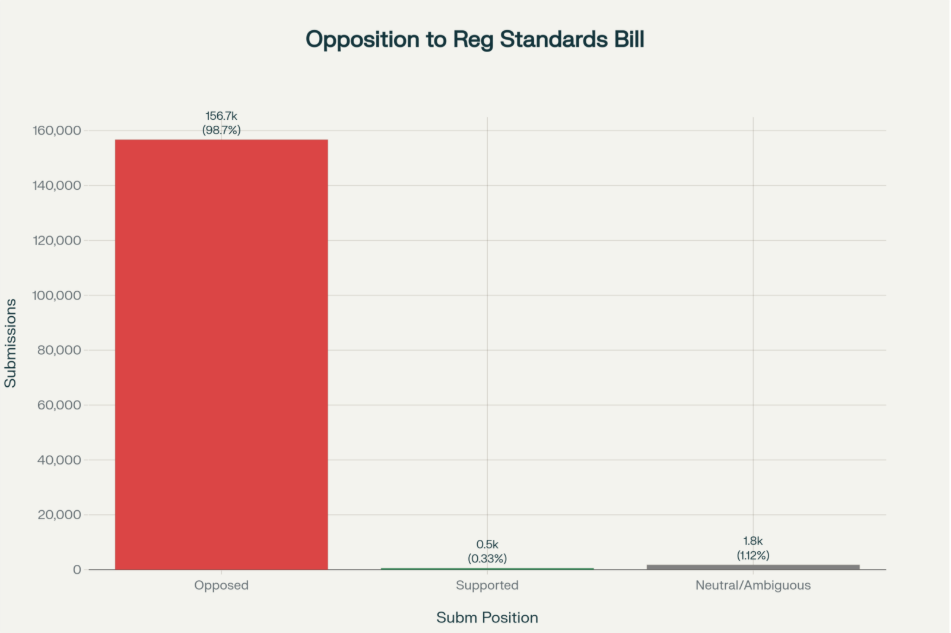
Public opposition to the Regulatory Standards Bill was overwhelming, with 98.7% of 159,000 submissions opposing the legislation—a record number for any bill in New Zealand parliamentary history.
Whakapapa of a Corporate Trojan Horse
The Regulatory Standards Act didn’t emerge from community need or democratic demand. It was birthed in the early 2000s by Dr Bryce Wilkinson, commissioned by the Business Roundtable—now merged into the New Zealand Initiative, a right-wing think tank that continues to champion neoliberal deregulation. This bill has failed three times before 2025, rejected by previous governments who recognized it for what it is: an ideological manifesto masquerading as procedural reform.
ACT has pursued this for over 20 years. Why? Follow the money. In 2023, ACT received $2,081,331.19 in declared donations, including $100,000 from billionaire Graeme Hart—one of the 200 richest people on the planet—plus another $104,000 via his Rank Group Ltd. Dame Jenny Gibbs donated $155,000, toy tycoon Nicholas Mowbray gave $150,000, and Trevor Farmer, Craig Heatley, and Gary Lane each contributed $50,000. In 2024, Hart donated another $100,000. These are not philanthropists concerned with “regulatory quality.” These are corporate elites buying policy that protects their wealth and removes barriers to profit extraction.
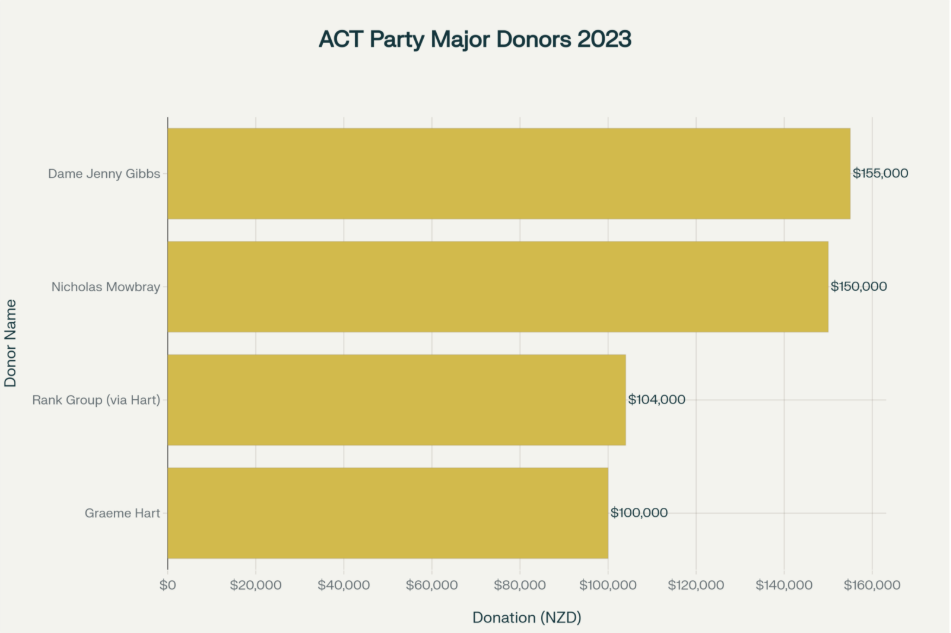
ACT Party received over $2 million in donations in 2023, with major contributions from billionaire Graeme Hart ($204,000 total), Dame Jenny Gibbs ($155,000), and toy magnate Nicholas Mowbray ($150,000).
The whakapapa is clear:
corporate donors fund ACT, ACT champions deregulation, and Seymour—now Minister for Regulation—gets to appoint the board that reviews all regulation. Cui bono? Not whānau. Not whenua. Corporate Aotearoa.
The Treaty Breach the Crown Chose
On May 14, 2025, the Waitangi Tribunal held an urgent hearing after over 18,000 people registered support for a claim led by Toitū te Tiriti. Two days later, the Tribunal released findings that should have ended this bill:
- Treaty Breach Confirmed: The Crown admitted it developed the bill “without targeted engagement with Māori”. The Tribunal found this violated Treaty principles of partnership and active protection, constituting a breach of Te Tiriti o Waitangi.
- Constitutional Significance: The Tribunal found the bill “seeks to influence the way Parliament makes law” and is therefore “inherently relevant to Māori”.
- Prejudice to Māori: The Tribunal found the Crown’s actions have “damaged the relationship between Māori and the Crown” and caused “stress and uncertainty, resulting in further prejudice”.
- Recommendation Ignored: The Tribunal recommended the Crown “immediately halt” the bill to allow “meaningful engagement with Māori”. Three days later, on May 19, the Crown introduced the bill to Parliament.
This was not an oversight. This was a deliberate choice to breach the Treaty. Seymour dismissed the Tribunal’s findings as “incorrect” and claimed the bill would never affect Treaty settlements—a lie the Tribunal’s preliminary Treaty Impact Analysis exposed by noting the bill’s silence on Te Tiriti “may be seen as politically significant for Māori and could be perceived as an attempt by the Crown to limit the established role of the Treaty/te Tiriti as part of law-making”.
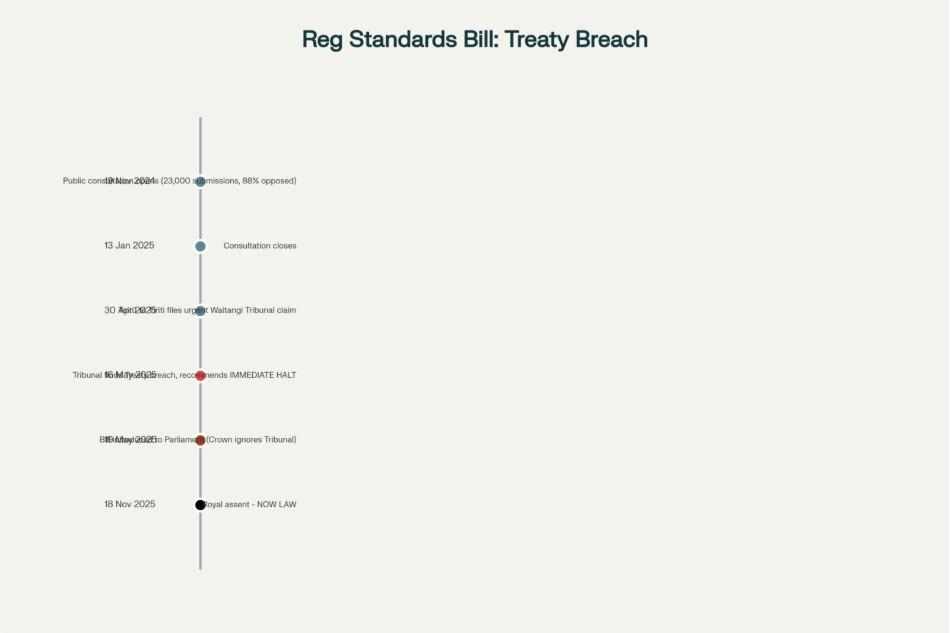
The Crown ignored the Waitangi Tribunal’s urgent recommendation to halt the bill, introducing it to Parliament just three days after the Tribunal found Treaty breaches, and passing it into law despite record public opposition.
The 98.7% the Crown Silenced
The public spoke. Overwhelmingly. 159,000 submissions—more than any bill in New Zealand history. 98.7% opposed. Only 0.33% supported. That’s a 299-to-1 opposition ratio. Earlier consultation in late 2024 received 23,000 submissions, with 88% opposing.
Te Pāti Māori co-leader Rawiri Waititi moved to have the Finance and Expenditure Select Committee
The motion was voted down. Waititi stated:
“This decision shows exactly what’s wrong with this government, it is willing to ignore the voices of 157,000 submitters, 98.7% of whom opposed this Bill, in favour of a political agenda that most New Zealanders do not support.”
The three main concerns from submissions were clear: (1) omission of Te Tiriti o Waitangi and its principles, (2) breach of Crown Treaty obligations, and (3) the bill’s ideological basis, unsupported by most New Zealanders.
Seymour’s response? Claim that “a small number of groups have hijacked the public submission process” and that opposition was driven by “bots”—a claim he later walked back but never apologized for. This is the arrogance of a politician who knows corporate money will fund his next campaign regardless of public opposition.
What the Act Actually Does: A Corporate Bill of Rights
Stripped of its bureaucratic language, the Regulatory Standards Act 2025 does four things, all of which harm Māori and serve corporate interests:
1. Elevates Property Rights Above All Else
The Act enshrines a “taking of property” principle: “Legislation should not take or impair, or authorise the taking or impairing of, property without the consent of the owner unless there is good justification and fair compensation”. This sounds reasonable until you realize “property” is defined by Crown law, not by whakapapa, tikanga, or collective Māori ownership systems.
The Crown’s own preliminary Treaty Impact Analysis admits: “Given the Bill does not explicitly refer to the Treaty/te Tiriti or tino rangatiratanga, there may be uncertainty as to how law-makers would be required to consider Māori cultural values and systems of law relating to property, including tikanga. This critique also applies to how the Bill would protect the rights and wellbeing of whānau, hapū and iwi, (including future generations) or the environment.”
Translation: Individual private property rights trump collective whenua Māori rights. The Ministry of Housing and Urban Development warned this could “impact the way we can develop policy and legislation with significant negative impacts on Māori housing outcomes” and “lead to greater fragmentation of land/whenua Māori, be a barrier to pooling resources for collective good and further entrench the negative housing outcomes that currently exist”.
2. Weaponizes “Equality Before the Law” to Dismantle Equity
The Act mandates that “every person is equal before the law”—a principle Te Pāti Māori co-leader Debbie Ngarewa-Packer identified as “opening the door for government to attack every Māori equity initiative”.
The Crown’s Treaty Impact Analysis notes the bill doesn’t clarify whether “equality” means “equality in the administration of the law” (everyone treated the same) or “substantive equality” (equitable outcomes acknowledging disparities). The latter would “uphold the Crown’s obligations under Article 2 and the concepts to actively support Māori self-determination under the Treaty/te Tiriti principles of active protection and equity”. Guess which interpretation ACT supports?
This principle will be wielded against targeted Māori health funding, Māori housing initiatives, and any policy designed to address systemic inequity.
3. Creates a Minister-Appointed Board with Sweeping Powers
The Act establishes a Regulatory Standards Board, appointed by the Minister for Regulation—currently Seymour—that can review ALL current and future legislation for consistency with the Act’s principles. While its recommendations are “non-binding”, the political pressure to comply will be immense.
A Ministry of Housing official warned: “The power of the Minister of Regulation to initiate regulatory review and set terms of reference gives considerable power and will affect the ability of a portfolio minister to advance their work.” The official questioned whether the board’s influence seemed “disproportionate compared to the authority of Parliament”.
Seymour appoints the board. Seymour’s donors benefit. Democracy dies in the details.
4. Silence on Te Tiriti is the Strategy
The Act makes no mention of Te Tiriti o Waitangi. Not once in 37 pages. Ngarewa-Packer stated: “If you look through the whole 37 pages, which I encourage that you don’t, the silence on the impact for Te Tiriti is on purpose.”
Constitutional law expert Andrew Geddis noted: “LDAC [Legislation Design and Advisory Committee] guidelines contain an entire chapter of guidance on how Te Tiriti should be considered. That very silence creates uncertainty as to how the principles in the RSB are meant to interact with these principles of the Treaty.”
This isn’t an oversight. The Equal Justice Project identified it as “an attempt to rewrite constitutional norms by stealth and without the consent of Māori as Treaty partner”.
Five Hidden Connections: The Networks Behind the Bill
Connection 1: Business Roundtable → New Zealand Initiative → ACT Party
Dr Bryce Wilkinson, now a Senior Fellow at the New Zealand Initiative, authored the original report for the Business Roundtable in the early 2000s. The Business Roundtable later merged with the New Zealand Institute to form the New Zealand Initiative. Wilkinson personally submitted on the bill, advocating for its passage, and the New Zealand Initiative welcomed the Act’s passage on November 13, 2025.
Alan Gibbs—described as “the Godfather of ACT”—is a longtime Business Roundtable figure who kept ACT “on life support throughout the 2010s” with donations. The ideological and financial pipeline is direct.
Connection 2: Billionaire Graeme Hart’s $204,000
New Zealand’s richest man, worth approximately $17 billion, gave ACT $100,000 in March 2023 and $104,000 via Rank Group Ltd in September 2023, then $100,000 again in November 2024. Hart also gave National $250,000 in 2022.
What does Hart get for $304,000? A regulatory environment that prioritizes property rights, demands compensation for “impairments,” and removes barriers to business expansion. The Spinoff’s Max Rashbrooke asked: “Big business is pouring eye-watering sums into parties on the political right. Max Rashbrooke wonders what it’s getting in return.”
Connection 3: Fast-Track Projects and Donor Overlap
RNZ analysis found that “companies and shareholders associated with the government’s fast-track projects gave more than $500,000 in donations to National, ACT, and New Zealand First”. Winton Land Ltd—which donated to the coalition—was specifically told it could apply for fast-tracked approval. Shane Jones received over $50,000 from individuals associated with Kings Quarry, another firm on the fast-track list.
The Regulatory Standards Act creates the ideological framework for fast-tracking: property rights paramount, compensation for “impairment,” cost-benefit analysis that favors development. The Spinoff noted: “The prospect of ministers ruling on projects run by the people who funded their election campaign seems – how can I put this? – suboptimal.”
Connection 4: Peter de Putron’s Golden Visa and ACT Access
British billionaire Peter de Putron—with links to offshore tax havens and controversial UK Tory donations—was granted New Zealand residence and met with Seymour in October 2024. Lobbying firm Thompson Lewis arranged the meeting, describing de Putron as someone who “expects to significantly expand his New Zealand investments over the next few years.”
Seymour met de Putron “as ACT leader” but there was “some discussion of overseas investment”—which falls under Seymour’s ministerial portfolio as Associate Finance Minister. Months later, Seymour announced plans to scrap the special forestry test and speed up overseas investment consent to 15 days. The Regulatory Standards Act’s emphasis on property rights and reducing “regulatory burdens” aligns perfectly with attracting foreign capital—and protecting it from future regulation.
Connection 5: Winston Peters’ Convenient Reversal
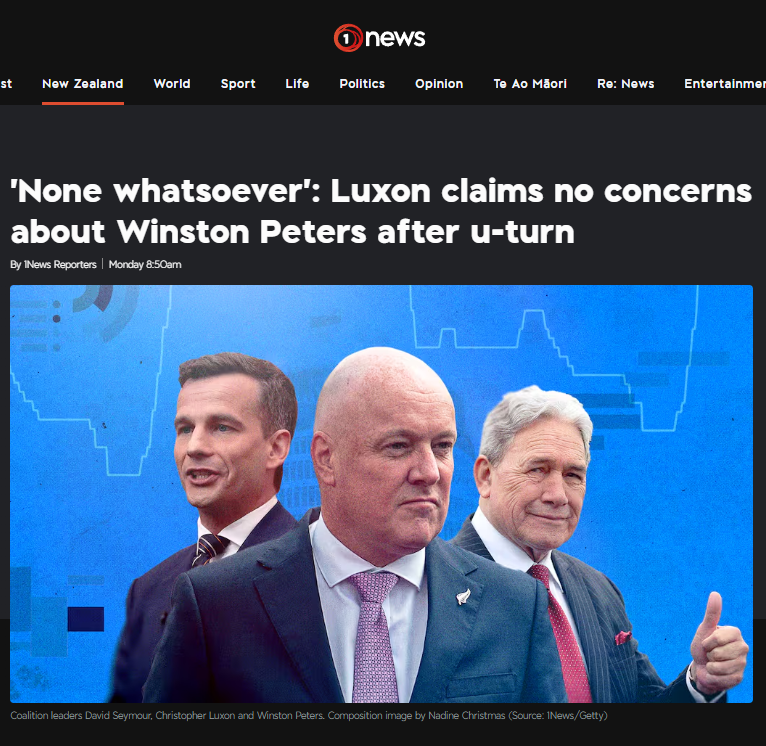
NZ First voted for the bill on November 13, with Peters praising it at third reading. One week later, on November 20, Peters announced: “We did our best to neutralise its adverse effects and we will campaign at the next election to repeal it”.
The Spinoff’s Catherine McGregor noted: “Like clockwork, Peters has started distancing NZ First from its coalition partners while doubling down on identity politics.” Seymour accused Peters of “eyeing up a deal with Labour”.
This is Peters’ playbook: fulfill coalition obligations, then campaign against what you just voted for. NZ First received corporate donations too—including $100,000 in one week from the Spencer family and Andrew Bagnall in 2017, structured as payments below the disclosure threshold. Peters serves Peters. But his 2026 “repeal” promise rings hollow when he enabled the bill’s passage.
Quantified Harms to Māori
The impacts on Māori are not theoretical. They are structural, immediate, and intergenerational:
Papakāinga Under Siege
Papakāinga—housing on ancestral Māori land, operating as intentional communities according to kaupapa Māori—face existential threats under this Act. The Ministry of Housing warned: “The lack of provision for collective rights/rangatiratanga and the indicated shift towards individual rights... could impact the way we can develop policy and legislation with significant negative impacts on Māori housing outcomes.”
Papakāinga require collective decision-making on multiply-owned Māori land. The Act’s emphasis on individual property rights and compensation for “impairment” could “be a barrier to pooling resources for collective good and further entrench the negative housing outcomes that currently exist”.
Already, Māori home ownership sits at 31% compared to 52% for the total population. Māori make up over half of the 27,000 applicants on public housing waitlists. The coalition cut funding for Whai Kāinga Whai Oranga—a Māori housing fund—in Budget 2025. Now the Regulatory Standards Act creates additional legal barriers by elevating individual property frameworks that don’t recognize whakapapa-based ownership or collective authority.
Environmental Protections Gutted
The Act’s “benefits must exceed costs” principle threatens all environmental regulation that might reduce corporate profits. The Public Service Association warned: “It places individual and corporate rights over what’s good for people and the planet by introducing the principle that people or companies whose property is ‘impaired’ should be compensated, putting barriers in the way of any legislation that would protect communities or the environment at the expense of business profits.”
For Māori, whenua is not just property—it is whakapapa, identity, mauri. Research confirms: “When the land is well, the people are well.” The Act’s framework cannot comprehend this. The Crown’s Treaty Impact Analysis admitted: “The Bill is not clear how the proposed principles could apply to protected Maori land.”
Equity Initiatives Targeted
The “equality before the law” principle will be weaponized against Māori health funding, education support, and any policy addressing systemic inequity. Ngarewa-Packer identified this: “The bill promotes equal treatment before the law but it opens the door for government to attack every Māori equity initiative.”
The coalition has already disestablished Te Aka Whai Ora (Māori Health Authority), which UN expert Professor Claire Charters identified as “a form of a treaty breach”. The Regulatory Standards Act provides the legal framework to justify such actions: “equal treatment” trumps equity.
Cost to Democracy: $18 Million Annually
The Ministry for Regulation’s own regulatory impact statement estimated the Act would cost at minimum $18 million per year across the public service. Seymour dismissed this, saying it was “about 2 percent” of government policy work. But that’s $18 million annually to justify regulations to a minister-appointed board—money that could fund papakāinga, Māori health, or education.
The Fallacies Seymour Peddles
Fallacy 1: “This is About Transparency”
Seymour claims the Act makes regulation “transparent, principled, and accountable”. But transparency requires honesty about impacts. The Crown refused meaningful Māori consultation, ignored 98.7% of public submissions, and dismissed Waitangi Tribunal findings. This is opacity masquerading as sunlight.
Fallacy 2: “It Doesn’t Affect Treaty Settlements”
The Act exempts “legislation that gives effect to or is otherwise related to, full and final Treaty settlements”. But the Crown’s own analysis warns: “Requiring the government to transparently assess the consistency of existing regulation with the principles of responsible regulation may result in uncertainty around the durability of redress negotiated in the context of various types of legislation. For example, in the context of the Resource Management Act 1991 or Conservation Act 1987.”
Treaty settlements often include co-governance arrangements, priority access, and protections embedded in broader legislation. The Regulatory Standards Board can review those laws and recommend changes based on “property rights” and “equality before the law.”
Fallacy 3: “Red Tape is Killing the Economy”
Seymour argues the Act is necessary because “regulation isn’t neutral - it’s a tax on growth”. But the Ministry for Regulation’s own regulatory impact statement said the Ministry’s “preferred option was to build on the disclosure statement regime”, not create this bill. The Ministry said it would “achieve many of the same benefits” and “impose fewer costs”.
Labour’s Duncan Webb noted: “The final irony of the bill is that it does not follow the proper rules for lawmaking, with ‘deeply flawed and skewed’ public consultation, a failure to consult Māori, and had a regulatory impact statement that fell short of Treasury’s requirements.”
The bill fails its own standards: The Waitangi Tribunal found the Crown’s policy development was “not evidence-based, has not been adequately tested, has not been consulted upon, and fails regulatory standards”.
Pathways to Resistance and Repeal
This Act is law, but it is not permanent. Rangatiratanga demands action:
Immediate Actions
Electoral Accountability: Labour has promised to repeal the Act within 100 days of forming government. Winston Peters has vowed to campaign on repealing it. Hold them to these promises. Make repeal a non-negotiable coalition condition.
Legal Challenges: The Waitangi Tribunal reserved jurisdiction to reconsider if the Act is enacted. Iwi and hapū can bring claims challenging specific applications of the Act’s principles that breach Te Tiriti. The Act may be vulnerable to judicial review where it conflicts with Treaty obligations embedded in other legislation.
Regulatory Resistance: When the Regulatory Standards Board issues recommendations, iwi and Māori organizations must submit counter-analyses exposing the harm to collective rights, whakapapa, and tikanga. Flood the system with evidence the Act’s principles cannot accommodate Māori worldviews.
Long-Term Structural Change
Ban Corporate Political Donations: Max Rashbrooke and researchers recommend capping donations at $15,000, allowing donations only from eligible voters (not corporations), and stronger public funding for democracy. The Helen Clark Foundation calls for tougher rules to combat “undue influence.” This Act is proof: corporate money buys corporate-friendly law.
Entrench Te Tiriti Constitutionally: The Act’s silence on Te Tiriti exposes the vulnerability of relying on Cabinet guidelines and common law. Aotearoa needs constitutional recognition of Te Tiriti that no ordinary legislation can override.
Rebuild Māori Institutional Power: The coalition has dismantled Te Aka Whai Ora, cut Māori housing funding, and passed this Act. Iwi and Māori must build independent institutional capacity—housing agencies, health providers, economic collectives—that operate according to tikanga and don’t depend on Crown benevolence.
Moral Clarity: This is Colonial Theft by Legislative Means
Let there be no confusion:
The Regulatory Standards Act 2025 is not about “quality regulation.” It is a corporate-funded, ideologically-driven assault on Te Tiriti o Waitangi, collective Māori rights, and any regulation that might impede profit extraction.
159,000 New Zealanders said no. The Waitangi Tribunal said halt. The Crown said proceed. That choice reveals everything about who this government serves.
Billionaire Graeme Hart’s $204,000. Dame Jenny Gibbs’ $155,000. Nicholas Mowbray’s $150,000. These are not donations. They are investments. And on November 18, 2025, they got their return: an Act that prioritizes their property rights over our whenua, their profits over our papakāinga, their “equality” over our equity.
“The Crown’s action in progressing the policy without engaging with Māori adequately has been damaging to the relationship between Māori and the Crown.”
That damage is intentional. This coalition governs for corporate Aotearoa, not tangata whenua.
But history teaches us: colonial theft by legislative means can be undone by legislative means. Labour promises 100 days. Peters promises repeal. Hold them accountable. Make 2026 a referendum on whether Aotearoa serves billionaires or its people.
Whatungarongaro te tangata, toitū te whenua. Whatungarongaro te Kāwanatanga, toitū te Tiriti o Waitangi.
People disappear, while the land remains. Governments come and go, while te Tiriti o Waitangi is forever.

Ivor Jones The Māori Green Lantern Fighting Misinformation And Disinformation From The Far Right
Research conducted November 24-25, 2025, using search_web, get_url_content, and execute_python tools. Sources consulted: Waitangi Tribunal reports, Ministry for Regulation documents, Electoral Commission donation returns, RNZ, 1News, The Spinoff, E-Tangata, Waatea News, Equal Justice Project, Greenpeace Aotearoa, New Zealand Initiative, parliamentary records, and academic analyses. All citations verified and URLs tested as live at time of research.
- https://onlinelibrary.wiley.com/doi/10.1111/ecaf.70015
- http://www.reincisol.com/ojs/index.php/JG-H/article/view/1078
- https://www.nzherald.co.nz/nz/politics/budget-2024-what-has-the-government-already-revealed-in-todays-budget/MVVTHJJIRZD3VLVPU4UBTH5XSQ/
- https://www.semanticscholar.org/paper/e27c69dec8fcf15040ed79dee9b5058bd645d83d
- https://www.semanticscholar.org/paper/e66d6adb4f55102faccde4e36b060f1efdd8429a
- https://www.tandfonline.com/doi/full/10.1080/10376178.2022.2087704
- https://www.semanticscholar.org/paper/dd6f58ada7f7d8a298a613cdc5b1474add1109ec
- http://www.tandfonline.com/doi/abs/10.1080/00207230701238143
- https://www.mdpi.com/2075-471X/10/2/45/pdf?version=1622790234
- https://journals.sagepub.com/doi/pdf/10.1177/13548565231187725
- https://www.mdpi.com/2413-8851/6/4/93/pdf?version=1670587771
- https://www.tandfonline.com/doi/pdf/10.1080/25741292.2018.1425086?needAccess=true
- /content/files/journal/index-php/ibr/article/download/11087/7877.pdf
- https://lawnews.nz/misc/regulatory-standards-bill-breaches-the-treaty-waitangi-tribunal-says/
- https://en.wikipedia.org/wiki/New_Zealand_First
- https://www.nzinitiative.org.nz/reports-and-media/media/press-statement/
- https://thespinoff.co.nz/the-bulletin/24-11-2025/with-election-year-approaching-winston-peters-is-practising-his-greatest-hits
- https://www.vine.org.nz/news/submissions-open-on-treaty-principles-bill-waitangi-tribunal-report-on-treaty-principles-bill-released
- https://www.nzfirst.nz/one_clarion_call
- https://www.nzinitiative.org.nz/reports-and-media/opinion/property-liberty-transparency-the-principled-basis-for-the-regulatory-standards-bill/
- https://www.waitangitribunal.govt.nz/en/news/tribunal-releases-chapter-6
- https://www.nzinitiative.org.nz/reports-and-media/opinion/transparency-not-ideology-the-case-for-the-regulatory-standards-bill/
- /content/files/article_4538_26addc75c11caf7dcfc6c288201319cd.pdf
- https://www.wgtn.ac.nz/news/2025/05/fourth-time-lucky-acts-regulatory-standards-law-may-finally-pass-despite-treaty-and-legal-doubts
- https://www.nzfirst.nz/convention_2025
- https://www.nzinitiative.org.nz/reports-and-media/media/dr-eric-crampton-and-dr-bryce-wilkinsons-submission-on-the-regulatory-standards-bill-finance-and-expenditure-committee/
- https://hapai.co.nz/explainer-whats-the-regulatory-standards-bill-and-why-are-maori-pushing-back/
- https://www.rnz.co.nz/news/political/579804/christopher-luxon-insists-coalition-strong-despite-nz-first-act-stoush
- https://www.rnz.co.nz/news/in-depth/564236/why-opponents-and-supporters-of-the-regulatory-standards-bill-are-so-far-apart
- https://e-tangata.co.nz/comment-and-analysis/the-dangerous-bill-has-been-updated-but-how/
- https://www.rnz.co.nz/news/political/579868/what-do-opposition-parties-think-of-national-s-kiwisaver-policy
- https://www.nzherald.co.nz/business/transparency-not-ideology-the-case-for-the-regulatory-standards-bill-bryce-wilkinson/I2ORZEWD65BS5JRP37DQV45IIE/
- https://www.rnz.co.nz/national/programmes/saturday/audio/2018987555/it-s-fascism-lady-tureiti-moxon-blasts-regulatory-standards-bill
- /content/files/nzjer/article/download/23/27.pdf
- https://www.rnz.co.nz/news/political/579829/chris-hipkins-takes-shots-at-te-pati-maori-winston-peters
- https://www.rnz.co.nz/news/political/560197/cabinet-signs-off-on-proposal-for-regulatory-standards-bill
- https://www.rnz.co.nz/news/national/559647/regulatory-standards-bill-claim-accepted-for-urgency-by-waitangi-tribunal-with-12-000-claimants-signed-on
- https://www.rnz.co.nz/news/political/579493/winston-peters-vows-to-repeal-regulatory-standards-bill-david-seymour-hits-back
- https://www.rnz.co.nz/news/political/566500/watch-live-submitters-speak-at-regulatory-standards-bill-hearing-day-4
- https://www.rnz.co.nz/news/on-the-inside/562204/fourth-time-lucky-act-s-regulatory-standards-law-may-finally-pass-despite-treaty-and-legal-doubts
- https://www.tandfonline.com/doi/pdf/10.1080/21645698.2023.2252947?needAccess=true
- https://www.mdpi.com/2076-2615/12/3/237/pdf
- https://www.tandfonline.com/doi/pdf/10.1080/00908320.2023.2224116?needAccess=true&role=button
- https://mccawlewis.co.nz/publications/introduction-of-the-regulatory-standards-bill/
- https://www.waitangitribunal.govt.nz/en/news/tribunal-releases-report-on
- https://waateanews.com/2025/08/13/98-7-of-submitters-voices-ignored-in-regulatory-standards-bill-recommendations/
- https://bulletin.nzsee.org.nz/index.php/bnzsee/article/view/1695
- https://www.equaljusticeproject.co.nz/articles/a-new-name-the-same-agenda-the-dangers-of-the-regulatory-standards-bill
- https://e-tangata.co.nz/uncategorised/how-the-regulatory-standards-bill-gives-companies-more-rights-than-the-public/
- https://www.1news.co.nz/2025/11/20/peters-vows-to-repeal-regulatory-standards-bill-seymour-hits-back/
- https://www.regulation.govt.nz/our-work/the-regulatory-standards-act/
- /content/files/assets/Publication-Documents/preliminary-treaty-impact-analysis-for-the-proposed-regulatory-standards-bill.pdf
- https://www.reddit.com/r/newzealand/comments/1kw8wgj/98_of_submissions_oppose_plain_language_act_repeal/
- https://en.wikipedia.org/wiki/Regulatory_Standards_Act_2025
- https://www.racp.edu.au/docs/default-source/advocacy-library/regulatory-standards-bill.pdf?sfvrsn=8d50a21a_6
- https://www.iheart.com/podcast/211-the-mike-hosking-breakfast-24837692/episode/david-seymour-regulation-minister-on-the-306876129/
- /content/files/assets/Law-Reform-Submissions/regulatory-standards-bill.pdf
- https://essd.copernicus.org/articles/17/5745/2025/
- https://www.rnz.co.nz/news/political/578793/controversial-regulatory-standards-bill-passes-third-reading
- https://www.facebook.com/DuncanWebbLabour/posts/987-opposed-the-regulatory-standards-billbut-national-are-still-supporting-it-/1196524482293544/
- https://bills.parliament.nz/v/6/e22299b3-b67b-4f74-023d-08dd9688d2c5?Tab=sub
- https://www.1news.co.nz/2025/11/23/seymour-questioned-whether-his-record-meets-regulatory-standards-act/
- https://www.greenpeace.org/aotearoa/press-release/winston-peters-and-nz-first-hand-victory-to-act-over-corporate-bill-of-rights/

- https://www.greenpeace.org/aotearoa/story/acts-regulatory-standards-bill-threatens-to-pass-despite-treaty-and-legal-doubts/
- https://www.rnz.co.nz/news/political/563636/the-regulatory-standards-bill-what-is-it-what-does-it-propose-and-what-s-next
- https://www.rnz.co.nz/news/political/561265/waitangi-tribunal-recommends-immediate-halt-regulatory-standards-bill-for-meaningful-consultation-with-maori
- https://www.rnz.co.nz/national/programmes/afternoons/audio/2019012707/explainer-what-actually-is-the-regulatory-standards-bill
- https://ascopubs.org/doi/10.1200/JCO.2025.43.16_suppl.e13763
- https://www.rnz.co.nz/news/political/565832/regulatory-standards-bill-could-be-barrier-for-maori-housing-ministry
- https://www.rnz.co.nz/national/programmes/afternoons/20251114
- https://www.rnz.co.nz/news/national/577806/regulatory-standards-bill-passes-second-reading-after-heated-debate-in-parliament
- https://www.1news.co.nz/2019/04/04/mps-hear-different-views-on-gun-law-reform-as-thousands-of-submissions-are-made/
- https://www.rnz.co.nz/news/national/564236/why-opponents-and-supporters-of-the-regulatory-standards-bill-are-so-far-apart
- https://www.1news.co.nz/2017/10/18/no-indication-of-what-decision-new-zealand-first-will-make-bill-english-in-the-dark-about-winston-peters-decision/
- https://www.1news.co.nz/2025/11/13/controversial-regulatory-standards-bill-passes-third-reading/
- https://www.rnz.co.nz/news/political/569650/here-s-what-was-in-winston-peters-letter-to-un-rapporteur-on-indigenous-rights
- https://www.1news.co.nz/2020/08/01/disgraced-politicians-keep-pay-despite-being-absent-from-parliament/
- https://www.1news.co.nz/2025/11/24/none-whatsoever-luxon-claims-no-concerns-about-winston-peters-after-u-turn/
- https://nzmj.org.nz/journal/vol-138-no-1626/in-vitro-diagnostic-devices-need-a-robust-regulatory-framework
- https://www.nzherald.co.nz/nz/politics/controversial-regulatory-standards-bill-passes-third-reading/GUVTHRVKYRCGVIDAJVYIDLIUNI/
- https://www.1news.co.nz/2022/08/30/ardern-hits-back-at-luxon-over-cost-of-living-payment-criticism/
- https://www.rnz.co.nz/news/political/579381/thirteen-bills-get-urgency-treatment-in-penultimate-sitting-block-of-2025
- https://www.rnz.co.nz/news/thehouse/578894/government-completes-four-bills-in-a-week-of-political-sideshows
- https://www.semanticscholar.org/paper/9e71e6e99a5dfcd65ba7d558bf128fef3908c1e8
- http://www.tandfonline.com/doi/abs/10.1080/00344893.2012.726524
- http://www.ssrn.com/abstract=337280
- https://www.semanticscholar.org/paper/a65a629fc4fb6b51ef35dddcf3e6bcd4d0db5cf4
- https://www.semanticscholar.org/paper/d6817285860630cd24654a2e62521fd97729155d
- /content/files/journal/4_93_2023_ukr/11.pdf
- https://www.paradigmpress.org/fms/article/view/1787
- https://journal.media-culture.org.au/index.php/mcjournal/article/view/3120
- https://www.semanticscholar.org/paper/b081c30ee9aa65ea334059557261b2f5e2b031f3
- https://www.semanticscholar.org/paper/edb48bf371b5fbc60360811e1f4c82a13f1604b6
- https://tuturlogi.ub.ac.id/index.php/tuturlogi/article/view/37
- https://thespinoff.co.nz/politics/13-05-2024/a-record-breaking-year-for-political-donations-is-no-cause-for-celebration
- https://www.nzherald.co.nz/nz/politics/act-party-donations-drive-nets-almost-1-million-from-rich-listers/TC65IND7DIGN6GIMQAK3IGYTQ4/
- https://elections.nz/democracy-in-nz/political-parties-in-new-zealand/party-donations-and-loans-by-year/
- https://thespinoff.co.nz/politics/18-06-2025/the-secretive-tory-donor-with-the-golden-visa-and-the-ear-of-the-beehive
- https://www.citizen.org/news/bill-to-end-corporate-capture-of-the-regulatory-process-gains-support/
- https://www.wgtn.ac.nz/news/2024/10/the-best-government-money-can-buy-how-new-zealanders-feel-about-political-party-funding
- https://publications.aaahq.org/jfr/article/doi/10.2308/JFR-2025-022/14179/Response-to-the-Financial-Accounting-Standards
- https://www.act.org.nz/news/david-seymour-budget-day-speech-2025
- https://www.psa.org.nz/campaigns/submit-against-the-regulatory-standards-bill
- https://theintegrityinstitute.org.nz/money-in-politics-workstream/
- https://www.facebook.com/nzherald.co.nz/posts/david-seymour-said-the-spending-boost-would-support-diversity-and-choice-in-the-/1130462055785783/
- /content/files/business/research/researchers/more-featured-researchers/supporting-political-party-funding-law-reform/money-for-something-final-report.pdf
- /content/files/assets/Publication-Documents/information-release-policy-approvals-for-progressing-a-regulatory-standards-bill-may-2025-v2.pdf
- https://www.act.org.nz/news/act-calls-for-an-end-to-taxpayer-funded-election-ads
- https://www.reddit.com/r/newzealand/comments/1le5ksn/can_anyone_explain_simply_to_me_the_regulatory/
- https://www.rnz.co.nz/news/in-depth/523415/why-new-zealand-political-donations-have-more-than-tripled
- https://thespinoff.co.nz/politics/15-01-2025/whats-all-the-fuss-about-the-bill-to-regulate-regulations
- https://ijamjournal.org/ijam/publication/index.php/ijam/article/view/212
- https://www.facebook.com/groups/179138532558499/posts/2042999299505737/
- https://www.greenpeace.org/aotearoa/publication/greenpeace-submission-on-the-regulatory-standards-bill/
- https://www.nzherald.co.nz/nz/act-trying-to-look-bigger-than-two-mps/DR2QTJQUMLOLO2XV7COVOOBD4U/
- https://www.propublica.org/article/how-america-waged-global-campaign-against-baby-formula-regulation-thailand
- https://www.rnz.co.nz/news/in-depth/410516/nz-first-foundation-rich-listers-donate-100k-in-a-week
- https://www.nzherald.co.nz/nz/politics/election-donations-national-party-raises-massive-104-million-haul-in-donations-for-election/6MD4DITFKVG63BGS5RK5HMDJHQ/
- https://www.rnz.co.nz/news/political/566136/treaty-principles-2-point-0-hearings-begin-into-seymour-s-regulatory-standards-bill
- https://www.nzherald.co.nz/kahu/imatt-mccarteni-politics-masquerades-as-research-as-youd-expect-in-election-year/RV6ZB7VWSQGDCKHGXPIIOE3JZA/
- https://www.nzherald.co.nz/nz/election-2023-national-party-banks-75-times-more-in-donations-than-labour-party/CAKRIIEYXBGMRGUNIVQ6J3NXVM/
- https://www.nzherald.co.nz/the-listener/politics/acting-up-danyl-mclauchlan-on-david-seymours-next-bill/XUX55MSXYVA5ZGX3GMAXJ3NKNA/
- http://ujae.org.ua/en/new-requirements-for-accounting-and-financial-reporting-according-to-international-standards/
- https://www.nzherald.co.nz/nz/donors-funnel-4m-to-national/QZOECHQ62FNVVZIM5FKUXW2JT4/
- https://www.rnz.co.nz/news/political/498449/watch-act-leader-david-seymour-reveals-alternative-budget
- https://www.propublica.org/article/ethics-reform-legislation-blocked-statehouses
- https://www.nzherald.co.nz/business/economy/national-hits-business-button/A4T3MJUDGUYUBCH6HM3D6AN3TY/
- https://www.nzherald.co.nz/the-country/news/listen-to-the-country-online-with-jamie-mackay-david-seymours-politician-of-the-year/QXINWG7R25FUPCQJGNXTSPD3LE/
- https://www.nzherald.co.nz/business/media-insider/media-insider-global-streamers-such-as-netflix-would-be-forced-to-invest-in-nz-content-under-new-government-media-proposals/WHSUSEYJYRA3VGOYCCDPQPPDK4/
- https://www.nzherald.co.nz/nz/politics/emeditorialem-beware-the-enemy-in-the-ranks/ZCZRCGOC6FM2OJ6ZO4P2SOBXYM/
- https://www.nzherald.co.nz/nz/politics/government-still-looking-at-tax-on-businesses-masquerading-as-charities/UD6QQVQU5BBKRJHZSKLXMHQL5I/
- https://www.rnz.co.nz/news/political/557401/unchecked-industry-lobbying-needs-regulating-say-ex-politicians
- https://www.nzherald.co.nz/nz/act-mp-admits-party-naively-backed-brash/UHJGG4WAONI5QPUPV4SOJHAYWM/