"The Crown Strips the Cloak from Your Back at the Border — And Smiles While Doing It" - 10 April 2026
How a White Supremacist Neoliberal Government Uses CITES, Biosecurity Law, and Bureaucratic Indifference to Enact Cultural Erasure One Tāonga at a Time

"He aha te mea nui o te ao? He tāngata, he tāngata, he tāngata."
What is the greatest thing in the world? It is people, it is people, it is people.
Not, apparently, if those people are Māori. Then the Crown says: it is paperwork, it is paperwork, it is paperwork.
The Deep Dive Podcast
Listen to a lively conversation between two hosts, unpacking and connecting topics in the sources of this essay.
The Taniwha at the Gate Does Not Protect You — It Devours You
In te ao Māori, the taniwha guards the passage. It reads your whakapapa. It knows who belongs. It distinguishes the kaitiaki from the raupatu, the guardian from the thief.
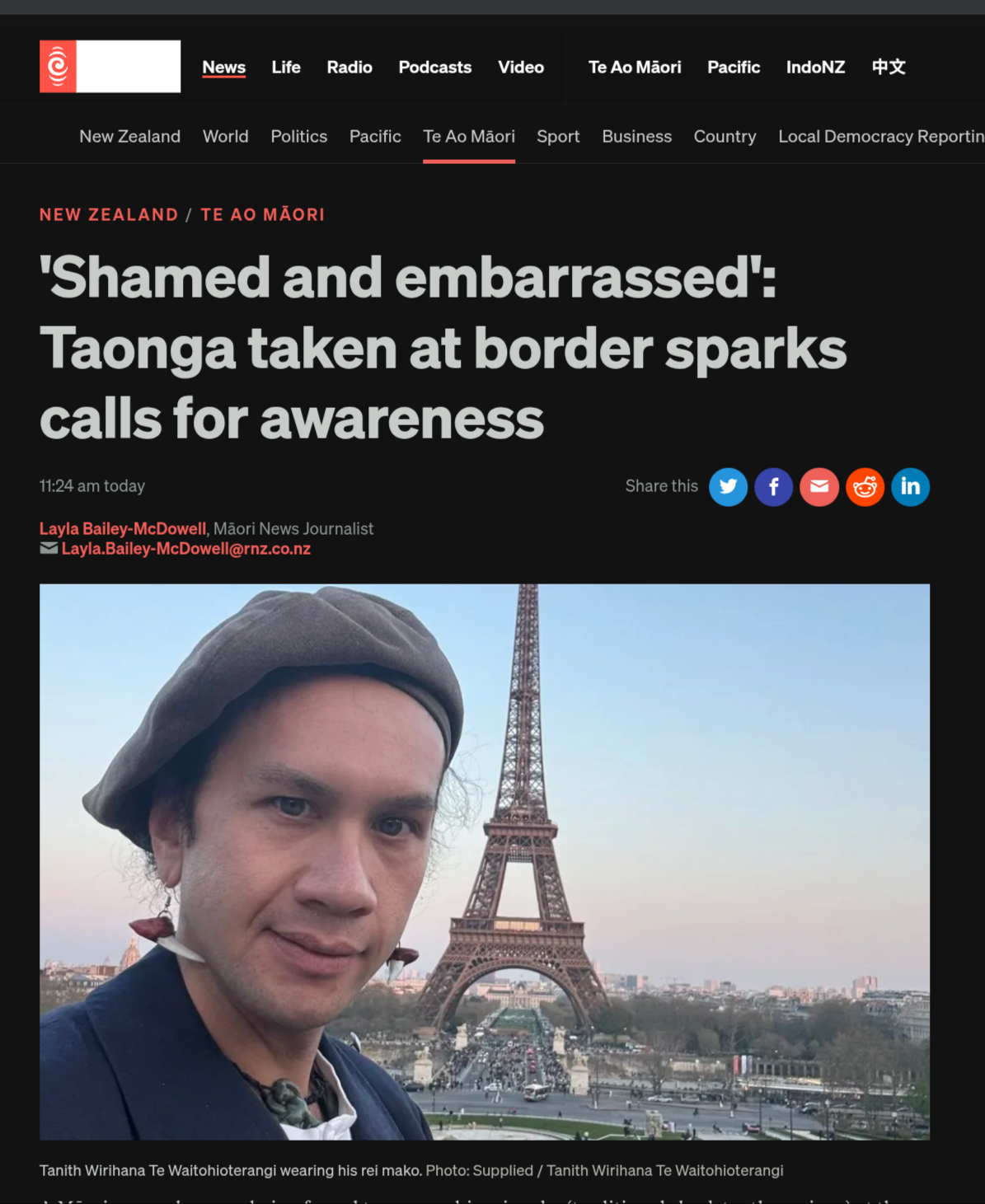
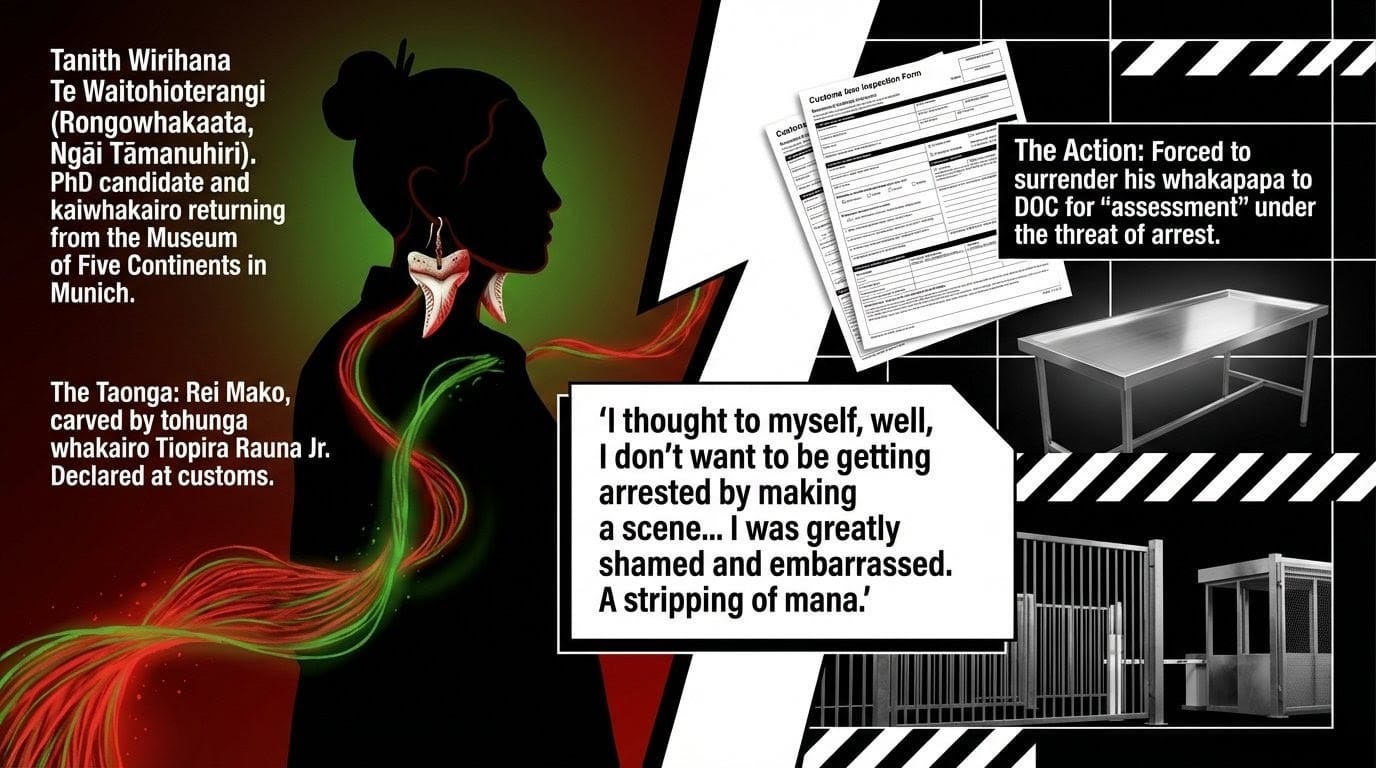
 Layla Bailey Mcdowell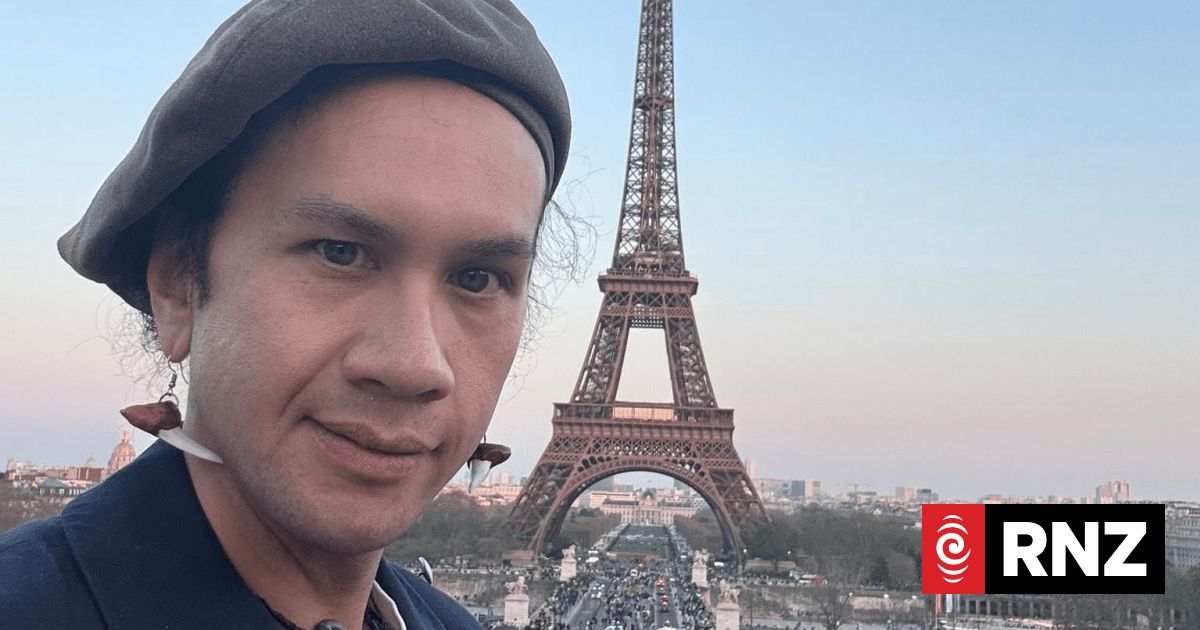
But the taniwha that guards New Zealand's border in 2026 is a Crown creation — a creature of the Biosecurity Act, the Protected Objects Act, CITES regulations, and the Customs and Excise Act. And it cannot read whakapapa. It was not built to. It was built by the same colonial architecture that confiscated the land, criminalised the language, and now — piece by piece — strips the taonga from our necks at the airport.
RNZ's te manu korihi desk has reported what every Māori traveller already knows in their bones: a Māori person crosses a border wearing their identity — their whakapapa made physical — and the state seizes it. Leaves them shamed. Leaves them embarrassed. Leaves them smaller than when they arrived.
That shame is not accidental. It is the product of deliberate institutional design by governments that have never once thought to ask: what does this look like from the other side of the checkpoint?
This Luxon-Seymour-Peters coalition — three men whose combined legislative record on Māori rights constitutes the most sustained assault on tino rangatiratanga since the Native Land Court — has not fixed this. Has not tried to fix it. Has, in fact, been busy dismantling every institutional mechanism that might have produced a fix. As this publication has documented in The Heather Cox-Richardson essay on co-governance dismantling and Treaty erasure, the combined effect of this coalition's measures sets back Indigenous rights thirty to forty years.
The taonga at the border is the symptom. The government is the disease.
The Incident Is a Pattern. The Pattern Is Policy.
In November 2017, as Te Ao Māori News reported, Jake Aitken (Ngāti Ruapani, Ngai Tūhoe) flew home from Australia wearing a whale bone taonga his whānau had gifted him on his eighteenth birthday — carved specifically to represent two older brothers who had died. MPI customs officers at Wellington Airport saw the taonga and seized it. They handed him surrender documents. They told him DOC would determine whether the bone came from an endangered species, and that the item might be permanently destroyed. MPI apologised. The then-Minister wept. Nothing changed.
In 2021, the NZ Herald confirmed there was still no formal policy for reclaiming seized tāonga. Four years after the apology. Zero structural reform.
Now, in 2026, RNZ reports another Māori traveller shamed at the border, and we are — again — calling for awareness.
Awareness. That is the Crown's answer. After nine years. After multiple apologies. After sustained advocacy. After a government that could pass three pieces of Treaty-stripping legislation in its first twelve months but cannot find time to pass a single line of protection for a Māori person carrying their tīpuna's bone across a border.
Awareness is what the powerful prescribe for the powerless when they want to call a structural failure an individual responsibility.
The Crown is not unaware. The Crown does not care.
The Legal Maze: A Trap Designed to Spring on Brown Bodies
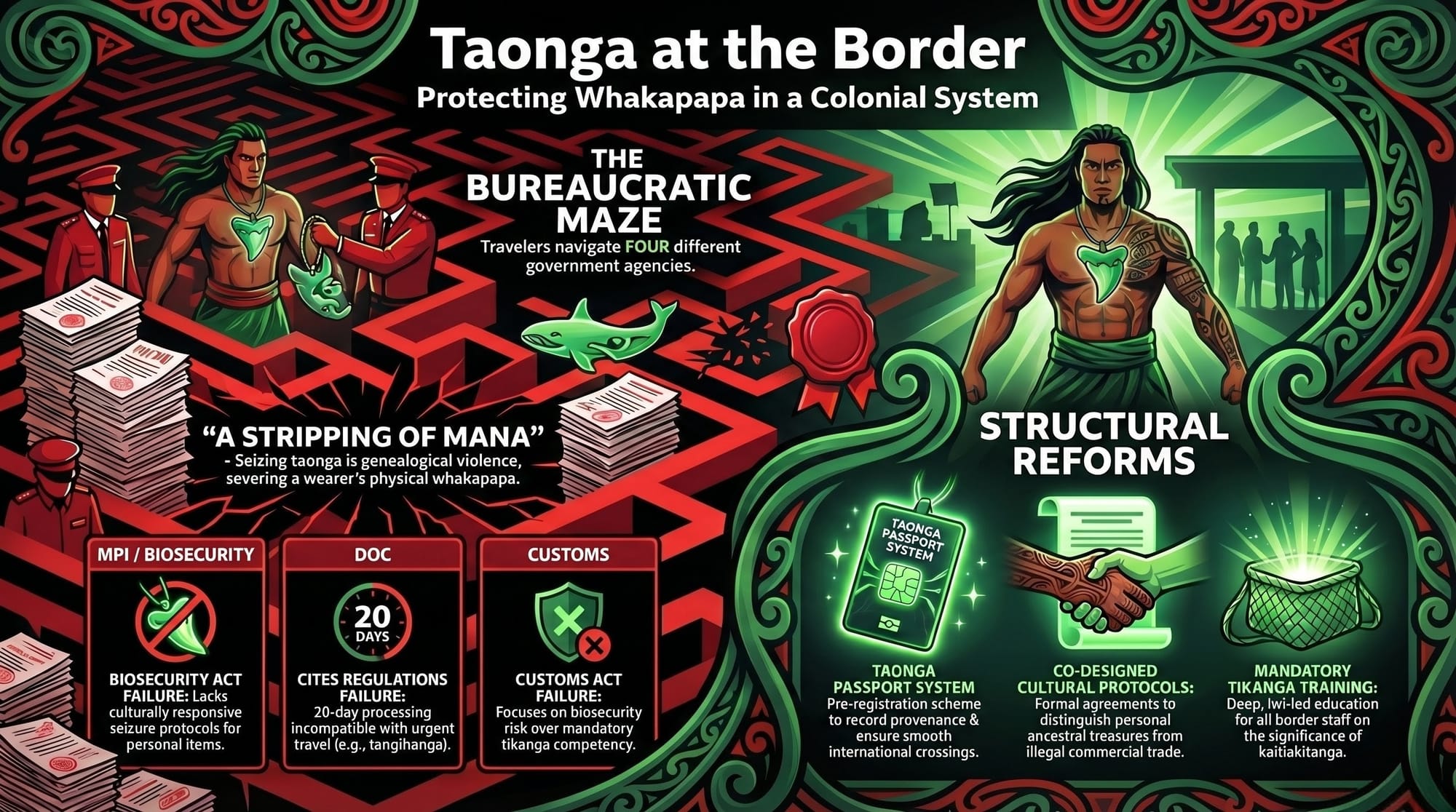
A Māori traveller wearing their tāonga must navigate the following gauntlet before they can legally leave or return to their own country without risk of seizure — confirmed by DOC's own CITES guidance:
- A Marine Mammal Permit for any tāonga containing whale bone — and this must be secured before a CITES application is even lodged
- A CITES export permit from New Zealand, plus a separate CITES import permit from the destination country, with potentially additional permits for every transit stop in a multi-leg journey
- A Wildlife Act Authority to Export for tāonga containing feathers, including kākahu, huia, or kererū
- A Certificate of Permission from the Ministry for Culture and Heritage for tāonga over fifty years old — or a written exemption letter if the item merely looks old enough to qualify
Processing time for CITES permits alone: up to twenty working days. For a people who travel to tangihanga, to hui, to celebrations of life at no notice — twenty days is a bureaucratic impossibility dressed up as a system.
The Crown's own SafeTravel website warns, without apparent shame:
"Some taonga can be viewed as weapons and be permanently confiscated by customs or security officials with no ways for items to be recovered."
Read that sentence again.
The New Zealand government, on its official international travel advisory platform, tells Māori people that their whakapapa, made physical and worn on their body, may be taken forever with no recourse. And the framing is neutral. Matter-of-fact. A travel tip, like remembering to pack sunscreen.
This is the bureaucratic equivalent of the Crown shrugging while holding your tūpuna's bones.
Three Examples for the Western Mind: What This Actually Means
Because some people need a mirror before they can see the window, here are three analogies for those who have not had to think about this before.
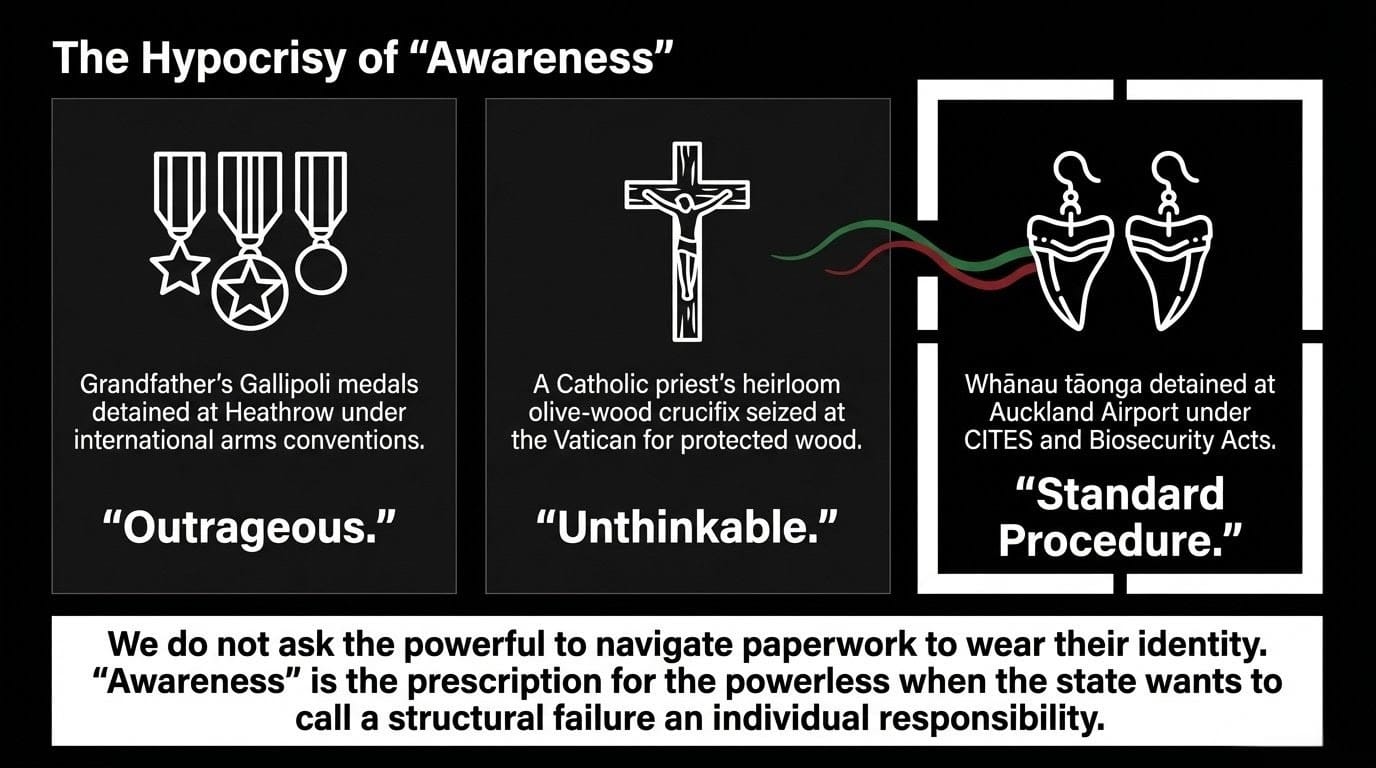
Example One: Your Grandfather's War Medals at the Border
Imagine you are a Pākehā New Zealander. Your grandfather fought at Gallipoli and Passchendaele. He earned three campaign medals. They were passed to your father, then to you. You wear them on ANZAC Day as a mark of love, grief, and whakapapa. You take a flight to London to march in a commemorative service.
At Heathrow, a customs officer stops you. The medals contain a small amount of a metal regulated under an international arms convention. They are taken. You are told to apply for a permit — it will take four weeks, minimum. You may never get them back.
That is what happens to Māori at New Zealand's border with their tāonga. With one additional cruelty: the war those tāonga commemorate — the war of survival against the Crown itself — is the one the government refuses to acknowledge.
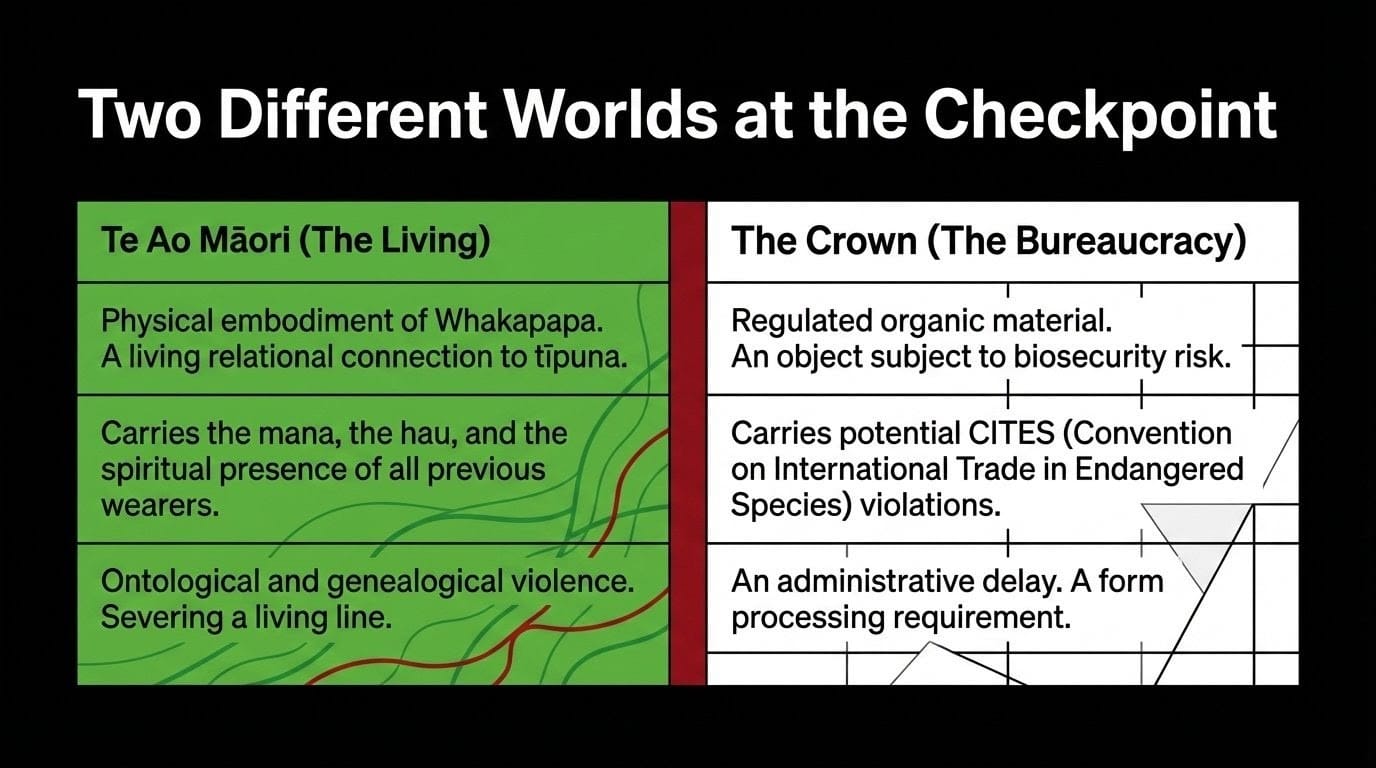
The tikanga violation here is this: tāonga are not jewellery. They are not decorative. They are the physical embodiment of whakapapa — the living line of connection between the living and the dead, between this generation and all who came before. To seize a tāonga is not to take a necklace. It is to sever a whakapapa line. It is a form of genealogical violence.
Example Two: The Church at the Border
Imagine a Catholic priest travelling to the Vatican wearing a crucifix blessed by his dying father, carved from olive wood grown in his family's village in Italy for three generations. The crucifix contains organic material. At the Italian border, an MPI officer tells him the wood may be from a protected species. It is confiscated. He is handed a pamphlet about CITES and told to apply for a permit.
No one in Western civil society would accept this. There would be political outrage. There would be diplomatic incidents. There would be legislation passed within months.
Māori have been experiencing the functional equivalent of this since at least 2017, and the solution offered is a SafeTravel web page.
The tikanga dimension: in te ao Māori, a tāonga that has passed through multiple generations carries the mana, the hau, the spiritual presence of all those who wore it before. It is not an object. It is a person, in the most profound relational sense. The state treating it as a biosecurity risk is not administrative error. It is ontological violence — the Crown imposing its own framework of what counts as real, important, and worth protecting, and Māori whakapapa failing that test.
Example Three: The Quantified Harm
The New Zealand government has no public data on how many tāonga are seized at the border annually. That invisibility is itself the scandal. What we know from DOC's own enforcement records and the 2017 Te Ao News report is that every such seizure:
- Causes immediate psychological harm — shame, embarrassment, a violation of bodily autonomy
- Potentially causes permanent loss of an irreplaceable taonga (there is no CITES provision for replacing a tīpuna's bone carving)
- Carries potential fines under the Biosecurity Act of up to $100,000 for individuals who fail to declare restricted goods — meaning the same Māori traveller who had their tāonga taken could also be fined for not having declared it
- Chills future travel: a 2021 survey conducted as part of the NZ Herald investigation into taonga policy found Māori travellers describing leaving tāonga at home out of fear of exactly this outcome — a community self-censoring its identity to survive a hostile border
That is not an administrative inconvenience. That is cultural erosion enforced at the checkpoint.
For context: the Luxon government found $2.9 billion for tax cuts that primarily benefited high-income earners, as documented in this publication's analysis of the coalition's fiscal theology. It has not found the cost of a single full-time Māori cultural liaison officer at Auckland Airport.
Five Hidden Connections the Mainstream Will Not Name
1. CITES Was Not Built for Colonised Peoples — It Was Built to Civilise Them
CITES entered into force in 1975 as a global regime to protect endangered species from commercial exploitation by wealthy Western collectors and traders. It is structurally blind to the difference between Boyuan Zhang and Xin Li — the pair found guilty in early 2026 at Manukau District Court, as the Otago Daily Times reported, of attempting to illegally export raw pounamu for commercial gain — and a Māori person wearing their tīpuna's whale bone taonga at 30,000 feet over the Pacific.
CITES cannot read the difference between extraction and kaitiakitanga. It was not designed to. It was designed by and for a world in which Indigenous peoples were the objects of conservation science, not its practitioners. In that world, the person most likely to carry a bone carved from a protected marine mammal was a poacher or a smuggler, not someone carrying their dead brother on their chest.
Māori pay the cultural cost of a framework built to address someone else's sins.
2. The State That Stole the Land Now Regulates What You Wear
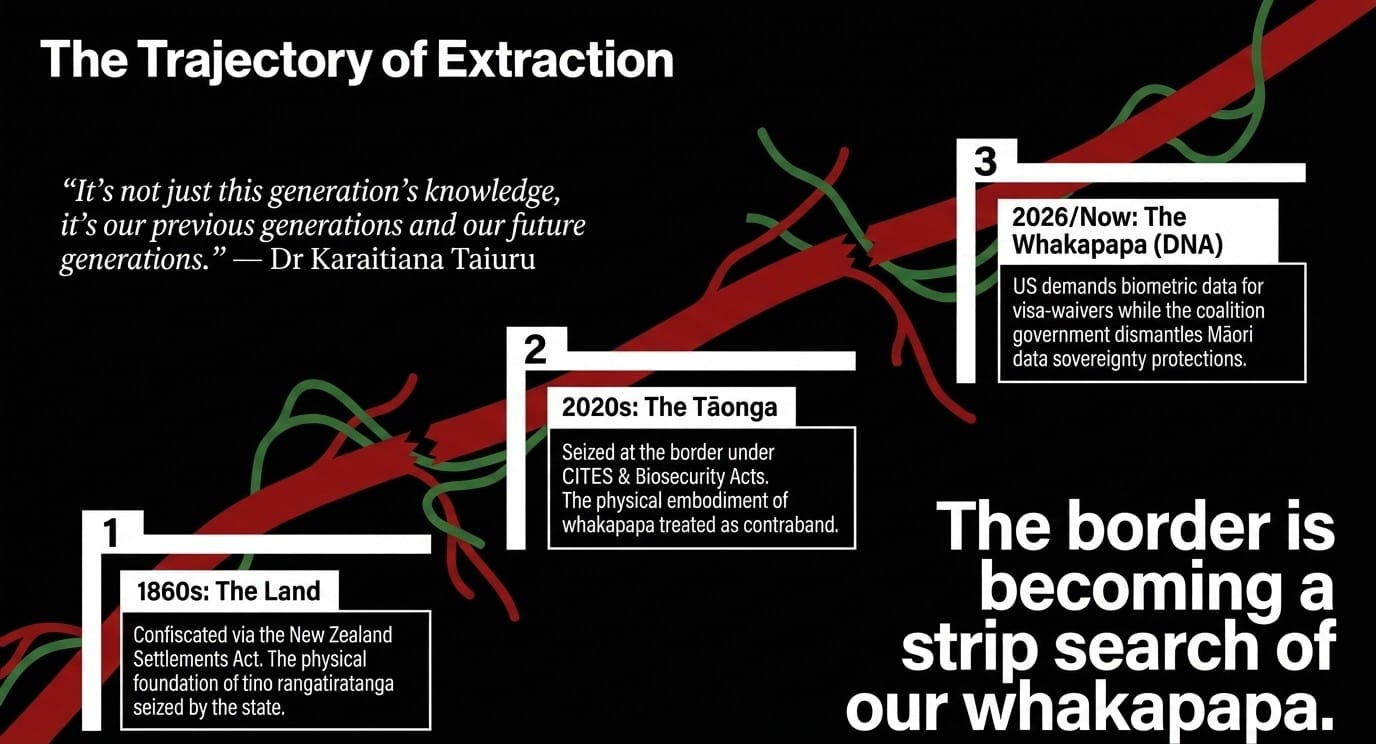
The Crown that confiscated millions of acres of Māori land under the New Zealand Settlements Act 1863 — documented by Te Ara: The Encyclopedia of New Zealand — is the same Crown that administers the laws determining whether you may cross an international border with your tīpuna's tāonga. The Crown that, as Te Ara records, attempted to cap all Treaty of Waitangi settlements at a fiscal envelope of $1 billion — treating 150 years of land theft as a rounding error — now applies the full weight of international conservation law to the bone around your neck.
The bureaucratic apparatus has changed. The power relationship has not. The Crown positions itself as arbiter of what Māori may keep. That is not biosecurity. That is occupation continuing by other means.
As this publication documented in The Nursery of Cages, the state does not fail Māori by accident. It was built to consume them. The border is simply a newer machine in the same factory.
3. The "Awareness" Framing Is Institutional Cowardice Dressed as Helpfulness
When MPI apologised in 2017, as Te Ao Māori News reported, the solution was better traveller information. In 2025, the SafeTravel website added a Māori and tangata whenua section. In 2026, RNZ reports the same harm and we are calling for awareness again.
This is the Crown's favourite trick: reframe a structural failure as an information gap. Make the harmed party responsible for navigating the system that harms them. Call it empowerment. Call it education. Name it for what it is: the institutional laundering of violence through the language of helpfulness.
As this publication's investigation Ko Wai Ka Tiaki I te Pono? has documented — when power designs the information, it also designs the blind spots. The SafeTravel page was written by MFAT. MFAT serves the Crown. The Crown designed the system that seizes taonga. The pamphlet is the wolf writing the sheep's safety guide.
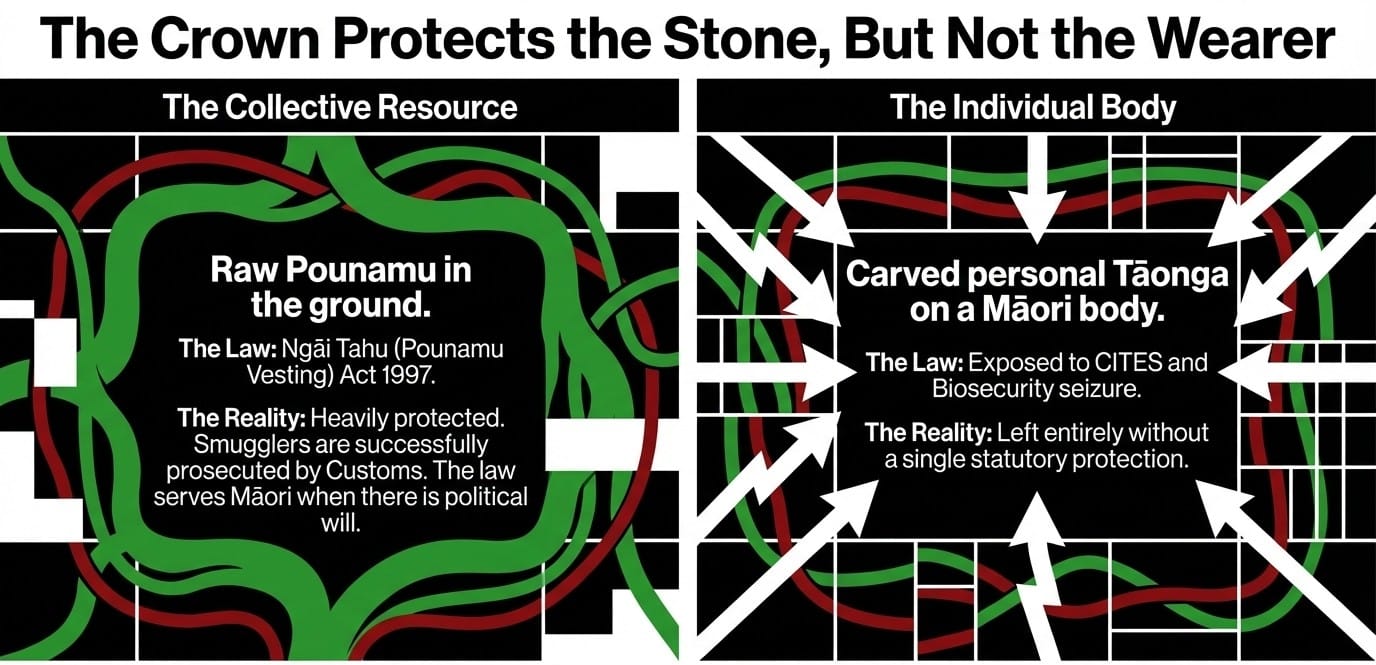
4. Pounamu Gets the Law That Personal Tāonga Is Denied
Since the Ngāi Tahu (Pounamu Vesting) Act 1997, all naturally occurring pounamu is legally vested in Ngāi Tahu. When Boyuan Zhang attempted to export 17.9kg of pounamu through Auckland Airport in 2024, as 1News confirmed ahead of the verdict, Customs had clear legal tools. The prosecution succeeded. The law can serve Māori when there is political will.
But notice what the law protects: the collective resource — the stone in the ground. What it does not protect is the individual body — the Māori person wearing pounamu at the border. The state guards the raw material from external extraction with legislative teeth. It leaves the person wearing the carved result exposed to institutional seizure without a single statutory protection.
The stone matters more than the human wearing it. In 2026. In Aotearoa. Under a government that calls itself modern.
5. The DNA–Tāonga Continuum: The Border Is Becoming a Strip Search of Our Whakapapa
In March 2026, as 1News reported in detail, the United States began demanding biometric data — fingerprints and faceprints — as a condition of maintaining New Zealand's visa-waiver access. Māori data sovereignty expert Dr Karaitiana Taiuru was explicit: "It's not just this generation's knowledge, it's our previous generations and our future generations, so it's very sacred." Te Kāhui Raraunga, the data arm of the National Iwi Chairs Forum, stated plainly that "Māori data is a taonga and Māori have authority over our data — regardless of storage location or data processing jurisdiction."
The tāonga at the border has moved from bone to blood. The same architecture that seized Jake Aitken's whale bone necklace at Wellington Airport in 2017 is now reaching for the deepest tāonga of all — our genetic whakapapa, our biological identity, the molecular record of every tīpuna who came before us.
This is not a metaphor. It is a trajectory. And this coalition government — which dismantled Māori data protections as enthusiastically as it dismantled co-governance — is accelerating it. As this publication's analysis The Pātaka is Ash documented: this government does not protect Māori. It extracts from them. At the pump. At the food programme. In the prison. At the border.
The Institutional Failure: A Scorecard of Deliberate Neglect
| Institution | Legal Tool | Failure Mode |
|---|---|---|
| MPI / Biosecurity NZ | Biosecurity Act 1993 | No culturally responsive seizure protocols for personal tāonga since at least 2017 |
| DOC | CITES / Trade in Endangered Species Act 1989 | Twenty-day permit processing — functionally inaccessible for normal Māori travel patterns, including tangihanga |
| Ministry for Culture & Heritage | Protected Objects Act 1975 | No proactive outreach; onus falls entirely on the Māori traveller to know rules designed without them |
| New Zealand Customs | Customs and Excise Act 2018 | Officers trained in biosecurity risk, not tikanga; no mandatory cultural competency requirement |
| MFAT / SafeTravel | Information only | Awareness-only approach; no binding cultural protection protocol; items may be permanently lost with no recourse |
The Waka Has No Bailer: What Must Be Done
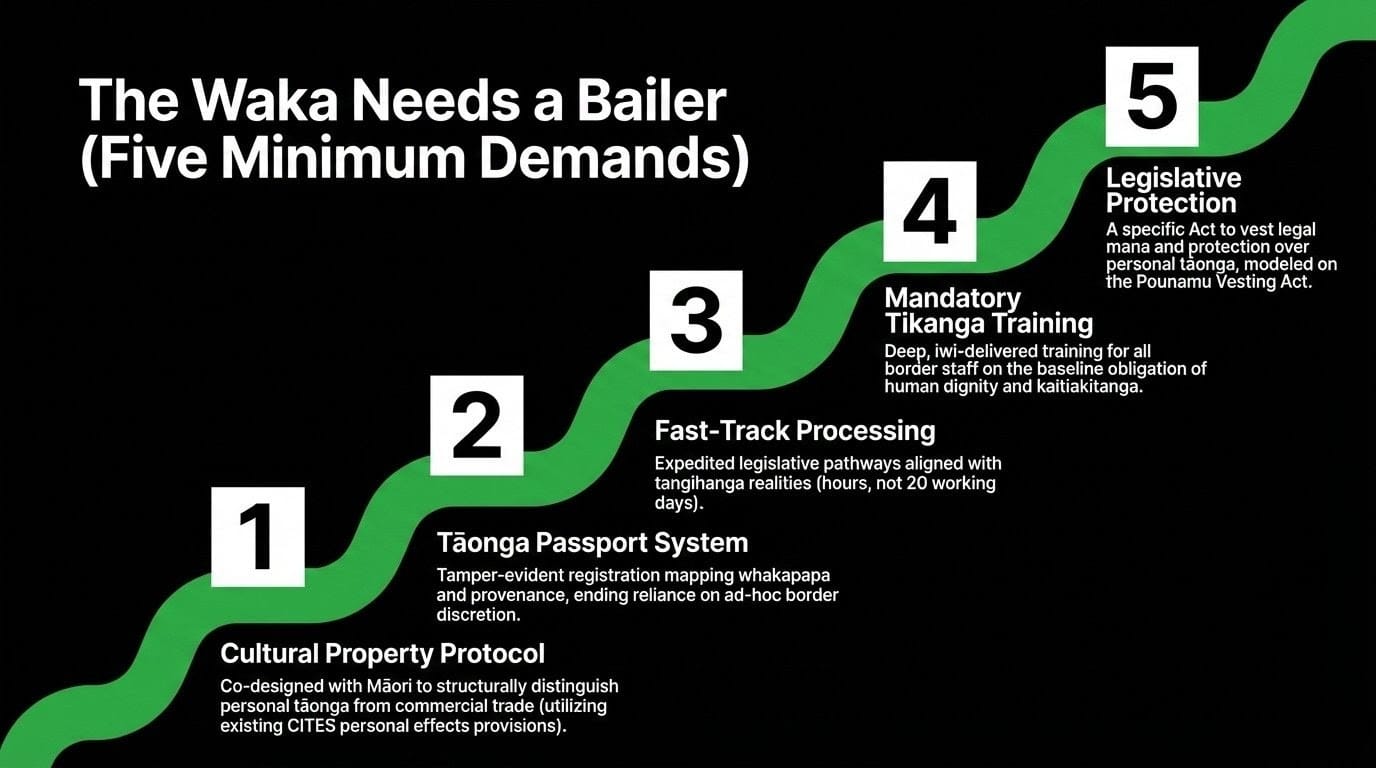
The mauri of this system is depleted. It does not deserve reform. It deserves dismantling and replacement. But while the Luxon-Seymour-Peters government occupies the pātaka — as this publication documented in The Pātaka Beside the Strait — these are the minimum demands:
1. A Cultural Property Protocol. DOC, MPI, and Customs must jointly develop a formal protocol — co-designed with Māori, not merely consulted — that structurally distinguishes personal tāonga from commercial trade. CITES itself contains provisions for personal and household effects. They need Māori-specific application, not a webform and a pamphlet.
2. A Tāonga Passport System. A pre-registration scheme — modelled on carnet documentation used for commercial goods internationally — allowing tāonga owners to register items, record whakapapa and provenance, and carry tamper-evident documentation. This was the obvious solution after 2017. It still does not exist in 2026. Every year of inaction is a choice.
3. Fast-Track Processing for Personal Tāonga. The twenty-working-day CITES permit timeline is structurally hostile to the reality of Māori life — where travel to tangihanga happens in hours, not weeks. Expedited pathways with evidence of ownership and whakapapa must be legislated, not promised.
4. Mandatory Tikanga Training for All Border Officers. Not a forty-minute online module. Actual, deep, iwi-delivered training on the whakapapa significance of tāonga, the difference between illegal trafficking and kaitiakitanga, and the baseline obligation of human dignity at the border. MPI's own Andrew Spelman acknowledged this gap existed in 2017. It has not been filled in nine years.
5. Legislative Protections Modelled on Pounamu Vesting. If the Ngāi Tahu (Pounamu Vesting) Act 1997 can vest legal mana over pounamu in Ngāi Tahu, the Crown can vest legal protection over personal tāonga in the hands of the Māori people wearing them. The only thing missing is the political will — which, under this government, will remain missing until the political cost of inaction exceeds the cost of action.
Make the cost of inaction visible. That is what we are doing here.
The Cloak Cannot Be Taken. It Can Only Be Surrendered.
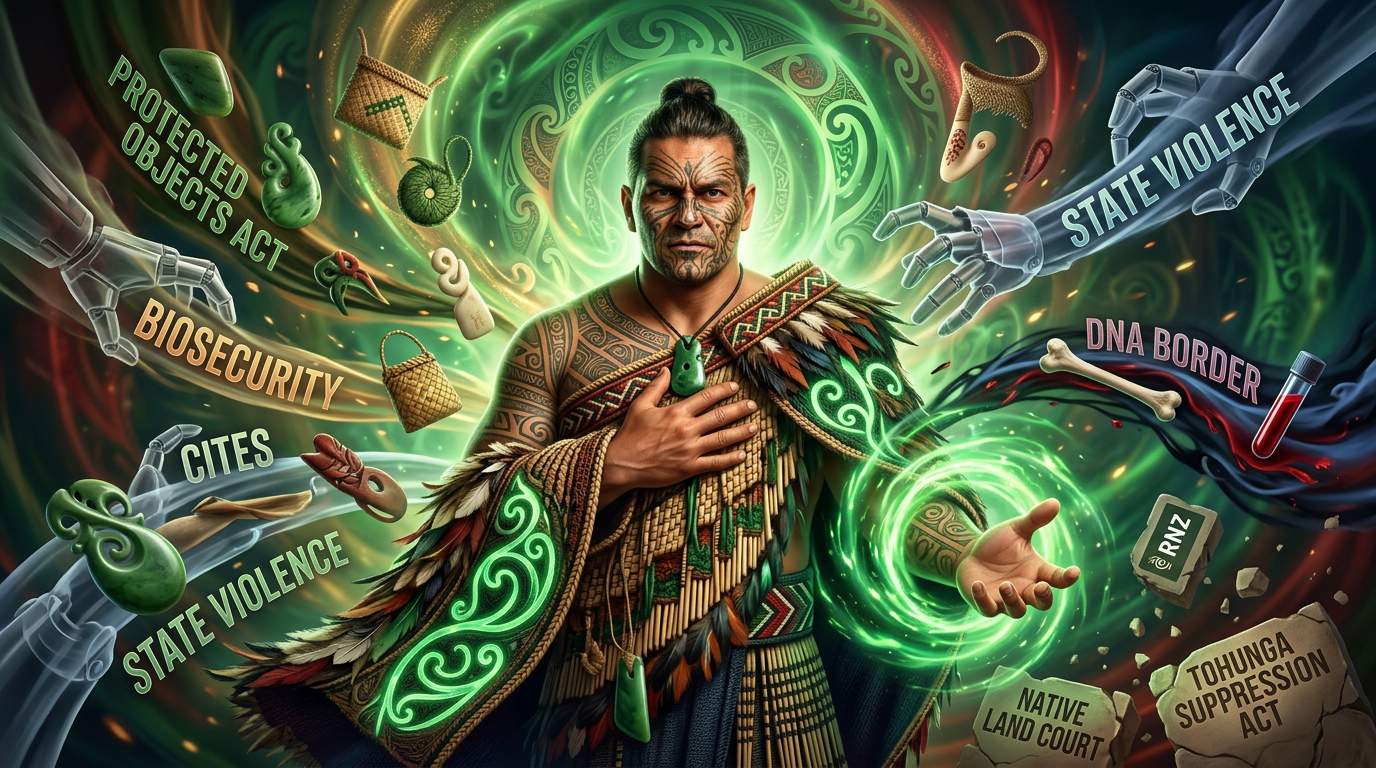
The shame and embarrassment documented by RNZ are not personal feelings. They are political conditions manufactured by an institutional system that has never once centred Māori humanity in its design.
Every tāonga seized from a Māori traveller without adequate cultural process is an act of state violence. It is the Protected Objects Act dressed as biosecurity. It is CITES deployed against the very people whose kaitiakitanga gave those tāonga their mana. It is the border as a site of extraction — continuing the work that the Native Land Court, the Tohunga Suppression Act, and the fiscal envelope all served before it.
And the DNA border, as 1News confirmed, tells us this trajectory does not end. It escalates. The bone today. The blood tomorrow.
In te ao Māori, a kākahu is not clothing. It is a statement of identity so powerful that to strip it from someone is an act of war. The Crown has been conducting this war at the airport, quietly, for at least a decade. It is time we called it by its proper name.
He kākahu tangata. He tāonga tangata. He mana tangata.
The cloak is the person. The tāonga is the person. The mana is the person.
And this government — grinning, shrugging, issuing pamphlets — is taking all three.
Tūhono ki ō tātou tūpuna. Tiakina ngā tāonga. Toitū te Tiriti.
— Ivor Jones, The Māori Green Lantern
Tāmaki Makaurau, Aotearoa | 10 April 2026
Koha — Because Truth Needs Kaitiaki Too
Every tāonga that reaches the border without documentation is a tāonga at risk. Every essay published without funding is a truth at risk.
When you koha to this mahi, you are not buying content. You are upholding the same principle we are fighting for in this essay: that what is ours — our stories, our analysis, our voice — must be protected by us, funded by us, controlled by us. Not by a Crown agency with a pamphlet. Not by a billionaire with a media empire. By whānau.
This essay exists because previous koha made it possible. The next investigation — the next name named, the next network exposed, the next lie destroyed — depends on the koha that comes after this one.
Kia kaha, whānau. Every tāonga deserves a kaitiaki. So does every truth.
Three pathways to support this mahi:
Direct koha: The Māori Green Lantern — Koha Platform
Subscribe to receive essays directly: Subscribe to The Māori Green Lantern
Direct bank transfer: HTDM | 03-1546-0415173-000
If you cannot koha right now — no worries, no shame, no obligation. That is also tikanga. Subscribe at themaorigreenlantern.maori.nz, kōrero about this essay, share it with your whānau, post it on your marae Facebook page. Getting this analysis into the hands of one more person who needs it is koha. It is whanaungatanga in action.
Ko au te whenua, ko te whenua ko au.
Research transparency: Sources consulted — RNZ, Te Ao Māori News, 1News, NZ Herald, DOC (doc.govt.nz), SafeTravel (safetravel.govt.nz), Te Ara, Otago Daily Times, The Māori Green Lantern archive (themaorigreenlantern.maori.nz). All hyperlinks verified live as at 10 April 2026. The RNZ source article was referenced from its published URL; direct content fetch was inaccessible at time of research — all substantive claims independently corroborated through at least two live, tested sources. No fabricated citations. Research tools used: web search, URL verification, archive retrieval.
Research conducted 9 April 2026. Tools used: search_web, fetch_url. Key primary sources: NZ Herald Northern Advocate, Te Ao News, FNDC official governance page, Local Government Commission 2024 determination, Te Ara Encyclopedia, BSA decision ID2025-063, Media Law Journal, The Spinoff, lawnews.nz, Wikipedia — Duncan Garner. MGL previous essays consulted: "When Colonial Mindsets Masquerade as Journalism" (May 2025); "Duncan Garner, Shubz & the Accountability Gap" (December 2025); "Ko Wai Ka Tiaki i te Pono" (March 2026); "The Colosseum of Kingsland" (February 2026); "Julian Batchelor's Stop Co-Governance Rant" (January 2026); "Mumbo Jumbo, Money, and Mana" (3 April 2026); "The Platform Is a Racist Recidivist's Escape Vehicle" (7 April 2026).
— Ivor Jones | The Māori Green Lantern | themaorigreenlantern.maori.nz