”The Crown's Colonial Gaslighting Machine: How Goldsmith and Jones Weaponise Poverty Against Ngāpuhi Sovereignty” - 11 July 2025
When Ministers Become Merchants of Misinformation
Kia ora whānau.
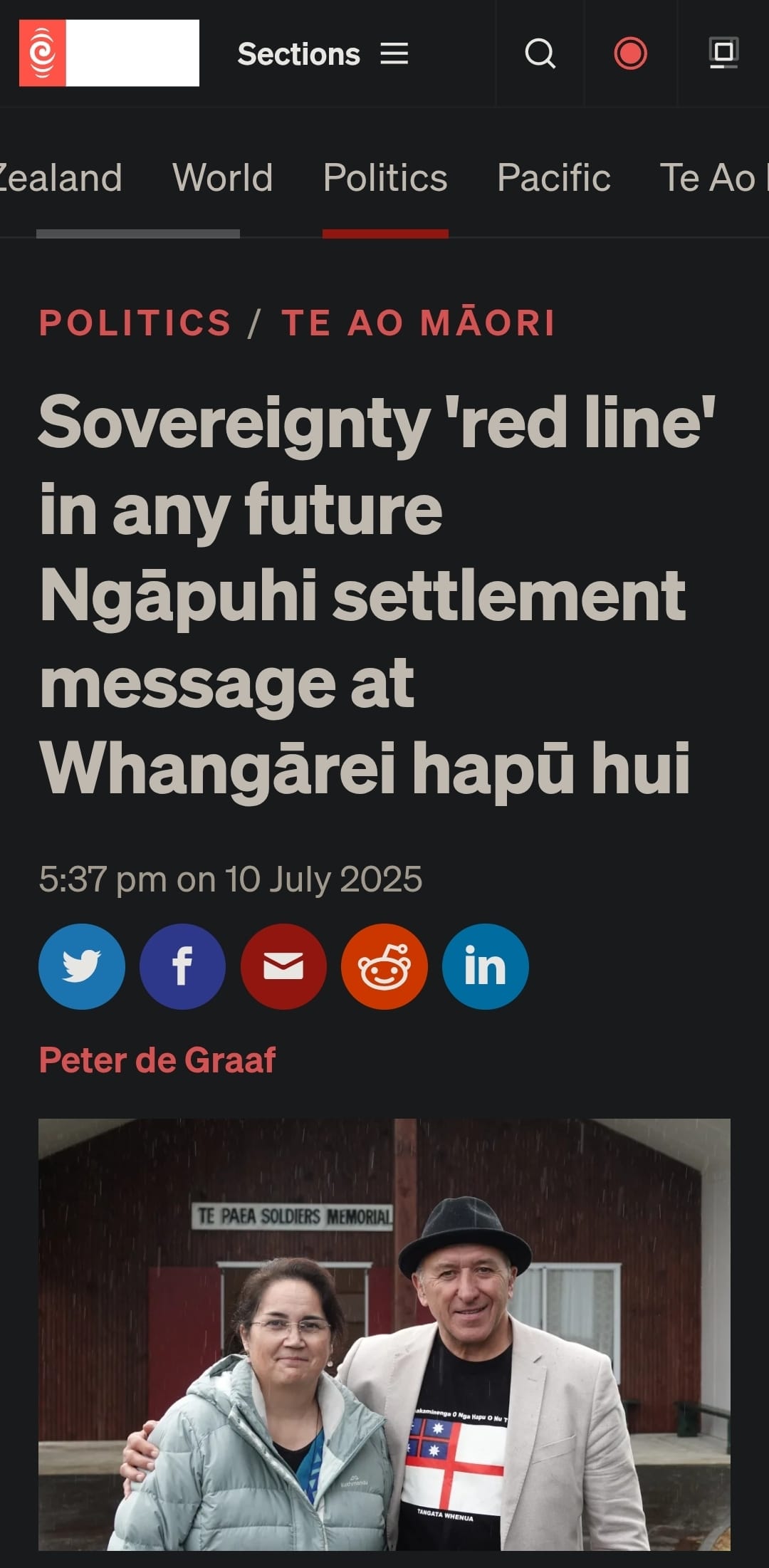
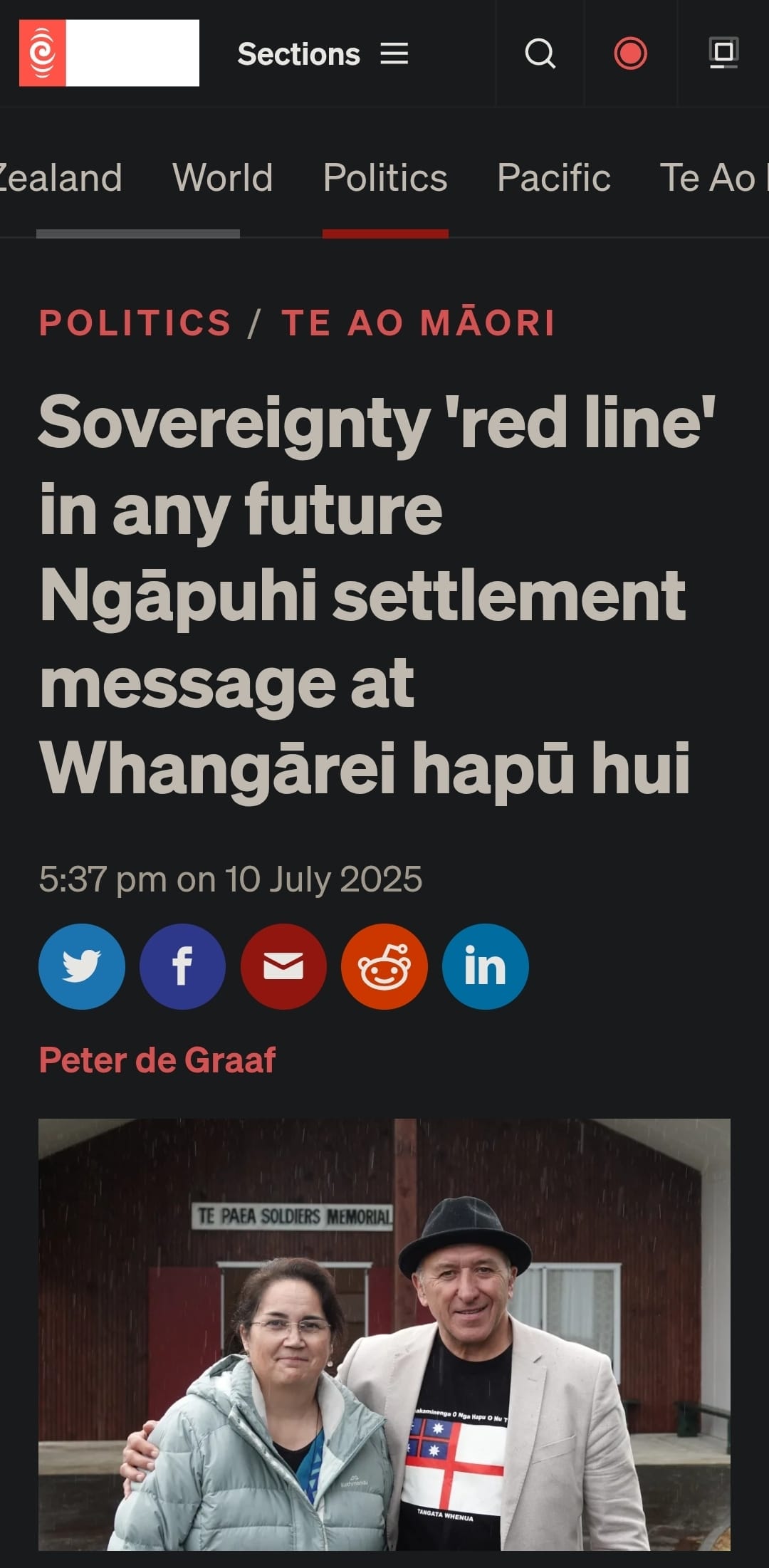
The message from Ngāpuhi hapū couldn't be clearer: sovereignty is a red line that will not be crossed. Yet in July 2025, we witness the full force of colonial arrogance unleashed by the current coalition government, as Treaty Negotiations Minister Paul Goldsmith and NZ First Minister Shane Jones orchestrate a coordinated assault on Indigenous self-determination. This brazen attempt to eliminate hapū sovereignty from Treaty settlements while forcing Ngāpuhi into a single "economic confetti" arrangement represents everything wrong with neoliberal colonialism - prioritising corporate efficiency over Indigenous rights, imposing Western economic models over Māori tikanga, and using manufactured urgency to justify the continued dispossession of tangata whenua.
https://www.rnz.co.nz/news/political/566561/sovereignty-red-line-in-any-future-ngapuhi-settlement-message-at-whangarei-hapu-hui
Background: The Constitutional Foundation of Indigenous Rights
The 2014 Te Paparahi o Te Raki Waitangi Tribunal report stands as one of the most significant constitutional findings in New Zealand's history. The Tribunal found unequivocally that Ngāpuhi chiefs did not cede sovereignty when they signed Te Tiriti o Waitangi in 1840. This wasn't mere academic interpretation - it was a definitive ruling that the Crown's claims to absolute sovereignty over Ngāpuhi territories lack any legitimate foundation.
The Tribunal's findings revealed that British representatives deliberately misrepresented Te Tiriti's meaning to Māori chiefs. While Britain intended to acquire sovereignty and the power to make laws over both Māori and Pākehā, this was never explained to the rangatira1. Instead, chiefs were told they would retain their tino rangatiratanga - their complete authority and independence.
This historical deception underlies every contemporary attack on Māori sovereignty. When Goldsmith declares "the Crown is sovereign"2 and refuses to acknowledge Indigenous self-determination, he perpetuates the same colonial lies that facilitated the original theft of Māori lands and authority.
Manufacturing Crisis to Justify Dispossession
The current controversy emerged when Goldsmith put settlement talks with Te Whānau-ā-Apanui on hold over a sovereignty clause that allowed both parties to maintain their positions. This "agree to disagree" clause, negotiated under the previous Labour government, simply acknowledged that iwi maintained their view of never having ceded sovereignty while allowing the Crown to assert its claims.
Simultaneously, Shane Jones announced his intention to draft legislation forcing Ngāpuhi into a single settlement, dismissing hapū aspirations for separate settlements as reducing the iwi to "economic confetti." The timing is no coincidence - this represents a coordinated neoliberal strategy to break Māori resistance by fragmenting opposition and forcing acceptance of Crown sovereignty.
At Wednesday's hui at Ngāraratunua Marae, Te Kotahitanga o Ngā Hapū Ngāpuhi co-chair Pita Tipene declared sovereignty a "red line" and "bottom line". His words expose the fundamental violence of the government's position: "It would mean everything that we've been fighting for, prosecuting through the Waitangi Tribunal that we have never ceded our sovereignty, will be signed away by a couple of signatures on a piece of paper."
The Neoliberal Logic of 'Economic Confetti'
Shane Jones' rhetoric about "economic confetti" reveals the deeply embedded neoliberal assumptions driving this assault. By framing hapū sovereignty as economically inefficient, Jones employs classic neoliberal propaganda that reduces all human relationships to market transactions. His claim that multiple settlements would turn Ngāpuhi into "confetti" echoes corporate consolidation logic - bigger is always better, efficiency trumps self-determination, and Indigenous political structures must conform to Western corporate models.
This language isn't neutral description - it's manufactured consent for dispossession. By characterising hapū autonomy as "confetti," Jones delegitimises Indigenous political organisation while promoting the false narrative that economic development requires surrendering sovereignty. The neoliberal state recognises Māori primarily as economic actors, not as Indigenous peoples with inherent rights to self-determination.
The "economic confetti" framing also serves to weaponise Northland's poverty against its own people. Jones argues that Ngāpuhi's "dire socio-economic statistics" demand urgent action, implying that maintaining hapū rangatiratanga is a luxury Māori cannot afford. This represents textbook neoliberal manipulation - create the conditions for Indigenous poverty through ongoing colonisation, then demand Indigenous peoples surrender their rights as the price for economic relief.
White Supremacist Narratives and Constitutional Adventurism
Goldsmith's dismissal of sovereignty clauses as "constitutional adventurism" exposes the white supremacist assumptions underlying his approach. His insistence that "the Crown is sovereign" and represents "the democratic will of New Zealand" erases Indigenous peoples from the constitutional equation entirely.
This rhetoric employs classic replacement theory logic - positioning any acknowledgment of Indigenous sovereignty as a threat to settler democratic rights. By framing Crown sovereignty as democratic legitimacy, Goldsmith obscures the fact that this "democracy" was imposed through colonial violence and continues to exclude Indigenous peoples from meaningful political participation.
The "constitutional adventurism" label reveals another white supremacist tactic: depicting Indigenous assertions of inherent rights as radical innovations rather than the continuation of pre-existing political authority. Māori sovereignty isn't "adventurism" - it's the maintenance of political systems that predate colonial occupation.
Goldsmith's previous comments that colonisation was "on balance" good for Māori9 expose the colonial apologia driving his negotiation stance. This isn't neutral policy analysis - it's white supremacist historical revisionism that denies the ongoing impacts of colonial violence while justifying continued dispossession.
The Politics of Mandate Manipulation
The government's approach to Ngāpuhi mandate politics reveals sophisticated colonial manipulation designed to manufacture consent for Crown sovereignty. The Tuhoronuku mandate, recognised by the Crown in 2014, was abandoned in late 2018 after being rejected by the majority of Ngāpuhi hapū.
The 2015 Waitangi Tribunal found that the Crown breached Treaty principles by recognising Tuhoronuku without clear evidence of hapū support10. The Tribunal identified fundamental flaws in Tuhoronuku's structure that undermined hapū rangatiratanga and their ability to make crucial decisions about settlement.
Te Kotahitanga o Ngā Hapū Ngāpuhi emerged as an informal resistance group, initially set up by Pita Tipene and the late Rudy Taylor to oppose the imposed mandate structure. Their continued resistance demonstrates the failure of Crown attempts to manufacture Indigenous consent for sovereignty cession.
Jones' proposed legislation represents an escalation of this mandate manipulation - using parliamentary force to impose a settlement structure that Ngāpuhi have repeatedly rejected. This isn't democratic mandate-seeking; it's authoritarian imposition disguised as efficiency.
Tikanga Māori and Constitutional Resistance
The hui declarations of sovereignty as a "red line" reflect deep tikanga Māori principles that the colonial state cannot comprehend. Rangatiratanga encompasses spiritual, physical, and reciprocal guardianship dimensions that cannot be reduced to Western legal concepts or economic arrangements.
Tino rangatiratanga represents the exercise of absolute mana derived from spiritual authority - power that is "inalienable so it cannot be ceded or given away to others." This spiritual dimension of sovereignty explains why Tipene describes signing away rangatiratanga as "giving up their soul for pieces of silver and gold."
The constitutional resistance demonstrated by Ngāpuhi hapū connects to broader patterns of Indigenous resurgence globally. Like other Indigenous nations, Māori exercise sovereignty not through Crown recognition but through the continued practice of Indigenous law and political authority.
Co-chair Lee Harris rejected using poverty statistics as weapons against hapū sovereignty4, stating: "We're pretty sick and tired of people using our existing very poor standards of living against us as a weapon by trying to push a settlement over the top of us." This analysis exposes how neoliberal colonialism weaponises the very deprivation it creates to justify further dispossession.
Coalition Government Neoliberalism in Action
The sovereignty assault on Ngāpuhi occurs within the broader context of the coalition government's aggressive neoliberal agenda. Defined by job cuts, tax cuts, and the elimination of previous Labour policies, this government represents one of the most reactionary administrations in New Zealand history.
The coalition's approach demonstrates classic neoliberal consensus between National and Labour on fundamental economic settings, with both parties agreeing that most people's living standards needed to reduce to combat inflation. This austerity logic now extends to Treaty settlements - Māori sovereignty must be sacrificed for economic efficiency.
The government's public sector cuts affecting nearly all departments create the material conditions for enhanced corporate power while weakening state capacity to honour Treaty obligations. This represents textbook shock doctrine politics - using manufactured crisis to impose unpopular policies.
The Violence of 'Full and Final' Settlement
The insistence on "full and final" settlements containing no sovereignty acknowledgment represents a sophisticated form of legal violence designed to permanently extinguish Indigenous political authority. Treaty settlements in their current form serve colonial rather than Indigenous interests, requiring iwi to create "western-style corporate structures" and accept Crown sovereignty as the price for limited compensation.
This process transforms Indigenous political relationships into corporate transactions while legitimising ongoing colonial occupation. The neoliberal emphasis on Māori economic development serves state interests by reducing welfare costs while maintaining political subordination.
The "full and final" framework also serves to prevent future Indigenous resistance by creating legal precedents that can be weaponised against sovereignty assertions. Once iwi sign settlements acknowledging Crown sovereignty, those agreements become tools for suppressing other Indigenous peoples' political aspirations.
Implications: The Broader Pattern of Indigenous Suppression
The assault on Ngāpuhi sovereignty connects to global patterns of neoliberal colonialism designed to eliminate Indigenous political alternatives to corporate capitalism. Across settler colonial states, neoliberal policies continue to restrict and marginalise Indigenous organisational forms and rights while promoting market-based solutions that serve capital rather than Indigenous communities.
The coalition government's approach reveals how contemporary colonialism operates through economic rather than military means. By controlling the terms of Treaty settlements, the state can appear to address historical grievances while actually deepening Indigenous political subordination.
For Māori more broadly, the Ngāpuhi precedent threatens all future Treaty negotiations. If the Crown succeeds in forcing sovereignty cession as a settlement condition, every other iwi will face the same ultimatum - accept colonial supremacy or remain without redress for historical crimes.
The international implications extend beyond New Zealand, as Indigenous peoples globally face similar pressures to surrender political authority for economic development opportunities. The Ngāpuhi resistance therefore represents not just local constitutional struggle but part of worldwide Indigenous resurgence against neoliberal colonialism.
Defending Indigenous Futurity
The clear message from Ngāpuhi hapū - that sovereignty remains a red line - represents hope for Indigenous political futurity in the face of intensifying colonial pressure. Te Kotahitanga's insistence that they "will be adhering strongly to our own rangatiratanga or sovereignty, and we won't be signing anything that may undermine that" demonstrates the continued vitality of Indigenous political authority despite centuries of attempted elimination.
The coalition government's sovereignty assault exposes the fundamental incompatibility between Indigenous self-determination and colonial capitalism. No amount of economic redress can compensate for the loss of political authority, and no settlement can be truly "full and final" while the constitutional foundation of colonialism remains unchallenged.
Māori resistance to the "economic confetti" narrative reveals sophisticated understanding of how neoliberal colonialism operates - using economic crisis to justify political surrender while presenting Indigenous political organisation as inefficient obstacle to development. The hapū response demonstrates that Indigenous peoples see through these manipulations and refuse to trade sovereignty for colonial economic integration.
The path forward requires solidarity with Indigenous constitutional resistance while exposing the white supremacist and neoliberal logics driving government policy. Every New Zealander benefits from challenging the colonial myths underlying Crown sovereignty claims, as these same myths legitimise economic inequality and democratic exclusion for all.
Kia ora to all whānau who find value in exposing these colonial deceptions. For those with capacity and desire to support this mahi, please consider a donation/koha to HTDM: 03-1546-0415173-000. The Māori Green Lantern understands these tough economic times for whānau so please only contribute if you wish to do so and have the means.
Mauri ora!
Ivor Jones The Māori Green Lantern